
Judge, 1882-02-18 · page 3 of 16
Judge — February 18, 1882 — page 3: what you’re looking at
What you’re looking at
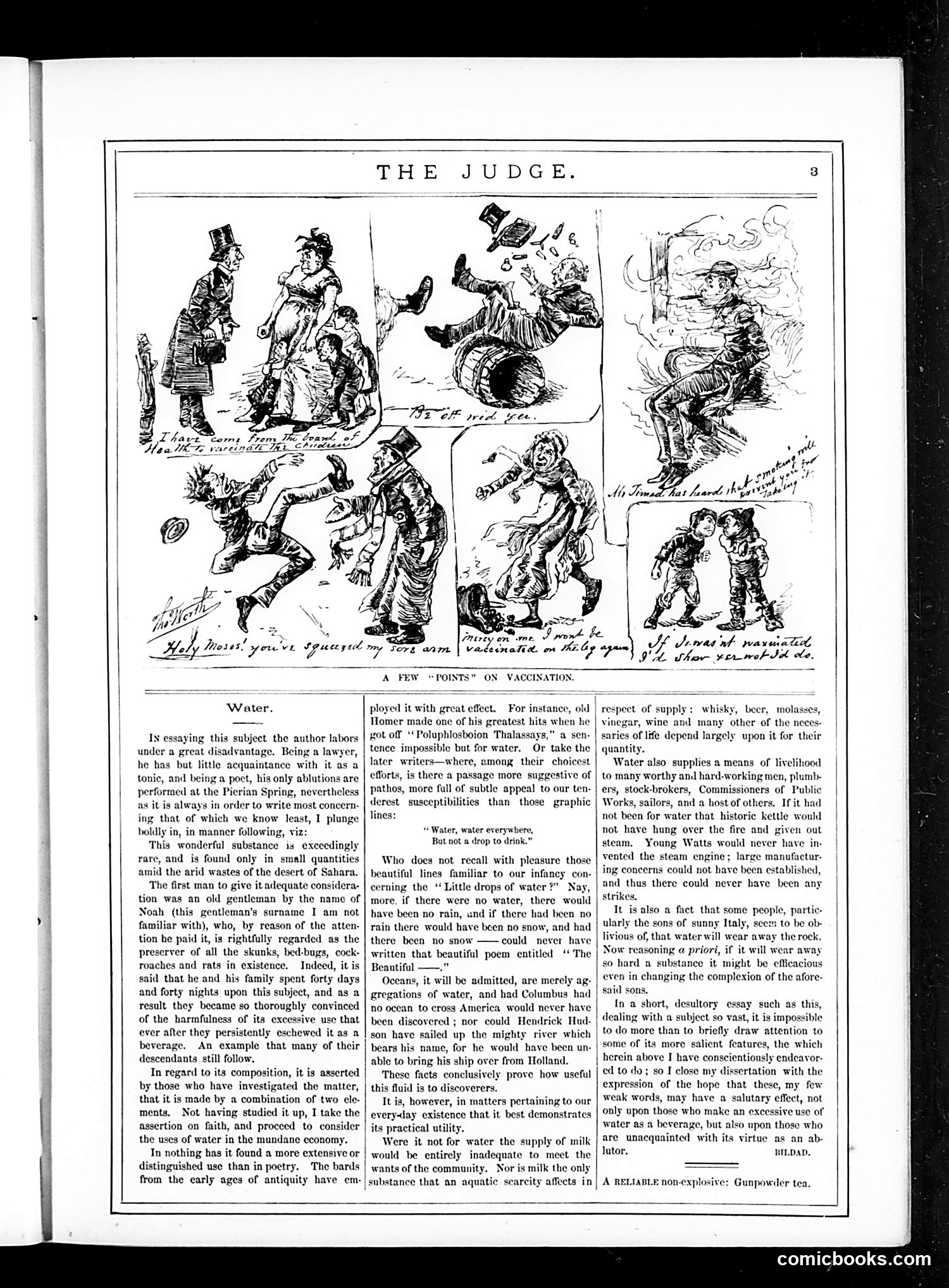
This page features satirical cartoons mocking anti-vaccination sentiment, paired with humorous text ostensibly "praising" water's importance. The six sketches show various mishaps befalling people—figures tumbling from barrels, being knocked about, and suffering indignities—apparently depicting the consequences of vaccination or anti-vaccination attitudes. The accompanying essay is mock-serious, written in deliberately overwrought, pseudo-intellectual language that parodies pompous arguments. By comparing vaccination debate to absurd claims about water (that Noah discovered it, that Homer wrote about it), the author ridicules opponents' reasoning as equally ridiculous. The cartoons' crude, chaotic imagery emphasizes how vaccination-related anxiety made people behave foolishly. The satire's point: anti-vaccine arguments lack substance and deserve mockery rather than serious engagement. This reflects late-19th-century public health debates when vaccination faced resistance.
📄 Transcribed text from this page (OCR, searchable)
Machine-transcribed from the original scan — historical spelling and the odd misread are preserved.
yn ve Yue gel 5 c Phirey ore oc Be 3 ay vadeinaled. om Haley apaen ie wnat Shar ¢erwek Jd ole, Water. IN essaying this subject the author labors under a great disadvantage. Being a lawyer, he has but little acquaintance with it as a tonic, and being a poct, his only ablutions are performed at the Pierian Spring, nevertheless as it is always in order to write most concern- ing that of which we know least, I plunge boldly in, in manner following, viz: This wonderful substance is exceedingly rare, and is found only in small quantities amid the arid wastes of the desert of Sahara. ‘The first man to give it adequate considera tion was an old gentleman by the namo of Noah (this gentleman's surname I am not familiar with), who, by reason of the atten- tion he paid it, is rightfully regarded as the preserver of all the skunks, bed-bugs, cock- roaches and rats in existence. Indeed, it is said that he and his family spent forty days and forty nights upon this subject, and as a result they became so thoroughly convinced of the harmfulness of its excessive use that ever after they persistently eschewed it ag a beverage. An example that many of their descendants still follow. In regard to its composition, it is asserted by those who have investigated the matter, that it is made by a combination of two cle- ments. Not having studied it up, I take the assertion on faith, and proceed to consider the uses of water in the mundane economy. In nothing has it found a more extensive or distinguished use than in poetry. The bards | from the carly ages of antiquity have em-| substance that an aquatic scarcity affects in| A RELIABLE non-explosive: Gunpowder tea. A FEW “POINTS” ON VACCINATION. ployed it with great effect. For instance, old Homer made one of his greatest hits when he got off “Poluphlosboion ‘Thalassays,” a sen- tence impossible but for water. Or take the later writers—where, among their choicest efforts, is there a passage more suggestive of pathos, more full of subtle appeal to our ten- susceptibilities than those graphic + Water, water everywhere, But not a drop to drink.” Who does not recall with pleasure those beautiful lines familiar to our infancy con- cerning the ‘ Little drops of water?” Nay, more. if there were no water, there would have been no rain, und if there had been no rain there would have been no snow, and had there been no snow ——could never have written that beautiful poem entitled “ The Beautiful ——.” Oceans, it will be admitted, are merely ag- | gregations of water, and had Columbus had no ocean to cross America would never have been discovered ; nor could Hendrick Hud- son have sailed up the mighty river which bears his name, for he would have been un- able to bring his ship over from Holland. These facts conclusively prove how useful this fluid is to discoverers. It is, however, in matters pertaining to our every-day existence that it best demonstrates its practical utility. Were it not for water the supply of milk would be entirely inadequate to meet the wants of the community. Nor is milk the only respect of supply: whisky, beer, mols vinegar, wine and many other of the nece: ries of life depend largely upon it for their quantity. Water also supplies a means of livelihood to many worthy and hard-working men, plumb- ers, stock-brokers, Commissioners of Public Works, sailors, and a host of others. If it had not been for water that historic kettle would not have hung over the fire and given out steam. Young Watts would never have in- vented the steam engine; large manufactur- ing concerns could not have been established, and thus there could never have been any strikes It is also a fact that some people, partic: ularly the sons of sunny Italy, seem to be ob- livious of, that water will wear away the rock. Now reasoning a priori, if it will wear away so hard a substance it might be efficacious even in changing the complexion of the afore- | said sons. In a short, desultory essay such as this, dealing with a subject so vast, it is impossible to do more than to briefly draw attention to some of its more salient features, the which herein above I have conscientiously endeavor- ed to do; so I close my dissertation with the expression of the hope that these, my few weak words, may have a salutary effect, not only upon those who make an excessive use of, water as a beverage, but also upon those who are unacquainted with its virtue as an ab- lutor. comicbooks.com