
A complete issue · 16 pages · 1882
Judge — February 4, 1882
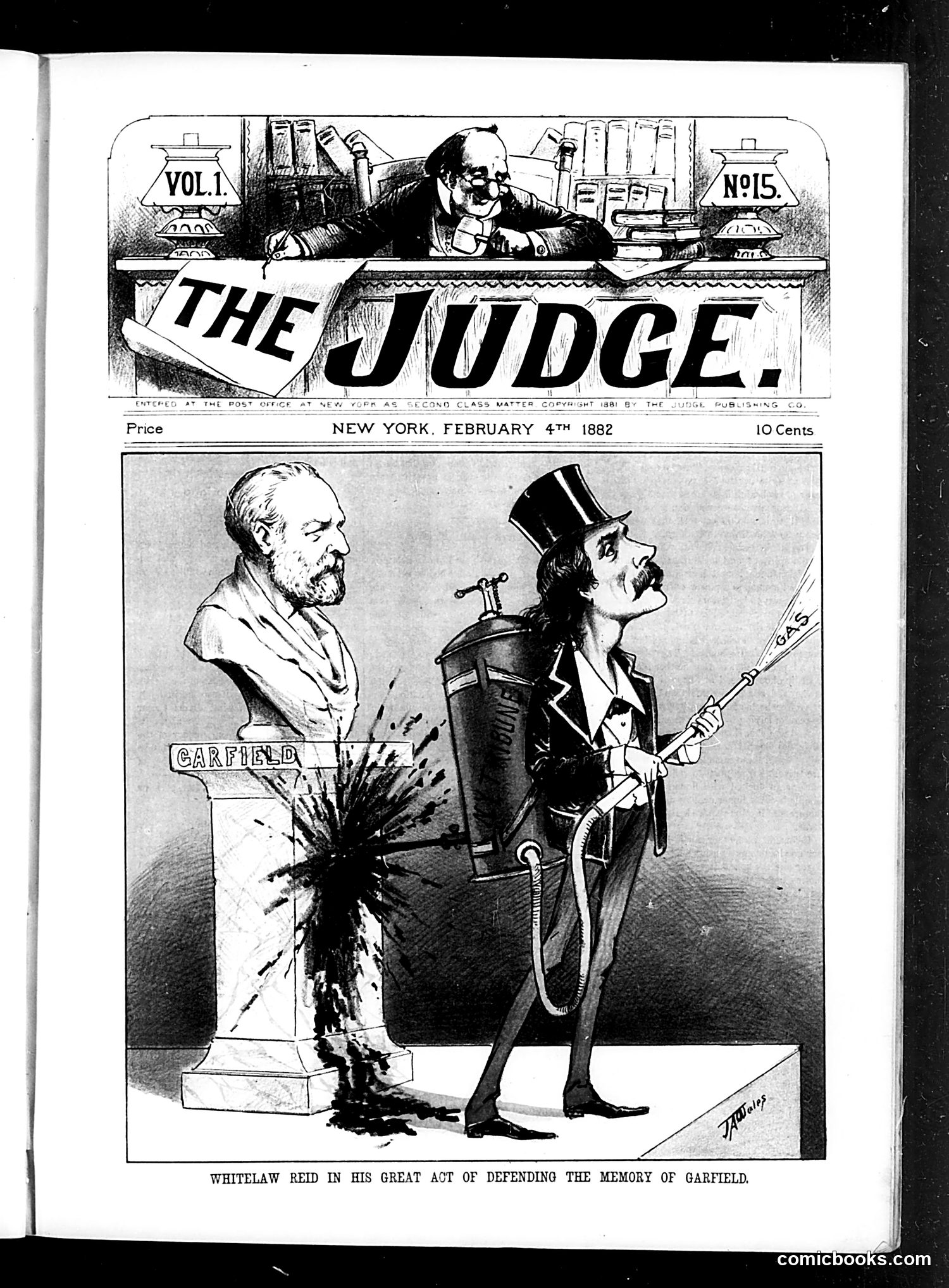
This *Judge* magazine cover from February 4, 1882, depicts **Whitelaw Reid** (identifiable by the label "GARFIELD" on the pedestal) defending the memory of President **James A. Garfield**, who was assassinated in 1881. The cartoon shows Reid as a caricatured figure in formal dress, wielding a sword or bayonet to protect a bust of Garfield. The satire appears to mock Reid's public defense of Garfield's legacy—suggesting his efforts are bombastic or theatrical ("great act"). Reid was a prominent journalist and Garfield associate, making him a natural target for satirical commentary during this period of national mourning and political realignment following the assassination. The exaggerated pose and theatrical costume emphasize the satirist's skepticism about Reid's motives or sincerity.
The main cartoon features **Whitelaw Reid**, editor of the New York Tribune, depicted as a vulture or rapacious bird. The satire attacks Reid for his audacity in writing letters to President Garfield while Garfield was mentally deteriorating before his assassination. The text compares Reid to **Charles Guiteau** (Garfield's actual assassin), suggesting Reid exploited the dying president's vulnerability to advance his own political agenda—"assuming to dictate to a President so wise and great." The cartoon's point: Reid abused a dying man's trust and mental state, making him morally equivalent to Guiteau himself. The references to **Horace Greeley** (a previous Tribune editor) reinforce that Reid's behavior dishonored the publication's legacy. This reflects 1880s anxieties about press power and journalistic ethics during national trauma.
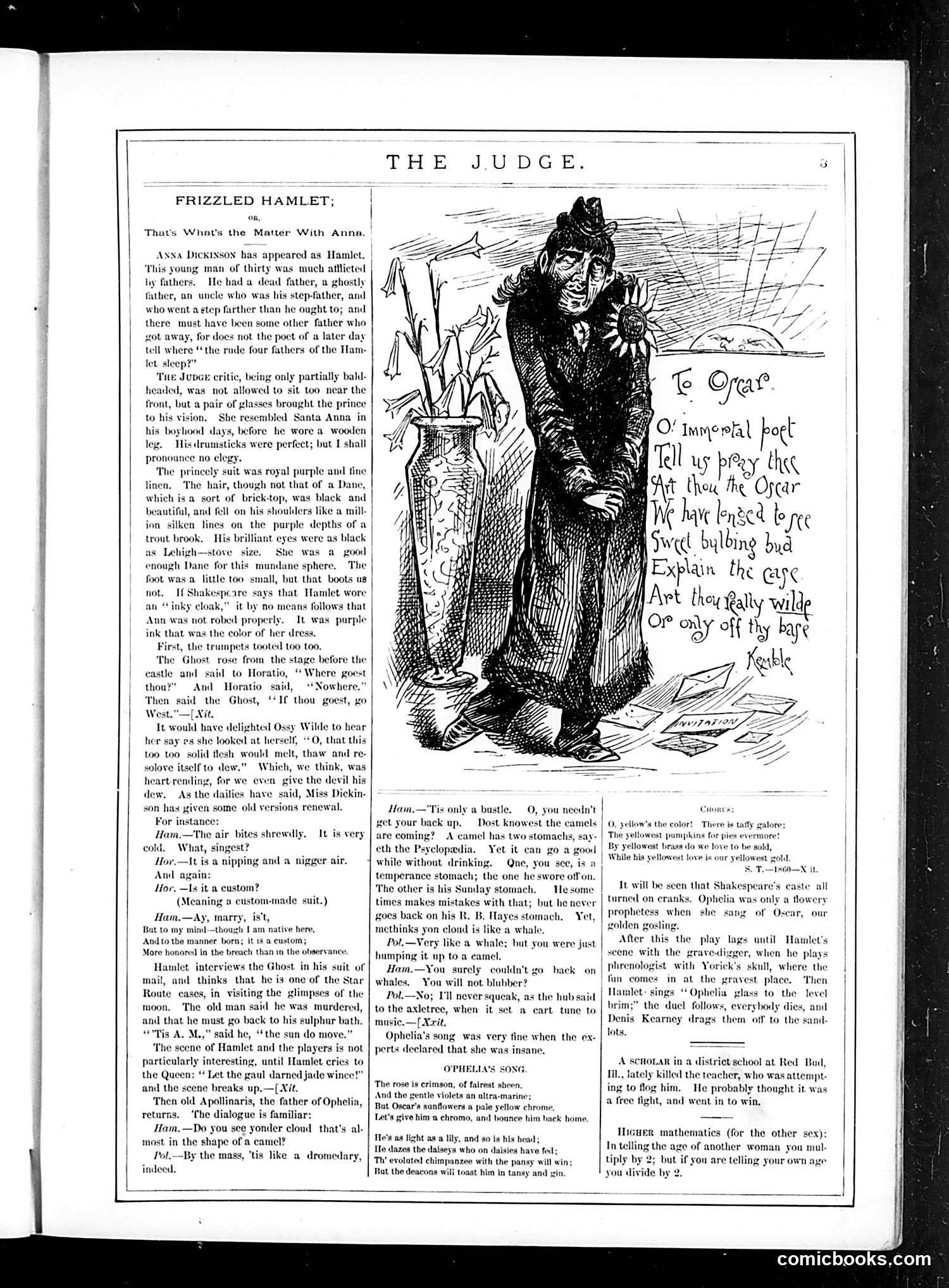
This is a satirical review of actress **Anna Dickinson's stage performance as Hamlet**. The critic mocks her casting in the traditionally male role, employing crude personal attacks: comparing her appearance to "Santa Anna in his boyhood days" and criticizing her physical features while grudgingly admitting her competence. The satire works through absurdist reimagining of the play's dialogue. The critic inserts contemporary references (the "Star Route cases," President R.B. Hayes) and adds nonsensical exchanges about camels and stomachs to ridicule the production. **The broader context**: This reflects 19th-century resistance to women in serious dramatic roles. While Judge magazine's critic attempts humor, the piece is fundamentally about delegitimizing a female actor's ambition through mockery rather than genuine critique. The accompanying illustration shows a hunched, grotesque figure—likely a caricature of Dickinson in costume—reinforcing the magazine's dismissive stance toward her Shakespearean aspirations.
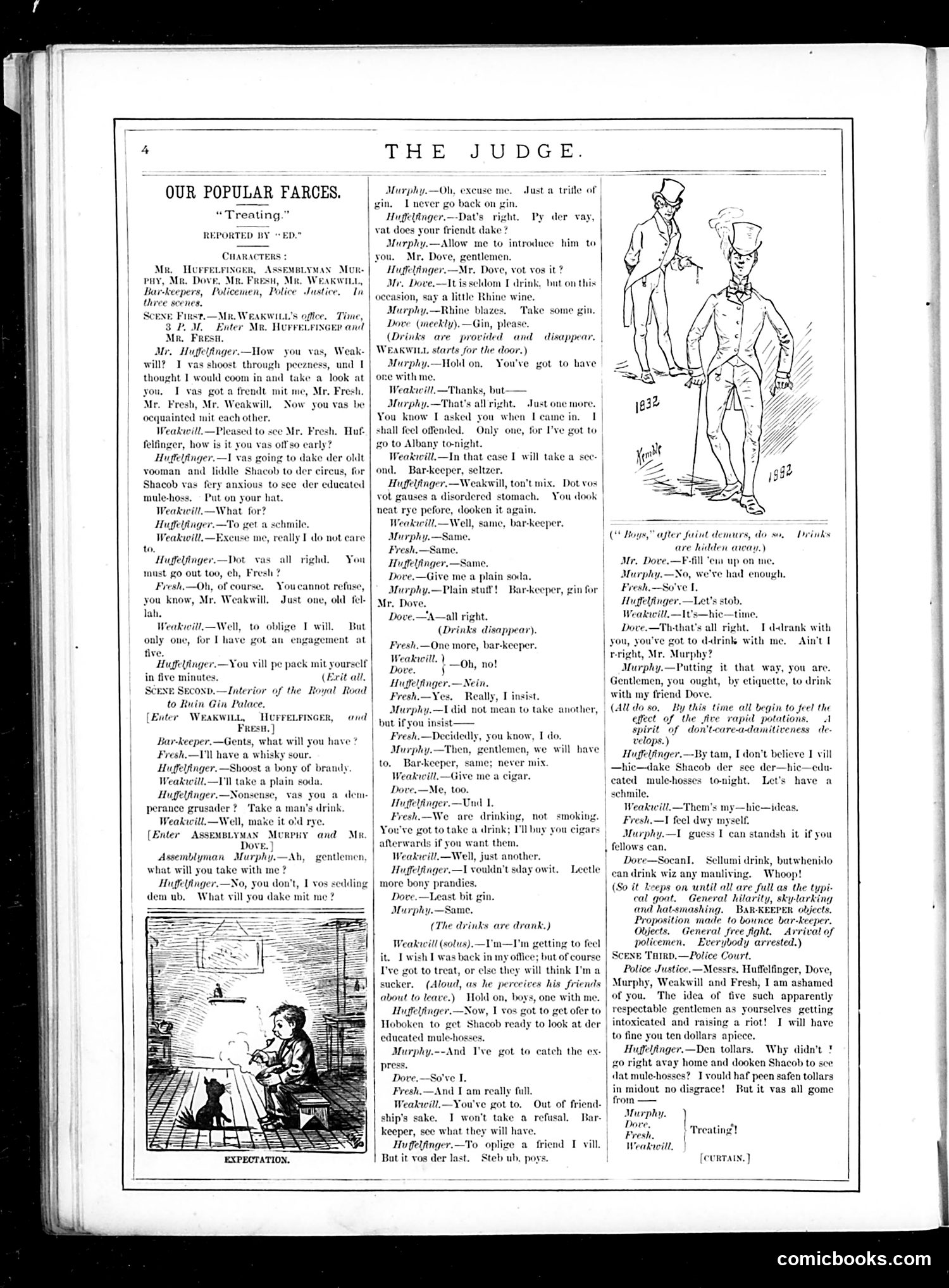
This satirical sketch mocks the common political practice of "treating"—politicians buying drinks for constituents to secure political loyalty and votes. The scene depicts Assemblyman Murphy and his associates pressuring reluctant acquaintance Weakwill into drinking at a gin palace. Each character uses social obligation ("etiquette," "you've got to") to force drinks on him despite his repeated refusals. The humor lies in the transparent manipulation: Murphy cynically uses friendship as pretext while Weakwill weakens under peer pressure, ultimately becoming intoxicated. The caricatured German-accented characters (Huffelfinger, Fresh) appear designed for comedic effect but also suggest immigrant or working-class representation. The "Royal Road to Ruin Gin Palace" setting reinforces the sketch's critique of how treating corrupts politics and harms participants. The satire targets the hypocrisy and coercive nature of this patronage system, portraying it as degrading to all involved while being endemic to political culture.
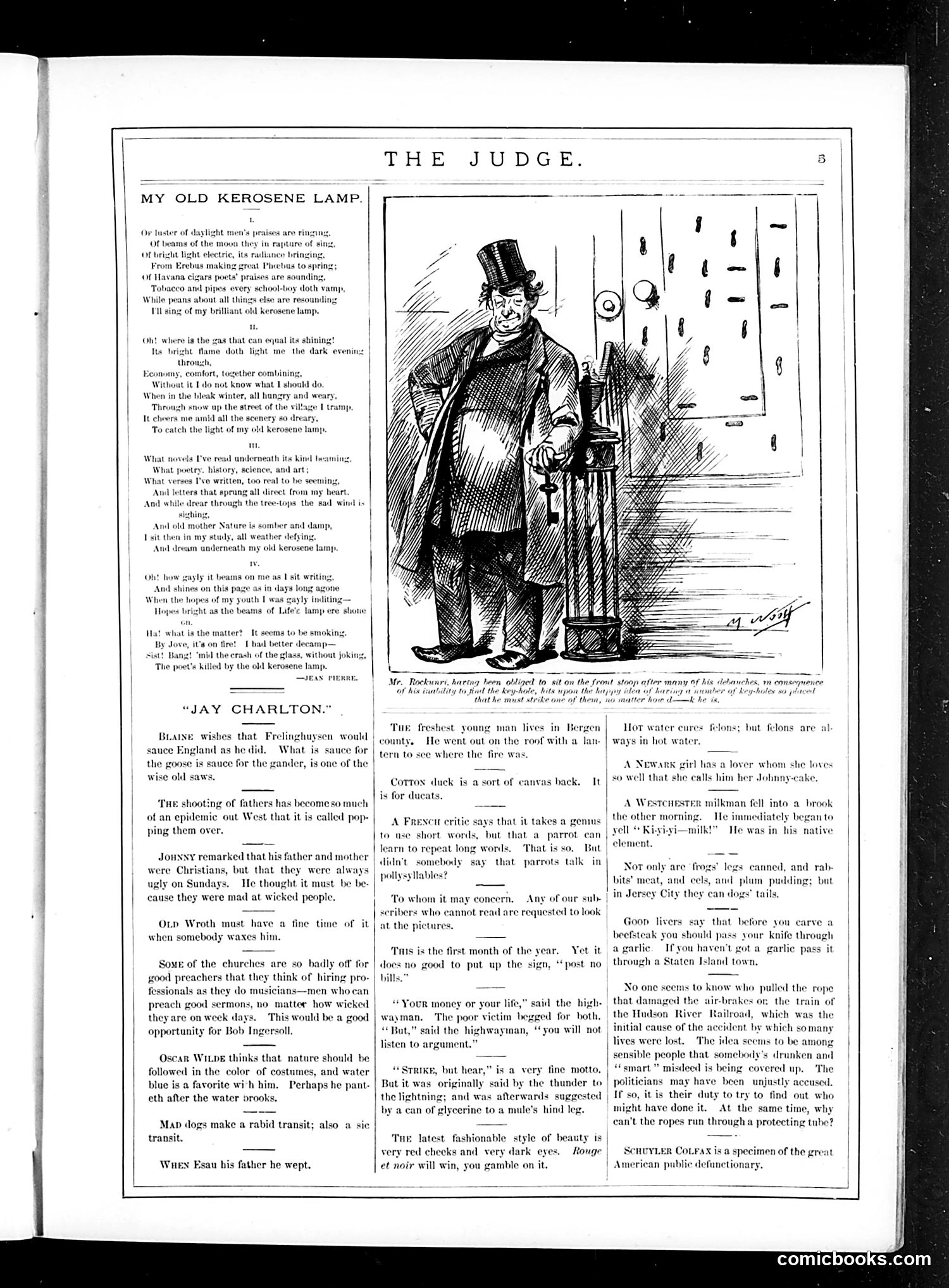
This page from *Judge* magazine contains mostly **humorous quips and short satirical observations** rather than a single political cartoon—typical of the publication's format. The main illustration shows an old man holding a kerosene lamp, accompanying a poem praising this humble light source. The satire is gentle: it nostalgically celebrates simple technology while implicitly mocking modern obsessions with newfangled alternatives (electric lights are mentioned in the poem as inferior). The text snippets below target various contemporary absurdities: corruption ("Mr. Rockunri" having to bribe officials), Western frontier violence (fathers being "popped"), clergy hypocrisy, Oscar Wilde's aesthetic affectations, and various local incidents (a rail accident, a milkman's mishap). The jokes rely on **puns, wordplay, and ironic observations** about daily life—nothing deeply political. The satire is **social rather than partisan**: poking fun at pretension, incompetence, and human folly generally rather than attacking specific political figures or parties. This reflects *Judge*'s role as an entertainment magazine alongside its satirical mission.
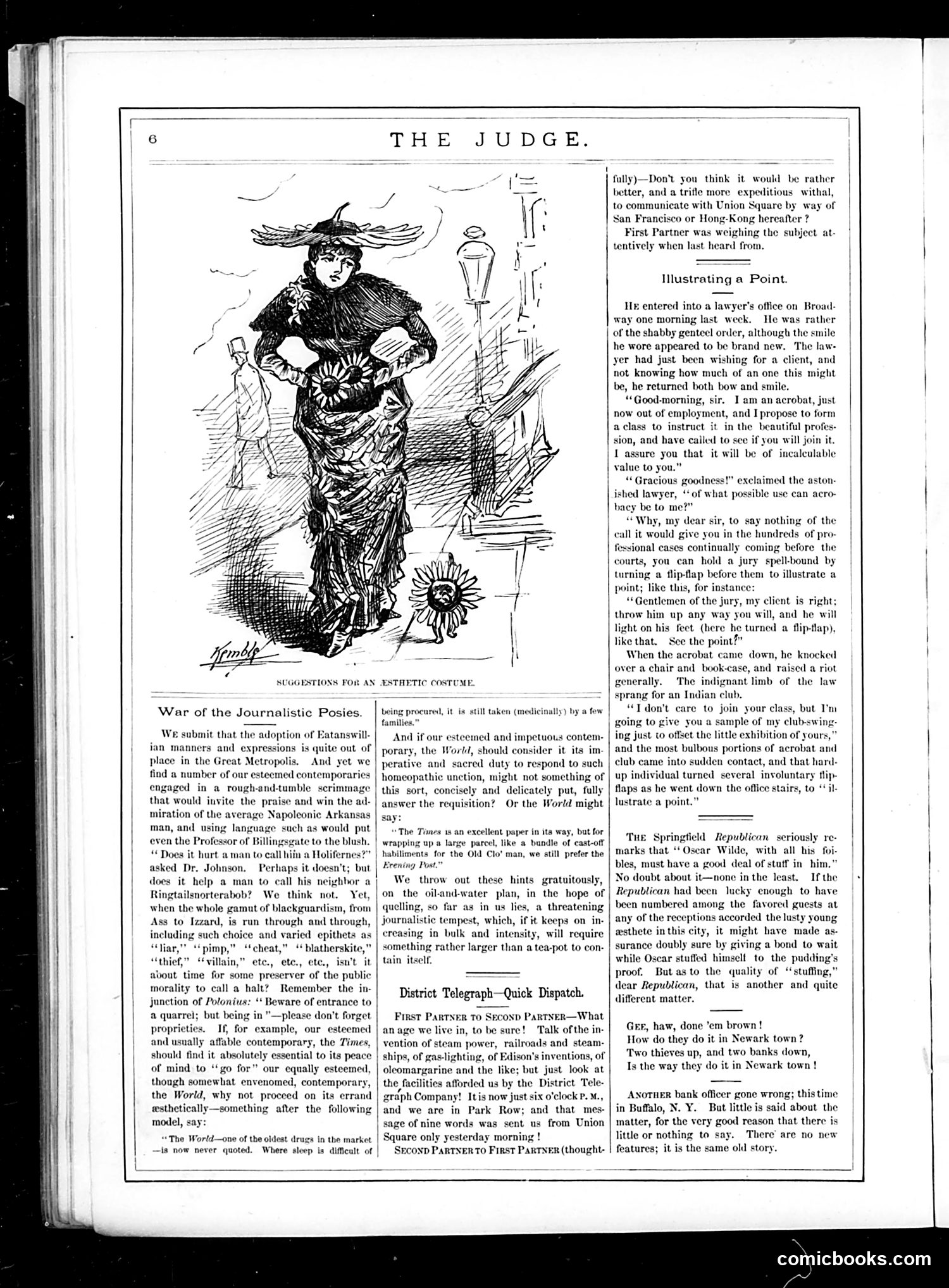
This page satirizes **New York newspaper editors' bitter rivalries** through three pieces: **"War of the Journalistic Posies"** mocks the crude personal attacks exchanged between competing papers (likely the *Times*, *World*, and *Evening Post*). Judge ridicules editors for using vulgar insults instead of witty, sophisticated criticism—suggesting they adopt genteel insults phrased like patent medicine advertisements. **"District Telegraph—Quick Dispatch"** jokes about the new District Telegraph Company's supposedly miraculous speed: a nine-word message took a full day to travel from Union Square to Park Row. The punchline—suggesting they use San Francisco or Hong-Kong instead—sarcastically highlights the service's uselessness. **"Illustrating a Point"** depicts a shabby acrobat pitching a business scheme to a gullible lawyer, satirizing either credulous urban professionals or dubious get-rich-quick ventures of the era. The illustration shows a fashionably dressed woman in exaggerated pose, labeled "Suggestions for an Aesthetic Costume"—likely mocking the pretentious "Aesthetic Movement" in fashion and art.
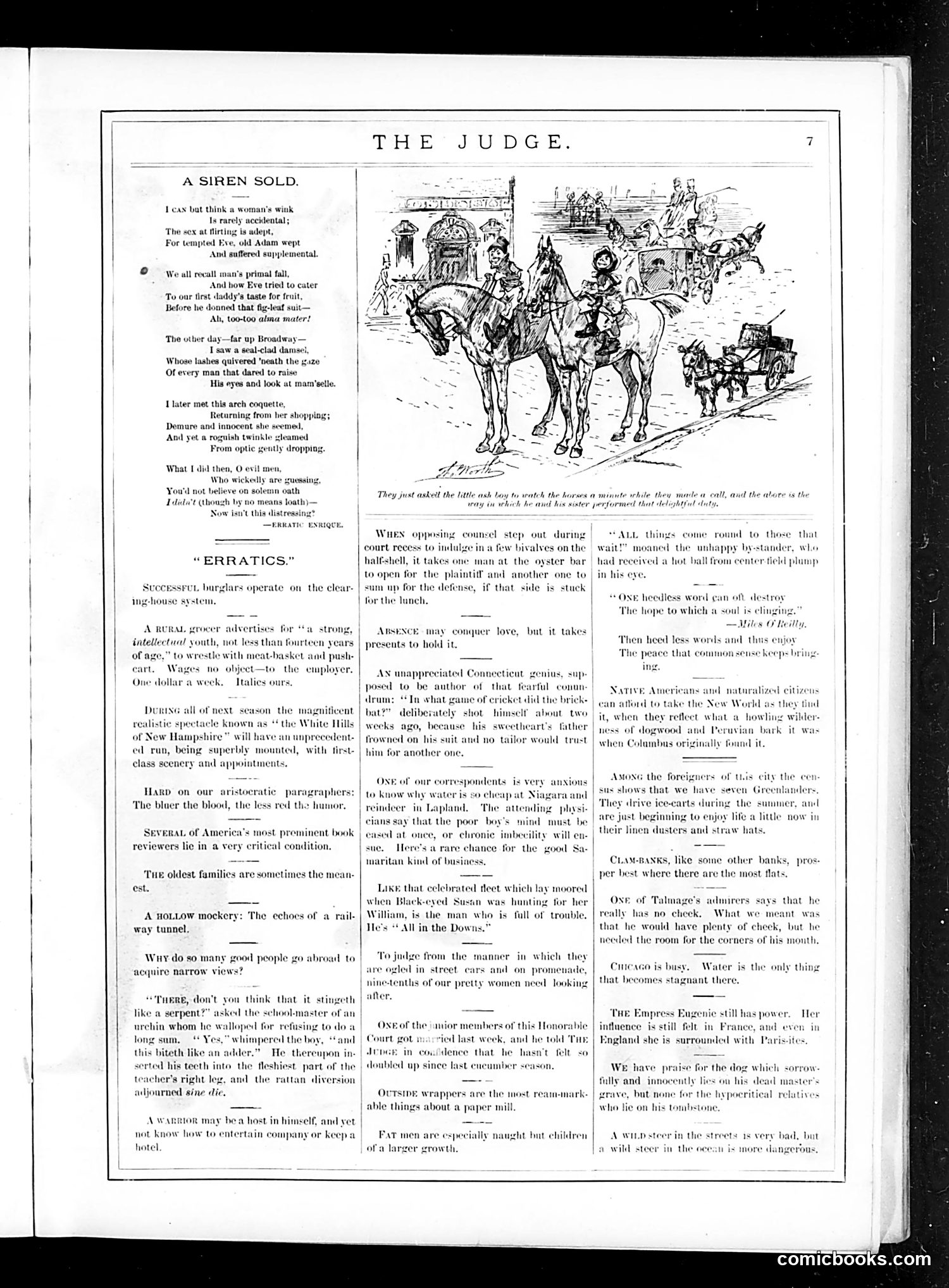
This page from *Judge* magazine consists primarily of **short satirical commentary and humorous anecdotes** rather than a single large political cartoon. The main illustration shows a street scene with horses and pedestrians. **Key content:** The poem "A Siren Sold" satirizes female flirtatiousness, suggesting women deliberately use charm and appearance to manipulate men—a common Victorian-era trope about women's deceptiveness. The "Erratics" section contains brief social jokes mocking: - Rural laborers and class differences - Prominent book reviewers as snobbish - Aristocratic pretension ("The bluer the blood, the less red the hunger") - School discipline and child behavior - Connecticut residents as foolish - Gender stereotypes (women seeking attention on streetcars; fat men as childish) **Overall tone:** Cynical, class-conscious humor targeting Victorian social conventions, feminine wiles, aristocratic affectation, and working-class simplicity. The satire reflects *Judge*'s typical late-19th-century conservative social commentary.
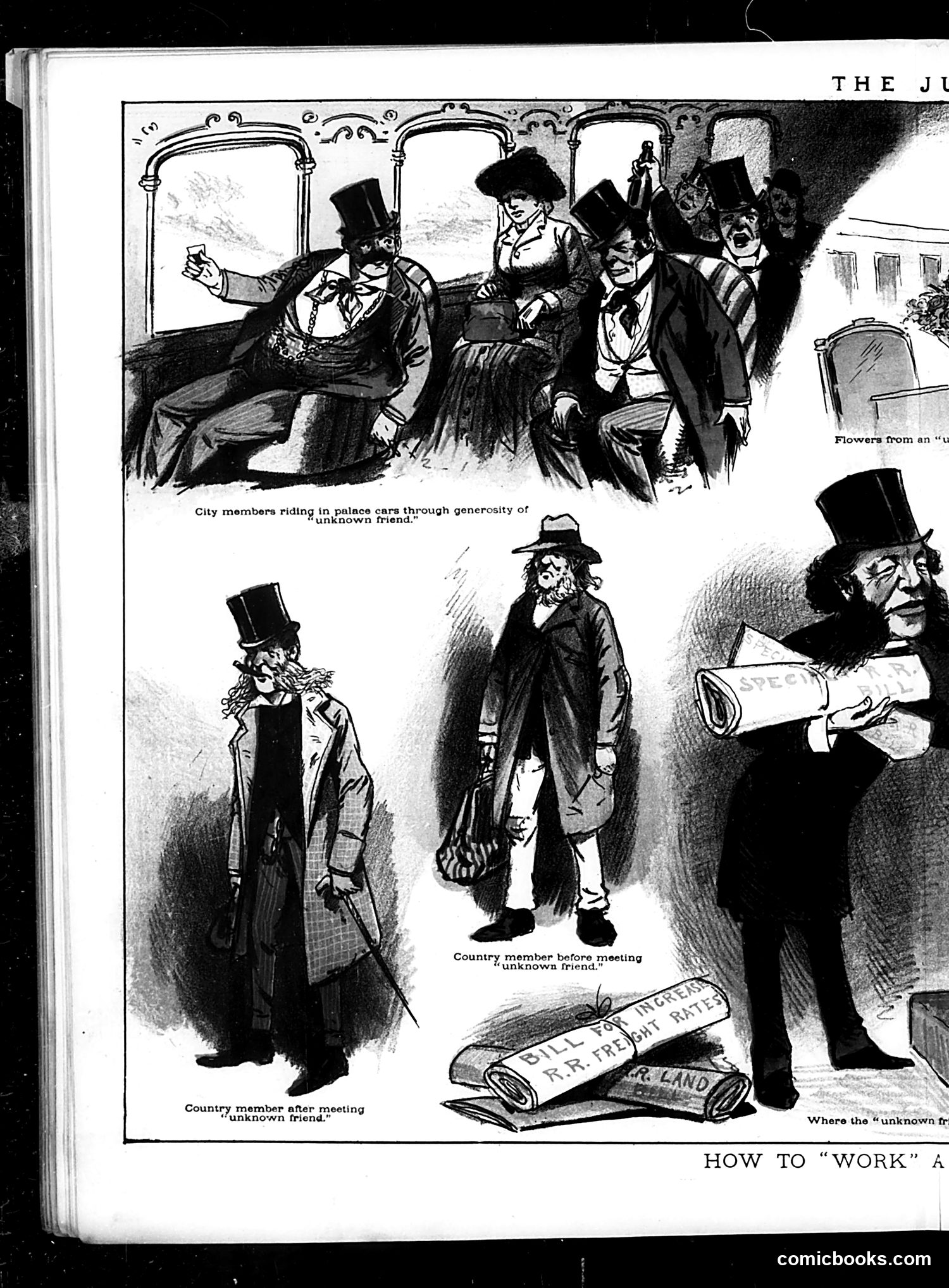
This satirical cartoon from *Judge* magazine depicts the contrast between urban and rural politicians regarding an "unknown friend"—likely a wealthy benefactor or lobbyist. The top panel shows well-dressed city members luxuriously riding in palace cars, implying they've already benefited from this mysterious patron's generosity. The bottom panels contrast a country member's appearance before and after meeting the unknown friend, showing the rural politician transformed—now dressed more fashionably and holding railroad documents (marked "R.R. FREIGHT RATES" and similar). The satire mocks how wealthy industrialists or corporate interests ("unknown friends") curry favor with politicians through gifts and perks, corrupting the legislative process. The rural politician's visible transformation suggests he's been "worked over" or compromised by promises of financial benefit. The cartoon critiques corporate influence on government and the disparity between urban and rural lawmakers' access to such patronage.
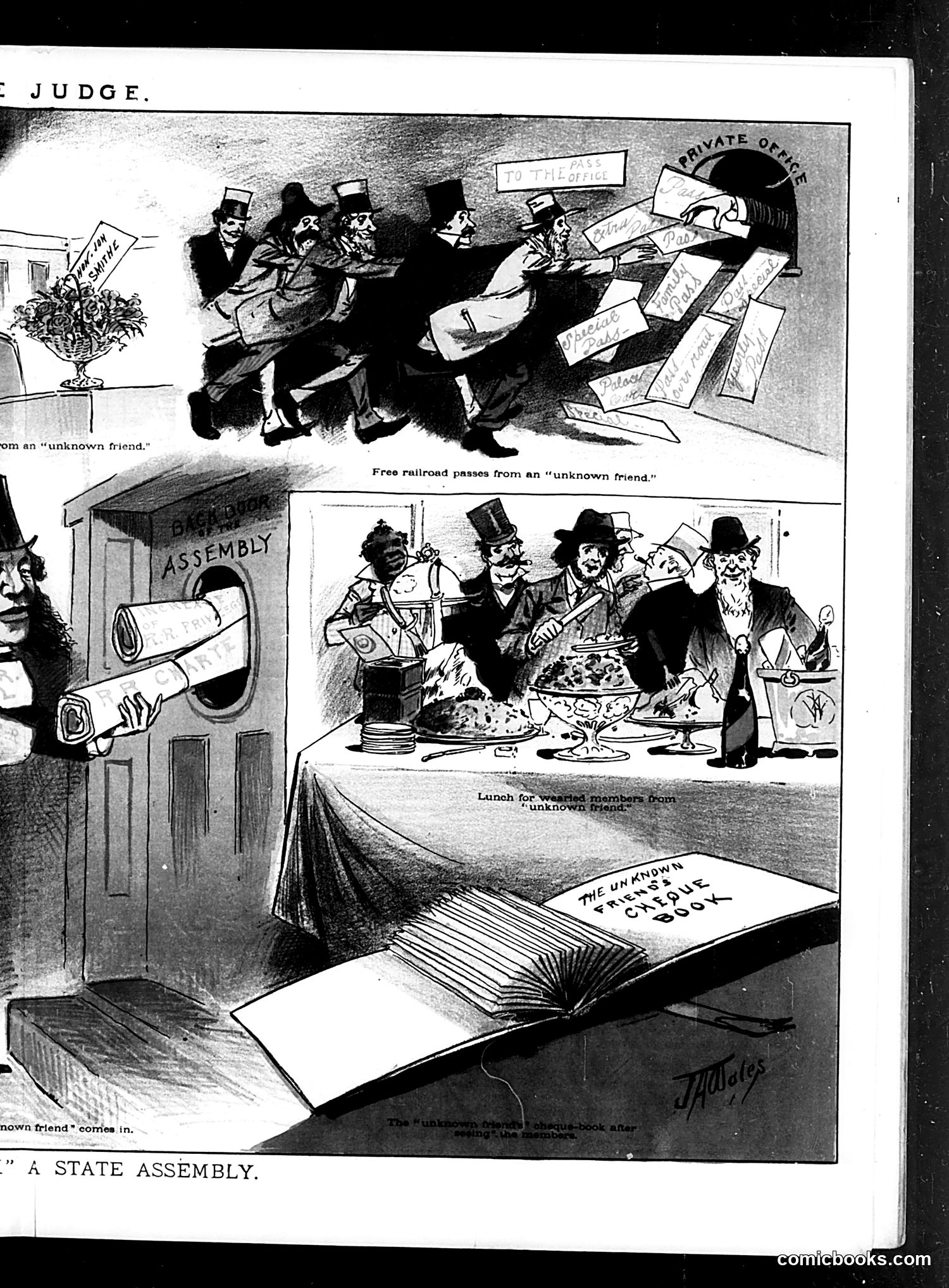
This satirical cartoon criticizes corrupt dealings within a state legislature. The top panel shows officials receiving "free railroad passes" from an "unknown friend"—a bribe. The middle panel depicts a lavish lunch provided to assembly members by the same mysterious benefactor, suggesting quid pro quo corruption. The bottom panel features "The Unknown Friend's Chque-Book"—revealing the source of these gifts. The satire exposes how railroad companies and wealthy interests literally bought influence with legislators through passes, meals, and money, corrupting the democratic process. The repeated phrase "unknown friend" is ironic; the cartoon makes clear such corruption was widely understood but officially unacknowledged. This reflects Gilded Age critiques of corporate influence in American government.
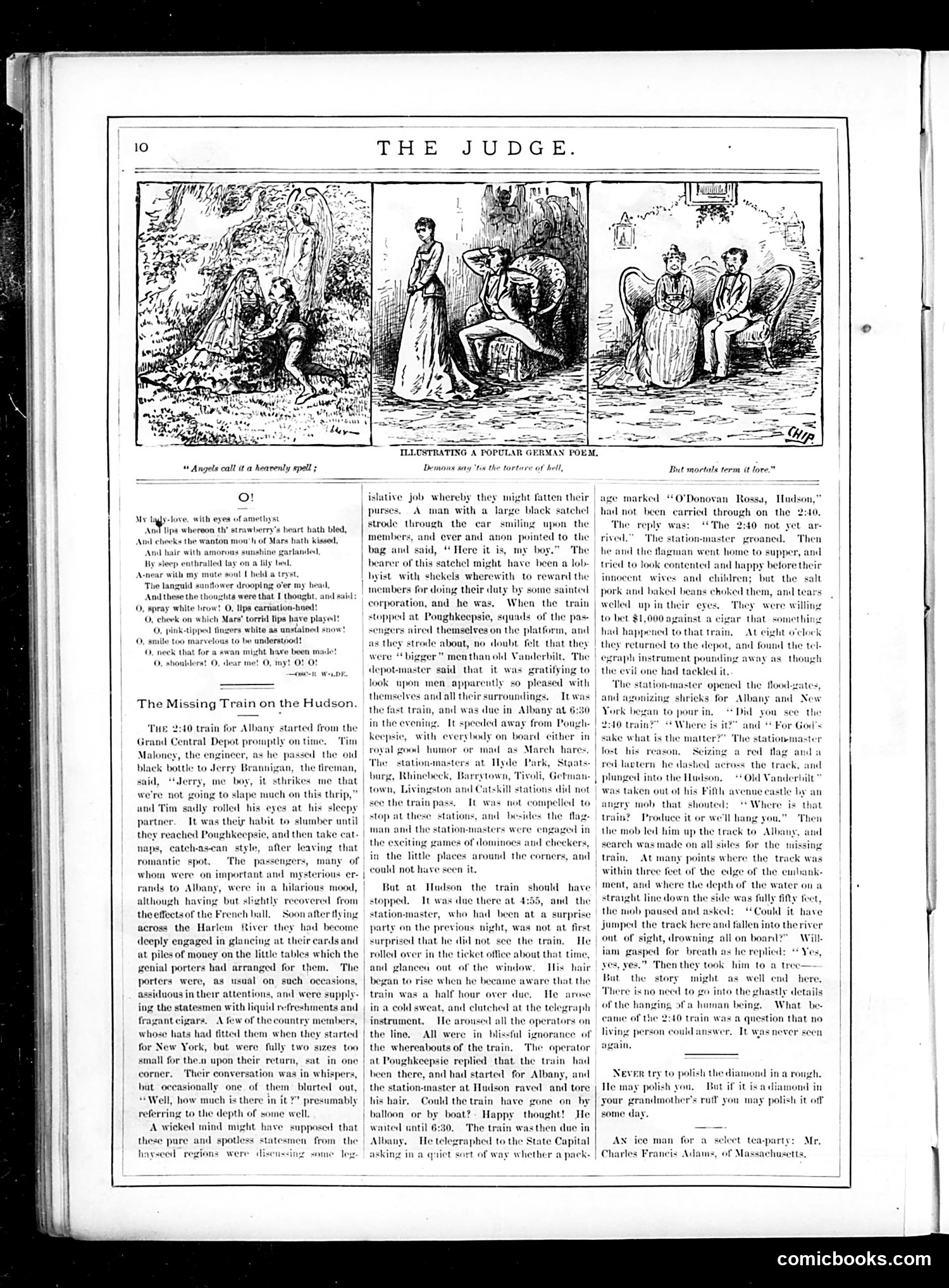
This page contains a satirical article about a missing Albany-bound train that disappeared between Hudson and Poughkeepsie, New York. The piece ridicules the incompetence of railroad officials and station-masters who cannot account for the train's whereabouts. The satire mocks the absurdity of the situation: operators frantically telegraph between stations, officials become increasingly flustered, and when pressed about the train's location, a stationmaster can only offer bewildered non-answers. The article sarcastically asks whether the train traveled "by balloon or by boat," highlighting the officials' complete inability to explain what happened. At the bottom, an unrelated aphorism jokes about polishing diamonds. The three illustrations at top appear to depict romantic or domestic scenes, likely illustrating a separate literary piece referenced as "Illustrating a Popular German Poem."
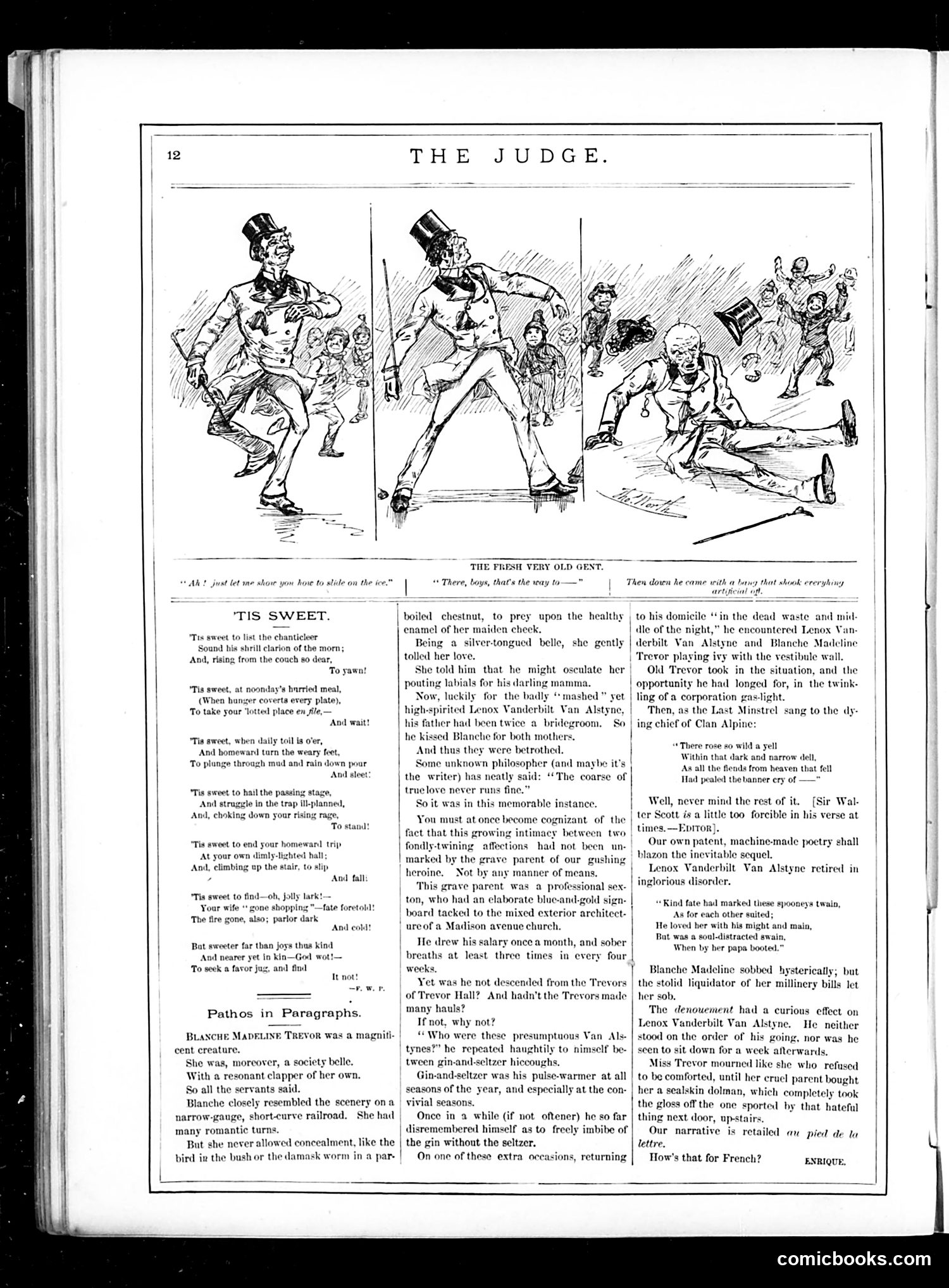
This page contains two separate pieces: a top cartoon and a prose story below. **The Cartoon** shows a figure in top hat repeatedly falling or slipping on ice, with onlookers watching. The caption "'Tis just let me show you how to slide on the ice" suggests someone confidently demonstrating ice-skating only to repeatedly fail—satirizing pompous expertise or overconfidence. **"Pathos in Paragraphs"** is a satirical melodrama mocking romantic fiction conventions. It tells of Blanche Madeline Trevor (a society belle) and Lenox Vanderbilt Van Alstyne's romance, interrupted when Blanche's father—a church sexton who drinks gin-and-seltzer—discovers them together. The father, obsessed with family prestige and aristocratic descent, chases Van Alstyne away. The satire ridicules: overwrought Victorian romance narratives, pretentious family lineage obsession, and heavy-handed literary dramatics (including a heavy-handed parody of Sir Walter Scott).
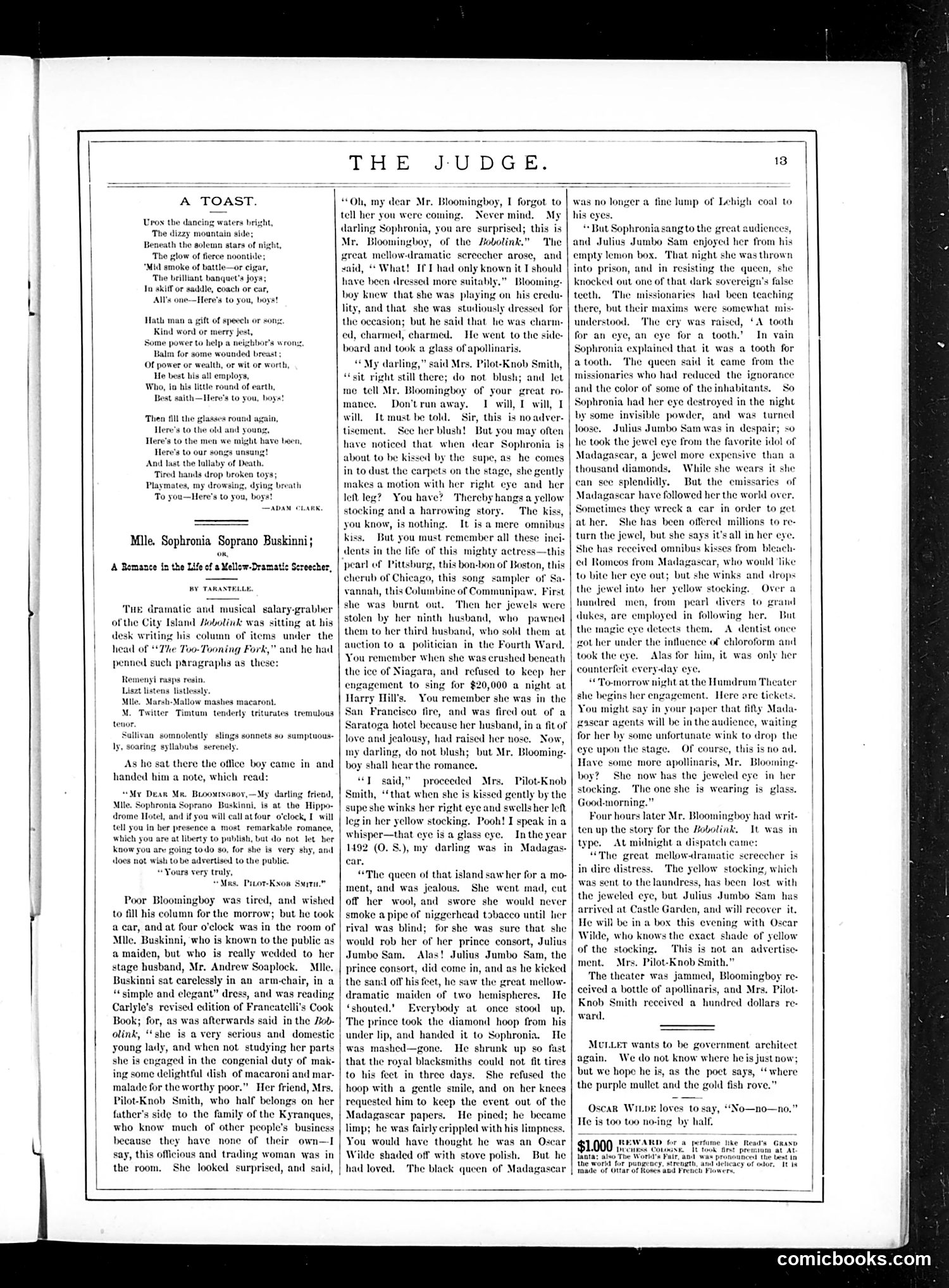
This page from *Judge* magazine contains a satirical story titled "Mille. Sophronia Soprano Buskinni: A Romance in the Life of a Mellow-Dramatic Screecher." The satire mocks theatrical melodrama and its performers. The protagonist, a theater critic named Bloomingboy, receives a note from Mrs. Pilot-Knob Smith inviting him to meet the supposedly unmarried actress Sophronia Buskinni. Upon arrival, he discovers she's actually married to "stage husband, Mr. Andrew Soaplock"—a deception played for dramatic effect. The humor targets: - **Theatrical affectation**: Sophronia pretends surprise at his visit though she was prepared - **Gossip culture**: Mrs. Pilot-Knob Smith is characterized as someone who meddles in others' business because she has none of her own - **Performative behavior**: The actress treats ordinary life as melodrama, even employing dramatic eye-movements The overall point ridicules both theatrical excess and the pretense surrounding performers' private lives in late 19th-century popular culture.
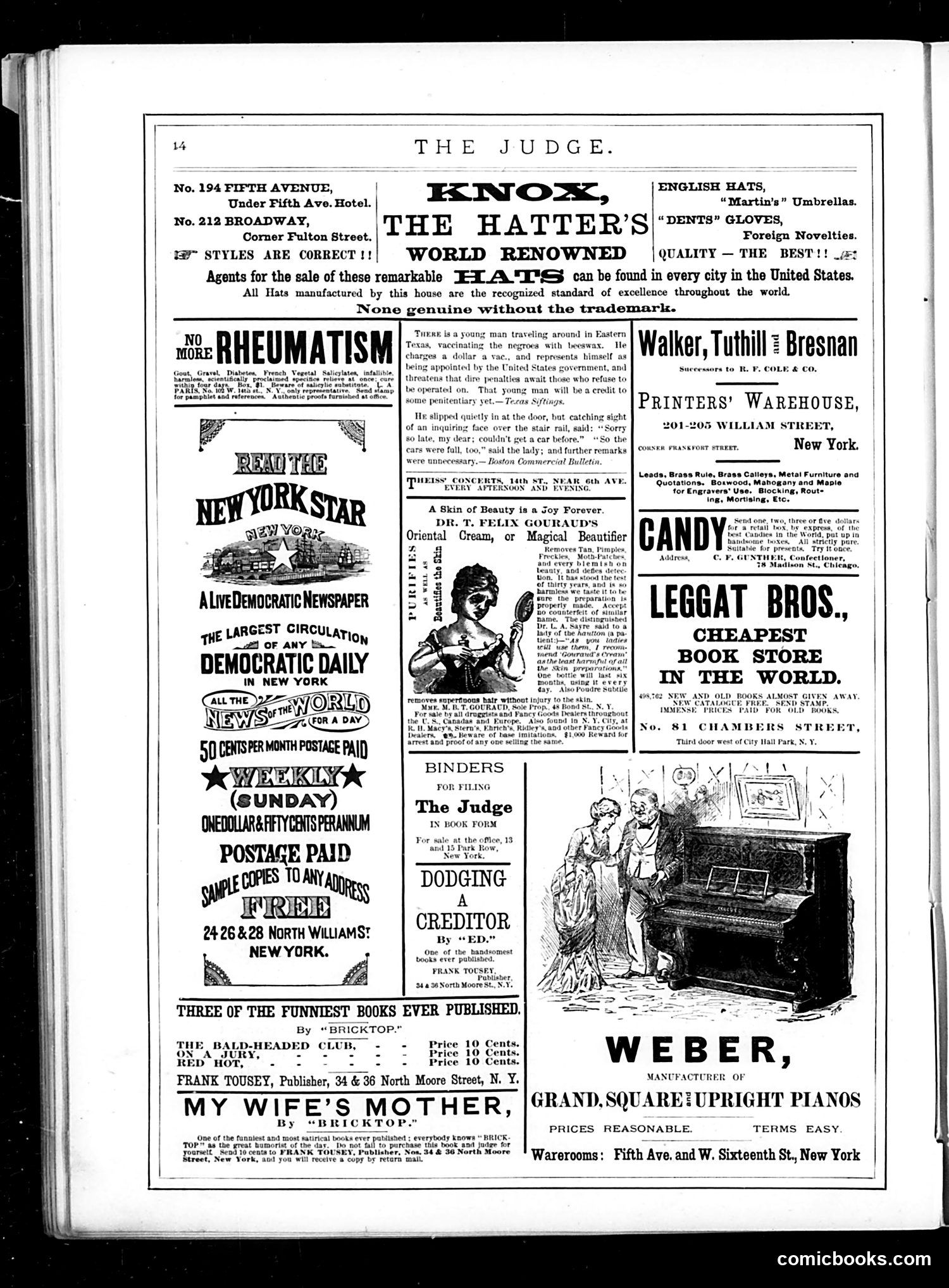
This page is primarily **advertising**, not editorial content or political cartoons. It's page 14 of *Judge* magazine and consists almost entirely of commercial advertisements for various products and services typical of late 19th-century New York. The ads include Knox hats (the dominant display), Dr. Gouraud's skin cream, the New York Star newspaper, Leggat Bros. bookstore, Weber pianos, and various other goods. There's also promotional material for *Judge* itself as a publication and for humorous books by "Bricktop." The only illustration with potential satirical content shows two figures at a piano, but without clearer context or caption, its meaning isn't evident from this page alone. The page functions primarily as a revenue source for the magazine rather than as a venue for political or social satire.
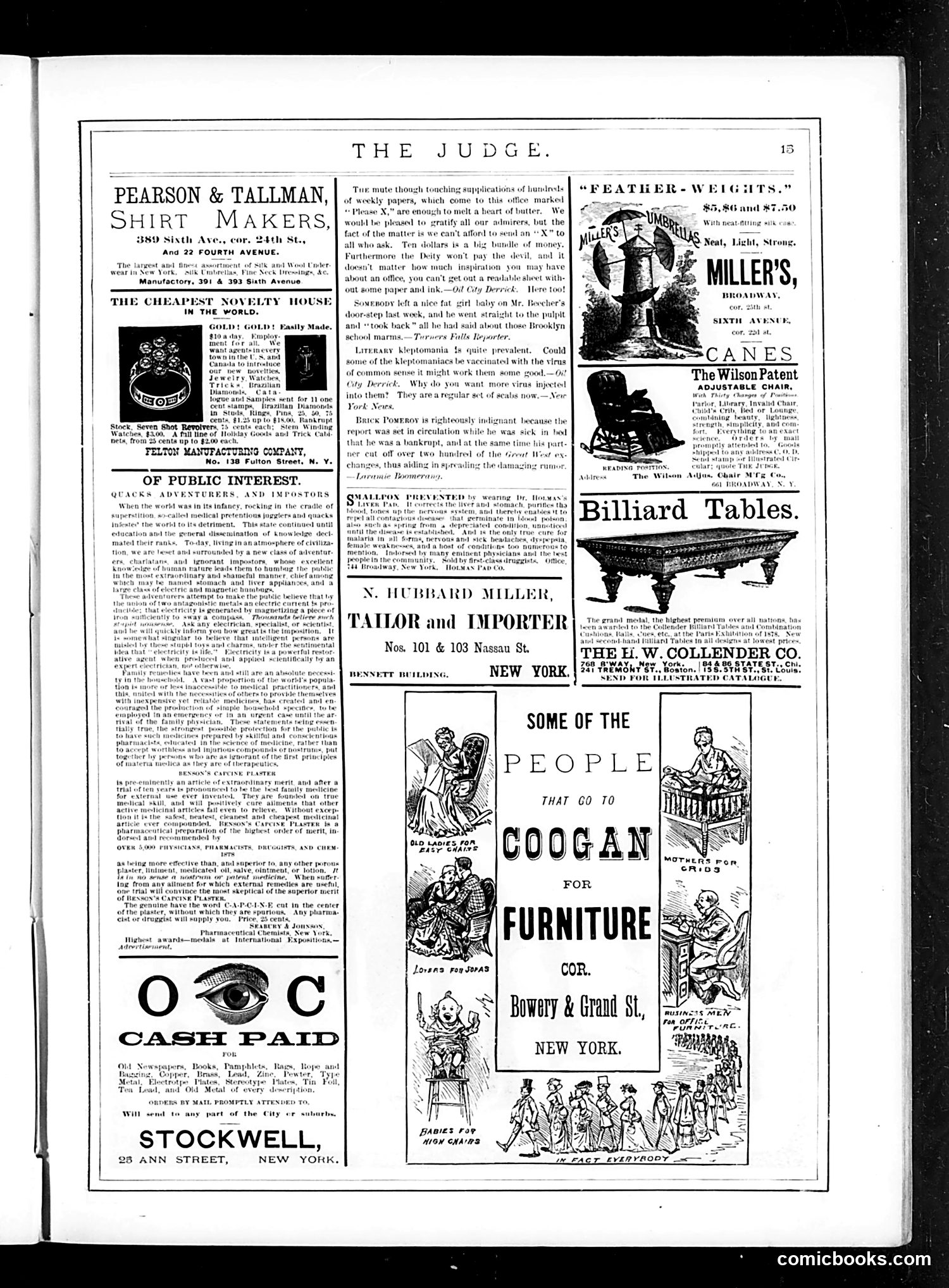
This is primarily an **advertising page** from Judge magazine, not a satirical cartoon page. The page contains commercial advertisements for various New York businesses: shirt makers, felting manufacturers, a tailor/importer, billiard tables, canes, and notably a large furniture store advertisement for Coogan's at Bowery & Grand Street. The Coogan's Furniture ad is the most visually prominent element, featuring illustrated vignettes of different social types ("people that go to Coogan") with sketched figures including babies, mothers, and families. This appears to be standard period advertising using relatable character types to market furniture to working and middle-class New Yorkers. The page reflects late 19th-century American consumer culture and advertising practices rather than political satire. No specific political figures or references are evident.
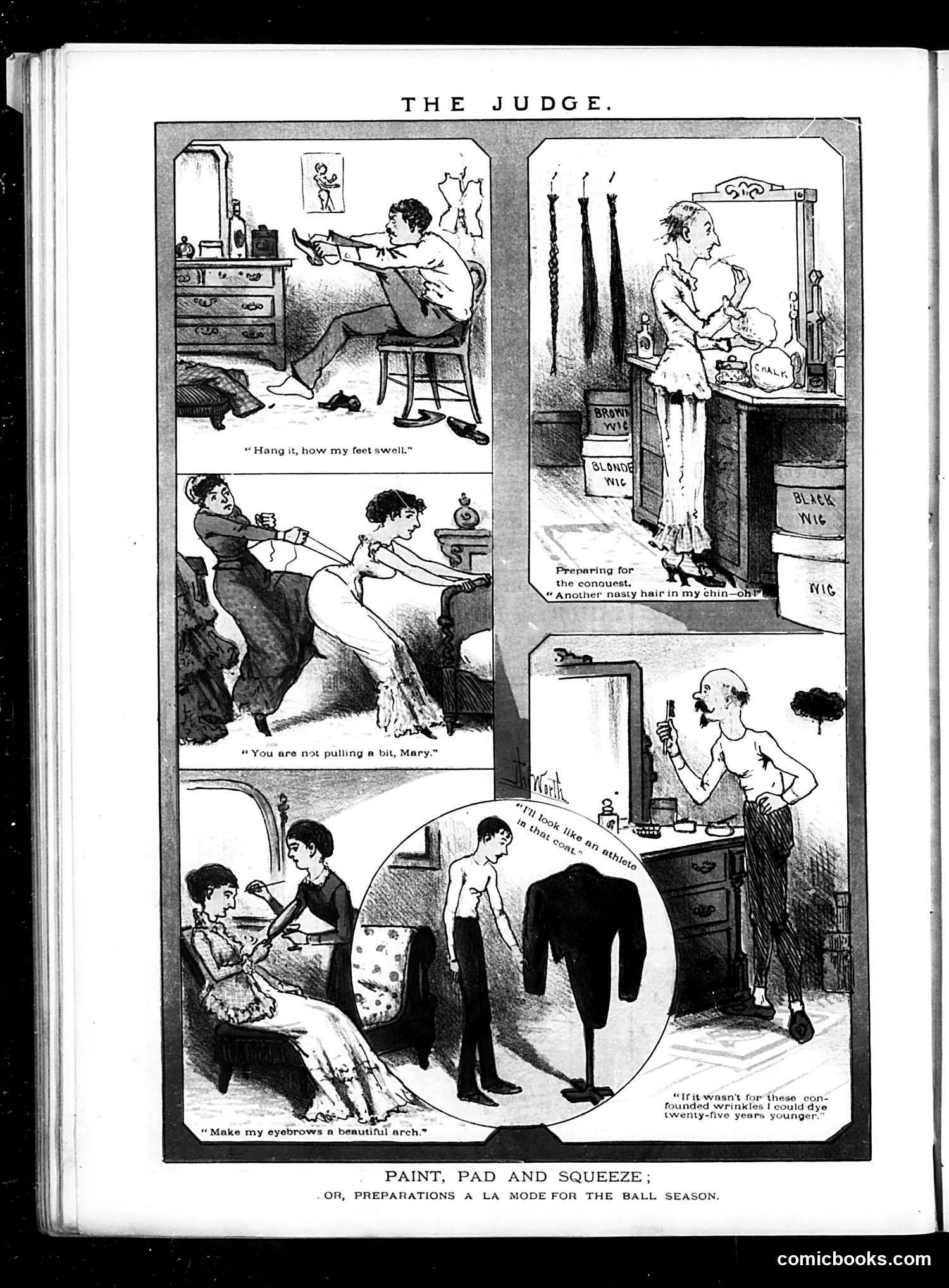
This satirical page mocks women's elaborate beauty preparations for the social ball season. The cartoon depicts various cosmetic and corsetry procedures: a woman soaking her feet, another applying hair treatments, someone adjusting her eyebrows, and multiple scenes of corseting and padding to achieve fashionable silhouettes. The central joke targets the contradiction between women's efforts to appear naturally beautiful while actually requiring extensive artifice—heavy makeup ("paint"), padding for figure enhancement ("pad"), and restrictive corseting ("squeeze"). Captions like "Make my eyebrows a beautiful arch" and complaints about wrinkles emphasize how women's appearance required constant, exhausting intervention. This reflects late 19th/early 20th-century satire of female vanity and the physical toll of fashion standards, presenting women's beauty routines as absurdly laborious performances rather than natural attributes.