
Judge, 1882-02-04 · page 3 of 16
Judge — February 4, 1882 — page 3: what you’re looking at
What you’re looking at
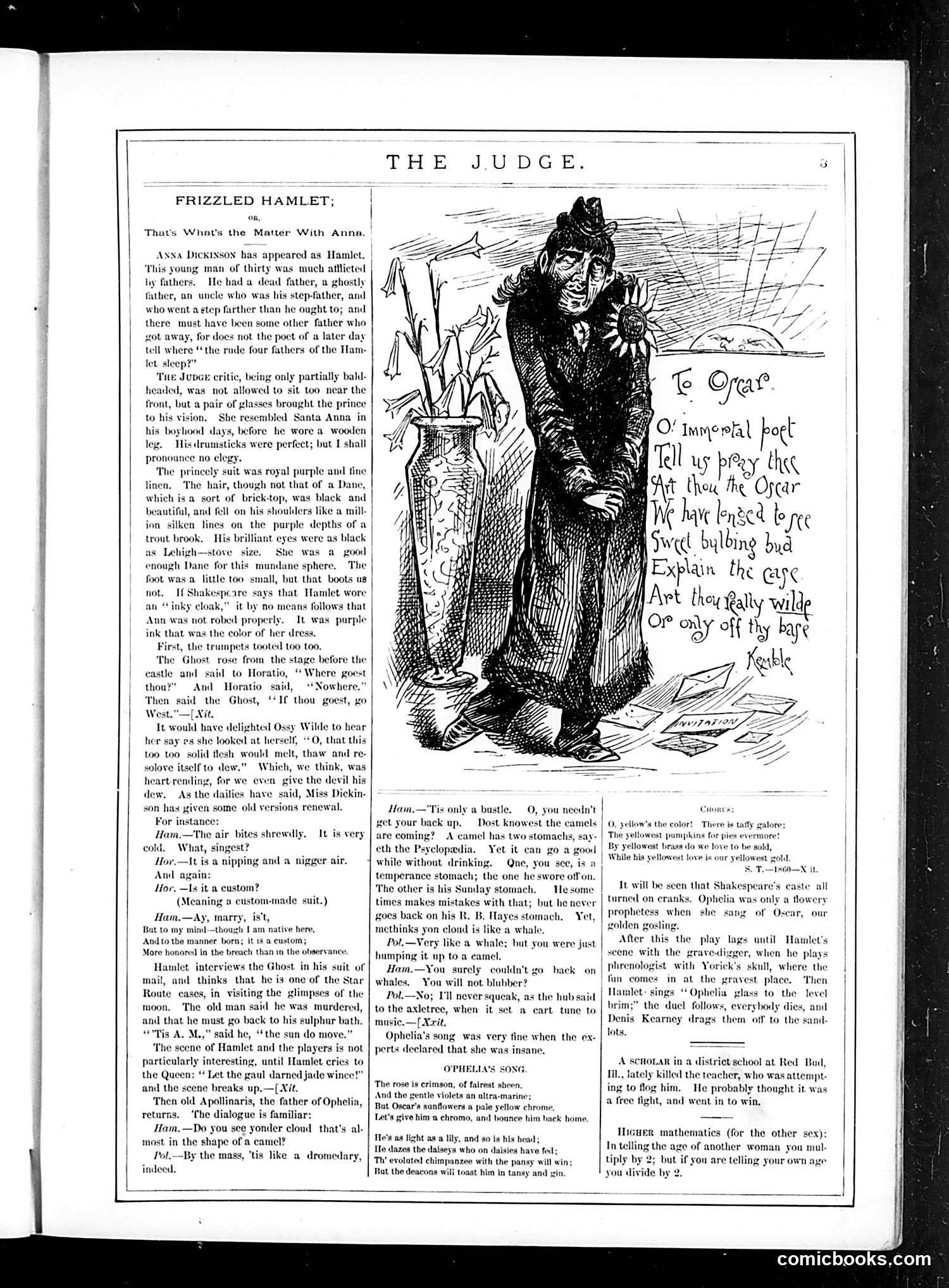
This is a satirical review of actress **Anna Dickinson's stage performance as Hamlet**. The critic mocks her casting in the traditionally male role, employing crude personal attacks: comparing her appearance to "Santa Anna in his boyhood days" and criticizing her physical features while grudgingly admitting her competence. The satire works through absurdist reimagining of the play's dialogue. The critic inserts contemporary references (the "Star Route cases," President R.B. Hayes) and adds nonsensical exchanges about camels and stomachs to ridicule the production. **The broader context**: This reflects 19th-century resistance to women in serious dramatic roles. While Judge magazine's critic attempts humor, the piece is fundamentally about delegitimizing a female actor's ambition through mockery rather than genuine critique. The accompanying illustration shows a hunched, grotesque figure—likely a caricature of Dickinson in costume—reinforcing the magazine's dismissive stance toward her Shakespearean aspirations.
📄 Transcribed text from this page (OCR, searchable)
Machine-transcribed from the original scan — historical spelling and the odd misread are preserved.
FRIZZLED HAMLET; | on, That's What's the Matter With Anna. ANNA DICKINSON has appeared as Hamlet. ‘This young man of thirt as much atilicted hy fathers. He had a dead father, a ghostly father, an uncle who was his step-father, and who went astep farther than he ought to; and there must have been some other father who. yot away, for docs not the poct of a later day tell where “the rude four fathers of the T let sleep?” ‘Tue Jupce critic, being only partially bald- headed, was not allowed to sit too near the front, but a pair of glasses brought the prince to his vision, She resembled Santa Anna in his boyhood days, before he wore a wooden leg. His drumsticks were perfect; but I shall pronounce no cle; ‘The princely suit was royal purple and fine lines The hair, though not that of a Dane, h isa sort of brick-top, was black and utiful, and fell on his shoulders like a mill- ion silken lines on the purple depths of a trout brook, His brilliant eyes were as black as Lehigh—stove size. She was a good enough Dane for this mundane sphere. The foot was a little too not that Hamlet wi an Ann was not robed properly. It was purple color of her dress. npets Looted too too. rose from the stage before the castle and said to Horatio, “Where goest thou?” And Horatio said, “Nowhere.” said the Ghost, ‘If thou goest, go y Wilde to hear her say es she looked at herself, “+0, that this too too solid tlesh would melt, thaw and re- solove itself to dew.” Which, we think, heartrending, for we even give the di dew. As the dailies have said, Miss Dickin- son has given some old versions renewal. For instance: Ham,—The air bit cold. What, singest? Hor.—It is a nipping and a nigger air. And agi Hor, —Is it a custom? hrewdly, It is very (Meaning a custom-made suit.) Ham.—Ay, marry, is't, Bat to my mind—thoughs [am native here, And to the manner born; it 1s a custom; More honored in the breach than in the observance, Hamlet interviews the Ghost in his suit of mail, and thinks that he is one of the Star Route cases, in visiting the glimpses of the moon, ‘The old man said he was murdered, and that he must go back to his s . M.,” said he, ‘the sun do move.” The scene of Hamlet and the players is not particularly interesting, until Hamlet cries to the Queen: “ Let the gaul darned jade wince!" and the scene breaks up.—[Xit. ‘Then old Apollinaris, the father of Ophelia, returns. ‘The dialogue is familiar: Ham.—Do you see yonder cloud that's al- most in the shape of a camel? Pol.—By the mass, ‘tis like a dromedary, indeed. mall, but that boots us | it by no means follows that | Ham.—'Tis only a bustle. get your back up. are coming? A O, you needn't Dost knowest the camels nel has two stomachs, say- eth the Psyclopedia. Yet it can go a g while without drinking. Qne, you see, is a temperance stomach; the one he swore off on. ‘The other is his Sunday stomach. He some times makes mistakes with that; but he never goes back on his R. B. Hayes stomach. Yet, ‘on cloud is like a whale. Pol.—Very like a whale: but you were just humping it up to a camel. Ham.—You surely couldn't go back on whales. You will not blubber? Pol.—No; I'll never squeak, as the hub said to the axletree, when it set a cart tune to music. Ophe' ine when the ex- perts declared that she was insane, OPHELLA'S SONG. The rose is crimson, of fairest shee And the gentle vio But Oscar's sunflowers a pale yellow chrome, Let's give him a chromo, and bounce him hack home. He's as light as a lily, and 0 is his head; He dazes the daiseys who on daisies have fed; Th’ evolated chimpanzee with the pansy will win; Bat the deacons wili toast him in tansy and sin O! Inmertal port Tall us preay thes at thou fe Oscar Ww have kenge fo ree Sweet bylbing bud Explain the Cyc Art they Rally wilde OF ony off thy bape O, yellow’s the color! Th | th st west pumpkins for pies lowest brass his yellowe 9 we love to be sold, love is our yellowest prophetess when she sang of ( | golden gosling. After this the seene with the g phrenologist with Yori Hamlet’ play lags until vealigger, when he plays 's skull, where the fun comes in at the gravest place. Then et sings “Ophelia glass to the level * the duel follows, everybody dies, and Denis Kearney drags them off to the sand- lots. A SCHOLAR in a district school at Red Bud, IIL, lately killed the teacher, who was attempt ing to flog him. He probably thought it was a free fight, and went in to win, Hicer mathematics (for the other sex): In telling the age of another woman you mul- . comicb: ooks.com