
A complete issue · 16 pages · 1881
Judge — December 17, 1881
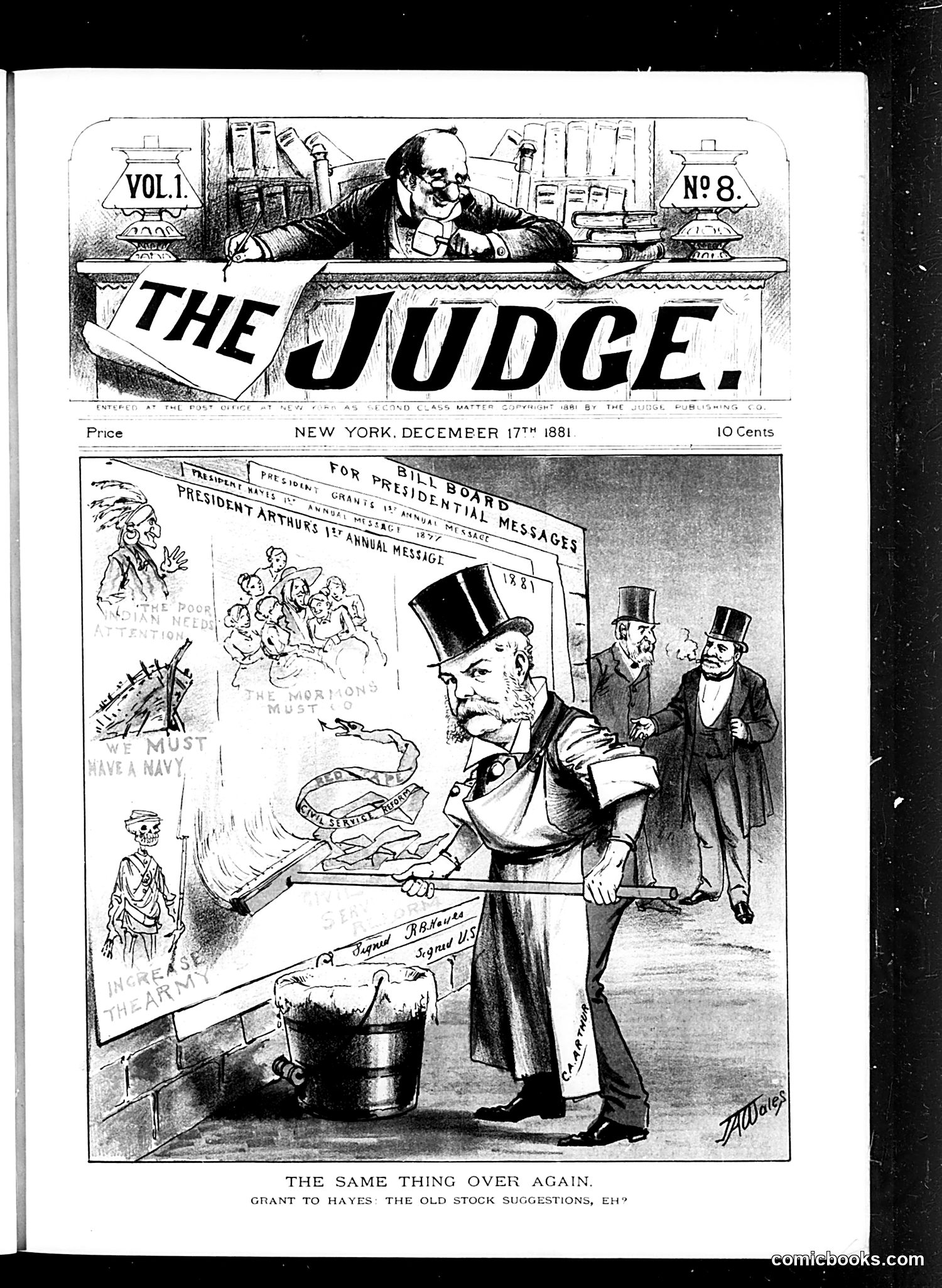
This cartoon satirizes the continuity of presidential policy between Ulysses S. Grant and Rutherford B. Hayes. The central figure (likely Hayes, based on the caption) is depicted as a cook stirring a pot labeled with presidential messaging, while Grant appears in the background offering suggestions. The cartoon's title and caption suggest Hayes is simply recycling Grant's old political proposals rather than offering fresh ideas. The "bill board" behind displays various presidential priorities including military and naval matters, implying routine, repetitive governance. The satire critiques the lack of innovation in late 19th-century Republican politics, suggesting successive administrations merely rehashed previous policies without substantial reform or new direction.
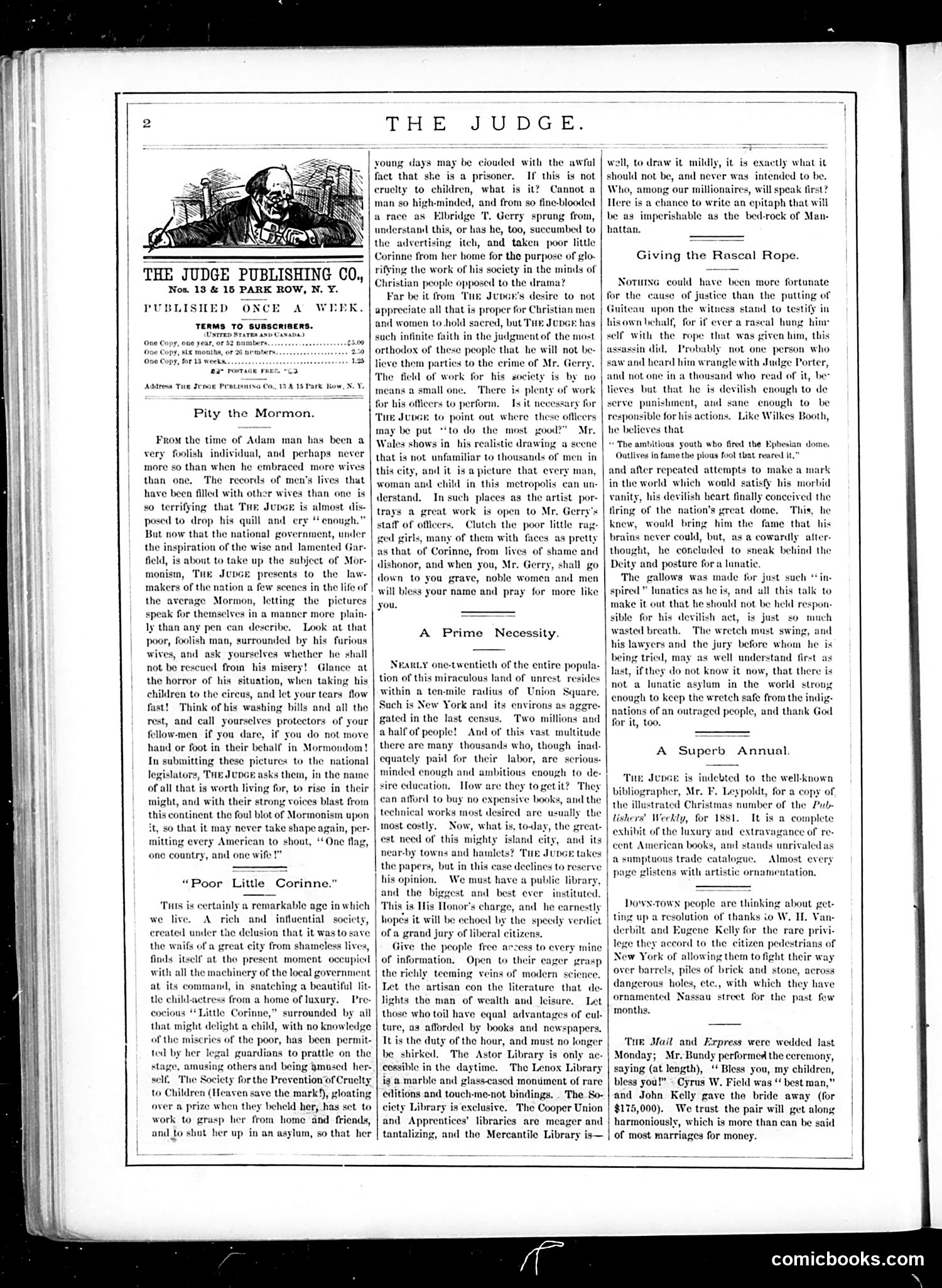
This page contains two satirical pieces targeting contemporary social issues: **"Pity the Mormon"** critiques polygamy in Mormon communities. Judge argues that multiple wives create domestic chaos—washing bills, circus trips with angry spouses—portraying the Mormon man as pitiable and suggesting federal intervention is justified. The satire appeals to nationalist sentiment ("One flag, one country, and one wife!"), reflecting 1880s anti-Mormon sentiment that led to federal prosecution of polygamy. **"Poor Little Corinne"** attacks Elbridge T. Gerry and the Society for Prevention of Cruelty to Children. Judge argues that removing child actress "Little Corinne" from her wealthy, comfortable home and placing her in an asylum is itself cruel—an abuse of power by reformers seeking publicity. The piece sarcastically questions whether Gerry, despite his "fine-blooded" heritage, has succumbed to "advertising itch." Judge suggests such reformers should focus on genuinely poor children instead. Both pieces satirize what Judge views as misguided moral crusades.
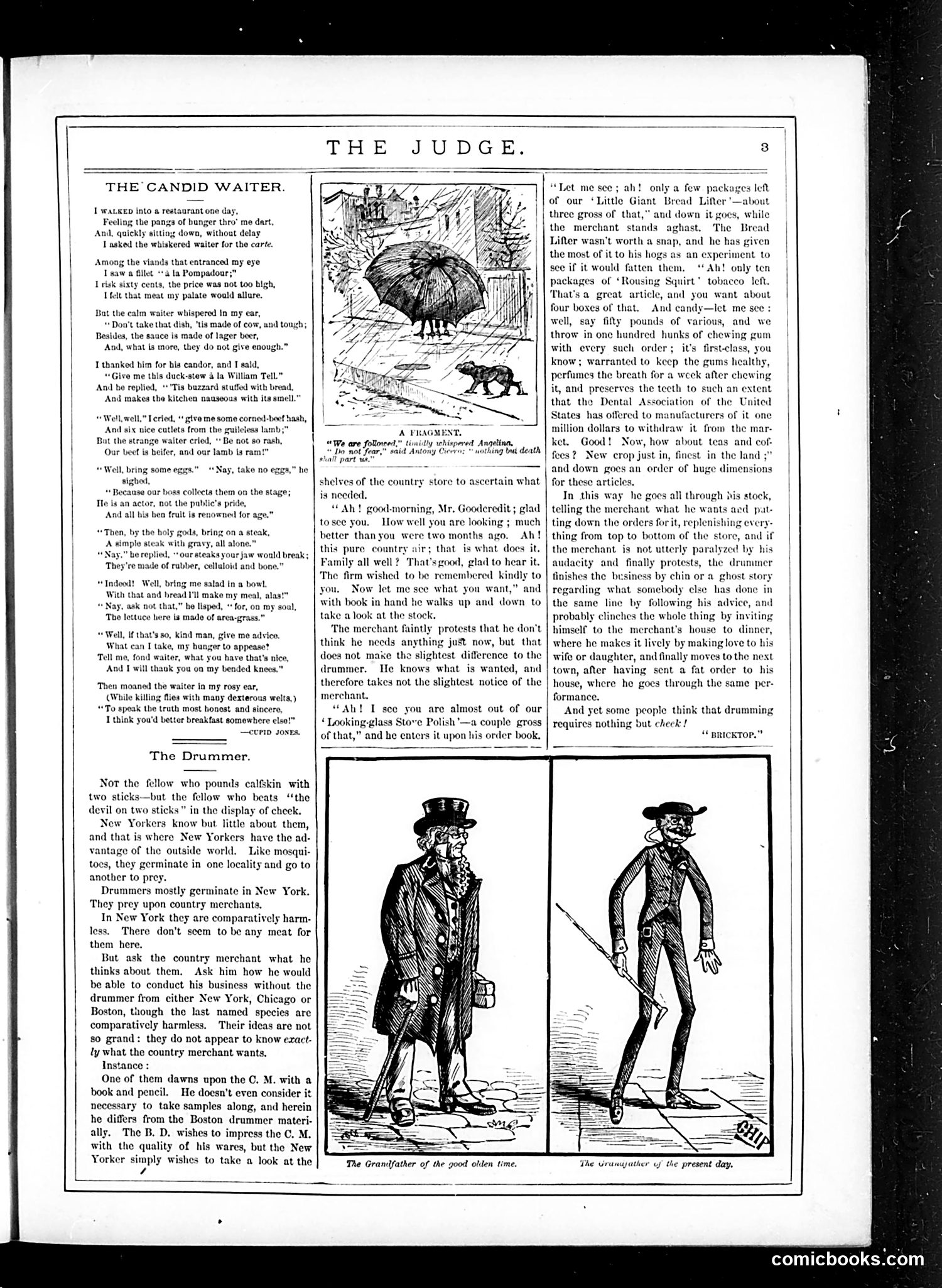
**"The Candid Waiter"** mocks deceptive restaurant practices. A diner asks a waiter for recommendations, but the waiter candidly reveals that every dish is fraudulent: the "fillet" contains cow offal, the duck-stew is buzzard, steaks are rubber and bone, lettuce is seaweed. The joke satirizes restaurants that serve inferior or adulterated food while charging premium prices—a common complaint in urban dining during this era. The waiter's honesty is unusual; normally such deceptions remain hidden. **"The Drummer"** (meaning a traveling salesman) criticizes aggressive sales tactics used by New York drummers preying on country merchants. Unlike Boston drummers who bring samples to demonstrate quality, the New Yorker simply inspects the merchant's stock and pressures him to order. The satire targets manipulative sales methods and the exploitation of rural shopkeepers by city-based salesmen who use flattery and presumption rather than genuine product knowledge. Both pieces reflect Gilded Age anxieties about urban commerce and dishonest business practices.
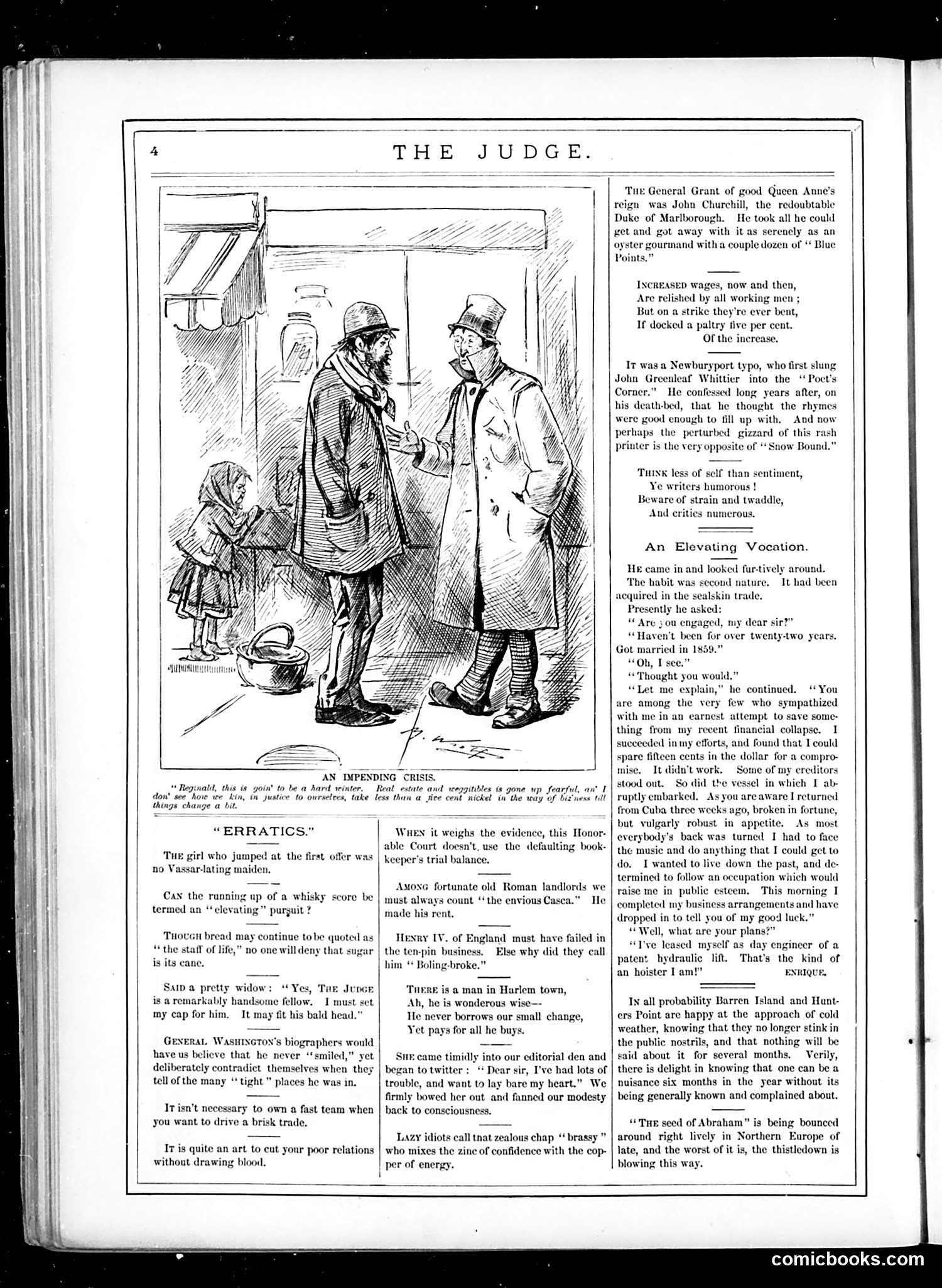
This page from *Judge* magazine contains several brief satirical jokes and one illustrated cartoon titled "An Impending Crisis." **The Main Cartoon** depicts a well-dressed man and woman confronting a poor woman with a child, apparently about unpaid rent or debt. The caption references harsh landlord practices, using the phrase "hard waster" and complaints about food costs. **The Surrounding Text** consists of short, punchy one-liners mocking various social types: lazy workers, ambitious social climbers, poor relations, widow-hunters, and failed businessmen. One piece, "An Elevating Vocation," tells of a financially ruined man who, forced to rebuild his reputation, takes a job as a hydraulic lift engineer—the pun being that he's literally an "hoister." **The Social Context**: These jokes target working-class struggles (wage disputes, debt), business failures, and social pretension—typical *Judge* fare from the Gilded Age. The humor relies on wordplay and class commentary rather than identifying specific politicians or events. The overall tone reflects cynicism about labor, poverty, and social mobility common to 19th-century American satirical magazines.
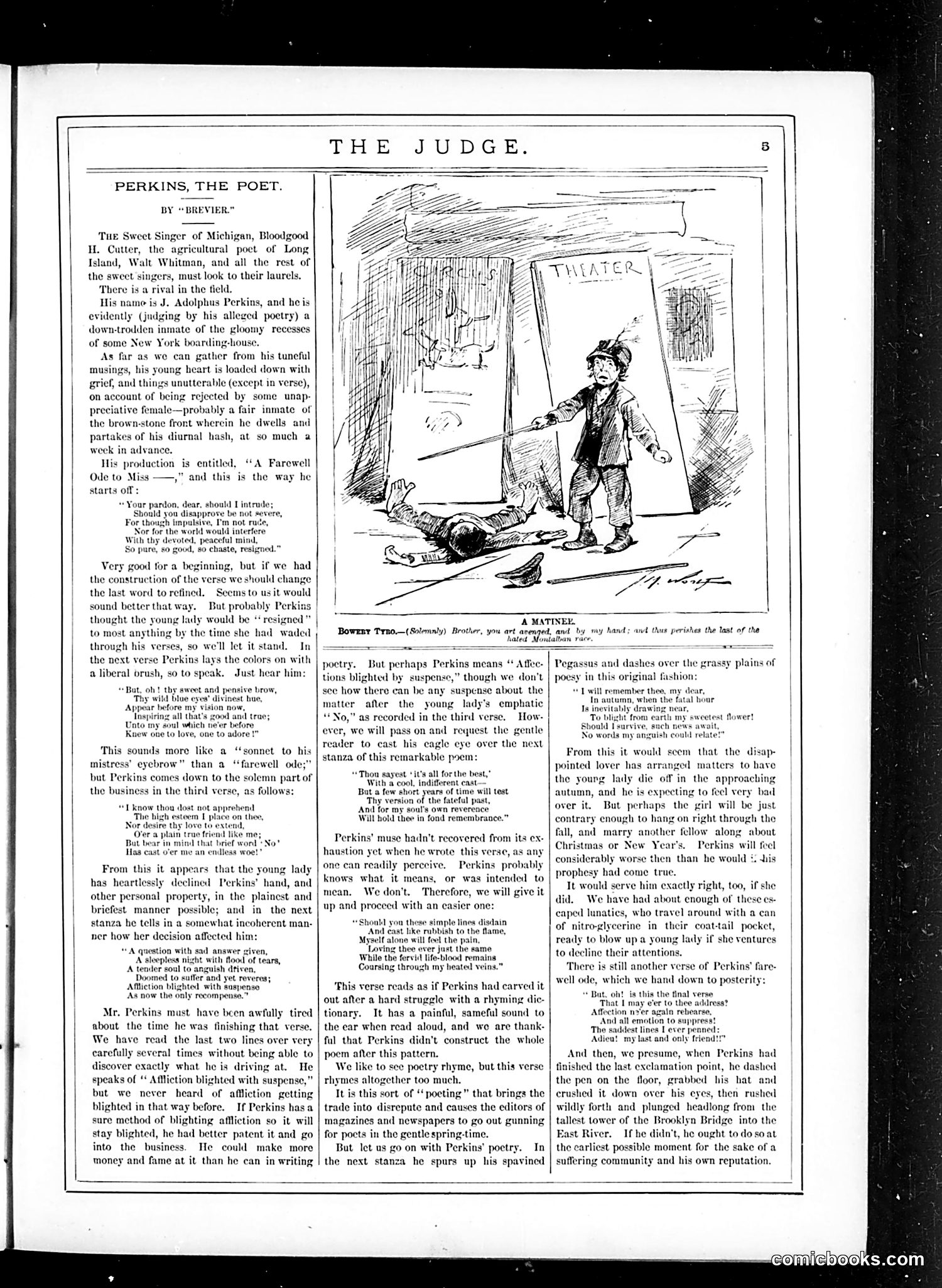
This page satirizes a talentless amateur poet named J. Adolphus Perkins, who apparently lives in a New York boarding house and has written a maudlin "Farewell Ode to Miss —" after romantic rejection. The satirist "Brevier" mocks Perkins's overwrought, poorly-constructed verses filled with melodramatic despair and confused metaphors (like "Affliction blighted with suspense"). The cartoon and accompanying text suggest Perkins represents a common type of the era: the lovesick, struggling artistic failure living in urban squalor. The satire targets both his pretensions to poetry and the broader phenomenon of untalented amateurs attempting serious literature. By comparing him unfavorably to established poets like Walt Whitman, the author emphasizes how far below professional standards Perkins falls. The secondary cartoon depicts a melodramatic theatrical scene, likely contrasting overwrought performance with Perkins's overwrought verse.
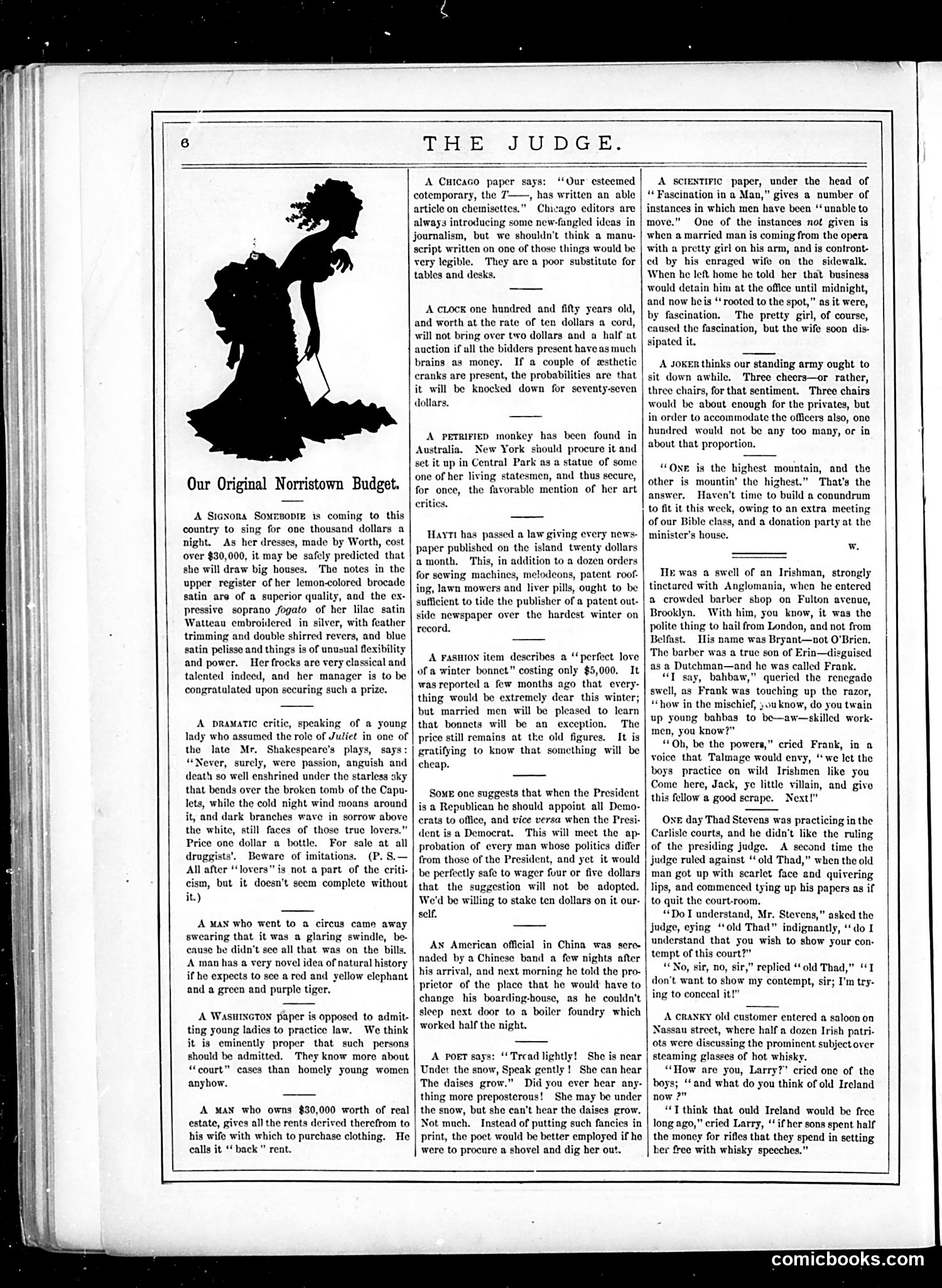
This page collects humorous social commentary typical of Judge's satirical "budget" columns. The content mocks various contemporary absurdities: **The silhouette cartoon** (top left) depicts a fashionably-dressed woman—likely satirizing the extravagant spending on haute couture, referenced in the opening item about an opera singer whose Worth gowns cost $30,000 while earning $1,000 nightly. **Key targets:** - **Fashion excess**: Mocking wealthy women's lavish spending on designer clothing - **Theatrical pretension**: Parodying overwrought dramatic criticism - **Journalism confusion**: Chicago editors introducing nonsensical writing surfaces ("chemisettes") - **Political appointments**: Suggesting alternating party control of government offices regardless of merit - **Economic absurdity**: A man donating all rental income to his wife's clothing purchases The satire attacks Gilded Age consumerism, artistic pomposity, and political patronage—arguing these represent society's misplaced values and poor judgment.
This page satirizes the frustrations of early telephone service, a relatively new technology in the late 19th/early 20th century. The piece, titled "Our Popular Farces: Our Telephones," depicts repeated comedic misconnections involving Mr. Hurry attempting to reach the Fifth Avenue Theater. The satire targets **operator incompetence and system unreliability**. Mr. Hurry is repeatedly connected to wrong numbers—a faro bank, the Astor House, a woman claiming to be his wife, strangers—creating absurd conversations. The operators admit mistakes casually ("Sure enough, I did make a mistake"), suggesting systematic indifference. The humor reflects genuine public frustration with early telephone switchboard service, where human operators manually routed calls and errors were common. By showing the protagonist's mounting exasperation through repeated failed connections, Judge mocks both the technology's immaturity and the operators' incompetence, capturing a moment when telephones were still unreliable novelties rather than dependable utilities.
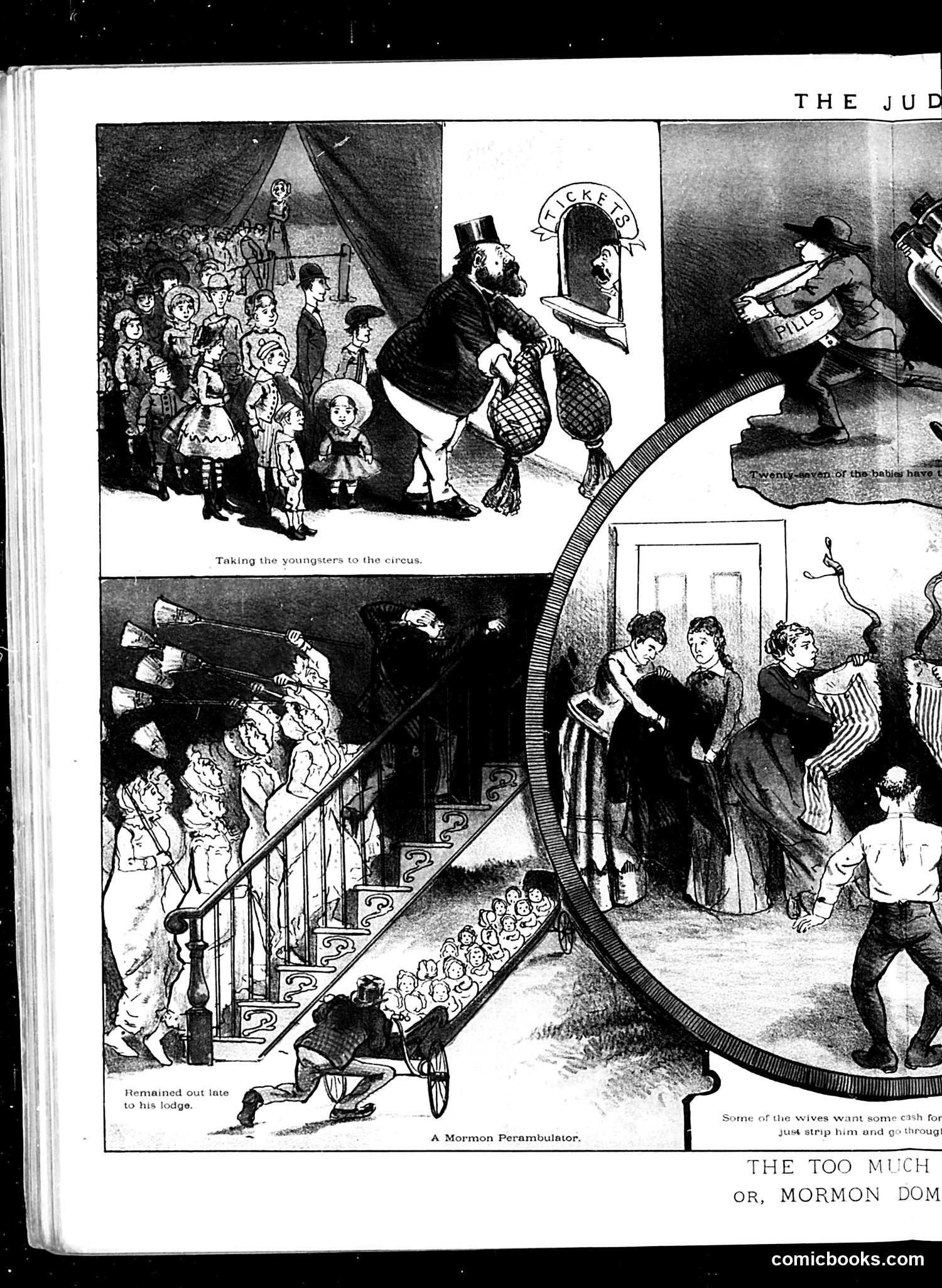
This satirical cartoon series mocks the Mormon practice of polygamy. The title page shows various scenes: a man (likely Joseph Smith or a generic Mormon leader) leading children to a circus; a "Mormon Perambulator" (baby carriage) overflowing with infants; wives confronting a man demanding cash, with the caption suggesting they'll "strip him" for money. The satire targets two contemporary concerns: the perceived chaos of polygamous households with excessive children, and the financial burden polygamy supposedly created. The exaggerated imagery—overcrowded carriages, numerous wives and children—ridicules Mormon family structures as absurd and unsustainable. This reflects late-19th-century anti-Mormon sentiment in American publications, when the LDS Church's polygamy was a major political and social controversy.
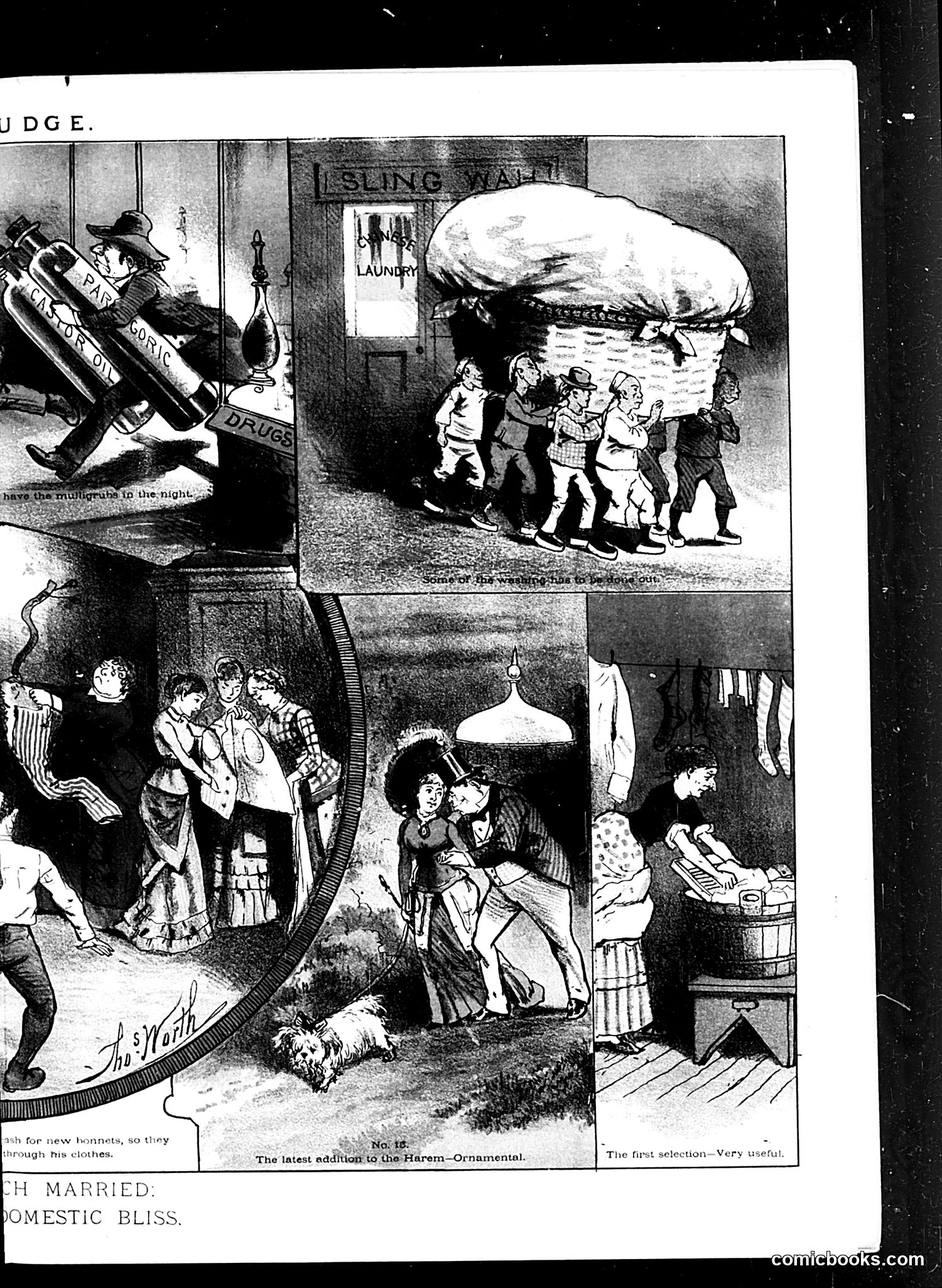
This page from *Judge* magazine satirizes tenement housing conditions and domestic life among poor immigrants, likely from the early 1900s. The top panel shows families crowded beneath a "Sling Wall" laundry line—depicting cramped, unsanitary living conditions. The middle and bottom panels illustrate the "Harem-Ornamental" and domestic activities: families in close quarters, children underfoot, laundry hanging, and basic household tasks. The satire targets overcrowded urban immigrant housing ("The latest addition to the Harem") while the "Domestic Bliss" heading ironically frames these harsh conditions as contentment. The cartoon critiques the gap between idealized domesticity and the grim reality of tenement life, mocking both the living conditions themselves and middle-class assumptions about working-class family life.
This is a humorous sketch—not a political cartoon—depicting rural American social customs. The author nostalgically describes quilting parties as they existed "when THE JUDGE was a boy," contrasting their former importance in farming communities with their decline. The satire targets small-town gossip culture. The piece humorously illustrates how quilting parties functioned less as sewing events than as social gatherings where women exchanged news and rumors. The extended dialogue example shows Mrs. Smith's breathless gossiping about Deacon Newton's secret trips to Frogtown and his romantic pursuits—scandals presented as riveting local entertainment. The joke is on the incessant, overlapping chatter: "How would you like to be in a room with twenty-five or thirty such news-gatherers, all talking at the same time?" This gentle mockery of rural village life, small-town morality, and women's reliance on quilting parties for social connection would resonate with Judge's urban, educated readership as quaint Americana.
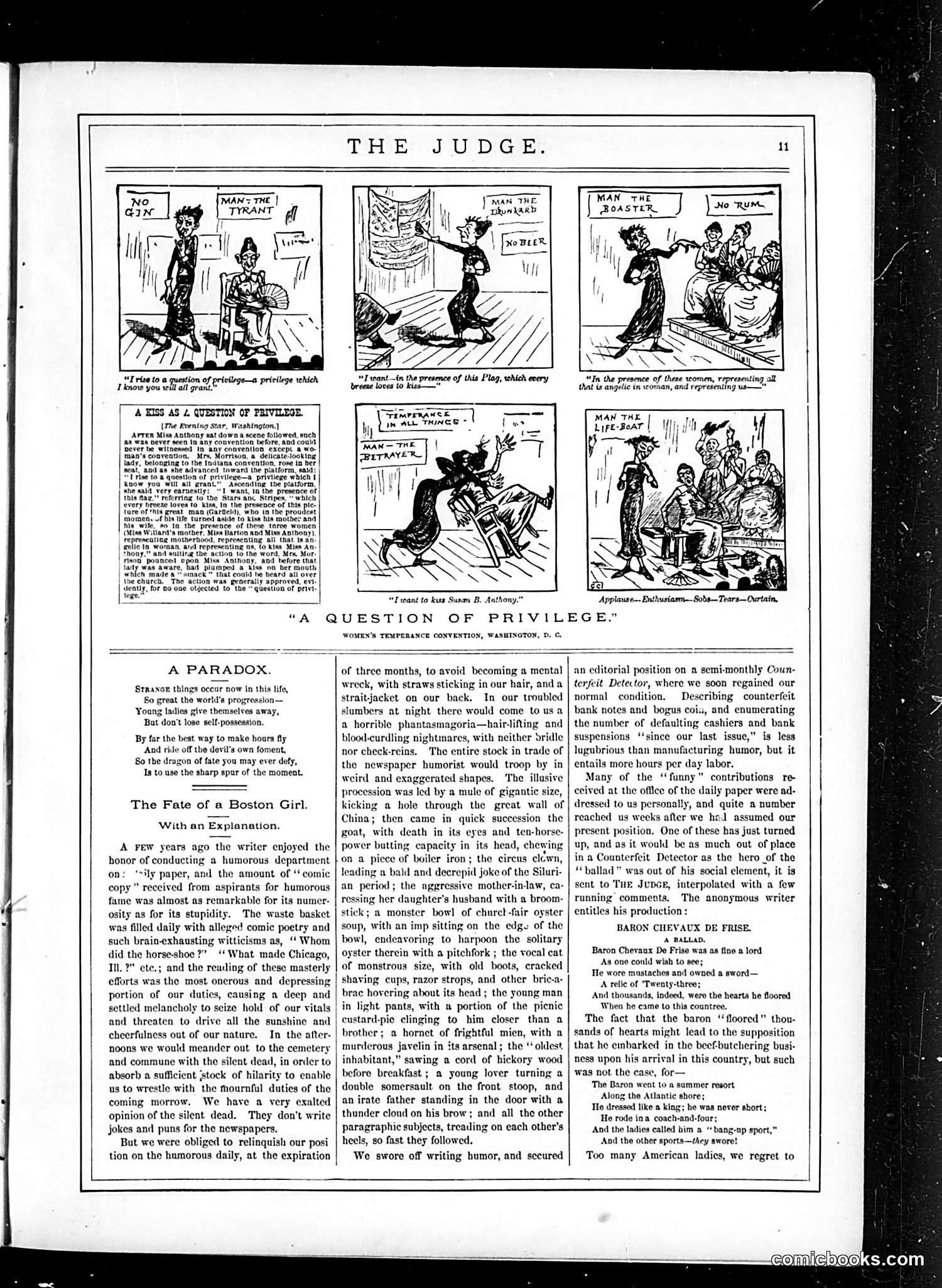
This page from Judge satirizes a women's temperance convention in Washington, D.C. The main cartoon depicts a dramatic moment where a woman named Mrs. Morrison invokes "a question of privilege" to publicly kiss Susan B. Anthony (the famous suffragist and temperance advocate visible in the scene). The satire mocks the emotional, theatrical nature of women's reform conventions—suggesting they dissolve into sentimental displays rather than serious political work. The accompanying text explains this was an actual event that caused a "scene." The cartoonist treats the women's public affection and passionate oratory as absurdly overwrought, reflecting period prejudices that women activists were hysterical or irrational. The other content—poetry and humorous essays about paradoxes and Boston girls—fills space typical of 1880s satirical magazines. The overall message: Judge dismisses women's temperance and suffrage movements as emotionally excessive rather than substantive political action.
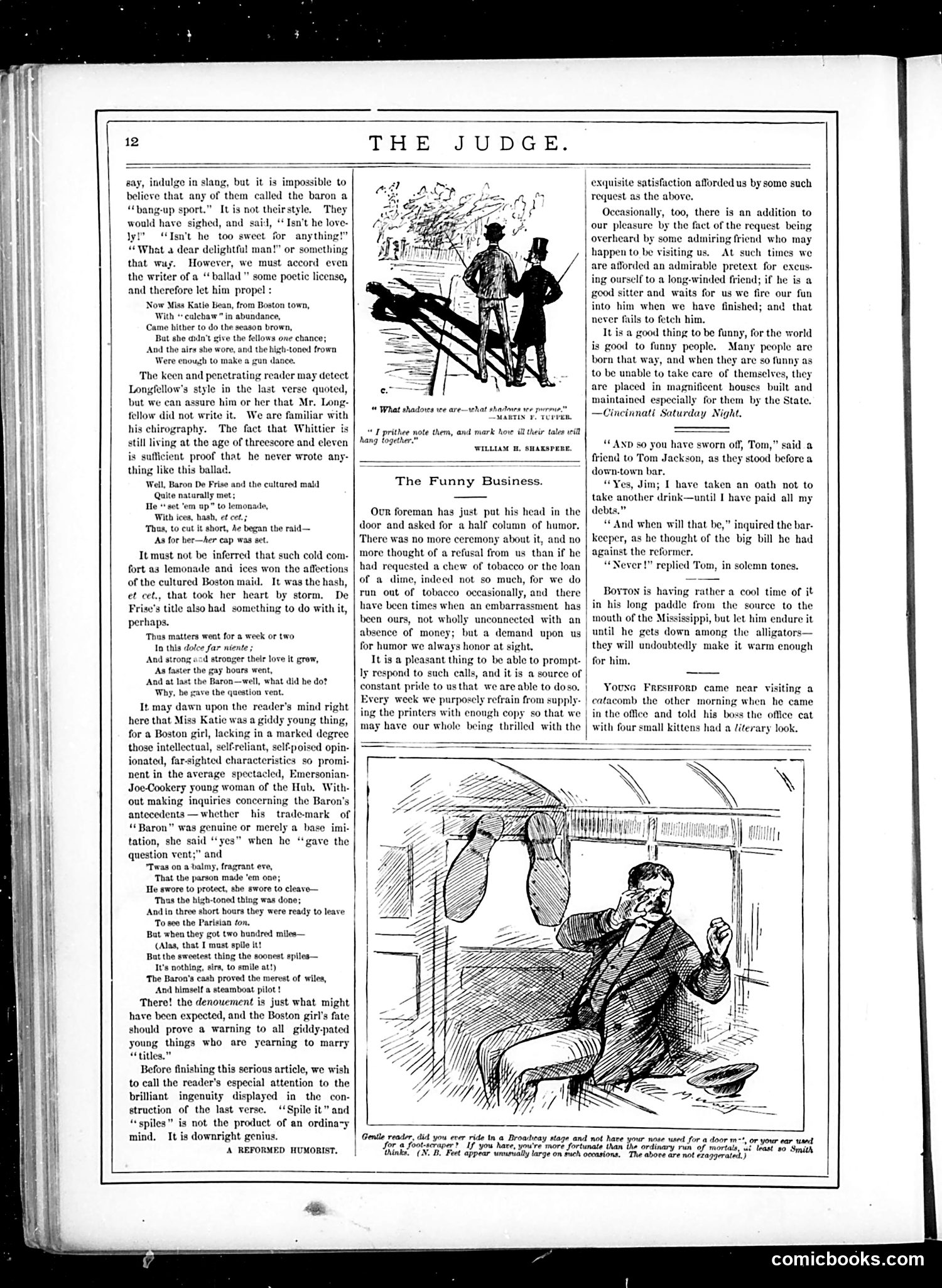
This page contains two distinct pieces of satirical content: **The Main Story** ("A Reformed Humorist"): A narrative poem mocking gullible Boston society women. It tells of "Miss Katie Bean," a pretentious Bostonian who falls for a European "Baron." After marrying him based on his title alone—without investigating his background—she discovers he's a fraud: merely a steamboat pilot. The satire targets upper-class Boston women for their snobbery, susceptibility to foreign aristocratic pretense, and lack of practical judgment. The poem ridicules both the women's affected behavior and their deserved comeuppance. **"The Funny Business"** (lower section): A meta-commentary on the magazine's own humor production. The foreman requests a humorous column without ceremony, comparing it to borrowing tobacco. This self-aware piece gently mocks the routine, casual nature of producing satirical content for magazines. The accompanying illustrations support both pieces' themes of social deception and editorial operations. The satire reflects 19th-century American skepticism toward European titles and nouveau-riche pretension.
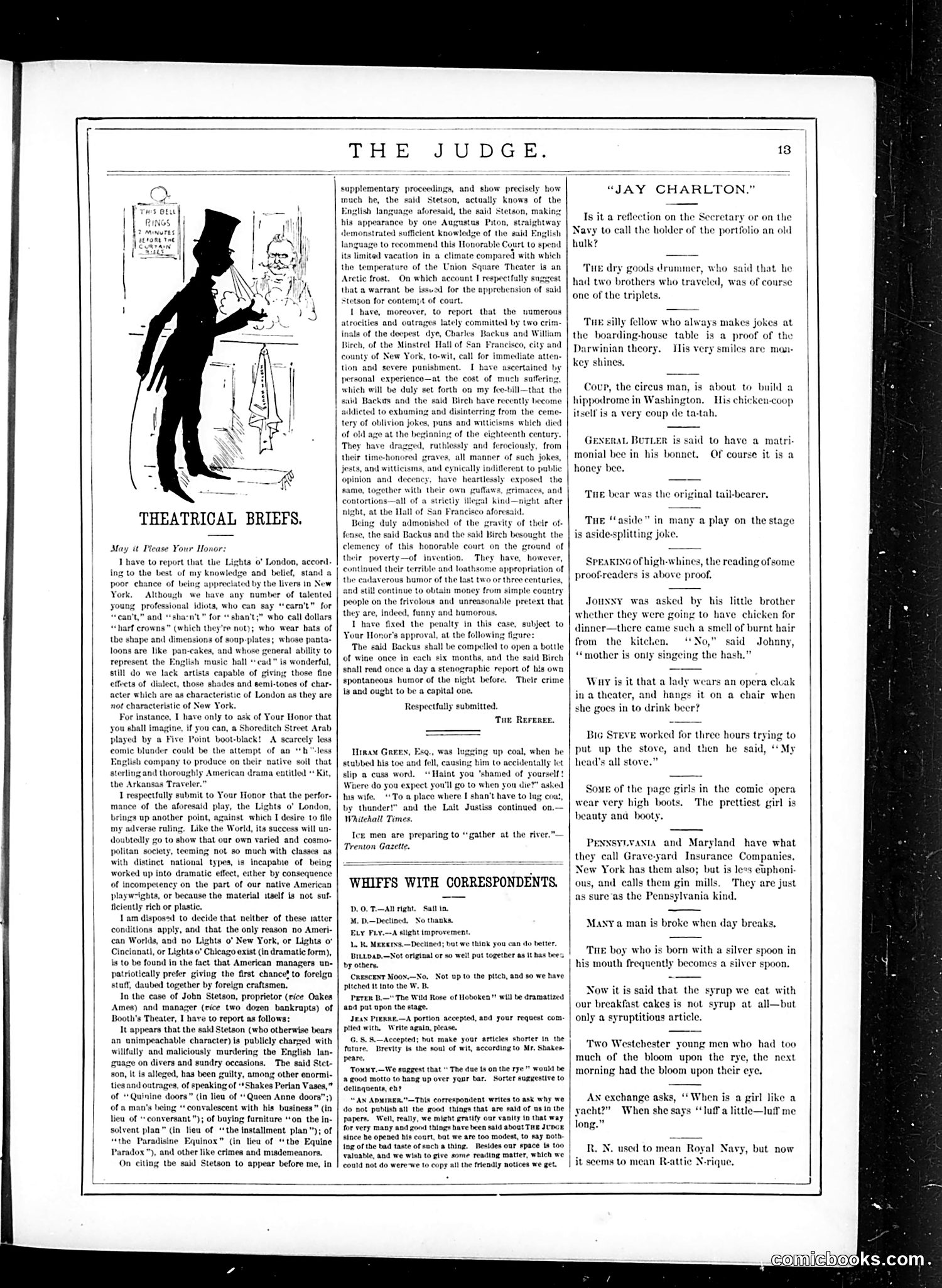
The main cartoon (top left) depicts a thin, formally-dressed man in a top hat gesturing at theatrical scenery—this appears to be a theater manager or impresario being satirized for poor taste or incompetence. The text is framed as a mock legal proceeding ("May it Please Your Honor") where the author (playing a judge) issues complaints against theater managers and actors. Key targets include: **John Stetson** (Booth's Theater manager) is charged with "murdering the English language"—his specific crimes are comedic misstatements like calling "Queen Anne doors" as "Quinine doors" and using "installment plan" as "insolvent plan." **Charles Backus and William Birch** (minstrel performers) are accused of robbing graves and making indecent jokes. The satire mocks both incompetent American theater management and the popularity of inferior British imports ("Lights of London") over homegrown American drama. The author argues American managers unpatriotically prefer foreign productions despite American society offering rich dramatic material. This is theatrical criticism disguised as humorous legal complaint—typical Judge magazine format lampooning cultural pretension and poor artistic judgment.
This page is primarily **advertisements** rather than satirical cartoons. It's a back page of *Judge* magazine filled with product ads typical of the 1880s-90s era. The only illustrated content appears to be **small sketches accompanying advertisements**: one shows a person at what looks like a piano or musical instrument (advertising Weber pianos), and another depicts the "Bricktop" character, possibly related to a serialized story. The text consists of jokes and humorous snippets scattered among ads for hats, books, medical plasters, umbrellas, pianos, billiard tables, and printing services. These are generic witticisms about cooking, bicycles, and rescue stories—not political satire. **For a modern reader**: This page demonstrates how 19th-century magazines blended entertainment and commerce, using humor and illustration to market everyday products to middle-class readers. There is no evident political commentary or social critique here—just typical period humor and advertising.
This page is primarily **advertising**, not editorial content or political cartoons. It's page 18 of *Judge* magazine and consists almost entirely of commercial advertisements and classifieds typical of late 19th-century publications. The main visual element is a large advertisement for **Coogan Furniture** (Bowery & Grand Street, New York) featuring illustrated vignettes of everyday people and family scenes—likely meant to appeal to middle-class consumers furnishing their homes. Other ads include clothing retailers, shirt makers, a tailor, patent medicines (Pond's Extract for inflammation and rheumatism, a candy product), and newspaper subscriptions (the *New York Star*, a Democratic daily). There are also small ads for humorous books with titles like "The Bald-Headed Club" and "On a Jury"—suggesting *Judge* also published comedic literature alongside its satirical magazine content. The page contains no identifiable political cartoons or social satire—it's a commercial/revenue-generating section of the publication.
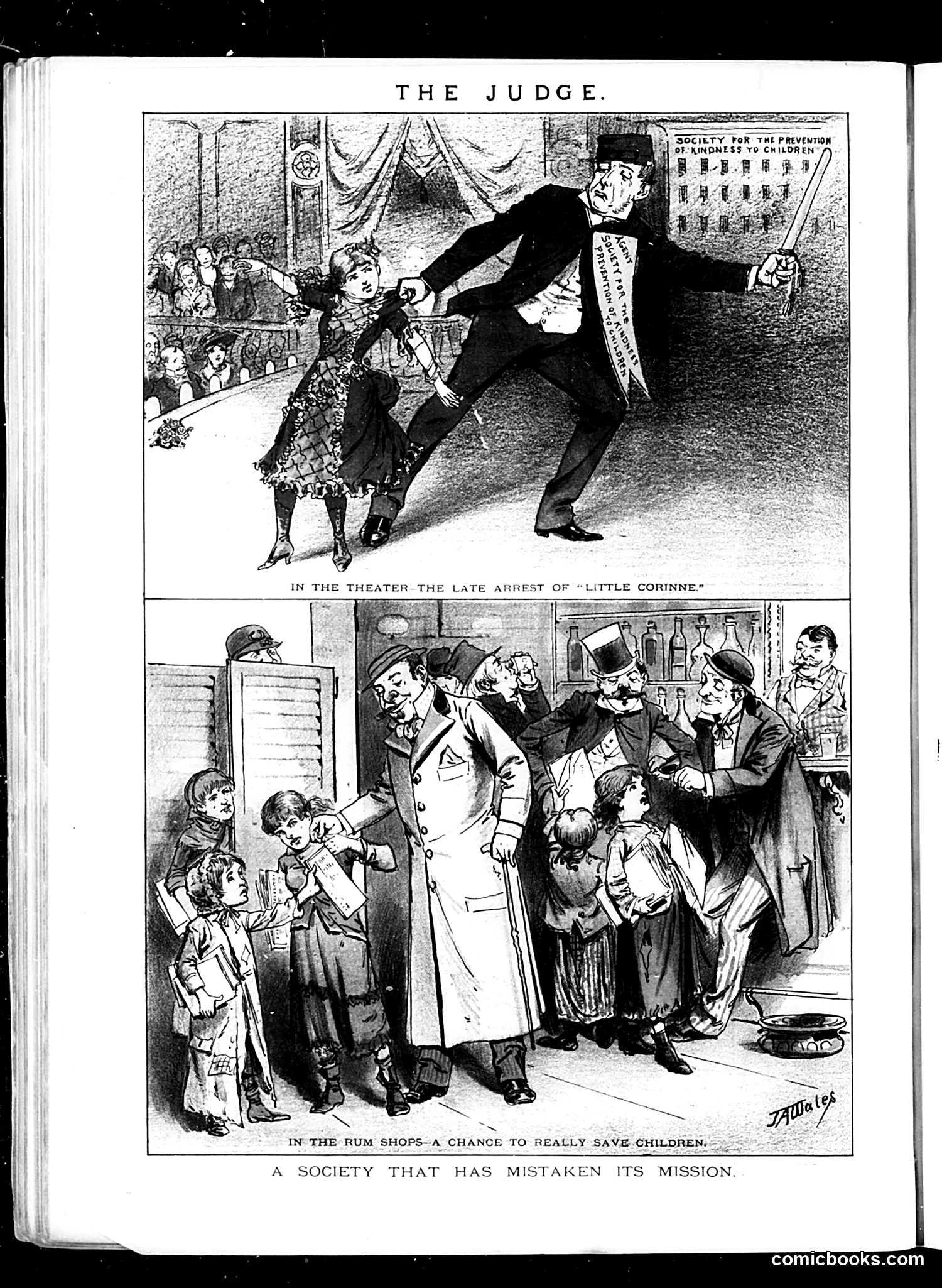
This Judge cartoon critiques a child-welfare organization's misguided priorities. The top panel shows a judge arresting "Little Corinne" in a theater—presumably for performing or vagrancy. The bottom panel, set in a rum shop, depicts the same organization's representative surrounded by children in a bar, seemingly doing nothing to protect them. The satire's point: the caption "A Society That Has Mistaken Its Mission" suggests the organization aggressively pursues minor theatrical infractions (top) while ignoring genuine child endangerment in saloons (bottom). The cartoon attacks the society for theatrical moralism—cracking down on entertainment venues—while neglecting actual harm to children in places serving alcohol. It's a critique of selective, performative morality masquerading as child protection.