
Judge, 1881-12-17 · page 5 of 16
Judge — December 17, 1881 — page 5: what you’re looking at
What you’re looking at
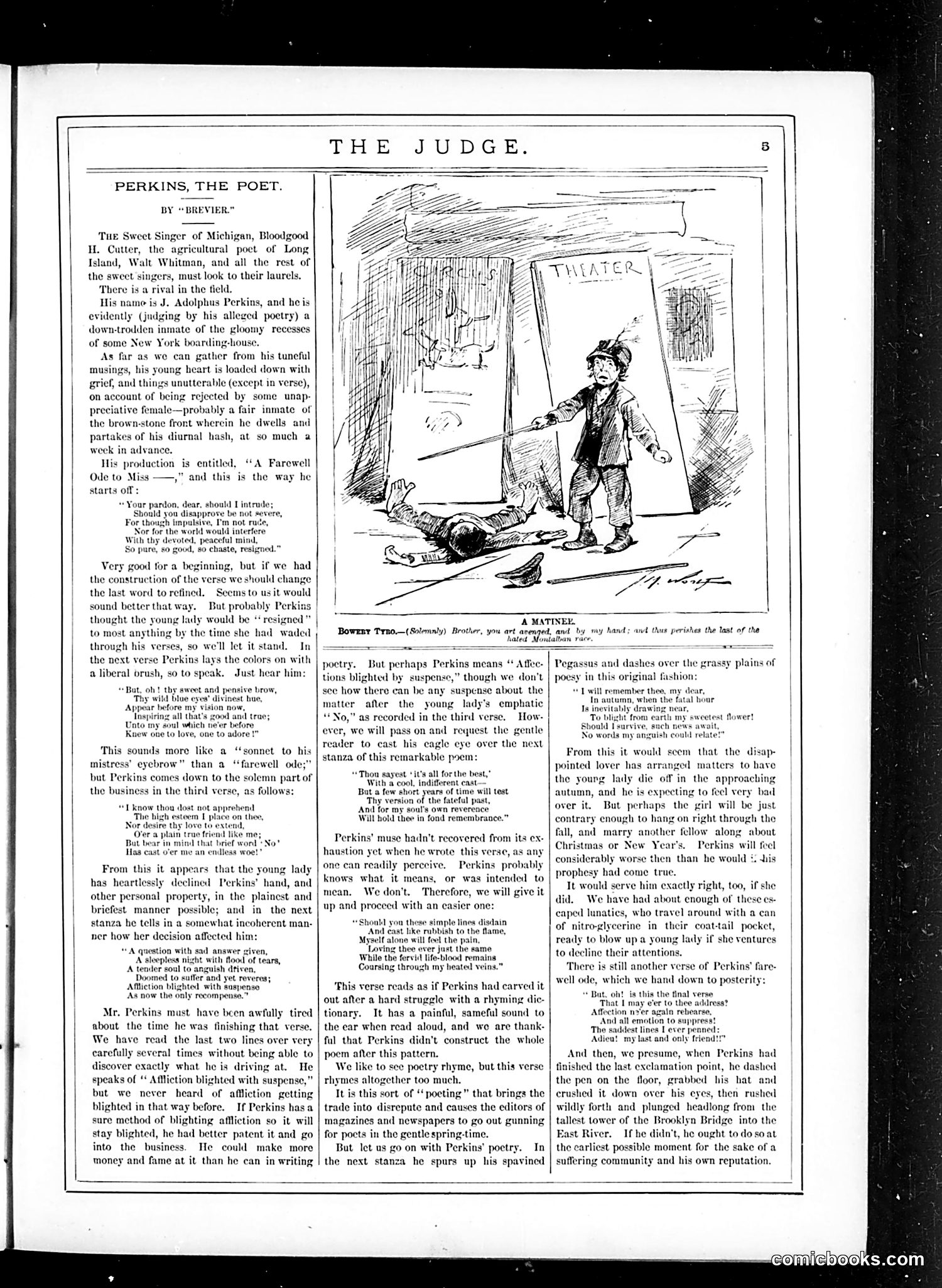
This page satirizes a talentless amateur poet named J. Adolphus Perkins, who apparently lives in a New York boarding house and has written a maudlin "Farewell Ode to Miss —" after romantic rejection. The satirist "Brevier" mocks Perkins's overwrought, poorly-constructed verses filled with melodramatic despair and confused metaphors (like "Affliction blighted with suspense"). The cartoon and accompanying text suggest Perkins represents a common type of the era: the lovesick, struggling artistic failure living in urban squalor. The satire targets both his pretensions to poetry and the broader phenomenon of untalented amateurs attempting serious literature. By comparing him unfavorably to established poets like Walt Whitman, the author emphasizes how far below professional standards Perkins falls. The secondary cartoon depicts a melodramatic theatrical scene, likely contrasting overwrought performance with Perkins's overwrought verse.
📄 Transcribed text from this page (OCR, searchable)
Machine-transcribed from the original scan — historical spelling and the odd misread are preserved.
PERKINS, THE POET. BY “BREVIER: ‘Tue Sweet Singer of Michigan, Bloodgood H. Cutter, the agricultural poct of Long Island, Walt Whitman, and all the rest of the sweet singers, must look to their laurels. ‘There is a rival in the field. His name is J. Adolphus Perkins, and he is evidently (judging by his alleged poetry) a down-trodden inmate of the gloomy recesses of some New York boarding-house. As far as we can gather from his tuneful musings, his young heart is loaded down with grief, and things unutterable (except in verse), on account of being rejected by some unap- preciative female—probably a fair inmate of the brown-stone front wherein he dwells and partakes of his diurnal hash, at so much a week in advance. His production is entitled, ‘A Farewell Oude to Miss —,” and this is the way he starts off : * Your pardon, dear, should [ intrude; Should you disapprove be not For though impulsive, I'm not n Nor for the world would interfere With thy devoted, peaceful tnind, So pure, so good, 80 chaste, resigned.” Very good for a beginning, but if we had the construction of the verse we should change the last word to refined. Seems to us it would sound better that w But probably Perki thought the young lady would be to most anything by the time she had waded through his verses, so we'll let it stand. In | the next verse Perkins lays the colors on with | a liberal orush, so to speak. Just hear him: * But, oh ! thy sweet and pensive brow, Thy wild blue eyes’ divine: Appear before 1 Inspiring all U nil trae; Knew one to love, one to ador This sounds more like a ‘sonnet to his mistress’ eyebrow" than a “farewell ode;” but Perkins comes down to the solemn part of the business in the third verse, as follows: “know thou dost not apprehend The high esteem L place on Uh Nor desire thy love to extend, Orer a plain true friend like me; But bear in mind that brief word * Has cast o'er me an enilless woe!" From this it appears that the young lady has heartlessly declined Perkins’ hand, and | other personal property, in the plainest and briefest. manner possible; and in the next stanza he tells in a somewhat incoherent man- ner how her decision affected him: A question with sad answer given, with flood of tears, guish dtive Doomed t AMliction ‘As now the only recompense Mr. Perkins must have been awfully tired about the time he was finishing that verse. We have read the last two lines over very carefully several times without being able to discover exactly what he is driving at. He speaks of “‘ Affliction blighted with suspense,” but we never heard of affliction getting blighted in that way before. If Perkins hasa sure method of blighting affliction so it will stay blighted, he had better patent it and go into the business. He could make more money and fame at it than he can in writing A MATINEE. Bowery Trno—(Solrmnly) Brother, you art avenged, ant by my hand; ant thus perishes the last of the hated Montalban race poetry. But perhaps Perkins means “ Affee- tions blighted by suspense,” though we don't see how there can be any suspense about the matter after the young lady's emphatic ‘* No,” as recorded in the third verse, How- ever, we will pass on and request the gentle reader to cast his eagle eye over the next stanza of this remarkable poem: “Thou sayest “it's all fort With a cool, indifferent cast Bat a few short years of time will test Thy version of the fateful past, And for my soul's own revere Will hotd thee in fond remembrance.” Perkins’ muse hadn't recovered from its ex- haustion yet when he wrote this verse, as any one can readily perceive. Perkins probably knows what it means, or was intended to mean. Wedon't. Therefore, we will give it up and proceed with an casier one: “Should you these simple lines disdain ‘And cast like rubbish to the flame, Myself alone will feel the pain, Loving thee ever just the same While the fervid lifeblood remains Coursing through my heated veins.” ‘This verse reads as if Perkins had carved it out after a hard struggle with a rhyming dic- tionary, It has a painful, sameful sound to the ear when read aloud, and wo are thank- ful that Perkins didn’t construct the whole poem after this pattern. We like to see poetry rhyme, but this verse rhymes altogether too much. It is this sort of “poeting” that brings the trade into disrepute and causes the editors of magazines and newspapers to go out gunning for pocts in the gentle spring-time. But let us go on with Perkins’ poetry. In the next stanza he spurs up his s Pegassus and dashes over the grassy plains of poesy’ in this original fashion: * L will remember thee, my dear, In autumn, when tal hour: Is inevitably drawing near, To blight from earth my sweetest Should Fsurvive, such news await No words my anguish could rela From this it would seem that the disap- pointed lover has arranged matters to have the young lady die off in the approaching autumn, and he is expecting to feel very bad over it. But perhaps the girl will be just contrary enough to hang on right through the fall, and marry another fellow along about Christmas or New Year's. Perkins will feel considerably worse then than he would {tis prophesy had come true. It would serve him exactly right, too, if she did. We have had about cnough of these caped lunatics, who travel around with a can of nitro-glycerine in their coat-tail pocket, ready to blow up a young lady if she ventures to decline their attentions. There is still another verse of Perkins’ fare- well ode, which we hand down to posterity: * But. oh! is this the final verse That I may eer to thee address? Affection nv‘er agaln rebe: And all emotion to suppr The saddest lines I ever penne Adieu! my last and only friend!!” And then, we presume, when Perkins had finished the last exclamation point, he dashed the pen on the floor, grabbed his hat and crushed it down over his eyes, then rushed wildly forth and plunged headlong from the tallest tower of the Brooklyn Bridge into the East River. If he didn’t, he ought to dosoat the carliest possible moment for the sake of a suffering community and his own reputation.