
Judge, 1881-12-17 · page 3 of 16
Judge — December 17, 1881 — page 3: what you’re looking at
What you’re looking at
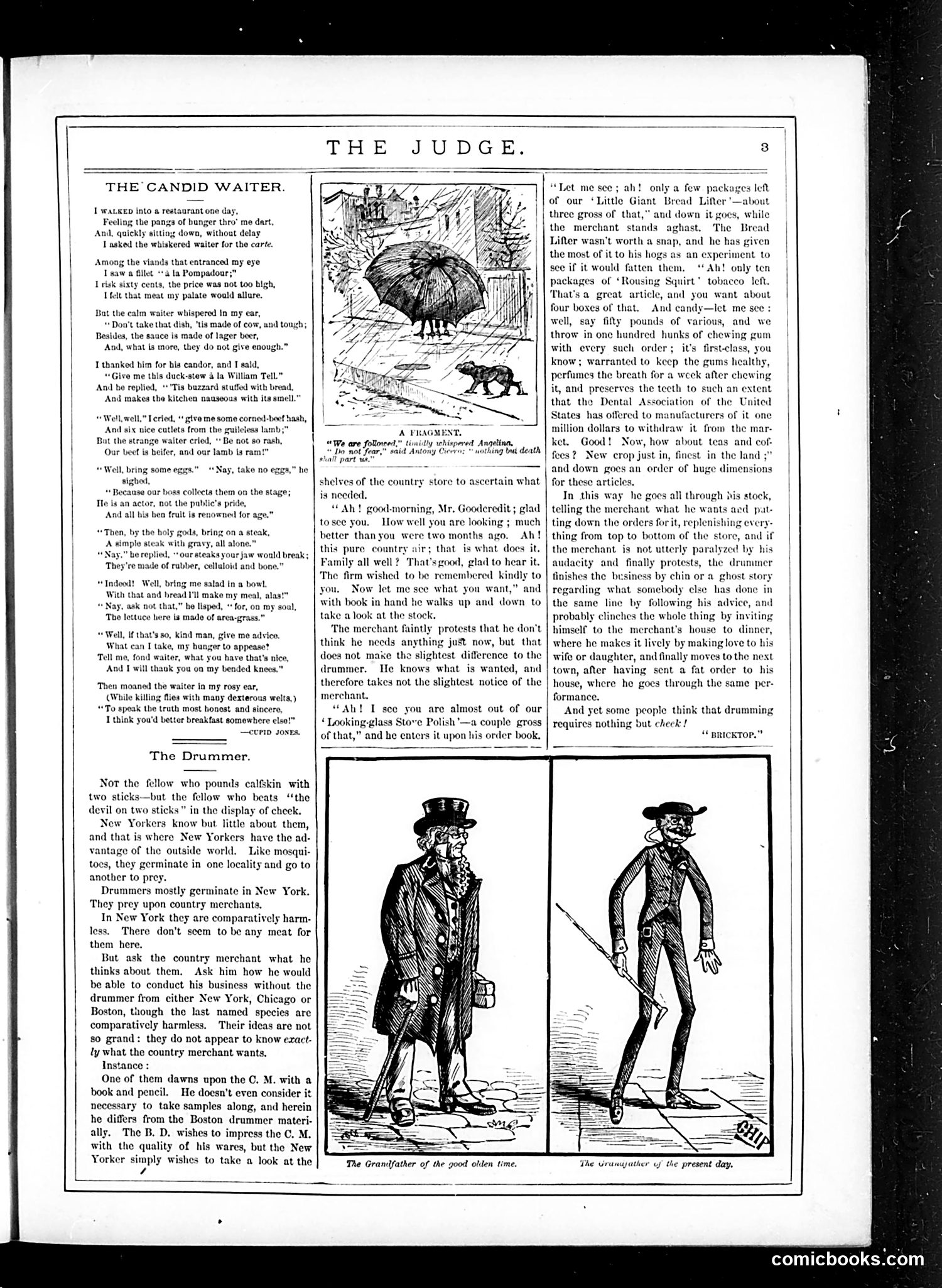
**"The Candid Waiter"** mocks deceptive restaurant practices. A diner asks a waiter for recommendations, but the waiter candidly reveals that every dish is fraudulent: the "fillet" contains cow offal, the duck-stew is buzzard, steaks are rubber and bone, lettuce is seaweed. The joke satirizes restaurants that serve inferior or adulterated food while charging premium prices—a common complaint in urban dining during this era. The waiter's honesty is unusual; normally such deceptions remain hidden. **"The Drummer"** (meaning a traveling salesman) criticizes aggressive sales tactics used by New York drummers preying on country merchants. Unlike Boston drummers who bring samples to demonstrate quality, the New Yorker simply inspects the merchant's stock and pressures him to order. The satire targets manipulative sales methods and the exploitation of rural shopkeepers by city-based salesmen who use flattery and presumption rather than genuine product knowledge. Both pieces reflect Gilded Age anxieties about urban commerce and dishonest business practices.
📄 Transcribed text from this page (OCR, searchable)
Machine-transcribed from the original scan — historical spelling and the odd misread are preserved.
THE CANDID WAITER. I watKeD into a restaurant one day, Feeling the pangs of hunger thro’ me dart, And, quickly sitting down, without delay Tasked the whiskered waiter for the carte. Among the viands that entranced my eye Tsaw a fillet ‘a la Pompadour;” I risk sixty cents, the price was not too bigh, Hfelt that meat my palate would allure. Bat the calm waiter whispered In my ear, “Don’t take that dish, ‘tis made of cow, and tou; Besides, the sauce is made of lager beer, And, what is more, they do not give enovgh.” T thanked him for bia candor, and T said, “Give me this duck-stew & la William Tell.” And bo replied, “Tis buzzard stuffed with bread. And makes tha kitchea nauseous with its s well,” Teried, “ give me some cornod-bwet hash, And six nice cutlets from the guileless lamb ; Bat the strange waiter cried, * Be not 80 rash, Our beet is beifer, and our lamb is ram!” “Nay, take no eggs,” he + Because our boss colleeta them on the stage; He is an actor, not the public's pride, And all his bea frult is renowned for age.” “Then, by the holy gods, bring on a steak, A aimplo ste all alone.” Nay.” be replied, “our steaks your jaw would break; They're made of rubber, celluloid and bone.” “Indoo! Well, bring me salad in a bowl, With that and bread I'll make my meal, alas!” “Nay, ask not that,” he lisped, “for, on my soal, Tho lettuce here is made of area-grass.” “Well, if that’s so, kind man, give me advice. What can I take, my bunger to appease? Tell me, fond waiter, what you have that's nice, And I will thauk you on my bended knees.” ‘Then moaned the waiter In my rosy ear, (While killing Mies with many dexterous welts,) “To speak the truth most honest and sincero, I think you'd better breakfast somewhere elso!” CUPID JONES. The Drummer. Nor the fellow who pounds calfskin with two sticks—but the fellow who beats “the devil on two sticks” in the display of cheek. New Yorkers know but little about them, and that is where New Yorkers have the ad- vantage of the outside world. Like mosqui- toes, they germinate in one locality and go to another to prey. Drummers mostly germinate in New York. ‘They prey upon country merchant: In New York they are comparatively harm- less. ‘There don’t scem to be any meat for them here. But ask the country merchant what he thinks about them. Ask him how he would be able to conduct his business without the drummer from either New York, Chicago or Boston, though the last named species are comparatively harmless, Their ideas are not so grand: they do not appear to know exact. ty what the country merchant wants, Instance : One of them dawns upon the ©. M. with a book and pencil. He doesn’t even consider it necessary to take samples along, and herein he differs from the Boston drummer materi- ally. The B. D. wishes to impress the C. M. with the quality of his wares, but the New Yorker simply wishes to take a look at the 4 “We are followed.” tiniilly whispered Angelina, we ae Pea ad anton Creeere = nothing oat death i part vis shelves of the country store to ascertain what is needed. “ Sh! good-morning, Mr. Gooderedit ; glad tosce you. How well you are looking ; much better than you were two months ago. Ah! this pure country air; that is what does it. Family all well? That's good, glad to hear it. The firm wished to be nembered kindly to you. Now let me sce what you want,” and with book in hand he walks up and down to. take a look at the stock, ‘The merchant faintly protests that he don’t think he needs anything just now, but that does not maxe the slightest difference to the drummer. He knows what is wanted, and therefore takes not the slightest notice of the merchant, “Ah! L sce you are almost out of our “Looking-glass Stove Polish '—a couple gross of that,” and he enters it upon his order book. Let me sce ; ah! only a few packages left of our ‘Little Giant Bread Lifter ’—about three gross of that,” and down it goes, while the merchant stands a, t. The Bread Lifter wasn’t worth a snap, and he has given the most of it to his hogs as an experiment to see if it would fatten them. ‘Ab! only ten packages of ‘Rousing Squirt’ tobacco left. ‘That's a great article, and you want about four boxes of that. And candy—let me see : well, say fifty pounds of various, and we throw in one hundred hunks of chewing gum with every such order; it's first-class, you know; warranted to keep the gums healthy, perfumes the breath for a week after chewing it, and preserves the tecth to such an extent that the Dental Association of the United States has offered to manufacturers of it one million dollars to withdraw it from the mar- ket. Good! Now, how about teas and cof. fees? New crop just in, finest in the land ;” and down goes an order of huge dimensions for these artic In this way he goes all through his stock, telling the merchant what he wants avd pat- ting down the orders for it, replenishing eve thing from top to bottom of the store, and if the merchant is not utterly paralyzed by his audacity and finally protests, the drummer finishes the business by chin or a ghost story regarding what somebody clse has done in the same line by following his advice, and probably clinches the whole thing by inviting himself to the merchant's house to dinner, where he makes it lively by making love to his wife or daughter, and finally moves to the next town, after having sent a fat order to hi house, where he goes through the same per- formance. ‘And yet some people think that drumming requires nothing but cheek / “ BRICKTOP.” The Grandfather of the good olden time. The Uranaather of the present day. comicbooks.com