
Judge, 1881-12-17 · page 6 of 16
Judge — December 17, 1881 — page 6: what you’re looking at
What you’re looking at
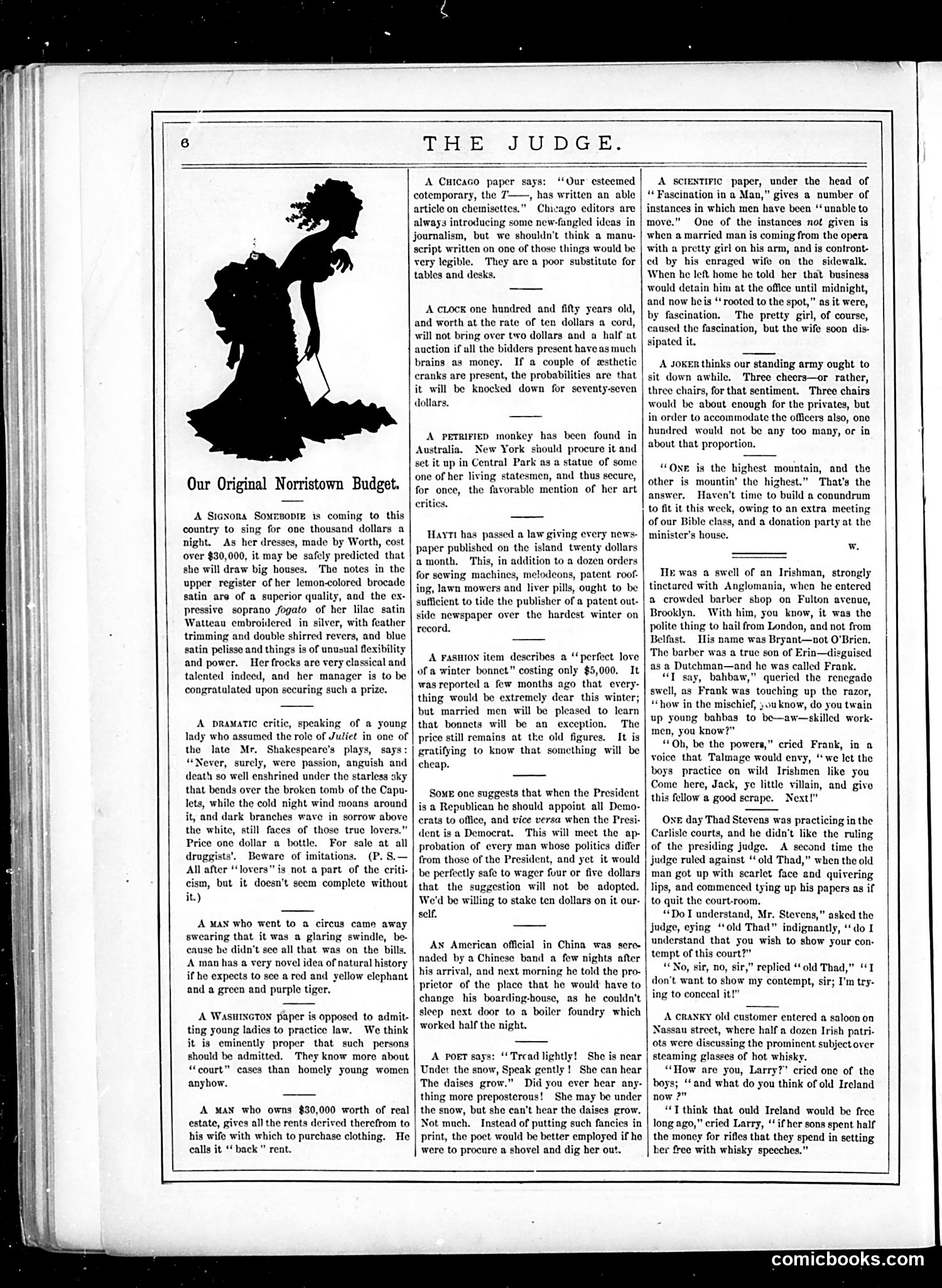
This page collects humorous social commentary typical of Judge's satirical "budget" columns. The content mocks various contemporary absurdities: **The silhouette cartoon** (top left) depicts a fashionably-dressed woman—likely satirizing the extravagant spending on haute couture, referenced in the opening item about an opera singer whose Worth gowns cost $30,000 while earning $1,000 nightly. **Key targets:** - **Fashion excess**: Mocking wealthy women's lavish spending on designer clothing - **Theatrical pretension**: Parodying overwrought dramatic criticism - **Journalism confusion**: Chicago editors introducing nonsensical writing surfaces ("chemisettes") - **Political appointments**: Suggesting alternating party control of government offices regardless of merit - **Economic absurdity**: A man donating all rental income to his wife's clothing purchases The satire attacks Gilded Age consumerism, artistic pomposity, and political patronage—arguing these represent society's misplaced values and poor judgment.
📄 Transcribed text from this page (OCR, searchable)
Machine-transcribed from the original scan — historical spelling and the odd misread are preserved.
| | | THE JUDGE. Our Original Norristown Budget. A Sicyona Somrsopre is coming to this country to sing for one thousand dollars a night. As her dresses, made by Worth, cost over $30,000, it may be safely predicted that she will draw big houses. The notes in the upper register of her lemon-colored brocade satin are of a superior quality, and the ex- pressive soprano fogato of her lilac satin Watteau embroidered in silver, with feather trimming and double shirred revers, and blue satin pelisse and things is of unusual flexibili and power. Her frocks are very classical and talented indeed, and her manager is to be congratulated upon securing such a prize. A pramatic critic, speaking of a young lady who assumed the role of Juliet in one of the late Mr. Shakespeare's plays, says: “Never, surely, were passion, anguish and death so well enshrined under the starless sky that bends over the broken tomb of the Capu- lets, while the cold night wind moans around it, and dark branches wave in sorrow above the white, still faces of those true lovers.” Price one dollar a bottle. For sale at all druggists’. Beware of imitations. (P. S.— All after ‘‘lovers” is not a part of the criti- cism, but it doesn't seem complete without it.) A MAN who went to a circus came away swearing that it was a glaring swindle, be- cause he didn’t see all that was on the bills, ‘A man has a very novel idea of natural history if he expects to sce a red and yellow elephant and a green and purple tiger. A WASHINGTON paper is opposed to admit- ting young ladies to practice law. We think it is eminently proper that such persons should be admitted. They know more about “court” cases than homely young women anyhow. A MAN who owns $30,000 worth of real estate, gives all the rents derived therefrom to his wife with which to purchase clothing. He ‘A Cutcaco paper says: “Our esteemed cotemporary, the 7- has written an able article on chemisettes.” Chicago editors are always introducing some new-fangled idcas in journalism, but we shouldn't think a manu- script written on one of those things would be very legible. They are a poor substitute for tables and desks. ACLOCK one hundred and fifty years old, and worth at the rate of ten dollars a cord, will not bring over two dollars and a half at auction if all the bidders present have as much brains as money. If a couple of esthetic cranks are present, the probabilities are that it will be knocked down for seventy-seven dollars. A PETRIFIED monkey has been found in Australia. New York should procure it and set it up in Central Park as a statue of some ‘one of her living statesmen, and thus secure, for once, the favorable mention of her art critics. Haytt has passed a law giving every news- paper published on the island twenty dollars amonth. This, in addition to a dozen orders for sewing machincs, melodeons, patent roof- ing, lawn mowers and liver pills, ought to be sufficient to tide the publisher of a patent out- side newspaper over the hardest winter on record, A FASHION item describes a “perfect love of a winter bonnet” costing only $5,000. It was reported a few months ago that every- thing would be extremely dear this winter; but married men will be pleased to learn that bonnets will be an exception. The price still remains at tke old figures. It is gratifying to know that something will be cheap. Some one suggests that when the President is a Republican he should appoint all Demo- crats to office, and vice versa when the Presi- dent isa Democrat. This will meet the ap- probation of every man whose politics differ from those of the President, and yet it would be perfectly safe to wager fuur or five dollars that the suggestion will not be adopted. We'd be willing to stake ten dollars on it our- self. Aw American official in China was sere. naded by a Chinese band a few nights after his arrival, and next morning he told the pro- prictor of the place that he would have to change his boarding-house, as he couldn't sleep next door to a boiler foundry which worked half the night. A port says: “Tread lightly! She is near Under the snow, Speak gently ! She can hear The daises grow.” Did you ever hear any- thing more preposterous! She may be under the snow, but she can’t hear the daises grow. Not much. Instead of putting such fancies in print, the poet would be better employed if he calls it ‘‘ back” rent. were to procure a shovel and dig her out. A SCIENTIFIC paper, under the head of “ Fascination in a Man,” gives a number of instances in which men have been ‘unable to move.” One of the instances not given is when a married man is coming from the opera with a pretty girl on his arm, and is contront- ed by his enraged wife on the sidewalk. When he left home he told her that business would detain him at the office until midnight, and now heis ‘‘ rooted to the spot,” as it were, by fascination, The pretty girl, of course, caused the fascination, but the wife soon dis- sipated it. A JOKER thinks our standing army ought to sit down awhile. Three cheers—or rather, three chairs, for that sentiment. Three chairs would be about enough for the privates, but in order to accommodate the officers also, one hundred would not be any too many, or in about that proportion. “One is the highest mountain, and the other is mountin’ the highest.” That's the answer. Haven't time to build a conundrum to fit it this weck, owing to an extra meeting of our Bible class, and a donation party at the minister’s house. w. He was a swell of an Irishman, strongly tinctared with Anglomania, when he entered a crowded barber shop on Fulton avenue, Brooklyn, With him, you know, it was the polite thing to hail from London, and not from Belfast. His name was Bryant—not O'Brien. The barber was a true son of Erin—disguised as a Dutchman—and he was called Frank. “I say, bahbaw,” queried the renegade swell, as Frank was touching up the razor, ‘how in the mischief, )ouknow, do you twain up young bahbas to be—aw—skilled work- men, you know?” “Oh, be the powers,” cried Frank, in a voice that Talmage would envy, “we let the boys practice on wild Irishmen like you Come here, Jack, ye little villain, and give this fellow a good scrape. Next!” Ove day Thad Stevens was practicing in the Carlisle courts, and he didn’t like the ruling of the presiding judge. A second time the judge ruled against “ old Thad,” when the old man got up with scarlet face and quivering lips, and commenced tying up his papers as if to quit the court-room. “Do IT understand, Mr. Stevens,” asked the Judge, eying ‘old Thad” indignantly, “do I understand that you wish to show your con- tempt of this court?” “No, sir, no, sir,” replied “old Thad,” 1 don’t want to show my contempt, sir; I'm try- ing to conceal it!” A cranky old customer entered a saloon on Nassau street, where half a dozen Irish patri- ots were discussing the prominent subject over steaming glasses of hot whisky “How are you, Larry?” cricd one of the boys; ‘and what do you think of old Ireland now ? “T think that ould Ireland would be free long ago,” cried Larry, “if her sons spent half the money for rifles that they spend in setting her free with whisky speeches.” comicbooks.com