
A complete issue · 16 pages · 1881
Judge — December 10, 1881
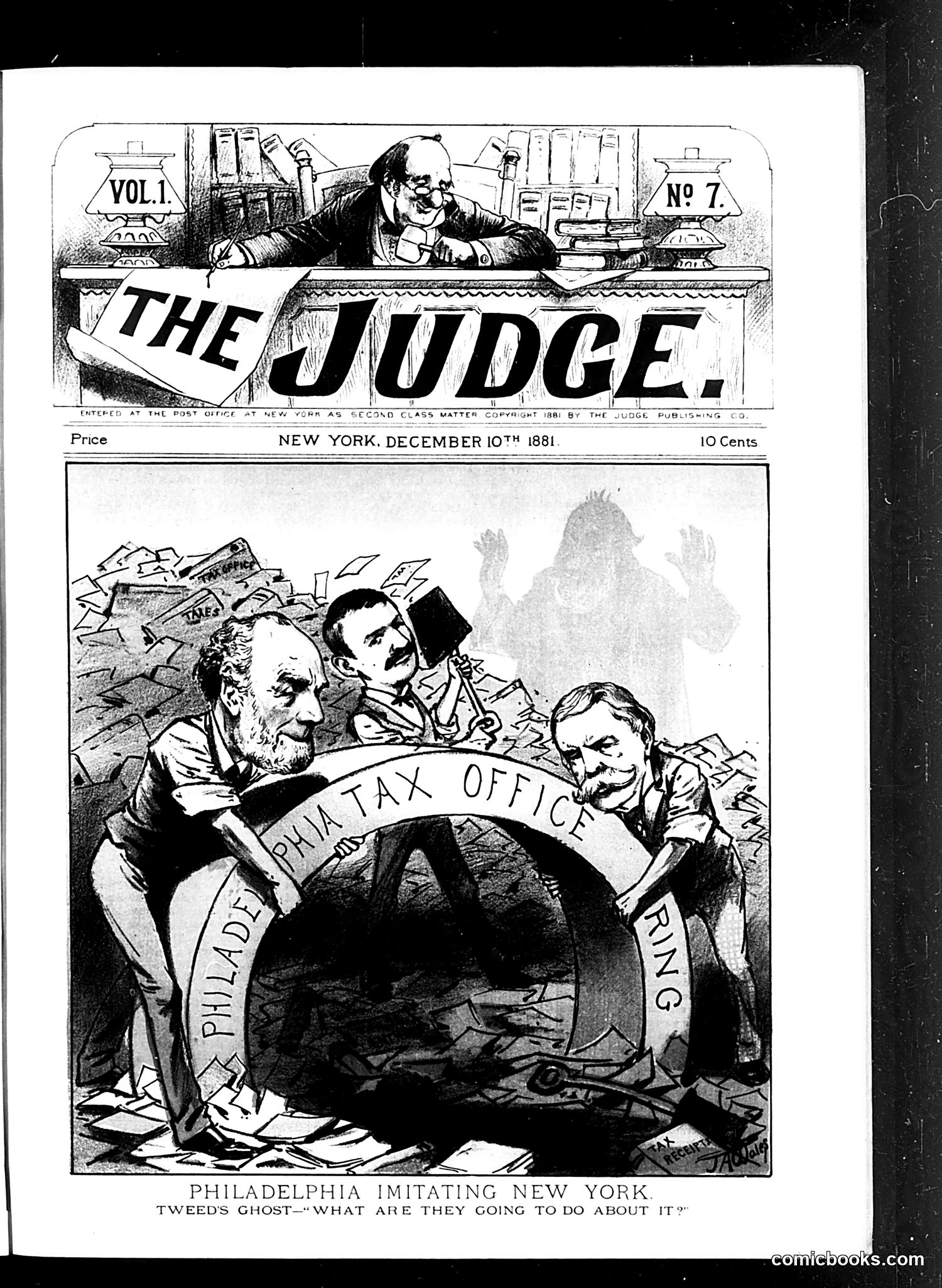
This cartoon satirizes Philadelphia's tax office corruption by comparing it to New York's notorious "Boss" Tweed scandal of the 1870s. The image depicts three Philadelphia officials emerging from a "Philadelphia Tax Office" barrel, visibly stuffed with money and documents—mimicking the massive theft Tweed orchestrated in New York. The caption references "Tweed's Ghost," suggesting Philadelphia politicians are copying Tweed's corrupt methods. The ghost figure looming above emphasizes the dark historical parallel. The satire's bite lies in its rhetorical question: "What are they going to do about it?"—implying authorities are powerless to stop such brazen official corruption. Judge magazine used this to shame Philadelphia for replicating New York's shameful recent past.
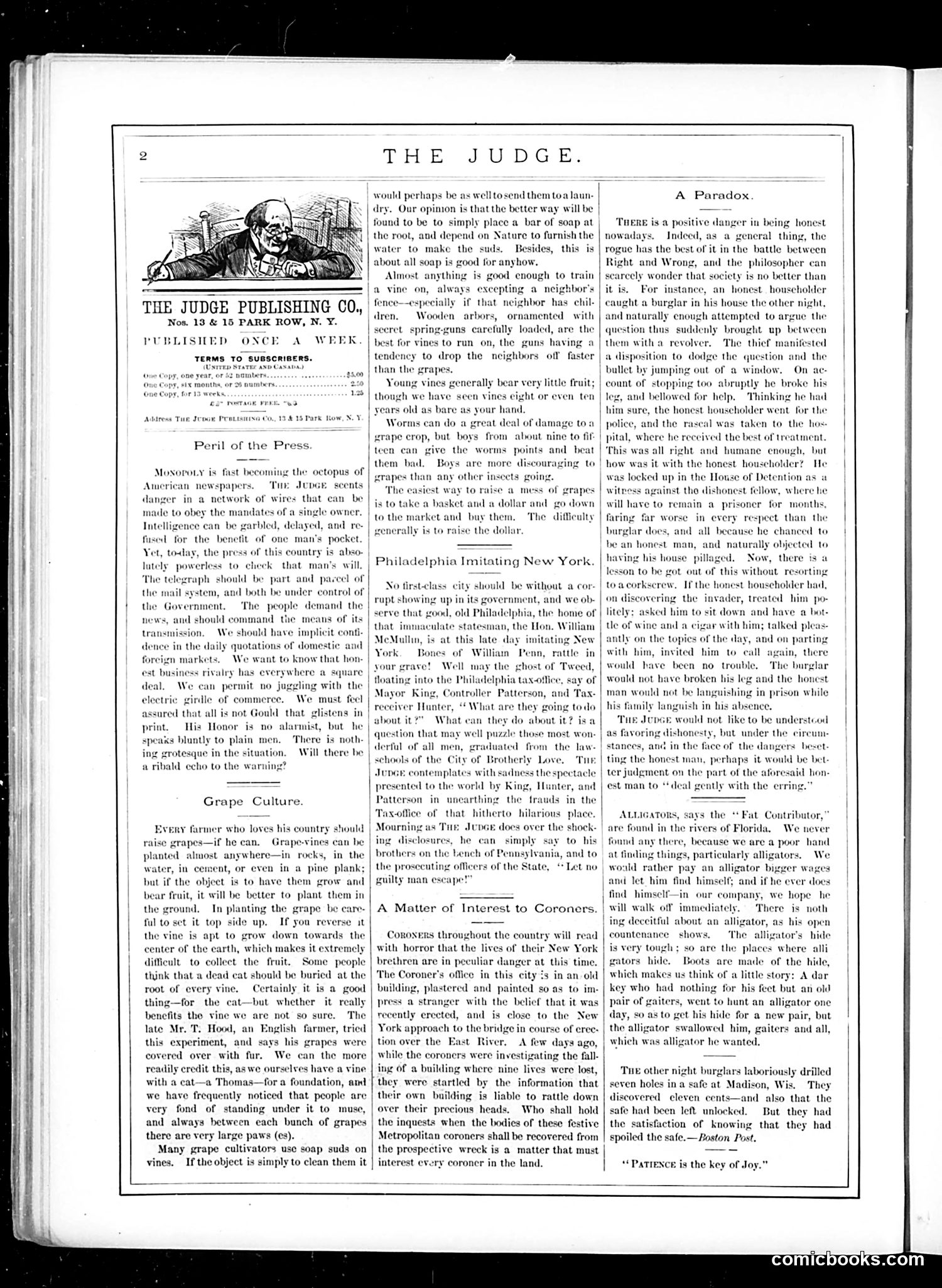
This page from Judge magazine contains three distinct sections: **"Peril of the Press"** critiques monopolistic control of American newspapers and telegraph systems. The text warns that a single wealthy owner (likely referring to figures like Jay Gould, who controlled major telegraph networks) could manipulate news distribution for personal profit. The satire argues for government regulation to prevent information suppression and ensure public access to reliable news. **"Grape Culture"** is humorous agricultural advice with absurdist social commentary. It mocks incompetent farmers while making dark jokes—warning that planting grapevines upside-down causes them to grow toward earth's center, and that spring-guns on arbors effectively remove troublesome neighbors' children faster than grapes grow. **"A Paradox"** (right column) discusses an honest householder caught burglarizing his own home, satirizing the tension between legal definitions and moral circumstances. The cartoons are typical Judge fare: satirizing monopoly power, agricultural foolishness, and legal/social absurdities through exaggeration and dark humor.
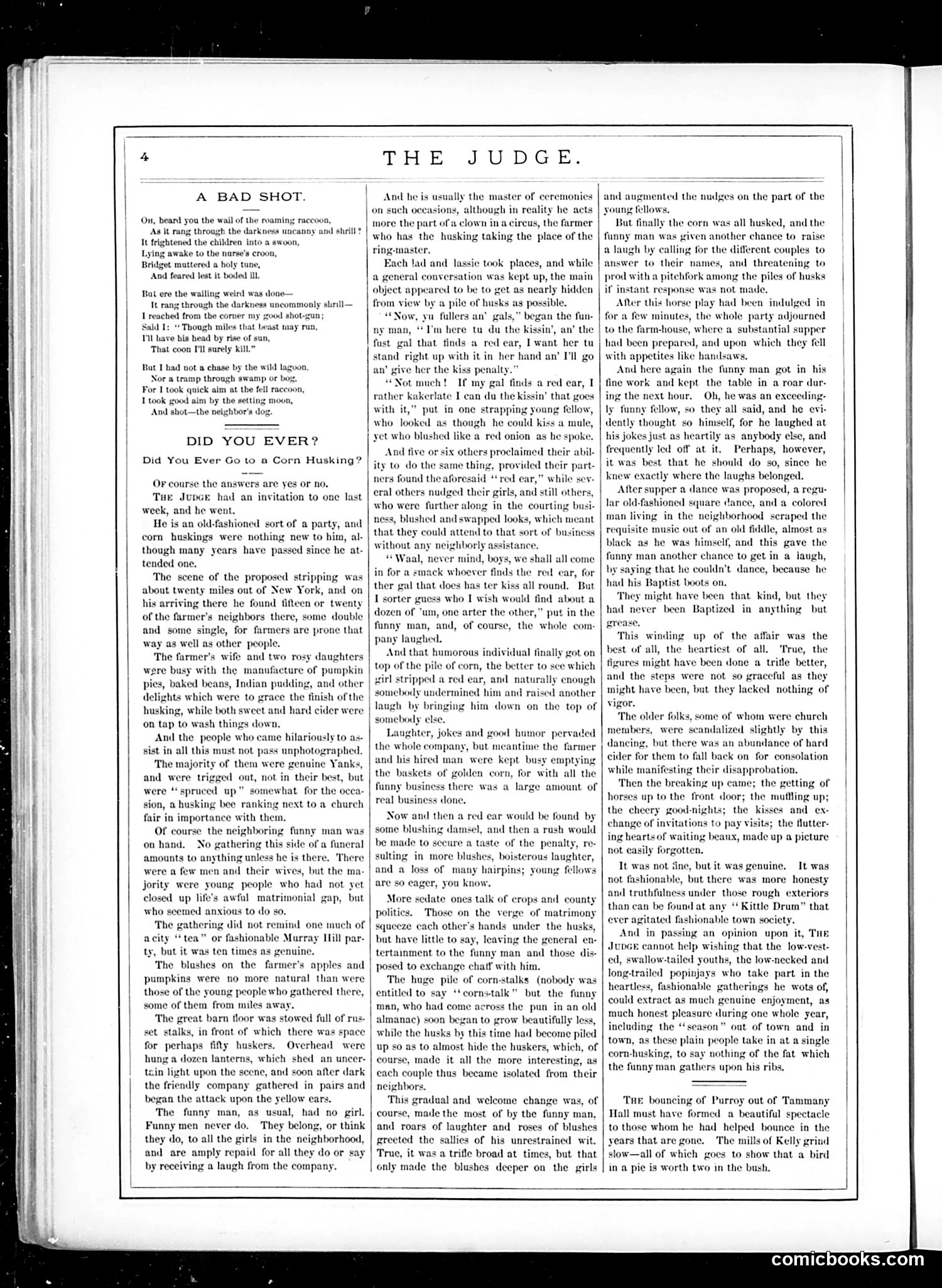
This page contains two humorous pieces from *Judge* magazine: **"A Bad Shot"** is a rural comedy poem about a farmer who attempts to shoot a troublesome raccoon at night but accidentally shoots his neighbor's dog instead—a classic case of mistaken identity humor playing on the risks of nighttime farm life. **"Did You Ever? Did You Ever Go to a Corn Husking?"** is a longer satirical piece describing a traditional 19th-century rural gathering. The humor centers on the "funny man"—an archetypal character who serves as master of ceremonies at such events, claiming kissing rights when girls find red ears of corn. The satire gently mocks rural customs, young courting behavior, and the self-important buffoon figure who inserts himself into social situations. The piece contrasts genuine rural authenticity with affected city pretensions, poking fun at both while celebrating old-fashioned country traditions. Both pieces exemplify *Judge*'s focus on Americana and rural life as subjects for gentle, affectionate satire.
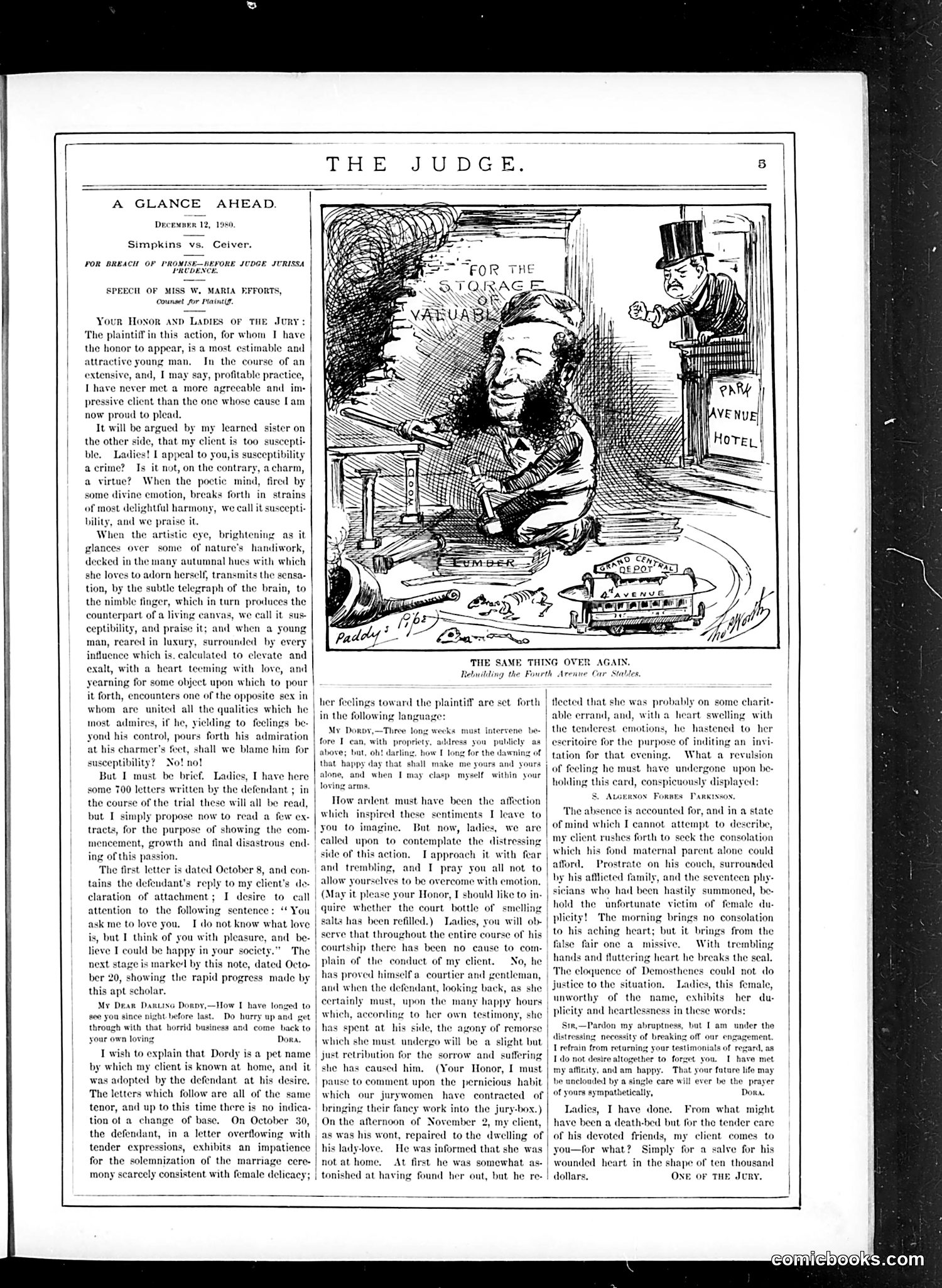
This page satirizes a breach-of-promise lawsuit titled "Simpkins vs. Geiver." The main cartoon depicts a man storing "valuables" in a hotel safe—a visual pun on the legal case about broken marriage promises. The accompanying text is counsel Maria Efforts's opening speech for the plaintiff (the jilted party). The satire mocks overly sentimental legal arguments: Efforts defends her client's "susceptibility" as a virtue rather than weakness, using flowery language about poetic minds and artistic souls. She claims 700 letters from the defendant prove his affection, then reads excerpts showing his growing eagerness to marry. The humor lies in the **exaggerated sentimentality** of Victorian courtship language and the absurdity of using emotional letters as legal evidence in breach-of-promise cases—a real legal category in 1880 America. The cartoon implies that romantic promises, like valuables, need protection from those who exploit them.
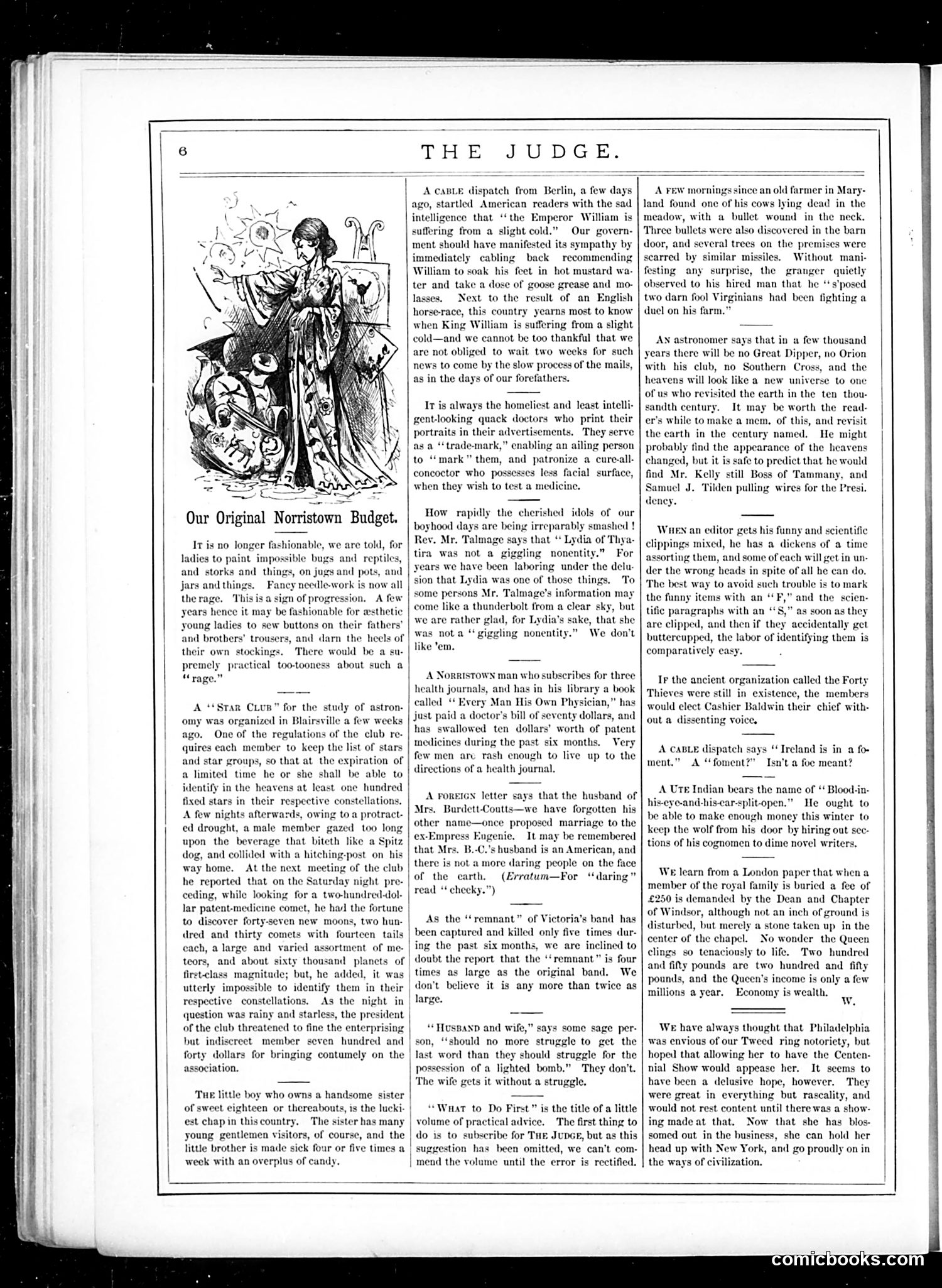
This satirical page from *Judge* magazine contains several short humor pieces mocking contemporary absurdities: **"Our Original Norristown Budget"** ridicules aesthetic fashion trends among young ladies—painting impossible creatures on pottery and needlework—while sarcastically suggesting that practical skills like sewing buttons might become fashionable. **The "Star Club" anecdote** satirizes both amateur astronomy clubs and drunk behavior. A male member, intoxicated after "the beverage that biteth like a Spitz dog," claims to have discovered dozens of new celestial bodies on a starless night, exposing his obvious inebriation through the absurd claim. **The main editorial column** mocks German Emperor William I's minor cold receiving transatlantic cable coverage, suggesting Americans are overly invested in foreign royalty. It also ridicules quack doctors who advertise with their own unflattering portraits as "trade-marks," and pokes fun at Rev. Talmage's biblical revisionism about Lydia of Thyatira. The humor relies on absurdist logic and gentle social criticism typical of 1880s American satirical magazines.
This page satirizes American charity organizations and their hypocrisy toward the poor. **"The Honest Tarrier"** is an Irish-dialect poem mocking Irish immigrants who arrive poor but adopt American materialism and voting patterns, abandoning their humble origins. **"Our Popular Farces"** presents two scenes exposing relief society fraud. In both, a starving widow seeks help from reverends (Reverend Hallelujah and Reverend Creamcheese) at relief organizations. Both clergymen refuse aid, claiming bureaucratic obstacles: excessive administrative costs, salary structures, or insufficient remaining funds after overhead. The cruel irony peaks when they offer religious tracts instead of food. The satire targets how charitable organizations—particularly Methodist and Evangelical societies—consumed donations through bloated administration rather than helping the destitute. The reverends' sanctimonious excuses ("sins of the fathers") while refusing actual assistance expose the gap between Christian charity's claims and actual practice. This reflects 1860s-era criticism of organized charity's inefficiency and moral bankruptcy.
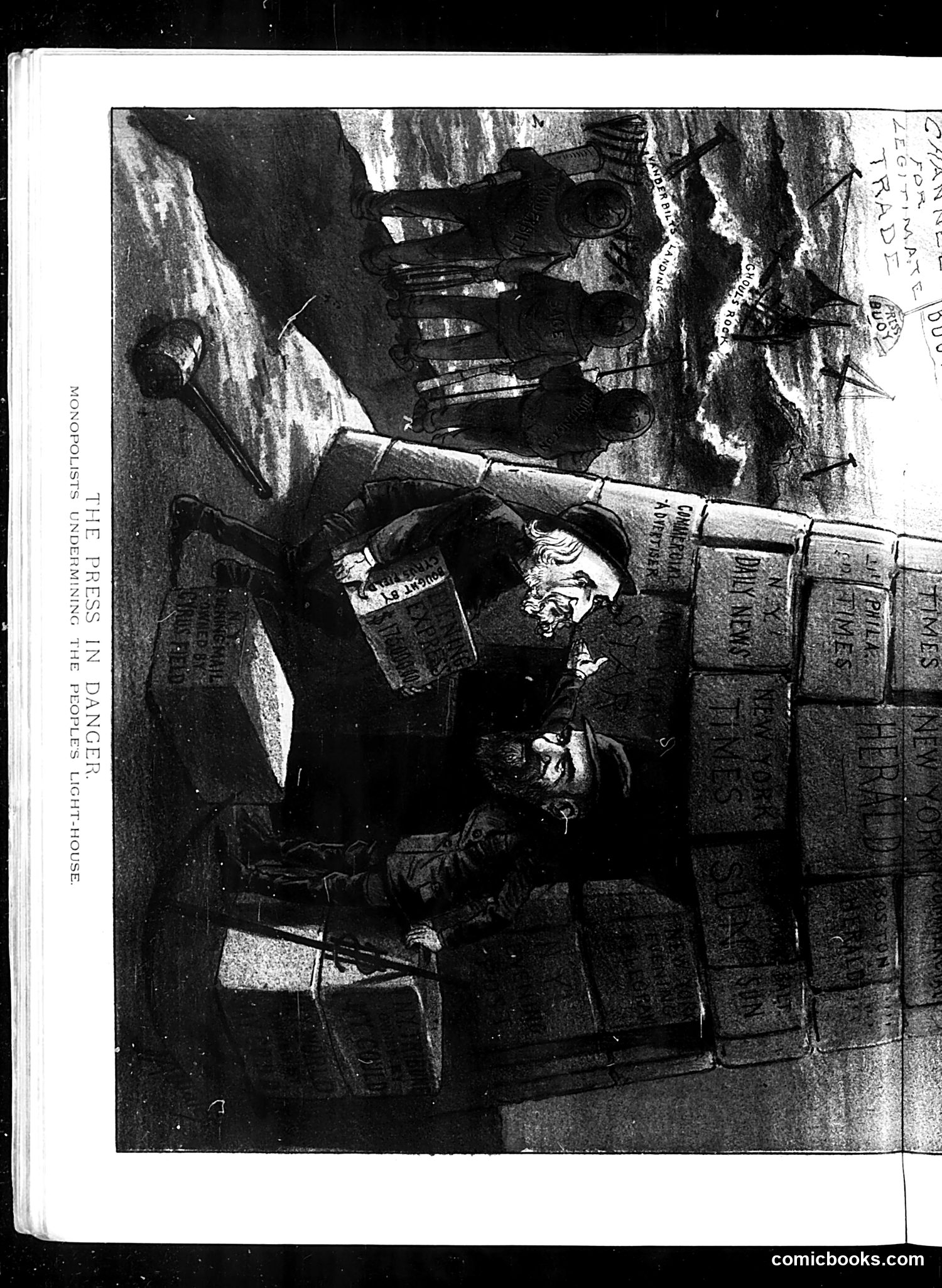
This page appears to show a satirical illustration titled "The Press in Danger: Uncorking the People's Lighthouse" (text visible on left margin, rotated). The image depicts what seems to be a printing press or printing operation with several figures. There are stacked boxes or crates labeled with text (partially legible in the image). A tall cylindrical object dominates the composition—likely representing a lighthouse or beacon metaphorically. The satire appears to critique journalism or press freedom, with the "lighthouse" metaphor suggesting the press as a guiding light for the public. The "uncorking" language suggests releasing or freeing something previously contained. However, without clearer text visibility and specific historical dating, I cannot definitively identify which political moment or figures this references. The satirical intent criticizes press suppression or constraints on journalism.
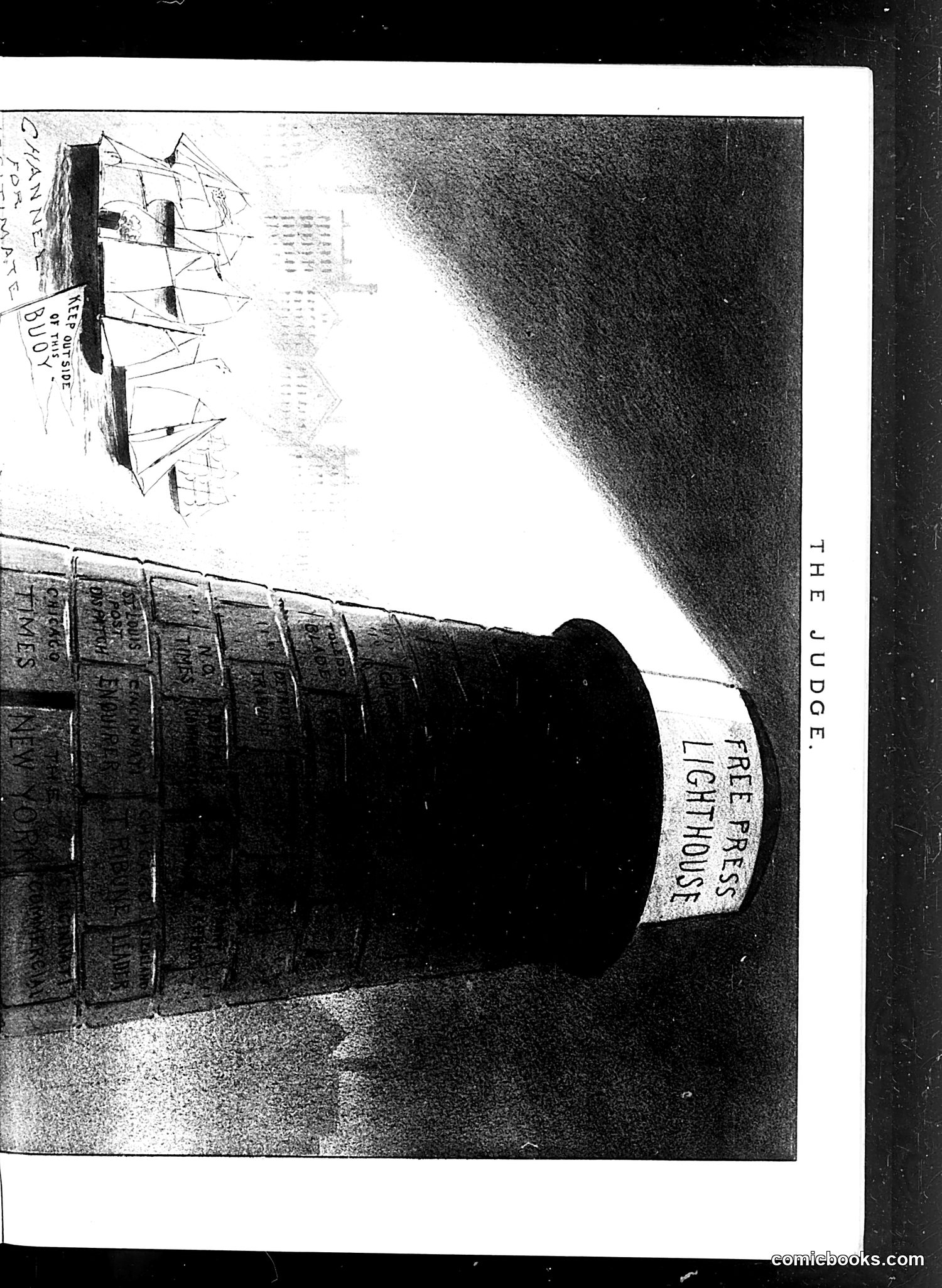
This page from *Judge* magazine shows a lighthouse labeled "FREE PRESS LIGHTHOUSE" positioned prominently in the center. The image appears to be a political cartoon emphasizing the importance of a free press as a guiding force—a common metaphor in American political discourse. The lighthouse symbolism suggests the press serves as a beacon of truth and guidance for society, likely critiquing threats to press freedom during the period this was published. In the upper left corner, there's a sketched ship, reinforcing the nautical metaphor of the press guiding the nation through turbulent waters. Without a visible date, the exact historical context remains unclear, but this reflects broader early-to-mid 20th-century concerns about maintaining editorial independence against government or corporate interference.
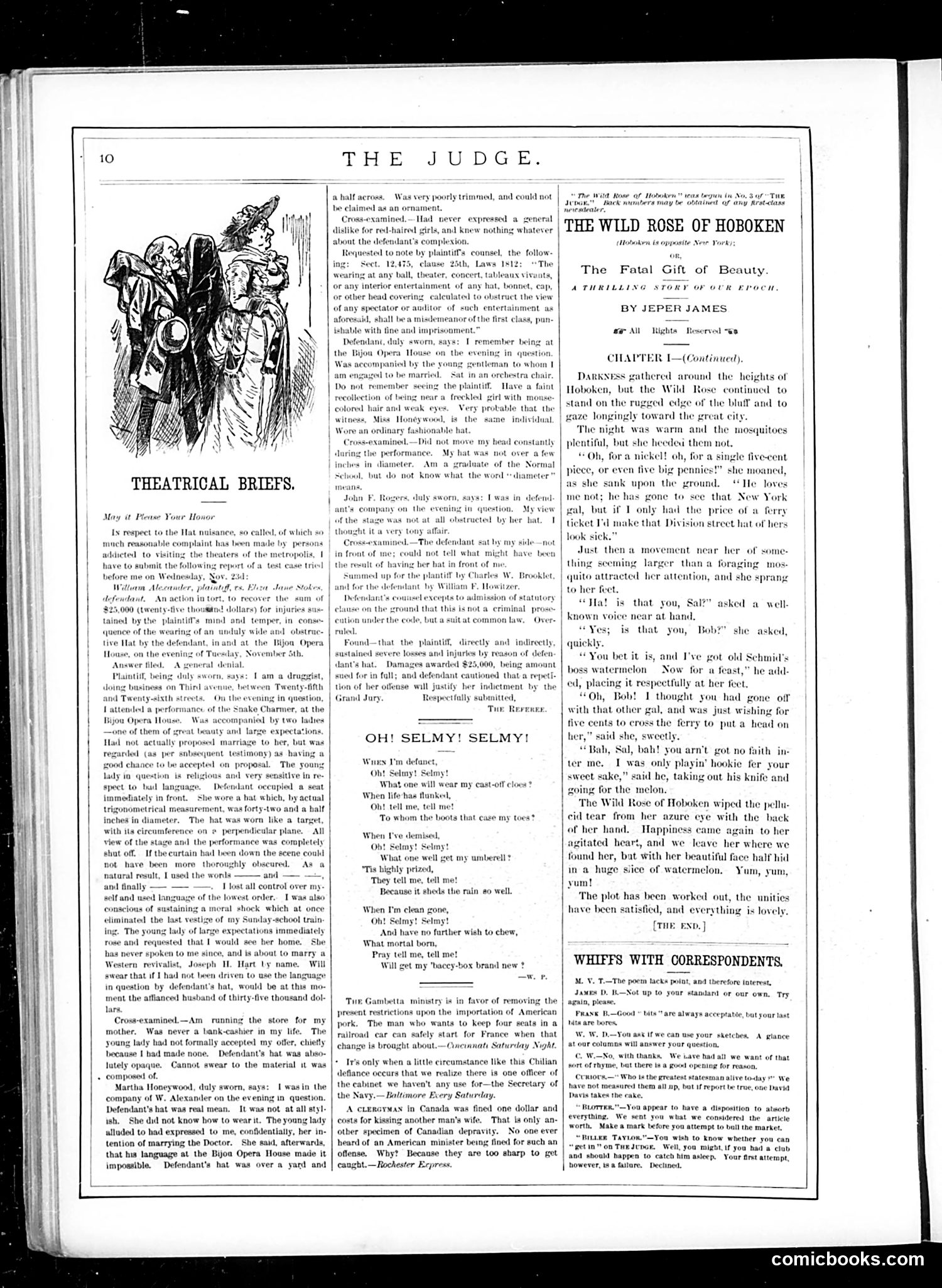
This is a humorous mock legal brief satirizing frivolous lawsuits. The "case" involves a plaintiff suing a woman for $25,000 because her oversized hat (depicted in the cartoon as enormous and ridiculous) obstructed his view at the Bijou Opera House, allegedly causing him to lose his temper and use profanity that scared away a young lady he was courting. The satire ridicules both: 1. **Absurd litigation** - suing over an obstructed theater view 2. **The fashion of the era** - women's large, decorative hats worn to social events 3. **Pompous legal language** - the formal testimony contradicts itself (he claimed he didn't know the young lady, but was hoping to marry her) The cartoon shows fashionably-dressed theatergoers with exaggerated hat sizes. This was a genuine social complaint of the period—large hats were genuinely disruptive at theaters—but Judge mocks the notion of actual legal remedies, poking fun at both excessive litigation and women's fashion excess.
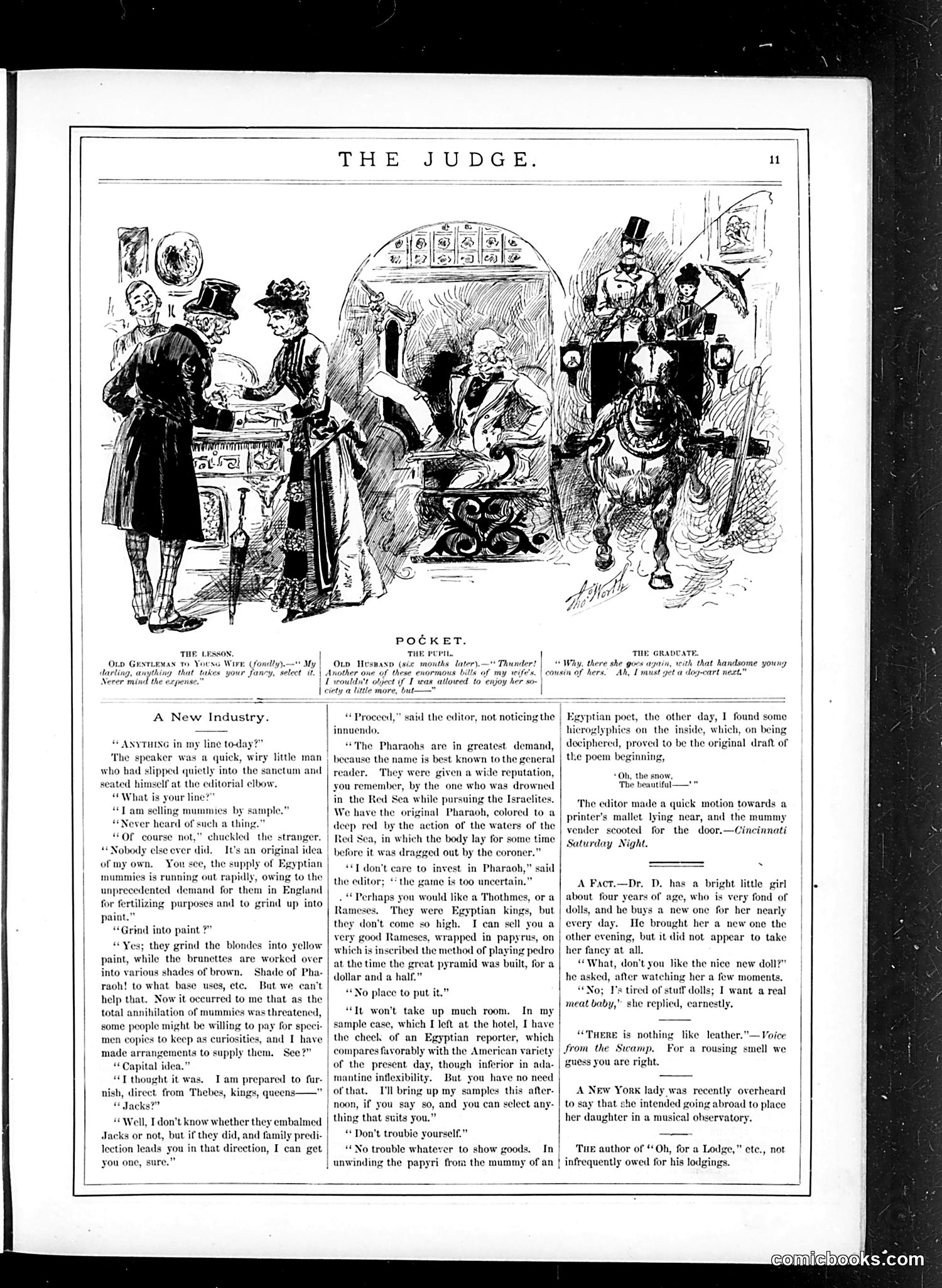
This page contains **three separate satirical pieces**: ## "A New Industry" (Main Cartoon) A con artist pitches selling **Egyptian mummies** to a magazine editor. The joke exploits contemporary absurdities: mummies were genuinely being ground into fertilizer and paint pigments in Victorian England—a real industrial practice. The salesman's pitch (offering famous pharaohs, even "the original Pharaoh" dyed red from the Red Sea) is obviously ridiculous, yet the editor almost bites before stopping him. The satire mocks both the gullible buyer and the absurd real-world practice of desecrating ancient bodies for profit. ## Smaller Cartoons **"The Lesson"** and **"The Graduate"** appear to be domestic humor pieces about marriage and childhood—unrelated to the main story. ## Context This likely dates to the 1880s-90s when mummy-grinding was an actual industrial phenomenon. Judge's satire works by taking a real practice to its logical absurd extreme, exposing Victorian society's casual commodification of ancient remains.
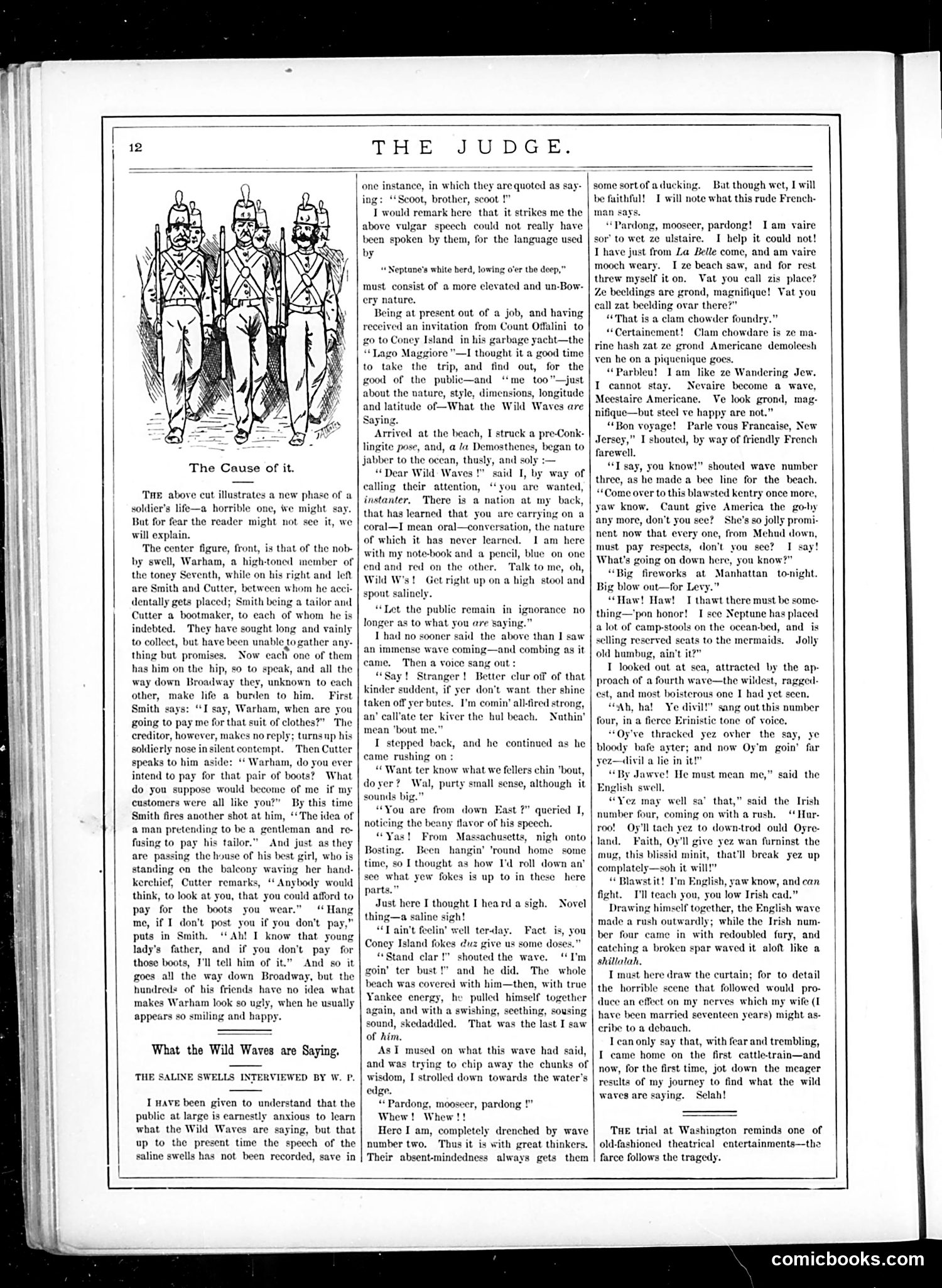
## "The Cause of It" The center cartoon depicts a well-dressed soldier named Warham sandwiched between two men—Smith (a tailor) and Cutter (a bootmaker)—both his creditors. The joke: Warham owes them money but avoids payment, so they heckle him relentlessly as he walks down Broadway in front of his sweetheart. The satire mocks both the soldier's pretense of respectability while dodging debts, and the creditors' public shaming tactics. It's a commentary on financial irresponsibility and debt avoidance among the military elite. ## "What the Wild Waves Are Saying" This article humorously "interviews" ocean waves at Coney Island, satirizing contemporary attempts to document nature poetically. The author expects elevated, Neptunian speech but instead receives coarse, vernacular warnings from the waves. The satire mocks both overly romantic nature writing and the contrast between literary pretension and crude reality—a common Judge theme.
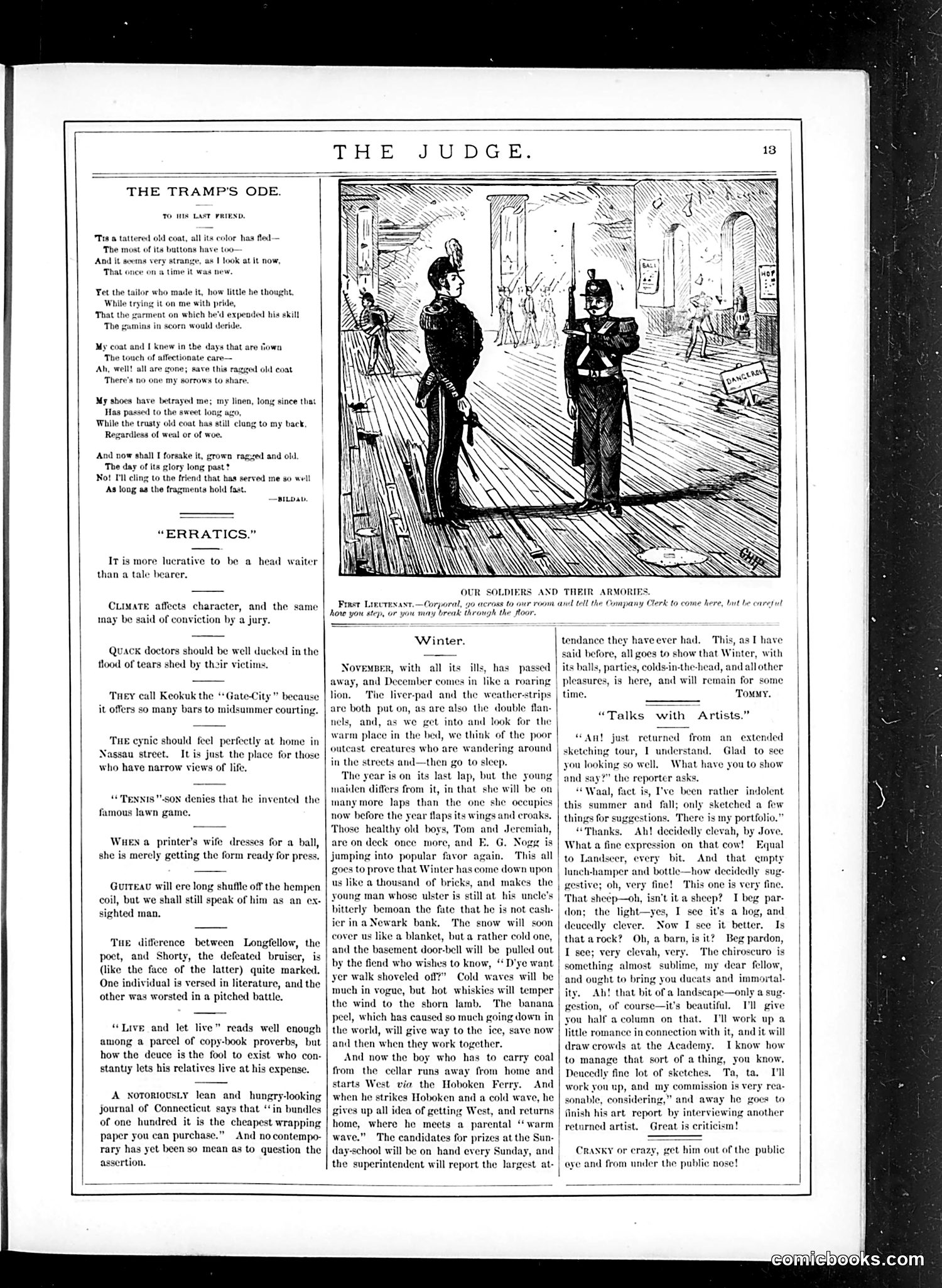
This page contains satirical commentary and light humor typical of Judge magazine. The main illustrated piece, "Our Soldiers and Their Armories," shows a military officer instructing a corporal—a visual joke about the poor condition of military barracks (the floor apparently so weak the corporal might fall through). The text sections labeled "Erratics" are brief satirical quips on various topics: the superiority of head waiters to gossips, climate's effect on character and juries, quack doctors, and Keokuk's reputation for romantic obstacles ("Gate-City" with too many "bars"). "The Tramp's Ode" is a sentimental poem from a homeless man about his ragged coat—his last loyal companion. It contrasts the coat's former dignity with its current state, reflecting on lost respectability. The "Talks with Artists" section discusses sketching and art criticism in a lighthearted manner. Overall, the page mixes gentle social satire with humor about poverty, military affairs, and everyday absurdities—typical Judge content for an unspecified date in the late 19th century.
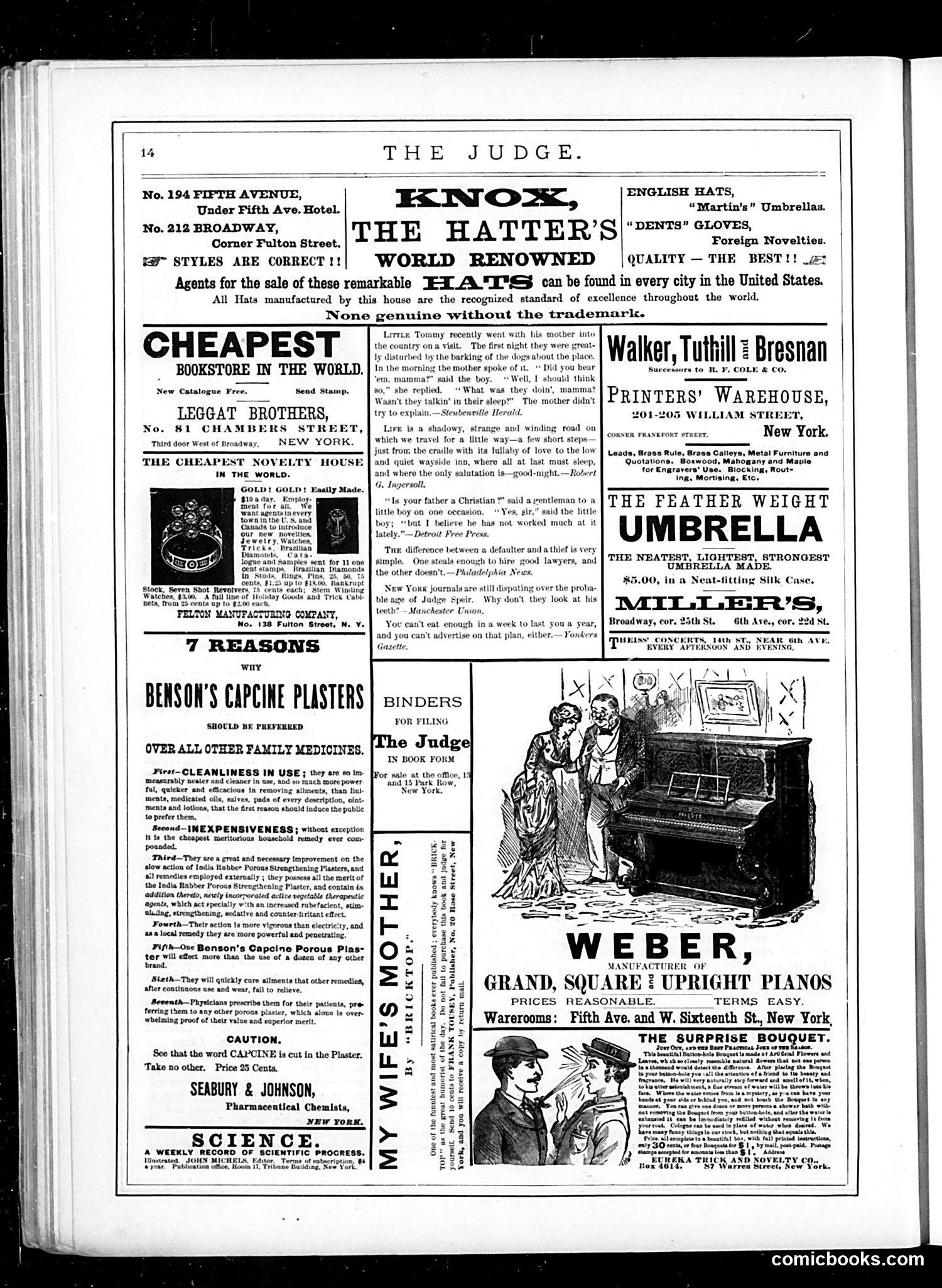
This page is primarily **advertisements**, not political satire. The main content consists of commercial notices for hats, bookstores, pianos, umbrellas, and medical plasters—typical late 19th-century magazine advertising. The only cartoon visible is **"The Surprise Bouquet"** at bottom right, showing two figures examining what appears to be a piano. The accompanying text describes a joke about a musical surprise: apparently someone placed a bouquet inside a piano, and when opened, it startled the viewer. The humor depends on the unexpectedness of finding flowers in an instrument. There is no clear political satire on this page. A brief text snippet references "Judge Speir" and compares defaulters to thieves, but this appears to be filler copy rather than developed satirical commentary. The page functions as a revenue-generating advertisement section rather than as editorial content.
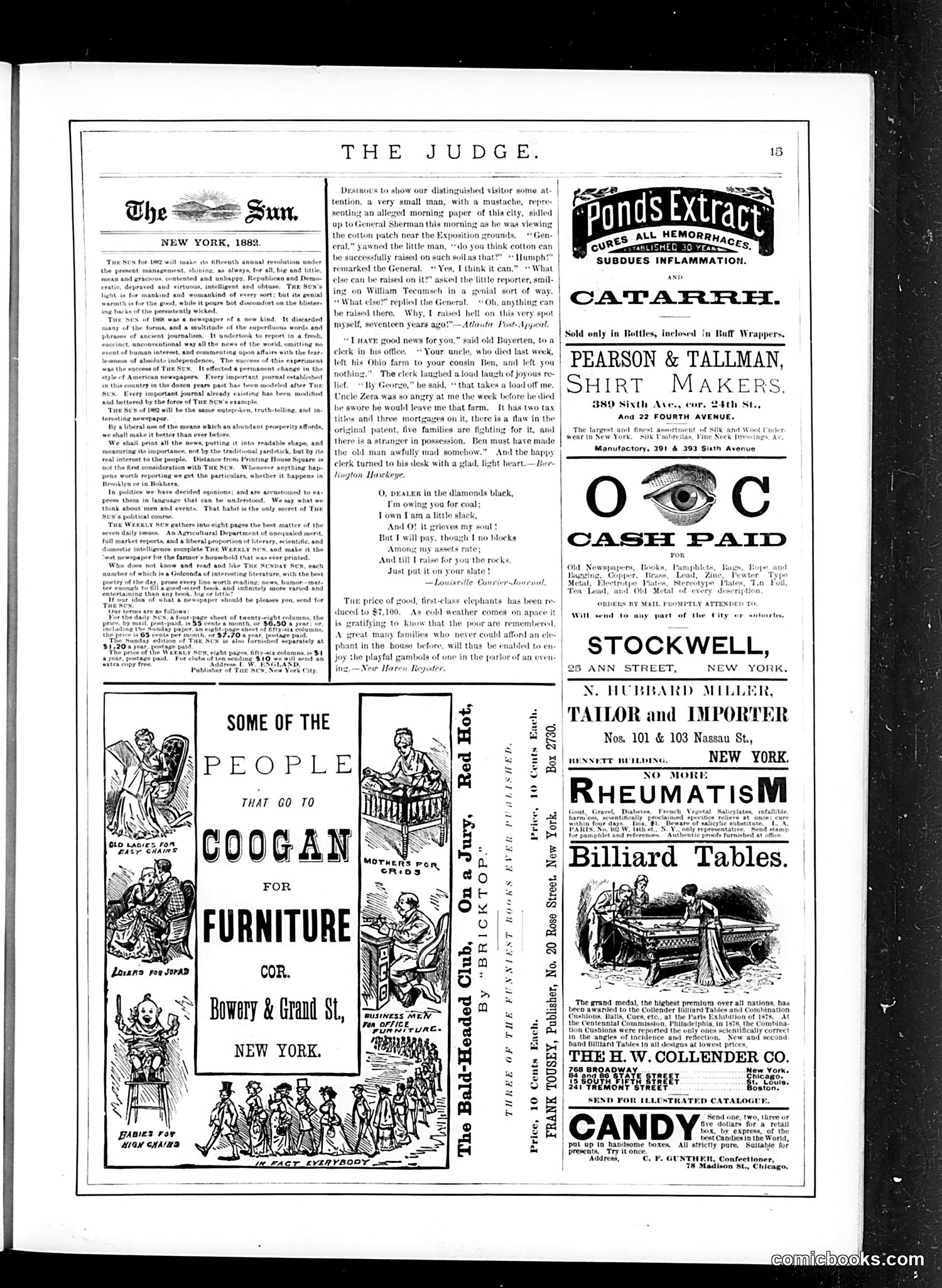
This page is primarily **advertising**, not editorial or political content. It contains commercials for period products including furniture, billiard tables, candy, clothing, and patent medicines. The only apparent cartoon is the **"Some of the People That Go to Coogan"** advertisement, which uses illustrations of various social types (old ladies, mothers, businessmen, families) to promote a furniture store at Bowery & Grand Street. The small comic vignettes are generic Victorian humor tropes depicting "funny" character types—not political satire. The editorial content visible mentions cotton cultivation and good news about elephants, but these snippets provide insufficient context to identify specific political or social commentary. The page's primary function is to generate advertising revenue, which was typical for satirical magazines of this era. The Judge masthead appears but without accompanying political cartoons or commentary on this particular page.
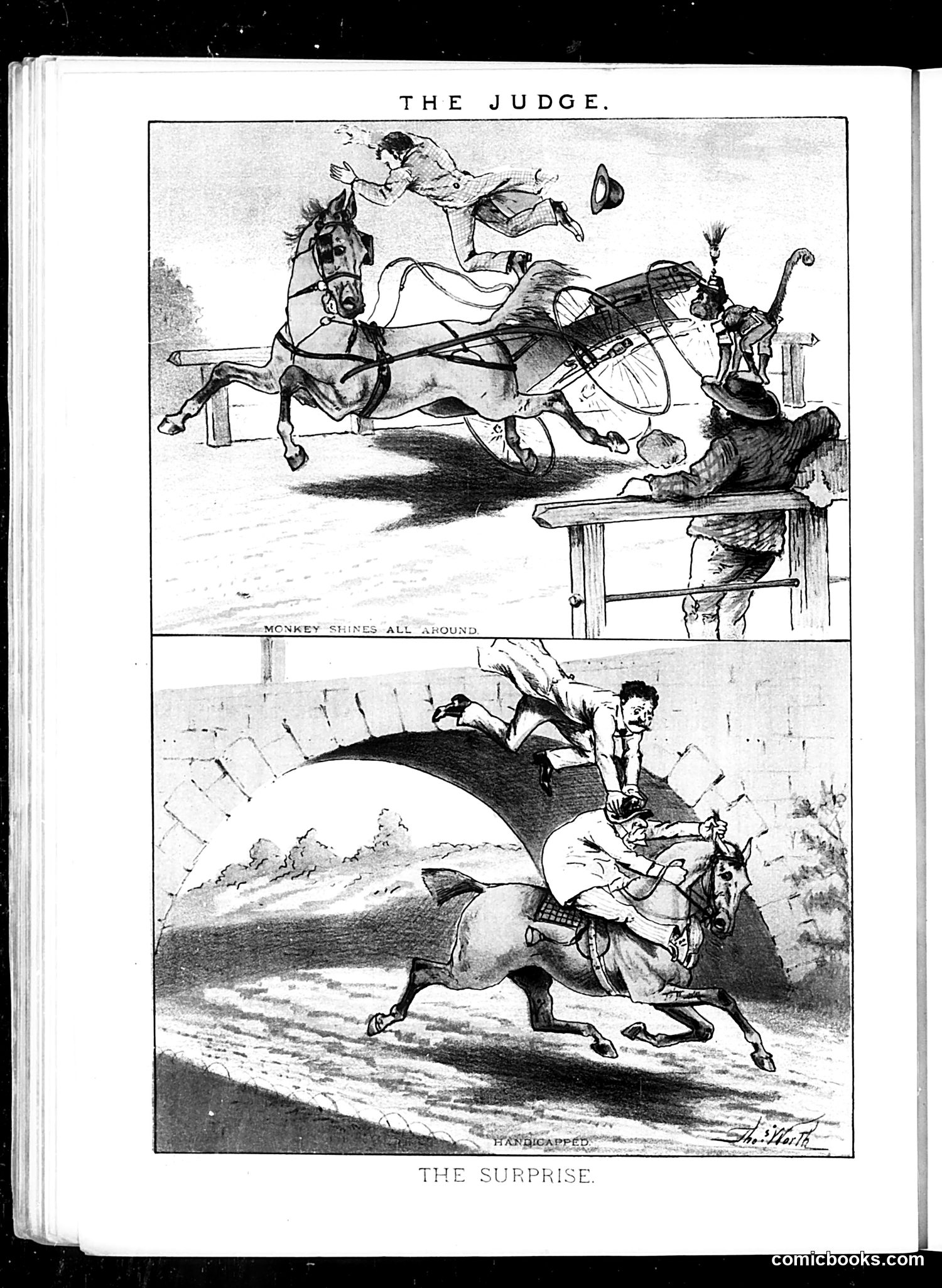
This page contains two sequential cartoon panels satirizing reckless or incompetent horsemanship. **Top panel ("Monkey Shines All Around"):** A figure precariously balances atop two galloping horses while onlookers watch from a fence. The "monkey shines" phrase suggests foolish antics or mischief. **Bottom panel ("The Surprise"):** A rider approaches a stone bridge on horseback, while another figure appears to be falling or being thrown from the animal. Together, these panels mock careless riders or perhaps political figures engaging in dangerous, undignified behavior. The "surprise" suggests unexpected consequences of reckless actions. Without additional context about the publication date or specific political figures referenced, the exact target of satire remains unclear, though the general message concerns foolish conduct leading to comic downfall.