
Judge, 1881-12-10 · page 12 of 16
Judge — December 10, 1881 — page 12: what you’re looking at
What you’re looking at
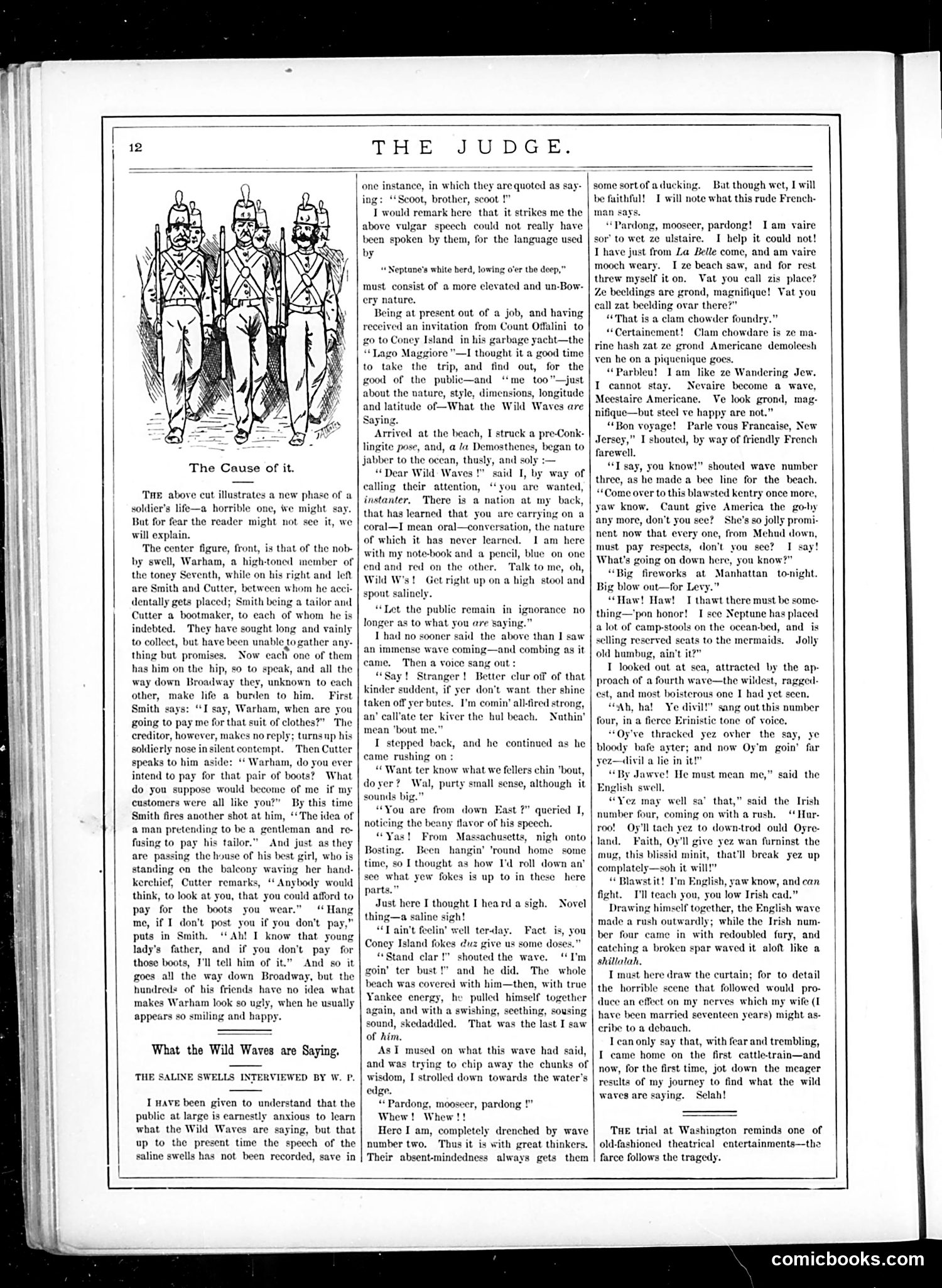
## "The Cause of It" The center cartoon depicts a well-dressed soldier named Warham sandwiched between two men—Smith (a tailor) and Cutter (a bootmaker)—both his creditors. The joke: Warham owes them money but avoids payment, so they heckle him relentlessly as he walks down Broadway in front of his sweetheart. The satire mocks both the soldier's pretense of respectability while dodging debts, and the creditors' public shaming tactics. It's a commentary on financial irresponsibility and debt avoidance among the military elite. ## "What the Wild Waves Are Saying" This article humorously "interviews" ocean waves at Coney Island, satirizing contemporary attempts to document nature poetically. The author expects elevated, Neptunian speech but instead receives coarse, vernacular warnings from the waves. The satire mocks both overly romantic nature writing and the contrast between literary pretension and crude reality—a common Judge theme.
📄 Transcribed text from this page (OCR, searchable)
Machine-transcribed from the original scan — historical spelling and the odd misread are preserved.
THE JUDGE. The Cause of it. Tre above cut illustrates a new phase of a soldier's life—a horrible one, we might say. But for fear the reader might not see it, we will explain. The center figure, front, is that of the nob- by swell, Warham, a high-toned inember of the toney Seventh, while on his right and let are Smith and Cutter, between whom he acci- dentally gets placed; Smith being a tailor and Cutter a bootmaker, to each of whom he is indebted. They have sought long and vainly to collect, but have been unable to gather any- thing but promises, Now each one of them has him on the hip, so to speak, and all the way down Broadway they, unknown to each other, make life a burden to him. First Smith says: “I say, Warham, when are you going to pay me for that suit of clothes?” The creditor, however, makes no reply; turns np his soldierly nose insilent contempt. Then Cutter speaks to him aside: ‘* Warham, do you ever intend to pay for that pair of boots? What do you suppose would become of me if my customers were all like you?” By this time Smith fires another shot at him, ‘The idea of a man pretending to be a gentleman and re- fusing to pay his tailor.” And just as they are passing the house of his best girl, who is standing on the balcony waving her hand- kerchief, Cutter remarks, “ Anybody would think, to look at you, that you could afford to pay for the boots you wear.” ‘Hang me, if I don't post you if you don't pay,” puts in Smith. ‘Ah! I know that young lady's father, and if you don't pay for those boots, I'll tell him of it.” And so it goes all the way down Broadway, but the hundreds of his friends have no idea what makes Warham look so ugly, when he usually appears so smiling and happy. What the Wild Waves are Saying, THE SALINE SWELLS INTERVIEWED BY W. P. I nave been given to understand that the public at large is earnestly anxious to learn what the Wild Waves are saying, but that up to the present time the speech of the saline swells has not been recorded, save in one instance, in which they are quoted as say- ing: “Scoot, brother, scoot ! I would remark here that it strikes me the above vulgar speech could not really have been spoken by them, for the language used by “ Neptune's white herd, lowing o'er the deep must consist of a more elevated and un-Bow- y nature. Being at present out of a job, and having received an invitation from Count Offalini to go to Coney Island in his garbage yacht—the “Tago Maggiore "—I thought it a good time to take the trip, and find out, for the good of the public—and “me too”—just about the nature, style, dimensions, longitude and latitude of—What the Wild Waves are Saying. Arrived at the beach, I struck a pre-Conk- lingite pose, and, @ la Demosthenes, began to »ber to the ocean, thusly, and soly :— “Dear Wild Wav said I, by way of calling their attention, ‘you are wanted, instanter, There is a nation at my back, that has learned that you are carrying on a coral—I mean oral—conversation, the nature of which it has never learned. 1 am here with my note-book and a pencil, blue on one end and red on the other, Talk to me, oh, Wild W's! Get right up on a high stool and pout salinely. “Let the public remain in ignorance no longer as to what you ave saying.” T had no sooner said the above than I saw an immense wave coming—and combing as it came. Then a voice sang ont “Say! Stranger! Better clur off of that kinder suddent, if yer don't want ther shinc taken off yer butes. I'm comin’ all-fired strong, an’ call'ate ter kiver the bul beach. Nuthin’ mean ‘bout me.” I stepped back, and he continued as he came rushing on : “Want ter know what we fellers do yer? sounds big. “You are from down noticing the be: in "bout, Wal, purty small sense, although it st 2” queried I, y flavor of his speech. “Yas! From Massachusetts, nigh onto Bosting. Been hangin’ 'round home some time, so I thought as how I'd roll down an’ see what yew fokes is up to in these here parts, Just here I thought I heard a sigh. thing—a saline “T ain't feelin’ Coney Island fokes duz give us some doses.” “Stand clar!" shouted the wave. ‘I'm goin’ ter bust and he did. The whole beach was covered with him—then, with true Yankee energy, he pulled himself together again, and with a swishing, seething, sousing sound, skedaddled. ‘That was the last I saw of him. AsI mused on what this wave had said, and was trying to chip away the chunks of wisdom, I strolled down towards the water's edge, ‘Pardong, mooseer, pardong Whew! Whew !! Here I am, completely drenched by wave number two. Thus it is with great thinkers. Their absent-mindedness always gets them Novel some sortof a ducking. ithful! man sa} “Pardong, mooseer, pardong! I am vaire sor’ to wet ze ulstaire. I help it could not! T have just from La Belle come, and am vaire mooch weary. I ze beach saw, and for rest threw myself it on. Vat you call zis plac Ze beeldings are grond, magnifique! Vat you call zat beelding ovar there?” “That is a clam chowder foundry.” “Certainement! Clam chowdare is ze ma- rine hash zat ze grond Americane demoleesh ven he on a piquenique goes. “Parbleu! Iam like ze Wandering Jew. I cannot stay. Nevaire become a wave, Meestaire Americane. Ve look grond, mag- nifique—but steel ve happy are not.” “Bon voyage! Parle vous Francaise, New Jersey,” I shouted, by way of friendly French farewell. “Tsay, you know!” shouted wave number three, as he made a bee line for the beach. “Come over to this blawsted kentry once more, yaw know. Caunt give America the go-by any more, don't you see? She's so jolly promi- nent now that every one, from Mehud down, must pay respects, don't you see? I say! What's going on down here, you know? “Big fireworks at Manhattan to-night. Big blow out—for Levy. “Haw! Haw! I thawt there must be some- thing—'pon honor! I see Neptune has placed a lot of camp-stools on the ocean-bed, and is selling reserved seats to the mermaids. Jolly old humbug, ain't it? T looked out at sea, attracted by the ap- proach of a fourth wave—the wildest, ragged- est, and most boisterous one I had yet seen. “Ah, ha! Ye divil!” sang out this number four, in a fierce tic tone of voie “Oy've thracked yez ovher the say, ye bloody bafe ayter; and now Oy'm goin’ far yez—divil a lie in it!” “By Jawve! He must mean me,” said the English swell, “Yez may well sa’ that,” said the Irish number four, coming on with a rush. “Hur. roo! Oy'll tach yez to down-trod ould Oyre- land. Faith, Oy'll give yez wan furninst the mug, this blissid minit, that'll break yez up complately—soh it wi “Blawstit! I'm English, yaw know, and can fight. I'll teach you, you low Irish cad.” Drawing himself together, the English wave made a rush outwardly; while the Irish num- ber four came in with redoubled fury, and catching a broken spar waved it aloft like a shillalah. I must here draw the curtain; for to detail the horrible scene that followed would pro- duce an effect on my nerves which my wife (I have been married seventeen years) might as- cribe to a debauch, Tcanonly say that, with fear and trembling, I came home on the first cattle-train—and now, for the first time, jot down the meager results of my journey to find what the wild waves are saying. Selah! Bat though wet, I will be I will note what this rude French- THE trial at Washington reminds one of old-fashioned theatrical entertainments—the farce follows the tragedy. comicbooks.com