
A complete issue · 16 pages · 1881
Judge — December 3, 1881
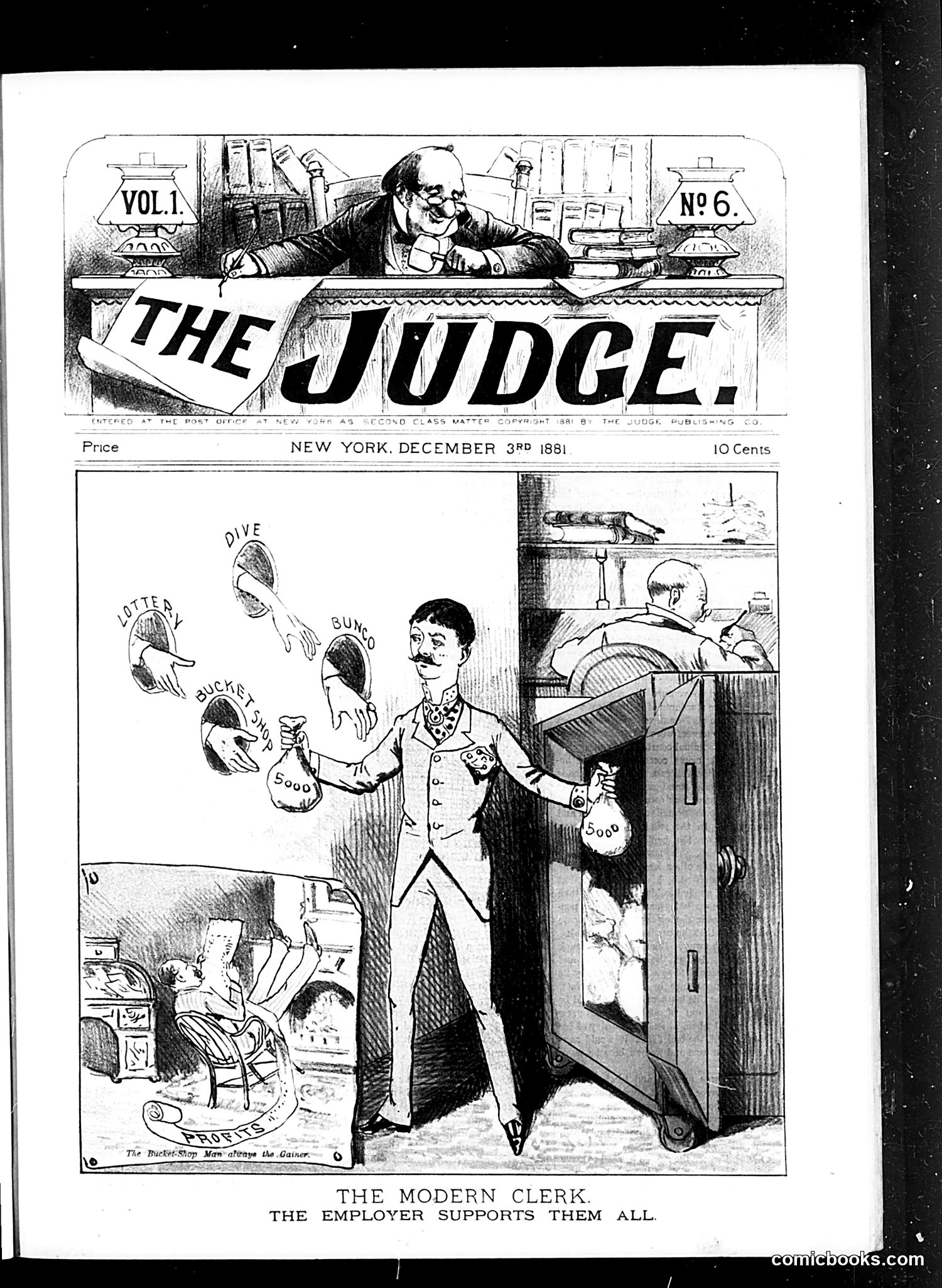
This satirical cartoon critiques the "bucket-shop man"—a speculator or small-time trader dealing in bucket shops (illegal or semi-legal establishments offering risky financial bets). The central figure juggles various earnings labeled "Lotteries," "Bunco," "Suckers," and "Dives," suggesting he profits through dubious schemes targeting the gullible. The right panel shows an employer supporting this corrupt clerk at his desk, suggesting workplace complicity in financial fraud. The title's irony—"The Employer Supports Them All"—indicates that legitimate businesses unknowingly or deliberately harbor employees engaged in scams. The cartoon satirizes 1880s financial speculation, workplace corruption, and predatory schemes targeting the innocent. It reflects public anxiety about unregulated markets and dishonest business practices of the Gilded Age.
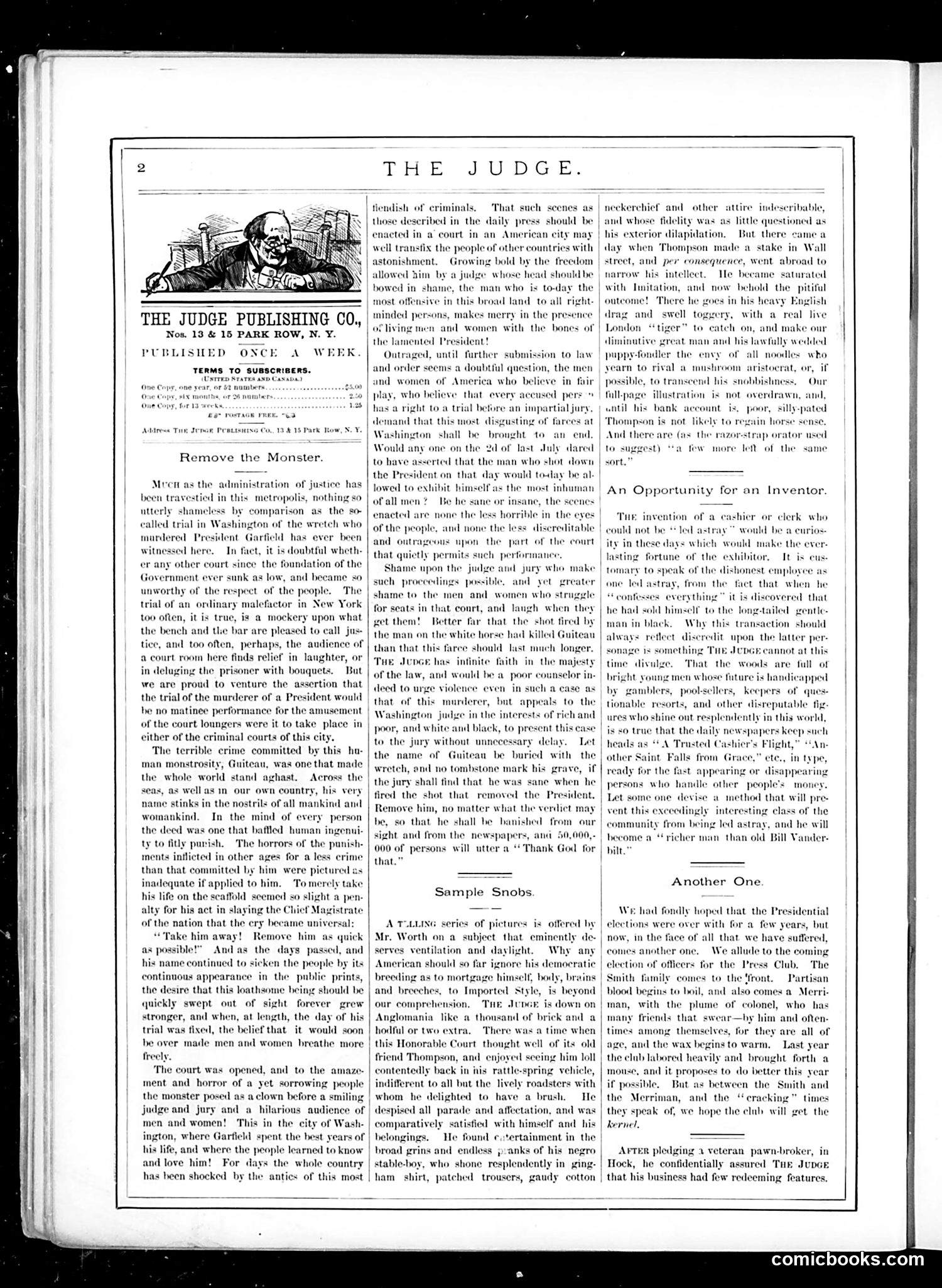
This page attacks the trial conduct surrounding **Charles Guiteau**, who assassinated President James Garfield in 1881. The editorial "Remove the Monster" condemns how the Washington court allowed Guiteau to behave theatrically and disruptively during his murder trial—acting as "a clown before a smiling Judge." The satire's point: Guiteau's courtroom antics were a mockery of justice that disgraced the nation's capital, where Garfield had lived and was beloved. The author argues that New York courts, though often lax, would never permit such degrading conduct at a presidential assassin's trial. The piece demands Guiteau be "quickly swept out of sight forever," reflecting public horror that this "loathsome being" was permitted to perform rather than face dignified legal proceedings. The cartoon's grotesque caricature reinforces the message: Guiteau embodied a monstrosity requiring swift removal from public view.
This satirical playlet mocks fire insurance companies' tactics for denying legitimate claims. Mr. Verdant, a naive businessman, seeks full payment ($50,000) after his firm burns down. Mr. Moloch, the insurance company president, uses absurd logic to devalue Verdant's losses: he inflates a $40 stove's worth to $500, and claims a sentimental parrot (worth $10) is really worth $500 based on "associations" and family memories. The joke is that Moloch manipulates valuations in the company's favor while pretending to operate on "equity." The directors' conspiratorial grinning and nodding reveal this as deliberate deception. Verdant's exasperation ("But I ain't") shows he recognizes the scam but is powerless against it. This reflects genuine late-19th-century complaints about fire insurance companies routinely underpaying legitimate claims through dubious appraisals and technicalities.
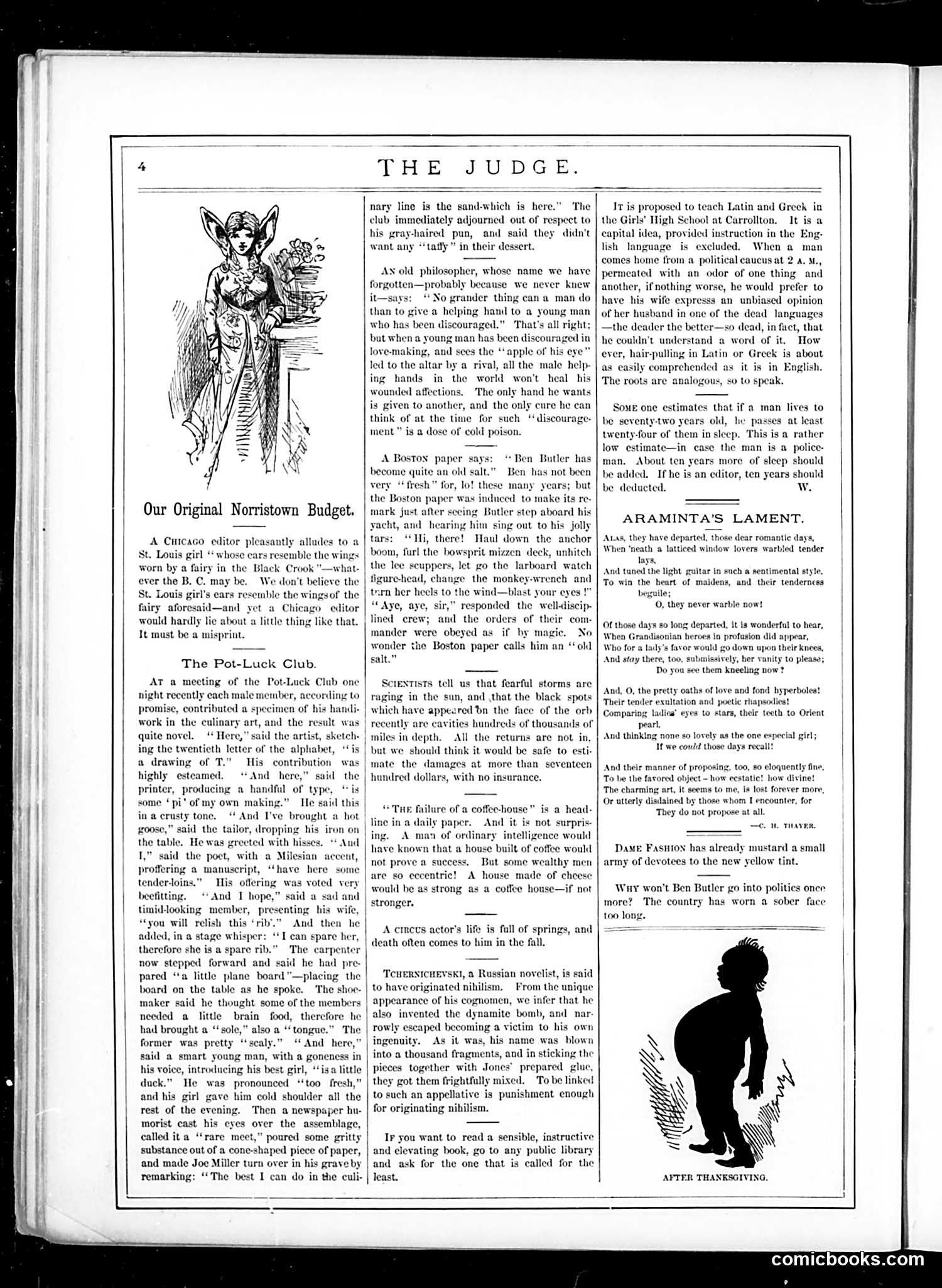
This page contains several humorous sketches and commentary typical of 19th-century satirical journalism: **"Our Original Norristown Budget"**: A light gossip item mocking a Chicago editor's dubious claim about a St. Louis girl's ears resembling fairy wings from a theatrical production. **"The Pot-Luck Club"**: A lengthy pun-based sketch where club members present food items with absurd wordplay—a "drawing of T," "pi," "hot goose," "spare rib," "plane board," "sole," "tongue," and "duck." The humor relies entirely on double meanings and groan-worthy puns, reflecting Victorian-era comedy sensibilities. **Right column content**: Commentary on various topics including Latin/Greek education, a reference to Ben Butler (likely General Benjamin Butler, a controversial Civil War figure) and nautical terminology, plus poetry titled "Araminta's Lament" about romantic departure. The cartoons are generic Victorian illustrations rather than specific political commentary. The satire targets social pretension, bad wordplay, and general absurdity rather than particular political figures or events—characteristic of Judge's lighter content pages.
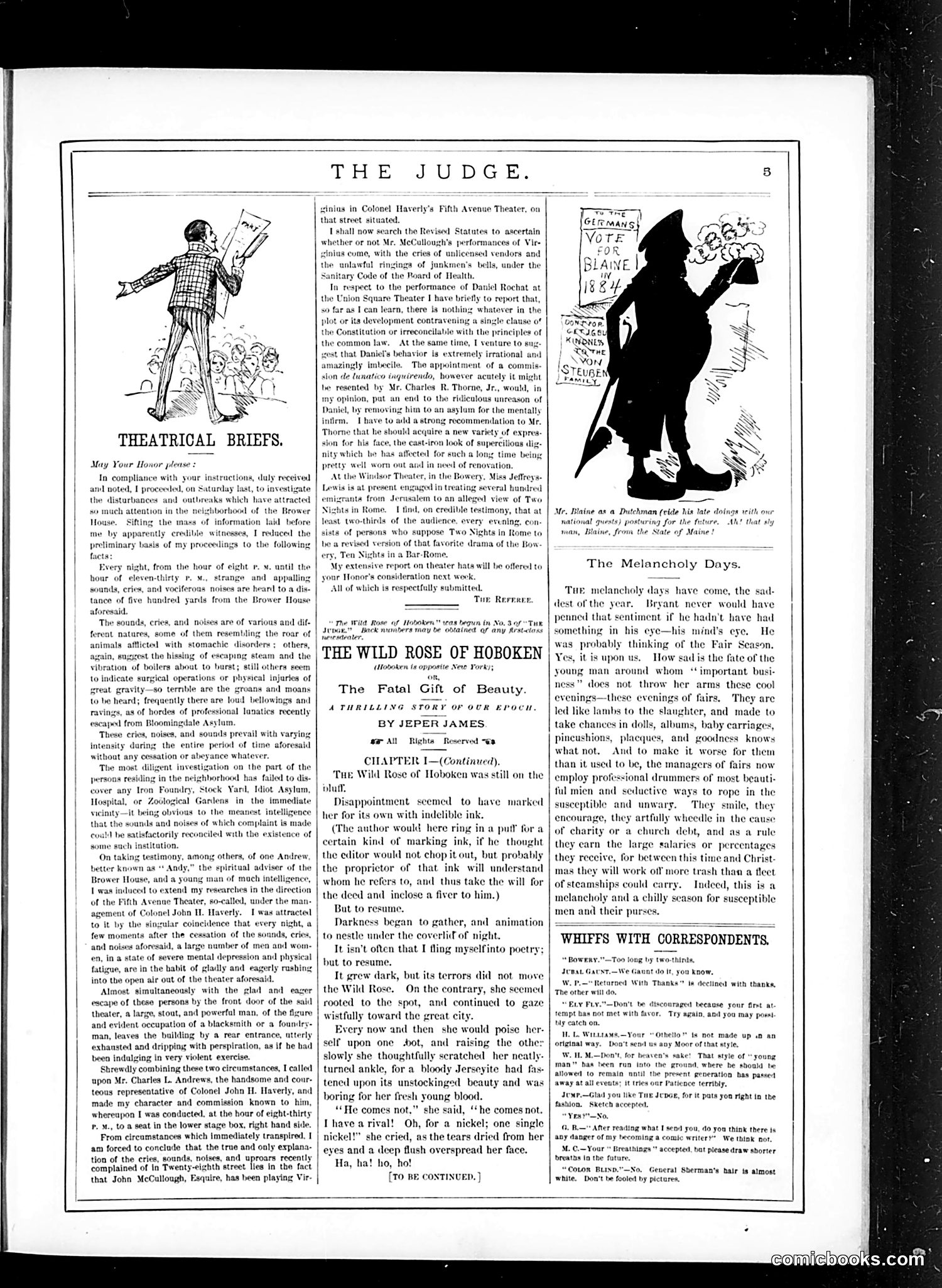
This page satirizes actor **John McCullough's** performance as Virginius (a classical tragedy role) at Colonel Haverly's Fifth Avenue Theater. The cartoon humorously "investigates" disturbances in the neighborhood by framing it as an official inquiry. **The joke:** McCullough's dramatic acting—specifically his intense, physical performance—is so exhausting and emotionally explosive that it produces ear-splitting roars, groans, and bellows audible five blocks away. The "blacksmith-like" man sweating profusely leaving the theater is McCullough himself after expending tremendous energy on stage. The satire mocks both the overwrought melodramatic style of 19th-century theatrical acting and McCullough's particularly vigorous interpretation. Judge is suggesting the performance is so loud and violent it constitutes a neighborhood nuisance worthy of health code investigation.
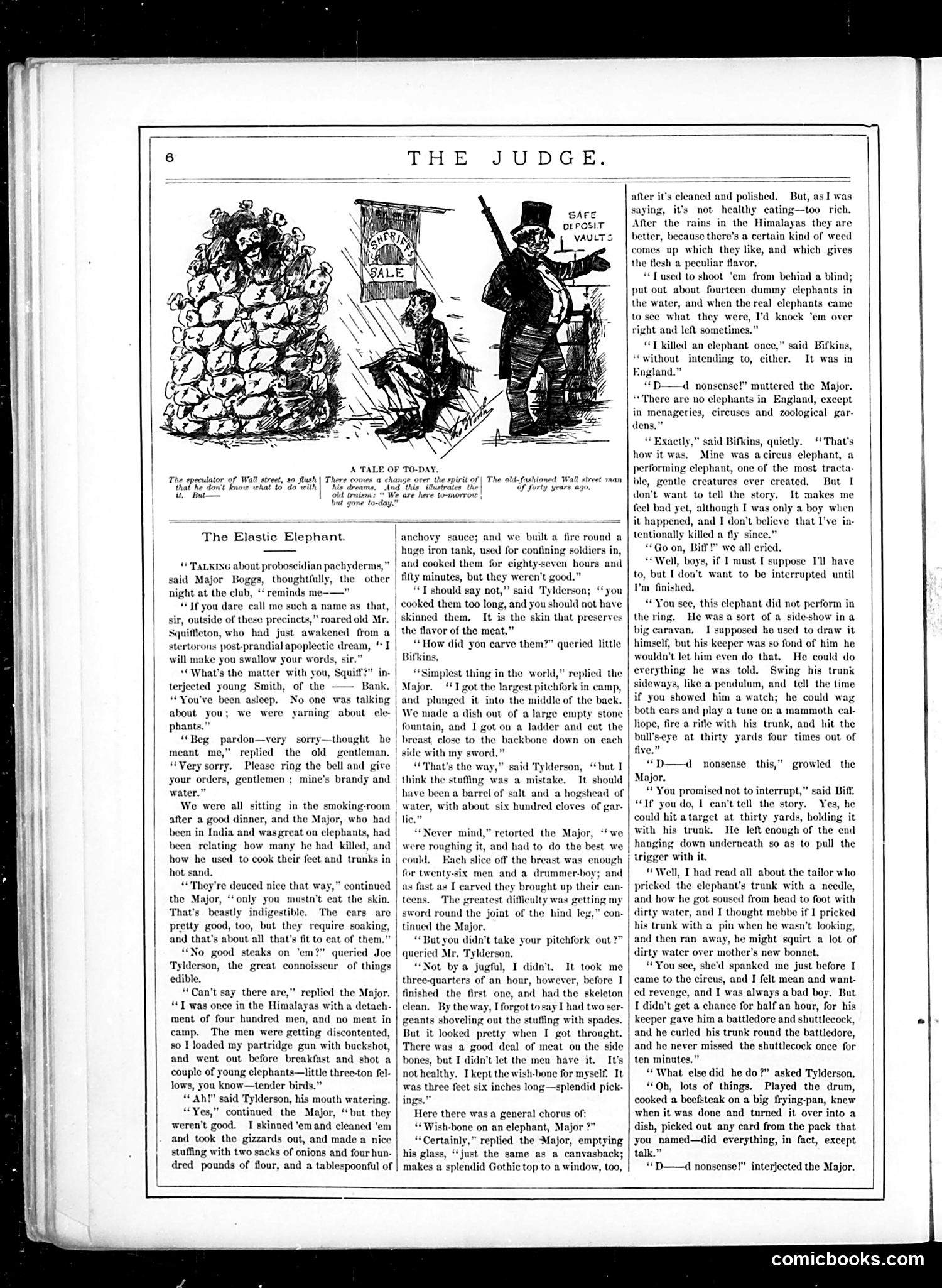
This is a humorous tall tale in which **Major Boggs** recounts increasingly absurd hunting stories to a club audience. The satire mocks the Victorian-era convention of after-dinner boasting by military men about colonial exploits in India. The joke escalates absurdly: Boggs claims he shot young elephants with a partridge gun, then cooked them for 87+ hours in a military tank with massive quantities of onions and flour. His companions (Tylderson, Bifkins, and others) interject with mock-serious culinary advice, treating the ridiculous preparation as if it were a legitimate cooking debate. The cartoon's humor lies in deflating pompous imperial braggadocio—the "elastic" elephant stretches credibility with each detail. The elaborate illustrations on the page (showing the pile of food, safe deposit vaults, and the old gentleman) provide visual comedy accompanying these verbal exaggerations. It's satire of overblown gentleman-storytelling culture.
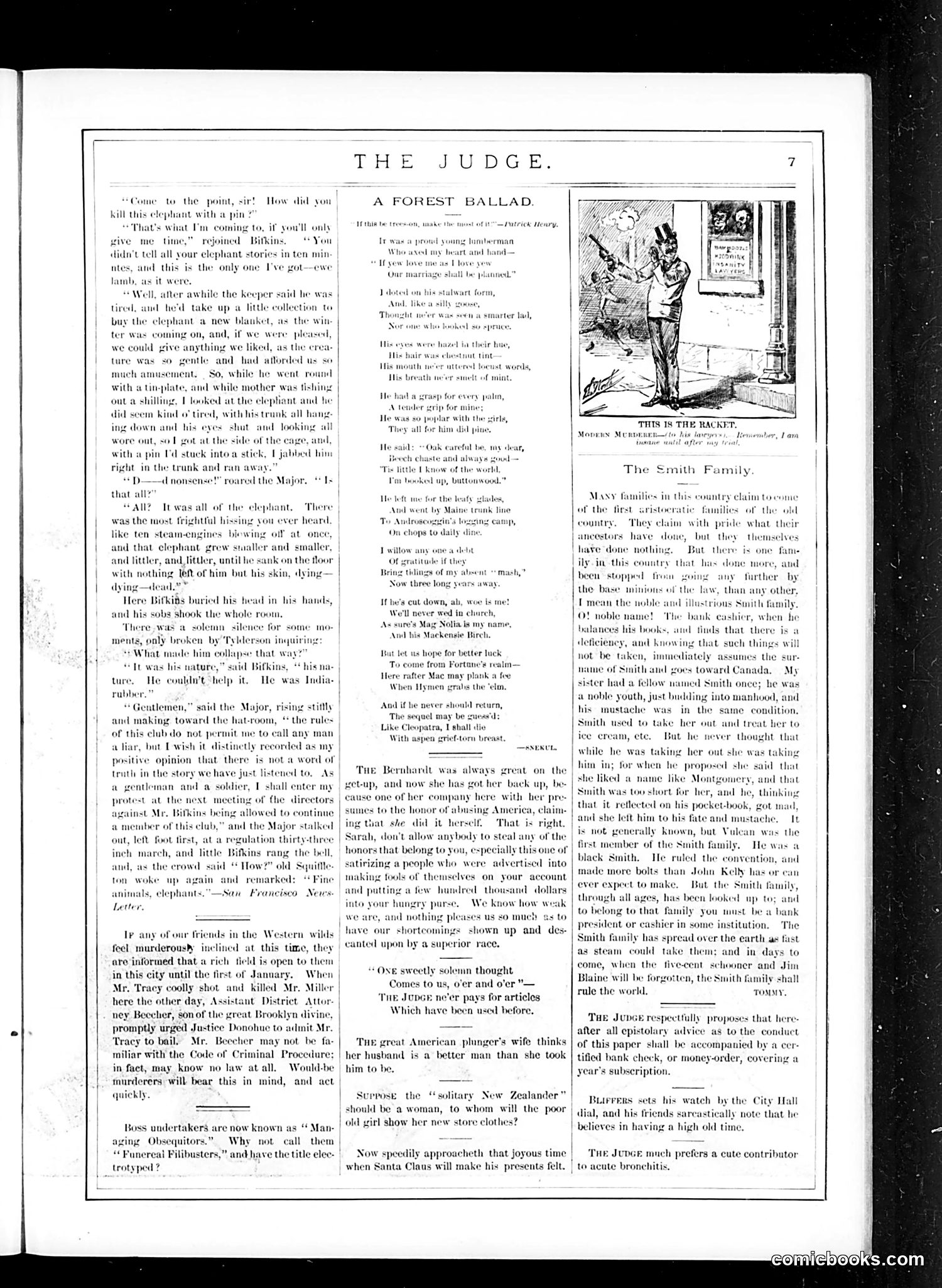
The page contains two distinct satirical pieces: **"A Forest Ballad"** (right column): A mock-sentimental poem parodying overly romantic, rustic folk ballads. It ridicules flowery nature metaphors by having every name be a tree species (*Buttonwood*, *Ash*, *Oak*, etc.), progressively undercutting the emotional tone. The joke: the "lumberman" literally becomes lumber. **"The Smith Family"** (text block): A commentary on American social climbing. The passage satirizes families who exaggerate their aristocratic credentials—claiming to descend from the "old guard" of America despite having recently made money. The specific reference to "Smith" (a common name) sharpens the mockery: these are ordinary people inventing nobility. Both pieces employ *Judge*'s typical strategy: using humor to deflate pretension and expose fraud—whether romantic sentimentality or false gentility.
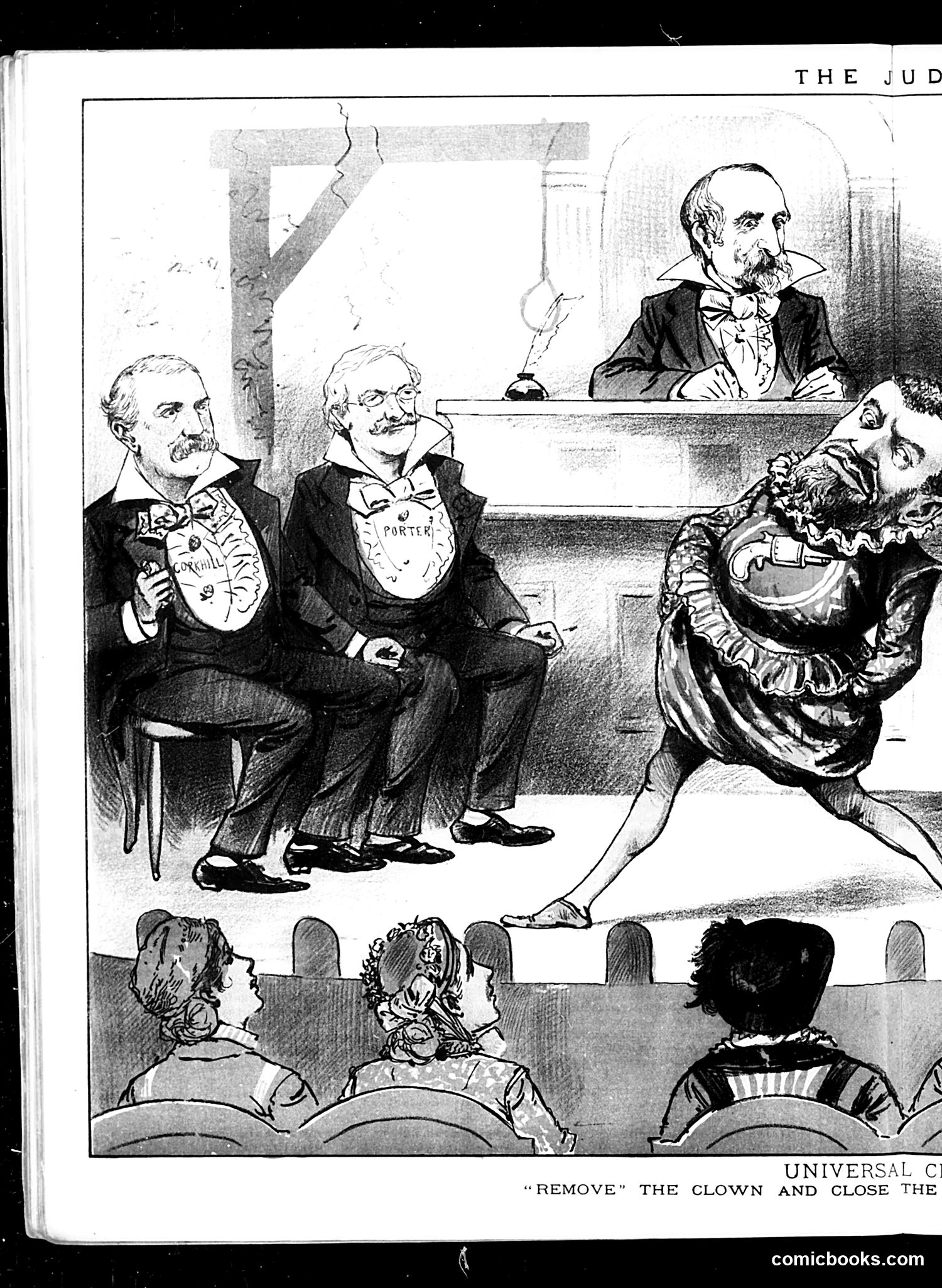
This is a satirical cartoon from *Judge* magazine depicting what appears to be a theatrical or political scene. Two formally-dressed gentlemen sit holding masks or organ diagrams labeled with internal organs (one reads "CORELLI," the other "PORTER"), while a judge or authority figure presides above them. On stage right stands an elaborately-dressed clown or performer in ruffled costume. The caption reads: "REMOVE THE CLOWN AND CLOSE THE [circus/theater]." The satire appears to target theatrical or political figures—the organ diagrams suggest either medical/anatomical mockery or symbolic representations of these men's "inner nature." The caption suggests removing an unwanted performer (the "clown") from a venue, likely commenting on contemporary entertainment or political controversy. Without the magazine's date and full context, the specific identities and event referenced remain unclear, though this appears to critique either theatrical management or public figures portrayed as performers.
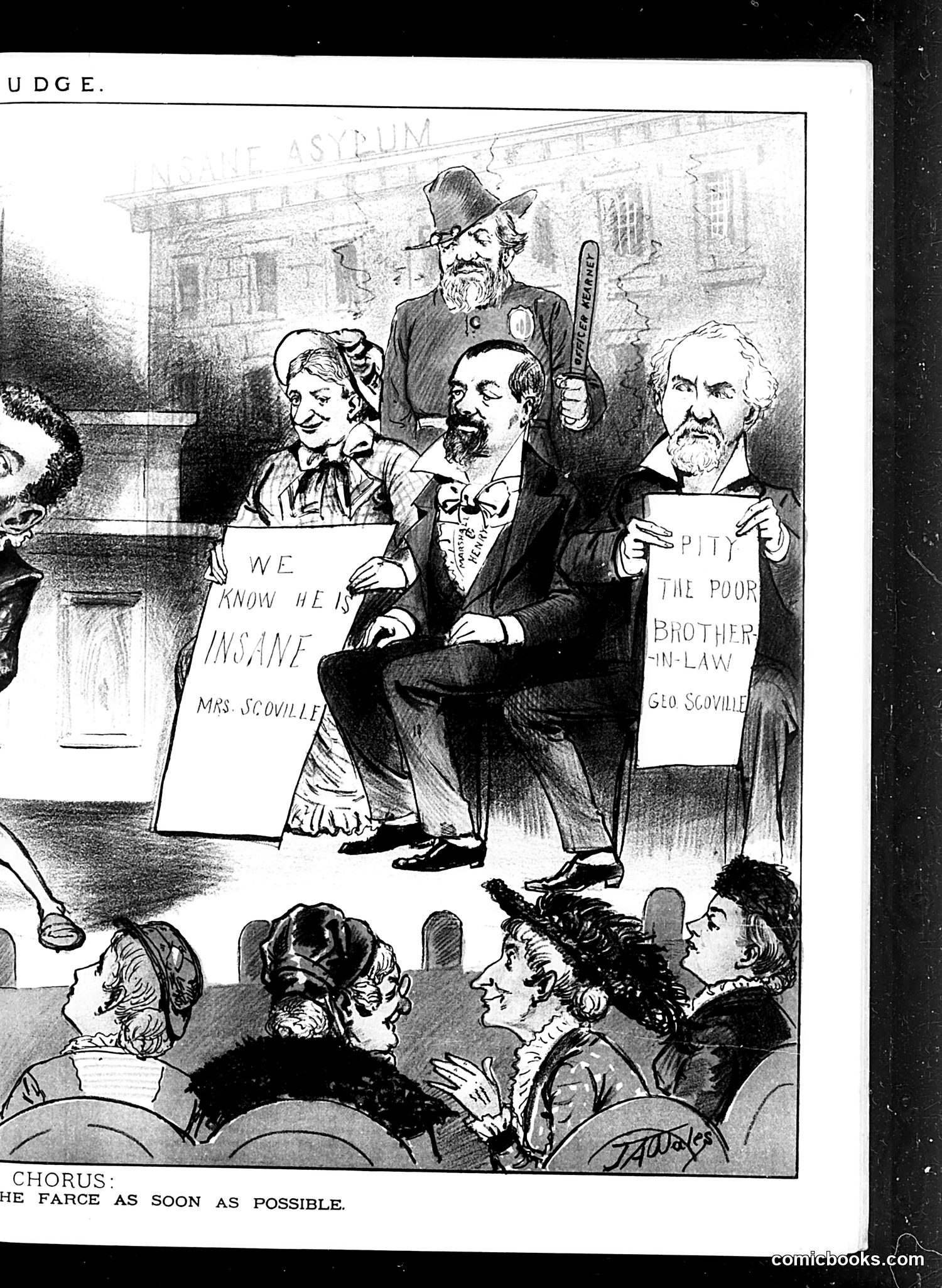
This satirical cartoon depicts what appears to be a public asylum scene, with figures holding signs identifying themselves as "Mrs. Scoville" ("We know he is insane") and "Geo Scoville" ("Pity the poor brother-in-law"). A guard or official stands behind them with a club. The cartoon mocks a legal or family dispute involving the Scoville family, apparently concerning someone's mental competency. The signs suggest relatives are testifying about or publicizing someone's insanity claim. The "brother-in-law" reference and the chorus caption ("The farce as soon as possible") indicate this is satirizing a sensationalized legal proceeding or commitment case. Without additional context identifying the specific Scoville case, the precise historical reference remains unclear, though this appears to be commentary on a contemporary family scandal involving contested sanity hearings—a subject Judge magazine frequently lampooned.
This page contains two satirical pieces characteristic of 19th-century American humor: **"The Vigilante's Story"** parodies Western frontier tales (styled after Bret Harte). It tells of a vigilante mob that lynches a man named Dan on suspicion of stealing mules, only to discover afterward that the mule was found safe. The satire critiques both mob justice and the self-congratulatory morality of vigilantes—Jones, who led the lynching, assuages his guilt by collecting money for Dan's widow, treating murder as a solved problem requiring only compensation. **"A Mixed Hunter"** features a drunk ("old Boozer") telling an increasingly absurd tall tale about hunting in Montana, mixing bears, panthers, and rivers with exaggerated weather conditions and impossible circumstances. The "(hic!)" notations indicate hiccups, marking him as intoxicated. The satire mocks both drunken braggadocio and the genre of tall Western hunting stories. Both pieces target American masculine pretension and frontier mythology through humor.
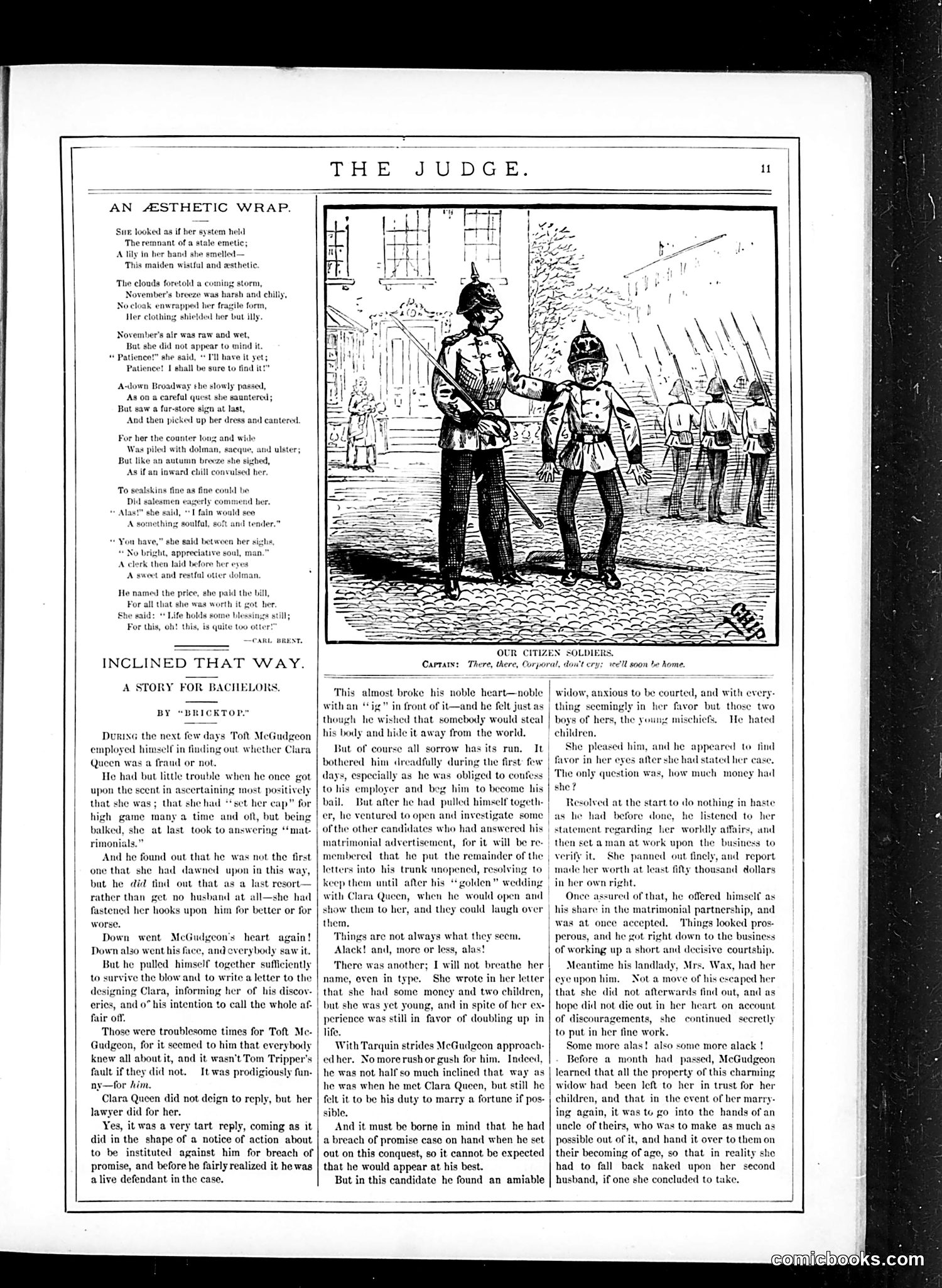
This page contains two satirical pieces from *Judge* magazine: **"An Aesthetic Wrap"** (poem with illustration): Mocks the "aesthetic movement"—a late-19th-century artistic trend emphasizing beauty and refinement. The poem ridicules an affected young woman who pretends indifference to cold weather while clutching her aesthetic lily, then immediately abandons her principles upon seeing expensive furs, abandoning her pretensions to rush toward luxury goods. **"Inclined That Way"** (short story): A bachelor's comeuppance tale. Toft McGudgeon places a matrimonial advertisement seeking an ideal wife, but when rejected by his first choice (Clara Queen), he discovers she's now suing him for breach of promise. The satirical point: his casual matrimonial hunting has legal consequences, and women aren't passive objects to be selected and discarded. The story suggests McGudgeon deserves his predicament for treating marriage dismissively. Both pieces critique contemporary social hypocrisy—aesthetic pretension and male carelessness in romantic matters.
This page presents a serialized comic narrative about McGudgeon, a man who foolishly pursues wealthy women for marriage. After two breach-of-promise lawsuits nearly ruin him, his employer Mr. Tripper doubles his salary on condition he abandon fortune-hunting. McGudgeon's sympathetic nurse, Mrs. Wax, secretly settles both lawsuits, then proposes marriage to him herself—revealing she has her own money, insurance, and owns property. Desperate and grateful, McGudgeon agrees. **The satire targets**: Male fortune-hunters who pursue women for money, and conversely, demonstrates how women (presented here as strategically intelligent) manipulate men through sympathy and self-interest to achieve their own matrimonial goals. The "leap-year" reference (when women traditionally propose) adds comic timing. The story celebrates Mrs. Wax's cleverness in outmaneuvering McGudgeon's schemes through superior cunning—a common Judge theme satirizing gender relations and marriage market dynamics of the era.
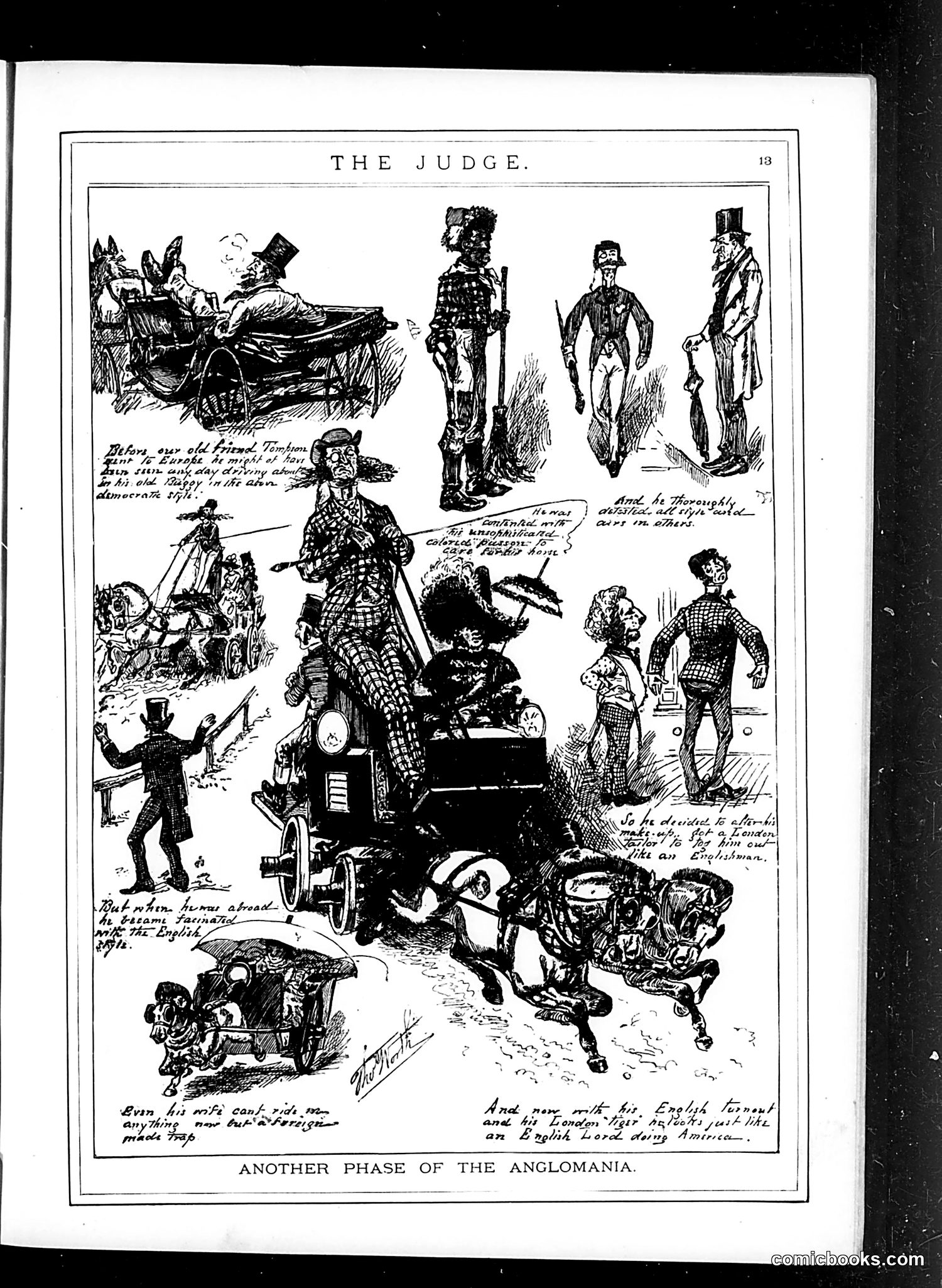
This Judge cartoon satirizes American "Anglomania"—the fashionable obsession with imitating English manners and style among wealthy Americans. The central figure appears to be a wealthy American who has adopted exaggerated British affectations: fancy dress, affected speech, and pretentious behavior. The satire shows this Anglophile as ridiculous and inconsistent. The text references him arriving from Europe with European servants, yet affecting English aristocratic style while remaining fundamentally American. The jokes mock how Americans slavishly imitate British fashion and speech patterns while being unconvincingly English—he still "can't ride" properly and his servants and carriages reveal his actual American origins. The cartoon ridicules both the absurdity of blind cultural imitation and the hypocrisy of Americans claiming European sophistication while remaining fundamentally American.
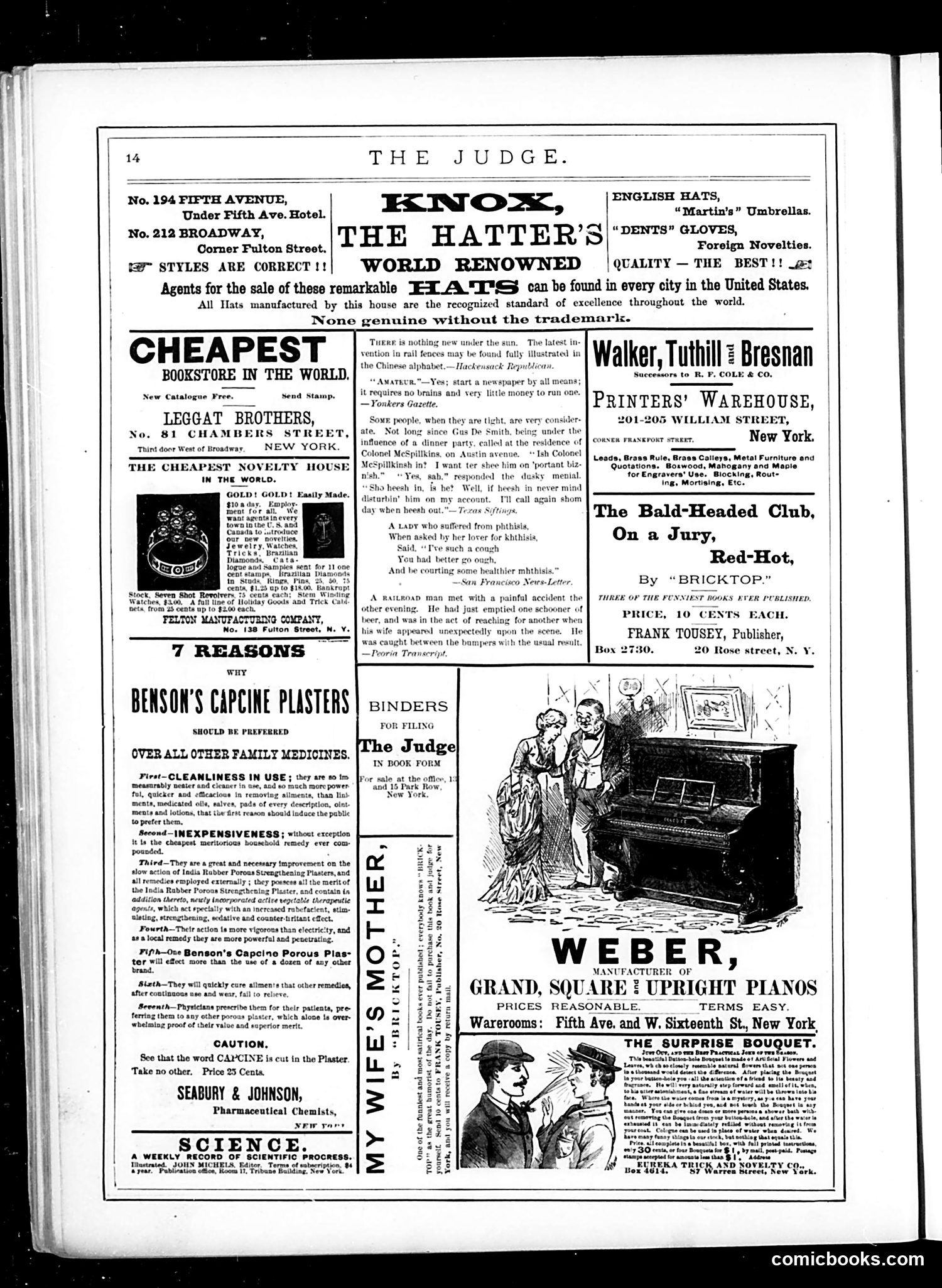
This is a humorous short story or sketch by "Bricktop," priced at 10 cents. The illustration shows two figures examining what appears to be a portrait or artwork in an interior setting. The joke likely plays on the phrase "bald-headed" — a period slang term with suggestive connotations — combined with jury duty. The visual gag seems to involve the characters' reactions to something, though the exact punchline isn't fully legible in the OCR text provided. **Context for modern readers:** This represents typical Judge magazine content: brief comedic pieces with illustrations targeting middle-class audiences. The humor relies on wordplay and double meanings common to 19th-century American satirical magazines. Without the complete text, the specific satire remains unclear, but it appears to mock either jury service absurdities or use crude innuendo, both popular Judge subjects. **Note:** This page is primarily advertising with scattered entertainment content; the story itself occupies modest space among printer, piano, and patent medicine ads.
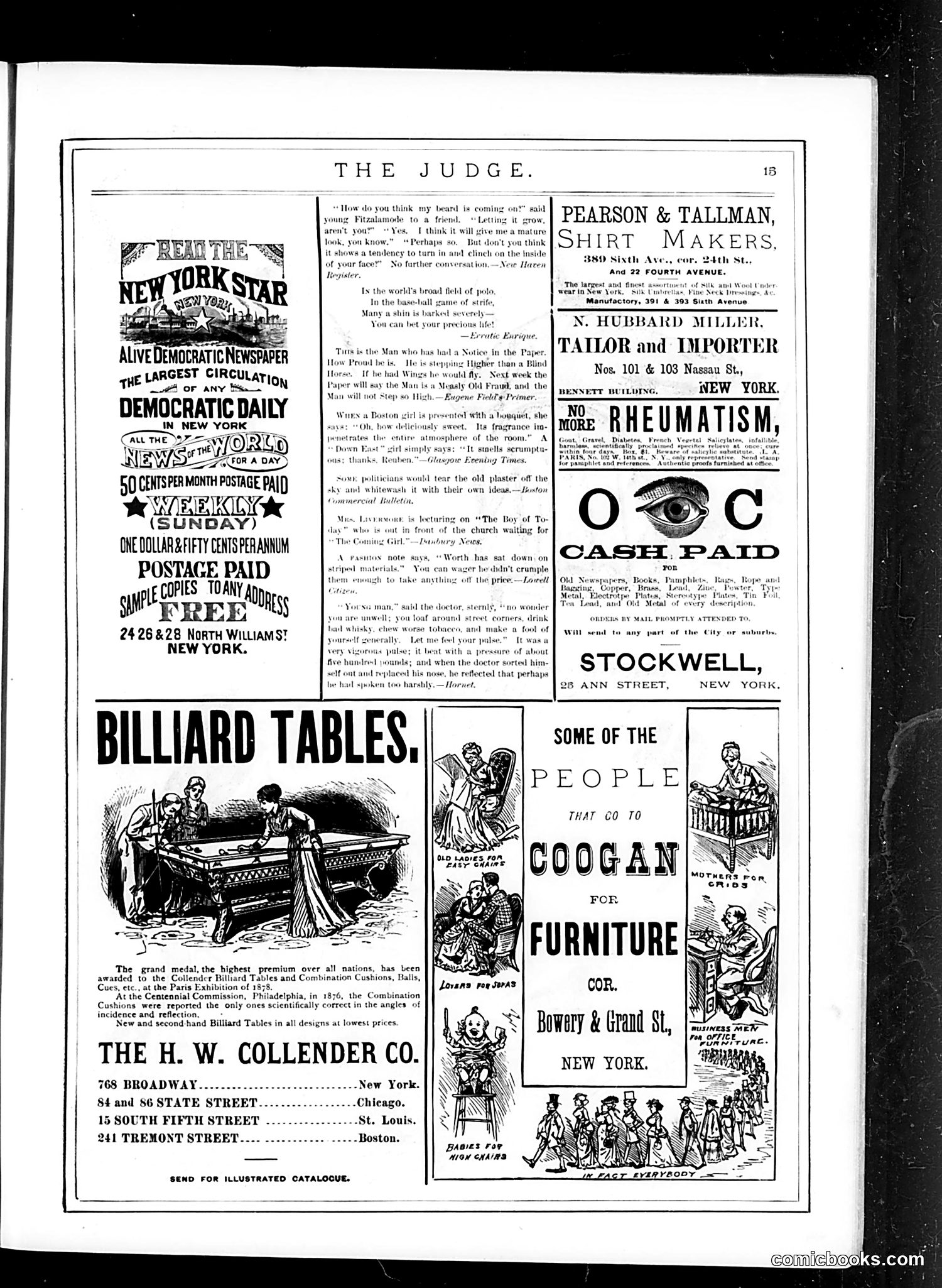
This page is primarily **advertisements**, not editorial content or cartoons. It shows business promotions for 1870s-80s New York establishments—shirt makers, tailors, importers, and billiard table manufacturers. The single visual element with satirical intent is the Coogan Furniture advertisement, which uses stereotyped character sketches (mothers, babies, working men) in Victorian illustrative style. The point appears gentle and commercial rather than politically sharp—advertising that furniture serves "people" from mothers to working-class figures. The New York Star masthead advertises itself as an "alive Democratic newspaper" with the largest circulation, typical era boasting. Overall, this is a commercial page showing what businesses advertised in Judge magazine, with minimal political satire or editorial commentary visible.
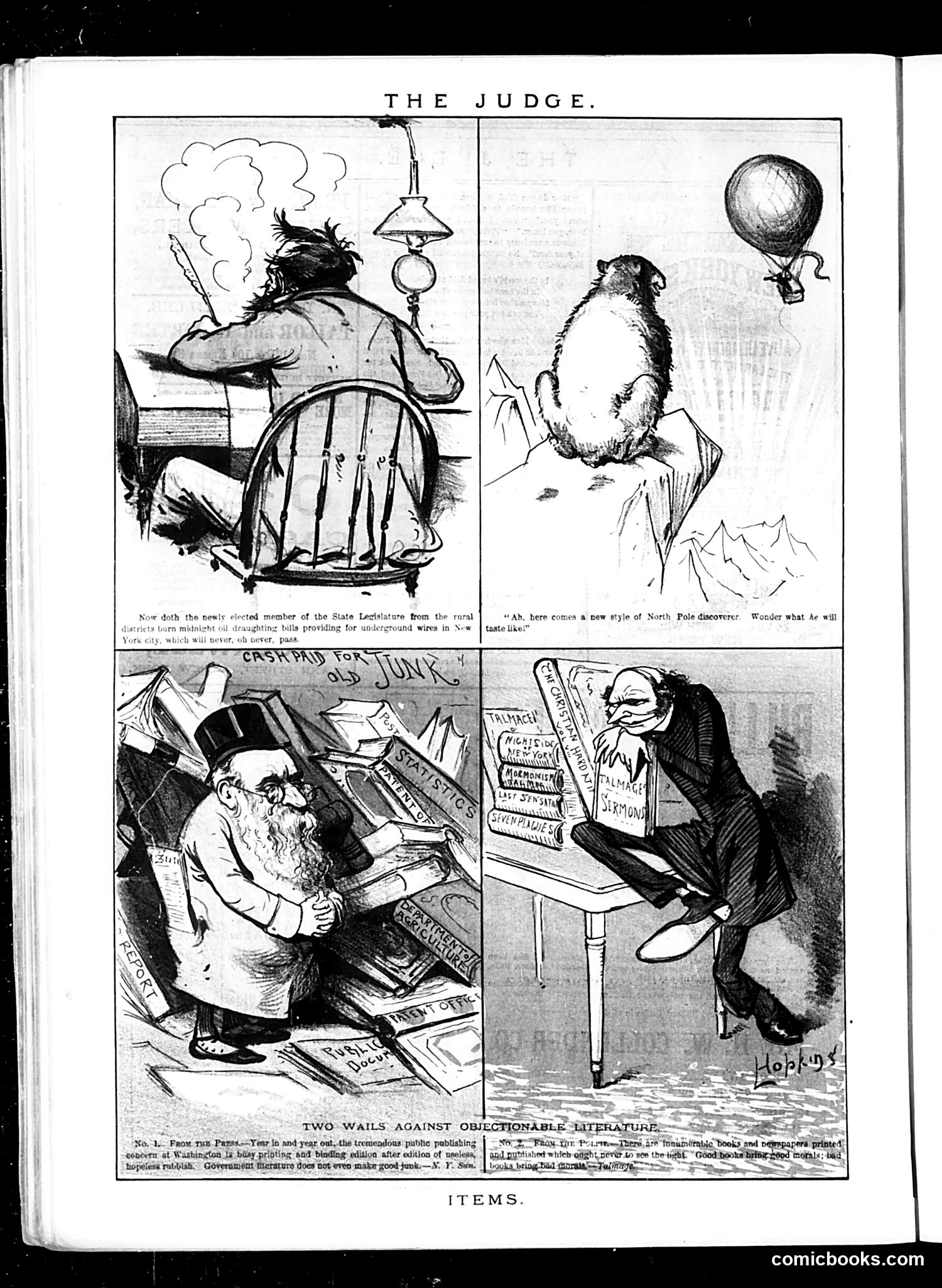
This page satirizes wasteful government printing practices and political incompetence. The top panels mock a newly elected rural legislator arriving in Washington with inflated expectations (shown with a hot air balloon), contrasted with a North Pole explorer—suggesting both are similarly out of their depth. The bottom panels depict "Two Wails Against Objectionable Literature." The left shows a bearded figure amid government publications labeled "junk," criticizing Washington's wasteful printing and binding of useless official documents. The right panel shows an official examining stacks of government literature, implying bureaucratic excess. The cartoon's point: government wastes taxpayer money printing worthless materials, and newly elected rural politicians are equally ill-equipped for their roles. The satire targets both governmental inefficiency and the quality of elected representatives from rural areas.