
Judge, 1881-12-03 · page 12 of 16
Judge — December 3, 1881 — page 12: what you’re looking at
What you’re looking at
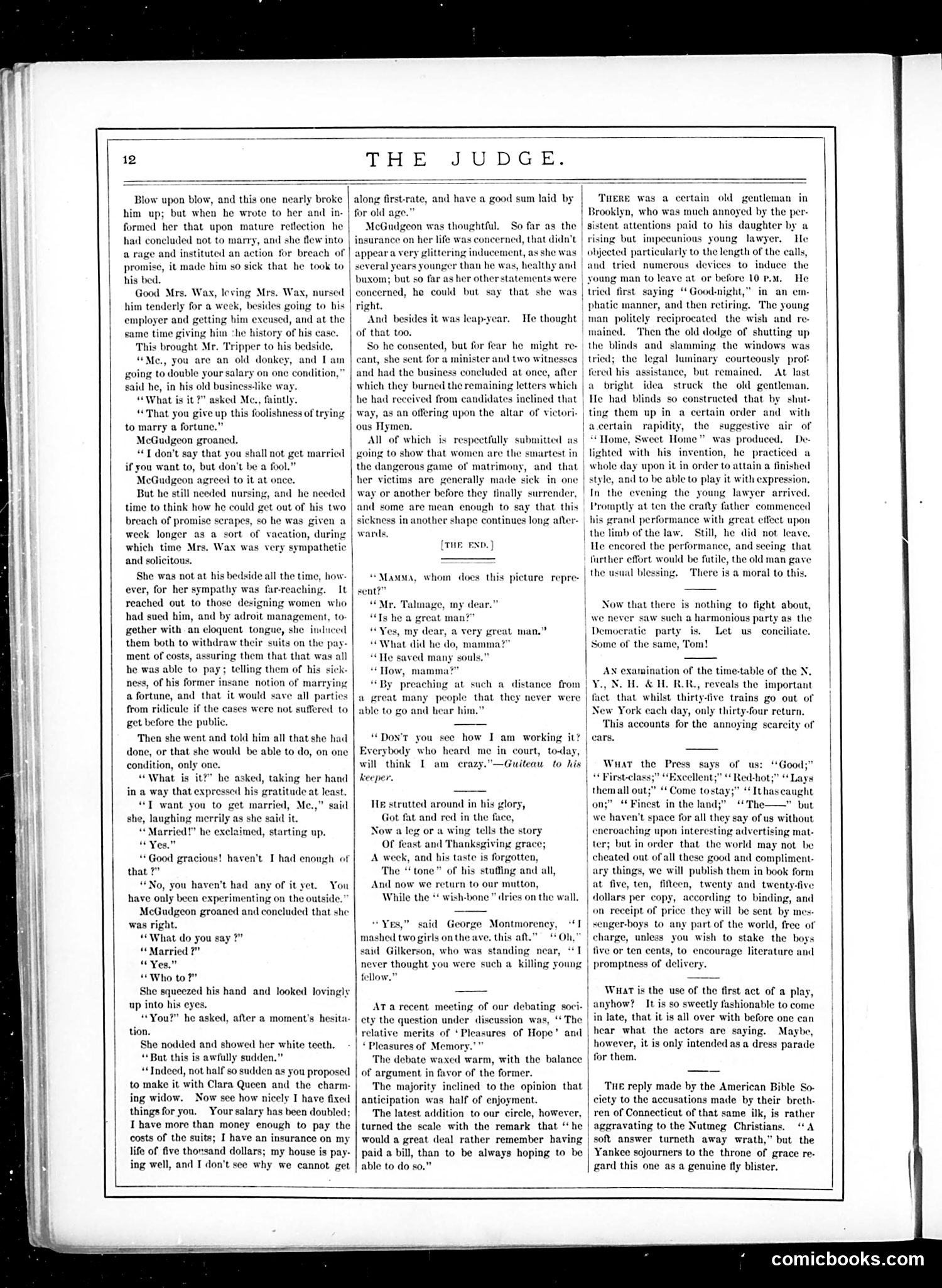
This page presents a serialized comic narrative about McGudgeon, a man who foolishly pursues wealthy women for marriage. After two breach-of-promise lawsuits nearly ruin him, his employer Mr. Tripper doubles his salary on condition he abandon fortune-hunting. McGudgeon's sympathetic nurse, Mrs. Wax, secretly settles both lawsuits, then proposes marriage to him herself—revealing she has her own money, insurance, and owns property. Desperate and grateful, McGudgeon agrees. **The satire targets**: Male fortune-hunters who pursue women for money, and conversely, demonstrates how women (presented here as strategically intelligent) manipulate men through sympathy and self-interest to achieve their own matrimonial goals. The "leap-year" reference (when women traditionally propose) adds comic timing. The story celebrates Mrs. Wax's cleverness in outmaneuvering McGudgeon's schemes through superior cunning—a common Judge theme satirizing gender relations and marriage market dynamics of the era.
📄 Transcribed text from this page (OCR, searchable)
Machine-transcribed from the original scan — historical spelling and the odd misread are preserved.
Blow upon blow, and this one nearly broke him up; but when he wrote to her formed her that upon mature retlection he had concluded not to marry, and she flew into a rage and instituted an action for breach of promise, it made him so sick that he took to his bed. Good Mrs. Wax, levin; him tenderly for a week, be employer and getting him excused, and at the same time giving hin che history of his case. This brought Mr. Tripper to his bedside. “Me, you are an old donkey, and I going to double your salary on one condition,” id he, in his old business-like way. “What is it?” asked Mc., faintly. “That you give up this foolishness of trying to marry a fortune.” McGudgeon groaned. “T don’t say that you shall not get married if you want to, but don’t be a fool.” McGudgeon agreed to it at once. But he still needed nursing, and he needed time to think how he could get out of his two breach of promise scrapes, so he was given a week longer as a sort of vacation, during which time Mrs. Wax was very sympathetic and solicitous, Mrs. Wax, nursed les going to bis m She was not at his bedside all the time, how- ever, for her sympathy was far-reaching. It reached out to those designing women who had sued him, and by adroit management, to- gether with an eloquent tongue, she induced them both to withdraw their suits on the pay- ment of costs, assuring them that that was all | he was able to pay; telling them of his sick- ness, of his former insane notion of marrying a fortune, and that it would save all p from ridicule if the cases were not suffe! get before the public. ‘Then she went and told him all that she had done, or that she would be able to do, on one condition, only one. “What is he asked, taking her hand in a way that expressed his gratitude at least. “T want you to get married, Me.,” said she, laughing merrily as she said it. ‘* Married!” he exclaimed, s “Yes.” “Good gracious! haven't I had enough of that 7” “No, you haven't had any of it yet. You have only been experimenting on the outside. McGudgeon groaned and concluded that she was right. What do you say ?” “Married 2” “Yes.” “Who to?” She squeezed his hand and looked lovingly up into his eyes. “You?” he asked, after a moment's hesita- tion. She nodded and showed her white teeth. “But this is awfully sudden.” “Indeed, not half so sudden as you proposed to make it with Clara Queen and the charm- ing widow. Now sce how nicely I have fixed things for you. Your salary has been doubled: I have more than money enough to pay the costs of the suits; I have an insurance on my life of five thonsand dollars; my house is pay- rting up. ing well, and I don't see why we cannot get and in- | fe McGuigeon was thoughtful. So far as the insurance on her life ¥ erned, that didn’t appeara very glittering inducement, as she w several y than he was, healthy and buxom; but so far as her other statements were rned, he could but say that she cont ars young, cone right. ‘And. besides it was leap-year. of that too. So he consented, but for fear he might re- cant, she sent for a minister and two witnesses and had the business concluded at once, after which they burned the remaining letters which he had received from candidates inclined that way, as an offering upon the altar of viete ous Hymen. All of which is respectfully submit going to show that women are the smartest in the dangerous game of matrimony, and that her victims are generally made sick way or another before they finally surrender, and some are mean enough to say that this sickness in another shape continues long after- wards. was. He thought in one (THE END. “Mamata, whom does this picture repre: sent ir. Talmage, my dear.” “Ts he a great man?” “Yes, my dear, a very great man.” “What did he do, mamn “He saved many souls. ‘How, mamma ‘By preaching at such a di from a great many people that they never were able to go and hear him.” “Dox'T you see how I am working it? Everybody who heard me in court, toa will ‘think I am crazy."—Guiteau keeper. cra to his He strutted around in his glory, Got fat and red in the face, Now a leg or a wing tells the story Of feast and Thanksgiving grace; A week, and his taste is forgotten, ‘The ‘‘tone” of his stuffing and all, And now we return to our mutton, While the * wish-bone " dries on the wall. ~ Yes,” id George Montmorency, “1 mashed two girls onthe ave. this at.” “Oh, said Gilkerson, who was standing near, “1 never thought you were such a killing young | fellow.” AT arecent meeting of our debating soci- ety the question under discussion was, ‘ The e merits of ‘Pleasures of Hope’ and ‘ Pleasures of Memory.’” The debate waxed warm, with the balance of argument in favor of the former. ‘The majority inclined to the opinion that anticipation was half of enjoyment. The latest addition to our circle, however, turned the scale with the remark that ‘he would a great «eal rather remember having paid a bill, than to be always hoping to be | able to do so.” | Tuere was a certain old gentleman in Brooklyn, who was much annoyed by the per- sistent attentions paid to his daughter by a | rising but impecunious young lawyer. He objected particularly to the length of the calls, tried numerous devices to induce the young man to leave at or before 10 pw. He | tried first. saying “Good-night,” in an em- | phatic manner, and then retiring. ‘The young man politely reciprocated the wish and re- mained, Then the old dodge of shutting up the blinds and slamming the windows was tried; the legal luminar purteou: prof. | tered his assistance, but remained, At last a bright idea struck the old gentleman. Me had blinds so constructed that by shut- ting them up in a certain order and with |acertain rapidity, the suggestive air of Home, Sweet Home" was produced, De- lighted with his invention, he practiced a whole day upon it in order to attain a finished style, and to be able to play it with expression, In the evening the young lawyer arrived. Promptly at ten the crafty father commenced his grand performance with great effect upon the limb of the law. Still, he did not leave. He encored the performance, and seeing that | further effort would be futile, the old man gave the usual blessing. There is a moral to this. and Now that there is nothing to fight about, | we never saw such a harmonious party as the Democratic party is. Let us conciliate. Some of the same, Tom! AN examination of the time-table of the N. Y., NL H. & H. RR. rev ct that whilst thirty-live trains go out of sw York cach day, only thirty-four return, This accounts for the annoying scarcity of cars. Is the important Wuat the Press says of us: ‘Good;” “* First-class;” “Excellen “Red-hot;” “Lays them all out;” “Come tostay;” “Ithaseaught “Finest in the land; “‘The——" but 't space for all they say of us without encroaching upon interesting advertising mat- ter; but in order that the world may not be cheated out of all these good and compliment- ary things, we will publish them in book form at five, ten, fifteen, twenty and twenty-five dollars per copy, according to binding, and on receipt of price they will be sent by mes- senger-boys to any part of the world, free of charge, unless you wish to stak five or ten cents, to encoura promptness of delivery. on;” | we hay the boys literature and Wuat is the use of the first act of a play, anyhow? It is so sweetly fashionable to come in late, that it is all over with before one can _ hear what the actors are saying. Maybe, | however, it is only intended as a dress parade | for them. Tue reply made by the American Bible So- ciety to the accusations made by their breth- ren of Connecticut of that same ilk, is rather | aggravating to the Nutmeg Christians. “A | soft answer turneth away wrath,” but the Yankce sojourners to the throne of grace re- gard this one as a genuine fly blister. comicbooks.com