
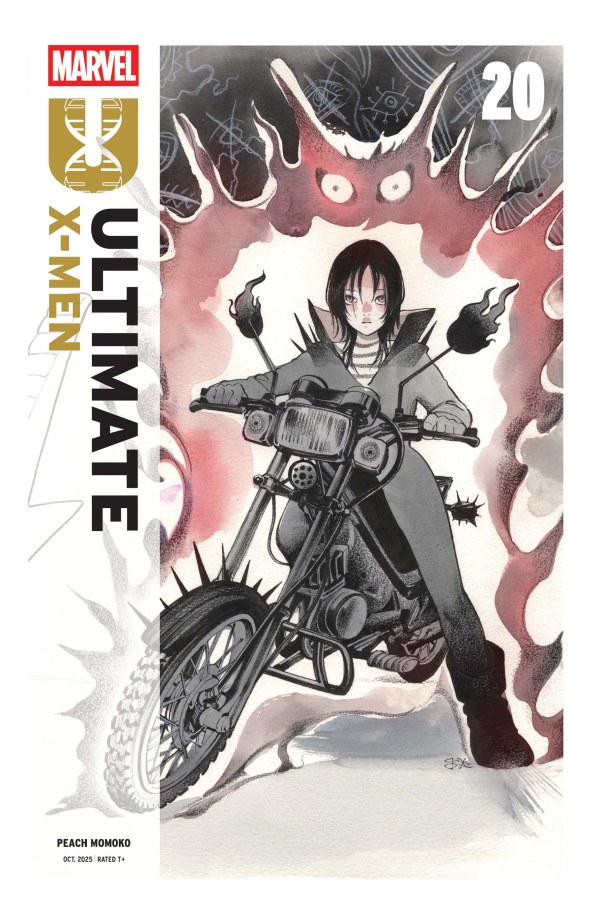
Ultimate X-Men #20
☆ Be the first to review + Add to your collection — Join freeUltimate X-Men #20 marks a meaningful creative milestone as the twentieth installment of Peach Momoko's radical reimagining of the X-Men franchise — a series that deliberately shed nearly every classic X-Men convention in favor of a Japanese school-horror aesthetic set entirely in a contemporary Japan steeped in urban legend and body-horror dread. The issue serves as a pivot point between the climax of the Children of the Atom arc and the looming threat of Sun-Emperor Sunfire's anti-mutant political campaign, escalating the series' central tension — the societal persecution of young mutants in Asia — into direct confrontation with state-level power through the menacing figure of Viper. As the first issue to place Kanon Sainouchi (the Ultimate Psylocke) and Viper in extended conflict while simultaneously questioning Armor's fate on the astral plane, #20 deepens Momoko's most original contribution to the X-Men mythology: a cast of entirely new or radically reconceived characters whose struggles with identity, fear, and public exposure resonate far beyond the superhero genre.
ComicBooks.com Value
This exact issue on ebay
Raw — NM ▾ $4.49–$6 3 listings
Raw / ungraded ▾ $4.49–$23.99 13 listings
- Arcane Comics · Shoreline, WA1 on eBay ↗
- CollegeComix.com · Athens, GA1 on eBay ↗
- JAF Comics · Bethlehem, PA1 on eBay ↗
Read it digitally
Sell my copy
Have this issue — or a whole collection? Get a fair offer from us, skip the marketplace fees and the hassle.
We Buy Collections ▸History
Ultimate X-Men Vol. 2 launched in March 2024 as the third title in Marvel's rebooted Ultimate Universe line — following Ultimate Spider-Man and Ultimate Black Panther — with writer-artist Peach Momoko and script adaptor Zack Davisson at the helm. Momoko has stated she was approached by Editor-in-Chief C.B. Cebulski at the Marvel Art Atelier program in Disneyland Paris, and that Jonathan Hickman and Cebulski intentionally gave her an unusually wide creative latitude, essentially offering the premise of 'What if X-Men, but in Japan?' with an entirely fresh roster. Momoko has publicly cited Japanese manga, body horror, and horror cinema as her primary creative touchstones for the series, while the Marvel Database wiki notes the broader series drew inspiration from anime such as Puella Magi Madoka Magica and Serial Experiments Lain, as well as Kamen Rider and Devilman. Issue #20, published October 1, 2025, was edited by Wil Moss (with Michelle Marchese as assistant editor) and lettered by Travis Lanham, maintaining the same core creative team that has shepherded the series from its debut.
Trivia · 8 facts
- Published October 1, 2025 by Marvel Comics; written and illustrated by Peach Momoko with script adaptation by Zack Davisson, lettering by Travis Lanham, and editing by Wil Moss.
- Issue #20 is the opening chapter of the story arc collected in Ultimate X-Men by Peach Momoko Vol. 4: Children's Whereabouts (collecting #19–24 plus an Ultimate Universe: Finale story).
- The issue functions as a post-arc regroup chapter following the climactic battle against the Children of the Atom, centering on the unresolved question of Armor's fate after she pursued Shadow King (Kageyama) into the astral plane.
- Key Collector Comics identifies this issue as the introduction of Ultimate Viper — the Sun-Emperor Sunfire's assassin and operative — making it a first-appearance issue for that Ultimate Universe version of the character.
- Kageyama receives a redesigned visual form in this issue that reviewers noted is a deliberate homage to Shadow King's classic design, giving the character a distinct look that sets him apart from previous Shadow King iterations across Marvel's publishing history.
- The political storyline escalates here as Sun-Emperor Shiro Yoshida publicly broadcasts anti-mutant messaging directed specifically at 'children of the future' born in Asia, directly mirroring real-world fears of minority persecution and tying the series' horror register to socio-political allegory.
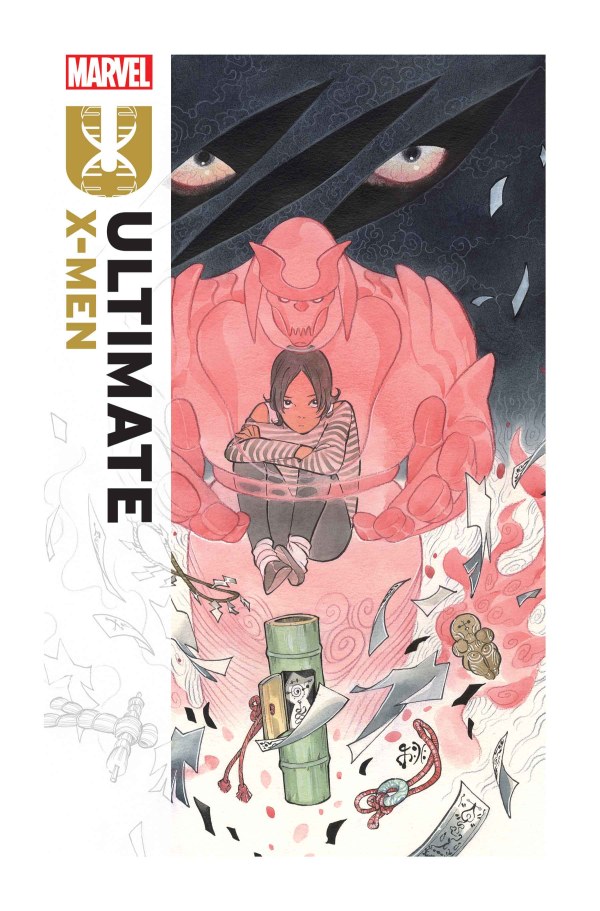
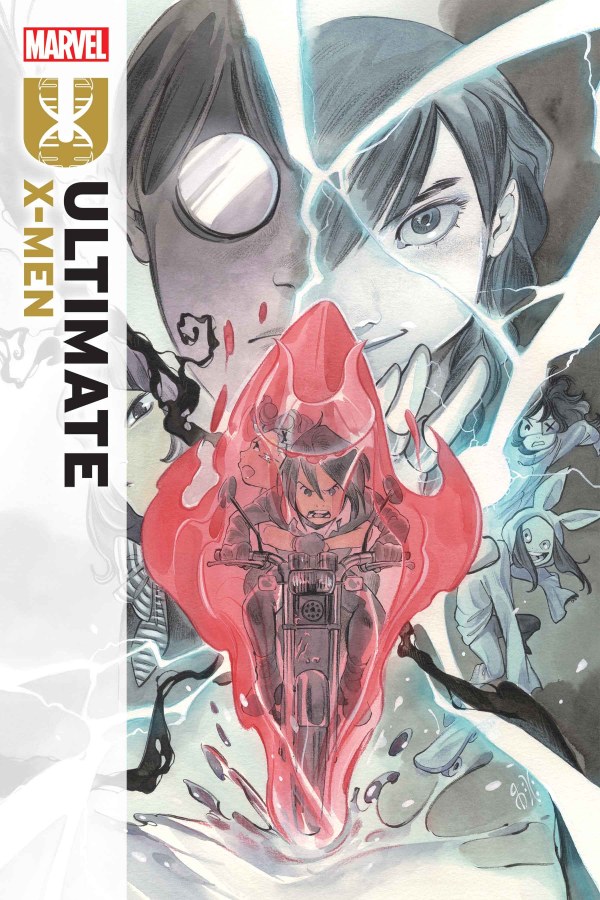
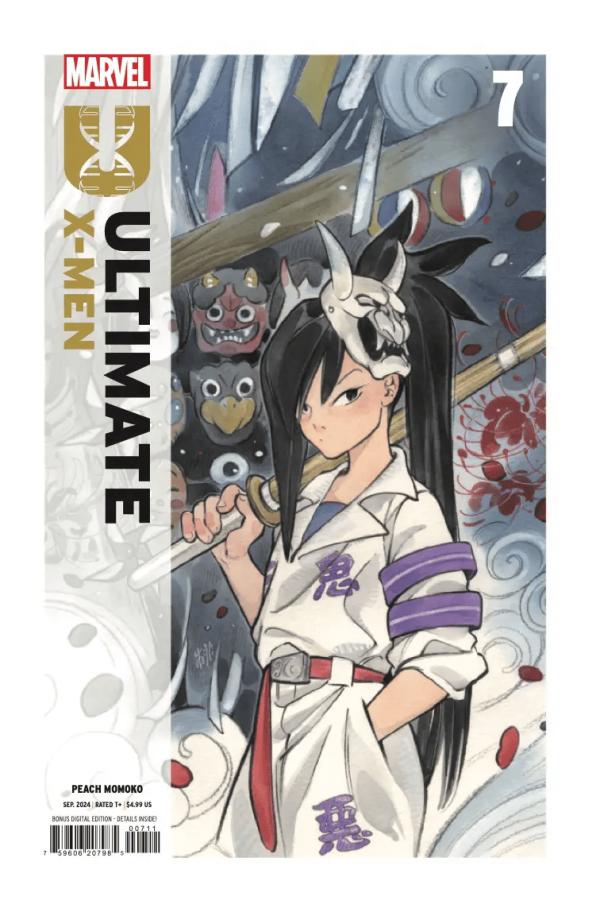
- The issue ships with four cover editions: the standard Peach Momoko cover, a Lee Garbett variant, a 1:25 Elizabeth Torque variant, and a Peach Momoko variant — consistent with the series' practice of multiple retail incentive editions.
- The series as a whole was noted by critics and scholars as one of the few mainstream superhero comics to authentically center Japanese cultural frameworks — urban legends, school life, Sukeban youth subculture — rather than treating Japan as mere exotic backdrop, with this issue continuing that approach through Kanon Sainouchi's Sukeban characterization.
Cast · 40 characters
Full credits
Key issues in Ultimate X-Men
Variants (3)
Reviews
Reader reviews
No reader reviews yet.