
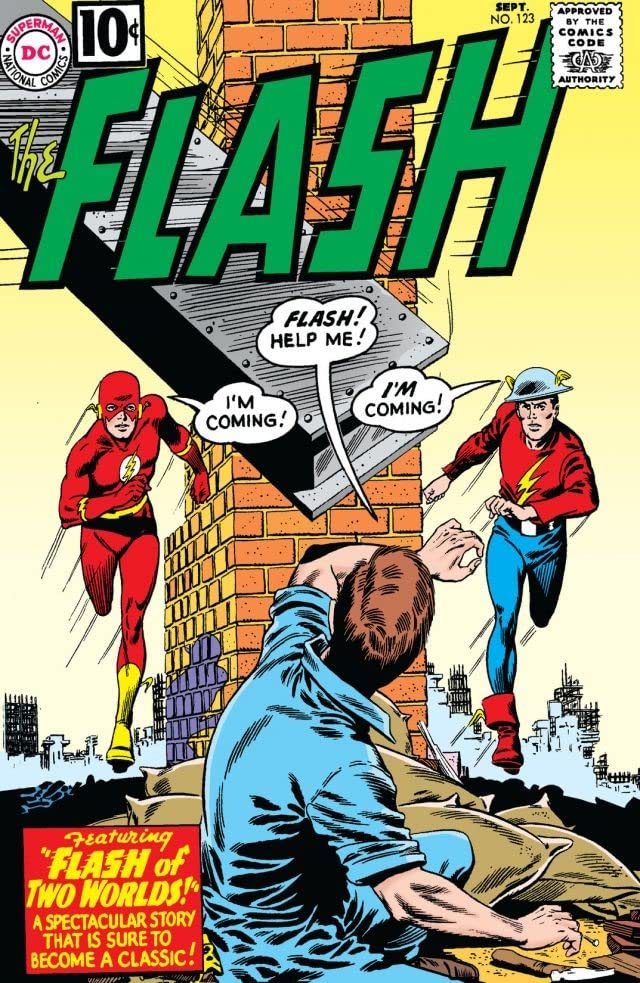
The Flash #123
☆ Be the first to review + Add to your collection — Join free"Flash of Two Worlds" is the single issue most responsible for establishing the concept of a DC Multiverse: by having Silver Age Barry Allen accidentally vibrate through a dimensional barrier into the world of Golden Age Jay Garrick, writer Gardner Fox introduced the framework of parallel Earths existing at different vibrational frequencies — a structural idea that would underpin DC storytelling for the next quarter-century and beyond. The story also executed the first meeting between a Silver Age hero and their Golden Age counterpart, rescuing Jay Garrick from continuity oblivion and setting a precedent for the legacy-hero tradition that defines DC to this day. Its metafictional conceit — that Earth-One's Gardner Fox unconsciously dreamed Jay Garrick's real adventures and published them as comics — planted a seed that writers like Grant Morrison would later cultivate into the fully self-aware multiverse narratives of The Multiversity. The annual Justice League/Justice Society crossovers that followed directly from this issue, beginning with Justice League of America #21 (1963), became one of the defining editorial traditions of the Silver Age.
In "Flash of Two Worlds! [Chapter 1]," Barry Allen finds himself unexpectedly whisked from Central City to the mysterious Keystone City—home of the original Flash, Jay Garrick—after a routine performance. As the two speedsters meet, Barry begins to piece together the staggering truth: Jay exists on a parallel Earth, a concept rooted in the very stories Gardner Fox once wrote in the 1940s. With a crime wave threatening Keystone, the pair must join forces, setting the stage for an unprecedented crossover. The story is illustrated by Carmine Infantino with inks by Joe Giella and lettering by Gaspar Saladino, while the cover by Carmine Infantino and Murphy Anderson captures the moment of their first meeting.
In "Flash of Two Worlds! [Chapter 1]," Barry Allen, the modern Flash of Central City, finds himself unexpectedly whisked to Keystone City during a children's show—only to meet the original Flash, Jay Garrick, who lives on a parallel Earth. As the two speedsters confront a sudden crime wave in Jay’s city, Barry begins to grasp the staggering truth of their shared legacy across different realities.
In "Flash of Two Worlds! Chapter 3," the newly united Jay Garrick and Barry Allen face off against the Fiddler, their combined speed and strategy putting the villain on the defensive. Meanwhile, the Shade and the Thinker, analyzing the situation, realize their ally is now being pursued by not one, but two Flashes—setting the stage for a clash of wits and speed across the multiverse.
ComicBooks.com Value
Show all 21 grades ▾
This exact issue on ebay
CGC 7 ▾ $3,750–$4,208 2 listings
CGC 6.5 ▾ $1,800–$1,995 2 listings
CGC 1 ▾ $435–$450 2 listings
Raw / ungraded ▾ $92–$1,200 5 listings
Read it digitally
Sell my copy
Have this issue — or a whole collection? Get a fair offer from us, skip the marketplace fees and the hassle.
We Buy Collections ▸History
The issue originated from penciller Carmine Infantino's practice of designing challenging, seemingly impossible cover images for writer Gardner Fox to construct stories around; Infantino produced a cover showing both Barry Allen and Jay Garrick racing side-by-side to save the same person, and Fox resolved the logical problem — Jay had been established as a fictional character in Barry's world — by borrowing the concept of parallel Earths from contemporary science fiction. Editor Julius Schwartz guided the project, and the interior art was pencilled by Infantino and inked by Joe Giella, while the cover inks were supplied by Murphy Anderson. The issue went on sale on or around July 18, 1961 (per the U.S. Copyright Office record), carried a cover date of September 1961, and won the fan-voted 1961 Alley Award for Best Single Issue.
Trivia · 9 facts
- Story title: 'Flash of Two Worlds!' — Written by Gardner Fox, pencilled by Carmine Infantino, inked by Joe Giella; cover pencilled by Infantino and inked by Murphy Anderson, under editor Julius Schwartz.
- First Silver Age appearance of Jay Garrick (Golden Age Flash), reintroducing the character to active continuity after roughly a decade of absence following the cancellation of Flash Comics.
- Introduces the concept of Earth-Two (referred to as a parallel Earth in this issue; not formally named 'Earth-Two' until Justice League of America #21, August 1963) and establishes the DC Multiverse framework of parallel worlds vibrating at distinct frequencies.
- First Silver Age appearances of three classic Golden Age Flash villains: the Thinker (Clifford DeVoe), the Fiddler (Isaac Bowin), and the Shade (Richard Swift) — all former foes of Jay Garrick who have reunited to plague Keystone City.
- The issue introduces the metafictional device in which Earth-One writer Gardner Fox is depicted as having written the Golden Age Flash comics by unconsciously 'tuning in' to the real events of Earth-Two — a concept later central to Grant Morrison's The Multiversity.
- The cover composition — both Flashes separated by a wall, racing toward the same endangered man — became one of the most referenced and homaged images in DC history, cited in Flash #147 (1964), Flash vol. 2 #123 (1997), Flash: Rebirth #5 (2010), and numerous others.
- Won the 1961 Alley Award for Best Single Issue (awarded 1962), one of comics' earliest fan-voted honors.
- Reprinted extensively, including: 80-Page Giant #9, The Flash Archives Vol. 3, Showcase Presents: The Flash Vol. 2, DC Comics Classics Library: The Flash of Two Worlds (2009), The Flash Chronicles Vol. 4, The Flash Omnibus Vol. 1, The Flash: A Celebration of 75 Years, The Flash: 80 Years of the Fastest Man Alive Deluxe Edition (2019), and multiple DC Facsimile Editions (2020, 2022, 2024). The story was also referenced and revisited in Final Crisis #2 (2008) and directly inspired the Post-Crisis retelling in Secret Origins vol. 2 #50.
- The issue was featured in the September 28, 2009 episode of The Big Bang Theory ('The Jiminy Conjecture'), in which the copy figures as a plot device.
Cast · 25 characters
Full credits
Reprints
Reprinted in Super Albo Nembo Kid #20 (1962), Flash #41 (1962), Batman #176 (1963), 80 Page Giant Magazine #9 (1965), Flits Classics #2610 (1970), The Greatest Team-Up Stories Ever Told #[nn] (1989), The Greatest Team-Up Stories Ever Told #[nn] (1990), DC Comics: Sixty Years of the World's Favorite Comic Book Heroes #[nn] (1995), Millennium Edition: The Flash Vol. 1, #123 #[nn] (2000), The Flash Archives #3 (2002), Crisis on Multiple Earths: The Team-Ups #1 (2006), Flash: The Greatest Stories Ever Told #[nn] (2007), Showcase Presents: The Flash #2 (2008), DC Comics Classics Library: The Flash of Two Worlds #[nn] (2009), Justice League: Cry for Justice #6 (2010), DC Comics Anthologie #[nn] (2012), The Flash Chronicles #4 (2013), Adventures of Superman #1 (2013), Batgirl #20 (2013), Batman Beyond Unlimited #16 (2013), Batman Incorporated #11 (2013), Batman: The Dark Knight #20 (2013), Batman: The Dark Knight Annual #1 (2013), Batwoman #20 (2013) + 27 more
Key issues in The Flash
Reviews
Reader reviews
No reader reviews yet.