
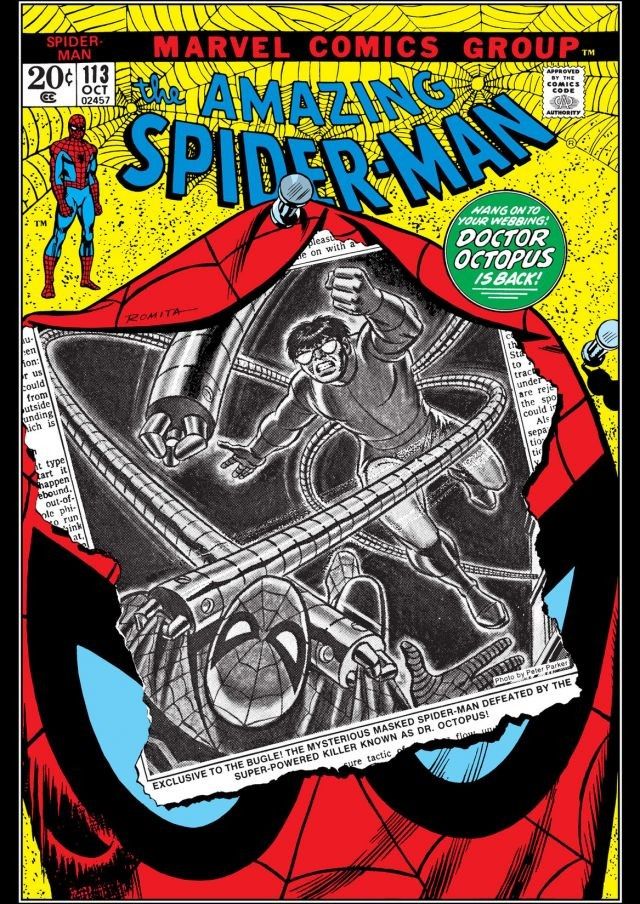
The Amazing Spider-Man #113
☆ Be the first to review + Add to your collection — Join freeThe Amazing Spider-Man #113 (October 1972) is a foundational Bronze Age key because it introduces Hammerhead, a Maggia crime boss whose metal-reinforced skull and retro-gangster persona made him one of the most distinctive additions to Spider-Man's rogues' gallery since the Kingpin. The issue also marks the very beginning of Gerry Conway's celebrated run as writer — a tenure that would go on to reshape Spider-Man mythology through the death of Gwen Stacy and the creation of the Punisher. By weaving a New York underworld gang war between Hammerhead and Doctor Octopus through the lens of Peter Parker's very human stress and illness, Conway and John Romita Sr. pushed the series toward a grittier, more grounded storytelling mode that defined the Bronze Age of comics. The simultaneous debut of Jonas Harrow — the unlicensed surgeon who transformed Hammerhead — added a recurring mad-science character to Marvel's street-crime corner, further enriching the book's world-building.
ComicBooks.com Value
Show all 19 grades ▾
This exact issue on ebay
CGC 9.8 ▾ $7,200–$8,250 3 listings
CGC 9.4 ▾ $450–$650 2 listings
CGC 9 ▾ $235–$325 2 listings
CGC 8.5 ▾ $155–$225 2 listings
CGC 7.5 ▾ $113–$250 2 listings
CGC 7 ▾ $100–$130 3 listings
CGC 6.5 ▾ $50–$120 4 listings
CGC 5.5 ▾ $79.99–$95 2 listings
Raw — VF/NM ▾ $185–$199 2 listings
Raw — FN/VF ▾ $79.76–$80.44 2 listings
Raw — FN+ ▾ $35–$100 4 listings
Raw — FN ▾ $29.95–$78 12 listings
Raw — FINE ▾ $29.99–$40.99 2 listings
Raw — VG+ ▾ $31.99–$47.99 4 listings
Raw / ungraded ▾ $18–$250 51 listings
Read it digitally
Sell my copy
Have this issue — or a whole collection? Get a fair offer from us, skip the marketplace fees and the hassle.
We Buy Collections ▸History
When Stan Lee stepped back from scripting The Amazing Spider-Man to take on his new role as Marvel's publisher, 19-year-old Gerry Conway inherited the flagship title at a moment of enormous editorial transition, with Roy Thomas becoming editor-in-chief and John Romita Sr. already serving as Conway's artistic collaborator for his opening issues. Conway later recalled that Hammerhead was directly inspired by the 'Big Man' and 'Crime-Master' tradition of Dick Tracy-style villains with exaggerated physical gimmicks — a lineage he consciously wanted to continue — while Romita Sr. designed the character's distinctive flat-skulled silhouette. The issue was edited by Roy Thomas, lettered by Artie Simek, and received additional inking from Tony Mortellaro and Jim Starlin, reflecting the collaborative bullpen workflow typical of early-1970s Marvel production.
Trivia · 8 facts
- First appearance of Hammerhead (real name unrevealed), a Maggia enforcer whose skull was surgically reinforced with a steel alloy by the rogue scientist Jonas Harrow, giving him a flat-topped head and a near-indestructible cranium he wields as a battering ram.
- First appearance of Jonas Harrow, the disgraced surgeon who performed Hammerhead's transformation and who would recur as a behind-the-scenes criminal mastermind in subsequent Conway and Len Wein stories.
- Written by Gerry Conway (his early issues on the title), penciled and inked by John Romita Sr., with additional inks by Tony Mortellaro and Jim Starlin; edited by Roy Thomas; lettered by Artie Simek.
- Story title: 'They Call the Doctor…Octopus!' Cover-dated October 1972; part of the three-issue gang-war arc spanning Amazing Spider-Man #113–115.
- Doctor Octopus unmasks Spider-Man mid-battle; the mask is later recovered by Randy Robertson, who passes it to his father Robbie Robertson, who pins it to the Daily Bugle bulletin board — a street-level identity-threat subplot that runs through the arc.
- Peter Parker is diagnosed with an ulcer during this issue, a rare moment of medically grounded physical consequence for the hero driven by chronic stress and sleeplessness.
- Hammerhead's origin, revealed across issues #113–114, hinges on an amnesiac thug who awakens from Harrow's surgery fixated on a gangster movie poster depicting Al Capone-era criminals — the source of his entire retro identity and speech patterns.
- The story was reprinted domestically in Marvel Tales #92 (June 1978) and internationally in multiple editions including Super Spider-Man (Marvel UK) #162 (March 1976) and Strange (Editions Lug) #100 (April 1978), attesting to its reach across the early Bronze Age reprint market.
Full credits
Reprints
Reprinted in L'étonnant Spider-Man #15 (1972), El Sorprendente Hombre Araña #143 (1972), Edderkoppen #3/1973 (1973), Hit Comics Die Spinne #250 (1973), Super Spider-Man #162 (1976), Strange #100 (1978), Marvel Tales #92 (1978), Spindelmannen #7/1979 (1979), Edderkoppen #7/1979 (1979), El Hombre Araña / El Asombroso Hombre Araña #109 (1982), Eks almanah #400 (1984), L'Uomo Ragno Classic #32 (1993), L'Uomo Ragno Classic #33 (1993), Spiderman de John Romita #49 (2003), Spider-Man kæmpepocket #2 (2005), Amazing Spider-Man Family #2 (2008), Marvel Masterworks: The Amazing Spider-Man #12 (2010), Amazing Spider-Man Epic Collection #7 (2017), The Amazing Spider-Man Omnibus #4 (2019), Die Spinne #114, El Asombroso Hombre-Araña #18, L'Uomo Ragno [Collana Super-Eroi] #114, O Homem-Aranha #52, Σπάιντερ Μαν [Spider-Man] #276 + 3 more
Key issues in The Amazing Spider-Man
 ★
★ ★
★ ★
★ ★
★ ★
★ ★
★ ★
★ ★
★Variants (1)
Reviews
Reader reviews
No reader reviews yet.