
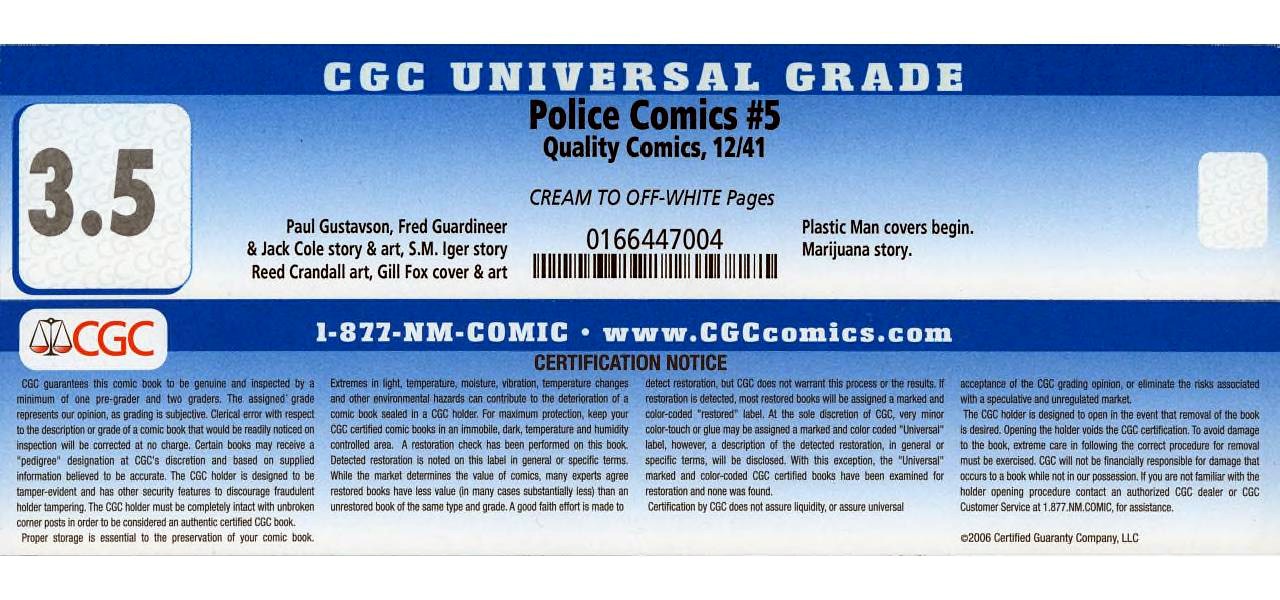
Police Comics #5
☆ Be the first to review + Add to your collection — Join freePolice Comics #5 (cover-dated December 1941, on sale October 10, 1941) marks the single most decisive editorial turning point in the early run of the title: Quality Comics pulled Firebrand off the cover and handed the spotlight to Jack Cole's Plastic Man, a promotional shift that signaled — permanently — which character had captured reader imagination. Plastic Man would hold that cover position through issue #102, a nine-year stretch that cemented him as one of Golden Age comics' most distinctive creations and eventually earned him a decades-long life at DC Comics. The issue is also notable for the first appearance of the Brick Bat, the inaugural masked villain faced by the prison-bound hero #711, expanding Quality's already rich gallery of supporting features. Taken together, the issue captures the Golden Age anthology format at full throttle: wartime espionage (Firebrand), surrealist comedy-action (Plastic Man), and costumed crimefighting operating under genuinely unusual constraints (#711 literally fighting crime from inside a prison cell).
In Police Comics #5 (1941), a prison trustee named Dyce—granted unusual freedoms due to his model behavior—finds himself caught between the law and a new kind of menace. When he encounters the masked criminal known as The Brick Bat, a man wielding a deadly gas-filled brick, his access to the prison’s daily news becomes a crucial clue in a mystery that blurs the line between justice and danger. Written, drawn, and inked by George Brenner, this story features a striking cover by Gill Fox.
In the shadowed halls of a model prison, inmate Dyce earns rare privileges—access to the office, the news, and the freedom to move between walls. But when he slips out under cover of night, he stumbles into a dangerous new world, facing his first masked adversary: The Brick Bat, a criminal wielding a deadly weapon designed to kill with a single, gas-filled strike.
In "The Return of Madam Brawn," the cigar-chomping villain makes a defiant comeback, only to meet a sudden end when Gassin Gert's gas gun sends her crashing onto a spike—just before Plas reveals his secret identity to her.
Super Snooper tangles with an unexpected breakfast catastrophe when a villainous scheme goes hilariously sideways. The Yegg Beater has cooked up a nasty plan involving explosive eggs, but our bumbling hero's knack for stumbling through danger—and his casual approach to food—turns the tables in the most ridiculous way possible.
In "The Madness of Professor Snook," the Mouthpiece hunts a ruthless gang led by the enigmatic Professor Snook, who vanished into the shadows after leaping from a castle wall rather than face capture. The mystery deepens as the detective follows a trail of chaos through the crumbling fortress, where every clue seems to whisper madness.
Burp the Twerp crashes a boxing exhibition when a mysterious fighter called Suicide Sam challenges anyone in the crowd to go five rounds for a $500 prize—and the old scrapper sees an opportunity he can't pass up. What unfolds is a fast-paced fight night surprise that leaves Burp declaring himself a victim of his own cunning.
ComicBooks.com Value
Show all 21 grades ▾
Find on ebay
Read it digitally
Sell my copy
Have this issue — or a whole collection? Get a fair offer from us, skip the marketplace fees and the hassle.
We Buy Collections ▸History
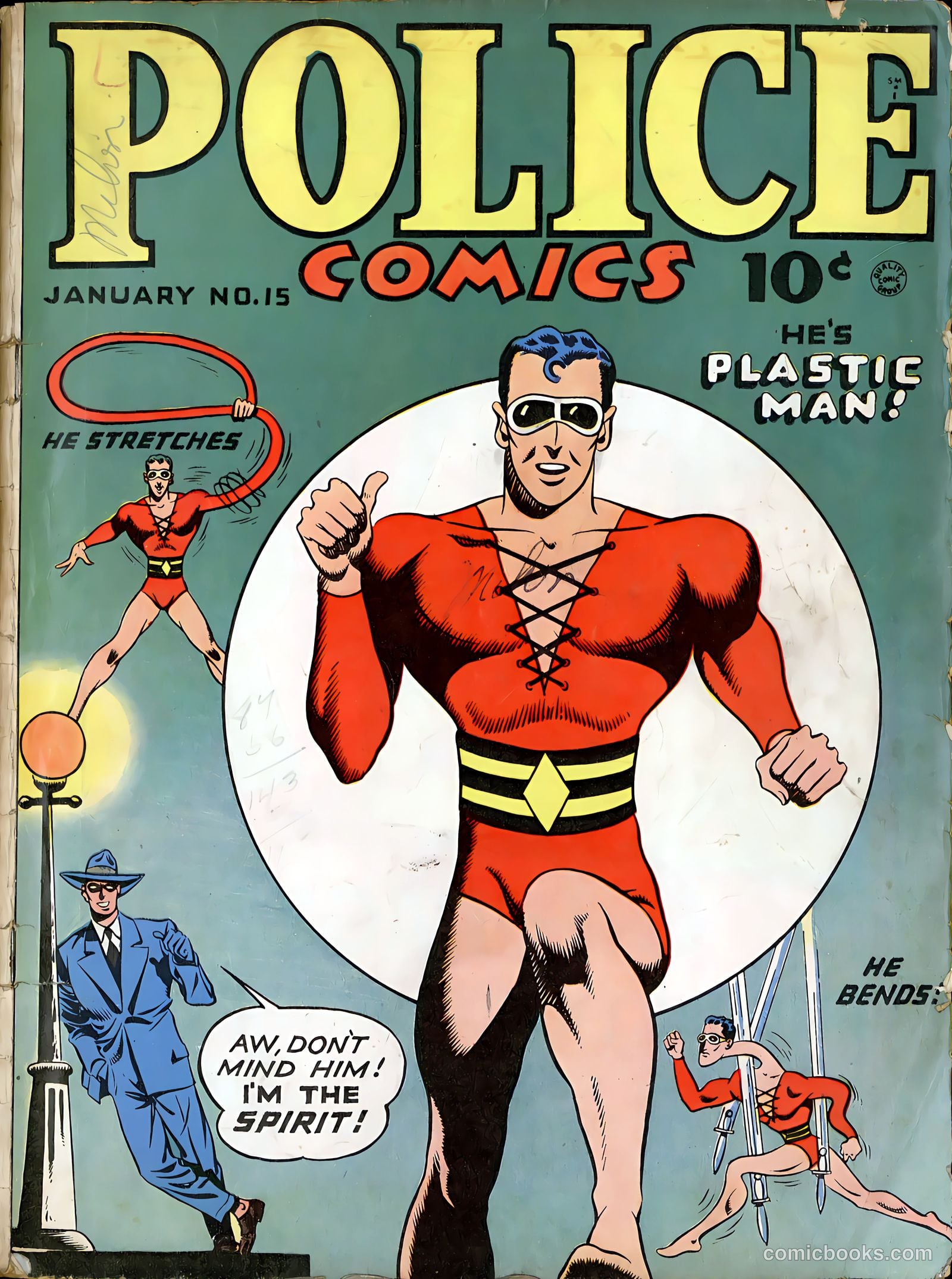
The book was edited by Ed Cronin and published under Quality Comics' indicia imprint Comic Magazines Inc., with a cover drawn by Gill Fox — the same hand who had produced the preceding four covers. The critical change was editorial, not accidental: Quality's staff recognized that Firebrand, scripted by Jerry 'S.M.' Iger with art by Reed Crandall, had been their intended flagship, but reader response made clear that Jack Cole's rubber-bodied creation was the real draw. By reassigning the cover to Plastic Man with issue #5, the editorial team effectively demoted Firebrand to a supporting strip; Firebrand would vanish from the title entirely after issue #13 in 1942. Cole wrote and drew the Plastic Man feature himself, maintaining sole creative control over the character's look, humor, and increasingly anarchic plotting.
Trivia · 8 facts
- On-sale date: October 10, 1941; cover date: December 1941; published by Quality Comics (indicia: Comic Magazines Inc.).
- First issue in the series to feature Plastic Man on the cover — a position the character would hold through issue #102 (October 1950).
- The Plastic Man story, 'The Return of Madam Brawn,' is written and drawn entirely by Jack Cole; it concludes the two-part Madam Brawn arc, with Brawn dying in the final confrontation after she forces Plastic Man — while drugged on marijuana — to impersonate his own criminal alter-ego Eel O'Brian.
- First appearance of the Brick Bat, the debut masked villain in the #711 strip (script and art by George E. Brenner); Brick Bat's bat-cowl was noted to closely resemble Batman's.
- The Brick Bat was later spotlighted in the book 'The Legion of Regrettable Supervillains.'
- The Firebrand story ('Framed By Axis Agents'), scripted by Jerry Iger with art by Reed Crandall, reflects the wartime sabotage themes prevalent in comics published in the months before the Pearl Harbor attack (December 7, 1941).
- The issue's Plastic Man story was reprinted in DC's Plastic Man Archives Vol. 1 (1998/1999), in DC Finest: Plastic Man: The Origin of Plastic Man (May 2025), and in PS Artbooks Softee: Police Comics #2 (September 2025).
- Cover art by Gill Fox; editor credited as Edward Cronin; the anthology carried features by Jack Cole, Reed Crandall, George E. Brenner, Vernon Henkel, Paul Gustavson, Arthur Peddy, Al Bryant, Fred Guardineer, and others.
Full credits
Reprints
Reprinted in Plastic Man Archives #1 (1999), Roy Thomas Presents Classic Phantom Lady Softee #1 (2013), Roy Thomas Presents Classic Phantom Lady #1 (2013), DC Finest: Plastic Man: The Origin of Plastic Man #[nn] (2025), PS Artbooks Softee: Police Comics #2 (2025)
Key issues in Police Comics
Reviews
Reader reviews
No reader reviews yet.