
Police Comics #15
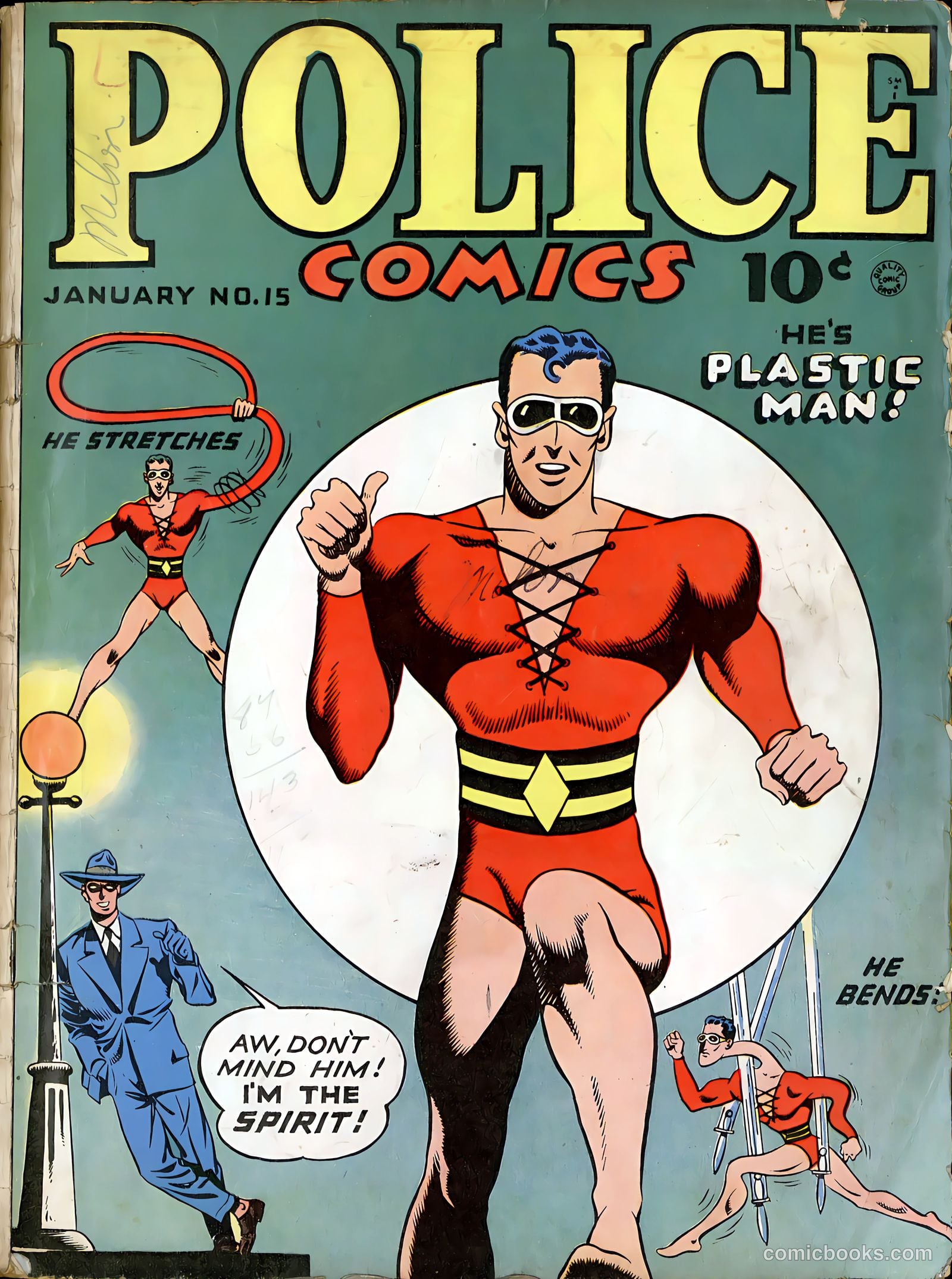
☆ Be the first to review + Add to your collection — Join freePolice Comics #15 (January 1943) occupies a singular place in Golden Age anthology history as the issue where one Quality Comics era ends and another begins in the same story. George Brenner killed off 711 — one of the title's original features, running since issue #1 — by having mobster Oscar Jones shoot the incarcerated hero, a startlingly blunt death for a superhero at a time when such permanent exits were essentially unheard of in comics. That same installment introduces his supernatural successor Destiny (a clairvoyant, teleporting figure who witnesses 711's murder and inherits his mission), making this the only Golden Age issue that functions as both a character funeral and a first appearance simultaneously. The issue further cements the anthology's wartime identity through Jack Cole's Plastic Man story, which satirizes Fifth Columnists and Nazi weather-weapon schemes with the irreverent wit that made Cole's work stand apart from any other Golden Age superhero strip.
In Police Comics #15 (1943), a 60-cent comic from the Golden Age, the enigmatic vigilante 711—his secret slipping as he grows careless—faces off against the ruthless racketeer Oscar Jones in a tense, brutal confrontation. As Jones recounts his sordid past and gains the upper hand with a gun, 711 falls, but not before the silhouette of Destiny looms over his body, hinting at a fate far beyond the prison walls. Written, drawn, and inked by George Brenner, with a striking cover by Gill Fox, this issue blends crime drama with early supernatural intrigue.
In "The Weather Weapon," Boreas, the elemental force of the north wind, is harnessed by the sinister Don Snitzel and his Fifth Columnist allies to manipulate the weather for their own ends. When the storm's fury meets the unshakable resilience of the hero Woozy—whose immunity to attacks only amplifies the force against them—the clash becomes a battle of wills as much as power.
In a wartime tale from 1943, Roy discovers an unexpected twist when Hustace Throckmorton, saved by a blood transfusion, begins to manifest explosive abilities—though instead of hands, it's his feet that detonate. The sudden shift in power sets off a chain of events that leaves Roy wondering just how much of Throckmorton’s new strength is truly his own.
Spirit [Denny Colt] faces a theatrical killer who goes by the name Mr. Midnight—a man who has orchestrated an elaborate murder before the hero's eyes in Commissioner Dolan's office, using a costume and props to stage his crimes like a twisted stage production. As the Spirit pursues him through fire and chaos, he must uncover the killer's deadly secret while Mr. Midnight grows increasingly obsessed with ensuring his grand finale plays out exactly as envisioned.
In "The Death of 711," the masked hero 711 faces off against the imprisoned racketeer Oscar Jones, whose bitter monologue reveals a past shaped by crime and incarceration. As Jones gains the upper hand with a gun, 711 falls, but in his final moments, the silhouette of Destiny looms over his body—leaving the fate of the hero and the meaning of that vision shrouded in mystery.
In "The School for Spies!", Melinda enrolls in an unusual class at Baron Torpe's home, learning the art of espionage—only to surprise him by claiming she’ll put her training to the test that very evening. When she returns with a stolen clock and secrets worth more than gold, her mentor’s true allegiance is revealed, and she finds herself captured in a web of deception.
ComicBooks.com Value
Show all 15 grades ▾
This exact issue on ebay
Read it digitally
Sell my copy
Have this issue — or a whole collection? Get a fair offer from us, skip the marketplace fees and the hassle.
We Buy Collections ▸History
The issue was published under Quality Comics' imprint Comic Magazines, Inc., edited by John Beardsley and bankrolled by publisher Everett 'Busy' Arnold. George Brenner — who would soon move into an editorial role at Quality — deliberately wrote the death of 711 to clear the way for Destiny, a character he also created, essentially engineering a planned succession within his own feature. The Grand Comics Database records a copyright date of 1942 for this January 1943 cover-dated issue, consistent with Quality's standard production calendar. The cover was penciled and inked by Gill Fox, while Jack Cole handled the lead Plastic Man story entirely solo — script, pencils, inks, and letters — as was his custom on the feature.
Trivia · 8 facts
- Cover date: January 1943; published by Quality Comics (imprint: Comic Magazines, Inc.); 68 pages, full color; cover price 10 cents.
- Final appearance and in-story death of 711 (Daniel Dyce): the pulp-styled imprisoned vigilante, created by George Brenner, who had appeared in every issue since Police Comics #1 (August 1941); he is fatally shot by racketeer Oscar Jones.
- First appearance of Destiny: a clairvoyant, teleporting Golden Age hero also created by George Brenner, who debuts as a shadowy silhouette witnessing 711's murder and vowing to pursue his killer — the character would run in Police Comics through issue #36 (November 1944).
- First appearance of Hustace Throckmorton: a recurring supporting character in the Human Bomb strip, introduced when an emergency blood transfusion from Roy Lincoln gives Throckmorton explosive powers in his feet rather than his hands; Throckmorton appears in most subsequent Human Bomb stories.
- Lead Plastic Man story ('The Weather Weapon'): fully written, penciled, inked, and lettered by Jack Cole; the story involves Plastic Man, Woozy Winks, and an FBI agent combating Fifth Columnists who have seized a weather-controlling device — a wartime espionage romp that showcases Cole's blend of physical comedy and action.
- The Spirit story ('Mr. Midnight') is a Will Eisner reprint, consistent with Quality's practice of running newspaper-strip reprints of Eisner's Spirit throughout this era.
- Additional contributors include Paul Gustavson (Human Bomb stories, per the Quality Companion, as corroborated by Gustavson's son Terry Gustafson), Gill Fox (cover art and additional interior stories), and a text story by Robert M. Hyatt; Jack Cole also contributed a one-page Burp the Twerp gag strip under the pseudonym 'Ralph Johns.'
- The Plastic Man story from this issue was reprinted in DC's Plastic Man Archives Vol. 1 (1998/1999), bringing Cole's Golden Age work to a new generation of readers.
Full credits
Reprints
↩ Reprints The Spirit #7/14/1940 (1940)
Reprinted in Plastic Man Archives #1 (1999), Roy Thomas Presents Classic Phantom Lady Softee #1 (2013), Roy Thomas Presents Classic Phantom Lady #1 (2013), DC Finest: Plastic Man: The Origin of Plastic Man #[nn] (2025)
Key issues in Police Comics
Reviews
Reader reviews
No reader reviews yet.