
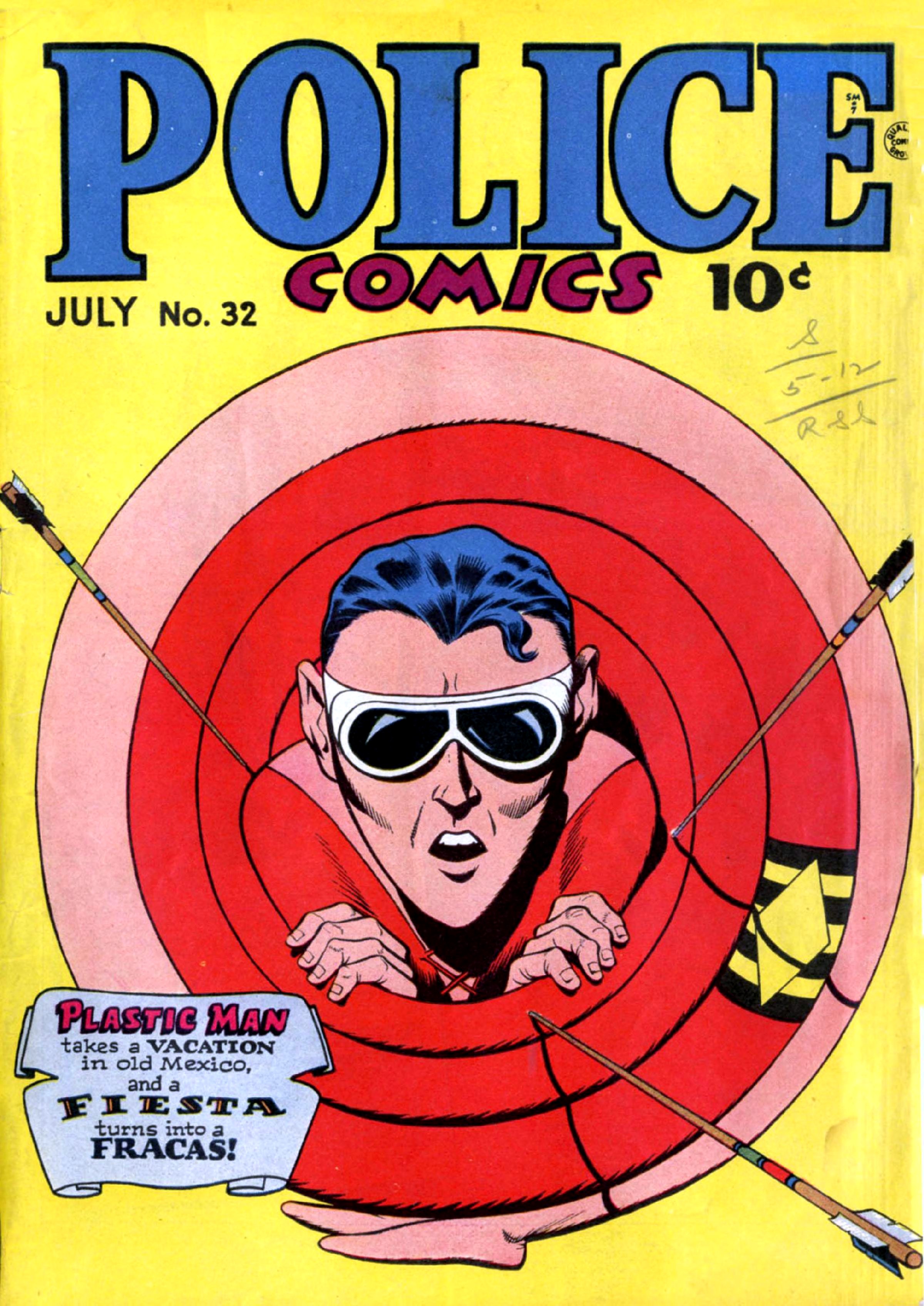
Police Comics #32
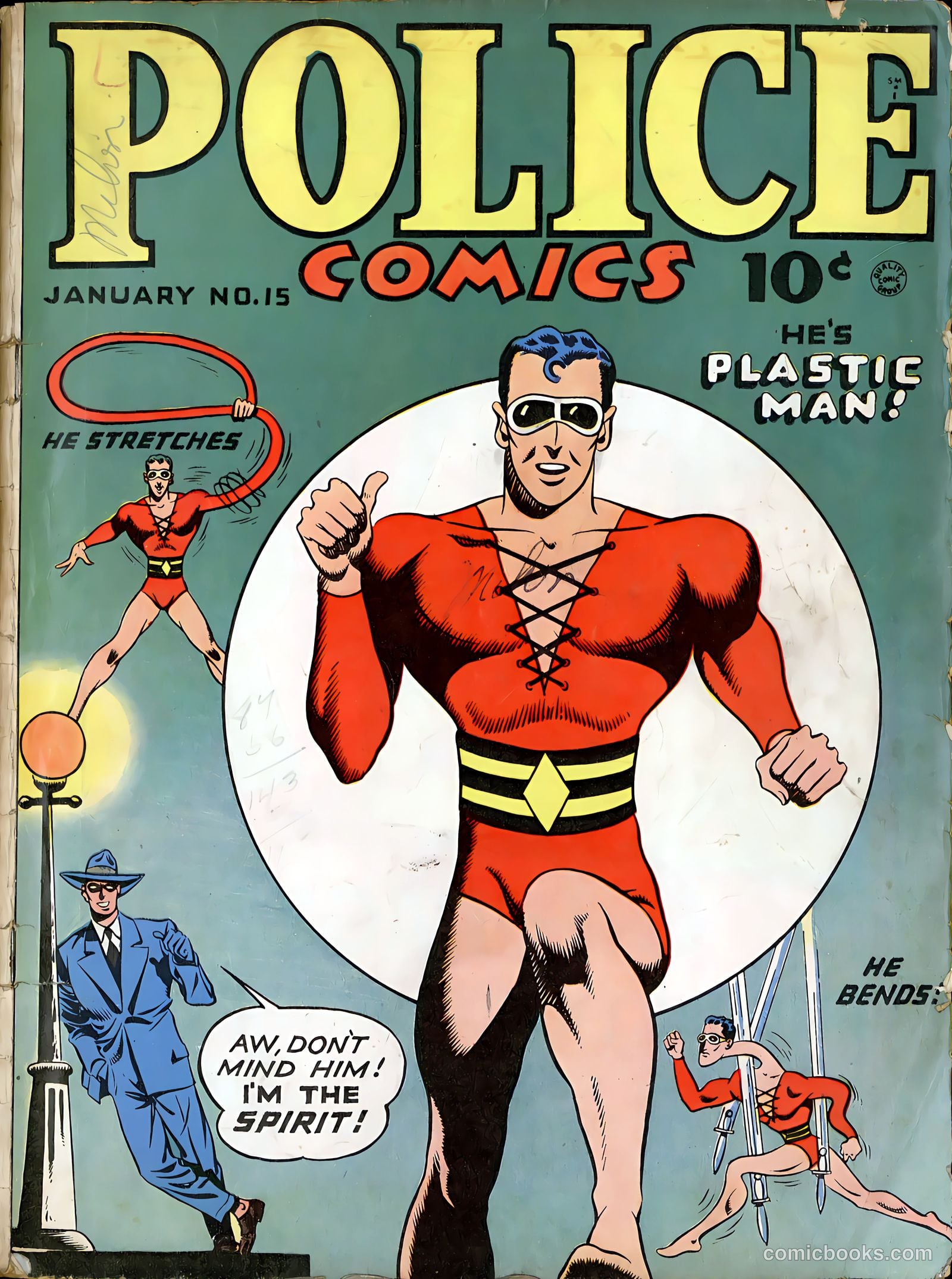
☆ Be the first to review + Add to your collection — Join freePolice Comics #32 (July 1944) represents Quality Comics' anthology format operating at its most creatively dense peak mid-war: Jack Cole's Plastic Man feature was already the engine of the series, and by this point in his run Cole had refined the strip's signature blend of slapstick invention and genuine wit into something unmistakably his own. The issue exists within a sustained stretch of the title during which three of the Golden Age's most distinctive creative voices — Cole on Plastic Man, Will Eisner on The Spirit, and Paul Gustavson on the Human Bomb — appeared under a single cover month after month, making each issue a de facto showcase for the range of what superhero comics could accomplish in tone and form. The characters assembled here — Plastic Man, Woozy Winks, the Spirit (Denny Colt), Manhunter (Dan Richards) and his android dog Thor, and the Human Bomb (Roy Lincoln) alongside sidekick Hustace Throckmorton — would all survive Quality's 1956 closure to be absorbed by DC Comics and eventually grouped into the Freedom Fighters mythology, cementing this era of the title as foundational to that corner of the DC universe. As such, any mid-run issue like #32 is a working record of that creative ecosystem in motion.
In "The La Cucaracha Caper," a 1944 entry from Police Comics #32, the enigmatic hero Destiny takes a daring risk by entering a trance to confront Death himself—only to be redirected to a red devil who rules the Underworld. With George Brenner handling writing, art, and inks, the story unfolds as Destiny faces a deadly duel, relying on his skill in jujitsu to overcome the devil and return to the waking world with a chance to clear an innocent man. The cover by Jack Cole captures the eerie, high-stakes atmosphere of the tale.
In a lighthearted 1944 wartime tale from *Police Comics #32*, Magnolia May frets over her silence from Dewey, prompting her uncle to try a bit of whimsical magic—channeling their thoughts to make Dewey stop writing and come home. Unbeknownst to them, Dewey’s mid-letter pause leads him straight to a camp canteen, where a new dance partner awaits.
In "null," Destiny confronts a man condemned to die, sensing a truth buried beneath the evidence. With a daring leap into a trance, she journeys to the Underworld, where Death himself refuses to intervene—bound by orders to spare her—before sending her to face the red-skinned Master of the Underworld in a duel of will and skill.
When a newly released convict named Thomas Hawkins tries to leave his criminal past behind, the Spirit sees an opportunity to prove that rehabilitation is possible—but society, an old underworld associate, and his own desperation conspire to push him back toward the darkness. This tale, by Will Eisner, explores whether a marked man can truly go straight when the world refuses to let him forget what he's done.
Roy Lincoln, the chemically gifted Human Bomb, springs into action when saboteurs threaten the government's oil supply in wartime. Racing to stop a ruthless scheme to torch the wells and corner the market, Roy and his sidekick Hustace find themselves buried, outnumbered, and facing a race against the clock as fire spreads toward disaster. This explosive 1944 adventure packs plenty of action as the Human Bomb learns that stopping crime sometimes means working with the very partner who keeps getting in the way.
When a diamond cutter preparing to work on the legendary Eye of Krishnu finds his household in supernatural chaos—a butler who speaks with shocking disrespect, mysterious disappearances, and impossible scenes playing out on ceilings—Manhunter suspects trickery rather than curses. As the household descends into apparent madness tied to the valuable stone, the masked crime-fighter must uncover who's orchestrating the elaborate deception and why before the prized diamond becomes part of a darker scheme.
ComicBooks.com Value
Show all 21 grades ▾
Find on ebay
Read it digitally
Sell my copy
Have this issue — or a whole collection? Get a fair offer from us, skip the marketplace fees and the hassle.
We Buy Collections ▸History
By mid-1944 Police Comics had settled into a well-oiled anthology rhythm under publisher Busy Arnold's Quality Comics imprint, with Jack Cole producing the Plastic Man lead feature entirely — script, pencils, and inks — virtually every issue from #5 onward. The Spirit material appearing in the issue was a reprint of Will Eisner's syndicated Sunday newspaper section; Eisner had been drafted into the U.S. Army in late 1941 and during his absence the strip was continued by ghost writers and artists including Cole himself and Lou Fine, meaning the precise creative hand behind the specific Spirit installment in #32 may reflect studio work rather than Eisner alone. Paul Gustavson handled the Human Bomb strip throughout this period, and Marvin (Milt) Stein contributed the Flatfoot Burns comedy feature.
Trivia · 8 facts
- Published July 1944 by Quality Comics under its 'Comic Magazines' imprint, cover art by Jack Cole.
- The Plastic Man story, 'The La Cucaracha Caper,' was written and drawn entirely by Jack Cole; the plot sends an overzealous Plas on a forced vacation because law enforcement can't keep up with processing his arrests.
- Plastic Man (Patrick 'Eel' O'Brian) had held the cover and lead slot in Police Comics since issue #5 — by #32 this was a well-established franchise feature and one of the first superhero strips to foreground comedy as a core storytelling mode.
- Woozy Winks, the comic-relief sidekick whose personality was modeled on Lou Costello and whose appearance was based on comedian Hugh Herbert, had debuted in Police Comics #13 (November 1942) and continued to appear alongside Plas throughout this run.
- The Spirit (Denny Colt) installment reprinted Will Eisner's newspaper Sunday section material; Eisner was on wartime military service during this period and ghost creative teams, including Jack Cole and Lou Fine at various points, contributed to the strip's continuity.
- Manhunter (Dan Richards) and his canine companion Thor the Thunder Dog — both introduced in Police Comics #8 (March 1942), with Thor later retconned in DC continuity as an android sentinel created by the alien Manhunters organization — continued their series in this issue.
- The Human Bomb (Roy Lincoln) strip, scripted and drawn by Paul Gustavson, featured Roy and his bumbling assistant Hustace Throckmorton; a story from the immediately preceding issues had formalized their partnership with the establishment of the Lincoln-Throckmorton Laboratory.
- The Plastic Man stories from this era, including 'The La Cucaracha Caper,' were later collected in DC's trade paperback reprint program covering Police Comics #1–36 and Plastic Man #1–2.
Cast · 11 characters
Full credits
Reprints
↩ Reprints The Spirit #5/25/1941 (1941)
Reprinted in Plastic Man Archives #3 (2002), Gwandanaland Comics #808 (2017), DC Finest: Plastic Man: The Origin of Plastic Man #[nn] (2025)
Key issues in Police Comics
Reviews
Reader reviews
No reader reviews yet.