
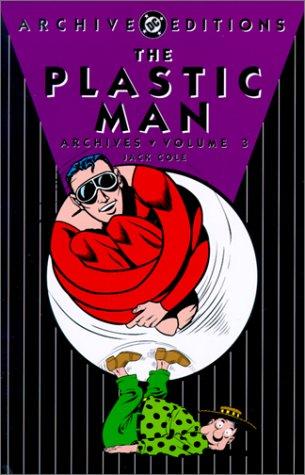
Plastic Man Archives #1
☆ Be the first to review + Add to your collection — Join freeThis first volume of the Plastic Man Archives collects the earliest adventures of the shape-shifting hero, reprinting his debut stories from Police Comics #1-20 and his first solo feature in Plastic Man #1. These golden-age tales, originally published by Quality Comics, showcase Jack Cole's inventive blend of slapstick humor and crime-fighting as the elastic ex-convict bends his way through a series of wild, imaginative capers. The hardcover archive edition preserves the original comic pages in a high-quality, black-and-white format, offering a definitive look at the character's formative years.
Eel O'Brian’s life takes a wild turn when a vat of acid spills on him during a getaway, transforming him into a stretchable, shape-shifting force. Now with a new power and a chance to start fresh, he must decide what kind of man he wants to become.
In "The Pinball Racket," Plastic Man takes on a bizarre case when Captain Murphey puts his badge on the line—solve one case a month or lose it. The culprit? A crooked operator running a rigged pinball machine scam, and only Plas can stretch his way to the truth.
In "Crime School for Delinquent Girls," Madam Brawn leads her gang of young offenders in a bid to seize control of Windy City’s protection racket. When Eel O'Brian infiltrates the operation, Plastic Man finds himself tangled in a high-stakes showdown—only to ultimately spare Brawn, who swears she’ll return for revenge.
In "The Return of Madam Brawn," the cigar-chomping villain makes a shocking comeback, reigniting her feud with Plastic Man. As their clash reaches a deadly climax, a sudden twist leaves the outcome hanging—just as Plas finally reveals his secret identity to her.
In "Case of the Disembodied Hands," a man haunted by a curse from an Indian prince finds his hands acting on their own, stealing without his control—until he cuts them off in desperation. When the severed hands continue their misdeeds, Plastic Man must track them down and find a way to end the curse once and for all.
In "The United Crooks of America," Eel makes a bold move to join a notorious gang by stealing a cache of furs—only to find his entrance met with suspicion. When one wiseguy questions his motives, citing the strange fate of O'Brien’s previous crew, Eel’s charm and cunning are put to the test in a high-stakes game of trust and deception.
In "Satan's Son Sells Out to the Japs," gang leader Hairy Arms, loyal to the Axis powers, finds his authority crumbling when his own crew turns against him after discovering his betrayal. With a ransom note demanding $50,000 at Wildwood Cemetery—and a trail of robot factories in his wake—Plastic Man and Officer Plotz race to stop him before the boy is harmed, only to see Arms undone by the very men he once commanded.
In "The Brain of Cyrus Smythe," a centuries-old villain’s consciousness survives in a jar of chemicals, only to be transplanted into the body of a modern-day soldier, Tad Wilkins, who never knew he was carrying a dead man’s mind. As the brain of the long-dead Cyrus Smythe reclaims a new life, he finds himself at odds with the ever-shifting hero Plastic Man, leading to a clash that will test the limits of identity and survival.
In "The Sinister Swami," the enigmatic mystic takes on a deadly bounty—his target: Plastic Man. But as he delves into the crime, he finds his own powers mysteriously weakened, as if something about Plastic Man’s very presence disrupts the fabric of his abilities.
In "Presenting the Man Who Can't Be Harmed," a grateful Zambi the Soothsayer grants Woozy invulnerability and immunity to pain—setting off a chain of choices that leads him down a criminal path. Partnering with Eel O'Brian, Woozy’s life takes a turn when Plastic Man convinces him to turn himself in, only to discover that no jail can hold a man who can’t be harmed. Now, with a new mission on the line, Woozy must decide where his loyalty truly lies.
In "The Weather Weapon," the forces of nature take a sinister turn when Boreas, the mighty north wind, is harnessed by Don Snitzel and his Fifth Columnist allies to manipulate the climate. But when the storm's fury meets the unshakable resilience of Woozy—whose every defense rebounds with equal force—the clash of wills becomes a battle of chaos against an unpredictable, living shield.
In "The Revenge of Chief Great Warrior," Plastic Man and his partner Woozy find themselves deep in the heart of the Blackfoot Indian reservation, undercover to quell a mysterious uprising. The threat comes from a powerful chief whose mystical gift lets him appear in mirrors and reflections, making him nearly impossible to pin down.
In "The Drafting of Plastic Man," the wacky hero is pulled from his usual antics when President Roosevelt personally calls to requisition his talents for the FBI, setting him on a new path in counter-espionage during wartime. Though previously deferred from civil service to aid Captain Murphey on the home front, Plas now finds himself answering a higher call—just as his rubbery form is tested by a mission that demands more than just stretchy limbs.
In "The Forest of Fear," Plastic Man’s first mission as a G-Man sends him to the eerie Hadley Lumber Company, where workers are vanishing and the surrounding woods seem alive with menace. When he uncovers a boneyard hidden deep in the forest, he faces a terrifying threat: sentient trees grown from the twisted experiments of a mad scientist who fused animal and plant life. As flames begin to spread, Plas makes a bold choice that could change everything.
In "Woozy Winks Detective Agency," a dreamlike tale unfolds as the heroes are felled by an explosion, leaving Jo to navigate a surreal case with the help of a legendary detective duo. As Plastic Man drifts through a fantastical vision of his own creation, Cole—portrayed as a stuttering, self-doubting artist—draws the faces of the crooks Abba and Dabba for a wanted poster, caught between imagination and reality. The story blurs the line between creator and character, with a mysterious publisher emerging to pull Cole from the grip of the villains.
ComicBooks.com Value
Find on ebay
Where to buy
Read it digitally
Sell my copy
Have this issue — or a whole collection? Get a fair offer from us, skip the marketplace fees and the hassle.
We Buy Collections ▸Full credits
Reprints
↩ Reprints Police Comics #1 (1941), Police Comics #2 (1941), Police Comics #3 (1941), Police Comics #4 (1941), Police Comics #5 (1941), Police Comics #6 (1942), Police Comics #7 (1942), Police Comics #8 (1942), Police Comics #9 (1942), Police Comics #10 (1942), Police Comics #11 (1942), Police Comics #12 (1942), Police Comics #13 (1942), Police Comics #14 (1942), Police Comics #15 (1943), Police Comics #16 (1943), Police Comics #17 (1943), Police Comics #19 (1943), Police Comics #18 (1943), Police Comics #20 (1943)
Variants (1)
Reviews
Reader reviews
No reader reviews yet.