
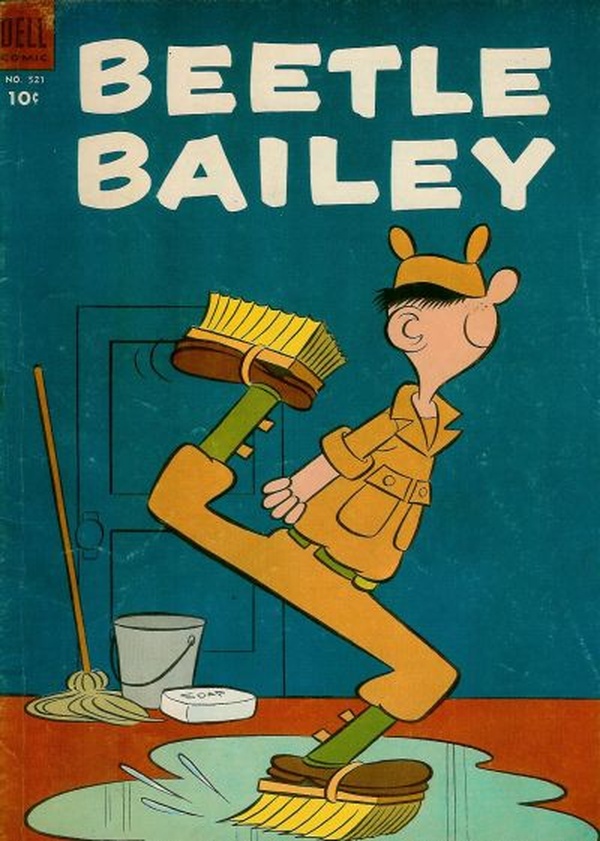
Four Color #521
☆ Be the first to review + Add to your collection — Join freeFour Color #521 is the second of only four Beetle Bailey one-shots Dell published within its massive try-out anthology series, appearing just seven months after the first (Four Color #469, May 1953) while the strip was still in its early momentum-building phase — the same year creator Mort Walker won the Reuben Award for it. The issue captures the Camp Swampy ensemble — Beetle, Sarge Snorkel, Killer Diller, and Captain Scabbard — in original comic-book stories at the precise moment the strip was transitioning from a scrappy newspaper newcomer to a genuine pop-culture institution, and the Four Color run as a whole served as the commercial proof-of-concept that convinced Dell to launch a dedicated Beetle Bailey ongoing series in 1956. As one of the early comic-book translations of a newspaper strip whose humor was rooted in the everyday absurdity of peacetime Army life, it also reflects a broader cultural moment: American readers in 1953 were deeply familiar with military service, and Walker's gentle satire of bureaucratic incompetence resonated in ways that soon made Beetle Bailey one of the most widely syndicated strips in the world.
"Hot Seat" delivers a classic comic caper from 1953, a 10-cent gem from Four Color #521, written and drawn by Mort Walker with inks by Fred Rhoads. When Captain Scabbard temporarily vacates his apartment at the Bent Arms, a series of overlapping requests—by a soldier’s girlfriend, a newlywed lieutenant, and a pair of tramps—set the stage for a perfectly timed comedic collision. The cover by Mort Walker and Fred Rhoads captures the chaos in the making.
In "The New Major," a comically mistaken identity kicks off a lighthearted farce when a new officer arrives at the battalion. Beetle, assigned to tidy the major’s quarters, is mistaken for the rank himself by two eager lieutenants—and soon finds himself enlisted in a very different kind of duty.
In "Always Room for One More," Capt. Scabbard leaves his apartment at the Bent Arms for a week, entrusting Sarge with its care—only to find himself back on base when his orders are canceled, just as a flurry of unexpected guests arrive: a soldier’s girlfriend, Lt. Snavely and his new wife, and two tramps who’ve heard the place is vacant. With no room to spare and everyone claiming the same space, chaos unfolds in the most crowded apartment in military history.
In this classic 1953 Four Color humor tale, Sarge’s forgetful slip accidentally puts Beetle Bailey on the promotion list—setting off a chain of chaos when Sarge is demoted to private and Beetle takes full, gleeful advantage. With Sarge scrambling to keep up and Beetle running him ragged, the office descends into comedic mayhem until Capt. Scabbard steps in to restore order—though not before the usual absurdities have run their course.
In "The Transformation," Jo, a young woman at a USO event, leaves Killer feeling underwhelmed—until a quick trip to the powder room changes everything. When she returns, her striking new look leaves him stunned, barely recognizing the girl he'd just been chatting with.
ComicBooks.com Value
This exact issue on ebay
Read it digitally
Sell my copy
Have this issue — or a whole collection? Get a fair offer from us, skip the marketplace fees and the hassle.
We Buy Collections ▸History
Beetle Bailey debuted as a King Features newspaper strip on September 4, 1950, created by Mort Walker — a World War II veteran who drew on his own Army experience for material — initially starring a lazy college student before pivoting to a military setting in March 1951 when the Korean War made the premise newly relevant. The strip's early survival was far from guaranteed: King Features nearly dropped it after the first year, and it was the notoriety from being banned by the Tokyo edition of Stars and Stripes (for allegedly encouraging disrespect toward officers) that gave it its first major circulation boost. By the time Four Color #521 was published in December 1953, Walker had already won the National Cartoonists Society's Reuben Award for the strip that year, and Dell — whose Four Color series functioned explicitly as a try-out vehicle for potential ongoing titles — was the natural home for comic-book adaptations of King Features properties. The issue's interior credits were documented by comics historian Craig Shutt in his 'Beetle Bailey's Secret Life' article in Hogan's Alley #12 (2004), which is the primary scholarly source for the production details of the early Dell issues.
Trivia · 8 facts
- Published December 1953 by Dell Publishing Co., Inc., as part of the Four Color (Series II) anthology; the indicia title reads 'BEETLE BAILEY, No 521,' with copyright held by King Features Syndicate.
- This is the second of four Beetle Bailey issues Dell published within the Four Color line; the first was Four Color #469 (May 1953), followed by #552 (April 1954) and one more, before Beetle Bailey launched as a standalone Dell ongoing series in 1956.
- All cover and interior art is by Mort Walker, the strip's creator — who had already won the 1953 Reuben Award from the National Cartoonists Society for Beetle Bailey in the same year this issue appeared.
- The issue features the core Camp Swampy ensemble in multiple self-contained stories: Beetle Bailey, Sarge Snorkel (full name Orville P. Snorkel, introduced in the newspaper strip in 1951), Private 'Killer' Diller (the ladies'-man character also introduced in the strip in 1951), and Captain Scabbard.
- Story content documented by the Grand Comics Database includes a plot in which Sarge accidentally lists Beetle for promotion to Corporal, is himself demoted to private as punishment, and is only restored to rank when Captain Scabbard realizes he needs Sarge to run his office — a classic Walker riff on military bureaucracy.
- Another story features Killer Diller disappointed by a plain-looking date at a USO, only to fail to recognize her after she does a makeover — typical of Walker's character-driven gag structure built around Killer's obsession with women.
- The Dell Four Color series, within which this issue appears, functioned explicitly as a try-out showcase: successful characters would graduate to their own ongoing titles, which is precisely the path Beetle Bailey followed by 1956.
- Interior story credits for this issue derive from Craig Shutt's scholarly article 'Beetle Bailey's Secret Life,' published in Hogan's Alley #12 (2004), indicating the issue has been the subject of dedicated comic-history scholarship.
Cast · 4 characters
Full credits
Reprints
Reprinted in Beetle Bailey #48 (1965), Beetle Bailey #49 (1965), Beetle Bailey #2
Key issues in Four Color
 ★
★ ★
★ ★
★ ★
★ ★
★ ★
★ ★
★Reviews
Reader reviews
No reader reviews yet.