
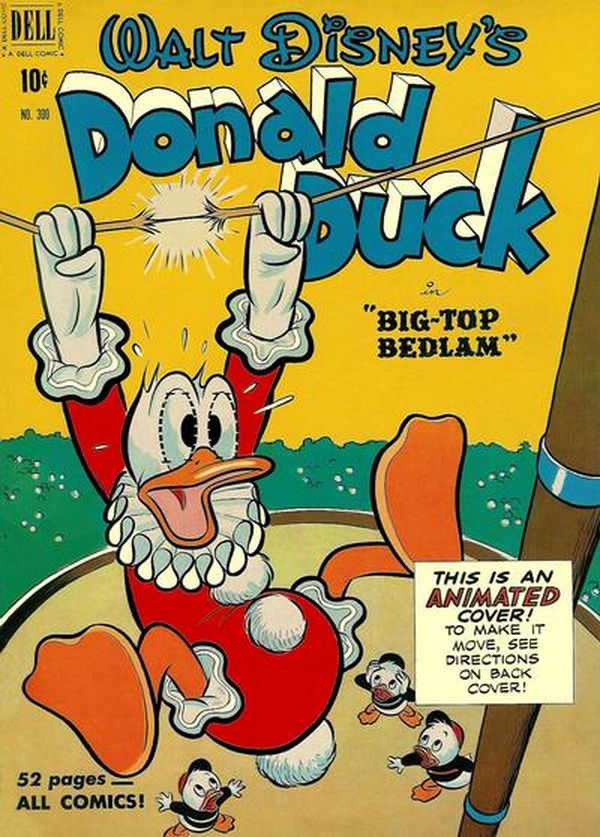
Four Color #300
☆ Be the first to review + Add to your collection — Join freeFour Color #300 preserves one of Carl Barks's most visually inventive late-Golden Age Donald Duck stories, 'Big-Top Bedlam,' in which the circus setting allowed Barks to push his panel layouts into unusually dynamic, unconventional territory that critics have singled out as a high-water mark of his draftsmanship around 1950. The issue also showcases Barks's gift for domestic comedy — Donald's attempt to secretly pawn Daisy's heirloom brooch sets off a chain of slapstick consequences — demonstrating how he consistently mined character embarrassment for storytelling momentum rather than relying on fantasy or adventure. Sitting near the tail end of his intensive Four Color one-shot run before he pivoted to the Uncle Scrooge solo title, this issue represents Barks at the height of his purely Donald-centric comic craft.
In "Firecracker Light," Donald Duck finds himself in a sticky situation when he accidentally loses Daisy's cherished heirloom brooch while trying to pawn it for circus tickets. The brooch turns up in the hands of a mysterious quick-change artist at the very same circus, prompting Donald to take a job as a clown in a desperate bid to reclaim it. Written and illustrated by Carl Barks, this 1950 classic from Four Color #300 blends humor and heart, with the cover by Carl Buettner capturing the whimsy of the moment.
In "Big-Top Bedlam," Donald Duck finds himself in a whirlwind of circus chaos after losing Daisy's precious heirloom brooch on the way to pawn it for tickets to the big show. When the brooch turns up in the hands of a slick quick-change artist, Donald takes a job as a clown to get close and reclaim it—unaware of the tangled antics that await.
In "The Firebugs," Donald's nephews unleash a series of pranks using a movie projector, sending fake fire images onto nearby homes and sending Donald and Goofy racing to the scene in their fire engine—only to find no real flames, just a string of escalating chaos. The story captures the classic humor of mischievous kids and the exasperated reactions of their well-meaning, perpetually fooled uncle and friend.
ComicBooks.com Value
Show all 17 grades ▾
This exact issue on ebay
Raw — VG ▾ $30–$125 10 listings
Raw / ungraded ▾ $8–$248 14 listings
Read it digitally
Sell my copy
Have this issue — or a whole collection? Get a fair offer from us, skip the marketplace fees and the hassle.
We Buy Collections ▸History
The lead story, 'Big-Top Bedlam,' was written and submitted by Carl Barks on April 20, 1950, and published by Dell in November 1950 as part of Dell's long-running Four Color anthology series, which served as the primary vehicle for Disney one-shot comics throughout the late 1940s and early 1950s. Barks produced these Donald Duck one-shots approximately four or five times a year during this period, handling all story, pencil, ink, and lettering duties himself. The issue also carried a backup story, 'The Firebugs!,' illustrated by long-time Disney comics artist Paul Murry, bringing the total story content to roughly 52 pages. The cover featured an interactive 'animated' gimmick — a back-cover punch-out piece designed to make Donald's eyes appear to move — a novelty element Dell used on several issues of this era.
Trivia · 8 facts
- Lead story is 'Big-Top Bedlam' (approx. 28 pages), written, penciled, inked, and lettered entirely by Carl Barks; story submitted April 20, 1950, published November 1950.
- Plot: Donald loses Daisy Duck's heirloom brooch while attempting to pawn it for circus money; disguises himself as a clown to recover it from a circus quick-change artist named Zippo — the debut appearance of the Zippo character.
- All human supporting characters inside the circus are depicted as humans rather than anthropomorphic animals, an unusual and noted stylistic choice by Barks for this story.
- Backup story 'The Firebugs!' (approx. 20 pages) is illustrated by Paul Murry, a long-time Dell/Disney comics artist; the issue totals approximately 52 pages of story content.
- The back cover featured an interactive punch-out 'animated eye' mechanism for Donald — a gimmick Dell employed on multiple issues of the era; surviving copies without the punch-out piece intact are common.
- Story was reprinted in Donald Duck #261 (Dell/Gold Key), and in a page-shortened version in Australian One Shot #27 and Donald Duck (Australian) #28, #136, and #249; the full story also appears in all editions of the Carl Barks Library, including the Fantagraphics Complete Carl Barks Disney Library.
- This issue is part of Barks's intensive mid-career run of Four Color Donald Duck one-shots — produced approximately four to five times per year — which wound down in the early 1950s as Barks transitioned his longer work to the Uncle Scrooge solo title launched in 1952.
- Carl Barks was credited on this and all his Dell Disney work anonymously at the time of publication; fans identified his distinctive style and called him 'The Good Duck Artist' before his true identity became known in the late 1950s.
Cast · 8 characters
Full credits
Reprints
Reprinted in Four Color #300 (1950), Topolino #27 (1951), Topolino #28 (1951), Donald Duck & Co #1/1959 (1959), Donald Duck & Co #10/1959 (1959), Donald Duck & Co #11/1959 (1959), Donald Duck & Co #12/1959 (1959), Donald Duck & Co #20/1959 (1959), Donald Duck & Co #21/1959 (1959), Donald Duck & Co #22/1959 (1959), Walt Disney's Giant Comics #293 (1963), Walt Disney's Donald Duck #249 (1977), De beste verhalen van Donald Duck #16 (1980), The Complete Carl Barks #9 (1984), The Carl Barks Library #2 (1986), Donald Duck Comics Digest #3 (1987), Donald Duck #261 (1988), Carl Barks Library of Walt Disney's Donald Duck Adventures in Color #16 (1995), O Melhor da Disney: As Obras Completas de Carl Barks #12 (2005), Carl Barks samlede verk #8 (2007), La Dynastie Donald Duck #1 (2010), The Complete Carl Barks Disney Library #[9] (2015), Walt Disney's Donald Duck #136
Key issues in Four Color
 ★
★ ★
★ ★
★ ★
★ ★
★ ★
★ ★
★Reviews
Reader reviews
No reader reviews yet.