
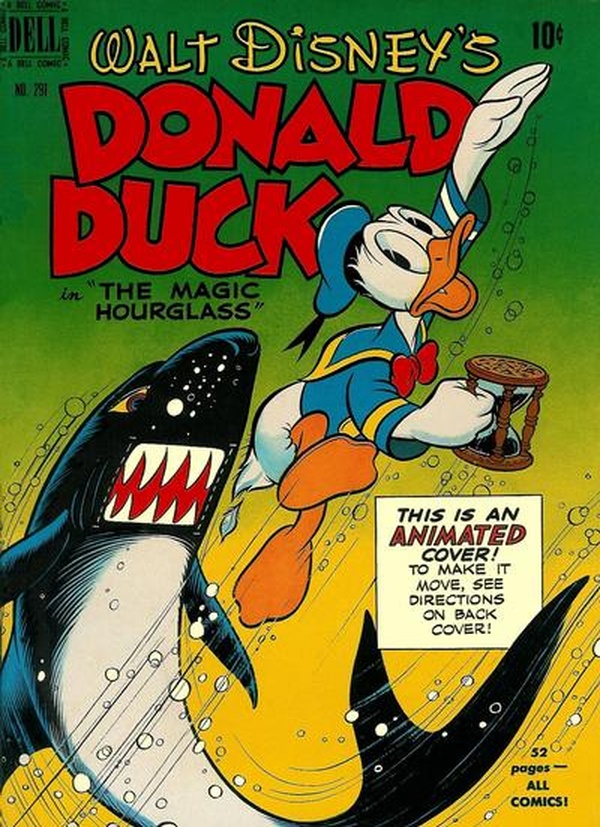
Four Color #291
☆ Be the first to review + Add to your collection — Join freeFour Color #291 contains Carl Barks's 'The Magic Hourglass,' a 28-page adventure published in September 1950 that scholars and critics have identified as a pivotal turning point in the Barks Duck saga — arguably the first story in which Uncle Scrooge, rather than Donald, drives the plot and becomes the character the reader most wants to follow. By sending Scrooge in frantic pursuit of the nephews across North Africa to recover an ancient hourglass he carelessly gave away, Barks began the transition of Scrooge from supporting miser to full-blown adventure protagonist, a shift that would culminate just two years later in Scrooge receiving his own ongoing title. The issue stands as one of the clearest early examples of Barks expanding the internal mythology of the Duck universe — here establishing that Scrooge's fortune has a near-magical origin tied to a specific physical object — a kind of world-building that no American funny-animal comic had attempted with such narrative ambition.
In "Beach Trouble," Carl Barks delivers a delightfully quirky adventure as Scrooge McDuck sets off on a wild quest after discovering that the hourglass he gave his nephews is the true source of his fortune. With a billion dollars in hand, he follows the ducks to Africa, chasing the elusive sand from the oasis of No Issa—sand that keeps the hourglass running perfectly and, by extension, keeps him richer by the hour. The story is a masterclass in Barks’ signature blend of humor, clever plotting, and visual storytelling, with the entire interior drawn, inked, and lettered by him, while the cover by Carl Buettner captures the escapade’s tropical flair.
In "The Magic Hourglass," Scrooge McDuck sets off on a wild adventure after realizing his fortune stems from a mysterious hourglass he once gave his nephews. Now racing across the world to reclaim it, he follows the ducks to the remote oasis of No Issa in Africa, where only the rare sand from that sacred place can keep the hourglass running—and his wealth growing.
In "The Spirit of '76," the nephews set their sights on staging a play about the American Revolution, with Donald taking the lead and insisting the family live like their colonial ancestors to truly capture the spirit of the times. As the ducks dive into period costumes and frontier chores, the whole household is thrown into a whirlwind of historical reenactment—complete with comically exaggerated patriotism and the usual chaos.
ComicBooks.com Value
Show all 21 grades ▾
This exact issue on ebay
Raw — VG ▾ $49.95–$113 9 listings
Raw / ungraded ▾ $13–$199 10 listings
More listings for this title
Read it digitally
Sell my copy
Have this issue — or a whole collection? Get a fair offer from us, skip the marketplace fees and the hassle.
We Buy Collections ▸History
The story was written and drawn entirely by Carl Barks and submitted to Western Publishing (Dell's editorial and production partner) on March 16, 1950, appearing on newsstands in September of that year. Western's art editor Carl Buettner oversaw the Duck line at this period, and Barks worked as a freelancer producing one or two Dell Four Color Donald Duck one-shots per year — this was one of two he completed in 1950, the other being Four Color #300 ('Big-Top Bedlam'). The Four Color series itself functioned at this point primarily as a try-out and prestige showcase for characters that Dell hoped would eventually sustain their own ongoing titles, which is exactly the trajectory Scrooge's growing prominence in issues like #291 helped accelerate.
Trivia · 8 facts
- Published September 1950 by Dell Comics as part of the long-running Four Color anthology series (Series 2), cover-titled 'Walt Disney's Donald Duck in The Magic Hourglass.'
- Written and drawn entirely by Carl Barks; story submitted to Western Publishing on March 16, 1950 — Barks was the sole credited creative force, handling both script and art.
- The 28-page lead story ('The Magic Hourglass') features Uncle Scrooge McDuck, Donald Duck, and Huey, Dewey, and Louie Duck in an adventure spanning Duckburg and North Africa, specifically the fictional oasis of No Issa.
- Central plot conceit: Scrooge unknowingly gives away an ancient Arabic hourglass that is the magical source of his wealth, then pursues the Duck family across continents carrying a billion dollars to buy it back.
- Widely recognized in Barks scholarship as a landmark moment in which Scrooge transitions from supporting character to the story's de facto protagonist — a narrative shift that foreshadowed his 1952 solo series.
- The issue also contains a shorter backup story, giving the issue its standard 52-page Dell one-shot format typical of Four Color Donald Duck entries of the era.
- Reprinted multiple times: in Gladstone's 'Donald Duck Adventures' #16 (1989, with a cover illustration by Don Rosa), in 'Carl Barks Library of Walt Disney's Donald Duck Adventures in Color' #16 (Gladstone), in 'Uncle Scrooge' #341, and collected in the Fantagraphics Complete Carl Barks Disney Library.
- Don Rosa, creator of 'The Life and Times of Scrooge McDuck,' deliberately chose not to incorporate the mythology of 'The Magic Hourglass' into his own canonical retelling of Scrooge's history, making the issue a notable point of creative divergence between the two defining Duck cartoonists.
Full credits
Reprints
Reprinted in Four Color #291 (1950), Cuentos de Walt Disney #17 (1951), Topolino #25 (1951), Topolino #26 (1951), Mickey Magazine #129 (1953), Oscar Mondadori [Oscar Fumetto] #170 (1968), Donald Duck Best Comics #[nn] (1978), The Walt Disney Best Comics Series #[4] (1980), The Complete Carl Barks #9 (1984), De beste verhalen van Donald Duck #37 (1984), Donald Duck bøker [Gullbøker] #[1985] (1985), The Carl Barks Library #2 (1986), Walt Disney's Donald Duck Adventures #16 (1989), Carl Barks Library of Walt Disney's Donald Duck Adventures in Color #16 (1995), Bilag til Donald Duck & Co #40/2002 (2002), Walt Disney's Uncle Scrooge #341 (2005), O Melhor da Disney: As Obras Completas de Carl Barks #12 (2005), Carl Barks samlede verk #8 (2007), La Dynastie Donald Duck #1 (2010), The Complete Carl Barks Disney Library #[9] (2015)
Key issues in Four Color
 ★
★ ★
★ ★
★ ★
★ ★
★ ★
★ ★
★Reviews
Reader reviews
No reader reviews yet.