
Four Color #199
☆ Be the first to review + Add to your collection — Join freeFour Color #199 is one of the most acclaimed entries in Carl Barks's long run of Dell Donald Duck one-shots, housing what the Disney Wiki describes as probably the longest Western story Barks ever wrote — a fully self-contained 32-page adventure that demonstrated his ability to sustain a complex mystery plot across an entire issue. The story blends genre parody (Donald's entire strategy is borrowed from Hollywood Westerns) with genuine suspense and clever puzzle-box plotting around a futuristic cattle-brand-changing device, qualities that scholar Thomas Andrae singled out in his study of Barks's work. At a moment when most funny-animal comics were built around short gag sequences, this issue stood as proof that the medium could carry long-form, genre-inflected storytelling with real narrative momentum. Its repeated reprint life — from Gladstone in the 1990s through Fantagraphics' definitive Complete Carl Barks Disney Library in the 2010s — reflects the ongoing critical consensus that it ranks among Barks's finest Golden Age achievements.
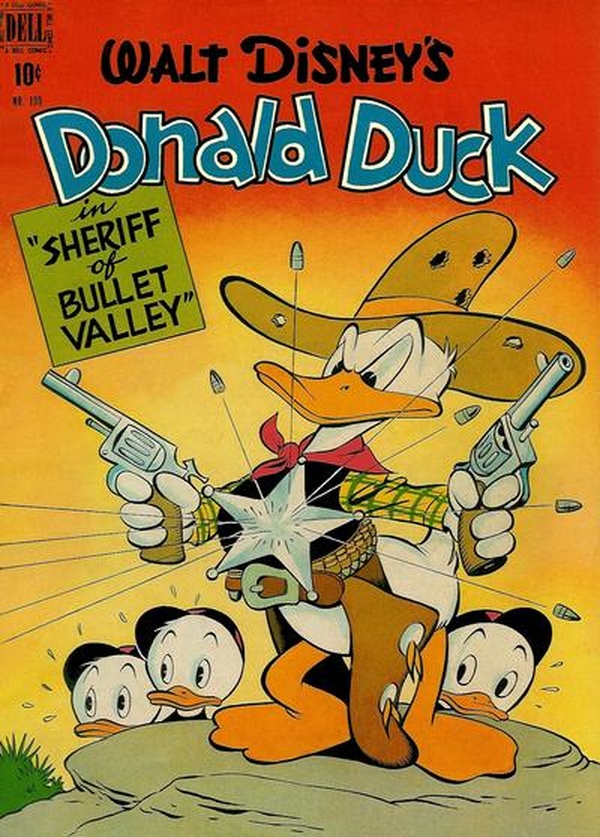
In "Sorry to be Safe," Donald Duck takes on a new role as a sheriff's deputy in the dusty town of Bullet Valley, tasked with tracking down a notorious gang of rustlers. Led by the cunning Blacksnake McQuirt—a man who hides his outlaw past behind a respectable rancher facade and uses a mysterious branding ray to alter cattle marks from a distance—this high-stakes pursuit puts Donald's nerve to the test. Written and illustrated by Carl Barks, this 1948 adventure blends Western grit with classic Disney charm, all captured in Barks’ dynamic art and signature storytelling. The cover, also by Barks, perfectly captures the tension of the moment.
In "Sorry to be Safe," Jo tries to play ball with the gang, but Donald’s fear of breaking a window sends them to a field outside town—only for a stray ball to hit a dynamite stash, sending shockwaves through the city and shattering every window in sight.
In "Sheriff of Bullet Valley," Donald takes on the role of deputy in a dusty frontier town, chasing down a gang of rustlers led by the cunning Blacksnake McQuirt—whose real identity hides behind a rancher's façade and a mysterious branding ray that alters cattle brands from a distance.
ComicBooks.com Value
Show all 18 grades ▾
This exact issue on ebay
Raw / ungraded ▾ $83.95–$303 7 listings
More listings for this title
Read it digitally
Sell my copy
Have this issue — or a whole collection? Get a fair offer from us, skip the marketplace fees and the hassle.
We Buy Collections ▸History
Carl Barks wrote, drew, and lettered every page of the issue, including the 32-page lead and three one-page gag strips; according to the Grand Comics Database, the lead story's art was submitted in March 1948 and the book was on sale in October 1948, published by Dell Publishing Co. Inc. under the Walt Disney Productions copyright. Barks worked anonymously throughout this period — fans of the era knew him only as 'the Good Duck Artist' — and he achieved wide public recognition only after he semi-retired in 1968. Scholar Thomas Andrae documented in Carl Barks and the Disney Comic Book that the story's Western milieu was directly inspired by the B-western films Barks loved, especially the Hopalong Cassidy series.
Trivia · 8 facts
- Published October 1948 by Dell Publishing Co. Inc. as part of Dell's long-running Four Color anthology (Series 2), with an original cover price of ten cents.
- Entire issue — cover, 32-page lead story ('Sheriff of Bullet Valley'), and three one-page gag strips ('Sorry to be Safe,' 'Best Laid Plans,' 'The Genuine Article') — written, drawn, and lettered solely by Carl Barks.
- The lead story is described by the Disney Fandom Wiki as probably the longest Western story Barks ever produced, featuring Donald Duck as a deputy sheriff who takes on villain Blacksnake McQuirt and his high-tech cattle-rustling gang in Bullet Valley.
- Key story conceit: rustler Blacksnake McQuirt uses a remote branding ray capable of re-branding cattle from a mile away — a science-fiction device embedded in an otherwise classic Western setup.
- Characters featured: Donald Duck, Huey, Dewey, and Louie Duck, plus original characters Jim Diamond and Blacksnake McQuirt (story-exclusive villains, not recurring Barks creations).
- Barks hid a self-caricature on a wanted poster on the final page of the story — a cameo noted in Michael Barrier's 1982 study Carl Barks and the Art of the Comic Book.
- The story took its inspiration from B-western films of the 1940s, particularly the Hopalong Cassidy (1935) series, according to Thomas Andrae's Carl Barks and the Disney Comic Book.
- Reprinted in Gladstone's Walt Disney's Donald Duck Adventures #28 (October 1994) and Carl Barks Library of Walt Disney's Donald Duck Adventures in Color #9 (September 1994); collected in Fantagraphics' Complete Carl Barks Disney Library vol. 6 (The Old Castle's Secret, 2013) and again as a standalone Fantagraphics book, Walt Disney's Donald Duck: Sheriff of Bullet Valley (2015).
Full credits
Reprints
Reprinted in Four Color #199 (1949), Donald Duck & Co #29/1961 (1961), Le Journal de Mickey #560 (1963), Donald Duck #7/1976 (1976), De beste verhalen van Donald Duck #6 (1977), Walt Disney's Klassiker #2/1977 (1977), Walt Disney's Klassikere #14 (1977), De beste verhalen van Donald Duck #8 (1978), Kalle Ankas bästisar #12 (1980), Walt Disney's Beste Historier om Donald Duck & Co [Disney-Album] #12 (1980), Die tollsten Geschichten von Donald Duck #66 (1981), Donald Duck and His Nephews Best Comics #[nn] (1983), The Complete Carl Barks #6 (1983), The Carl Barks Library #1 (1984), The Complete Carl Barks #32 (1985), Wir, Tick, Trick und Track #[nn] (1985), Donald Duck #260 (1987), Gladstone Comic Album #5 (1988), Walt Disney's Donald Duck Adventures #10 (1988), Walt Disney's Donald Duck Adventures #19 (1990), Donald Duck & Co #35/1991 (1991), Walt Disney's Donald Duck Adventures #37 (1993), Carl Barks Library of Walt Disney's Donald Duck Adventures in Color #9 (1994), Walt Disney's Donald Duck Adventures #28 (1994) + 12 more
Key issues in Four Color
 ★
★ ★
★ ★
★ ★
★ ★
★ ★
★ ★
★Reviews
Reader reviews
No reader reviews yet.