
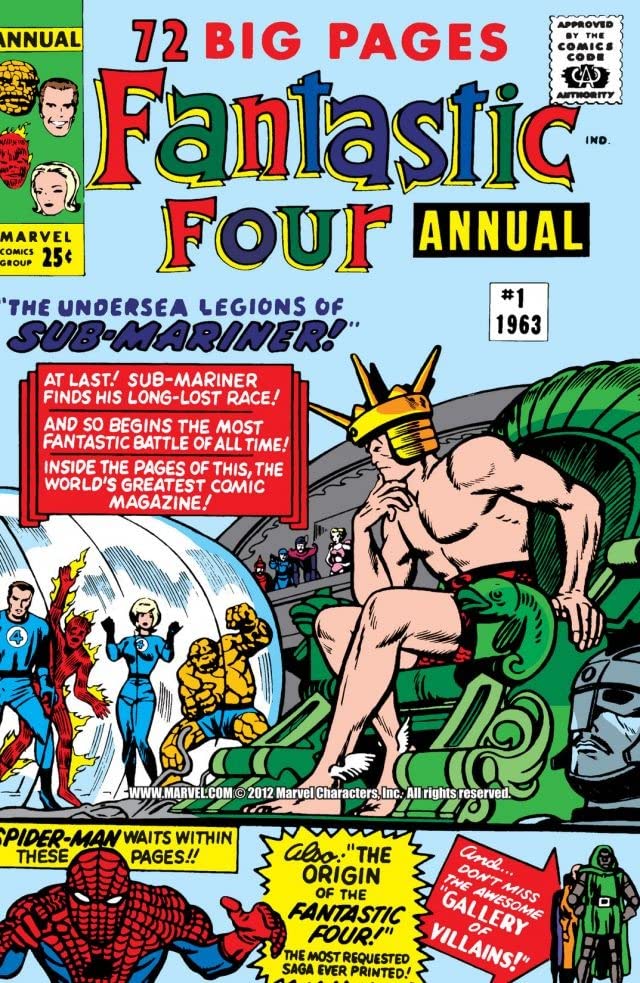
Fantastic Four Annual #1
Fantastic Four Annual #1 (July 1963) is a watershed moment in Marvel's Silver Age annuals program — at 72 pages it was among the first Marvel annuals built predominantly around new, original material rather than reprints, establishing a template for 'summer specials' that Stan Lee and Jack Kirby would sustain through 1968. The issue fundamentally reshaped the Sub-Mariner's place in the Marvel Universe: it introduced his Silver Age Atlantis complete with its redesigned blue-skinned Homo Mermani, gave Namor his full retold origin, crowned him emperor, and delivered the first appearances of Warlord Krang and Lady Dorma — two characters who would anchor Sub-Mariner mythology for decades. Crucially, it hit newsstands on the same day as X-Men #1 (July 2, 1963), and within its pages Namor explicitly describes himself as a mutant, a detail that predates by decades the 'Marvel's first mutant' marketing language later associated with his solo series. The issue also expanded the FF's initial skirmish with Spider-Man from Amazing Spider-Man #1 into a six-page sequence with Steve Ditko brought in as inker to keep Spider-Man's costume accurate — an early example of Marvel's cross-title continuity being actively curated and deepened for readers.
In "Sub-Mariner Versus the Human Race!", the Fantastic Four reunite under urgent circumstances, with Mister Fantastic rallying the team after a mysterious signal draws them together. This landmark annual revisits the team's explosive origin—revealing how their ill-fated rocket flight into space exposed them to cosmic rays, transforming them into the super-powered quartet the world would come to know. Written by Stan Lee and brought to life with dynamic art by Jack Kirby, Sol Brodsky, and George Klein, the issue features a striking cover by Kirby and Dick Ayers.
ComicBooks.com Value
Show all 22 grades ▾
This exact issue on ebay
CGC 2.5 ▾ $200–$370 2 listings
Raw — VG+ ▾ $219–$405 2 listings
Raw — VG ▾ $160–$240 2 listings
Raw / ungraded ▾ $79.99–$300 9 listings
Read it digitally
Sell my copy
Have this issue — or a whole collection? Get a fair offer from us, skip the marketplace fees and the hassle.
We Buy Collections ▸History
Written by Stan Lee and penciled by Jack Kirby with inks by Dick Ayers on the lead feature and letters by Art Simek, the book was produced in mid-1963 between Fantastic Four #17 and #18 based on surviving job-number analysis. Stan Lee consciously chose Sub-Mariner over Doctor Doom as the centerpiece antagonist, reportedly because Namor's rich Timely-era backstory offered more room for spectacle — including the long-deferred payoff of reuniting Namor with his people, a thread left dangling since Fantastic Four #4 (1962). The partial reprint of Fantastic Four #1 was updated by Sol Brodsky so that the Human Torch's featureless flame-blob design was replaced with his recognizable humanoid form, and the Thing and Reed Richards were touched up to match their then-current looks, ensuring the recap would not confuse newer readers. The villain gallery section — eleven full-page character spreads covering every major FF adversary through issue #15 — proved popular enough that it was continued in Fantastic Four Annual #2 and adapted for Amazing Spider-Man Annual #1 the following year.
Trivia · 8 facts
- Released July 2, 1963 (on-sale date per U.S. Copyright Office filings), with a cover date of September 1963; written by Stan Lee, penciled by Jack Kirby, inked by Dick Ayers (main story), lettered by Art Simek — the same day X-Men #1 hit newsstands.
- First appearance of Warlord Krang and first Silver Age appearance of Lady Dorma, both Atlantean supporting characters who became central to Sub-Mariner continuity.
- First Silver Age depiction of the Atlanteans with their now-trademark blue skin; all prior Timely/Atlas-era Atlantean males had been drawn with green scaly skin, large eyes, and catfish-like barbels.
- Namor explicitly calls himself a mutant within this issue's story — on the same publication date as X-Men #1 — establishing that his 'Marvel's first mutant' designation was built into the Silver Age mythology from the outset, not retrofitted.
- Contains a second new story, 'The Fabulous Fantastic Four Meet Spider-Man!', a six-page expansion of the brief Spidey-vs.-FF skirmish from Amazing Spider-Man #1; Steve Ditko was brought in as inker specifically to keep Spider-Man's costume details accurate on Kirby's pencils.
- A 'Gallery of the Fantastic Four's Most Famous Foes' features eleven full-page villain spreads — Mole Man through Mad Thinker — each with biography and first-appearance citation; this feature format was reprised in FF Annual #2 and Amazing Spider-Man Annual #1.
- The issue includes a partial reprint of Fantastic Four #1 (first 13 pages), updated by Sol Brodsky to revise the Human Torch's appearance from an indistinct flame-blob to his recognizable humanoid form, and to update Thing's and Reed Richards's looks to match 1963 standards.
- The main story has been reprinted numerous times, including Fantastic Four King-Size Special #8 (1970), Marvel Treasury Edition #2 (1974), Fantastic Four Special Edition #1 (1984), and in collected editions such as Marvel Masterworks: Fantastic Four Vol. 2 and the Fantastic Four Omnibus Vol. 1.
Cast · 27 characters
Full credits
Reprints
↩ Reprints Fantastic Four #1 (1961)
Reprinted in The Amazing Spider-Man Annual #6 (1969), Fantastic Four Annual #8 (1970), I Fantastici Quattro #15 (1971), The Mighty World of Marvel #3 (1972), The Mighty World of Marvel #6 (1972), The Mighty World of Marvel #8 (1972), The Mighty World of Marvel #12 (1972), The Mighty World of Marvel #13 (1972), The Mighty World of Marvel #9 (1972), The Mighty World of Marvel #14 (1973), The Mighty World of Marvel #16 (1973), The Mighty World of Marvel #22 (1973), The Mighty World of Marvel #30 (1973), The Mighty World of Marvel #33 (1973), The Mighty World of Marvel #35 (1973), The Mighty World of Marvel #36 (1973), The Mighty World of Marvel #37 (1973), The Mighty World of Marvel #38 (1973), Strange #43 (1973), Giant-Size Super-Stars #1 (1974), Hulk #9 (1974), Marvel Treasury Edition #2 (1974), Giant-Size Fantastic Four #4 (1975), Giant-Size Fantastic Four #6 (1975) + 35 more
Key issues in Fantastic Four Annual
Reviews
Reader reviews
No reader reviews yet.