
Fantastic Four #52
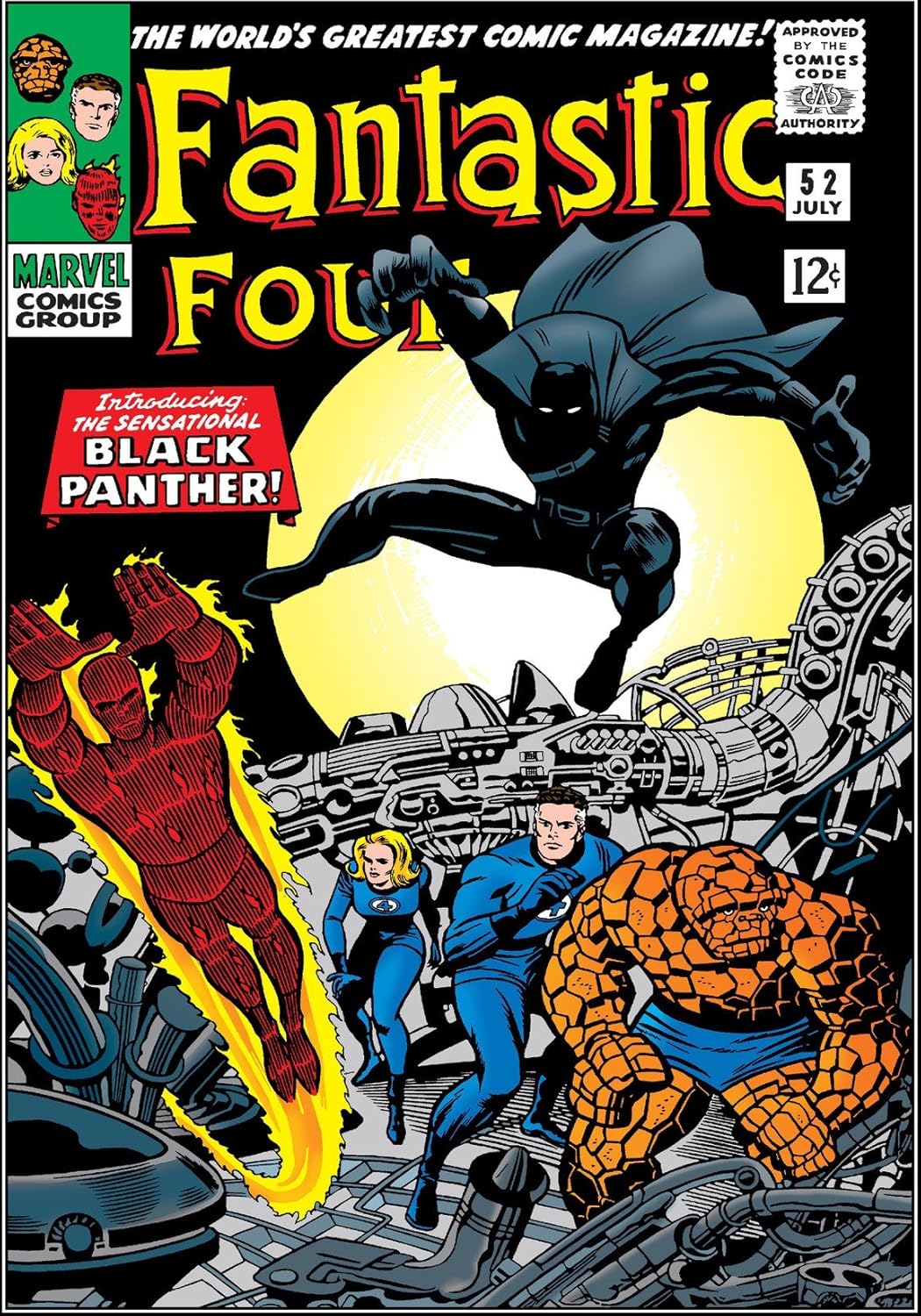
☆ Be the first to review + Add to your collection — Join freeFantastic Four #52 marks one of the most consequential single issues in the Silver Age: it introduced T'Challa, the Black Panther, the first Black superhero in mainstream American comics — a character who arrived years before the Falcon (1969), Luke Cage (1972), or John Stewart as Green Lantern (1971). Beyond the milestone of representation, Lee and Kirby conceived Wakanda as a hidden, hyper-advanced African nation, a concept so radical for 1966 that scholars have since analyzed it through lenses ranging from Afrofuturism to Cold War politics and decolonization. The issue also demonstrated a new mode of superhero storytelling: T'Challa's debut works not as a simple origin tale but as a tactical thriller in which a new character methodically outmaneuvers Earth's most celebrated team, establishing his intellect as the character's defining trait from page one. That narrative confidence helped cement Black Panther as a fully realized king and scientist rather than a supporting player, a foundation every subsequent writer has built upon.
ComicBooks.com Value
Show all 22 grades ▾
Find on ebay
Read it digitally
Sell my copy
Have this issue — or a whole collection? Get a fair offer from us, skip the marketplace fees and the hassle.
We Buy Collections ▸History
The character began life in Jack Kirby's sketchbook under the working name 'Coal Tiger' — a brightly costumed, unmasked figure that Stan Lee felt needed rethinking before it was ready to print. Kirby's redesign produced the sleek, all-black suit that appeared in #52, but editorial intervention altered it further: Kirby originally drew T'Challa in a half-cowl that exposed his lower face and jaw, and before the issue went to press that mask was filled in to produce a full face-covering, with interior panels similarly darkened at the inking stage — widely attributed to caution about newsstand reaction to an overtly Black hero during the height of the Civil Rights era. There was acknowledged internal debate at Marvel over the commercial risk of launching a Black superhero, and the issue was not previewed in other comics' house ads, an unusual omission that itself signals editorial hesitation. Kirby later stated independently that the drive to create a Black hero came from his own recognition of the absence of Black characters in his strips, while Lee recalled wanting to deliberately counter stereotypes by making T'Challa a genius-king comparable to Reed Richards; both accounts are consistent in motivation if contested in precise origination.
Trivia · 8 facts
- First appearance of T'Challa, the Black Panther (Marvel's first Black superhero in mainstream comics), in a story titled 'The Black Panther!' — written by Stan Lee, penciled by Jack Kirby, inked by Joe Sinnott, lettered by Sam Rosen, and edited by Stan Lee; cover date July 1966, on-sale date April 12, 1966.
- First appearance of Wakanda, the technologically advanced fictional African nation whose hidden vibranium deposits form the core of T'Challa's world and motivation — also the debut of the concept that the nation conceals its technological sophistication beneath a surface appearance of a traditional jungle.
- First appearance of Wyatt Wingfoot, Johnny Storm's college roommate at Metro College and a Native American of the fictional Keewazi tribe, who accompanies the team to Wakanda and inadvertently breaks T'Challa's carefully set trap — making him integral to the plot of the very issue in which he significantly appears.
- Kirby's original pre-publication cover depicted Black Panther in a half-cowl that exposed his face; before printing, the mask was converted to a full face-covering in the interior art and on the published cover, with the rejected original cover later first published in Jungle Action #11 (September 1974).
- The character's earliest concept name was 'Coal Tiger' — a brightly colored, unmasked design that Kirby sketched before Lee prompted a revision; that watercolor sketch has been widely reprinted in Marvel histories and Jack Kirby Collector magazine.
- The issue runs 20 story pages under the Marvel Method: Kirby plotted and penciled, Lee added dialogue and captions; Joe Sinnott inked and Stan Goldberg colored the cover, with Artie Simek providing cover lettering.
- The story arc begun in #52 continues directly into Fantastic Four #53 (August 1966), which reveals T'Challa's origin, names the villain Klaw (who murdered T'Challa's father King T'Chaka), and formally introduces vibranium — making #52 and #53 an inseparable two-part debut sequence.
- The issue has been reprinted multiple times, including in Marvel's Greatest Comics #39 (November 1972) and as a Facsimile Edition (most recently January 28, 2026); the story is also collected in Marvel Masterworks: Fantastic Four volumes covering the mid-1960s run.
Key issues in Fantastic Four
 ★
★ ★
★ ★
★ ★
★ ★
★ ★
★ ★
★ ★
★Reviews
Reader reviews
No reader reviews yet.