
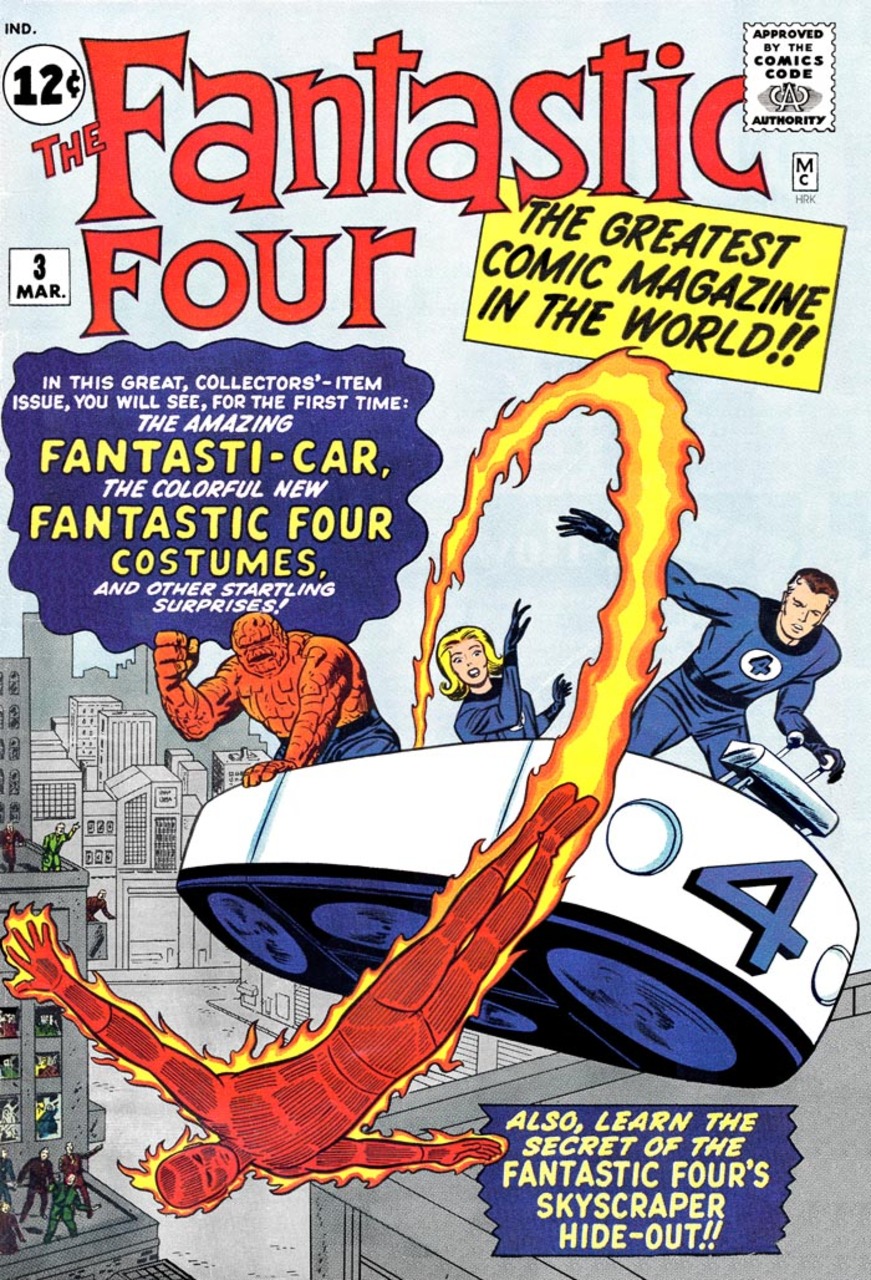
Fantastic Four #3
Fantastic Four #3 is the issue where the Marvel Universe's first family stopped being an anomaly and started looking like a superhero team — it introduces the blue "4" uniforms, the Fantasti-Car, and a detailed schematic of the Baxter Building headquarters, all in a single issue, cementing the visual and conceptual identity the team would carry for decades. The cover also debuts the boast 'The Greatest Comic Magazine in the World,' a banner that would remain a fixture of the series for years. Beyond the iconography, the issue plants a crucial narrative seed: the Human Torch's frustrated departure from the team at the story's close is the precise event that sends him into the encounter with Namor in the very next issue, making this a quiet but essential hinge in the early Marvel continuity. It also launched the Fantastic Four Fan Page — the first-ever Marvel letters column — establishing the direct, conversational relationship between Stan Lee and readers that would come to define the entire line's culture.
In "Chapter 1 The Menace of the Miracle Man," the Fantastic Four face a mysterious new threat as their latest adventure begins with a flurry of fan letters—some from real readers, some from the very people they’re trying to stop. Written by Stan Lee and brought to life with dynamic energy by Jack Kirby, the cover by Kirby and Sol Brodsky captures the team’s first major crisis with a bold, timeless design.
In "Chapter 1 The Menace of the Miracle Man," the Fantastic Four face their first true test when the enigmatic Miracle Man hijacks a magic show to humiliate the Thing and unleash chaos. As the Human Torch battles an animated movie monster statue and the Invisible Girl is captured during a daring escape, the team's unity is pushed to the edge—especially when the Thing recalls the moment they became heroes. The Miracle Man’s grand scheme unfolds with theatrical flair, but the cost of victory may be greater than any of them expected.
In "Chapter II The Monster Lives!", the Miracle Man unleashes his first act of villainy at a magic show, humiliating the Thing and declaring war on humanity. When he animates a movie monster statue from Mars, the Fantastic Four must fight back—only to face a shocking cost as the Human Torch departs after the battle.
In "Chapter IV In the Shadow of Defeat!", the Fantastic Four face their first true test when the enigmatic Miracle Man unleashes a magical assault during a public performance, humiliating the Thing and declaring war on humanity. With the Human Torch battling a monstrous statue brought to life from a movie prop, and the Invisible Girl taken hostage aboard a stolen atomic tank, the team’s unity is pushed to the edge—especially as the Thing confronts memories of their origin, and the cost of victory begins to weigh heavy.
ComicBooks.com Value
Show all 22 grades ▾
This exact issue on ebay
CGC 9.8 ▾ $55.96–$75 2 listings
CGC 5.5 ▾ $2,475–$3,700 2 listings
CGC 4 ▾ $800–$1,900 3 listings
CGC 3.5 ▾ $1,370–$1,475 2 listings
CGC 2.5 ▾ $925–$940 2 listings
CGC 0.5 ▾ $479–$750 3 listings
Raw / ungraded ▾ $3.19–$636 8 listings
Read it digitally
Sell my copy
Have this issue — or a whole collection? Get a fair offer from us, skip the marketplace fees and the hassle.
We Buy Collections ▸History
Written by Stan Lee, penciled by Jack Kirby, inked by Sol Brodsky, colored by Stan Goldberg, and lettered by Art Simek, the issue carried a March 1962 cover date but went on sale in December 1961. Tom Brevoort's editorial analysis of the surviving original art revealed that an alternate cover by Kirby — later published as the back cover of The Official Marvel Index to the Fantastic Four #1 and reprinted as a pinup in Fantastic Four #224 — was rejected; the replacement cover added in-story costume details that Brodsky inked over figures Kirby had originally drawn in civilian clothes, suggesting the team's visual identity was still being finalized during production. Brevoort's notes also established that the seemingly genuine 'S. Brodsky' letter on the inaugural Fan Page was actually written by Stan Lee himself as a plug for Marvel's other titles, while the lead letter — from a reader in Las Vegas — was later confirmed to be from future Marvel artist Alan Weiss.
Trivia · 8 facts
- First appearance of Miracle Man (Joshua Ayers), a stage hypnotist-turned-villain who uses mass illusion rather than genuine superpowers — a twist that makes him one of early Marvel's more conceptually interesting one-shots, even if he remained a minor character who did not return until Fantastic Four #138.
- First appearance of the Fantastic Four in their matching blue uniforms adorned with the '4' logo, described in-story as designed by Sue Storm — the visual template the team has used, with variations, ever since.
- First appearance of the original Fantasti-Car (nicknamed the 'flying bathtub' by fans for its distinctive shape), shown splitting into four independently operable sections when the team pursues Miracle Man.
- First appearance of the Baxter Building headquarters, introduced via an in-story cutaway schematic that includes hangars for the Fantasti-Car, the pogo orbit plane, the fantasticopter, a photo analysis room, an observatory, and a long-range passenger missile.
- First Marvel Comics letters page ('The Fantastic Four Fan Page'), inaugurating the direct reader-dialogue format Stan Lee would deploy across the entire line; one printed letter was from future Marvel artist Alan Weiss, and the 'S. Brodsky' letter was written by Lee himself as a house ad.
- The issue marks the first time the Thing's rocky hide is covered by a full bodysuit and helmet — a costume that does not survive the issue, as the Thing tears it off during the fight.
- The Human Torch quits the team at the story's end, a plot development that directly causes his encounter with the amnesiac Namor the Sub-Mariner in Fantastic Four #4.
- The issue has been reprinted in over 30 editions worldwide (per GCD records), including Marvel Collectors' Item Classics #2 (1966), Marvel Masterworks Vol. 1 (1987), Essential Fantastic Four Vol. 1 (1998), the Fantastic Four Omnibus Vol. 1 (2005), and a new Facsimile Edition in May 2025, timed to Marvel Studios' The Fantastic Four: First Steps film.
Full credits
Reprints
Reprinted in Los 4 Fantásticos #3 (1962), Creepy Worlds #35 (1964), Marvel Collectors' Item Classics #2 (1966), Fantastiske Fire #3/1968 (1968), Fantask #1 (1969), Hit Comics #137 (1970), Strange #3 (1970), Strange #4 (1970), I Fantastici Quattro #2 (1971), The Mighty World of Marvel #5 (1972), The Mighty World of Marvel #6 (1972), Marvel Comics' The Fantastic Four #81445 (1977), The Fantastic Four #1 (1979), Une Aventure des Fantastiques #21 (1980), Los Cuatro Fantásticos #3 (1980), The Marvel Saga the Official History of the Marvel Universe #2 (1986), Marvel Masterworks #2 (1987), Marvel Masterworks #13 (1990), Orígenes Marvel #1 (1991), Fantastic Four Classic #2 (1993), Marvel Masterworks: The Fantastic Four #[1] (1997), Marvel Klassik #4 (1998), Essential Fantastic Four #1 (1998), Essential Fantastic Four #1 (1998) + 30 more
Key issues in Fantastic Four
 ★
★ ★
★ ★
★ ★
★ ★
★ ★
★ ★
★ ★
★Variants (1)
Reviews
Reader reviews
No reader reviews yet.