
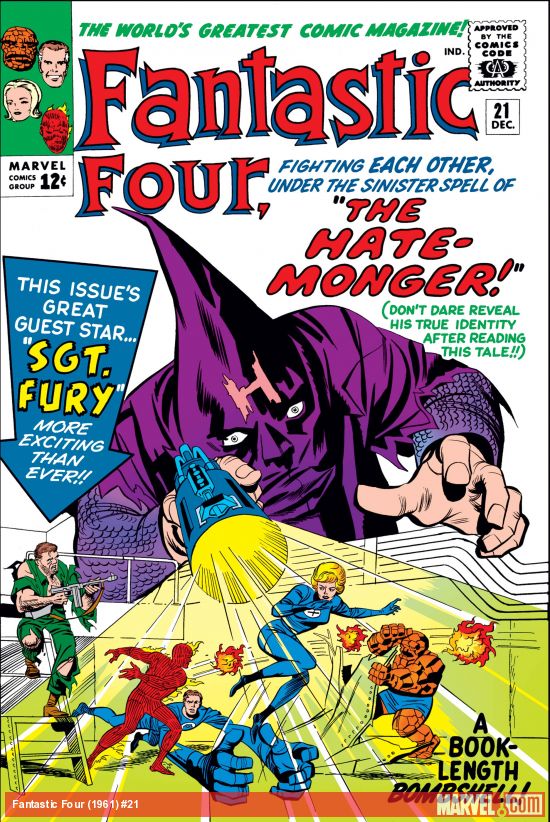
Fantastic Four #21
☆ Be the first to review + Add to your collection — Join freeFantastic Four #21 marks the debut of the Hate-Monger, one of the Silver Age's most politically charged villains — a KKK-hooded demagogue wielding a 'Hate-Ray' to stoke xenophobia and fracture the team, who is ultimately unmasked as a figure identified as Adolf Hitler. Published in September 1963, the same season as the March on Washington and in the months following Dr. King's 'Letter from a Birmingham Jail,' the story represented Stan Lee and Jack Kirby — both Jewish men with deep personal stakes in anti-fascist storytelling — using a mainstream superhero book to deliver an explicit allegorical rebuke of American racism and bigotry at the height of the Civil Rights Movement. The issue is equally significant as the first contemporary appearance of Nick Fury outside the Sgt. Fury war title, transplanting the WWII sergeant into a modern-day CIA agent role that laid the foundational continuity bridge leading directly to his transformation into the leader of S.H.I.E.L.D. two years later in Strange Tales #135. Together, these two threads — a socially conscious villain debut and a pivotal character transition — make this one of the most narratively loaded single issues of the early Marvel era.
In "The Hate-Monger!", the Fantastic Four find themselves under the sinister influence of a mind-control device, yet even in their compromised state, they’re called upon by Colonel Nick Fury of the CIA to stop a dangerous new threat. Written by Stan Lee and brought to life with dynamic art by Jack Kirby, this pivotal 1963 issue features Kirby’s bold cover pencils and Paul Reinman’s inks, capturing the tension of a team fighting their own minds.
ComicBooks.com Value
Show all 22 grades ▾
This exact issue on ebay
CGC 9.6 ▾ $49.99–$50 2 listings
CGC 9 ▾ $1,500–$1,595 2 listings
CGC 4 ▾ $135–$208 2 listings
Raw — VF ▾ $4.5–$250 2 listings
Raw — FN ▾ $175–$199 2 listings
Raw — VG ▾ $100–$120 3 listings
Raw / ungraded ▾ $32.95–$185 12 listings
Read it digitally
Sell my copy
Have this issue — or a whole collection? Get a fair offer from us, skip the marketplace fees and the hassle.
We Buy Collections ▸History
The issue was written by Stan Lee, penciled by Jack Kirby, and inked by George Roussos (credited as 'George Bell'), with lettering split between Artie Simek and Sam Rosen; the cover was inked by Paul Reinman. It went on sale September 10, 1963, with a December 1963 cover date. The crossover with Nick Fury was a natural outgrowth of the two titles sharing creators: Lee had already inserted a young Reed Richards into Sgt. Fury and His Howling Commandos #3 (September 1963) to build connective tissue between the war book and the superhero line, and this issue returned the favor by aging Fury forward two decades into a CIA operative. One scholarly analysis suggests Lee and Kirby likely developed the Hate-Monger concept in the weeks following President Kennedy's June 11, 1963 televised address on the moral crisis of racial discrimination, giving the story a remarkably compressed topical urgency from conception to newsstand.
Trivia · 8 facts
- First appearance and death of the Hate-Monger, a purple-robed, KKK-hooded villain armed with an 'H-Ray' (hatred ray) capable of inducing violent bigotry — revealed at issue's end to be a figure identified as Adolf Hitler (later retconned in Super-Villain Team-Up #17 as an Arnim Zola–engineered Hitler clone).
- First contemporary/modern-day appearance of Nick Fury, now a colonel working for the CIA rather than the U.S. Army — the crucial bridge between his WWII persona in Sgt. Fury and His Howling Commandos #1 (May 1963) and his later role as S.H.I.E.L.D. director beginning in Strange Tales #135 (August 1965).
- Constitutes the first crossover between the Fantastic Four title and the Sgt. Fury and His Howling Commandos series, both created by the Lee–Kirby team; Fury appears without his trademark eyepatch, an absence later explained in Sgt. Fury #27 (February 1966).
- Written by Stan Lee, penciled by Jack Kirby, inked by George Roussos (as 'George Bell') — marking Roussos's first inking assignment on the Fantastic Four series — with cover art inked by Paul Reinman and colors by Stan Goldberg.
- Released on newsstands September 10, 1963, with a December 1963 cover date, placing it squarely within the summer–fall arc of the Civil Rights Movement (the March on Washington had occurred just two weeks prior on August 28, 1963).
- The story takes place partly in the fictional South American nation of San Gusto, where the Hate-Monger has also been fomenting revolutionary unrest — one of the earliest examples of Lee and Kirby extending Marvel's geopolitical canvas beyond New York City.
- Reprinted multiple times, including Marvel Collectors' Item Classics #15 (June 1968), Giant-Size Fantastic Four #3 (November 1974), Marvel Masterworks: The Fantastic Four Vol. 13 (1990), Fantastic Four Epic Collection Vol. 2: The Master Plan of Doctor Doom, and Mighty Marvel Masterworks: The Fantastic Four Vol. 3 (2023).
- A full-page house ad for Amazing Spider-Man #7 appears inside the issue, reflecting Marvel's rapidly expanding line and the cross-promotional strategy Lee used to build the shared universe in real time.
Full credits
Reprints
Reprinted in Marvel Collectors' Item Classics #15 (1968), Marvel #1 (1970), I Fantastici Quattro #16 (1971), The Mighty World of Marvel #45 (1973), The Mighty World of Marvel #46 (1973), Giant-Size Fantastic Four #3 (1974), Los Cuatro Fantásticos #19 (1980), Une Aventure des Fantastiques #28 (1982), Marvel Masterworks #13 (1990), Essential Fantastic Four #2 (1999), Biblioteca Marvel: Los 4 Fantásticos #03 (1999), Marvel Klassik #11 (2000), Marvel Masterworks: The Fantastic Four #3 (2003), The New Smithsonian Book of Comic-Book Stories: From Crumb to Clowes #[nn] (2004), Fantastic Four Omnibus #1 (2005), Marvel Masterworks: Nick Fury, Agent of S.H.I.E.L.D. #1 (2007), Marvel Masterworks: The Fantastic Four #3 (2010), S.H.I.E.L.D. by Lee & Kirby: The Complete Collection. #[nn] (2015), S.H.I.E.L.D.: The Complete Collection Omnibus #[nn] (2015), Marvel Gold. Los 4 Fantásticos #1 (2016), L'ère des Comics Marvel 1961-1978 #[nn] (2017), Fantastic Four Epic Collection #2 (2017), Mighty Marvel Masterworks: The Fantastic Four #3 (2023), Fantastic Four Omnibus #1 [Fourth Edition] (2024) + 3 more
Key issues in Fantastic Four
 ★
★ ★
★ ★
★ ★
★ ★
★ ★
★ ★
★ ★
★Variants (1)
Reviews
Reader reviews
No reader reviews yet.