
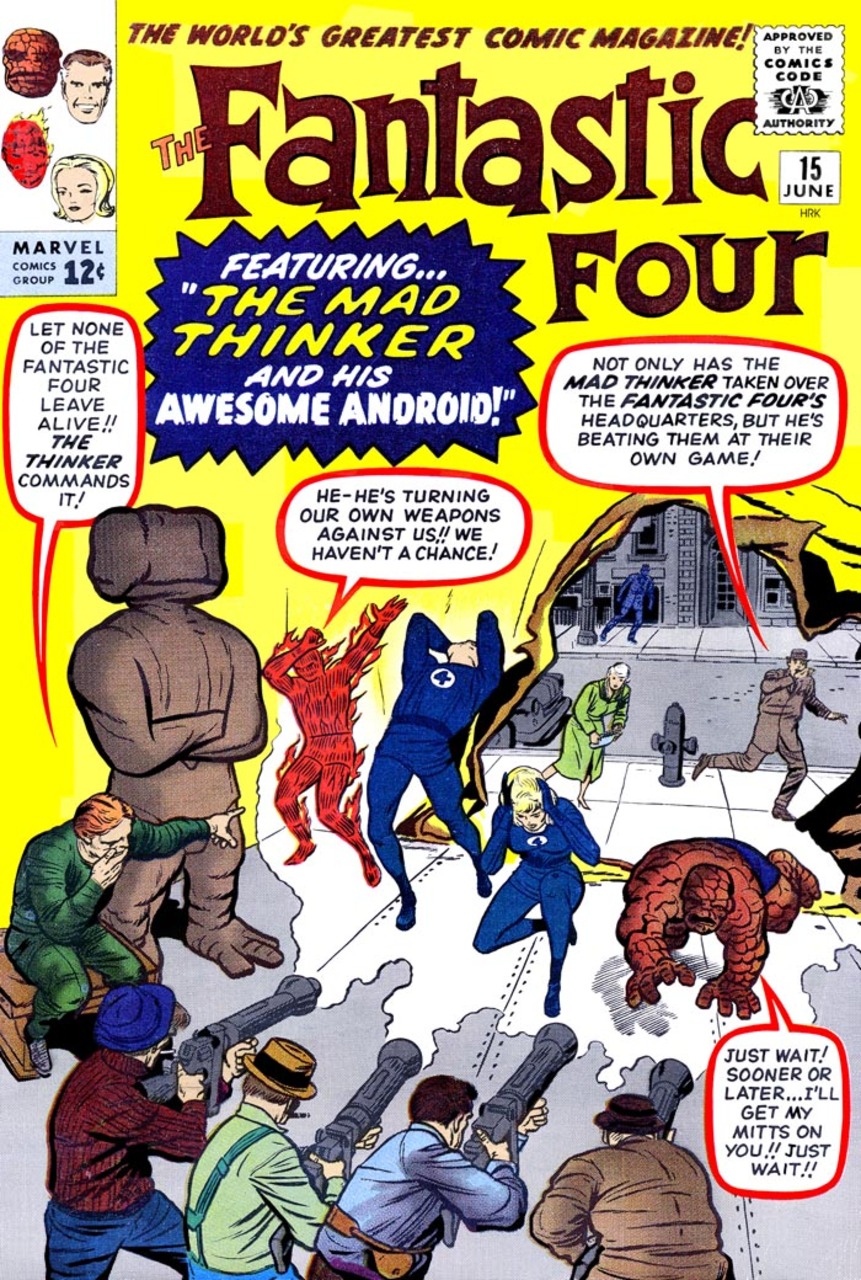
Fantastic Four #15
Fantastic Four #15 (cover date June 1963, on sale March 1963) is a genuine triple debut: it introduces the Mad Thinker, the Awesome Android, and the Yancy Street Gang in a single issue, gifting the Fantastic Four's rogues' gallery with one of its most durable intellect-based villains and Marvel's most memorable street-level comedy antagonists in one fell swoop. The Mad Thinker's core gimmick — a calculator-brain who can predict virtually any event yet still loses because he cannot account for pure human unpredictability — gave Stan Lee and Jack Kirby a thematic counterweight to Reed Richards' own genius, exploring the limits of pure rationalism in a way that resonated well beyond Silver Age superhero conventions. The Awesome Android, constructed by the Thinker from stolen Mister Fantastic research, became a surprisingly long-lived character who decades later underwent a genuine redemption arc as 'Awesome Andy' in Dan Slott's She-Hulk — a trajectory that begins with his blank, imposing first appearance here. The issue also features a letters-page appearance by a young Roy Thomas, whose enthusiastic fan letter anticipates his own imminent rise to Marvel writer and editor.
In Fantastic Four #15 (1963), the Mad Thinker launches a cunning scheme to conquer New York by manipulating gang leaders and luring the Fantastic Four into splitting up—leaving the Baxter Building vulnerable. With the team distracted, he uses their own headquarters to construct his terrifying Awesome Android, setting the stage for a clash of wits and might. Written by Stan Lee and brought to life with dynamic art by Jack Kirby, inks by Dick Ayers, and vibrant colors by Stan Goldberg, the cover by Kirby and Ayers captures the tension perfectly.
ComicBooks.com Value
Show all 22 grades ▾
This exact issue on ebay
Read it digitally
Sell my copy
Have this issue — or a whole collection? Get a fair offer from us, skip the marketplace fees and the hassle.
We Buy Collections ▸History
The issue was produced by the core Lee–Kirby creative engine at the height of their early collaborative rhythm, with Jack Kirby penciling and designing the cover, Dick Ayers inking, Stan Goldberg on colors, and Artie Simek lettering — the same team responsible for the surrounding issues of the run. Stan Lee scripted over Kirby's plots and character designs, as was standard Marvel Method practice of the period; the Mad Thinker's visual concept draws on the famous Rodin sculpture 'The Thinker,' a piece of classical-culture appropriation typical of Kirby's habit of retooling historical or mythological imagery for new stories. The issue's cover price was twelve cents and its on-sale date of March 12, 1963 places it squarely in the explosive first two years of Marvel's superhero revival.
Trivia · 8 facts
- First appearance of the Mad Thinker (later revealed as Julius / René Rodin), created by Stan Lee and Jack Kirby; the character's defining power is the ability to predict events to the precise second, though he is ultimately undone by an unpredictable human variable.
- First appearance of the Awesome Android, an android built by the Mad Thinker using stolen research notes from Reed Richards' lab in the Baxter Building; its key vulnerability is a cluster of nerve ganglia beneath its left arm that can shut down its entire system.
- First full appearance of the Yancy Street Gang, the off-panel street gang rooted in Jack Kirby's own Lower East Side childhood neighborhood; in this debut they are shown only as arms and voices taunting Ben Grimm, a visual convention that persisted throughout the run.
- The story's central plot turn — that the Mad Thinker's 'perfect' plan is defeated by Willie Lumpkin, the Baxter Building's mailman, pressing a button that deactivates all lab devices — established a recurring Lee–Kirby storytelling motif: even the most brilliant villain cannot account for the mundane and the human.
- Credits: Writer Stan Lee, penciler Jack Kirby, inker Dick Ayers, colorist Stan Goldberg, letterer Artie Simek, editor Stan Lee. Cover date June 1963; on-sale date March 12, 1963.
- The letters page ('Fantastic Four Fan Page') includes a published letter from Roy Thomas — then still a reader — to which Stan Lee replies with a quip; Thomas would shortly become a Marvel staff writer and later editor-in-chief.
- The issue also includes a 'Fantastic Four Pin-up Page' signed by Stan Lee and Jack Kirby.
- Notable reprints include: Giant-Size Fantastic Four #5 (May 1975); Marvel Masterworks: The Fantastic Four #6 (1988); True Believers: Fantastic Four — Mad Thinker & Awesome Android #1 (February 2019); and Mighty Marvel Masterworks: The Fantastic Four Vol. 2 — The Micro-World of Doctor Doom (2021).
Cast · 10 characters
Full credits
Reprints
Reprinted in Los 4 Fantásticos #15 (1963), Fantastic! #15 (1967), Marvel Collectors' Item Classics #10 (1967), Fantask #6 (1969), Fantask #7 (1969), Demonen #2/1970 (1970), I Fantastici Quattro #11 (1971), The Mighty World of Marvel #30 (1973), The Mighty World of Marvel #31 (1973), The Mighty World of Marvel #41 (1973), Une Aventure des Fantastiques #2 (1973), Giant-Size Fantastic Four #5 (1975), Une Aventure des Fantastiques #27 (1982), Marvel Masterworks #6 (1988), Essential Fantastic Four #1 (1998), Biblioteca Marvel: Los 4 Fantásticos #03 (1999), Marvel Masterworks: The Fantastic Four #2 (2003), Fantastic Four Omnibus #1 (2005), Marvel Masterworks: The Fantastic Four #2 (2009), Hasbro / Secret Wars #12 (2009), Fantastic Four Epic Collection #1 (2014), Marvel Gold. Los 4 Fantásticos #1 (2016), The A-Z of Marvel Monsters #[nn] (2017), True Believers: Fantastic Four - Mad Thinker & Awesome Android #1 (2019) + 11 more
Key issues in Fantastic Four
 ★
★ ★
★ ★
★ ★
★ ★
★ ★
★ ★
★ ★
★Variants (1)
Reviews
Reader reviews
No reader reviews yet.