
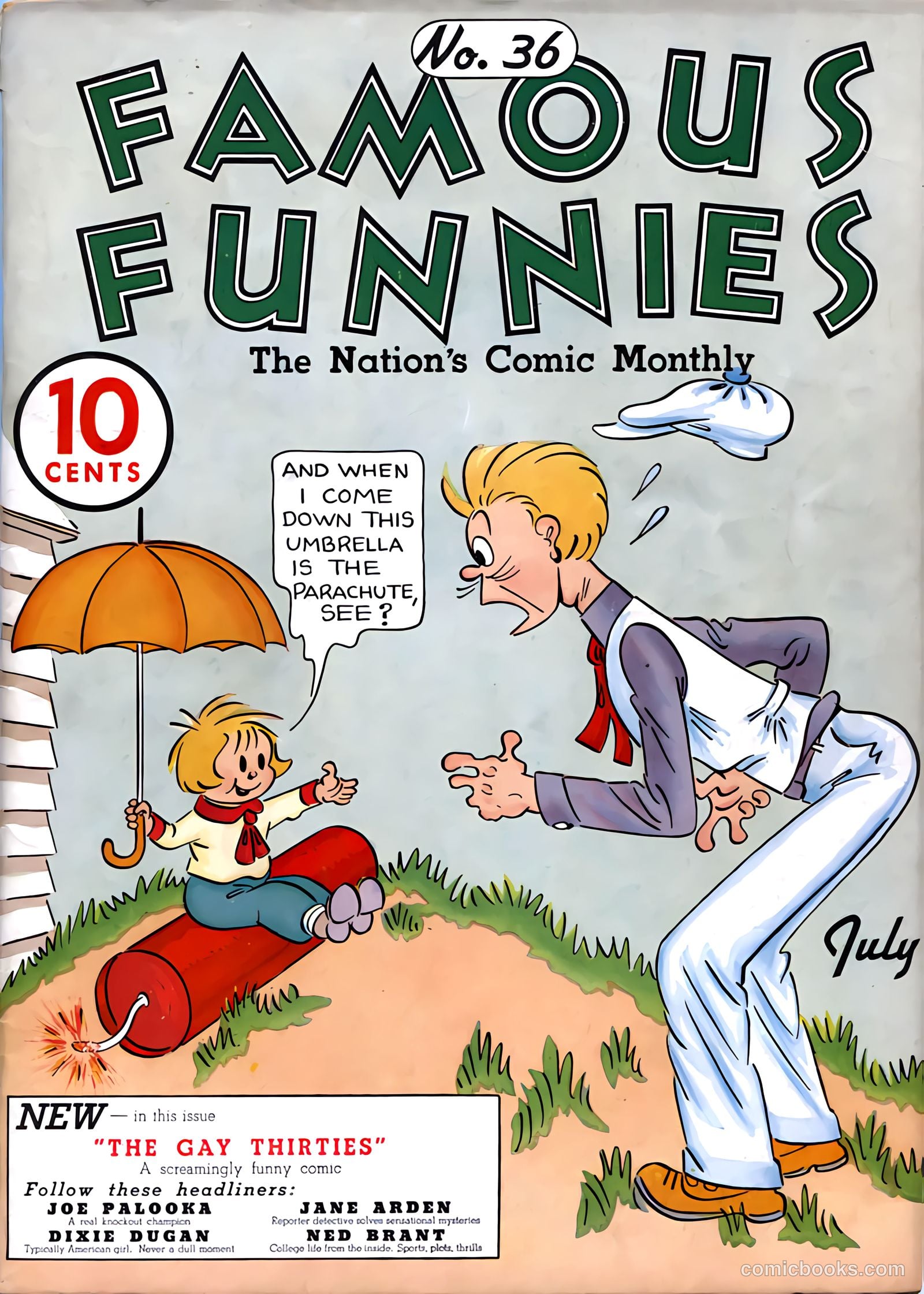
Famous Funnies #36
☆ Be the first to review + Add to your collection — Join freeFamous Funnies #36 is a mid-run entry in what historians consider the first ongoing American comic book sold on newsstands, a series that essentially invented the modern monthly comic book format. By 1937 the title was at or near the apex of its circulation, demonstrating that the medium Eastern Color had almost accidentally pioneered in 1934 had become a genuine mass-market institution. Its sustained reprinting of Buck Rogers — America's first major science-fiction newspaper strip, featuring Wilma Deering as one of the earliest active, capable female characters in popular sequential art — placed cutting-edge adventure storytelling in the hands of newsstand readers who had no other reliable venue for it. The sheer continuity of Buck Rogers across the run of Famous Funnies, spanning more than 180 issues, underscores how central the character was to proving the commercial viability of the comic book as a standalone format.
Famous Funnies #36 is an anthology featuring multiple comic strips. "Dickie Dare" follows the titular character and his companion Wags as they investigate a stolen pearl and a native hand box, leading them to discover a rowboat and pursue the culprits. "Oaky Doaks" depicts a king seeking employment at an agency, claiming extensive experience in kingship. "Butty and Fatty" shows two boys celebrating Independence Day by igniting fireworks, with one rocket launching unexpectedly and exploding near a tree, causing comedic chaos.
In a gritty Toronto boxing ring, Joe faces off against the heavily tattooed Sailor Jack Tupper, trading blows with relentless energy. As the fight reaches its climax, a sudden shift in focus comes not from the punch, but from a curious request—after the final round, Joe asks Tupper to show him the tattoo up close.
In this brief 1937 humor tale from *Famous Funnies #36*, Dixie takes her niece Imogene on a countryside drive and points out a sow nursing her piglets—only for Imogene to innocently ask if she can have little pork sausages for breakfast tomorrow.
George comes home early with flowers for his wife, but she suspects there's more to the story—and she's right. When pressed for the truth, George admits to a losing bet on a horse race, though his explanations keep shifting, leaving his wife uncertain whether he's finally leveling with her about what really happened.
In this 1937 adventure from *Famous Funnies* #36, King Cedric—reluctant and unimpressed by the idea—finds himself swept into an odd job application after being persuaded by his loyal companion Oaky. When Cedric fails the physical test for the position of ruler in a faraway land, his very inadequacy makes him the ideal candidate, setting the pair on a sea voyage to a kingdom they’ve never seen.
ComicBooks.com Value
Show all 7 grades ▾
This exact issue on ebay
Raw / ungraded ▾ $65–$75 2 listings
Read it digitally
Sell my copy
Have this issue — or a whole collection? Get a fair offer from us, skip the marketplace fees and the hassle.
We Buy Collections ▸History
Eastern Color Printing launched Famous Funnies #1 with a July 1934 cover date after an earlier Dell-partnered test edition sold out; by issue #3 the Buck Rogers newspaper strip reprint feature had been added and would anchor the title for decades. Eastern Color's model — folding full-size newspaper Sunday pages down to comic book dimensions and reworking the lettering for legibility — was the editorial and production template that made Famous Funnies work, and issue #36 (1937) was produced under that same workflow. The art appearing under Dick Calkins's credit in the Famous Funnies Buck Rogers pages was by this period largely executed by Rick Yager, who had begun ghosting the Sunday strips in 1933, though Calkins's name remained on the work.
Trivia · 8 facts
- Published by Eastern Color Printing, the series of which this is issue #36 is considered by historians the first true ongoing American newsstand comic book, launched July 1934.
- Buck Rogers had been a continuous feature in Famous Funnies since issue #3 and would run through issues #3–190 and #209–215 — one of the longest uninterrupted character runs in early comic book history.
- The Buck Rogers strip was created by writer Philip Francis Nowlan (adapting his 1928 Amazing Stories novella 'Armageddon 2419 A.D.') and artist Dick Calkins; it debuted in newspapers on January 7, 1929.
- Wilma Deering, Buck's co-star and the first person he encounters upon waking in the 25th century, appeared from the strip's very first installment and was notably portrayed as a capable, combat-ready fighter rather than a passive companion.
- The Buck Rogers material reprinted in Famous Funnies consisted of Sunday pages, which ran a separate continuity from the daily strips — at this period centered on characters including Buddy Deering (Wilma's younger brother) and spanning planetary adventure storylines.
- By late 1937, Famous Funnies was approaching peak circulation (documented at over 530,000 copies for issue #38, one issue after this one), reflecting the extraordinary commercial success the title had achieved by this stage of its run.
- Other features confirmed in mid-to-late 1930s issues of Famous Funnies alongside Buck Rogers include Alley Oop, Apple Mary, Jane Arden, Dan Dunn, and Napoleon.
- Eastern Color began adapting newspaper reprints specifically for the comic book page — reworking lettering and trimming recap panels — an editorial practice that influenced how all subsequent reprint-based comics were produced.
Cast · 2 characters
Full credits
Key issues in Famous Funnies
Reviews
Reader reviews
No reader reviews yet.