
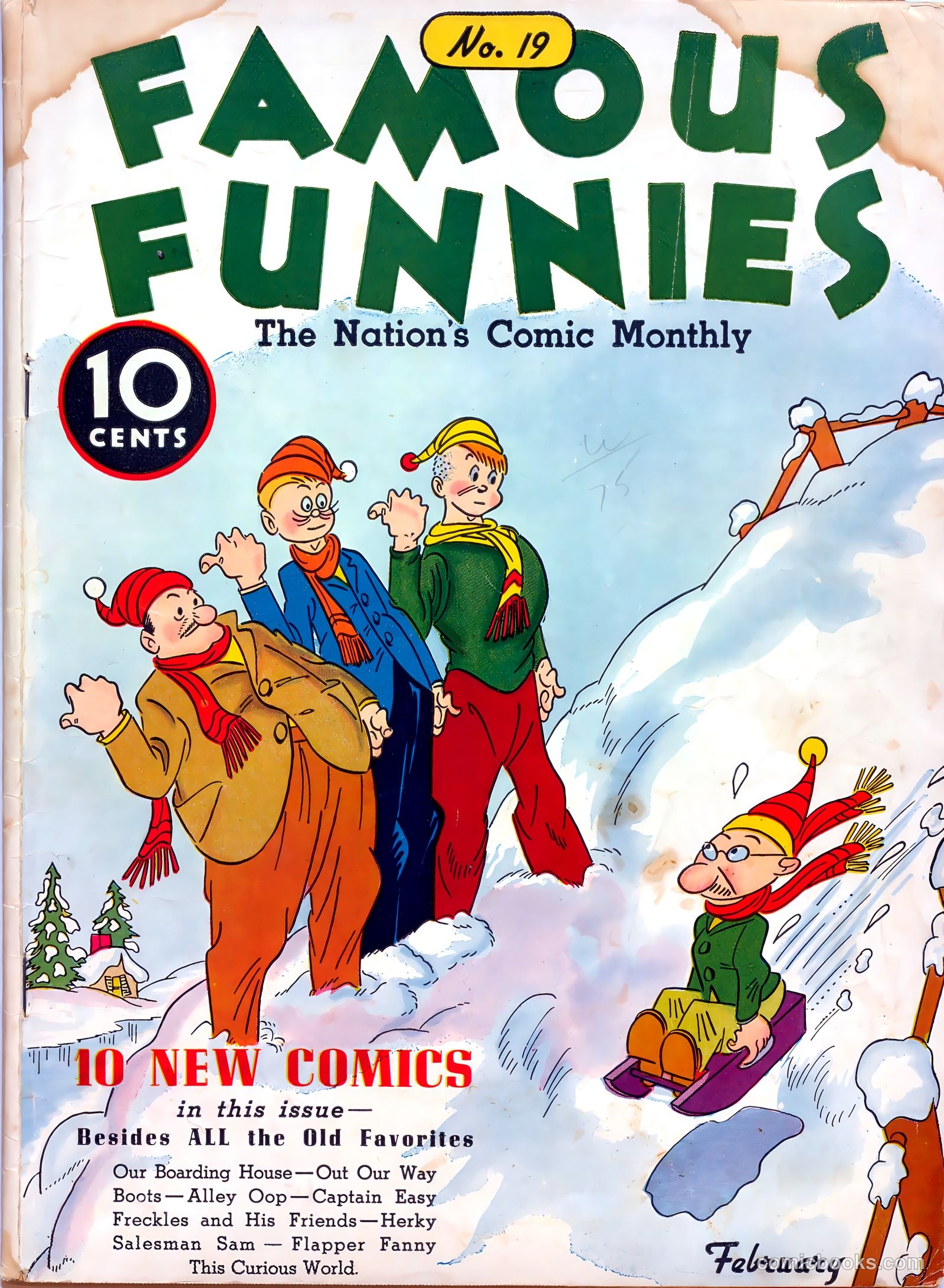
Famous Funnies #19
☆ Be the first to review + Add to your collection — Join freeFamous Funnies #19 (February 1936) is one of the ongoing monthly issues of what popular-culture historians regard as the first true American comic book series — a distinction that places every issue, including this one, at the foundation of the medium as we know it. Published by Eastern Color Printing, the series established the standard newsstand comic book format, page count, and ten-cent price point that the entire Golden Age would inherit. Issue #19 continues the run of Buck Rogers — Philip Francis Nowlan and Dick Calkins's science-fiction strip that had been running in the title since issue #3 (October 1934) and would persist for nearly 190 consecutive issues — bringing the first major sci-fi hero in American pop culture to a mass comic-book readership. As one chapter in a 218-issue run that proved comic books could be a commercially viable publishing category, it represents an industry proving its own viability in the middle of the Great Depression.
Famous Funnies #19 is an anthology issue featuring multiple comic strips and activities. "The Frog Pond Ferry" follows a skipper and a squirrel named Nutsy transporting a Gorgonzola mouse and his family by boat. The issue includes puzzle games, magic tricks, and educational features such as "Amaze-a-Minute," which presents facts about the South Pole, California hangars, Mount Everest preparation, and other topics. Additional content includes hidden picture games, mazes, and instructional activities alongside the comic strips advertised on the cover.
A Hollywood starlet and a movie extra clash over an unlikely casting choice for a jungle picture when the production's ape actor passes away. When a fellow actor suggests the extra could step into the role, things take a comedic turn as egos and pride collide over who's really the monkey in this scenario.
An' I Says to Him— A series of tall tales where an everyday fellow recounts the zingers he claims to have delivered in various situations—from standing up to his wife about rearranged furniture to talking back to a traffic judge about an impossible speeding ticket. Each vignette captures that peculiar boastfulness of someone convinced he always had the perfect comeback, whether he actually did or not.
ComicBooks.com Value
Show all 10 grades ▾
This exact issue on ebay
Raw / ungraded ▾ $340 2 listings
Read it digitally
Sell my copy
Have this issue — or a whole collection? Get a fair offer from us, skip the marketplace fees and the hassle.
We Buy Collections ▸History
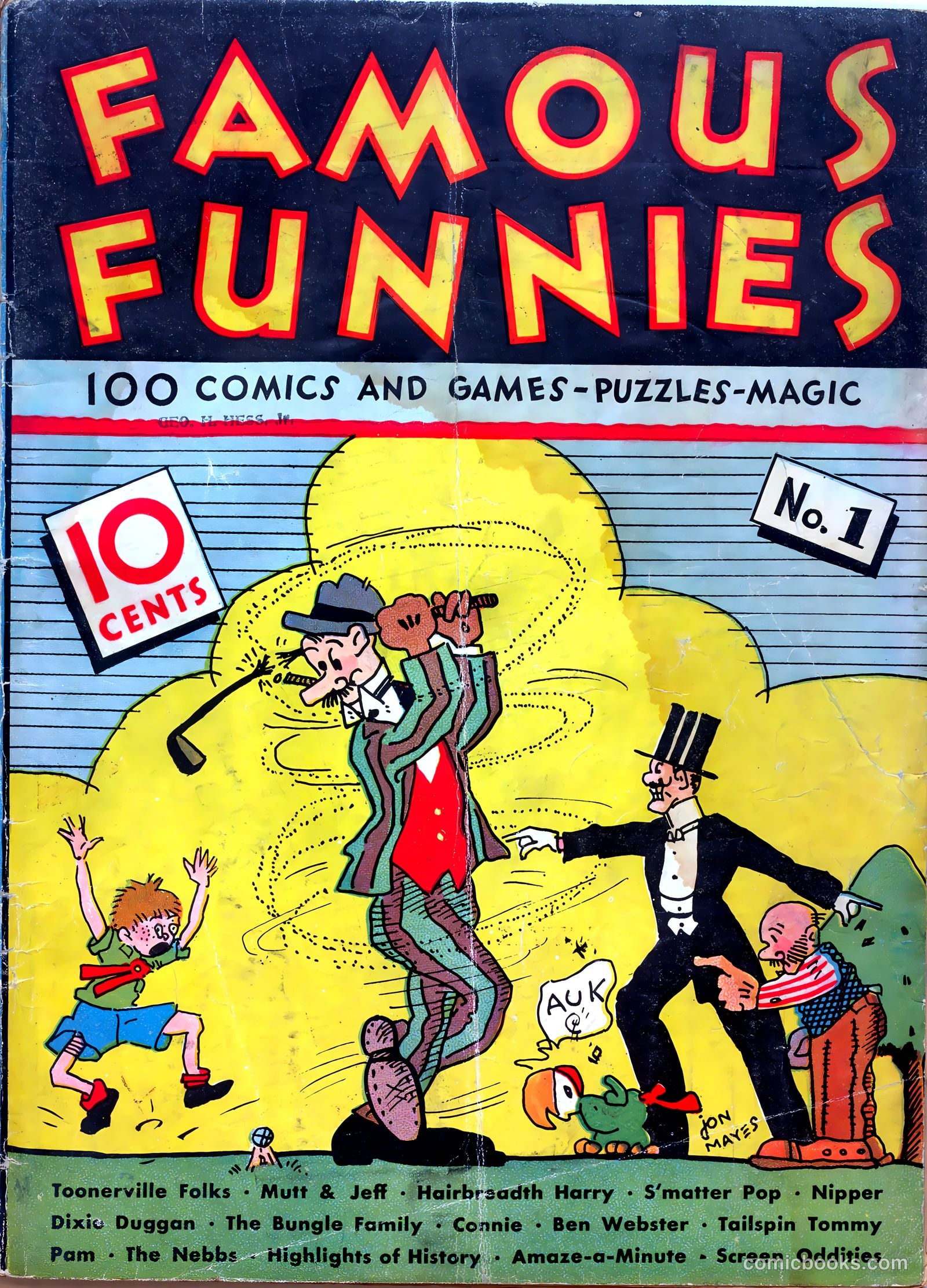
Eastern Color Printing launched Famous Funnies #1 in July 1934 after Eastern employee Harold Moore proposed a monthly anthology and Dell declined to continue the joint venture that had produced the series' precursors. Distributed by the American News Company, the series sold roughly 90 percent of its 200,000-copy print run from the start, though it did not turn a profit until around issue #12; by issue #19 the title was a firmly established commercial success and the dominant model for the nascent comic book industry. Each issue — including #19 — was assembled from licensed Sunday newspaper strips reformatted and relettered to fit the smaller comic book page, a production process Eastern Color had been refining since the very first issue. Stephen Douglas served as the effective day-to-day editor of Famous Funnies through this period, per Ron Goulart's Comic Book Culture.
Trivia · 8 facts
- Published February 1936 by Eastern Color Printing / Famous Funnies, Inc.; cover price 10¢; approximately 68 pages, full color.
- Part of the series historians consider the first true American comic book, which ran 218 issues from July 1934 to July 1955.
- Carries a Buck Rogers installment credited to Philip Francis Nowlan and Dick Calkins — the Grand Comics Database notes that the art during this period was actually ghosted by Rick Yager, who had taken over the Sunday strip pages.
- Buck Rogers had debuted in the series with issue #3 (October 1934) and would continue as a feature through issue #190 and again in #209–215, making Famous Funnies the primary comic book home for the character across its entire Golden Age run.
- Other confirmed features in this issue include: 'Joe Palooka' (Ham Fisher / Al Capp), 'Somebody's Stenog' (A.E. Hayward), 'Hairbreadth Harry' (F.O. Alexander), 'Above the Crowd' (Stookie Allen), 'Jane Arden' (Monte Barrett / Jack McGuire), 'Napoleon' (Clifford McBride), 'Nipper' (Clare Victor Dwiggins), 'Goofie Gags' (Victor E. Pazmiño), 'The Adventures of Jabby' (Tom Carlisle), 'Pee Wee' (S.M. Iger), and 'Flight' (Tipton / Mason), among others.
- Victor E. Pazmiño drew covers for Famous Funnies across most of this era; he also contributed the recurring interior gag feature 'Goofie Gags' and the strip 'Seaweed Sam.'
- All content consists of newspaper strip reprints reformatted for the comic book page, with original publication dates removed — a standard Eastern Color production practice documented across the entire run.
- The series had demonstrated by this point (issue #19, roughly its second year) that comic books could sustain a monthly print run commercially, a proof-of-concept that directly inspired competitors including Dell's The Funnies (launched October 1936) and ultimately the entire Golden Age boom.
Full credits
Key issues in Famous Funnies
Reviews
Reader reviews
No reader reviews yet.