
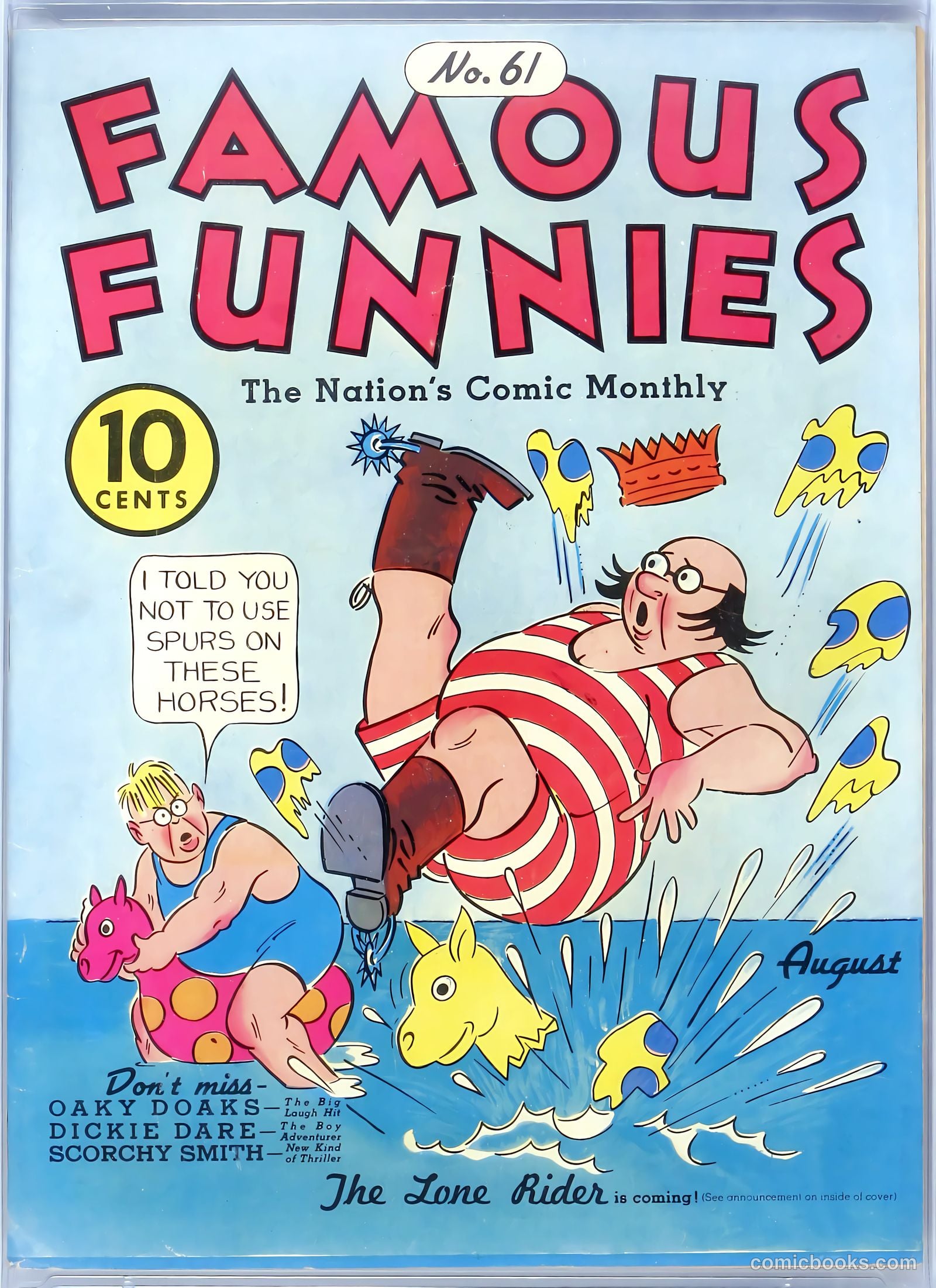
Famous Funnies #61
☆ Be the first to review + Add to your collection — Join freeFamous Funnies #61 is part of the foundational ongoing series that popular culture historians regard as America's first true monthly comic book — a format Eastern Color Printing established and sustained from 1934 all the way through 218 issues to 1955. By mid-1939, the series had already proven that newsstand comic books could be commercially sustainable, paving the road for the Golden Age boom that was just then exploding around it. This particular issue represents a transitional moment in the Buck Rogers reprint run: according to the documented strip chronology, issues #61–65 marked a brief gap in the Buck Rogers Sunday pages that had been a staple of the title since issue #3, underscoring how the series balanced multiple licensed properties rather than depending on any single strip. As an artifact of 1939 — the same year Action Comics and Detective Comics were reshaping what a comic book could be — Famous Funnies #61 illustrates the reprint-anthology model that the superhero revolution would soon displace.
Famous Funnies #61 is an anthology featuring several comic strips. "Jitter" by Aitchie Powers follows a mischievous character through a series of mishaps involving target shooting, household paint disasters, and traffic disruptions. "Oaky Doaks" presents a period romance in which a young noblewoman named Elisabeth falls for a humble peasant boy, though their differing social stations create conflict. "Babe Bunting" by Williams depicts a young girl helping her father Jake Heep gather story material by recruiting neighborhood children for various chores, leading to an unexpected nighttime discovery in an old house.
Uncle Elby takes his young charge out for what he claims is a fishing trip, but the boy quickly discovers there's more to the outing than just casting a line. This lighthearted animal tale plays on the gap between expectation and reality as the day unfolds in unexpected ways.
Jitter finds himself in quite the predicament when a simple situation gets hilariously out of hand, leading to the kind of physical comedy that defines early animal humor strips. With each mishap compounding the last, this one-page story captures the rapid-fire gag style that made these early funny-animal tales so entertaining.
In this humorous frontier tale, Mescal Ike tangles with troublemaker Muley Bates after a run-in at a field meet, but Pa Piffle and Miss Sally find themselves caught in the middle of the brewing conflict. With tensions rising and tempers flaring, this one-pager delivers the kind of slapstick mischief that makes frontier life anything but dull.
Spunky Dory finds himself stranded at the bottom of a canyon with only his goat Duchess and her supplies to keep him going. When snakes threaten to make a meal of him, Spunky toughs it out and faces down the vipers, all while dreaming of honey pancakes under the desert moon. It's a survival tale told straight from the desert, where resourcefulness and a loyal companion make all the difference.
ComicBooks.com Value
Find on ebay
Read it digitally
Sell my copy
Have this issue — or a whole collection? Get a fair offer from us, skip the marketplace fees and the hassle.
We Buy Collections ▸History
Eastern Color Printing launched the ongoing Famous Funnies series in July 1934 after Dell declined to continue the joint venture, distributing the title through the American News Company. By the time issue #61 appeared with a cover date of around August 1939, the book had settled into a stable editorial formula: reformatted reprints of licensed newspaper Sunday pages, with lettering reworked for legibility at the smaller comic-book page size and recap panels trimmed to improve narrative flow. The Ledger Syndicate supplied many of the strips through issue #87, and the John F. Dille Co. supplied the Buck Rogers pages; Eastern Color's editorial offices operated out of 500 Fifth Avenue in New York, with printing done at the company's plant in Waterbury, Connecticut.
Trivia · 8 facts
- Published by Eastern Color Printing, cover-dated approximately August 1939, as part of the 218-issue run of Famous Funnies (1934–1955) — the series historians identify as America's first true ongoing monthly comic book.
- The series had featured Buck Rogers Sunday strip reprints (Philip Francis Nowlan/Dick Calkins, syndicated by the John F. Dille Co.) as a core feature beginning with issue #3; however, documented strip records show that issues #61–65 did not contain Buck Rogers comic strips, marking a notable interruption in that regular feature.
- At this stage in the series (pre-#89), all content consisted of reformatted reprints of licensed newspaper strips — original commissioned material did not begin until issue #89 (late 1941), forced by wartime paper-conservation measures that shrank syndicate pages below a usable reprint size.
- The Ledger Syndicate supplied the majority of strips for Famous Funnies through issue #87, including Frank Godwin's adventure strip Connie, F. O. Alexander's Hairbreadth Harry, and other staples of the era.
- Eastern Color actively reworked the newspaper reprints for the comic-book page: recap panels were cut for narrative economy, and lettering too small to read at reduced size was redrawn — making Famous Funnies an early site of editorial adaptation craft.
- The series that issue #61 belongs to directly inspired imitators across the industry and helped establish the 10-cent, 68-page comic-book format that became the Golden Age standard.
- Invisible Scarlet O'Neil — one of the earliest superpowered heroines in comics, created by Russell Stamm — would not debut in the title until Famous Funnies #81 (1941); she is not present in issue #61.
- Victor E. Pazmiño served as the primary cover artist for Famous Funnies through much of the late 1930s run, giving the series a consistent visual identity during the period that includes issue #61.
Full credits
Reprints
Reprinted in The Complete Jack Kirby #1 (1997), Gwandanaland Comics #2773 (2020)
Key issues in Famous Funnies
Reviews
Reader reviews
No reader reviews yet.