
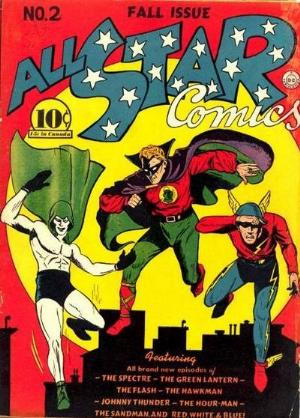
All-Star Comics #2
☆ Be the first to review + Add to your collection — Join freeAll-Star Comics #2 (cover-dated September 1940, published August 23, 1940) occupies a precise hinge point in comics history: it is one of only two issues of the series to exist entirely as a solo-hero anthology before the title's seismic transformation into the home of the Justice Society of America beginning with issue #3. The reader-poll mechanism published inside this issue directly drove the roster changes that made the JSA possible — Green Lantern and Johnny Thunder were added to the lineup as a direct result of that poll, and a notice inside promised that Doctor Fate would follow in the very next issue. It also contains the debut of the cosmic sorcerer Kulak, a villain whose shadow would stretch across four decades of DC continuity, from the Bronze Age All-Star Squadron to JSA team-ups of the 2010s, making it the earliest seed of one of the publisher's most durable supernatural antagonists.
In "Sacrifice for Yum-Chac," Hawkman investigates a mysterious drowning in a suburban home, uncovering a glass knife tied to ancient Aztec rituals. When his sister is kidnapped as part of a deadly sacrifice to the rain god Yum-Chac, Hawkman must race against time to stop the ritual. Written by Gardner Fox and illustrated by Sheldon Moldoff, this early All-Star Comics tale blends mystery and myth with a grounded sense of urgency. The cover, by Howard Purcell, captures the story’s eerie, suspenseful tone.
In "Sacrifice for Yum-Chac," Hawkman investigates a mysterious death in a suburban home, uncovering a glass knife linked to ancient Aztec rituals tied to the rain god Yum-Chac. When he learns his sister has been taken for a sacrifice, Hawkman must race against time to stop the ritual before it's too late.
In "The 'Robot' Men," Alan Scott investigates a strange wave of disappearances across American cities, where homeless men are replaced by eerie, robotic figures. When he discovers a drug in the creatures' blood that paralyzes the nervous system, he goes undercover as a hobo to expose the sinister mind behind the scheme—Baron von Zorn—before the mind-control plot spreads further.
In "The Curse of Kulak," Jim Corrigan investigates the theft of an ancient manuscript tied to a forgotten civilization, following a guard’s terrified utterance of the name “Kulak!” The Spectre takes charge, unveiling a vision of the stolen parchment before confronting Kulak himself—whose ominous warning sets the stage for a city plunged into plague. As the Ghostly Guardian battles each curse, the final clash between spectral power and ancient evil looms.
In "The Glowing Globe," Sandman—real name Wes Dodds—investigates a string of mysterious deaths linked to a sinister, glowing orb known as the Life Stealer. When the creature strikes close to home, targeting the renowned Sir Basil, Sandman must outwit both the glowing menace and its yellow-faced master before the power of the orb claims another life.
In "Invisible-Ink Gas," Red Dugan and Doris stumble upon a fire that leads to a shocking discovery: a body and gas tanks hidden in the wreckage. When Red finds a mysterious badge at the scene, he teams up with Whitey and Blooey to unravel a sinister scheme involving a gas that erases secret government messages—before the thieves can steal the information.
In "The Darling Apartment," a comedic twist on real estate woes, Johnny finds himself tangled in a peculiar eviction battle when the former owner of Herman Darling’s new property refuses to budge. With a little help from the Thunderbolt and a series of escalating mishaps, Johnny takes on the task of clearing the site—only to discover that being the one doing the throwing out isn’t quite as simple as it sounds.
In "Dr. Morte, Spiritualist," a 1940 tale from All-Star Comics #2, a cunning fraud preys on the grieving by pretending to commune with the dead. When Rex Tyler, as Hour-Man, uncovers the deception, he enlists Minute Man Martin and the Minute Men to expose the charlatan—while he takes the lead in tracking down the man behind the séance.
In "The One-Man Newspaper," Jay Garrick, as the Flash, stumbles upon the eerily deserted Daily Column office while visiting his friend Bill Jackson. Determined to uncover the mystery behind the missing staff, he takes it upon himself to publish a new edition—turning the newsroom into his own investigative trap. As the paper goes out, the culprit’s interest is piqued, setting off a high-speed chase through the city’s underbelly.
ComicBooks.com Value
Show all 21 grades ▾
This exact issue on ebay
CGC 6.5 ▾ $4,199–$4,500 3 listings
Raw / ungraded ▾ $3.99–$33.99 2 listings
Read it digitally
Sell my copy
Have this issue — or a whole collection? Get a fair offer from us, skip the marketplace fees and the hassle.
We Buy Collections ▸History
All-Star Comics was a joint venture between All-American Publications and National Periodical Publications — two editorially independent companies that would not formally merge into what we now call DC Comics until 1946 — and was edited by the remarkably young Sheldon Mayer, who oversaw the All-American line alongside publisher M.C. Gaines. The original concept was straightforward: give the most popular characters from each company's separate anthology titles more page space by running their solo adventures together in one quarterly package. Issue #2's cover was drawn by Howard Purcell and assembled primarily from figures lifted from existing published artwork — a common production shortcut of the era — and research from the Grand Comics Database notes that this particular cover composition was originally believed to have been slated for issue #3 until the Justice Society concept crystallized and required an entirely different approach. The reader-poll inserted in issue #1 (and repeated in #2) was an unusually direct act of audience collaboration for 1940, and the editorial letter in #2 announcing the results amounts to a documented moment in which fan feedback visibly reshaped the direction of a superhero title.
Trivia · 8 facts
- Cover date: September 1940; on-sale date: August 23, 1940; published quarterly by All-American Comics, Inc. at a cover price of ten cents for 68 full-color pages.
- Editor: Sheldon Mayer. Writers include Gardner Fox, Jerry Siegel, Bill Finger, Ken Fitch, and John B. Wentworth; artists include Sheldon Moldoff (Hawkman), Martin Nodell (Green Lantern), Bernard Baily (Spectre and Hour Man), Creig Flessel (Sandman), and Everett E. Hibbard (Flash). Cover art by Howard Purcell.
- First appearance of Kulak, High Priest of Brztal — a cosmic sorcerer introduced as the Spectre's opponent in 'The Curse of Kulak,' scripted by Jerry Siegel and illustrated by Bernard Baily; Kulak went on to reappear across decades of DC continuity, including the Bronze Age All-Star Squadron.
- First appearance of Nyola, a villain portrayed as a descendant of Montezuma, featured in the Hawkman story 'Sacrifice for Yum-Chac' illustrated by Sheldon Moldoff — though one source (Quality Comix) describes her power as weather manipulation, this characterization is not fully corroborated in the detailed plot synopses from GCD/DC Database.
- The issue contains an editorial letter announcing that, in direct response to the reader poll published in issue #1, Green Lantern and Johnny Thunder were being added as regular features, and that Doctor Fate would join the lineup starting with issue #3 — a transparent record of fan-driven editorial decision-making.
- This is one of only two issues (alongside #1) in which All-Star Comics functioned purely as a solo-hero anthology; beginning with issue #3, the title permanently became the home of the Justice Society of America, the first superhero team in comics history.
- The cover of issue #2 features the Spectre, the Flash, and Green Lantern assembled in a montage format, and according to the Grand Comics Database the composition was likely originally prepared for issue #3 before the JSA concept was finalized and required a new approach.
- The issue has been reprinted in All-Star Comics Archives Vol. 0, a DC hardcover collecting the earliest pre-JSA issues of the series.
Full credits
Reprints
Reprinted in Adventure Comics #55 (1940), Detective Comics #44 (1940), Adventure Comics #56 (1940), Detective Comics #45 (1940), Adventure Comics #57 (1940), Comic Cavalcade #1 (1942), Flashback #13 (1974), All Star Comics Archives #0 (2006)
Key issues in All-Star Comics
Reviews
Reader reviews
No reader reviews yet.