
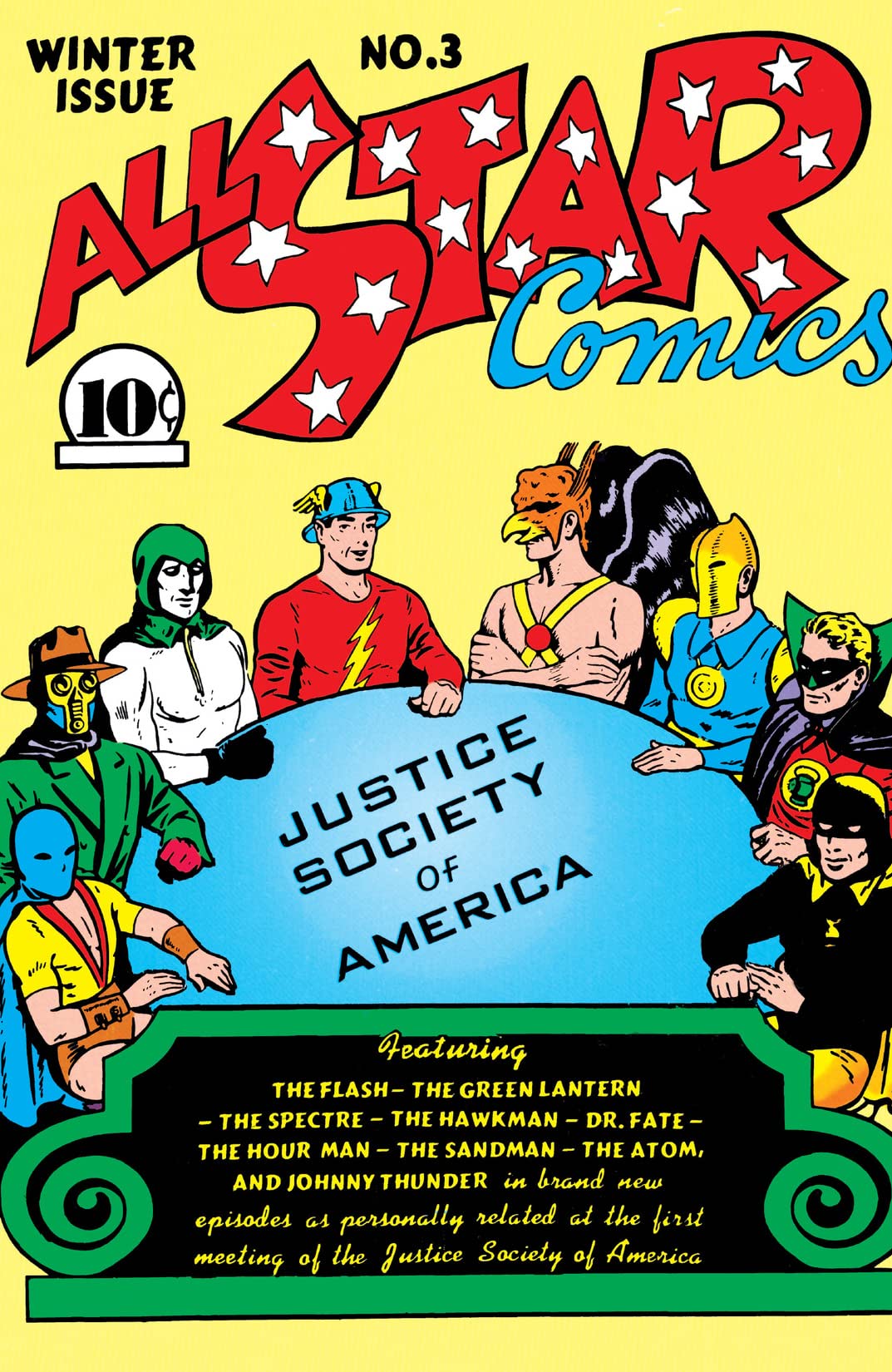
All-Star Comics #3
☆ Be the first to review + Add to your collection — Join freeAll-Star Comics #3 is the foundational document of the superhero team genre — the first comic book in history to unite multiple costumed heroes under a single organizational banner. Because several of its eight founding members (the Atom, Flash, Green Lantern, and Hawkman) were published by All-American Publications while others belonged to National Comics, the issue also qualifies as comics' first inter-company crossover title, a structural achievement that prefigured every shared universe to follow. The storytelling device it introduced — a framing sequence in which heroes gather and recount individual adventures — set an ensemble template that shaped the Justice League, the Avengers, and virtually every major superhero team that came after. Its cultural shadow is enormous: the Justice Society of America born here became the spiritual ancestor of the entire team-book genre that now dominates mainstream comics and superhero cinema.
In a tale from the early days of superheroics, the Flash recounts the legend of the sunken galleon *Sancta Joanna*, lost in 1567 with a fortune in Aztec gold—now sought by Tim Rogers’s father, whose salvage efforts are threatened by a ruthless rival crew. With the Flash stepping in to protect the dig, justice is served before the tale turns to Hawkman’s own story of fire-dwellers from ancient times.
In "The First Meeting of the Justice Society of America, Chapter 2: The Men Who Could Live in Fire," Shiera and Carter race to uncover the secrets of the Krakatoa volcano, only to face a deadly warning and a terrifying encounter with fire-walking beings from within the crater. As they’re captured and sentenced to die by the mysterious Mazda, Hawkman’s courage and quick thinking lead to a daring escape—just before the volcano erupts. The Spectre then steps forward to share his own tale.
In "The First Meeting of the Justice Society of America, Chapter 3," the Ghostly Guardian faces off against Oom, a lunar creature born from the dark side of the Moon, after a string of full-moon murders plague the city. When the two clash, they strike a desperate bargain: the one who brings the Red Moon Stone of Yzgartyl to Earth will stay, while the other is banished. Though Oom claims the stone first, the Spectre outwits him, trapping the creature in stone forever. As the dust settles, Hour-Man steps forward to share his own story.
In this 1940 installment from All-Star Comics #3, Rex Tyler, now the Hour-Man, attends a costume party with his niece—only to find himself outmatched by a room full of impostors wearing the same iconic suit. As the real Hour-Man uncovers a theft orchestrated by a fake Diamond Collection and a crooked host, he takes down the gang and exposes the mastermind behind the scheme. With the truth revealed, the spotlight shifts to the Sandman, who’s about to take the stage.
In a quiet moment between tales, the Red Tornado steps into the room, having listened to the Justice Society’s gathering, then quietly departs—leaving behind her red pants, now with a noticeable hole, as a curious afterthought.
In the countryside, Wes and Dian witness the sudden collapse of a giant man, setting off a chain of strange discoveries. When reports surface of mysterious bags containing human remains, the Sandman tracks the clues to Dr. Faversham’s secluded home, where he uncovers a sinister experiment involving a secret formula injected into victims’ pituitary glands. As the Sandman confronts the doctor, the mystery deepens—only to be handed off to Dr. Fate, who promises to continue the tale.
Inza visits an antique store where a mysterious woman leaves her a box before vanishing—only for it to unleash the drug Chevergris and send her into unconsciousness. Dr. Fate steps in, guiding her through a haunting encounter with phantoms in the Moors, where dark magic threatens to claim her. As he confronts the sorcerer behind the ancient book of resurrection, fate itself hangs in the balance.
In this 1940 tale from All-Star Comics #3, geology student Al stumbles upon a gang of criminals in Brooklyn disguising themselves as soldiers, setting up a heist that may involve a stolen government gold cache. When he tries to intervene, he’s knocked out—only to be found by Mary, who nearly uncovers his secret. As he regains consciousness and spots the armored truck again, he springs into action. Johnny then takes the floor, signaling it’s time for another story to unfold.
In the shadowed streets of 1940s America, a corrupt police commissioner’s downfall sparks a wave of criminal activity that no one can stop—until Green Lantern uncovers the truth behind the new Commissioner Lacy’s rise. With the help of reporter Paul Pryor, he races to expose a conspiracy that’s rewriting justice from within, but when the stakes turn deadly, even the mightiest hero may not survive the night.
In the final pages of All-Star Comics #3, the Justice Society of America gathers as the Flash returns from Washington, where he’s been briefing the government. With the team now aware of a scheduled meeting with the FBI Chief for the coming Tuesday, they unanimously agree to travel to Washington—setting the stage for what comes next.
ComicBooks.com Value
Show all 21 grades ▾
This exact issue on ebay
Raw — NM ▾ $9.95–$14.99 3 listings
Raw / ungraded ▾ $9.99–$1,990 4 listings
Read it digitally
Sell my copy
Have this issue — or a whole collection? Get a fair offer from us, skip the marketplace fees and the hassle.
We Buy Collections ▸History
All-Star Comics had launched in the summer of 1940 as a straightforward anthology, starring heroes from two sister publishers — All-American Publications and National Comics — in completely separate stories with no interaction. Editor Sheldon Mayer and writer Gardner Fox recognized that the title's 'greatest hits' premise had a logical next step: what if those heroes actually met and talked to one another? Fox scripted the framing narrative that brought eight champions together in a hotel meeting room, with the uninvited Johnny Thunder accidentally accelerating the gathering through his magic Thunderbolt. The cover of the issue — and much of the interior art — was the work of Everett E. Hibbard, while the individual chapter segments were illustrated by a rotating pool of Golden Age artists including Sheldon Moldoff, Bernard Baily, Howard Sherman, and Martin Nodell, reflecting the multi-studio origins of the characters themselves.
Trivia · 8 facts
- First appearance and origin of the Justice Society of America (JSA) — the first superhero team in comic book history — with a cover date of Winter 1940–1941, published November 22, 1940.
- Charter membership consisted of eight heroes: Doctor Fate, Hourman, the Spectre, Sandman, the Atom, the Flash (Jay Garrick), Green Lantern (Alan Scott), and Hawkman.
- Written by Gardner Fox and edited by Sheldon Mayer; the framing sequence and cover art were by Everett E. Hibbard, with interior chapter art contributed by Sheldon Moldoff, Bernard Baily, Howard Sherman, Martin Nodell, and others.
- Because the Flash, Atom, Green Lantern, and Hawkman were All-American Publications characters while the Spectre, Sandman, Hourman, and Doctor Fate were National Comics characters, this is widely cited as the first inter-company superhero crossover title in comics history.
- Superman and Batman are referenced in the issue's text as having been invited to the founding meeting but absent due to other duties; both were classified as 'honorary members' since they already headlined their own titles — an in-house editorial rule that was formalized in print with All-Star Comics #5.
- The original Red Tornado (Ma Hunkel) also appears in the issue, arriving at — then deciding against joining — the meeting, giving her a unique cameo association with the JSA's very first gathering.
- The issue has been reprinted multiple times: in Famous First Edition #F-7 (1975), All-Star Comics Archives Vol. 1 (1992), DC's Millennium Edition (June 2000), a Facsimile Edition (2024), and DC Finest: Justice Society of America: For America and Democracy (2024).
- The JSA concept born here directly inspired DC's Silver Age Justice League of America (debuting in The Brave and the Bold #28, 1960), which Gardner Fox also scripted, closing a creative loop between the genre's founding text and its Silver Age reinvention.
Full credits
Reprints
Reprinted in Action Comics #32 (1941), Adventure Comics #58 (1941), Detective Comics #47 (1941), Comic Reprints #[3] (1974), Famous First Edition #F-7 (1975), America vs. the Justice Society #2 (1985), All Star Comics Archives #1 (1992), Millennium Edition: All Star Comics No. 3 #[Chromium Edition] (2000), Millennium Edition: All Star Comics No. 3 #[nn] (2000), Coleção DC 75 Anos #1 (2010), L'histoire des super-héros #[nn] (2016), DC Comics Graphic Novel Collection #91 (2016), All-Star Comics 3 (Facsimile Edition) #[nn] (2024), DC Finest: Justice Society of America: For America and Democracy #[nn] (2025)
Key issues in All-Star Comics
Variants (1)
Reviews
Reader reviews
No reader reviews yet.