
All-Star Comics #1
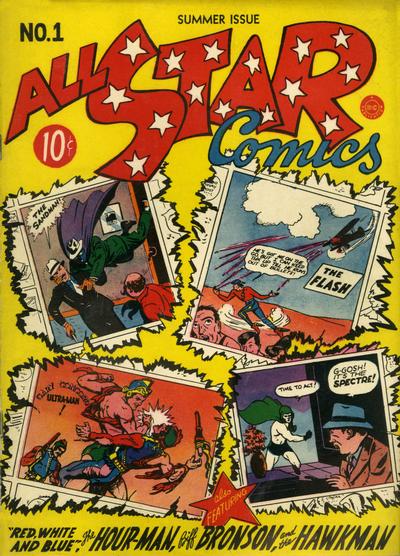
☆ Be the first to review + Add to your collection — Join freeAll-Star Comics #1 launched an ambitious cross-publisher anthology built on the premise of concentrating the most popular heroes from both All-American Publications and National Periodical Publications into a single title — a concept that would, just two issues later, evolve into the Justice Society of America, the first superhero team in comic book history. The series' first two issues served as a transitional anthology format, spotlighting heroes in standalone adventures and effectively road-testing an ensemble cast before issue #3 folded them into a shared continuity through a JSA framing device. That development constituted comics' first intercompany crossover, with characters drawn from two distinct publishers operating within the same story. The anthology-within-a-team structure All-Star pioneered established a template for ensemble superhero narratives that preceded Marvel's Avengers concept by more than two decades.
"Vs. the Sorceror Trygg" kicks off with Red, Whitey, and Blooey on a surprise vacation in Alaska—only to find themselves tangled in a mystery when local girl Doris West warns them about a hidden threat: a secret underground fortress built by disguised Kavinise men, believed to have captured a G-2 agent. Written by Jerry Siegel and illustrated by William Smith, this early All-Star Comics entry blends wartime espionage with pulp adventure, all wrapped in a cover by Creig Flessel, Harry Lampert, Jon L. Blummer, and Bernard Baily.
In "Vs. the Sorceror Trygg," Hawkman soars over the Welsh Mountains, drawn by a desperate cry from a young woman named Jan, who claims to be fleeing from undead workers. When he learns her uncle, the sorceror Trygg, has been using dark magic to control zombies in forgotten mines, Hawkman steps in to stop the injustice—only to uncover deeper witchcraft at play, entangling both Jan and another woman, Margo.
In "The Twin Thieves," a chance encounter at a jewelry store sets Wes on a trail that leads from a masked robber to a mysterious man who changes suits mid-chase. When Wes returns as the Sandman to investigate the thief’s home, he uncovers a hidden safe full of stolen jewels—only to face a trap set by the real mastermind behind the crime.
In the year 2240, as war rages between Toutonia and Balkania, Ultra-Man—Gary Concord, High Moderator of the United States—steps in to broker peace and restore order, especially in the war-ravaged uranium mines. When he uncovers a secret plot by Balkanian agents Criket and Krieg to seize the mines through deception, Concord moves swiftly to stop them before the conflict deepens.
In "The Murder of Widow Jones," the Flash investigates a chilling crime scene after a mysterious open window and a silent, locked door raise alarms in a quiet neighborhood. When he discovers the widow Jones dead and her home ransacked, he takes on the case personally—posing as a detective to catch the thief in under thirty minutes.
In "The Tenement Fires," Jim Corrigan investigates a blaze that defies explanation, uncovering a deadly secret in the victim’s clothing. The Spectre, drawn by the tragedy, ascends to heaven and learns the fire was no accident—someone is deliberately setting blazes, and the dead man has seen the arsonist. With a new lead, the Spectre sets out to track down the culprit before more lives are lost.
In the early days of superheroics, Biff and Mulligan are called to uncover a mystery: government bomber plans seem stolen, yet they’re still in the safe. When Biff notices a mysterious poster advertising the Great Remembo, a stage magician with a flair for the dramatic, he senses something’s off—leading him on a trail that proves the real trick is yet to come.
In "The Forest Fire," Hour-Man steps in when a raging blaze threatens a camp under Uncle Sam’s protection, saving everyone in the process. But as the smoke clears, a chilling warning arrives: the camp must be evacuated immediately—or someone will die. With time on his side and danger on the rise, Rex Tyler, as Hour-Man, takes the lead in uncovering the source of the threat.
In "The Volcano Invasion," Red, Whitey, and Blooey trade their usual missions for a well-earned vacation in Alaska—only to find themselves back in action when Doris West warns them of a hidden threat: Kavinise men infiltrating the region, masquerading as Eskimos and hoarding weapons in an underground fortress. With a G-2 operative missing and the danger growing, the trio sets out to uncover the truth and stop the invasion before it’s too late.
ComicBooks.com Value
Show all 22 grades ▾
This exact issue on ebay
Read it digitally
Sell my copy
Have this issue — or a whole collection? Get a fair offer from us, skip the marketplace fees and the hassle.
We Buy Collections ▸History
All-Star Comics #1 was published on June 12, 1940 by All-American Publications, an unusual joint venture that pooled the characters and talent of both All-American and National Periodical Publications under one cover. Editor Sheldon Mayer — listed without credit in the indicia — shaped the title from its inception, and it was Mayer working alongside writer Gardner Fox who conceived the idea of having the anthology's solo stars actually meet and interact, the creative spark that would directly produce the Justice Society of America in issue #3. The title launched on a quarterly schedule, with its first four issues carrying Summer, Fall, Winter, and Spring cover dates respectively. The two companies behind the title would ultimately merge and become modern DC Comics in 1946.
Trivia · 8 facts
- Published June 12, 1940 (Summer 1940 cover date); edited by Sheldon Mayer, uncredited in the indicia.
- Features solo stories of six Golden Age heroes across two publishers: All-American's Flash (Jay Garrick), Hawkman, and Ultra-Man; and National's Hour-Man, the Spectre, and the Sandman.
- Gary Concord the Ultra-Man — scripted and drawn by Jon L. Blummer under the pen name 'Don Shelby' — makes his only Golden Age appearance in this issue.
- Creative roster spans multiple writers and artists: Gardner Fox scripted both the Hawkman (art by Sheldon Moldoff) and Flash (art by E.E. Hibbard) stories; Jerry Siegel scripted the Spectre (art by Bernard Baily) and Red, White and Blue (art by William Smith); Ken Fitch scripted Hour Man (also art by Baily).
- The cover is a composite montage assembled from artwork by Creig Flessel, E.E. Hibbard, Jon L. Blummer, and Bernard Baily — not a single original cover illustration.
- The issue hosted an early reader-participation contest, inviting fans to vote by coupon on which characters to include or exclude in issue #2, an unusually direct editorial feedback mechanism for 1940.
- Also includes a two-page prose text story, 'Exile to Jupiter,' by Evelyn Gaines — a requirement at the time for second-class postal mailing rates.
- The issue was reprinted in its entirety in DC's All-Star Comics Archives Vol. 0 (2006).
Full credits
Reprints
Reprinted in Adventure Comics #52 (1940), Superman #5 (1940), Action Comics #28 (1940), Detective Comics #43 (1940), Superman #6 (1940), Action Comics #29 (1940), The Great Comic Book Heroes #[nn] (1965), Flashback #22 (1974), Great American Comic Books #[nn] (2001), All Star Comics Archives #0 (2006)
Key issues in All-Star Comics
Reviews
Reader reviews
No reader reviews yet.