
A complete issue · 16 pages · 1878
Puck — December 25, 1878
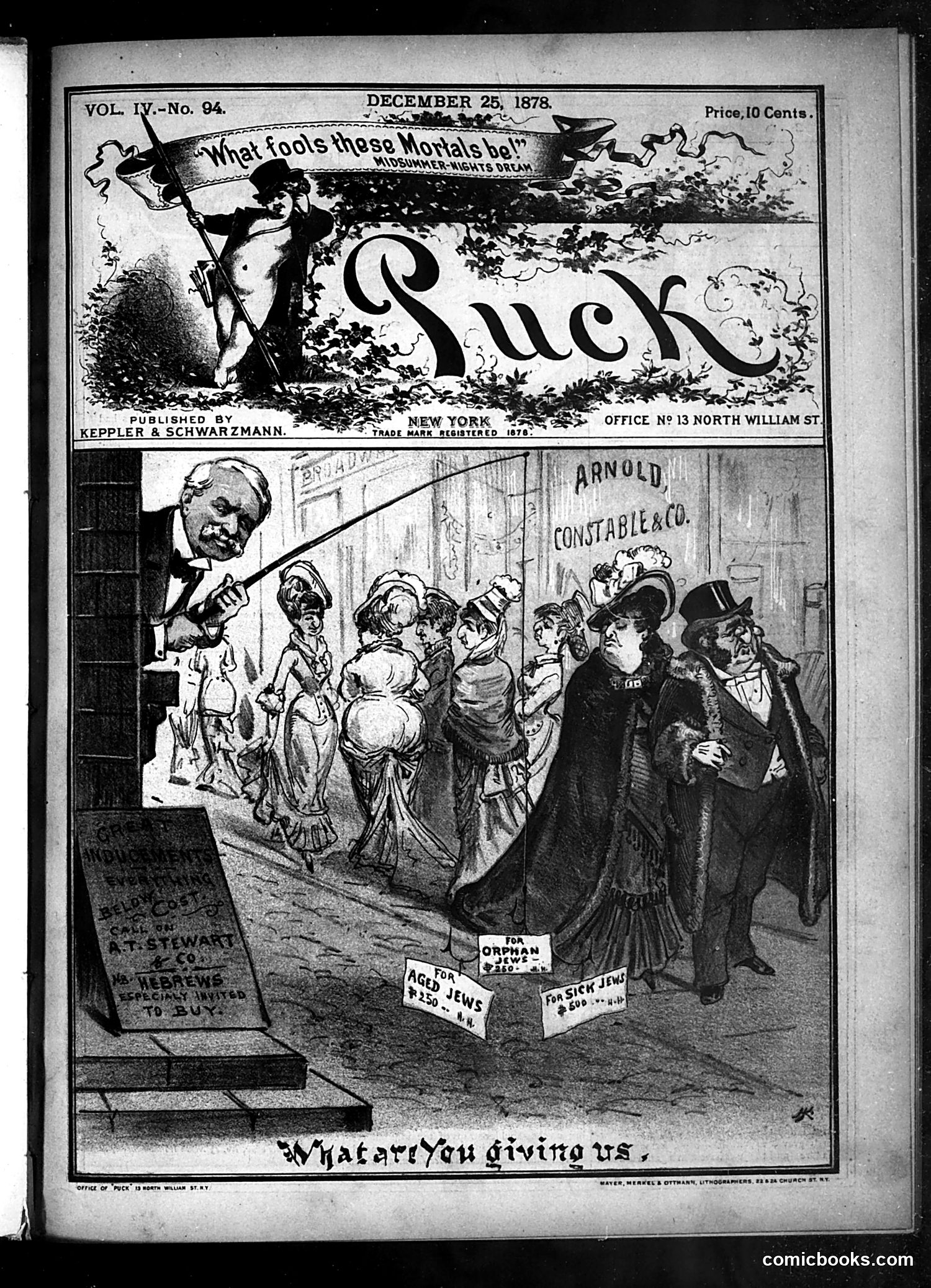
This satirical cartoon critiques charitable giving practices of the wealthy. The top panel asks "What fools these Mortals be!" The main illustration depicts well-dressed gentlemen outside "Arnold Constable & Co." (a real New York department store) observing children and poor people labeled "For Orphans," "For Aged Jews," "For Sick Jews," and "For Orphan Asylums." A caricatured figure (appears to be a wealthy businessman or philanthropist) manipulates these charitable causes like a puppet show. The satire suggests that wealthy donors cynically use charity for show rather than genuine compassion—treating human suffering as objects for public display and moral posturing. The bottom caption "What are You giving us" reinforces the accusation that charitable donations are performative rather than meaningful.
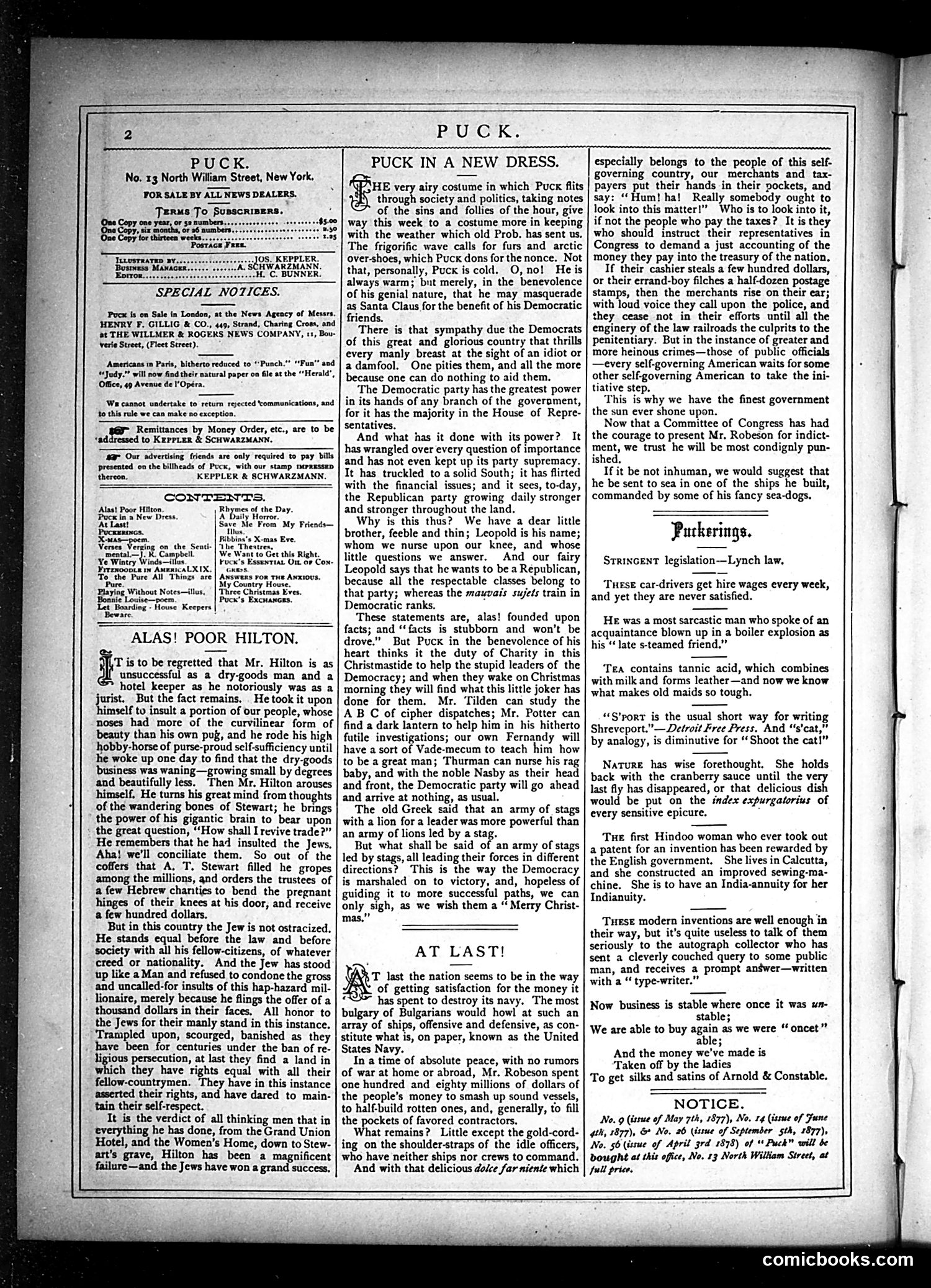
This page contains several satirical articles rather than visual cartoons. The main political content targets the Democratic Party's leadership and strategy during what appears to be a late 19th-century election cycle. The article "Puck in a New Dress" mocks Democratic leaders, naming figures like Leopold (likely referring to a prominent Democrat) and criticizing the party's inability to effectively govern. It ridicules the party's failure to maintain power and suggests their leaders are incompetent—comparing them to various ineffectual characters. The piece "Alas! Poor Hilton" satirizes an unsuccessful businessman, using his failure as a metaphor for Democratic political incompetence. The section "At Last!" criticizes government spending, specifically naval expenditures under what appears to be a Republican administration, sarcastically commenting on money wasted on military vessels. The tone is consistently mocking toward Democratic leadership and governance failures.
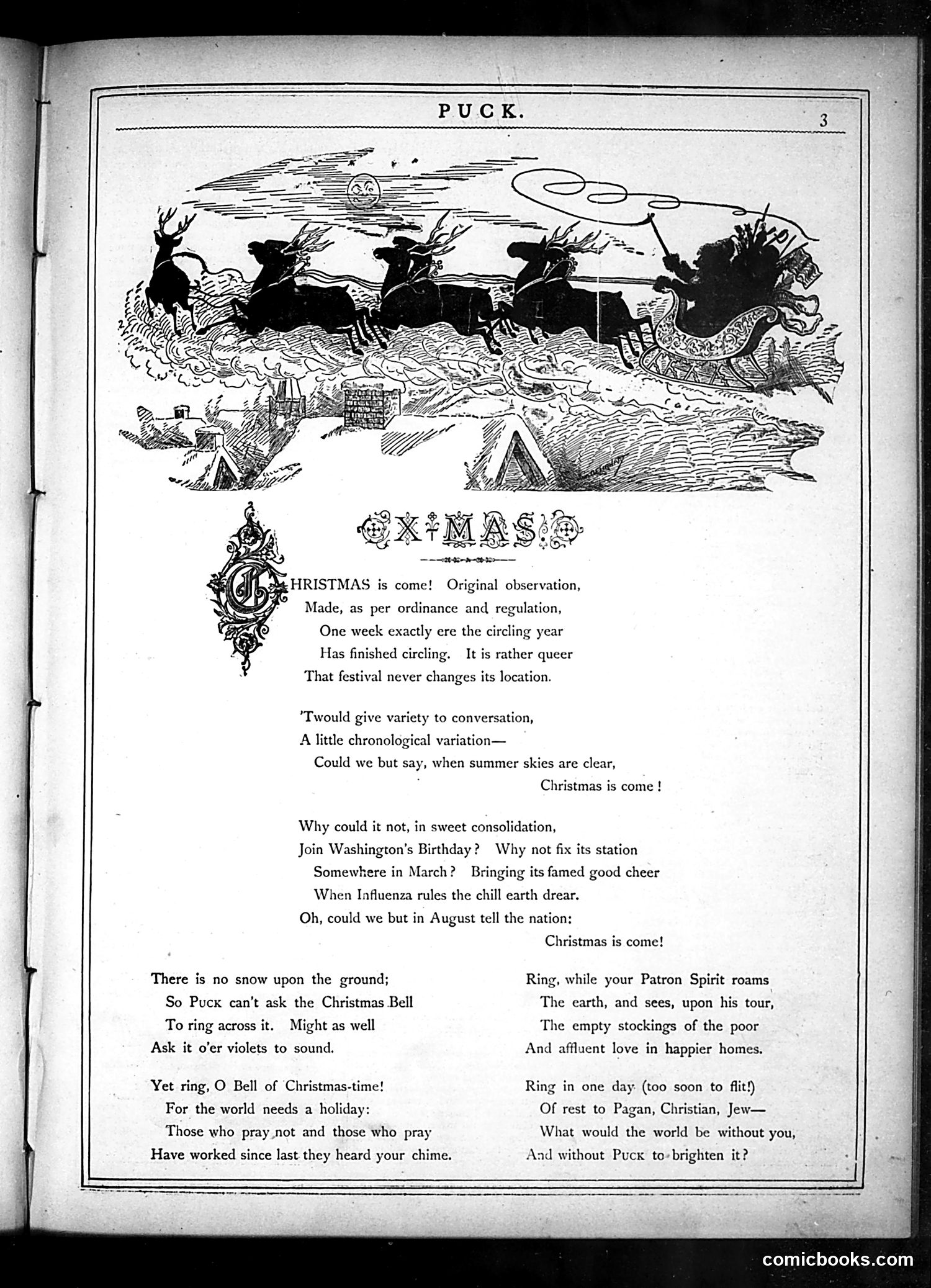
This page contains a satirical poem about Christmas rather than a political cartoon. The illustration shows Santa's sleigh flying over a winter landscape with soldiers and military encampments below. The poem satirizes the fixed timing of Christmas, proposing it could be moved—to summer, March, or August—to provide "variety" and better timing (like during flu season for morale). The poem jokes that Christmas is immovable despite practical arguments for relocation. The military imagery in the illustration likely reflects WWI-era concerns, suggesting the poem was written during wartime when the holiday's fixed observance seemed inflexible compared to actual needs. The final lines appeal to Christmas's universal value across religious groups ("Pagan, Christian, Jew"), emphasizing its importance to society's wellbeing.
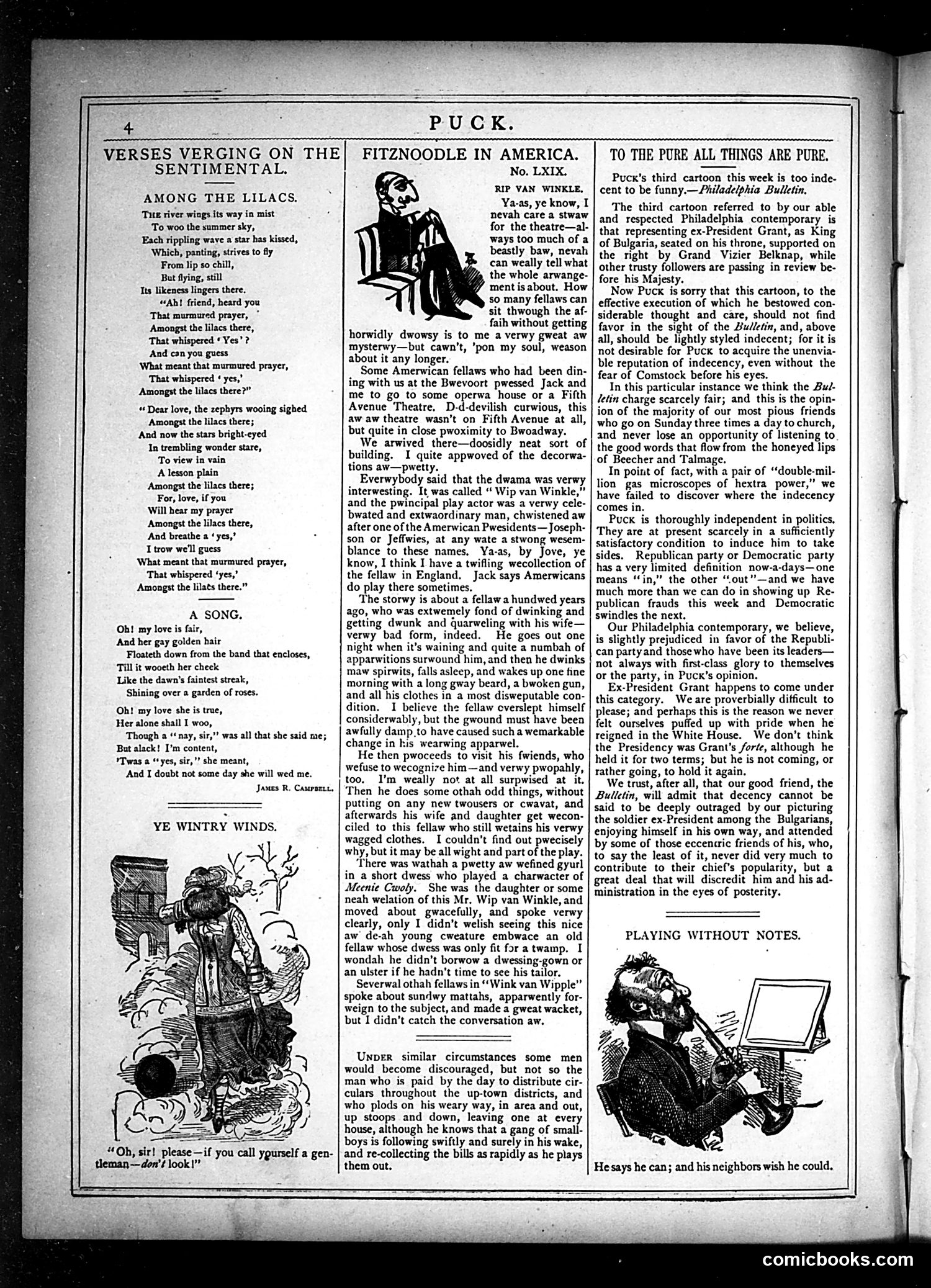
This page contains three distinct pieces: 1. **"Fitznoodle in America" (center)**: A satirical story about an eccentric European character visiting New York theaters and opera houses. The accompanying illustration shows a man in formal dress, apparently representing a comically out-of-place foreign visitor observing American theatrical culture. 2. **Poetry and verse** (left and right columns): Including "Among the Lilacs," "A Song," and "Ye Wintry Winds"—literary content typical of Puck's miscellaneous offerings. 3. **Editorial commentary** (top right, "To the Pure All Things Are Pure"): Criticizes Puck's own recent cartoon depicting President Grant and Bulgarian dignitaries, arguing the artwork shouldn't be considered indecent. This appears to be defending editorial choices against readers' objections. The page reflects Puck's mix of satire, literature, and self-defense of its editorial decisions.
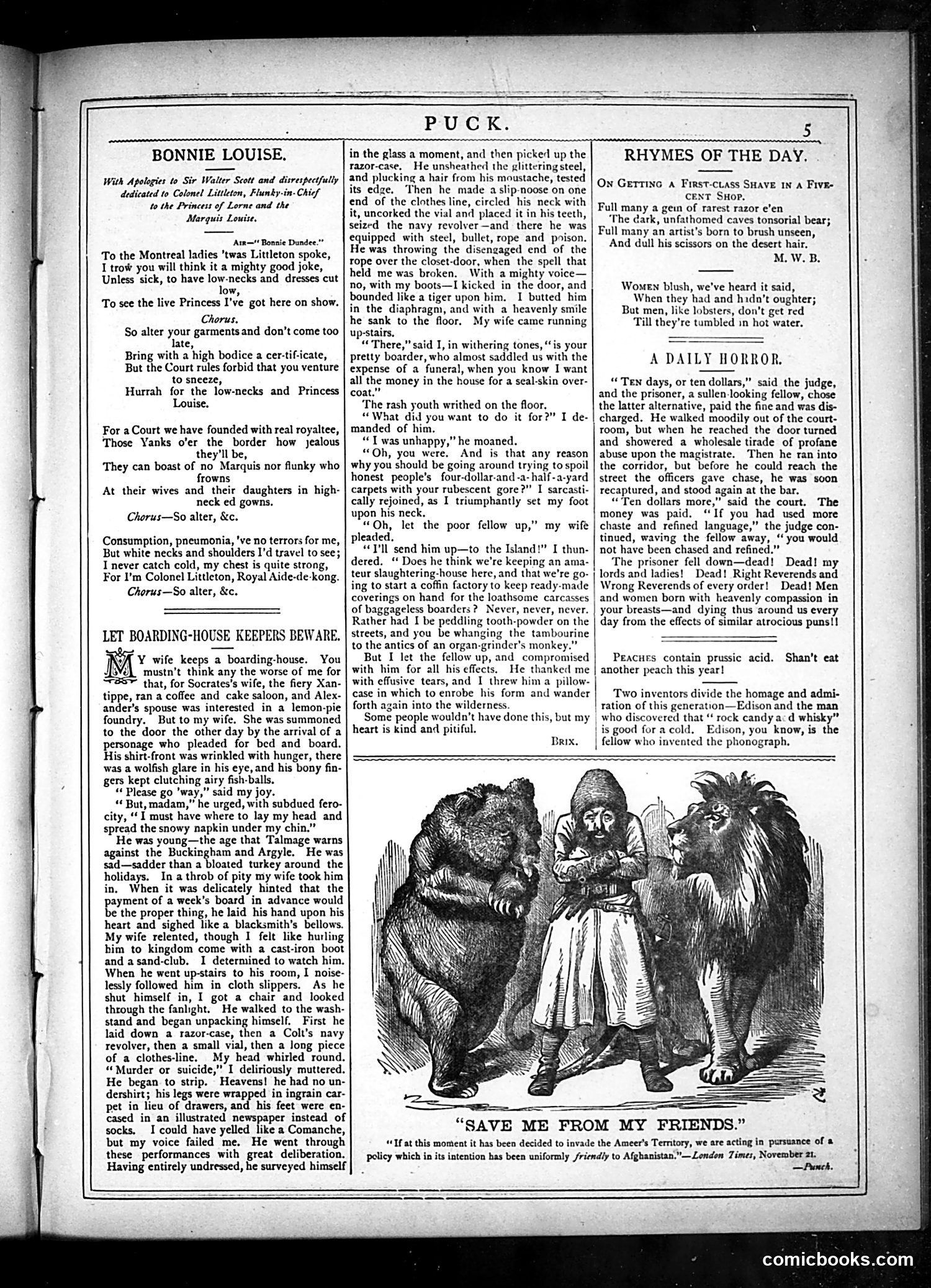
The main cartoon depicts a grotesque figure (appearing to be Uncle Sam or an American authority figure) menacing a smaller, cowering character, with the caption "SAVE ME FROM MY FRIENDS." The subtitle references a London Times quote about invading the Ameer's Territory in Afghanistan, criticizing U.S. policy there as ostensibly "friendly" but actually hostile. The satire suggests that American military intervention in Afghanistan—framed as aid or friendship—is actually harmful aggression. The cartoon mocks the hypocrisy of describing imperial expansion as benevolent assistance. The grotesque caricature style emphasizes the brutality masked by diplomatic language. This likely reflects late-19th-century American debates over expansionism and foreign policy.
This page appears to be primarily **text narrative rather than a political cartoon**. It's titled "Bibbins's Xmas Eve" and tells a satirical story about the Bibbins family and their Christmas preparations. The narrative mocks the Bibbins household—described as a large, chaotic family of ten children—and their attempts at genteel propriety despite financial modesty. The satire targets middle-class pretension: Mr. Bibbins distributes small gifts through a "District Telegraph Messenger" to maintain appearances of generosity while managing limited means. The humor lies in the family's anxiety about appearances (clearing the dining room, hiding modest circumstances) and the contrast between their aspirations and actual circumstances—typical Puck satire of Victorian-era social climbing and domestic comedy rather than political commentary.
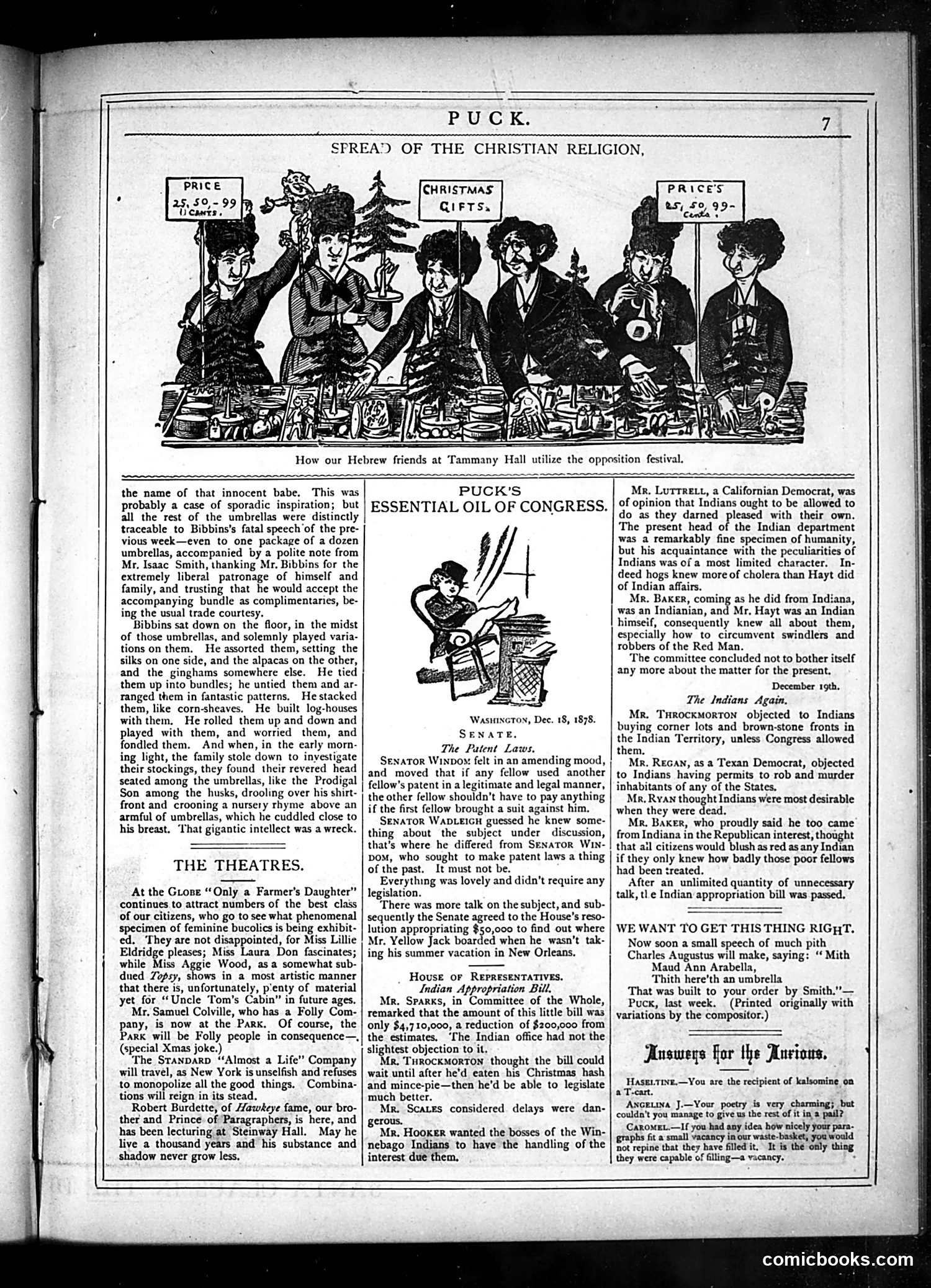
This satirical cartoon mocks what appears to be Jewish merchants or traders exploiting Christmas commercialism. Six figures display price signs (25.50-99 cents and higher) above merchandise and Christmas gifts, with the caption "How our Hebrew friends at Tammany Hall utilize the opposition festival." The satire attacks the perceived commodification of Christmas and implies corrupt dealings between Jewish businesspeople and Tammany Hall (New York's Democratic political machine). The cartoon trades in antisemitic stereotypes, portraying Jews as greedy merchants profiting from Christian holidays. The accompanying text discusses congressional debates about Native American affairs and patent laws, unrelated to the cartoon's theme. This reflects Puck's typical mix of political commentary and satirical imagery from the 1870s-80s era.
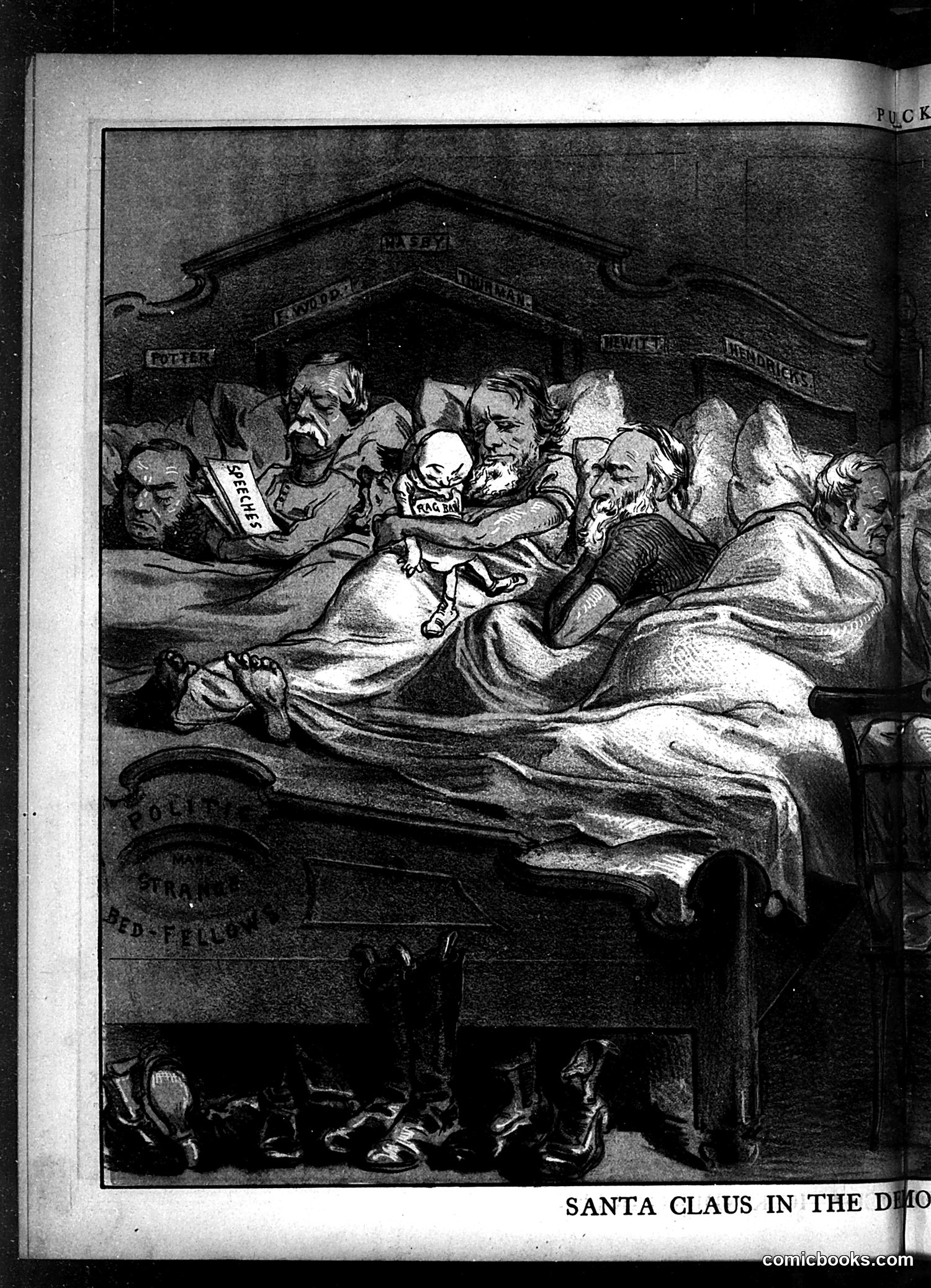
This political cartoon depicts Santa Claus surrounded by prominent Democratic figures in what appears to be a bed or enclosed space. The caption references "the Demo[cratic Party]," indicating this is satirizing Democratic leadership or policy. The figures shown appear to be caricatured politicians with exaggerated features typical of Puck's style. Labels visible on some figures include references to political positions or identities, though specific names are difficult to read clearly in this reproduction. The satire likely mocks Democratic leadership or priorities by presenting them as crowded around Santa Claus—suggesting they're either childish, greedy, or pursuing unrealistic gifts/promises. Without clearer text or dates, the specific political events or figures referenced remain unclear to a modern reader unfamiliar with this era of Puck magazine.
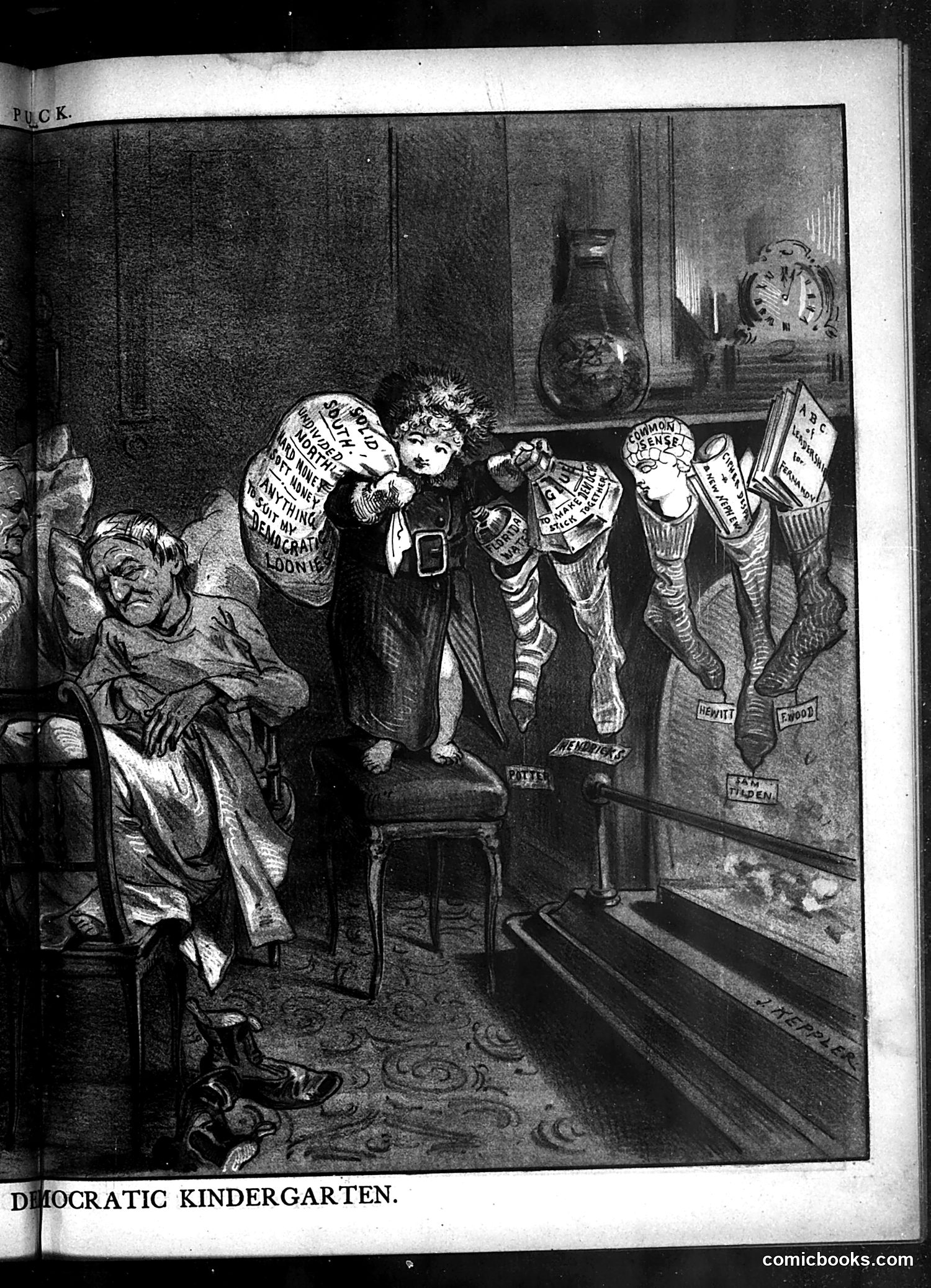
This political cartoon satirizes the Democratic Party as a chaotic kindergarten class. An adult figure (likely representing Democratic leadership) attempts to manage several unruly children wearing labeled caps and clothing with various political slogans and names—appearing to represent different Democratic factions or politicians. The cartoon's joke rests on portraying Democrats as immature, disorganized, and difficult to control, unable to work cohesively. The "kindergarten" metaphor suggests childish squabbling and lack of discipline within the party. The clock in the background may reference time-sensitive political matters or deadlines. The overall message criticizes Democratic Party infighting and dysfunction compared to Republican unity, typical of Puck's partisan Republican perspective during this era.
This page from *Puck* magazine contains **no political cartoon**. Instead, it presents the opening of a serialized short story titled "Three Christmas-Eves" (credited to Tinsley's Magazine). The left column features poetry titled "My Country House," celebrating English rural life and domestic contentment. The right column begins Chapter I of a domestic fiction narrative set at Woodchester Cathedral, describing a young organist's Christmas Eve visit to a country house where he encounters various characters—Colonel Wynford, his daughter Caroline, and Miss Wynford—in what appears to be a romantic social drama. This is **literary content**, not satire or political commentary. The page demonstrates *Puck's* editorial range beyond humor.
This page contains primarily **text narrative rather than cartoons**—it appears to be Chapter II of a serialized story titled "Sidney," featuring dialogue among characters including Sidney, Stephen, Carrie, Mrs. Dainton, and others. The content is a domestic comedy centered on Christmas preparations and romantic entanglements. Characters discuss holiday plans, gift-giving, and relationships with gentle humor. Mrs. Dainton scolds Sidney for his inconsiderateness; Carrie displays romantic interest; and Maggie appears as a young woman receiving Christmas attention. **No clear political or social satire is evident** on this particular page. It functions as narrative fiction rather than satirical commentary, typical of Puck's mixed content format combining humor, cartoons, and serialized stories for entertainment purposes.
This page contains **"Rain on the Roof,"** a sentimental poem illustrated at the top, alongside various brief satirical commentary items typical of Puck's format. The main cartoon depicts **Puck's Exchanges**—short humorous observations on current events and social topics. Items reference: - **Spiritual mediums** and séance pricing (suggesting skepticism about spiritualism) - **The Princess Louise** and Canadian governor-general appointments - **Scientific American's** reporting on nosebleeds from altitude - **Marriage and divorce** commentary - Various social observations about clothing, weather, and human behavior The page is primarily **text-based satire** rather than large political cartoons—typical of Puck's miscellaneous commentary sections. Without specific historical context visible in the image itself, the precise targets of individual jokes remain unclear, though the tone suggests mockery of contemporary social pretensions and pseudoscience.
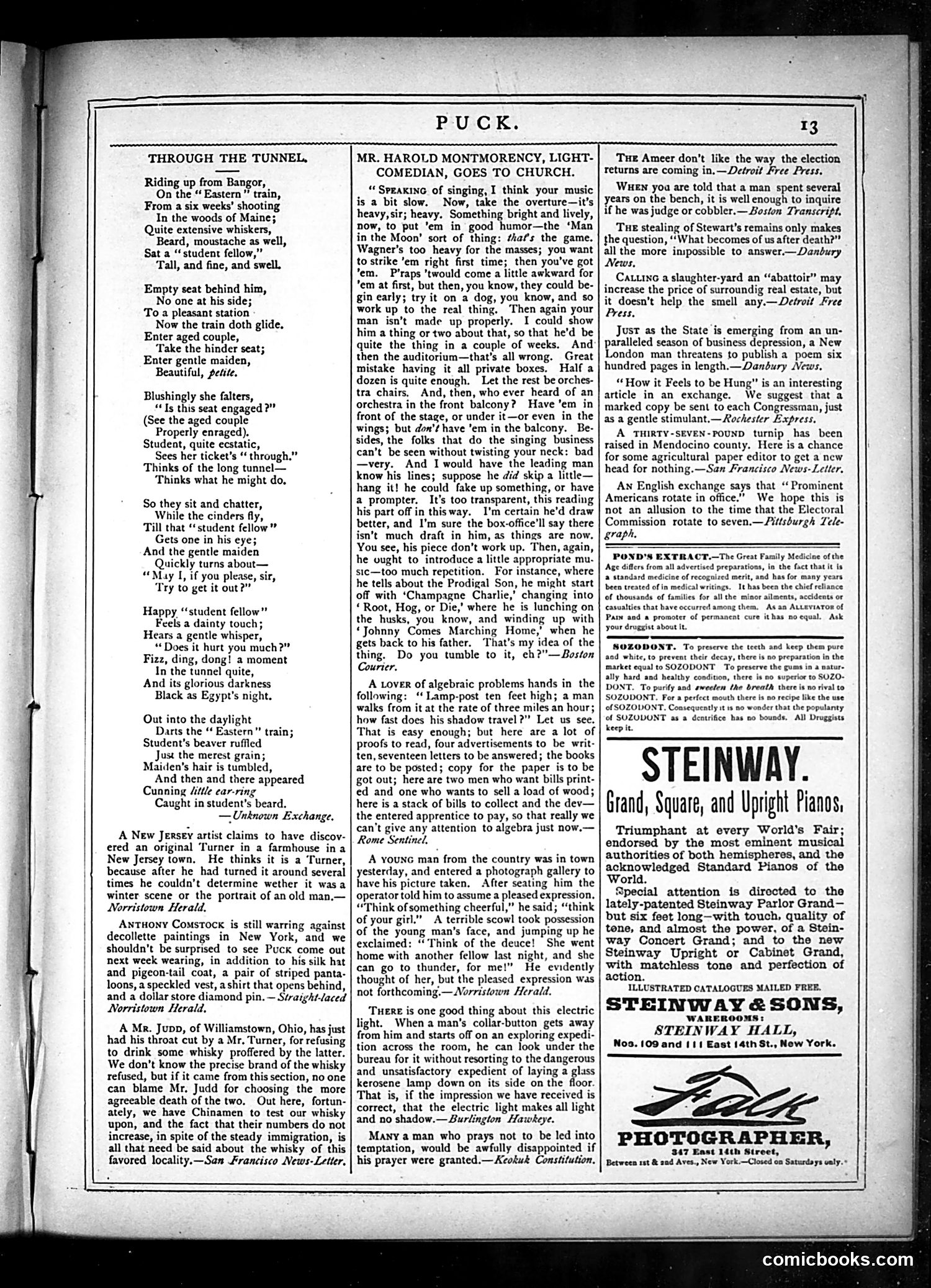
This page contains primarily text content rather than prominent political cartoons. The left column features a poem titled "Through the Tunnel" describing a train journey from Bangor. The right side contains brief news commentary items mocking various topics: election returns, Stewart's remains, business depression, and ecclesiastical matters. There's commentary on American rates and Electoral Commission issues. The page is dominated by advertisements, including a large Steinway pianos ad claiming superiority at World's Fairs, and a photographer's advertisement for "347 East 14th Street." Without clear identifying illustrations or named political figures visible in the main content area, the specific satirical targets remain unclear from this page alone. The brief commentary items appear to reference contemporary 1880s-90s issues but lack sufficient context for detailed interpretation.
This is primarily an **advertising and announcements page** rather than a satirical cartoon page. The main content includes: 1. **Puck's Pictorial Department announcement** — promoting a new general designing office with cartoonist Joseph Keppler available for lithographic portraits, addressing the theatrical profession specifically. 2. **Multiple advertisements** for period products: Piper-Heidsieck champagne and beer, Continental champagne, dental services, and back issues of Puck magazine. 3. **Daniell & Son** holiday goods promotion with pricing. The page serves primarily as **commercial space** rather than editorial satire. The only illustrative content visible is product imagery (champagne bottles) and what appears to be a small theatrical scene illustration at bottom right. This was typical of magazine revenue models—advertising subsidized publication costs.
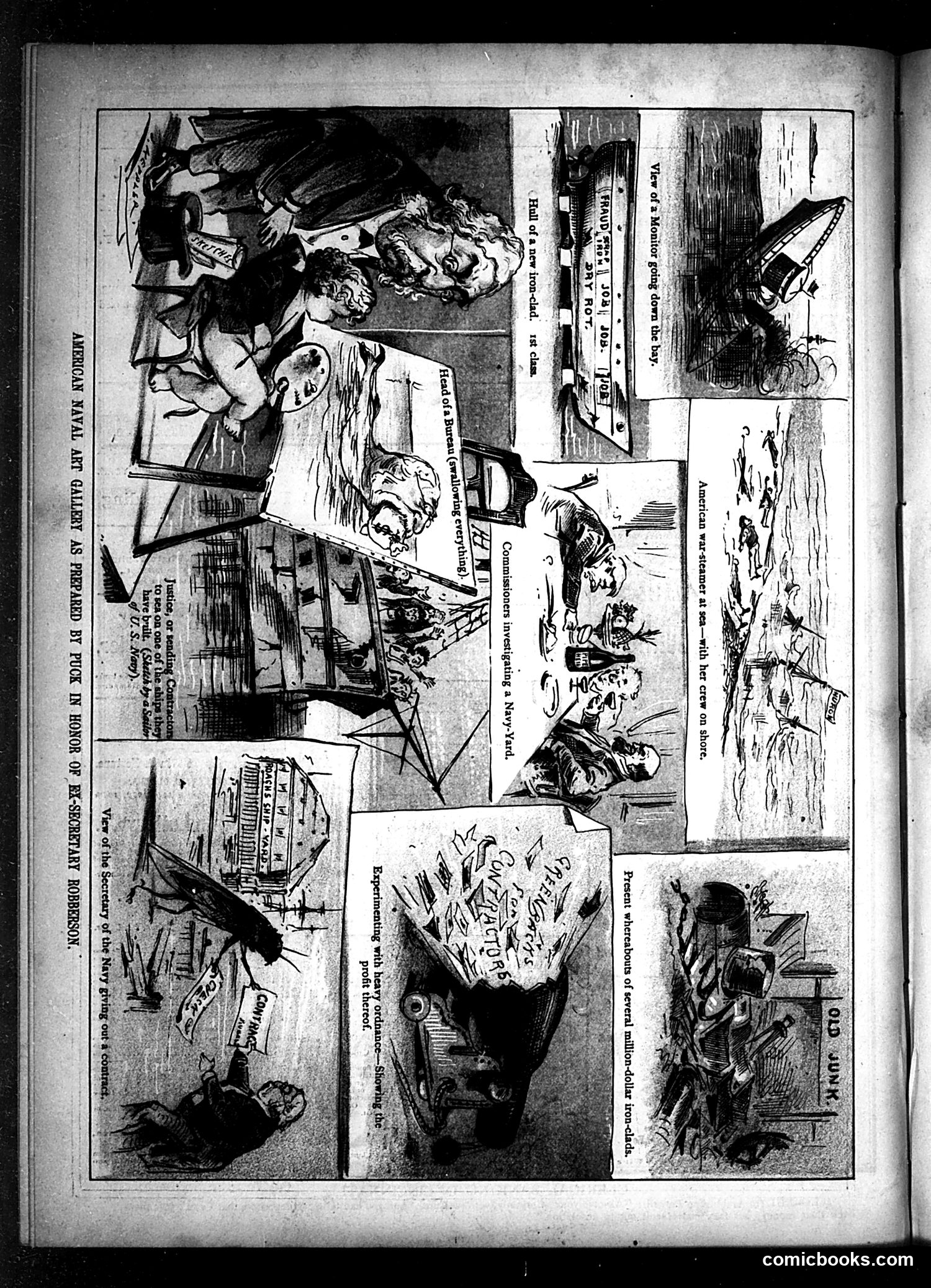
I can see this is a Puck magazine page with multiple comic panels arranged vertically, but the OCR text provided is incomplete or illegible—it appears to contain only fragmentary captions and labels that don't clearly convey the narrative or political content. From the IMAGE alone, I can observe: - Multiple black and white satirical drawings in a sequential comic format - Various human figures in what appears to be late 19th or early 20th-century dress - Scenes suggesting domestic or social situations - Exaggerated facial features typical of period caricature **Without legible caption text, I cannot reliably identify the specific figures, political references, or satirical point.** To accurately explain this page's meaning to modern readers, I would need clearer OCR text or additional context about the publication date and subject matter.