
Puck, 1878-12-25 · page 7 of 16
Puck — December 25, 1878 — page 7: what you’re looking at
What you’re looking at
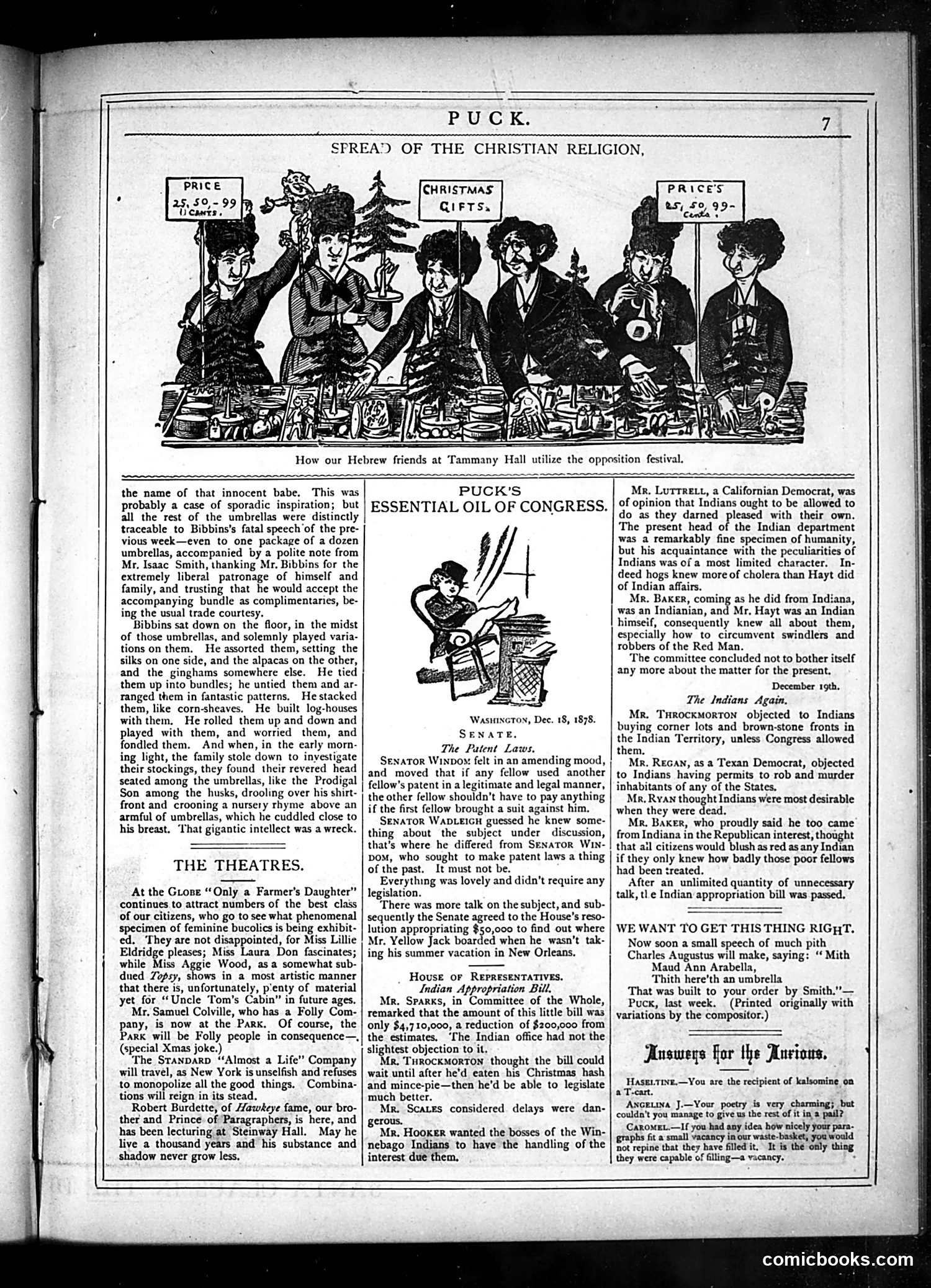
This satirical cartoon mocks what appears to be Jewish merchants or traders exploiting Christmas commercialism. Six figures display price signs (25.50-99 cents and higher) above merchandise and Christmas gifts, with the caption "How our Hebrew friends at Tammany Hall utilize the opposition festival." The satire attacks the perceived commodification of Christmas and implies corrupt dealings between Jewish businesspeople and Tammany Hall (New York's Democratic political machine). The cartoon trades in antisemitic stereotypes, portraying Jews as greedy merchants profiting from Christian holidays. The accompanying text discusses congressional debates about Native American affairs and patent laws, unrelated to the cartoon's theme. This reflects Puck's typical mix of political commentary and satirical imagery from the 1870s-80s era.
📄 Transcribed text from this page (OCR, searchable)
Machine-transcribed from the original scan — historical spelling and the odd misread are preserved.
PUCK. SPREA) OF THE CHRISTIAN RELIGION, How our Hebrew friends at Tammany Hall utilize the opposition festival. PRICE'S the name of that innocent babe. This was probably a case of sporadic inspiration; but all the rest of the umbrellas were distinctly traceable to Bibbins’s fatal speech’of the pre- vious week—even to one package of a dozen umbrellas, accompanied by a polite note from Mr, Isaac Smith, thanking Mr. Bibbins for the extremely liberal patronage of himself and family, and trusting that he would accept the accompanying bundle as complimentaries, be- ing the usual trade courtesy, Bibbins sat down on the floor, in the midst of those umbrellas, and solemnly played varia- tions on them. He assorted them, setting the silks on one side, and the alpacas on the other, and the ginghams somewhere else. He tied them up into bundles; he untied them and ar- ranged them in fantastic patterns. He stacked them, like corn-sheaves. He built log-houses with them, He rolled them up and down and played with them, and worried them, and fondled them. And when, in the early morn- ing light, the family stole down to investigate their stockings, they found their revered head seated among the umbrellas, like the Prodigal Son among the husks, drooling over his shirt- front and crooning a nursery thyme above an armful of umbrellas, which he cuddled close to his breast. ‘That gigantic intellect was a wreck. THE THEATRES. At the Grose “Only a Farmer's Daughter” continues to attract numbers of the best class of our citizens, who go to see what phenomenal specimen of feminine bucolics is being exhibit- ed. ‘They are not disappointed, for Miss Lillie Eldridge pleases; Miss Laura Don fascinates; while Miss Aggie Wood, as a somewhat sub- dued psy, shows in a most artistic manner that there is, unfortunately, p'enty of material yet for “Uncle Tom’s Cabin” in future ages. Mr. Samuel Colville, who has a Folly Com- pany, is now at the Park. Of course, the Park will be Folly people in consequence—, (special Xmas joke.) The Stanparp ‘Almost a Life’ Company will travel, as New York is unselfish and refuses to monopolize all the good things. Combina- tions will reign in its stead. Robert Burdette, of Hawkeye fame, our bro- ther and Prince ofParagraphers, is here, and has been lecturing at Steinway Hall. May he live a thousand years and his substance and shadow never grow less, PUCK’S ESSENTIAL OIL OF CONGRESS. ‘Wasitxcton, Dee. 18, 1878. SENATE. The Patent Laws, Senator Winpos felt in an amending mood, and moved that if any fellow used another fellow’s patent in a legitimate and legal manner, the other fellow shouldn’t have to pay anything if the first fellow brought a suit against him, SENATOR WADLEIGH guessed he knew some- thing about the subject under discussion, that’s where he differed from Senator WIN- pom, who sought to make patent laws a thing of the past. It must not be. Everything was lovely and didn’t require any legislation. ‘There was more talk on the subject, and sub- sequently the Senate agreed to the House's reso- lution appropriating $50,000 to find out where Mr. Yellow Jack boarded when he wasn’t tak- ing his summer vacation in New Orleans. House or REPRESENTATIVES. Indian Appropriation Bill, Mr. Sparks, in Committee of the Whole, remarked that the amount of this little bill was only $4,710,000, a reduction of $200,000 from the estimates. ‘The Indian office had not the slightest objection to it. Mr. THRocKMoRTON thought the bill could wait until after he’d eaten his Christmas hash and mince-pie—then he'd be able to legislate much better. Mr. Scares considered delays were dan- gerous. Mr. Hooker wanted the bosses of the Win- nebago Indians to have the handling of the interest due them, Mr. Lurrrett, a Californian Democrat, was of opinion that Indians ought to be allowed to do as they darned pleased with their own. The present head of the Indian department was a remarkably fine specimen of humanity, but his acquaintance with the peculiarities of Indians was of a most limited character. In- deed hogs knew more of cholera than Hayt did of Indian affairs. Mr. Baker, coming as he did from Indiana, was an Indianian, and Mr, Hayt was an Indian himseif, consequently knew all about them, especially how to circumvent swindlers and robbers of the Red Man. The committee concluded not to bother itself any more about the matter for the present, December 19th. The Indians Again, Mr. THrockmorton objected to Indians buying corner lots and brown-stone fronts in the Indian Territory, unless Congress allowed them. MR. Recan, as a Texan Democrat, objected to Indians having permits to rob and murder inhabitants of any of the States. Mr. Ryan thought Indians were most desirable when they were dead. Mr. Baker, who proudly said he too came from Indiana in the Republican interest, thought that ail citizens would blush as red as any Indian if they only knew how badly those poor fellows had been treated. After an unlimited quantity of unnecessary talk, tle Indian appropriation bill was passed, WE WANT TO GET THIS THING RIGHT. Now soon a small speech of much pith Charles Augustus will make, saying: ‘‘ Mith Maud Ann Arabella, Thith here’th an umbrella ‘That was built to your order by Smith.”— Puck, last week. (Printed originally with variations by the compositor.) Answers for the Anriows, Hasgitivg.—You are the recipient of kalsomine on a T-cart. ANGELINA J.—Your poetry is very charming; but couldn't you manage to give us the rest of it in a pail? Canomet.—If you had any idea how nicely your para- graphs fit a'small Vacancy in our waste-basket, you would not repine that they have filled it, It is the only thing they were capable of filling—a vacancy. . comicbooks.com