
Puck, 1878-12-25 · page 6 of 16
Puck — December 25, 1878 — page 6: what you’re looking at
What you’re looking at
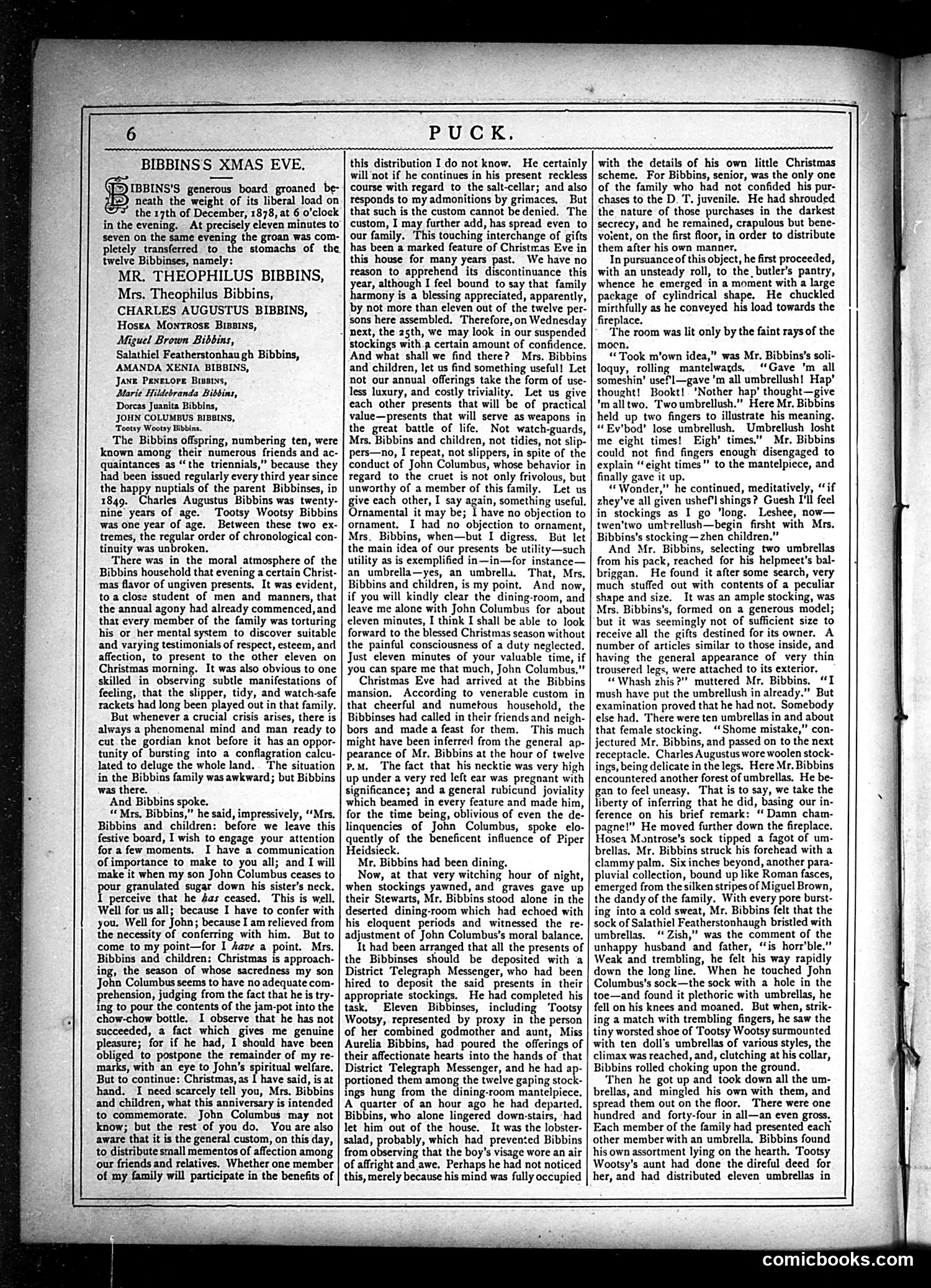
This page appears to be primarily **text narrative rather than a political cartoon**. It's titled "Bibbins's Xmas Eve" and tells a satirical story about the Bibbins family and their Christmas preparations. The narrative mocks the Bibbins household—described as a large, chaotic family of ten children—and their attempts at genteel propriety despite financial modesty. The satire targets middle-class pretension: Mr. Bibbins distributes small gifts through a "District Telegraph Messenger" to maintain appearances of generosity while managing limited means. The humor lies in the family's anxiety about appearances (clearing the dining room, hiding modest circumstances) and the contrast between their aspirations and actual circumstances—typical Puck satire of Victorian-era social climbing and domestic comedy rather than political commentary.
📄 Transcribed text from this page (OCR, searchable)
Machine-transcribed from the original scan — historical spelling and the odd misread are preserved.
BIBBINSS XMAS EVE. IBBINS'S generous board groaned be- neath the weight of its liberal load on the 17th of December, 1878, at 6 o'clock in the evening. At precisely eleven minutes to seven on the same evening the groan was com- pletely transferred to the stomachs of the twelve Bibbinses, namely: MR. THEOPHILUS BIBBINS, Mrs. Theophilus Bibbins, CHARLES AUGUSTUS BIBBINS, Hosea Montrose Bisstns, Miguel Brown Bibbins, Salathiel Featherstonhau gh Bibbins, AMANDA XENIA BIBBINS, Jane Penexore Buvsiys, Marie Hildebranda Bibbins, Dorcas Juanita Bibbins, JOHN COLUMBUS BIBBINS, Teotsy Wootsy Bibbins. The Bibbins offspring, numbering ten, were known among their numerous friends and ac- quaintances as “the triennials,” because they had been issued regularly every third year since the happy nuptials of the parent Bibbinses, ip 1849. Charles Augustus Bibbins was twenty- nine’ years of age. Tootsy Wootsy Bibbins was one year of age. Between these two ex- tremes, the regular order of chronological con- tinuity was unbroken. There was in the moral atmosphere of the Bibbins household that evening a certain Christ- mas flavor of ungiven presents. It was evident, to a close student of men and manners, that the annual agony had already commenced, and that every member of the family was torturing his or her mental system to discover suitable and varying testimonials of respect, esteem, and affection, to present to the other eleven on Christmas morning. It was also obvious to one skilled in observing subtle manifestations of feeling, that the slipper, tidy, and watch-safe rackets had long been played out in that family. But whenever a crucial crisis arises, there is always a phenomenal mind and man ready to cut the gordian knot before it has an oppor- tunity of bursting into a conflagration calcu- lated to deluge the whole land... The situation in the Bibbins family was awkward; but Bibbins was there. And Bibbins spoke. ‘Mrs, Bibbins,” he said, impressively, ‘Mrs, Bibbins and children: before we leave this festive board, I wish to engage your attention for a few moments, I have a communication of importance to make to you all; and I will make it when my son John Columbus ceases to pour granulated sugar down his sister’s neck. I perceive that he das ceased. This is well. Well for us all; because I have to confer with you. Well for John; because I am relieved from the necessity of conferring with him. But to come to my point—for I Aave a point. Mrs. Bibbins and children: Christmas is approach- ing, the season of whose sacredness my son John Columbus seems to have no adequate com- prehension, judging from the fact that he is try- ing to pour the contents of the jam-pot into the chow-chow bottle. I observe that he has not succeeded, a fact which gives me genuine pleasure; for if he had, I should have been obliged to postpone the remainder of my re- marks, with an eye to John’s spiritual welfare. But to continue: Christmas, as I have said, is at hand. I need scarcely tell you, Mrs. Bibbins and children, what this anniversary is intended to commemorate. John Columbus may not know; but the rest of you do, You are also aware that it is the general custom, on this day, to distribute small mementos of affection among our friends and relatives. Whether one member of my family will participate in the benefits of this distribution I do not know. He certainly will not if he continues in his present reckless course with regard to the salt-cellar; and also responds to my admonitions by grimaces, But that such is the custom cannot be denied. The custom, I may further add, has spread even to our family. This touching interchange of gifts has been a marked feature of Christmas Eve in this house for many years past. We have no reason to apprehend its discontinuance this year, although I feel bound to say that family harmony is a blessing appreciated, apparently, by not more than eleven out of the twelve per- sons here assembled. Therefore,on Wednesday -| next, the 25th, we may look in our suspended stockings witha certain amount of confidence. And what shall we find there? Mrs. Bibbins and children, let us find something useful! Let not our annual offerings take the form of use- less luxury, and costly triviality. Let us give each other presents that will be of practical value—presents that will serve as weapons in the great battle of life. Not watch-guards, Mrs. Bibbins and children, not tidies, not slip- pers—no, I repeat, not slippers, in spite of the conduct of John Columbus, whose behavior in regard to the cruet is not only frivolous, but unworthy of a member of this family. Let us give cach other, I say again, something useful. Ornamental it may be; I have no objection to ornament, I had no objection to ornament, Mrs, Bibbins, when—but I digress. But let the main idea of our presents be utility—such utility as is exemplified in—in—for instance— an umbrella—yes, an umbrella, That, Mrs. Bibbins and children, is my point. And now, if you will kindly clear the dining-room, and leave me alone with John Columbus for about eleven minutes, I think I shall be able to look forward to the blessed Christmas season without the painful consciousness of a duty neglected. Just eleven minutes of your valuable time, if you can spare me that much, John Columbus,” Christmas Eve had arrived at the Bibbins mansion, According to venerable custom in that cheerful and numetous household, the Bibbinses had called in their friends and neigh- bors and made a feast for them. ‘This much might have been inferred from the general ap- pearance of Mr. Bibbins at the hour of twelve P.M. The fact that his necktie was very high up under a very red left ear was pregnant with significance; and a general rubicund joviality which beamed in every feature and made him, for the time being, oblivious of even the de- linquencies of John Columbus, spoke elo- quently of the beneficent influence of Piper Heidsieck. Mr. Bibbins had been dining. Now, at that very witching hour of night, when stockings yawned, and graves gave up their Stewarts, Mr. Bibbins stood alone in the deserted dining-room which had echoed with his eloquent periods and witnessed the re- adjustment of John Columbus's moral balance. It had been arranged that all the presents of the Bibbinses should be deposited with a District Telegraph Messenger, who had been hired to deposit the said presents in their appropriate stockings. He had completed his task, Eleven Bibbinses, including ‘Tootsy Wootsy, represented by proxy in the person of her combined godmother and aunt, Miss Aurelia Bibbins, had poured the offerings of their affectionate hearts into the hands of that District Telegraph Messenger, and he had ap- portioned them among the twelve gaping stock: ings hung from the dining-room mantelpiece, A quarter of an hour ago he had departed, Bibbins, who alone lingered down-stairs, had let him out of the house. It was the lobster- salad, probably, which had prevented Bibbins from observing that the boy’s visage wore an air of affright and awe, Perhaps he had not noticed this, merely because his mind was fully occupied with the details of his own little Christmas scheme. For Bibbins, senior, was the only one of the family who had not ‘confided his pur- chases to the D. T. juvenile. He had shrouded the nature of those purchases in the darkest secrecy, and he remained, crapulous but bene- voient, on the first floor, in order to distribute them after his own manner, In pursuance of this object, he first proceeded, with an unsteady roll, to the, butler’s pantry, whence he emerged in a moment with a large package of cylindrical shape. He chuckled mirthfully as he conveyed his load towards the fireplace. The room was lit only by the faint rays of the mocn. “Took m’own idea,” was Mr. Bibbins’s soli- loquy, rolling mantelwatds, ‘Gave 'm all someshin’ usef'1—gave ’m all umbrellush! Hap’ thought! Bookt!. 'Nother hap’ thought—gi' ’m alltwo, Twoumbrellush.” Here Mr. Bibbins held up two fingers to illustrate his meaning. “Ev’bod’ lose umbrellush. Umbrellush losht me eight times! Eigh’ times.” Mr. Bibbins could not find fingers enough disengaged to explain “eight times” to the mantelpiece, and finally gave it up. “Wonder,” he continued, meditatively, “if zhey've all given ushef'l shings? Guesh I'll feel in stockings as I go ‘long. Leshee, now— twen’two umtrellush—begin firsht with Mrs. Bibbins’s stocking —zhen children.” And Mr. Bibbins, selecting two umbrellas from his pack, reached for his helpmeet’s bal- briggan. He found it after some search, very much stuffed out with contents of a peculiar shape and size. It was an ample stocking, was Mrs. Bibbins’s, formed on a generous model; but it was seemingly not of sufficient size to receive all the gifts destined for its owner. A number of articles similar to those inside, and having the general appearance of very thin trousered legs, were attached to its exterior. “‘Whash zhis?” muttered Mr. Bibbins. “I mush have put the umbrellush in already.” But examination proved that he had not. Somebody else had, There were ten umbrellas in and about that female stocking. ‘Shome mistake,” con- jectured Mr. Bibbins, and passed on to the next receptacle. Charles Augustus wore woolen stock- ings, being delicate in the legs. Here Mr. Bibbins encountered another forest of umbrellas. He be- gan to feel uneasy. That is to say, we take the liberty of inferring that he did, basing our in- ference on his brief remark: “ Damn cham- pagne!” He moved further down the fireplace. Hosea Montrose’s sock tipped a fagot of um- brellas, Mr. Bibbins struck his forehead with a clammy palm, Six inches beyond, another para- pluvial collection, bound up like Roman fasces, emerged from the silken stripes of Miguel Brown, the dandy of the family. With every pore burst- ing into a cold sweat, Mr. Bibbins felt that the sock of Salathiel Featherstonhaugh bristled with umbrellas, “ Zish,” was the comment of the unhappy husband and father, “is horr’ble.” Weak and trembling, he felt his way rapidly down the long line. When he touched John Columbus's sock—the sock with a hole in the toe—and found it plethoric with umbrellas, he fell on his knees and moaned. But when, strik- ing a match with trembling fingers, he saw the tiny worsted shoe of Tootsy Wootsy surmounted with ten doll’s umbrellas of various styles, the climax was reached, and, clutching at his collar, Bibbins rolled choking upon the ground. Then he got up and took down all the um- brellas, and mingled his own with them, and spread them out on the floor. There were one hundred and forty-four in all—an even gross, Each member of the family had presented each other member with an umbrella. Bibbins found his own assortment lying on the hearth. Tootsy Wootsy’s aunt had done the direful deed for her, and had distributed eleven umbrellas in comicbooks.com