
A complete issue · 16 pages · 1877
Puck — July 4, 1877
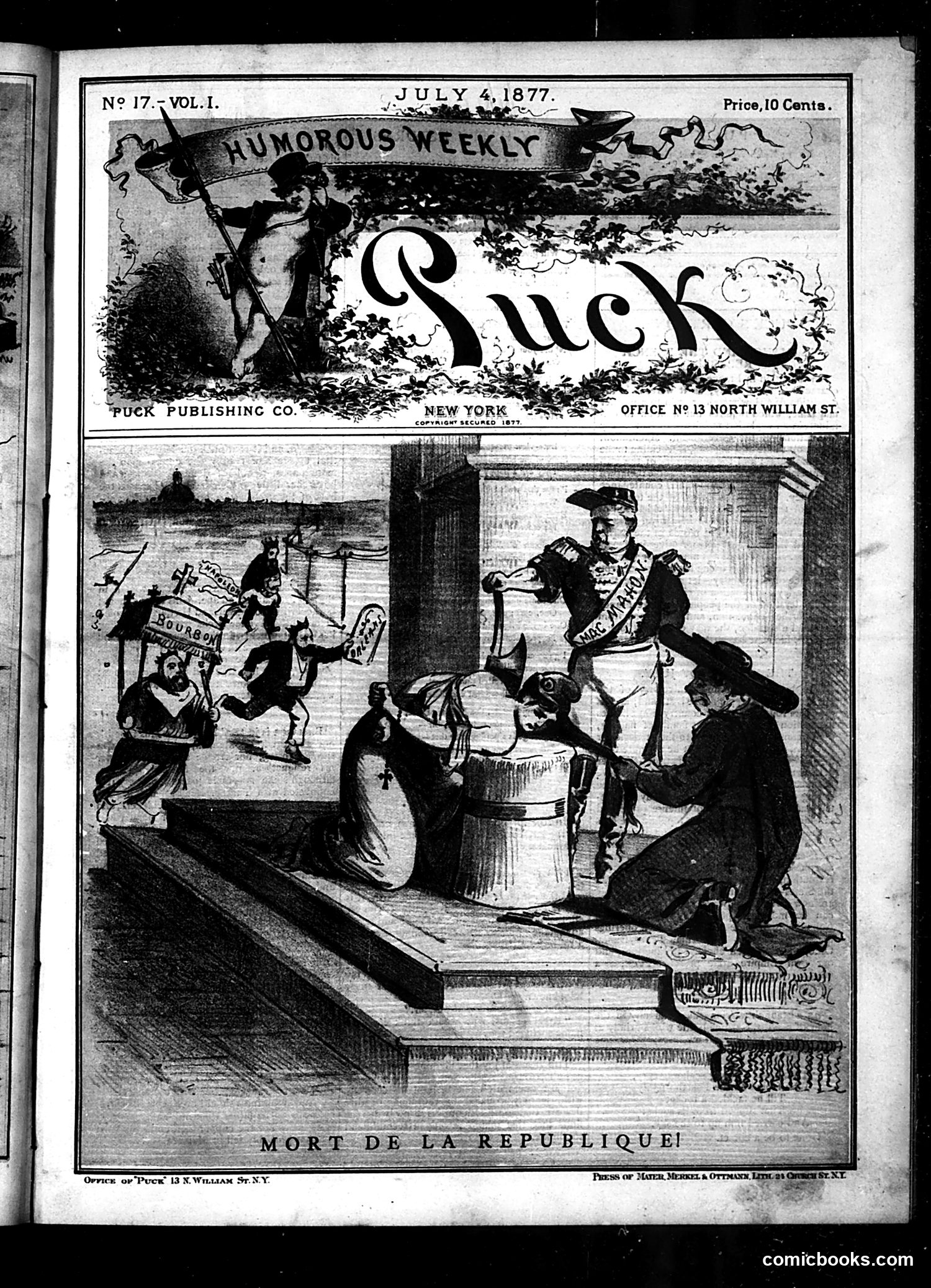
This July 4, 1877 Puck cartoon satirizes the collapse of American republican ideals during the Reconstruction era's end. The French caption—referencing the failed French Republic—suggests the U.S. government is similarly dying. The central image depicts a funeral or deathbed scene where a large figure wearing a sash (likely representing the Republic or a corrupt official) lies dying or dead. Smaller figures around appear to be politicians or officials, some appearing to loot or disturb the body, while others mourn or participate in the chaotic scene. The satire critiques political corruption, the abandonment of democratic principles, and what cartoonists viewed as the betrayal of Reconstruction ideals—particularly after the controversial 1876 election and the subsequent end of federal protection for freedmen in the South.
This page contains editorial content and humor rather than a primary political cartoon. The main pieces are: **"MacMahon and the French Republic"** — A commentary on France's precarious political situation, criticizing it as unstable and prone to internal conflict between competing factions (apparently referencing the Ultramontanists, cardinals, and supporters of different claims to power). **"The Fourth of July"** — A patriotic essay celebrating American independence and contrasting America's stable union with the fractious European powers mentioned above. **"Pickerings"** — A humor column with short jokes and anecdotes, including puns about names (Moses/maces) and observations about daily life. The page demonstrates Puck's mix of satire, patriotic commentary, and light humor rather than featuring a single prominent political cartoon.
This page contains three distinct sections: **"Love's Defiance"** (left column): A poem about romantic rebellion, likely satirizing Victorian courtship conventions through dramatic declarations of love overcoming social obstacles. **"The Glorious Fourth: Leaf from a Physician's Diary"** (center): A satirical account of Fourth of July injuries—burns, explosions, severed fingers, and other gruesome accidents. The humor targets American Independence Day celebrations, mocking both the dangerous fireworks customs and the medical profession's resigned acceptance of predictable holiday injuries. **"Fitznoodle in New York"** (right): An illustration showing a figure in a chair, accompanied by text discussing water-cooling methods and social observations about New York summer heat—likely satirizing either a visiting foreigner's reactions to American customs or urban summer discomforts. The page emphasizes Puck's signature blend of romantic, medical, and social satire.
This page contains no political cartoons—it's primarily text content from Puck magazine. The main feature is "An Apostle of Temperance," a satirical essay about a character named Peleg, described as a temperance lecturer who ironically frequents taverns and has a drinking problem himself. The piece mocks the hypocrisy of temperance movement advocates who fail to practice what they preach. The right column contains "Summer Resort Notes," gossipy society updates about wealthy Americans visiting fashionable destinations like St. Augustine, Narragansett Pier, and Saratoga Springs. A brief "Fashionable Intelligence" section notes a young man named Cooper being engaged to Miss Sara Soldene. The satire targets both temperance hypocrisy and high-society pretension.
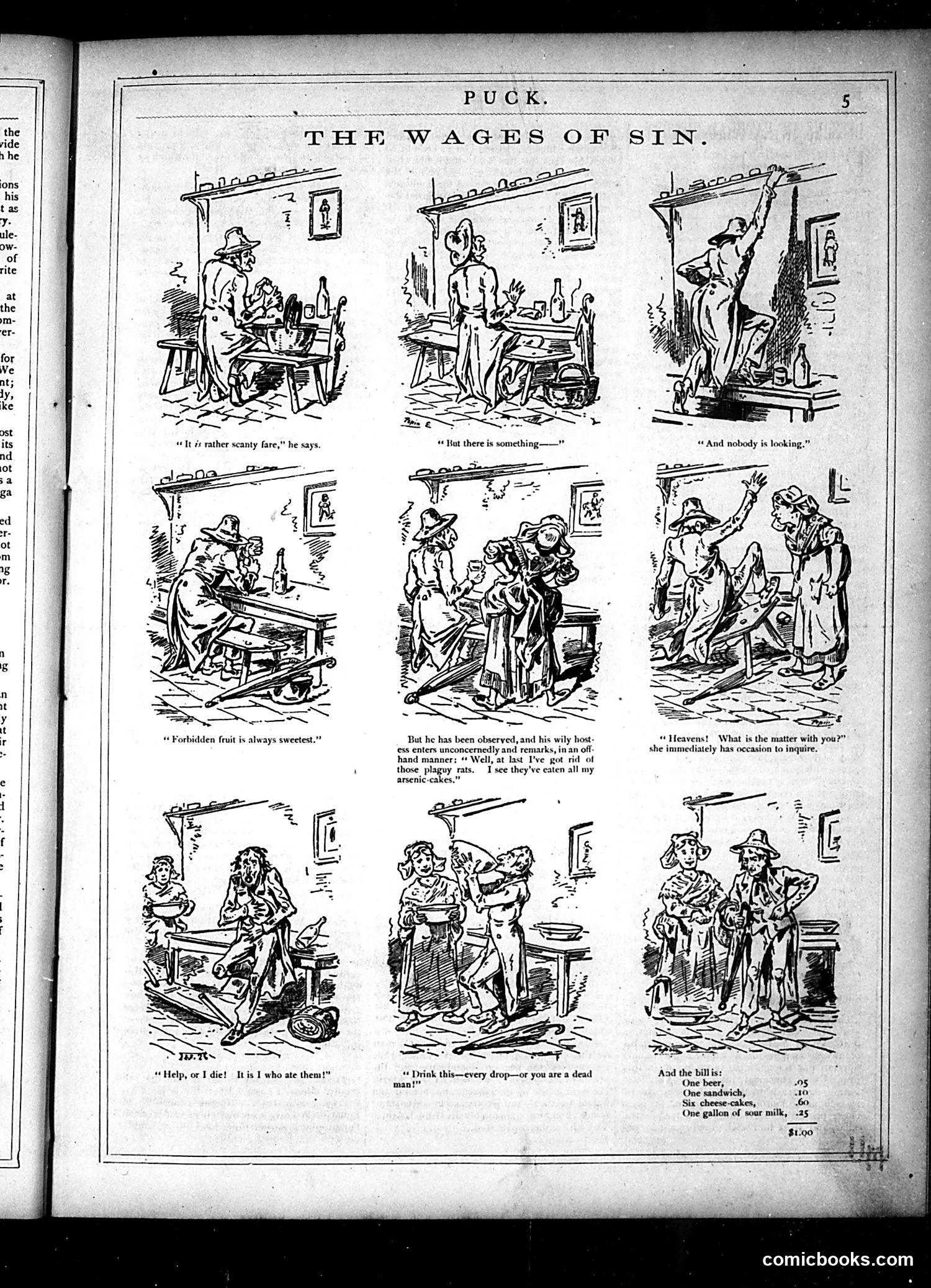
This satirical comic strip follows a moral cautionary tale. The sequence depicts a man's progressive downfall through indulgence and vice. He begins drinking alone at a table ("It is rather scanty fare"), progresses to debauchery ("there is something—"), and eventually finds himself abandoned and destitute ("And nobody is looking"). The narrative arc shows social decay—from respectable consumption to desperation, culminating in poverty and what appears to be begging or death ("Help, o I die! It is I who ate them!"). The strip's moralistic title and sequential storytelling format exemplify late-19th/early-20th century Puck's social satire: depicting the consequences of sin and excess as a cautionary lesson for readers. The specific vice referenced remains somewhat ambiguous from the OCR text provided.
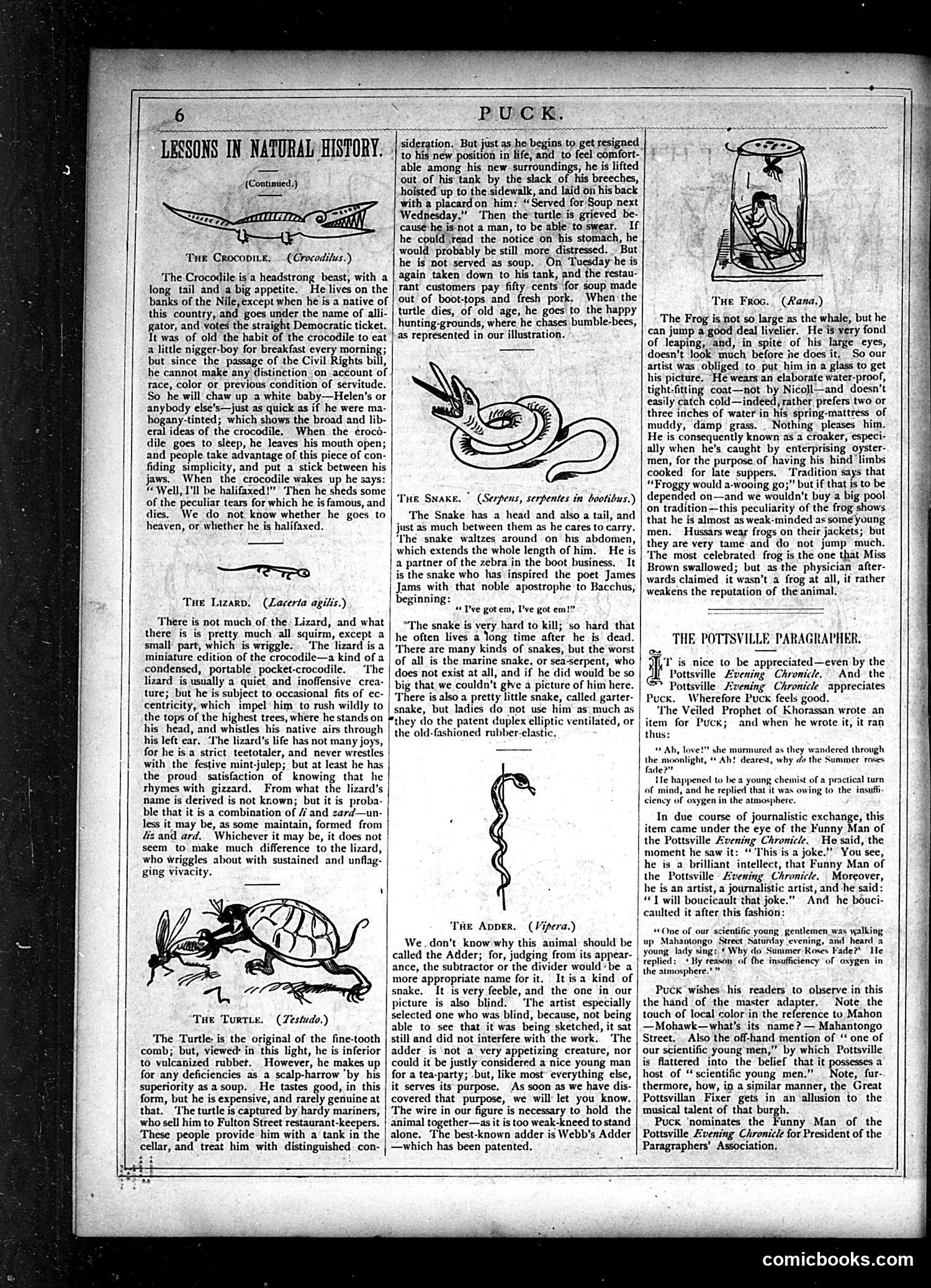
This page from *Puck* magazine contains **"Lessons in Natural History,"** an educational feature (marked "Continued") describing various animals with accompanying illustrations. The text humorously presents creatures like the crocodile, lizard, turtle, adder, snake, and frog through satirical natural history descriptions. Rather than straightforward science, the writing uses wit and anthropomorphism—ascribing human qualities and social commentary to animals. **No political cartoons appear on this page.** Instead, it's a humorous educational series typical of *Puck's* lighter content. The snake section includes a brief sidebar article about "The Pottsville Paragapher," discussing a local journalist's joke about oxygen in the atmosphere. This represents *Puck's* mixture of satire, humor, and social observation rather than direct political commentary.
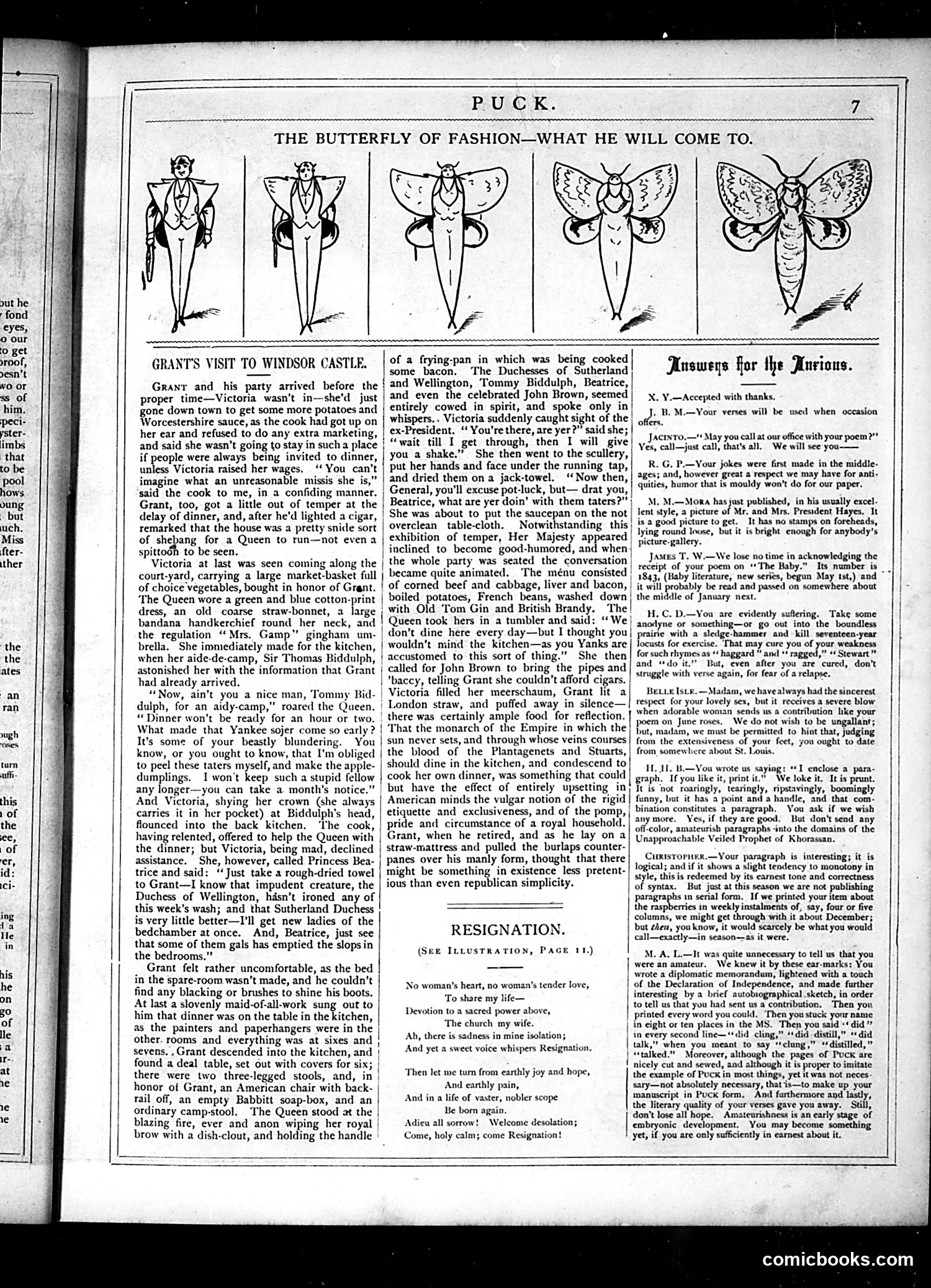
**"The Butterfly of Fashion"** is a satirical visual sequence showing a woman's transformation from fashionable society figure into a literal butterfly—a commentary on how fashion obsesses consume women until they become insubstantial or ridiculous. **"Grant's Visit to Windsor Castle"** is a humorous account of President Ulysses S. Grant's social awkwardness during a formal British dinner. The satire mocks Grant's discomfort with etiquette, his blunt manner, and the tension between American informality and rigid Victorian formality. The piece suggests Grant—though powerful militarily—is socially out of place in refined society. **"Resignation"** appears to be a poem about renouncing worldly ambitions for spiritual devotion, likely satirizing religious hypocrisy among society figures.
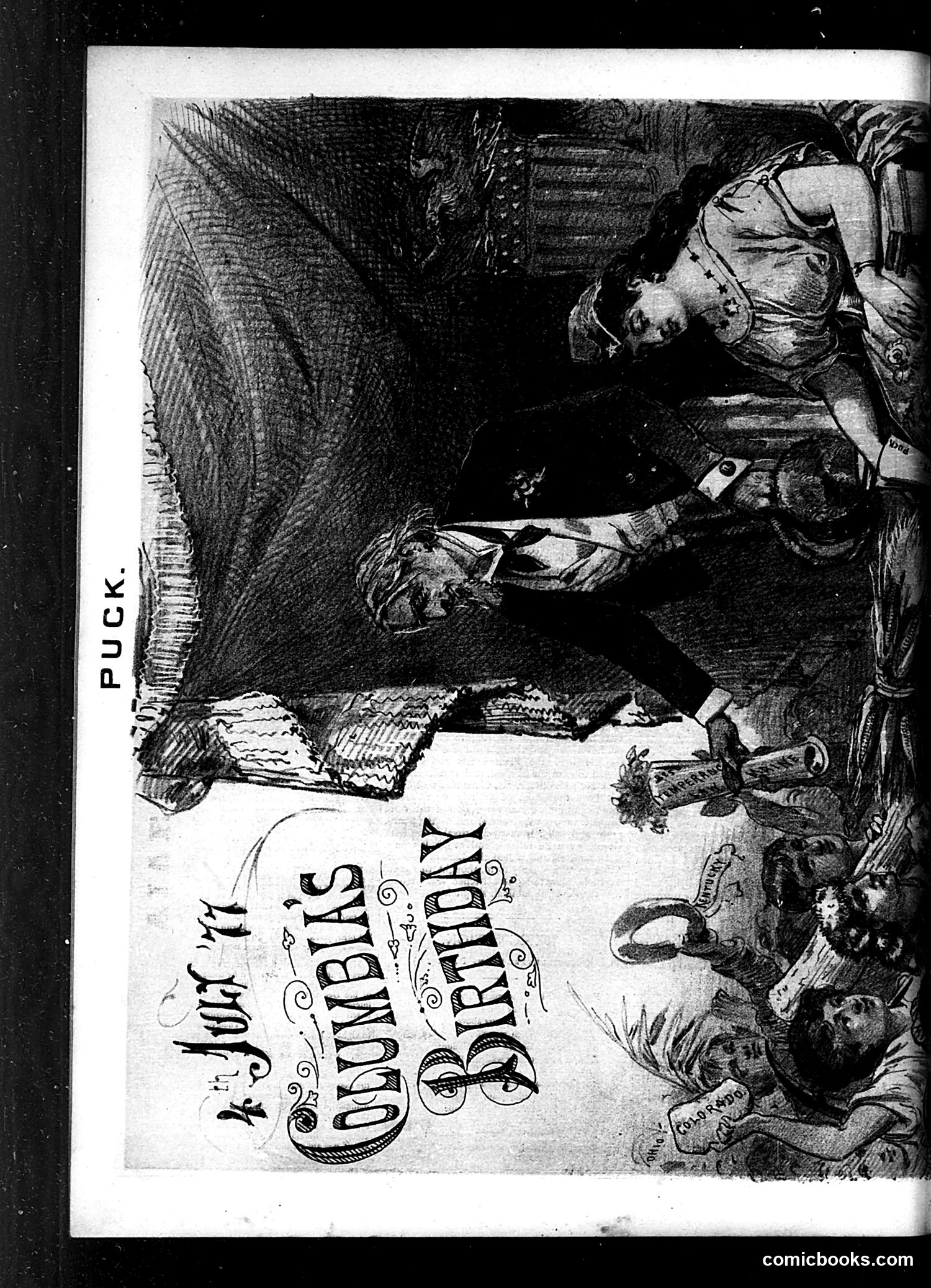
This appears to be a title page or cover from **Puck** magazine, featuring an ornate title reading "Puck: Its Omblils [sic] Broadway" (the exact text is unclear due to OCR errors and decorative lettering). The main illustration shows a figure in period dress (appears to be 18th or 19th century clothing) in an exaggerated pose. The word **"PUCK"** appears vertically on the left margin, indicating this is from the magazine. Without clearer text or additional context, the specific political or social satire being referenced is **difficult to determine with certainty**. The theatrical costume and Broadway reference suggest this may relate to theater, performance, or entertainment industry commentary, which were common Puck subjects. More legible source material would be needed for precise interpretation.
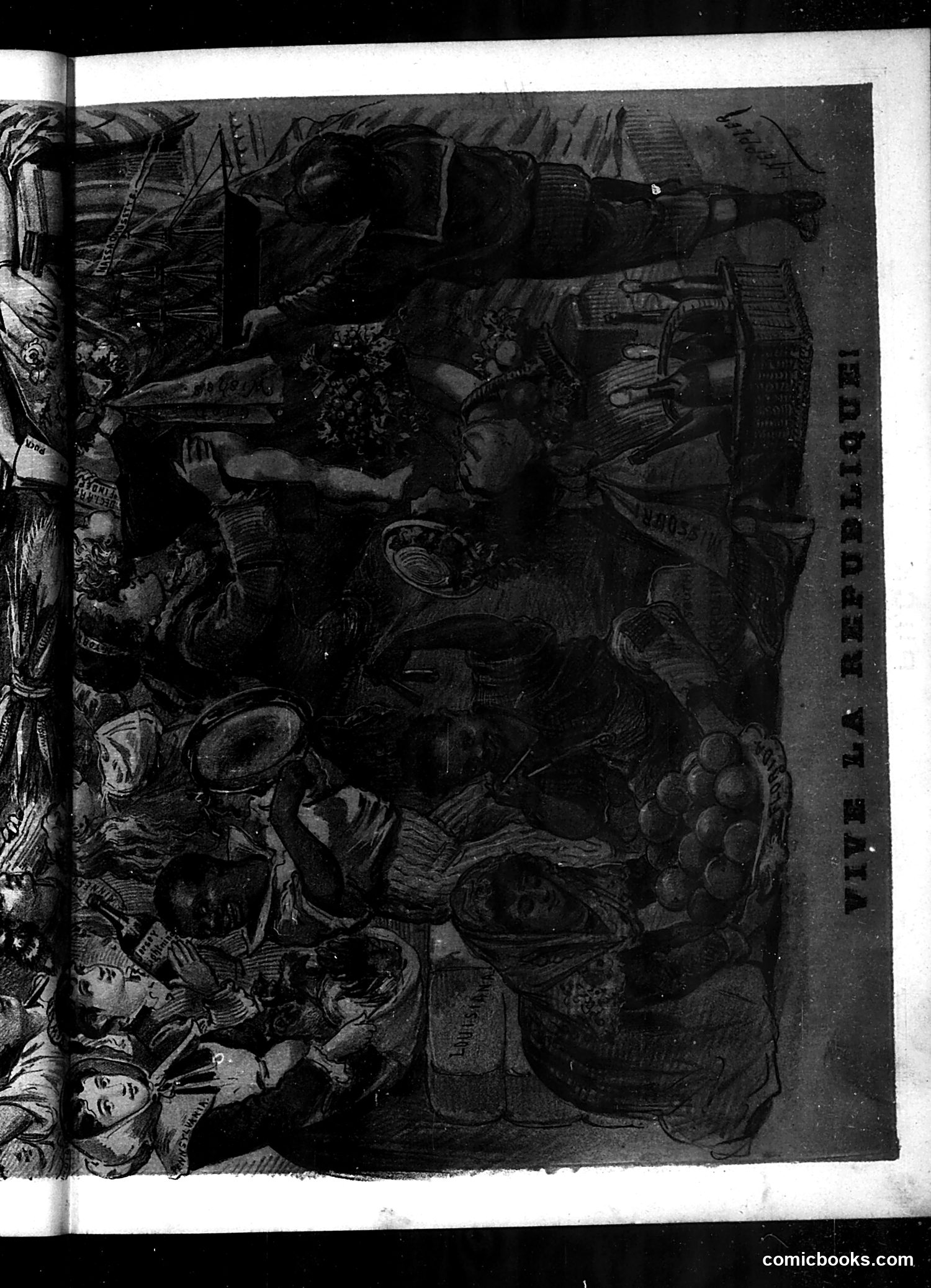
I can see this is a black and white engraved illustration from Puck magazine, rotated 90 degrees. The image depicts a crowded indoor scene with multiple figures in period dress (appearing to be 18th or 19th century based on clothing styles), with elaborate furnishings, food, and what appears to be social revelry or a gathering. However, the OCR text provided is blank, making it difficult to identify specific political figures, the exact event being satirized, or the cartoon's intended message. Without accompanying text or captions visible in the image itself, I cannot reliably determine which historical figures are caricatured, what social or political situation is being mocked, or the satire's specific point. To properly analyze this cartoon's meaning, I would need either legible text from the page or additional context about the publication date.
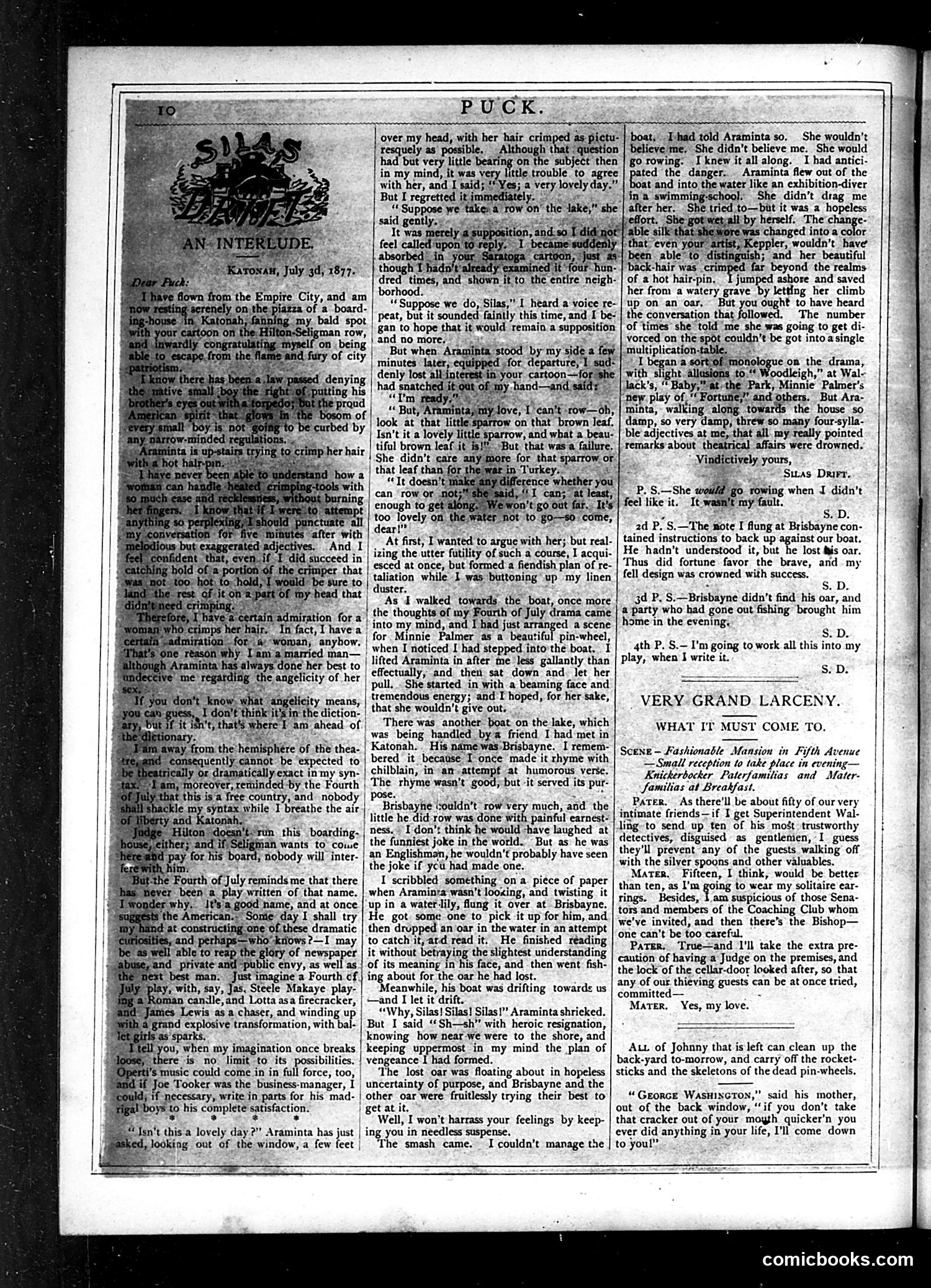
This page contains a satirical short story by Silas Driffet titled "An Interlude," set in Kayonah, July 3, 1877. The narrative describes a romantic encounter on a lake between the narrator and a woman named Araminta, interrupted by various comic mishaps involving boats and a sparrow. The right column contains reader correspondence addressing theatrical matters and social etiquette—including discussions of backing up boats and preventing guests from walking off with spoons and valuables. A final exchange references "George Washington" humorously, regarding table manners. Rather than a political cartoon, this is primarily **humorous domestic fiction** satirizing romantic pretense, incompetence, and social anxieties of the era.
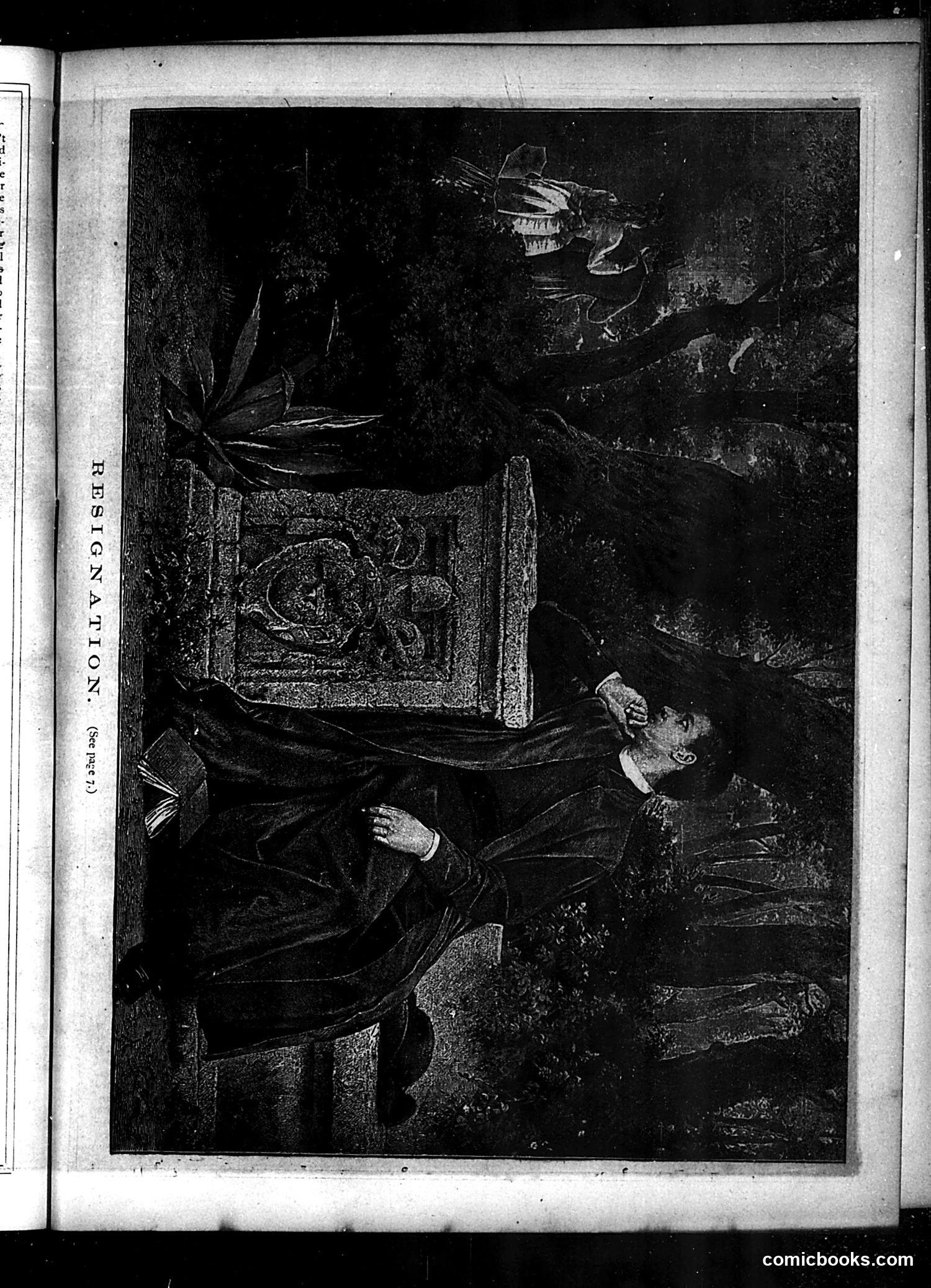
This appears to be a satirical illustration showing a man reclining while examining or admiring an ornate decorative box or design element. The image's title references "Design" and "Atton" (possibly a misspelling in OCR). The satire likely comments on artistic or architectural pretension—perhaps mocking someone's obsessive appreciation of elaborate decorative design. The man's recumbent pose suggests leisure or idle admiration of aesthetic objects, while supernatural or fantastical elements appear above (possibly creatures or allegorical figures), suggesting the artist is satirizing either overblown artistic ambition or the gap between highbrow design aspirations and reality. Without clearer OCR text or additional context about the publication date, the specific target of this satire remains unclear.
This page contains literary content rather than political cartoons. The left column discusses "The First Ten Pages," analyzing a theatrical collaboration between two authors—one younger and enthusiastic, the other older and more measured. The text critiques their working process, noting tensions between their different approaches to dramatic writing. The right side features "Two Knaves and a Knop," described as "An English Story," beginning Chapter XIV. It concerns Mr. Fox and Mr. Hiron in what appears to be a domestic drama involving questions of honor and propriety. Rather than satire of current events, this page offers literary criticism and serialized fiction—typical Puck content mixing entertainment with commentary on artistic and social matters.
This page from *Puck* magazine (page 13) contains **no cartoon or illustration**—it is entirely text, appearing to be a serialized story or serial fiction titled "PUCK" at the top. The narrative concerns a character named René and her relationship difficulties, involving mentions of a cousin Hugh Hiron and a character named M. de Gaillefontaine. The text discusses romantic entanglements, social propriety, and character motivations in what appears to be 19th-century literary fiction. Without accompanying illustrations, this page serves as **narrative content rather than political or social satire**. It represents *Puck*'s mixed format of combining satirical cartoons with serialized stories for reader entertainment.
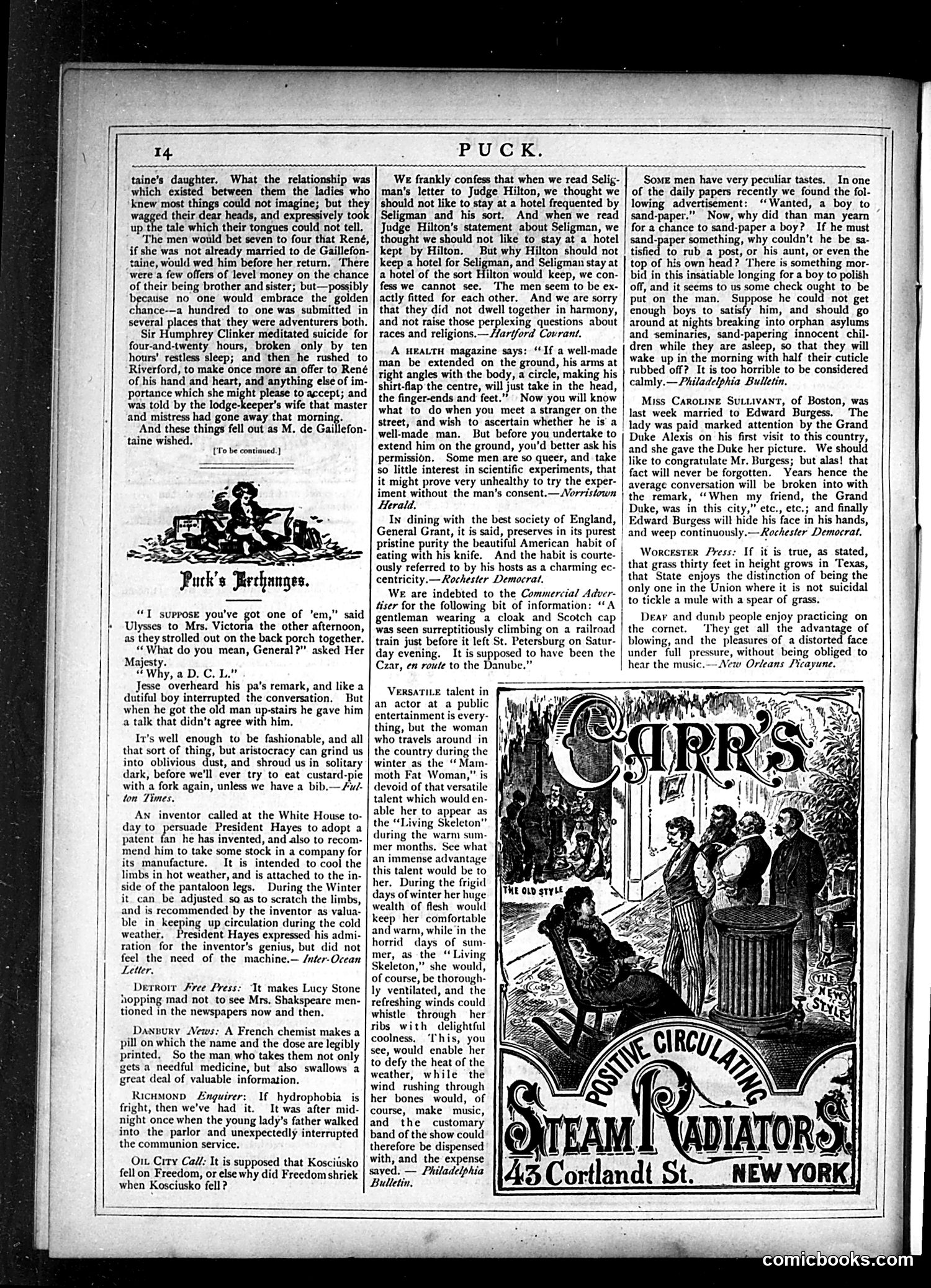
This page contains satirical commentary sections ("Puck's Briefings") rather than a single cartoon. The content mocks various contemporary figures and practices: **Notable sections:** - Commentary on General Grant's social habits and his tendency to visit hotels frequented by wealthy men - Criticism of phrenology (the pseudoscience of reading character from skull shape) - A joke about President Hayes and an inventor's leg-scratching device for winter - Medical satire about a French chemist's dubious "dose-legible" pills - Mockery of phophobia (fear of light) The page reflects late-19th-century American satirical humor targeting public figures, pseudoscientific fads, and medical quackery. An advertisement for "Positive Circulating Steam Radiators" appears at bottom right.
This is primarily an **advertising page** from Puck magazine, not a political cartoon page. The page is dominated by commercial advertisements for products and services available in New York during this period, including: - Gentlemen's hats (Dunlap & Co.) - Champagne (A. Lalande & Co.) - A pamphlet binder - Puck's Illustrated Almanac - Various restaurants and billiard rooms - Boker's Bitters (patent medicine) - Back issues of Puck The only satirical content appears in the left column, which contains brief humorous anecdotes and quips typical of Puck's commentary style, but these are disconnected observations rather than unified cartoons. This appears to be a **back cover or filler page** designed primarily for revenue through advertising rather than editorial content.
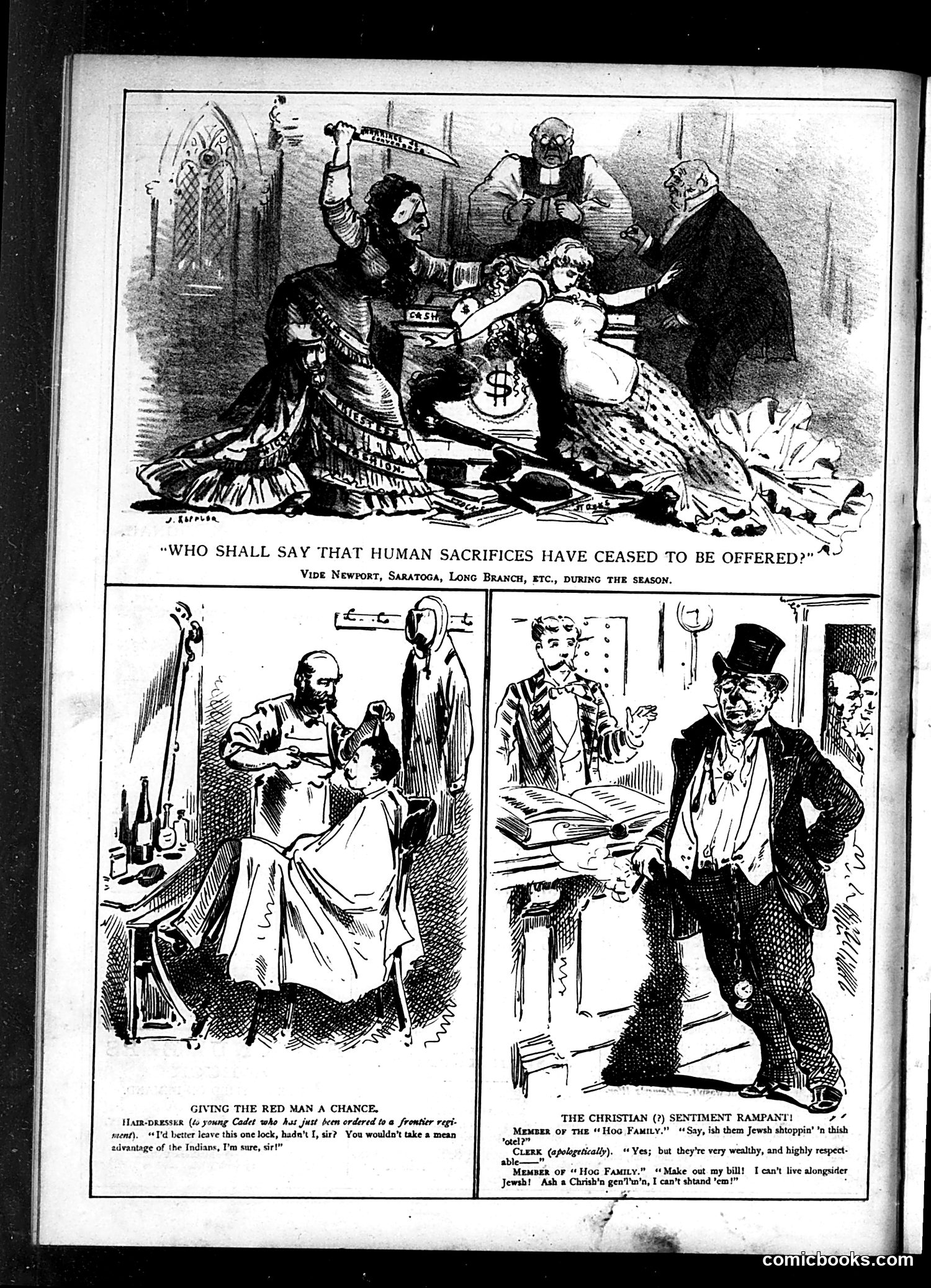
This satirical page critiques American Christian hypocrisy regarding Native Americans. The top cartoon shows religious and political figures conducting a "human sacrifice" ceremony, sarcastically asking "Who shall say that human sacrifices have ceased to be offered?" referencing alleged atrocities at locations like Newport, Saratoga, and Long Branch. The lower panels depict specific scenarios: a hair-dresser performing a "frontier regiment" procedure on a young cadet, and a Christian merchant refusing to help Native Americans while citing business concerns and anti-Semitic stereotypes ("Jews! Ah a Crumb's gen'l'men, I can't abide 'em!"). The satire targets upper-class Americans who profit from or ignore Indian suffering while claiming Christian morality. The caricatures appear to represent generic wealthy merchants and clergy rather than specific identifiable individuals.