
Puck, 1877-07-04 · page 6 of 16
Puck — July 4, 1877 — page 6: what you’re looking at
What you’re looking at
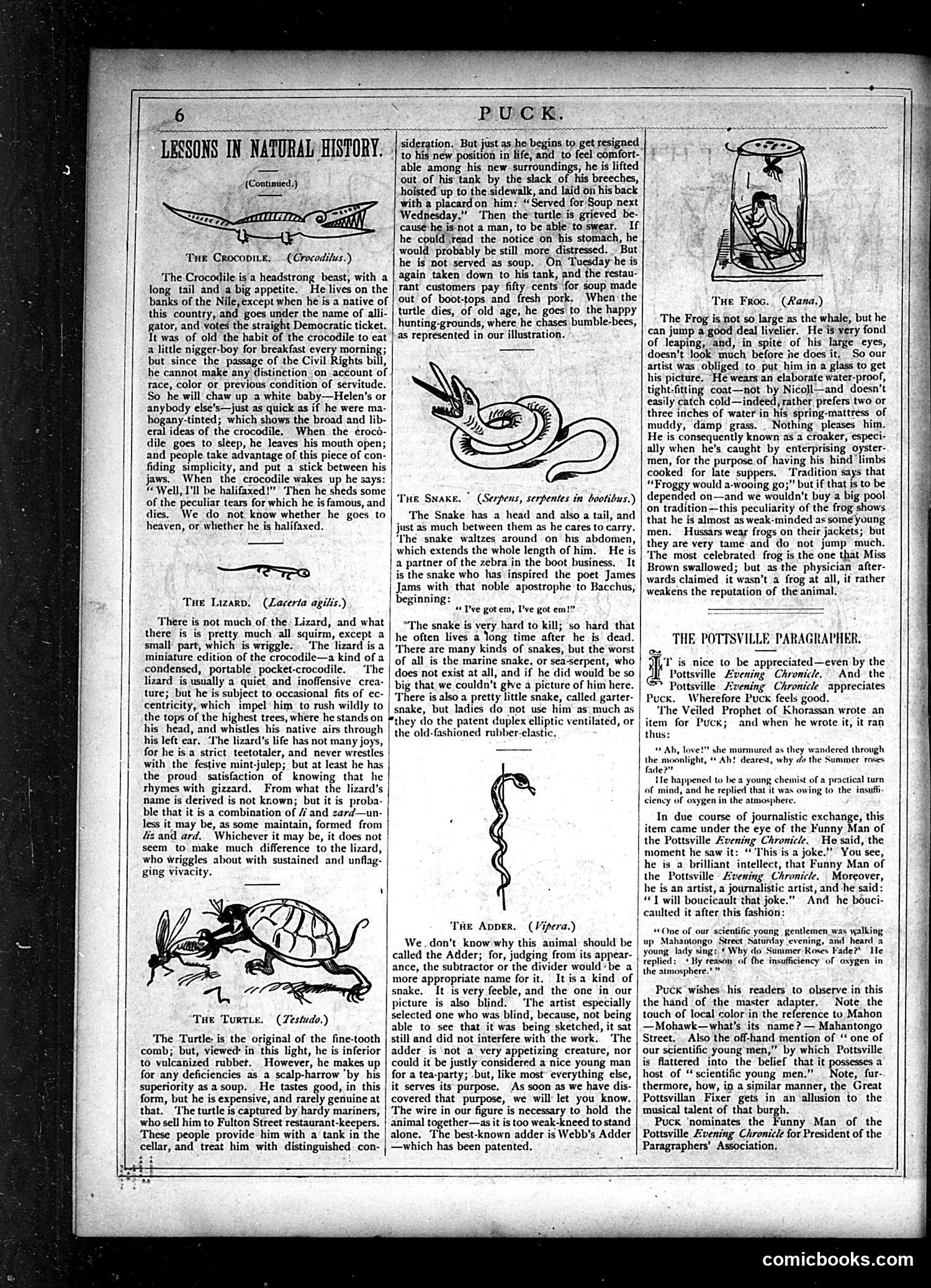
This page from *Puck* magazine contains **"Lessons in Natural History,"** an educational feature (marked "Continued") describing various animals with accompanying illustrations. The text humorously presents creatures like the crocodile, lizard, turtle, adder, snake, and frog through satirical natural history descriptions. Rather than straightforward science, the writing uses wit and anthropomorphism—ascribing human qualities and social commentary to animals. **No political cartoons appear on this page.** Instead, it's a humorous educational series typical of *Puck's* lighter content. The snake section includes a brief sidebar article about "The Pottsville Paragapher," discussing a local journalist's joke about oxygen in the atmosphere. This represents *Puck's* mixture of satire, humor, and social observation rather than direct political commentary.
📄 Transcribed text from this page (OCR, searchable)
Machine-transcribed from the original scan — historical spelling and the odd misread are preserved.
| SS CEES RSI GHA SR OE em LESSONS IN NATURAL HISTORY. » sideration. But just as he begins to get resigned able among his new surroundings, he is lifted to his new position in life, and to feel comfort-| ? ‘Tue Crocopite, (Crocodilus.) The Crocodile is'a headstrong beast, with a long tail and a big appetite. He lives on the banks of the Nile,except when he is a native of this country, and goes under the name of alli- gator, and votes the straight Democratic ticket. It was of old the habit of the crocodile to cat a little nigger-boy for breakfast every morning; but since the passage of the Civil Rights bill, he cannot make any distinction on account of race, color or previous condition of servitude. So he will chaw up a white baby—Helen’s or anybody else’s—just as quick as if he were ma- hogany-tinted; which shows the broad and lib- eral ideas of the crocodile. When the ¢rocd- dile goes to sleep, he leaves his mouth open; and people take advantage of this piece of con- fiding simplicity, and put a stick between his WS, “ Well, I'll be halifaxed!”. Then he sheds some of the peculiar tears for which he is famous, and dies, We do not know whether he goes to heaven, or whether he is halifaxed. TESTO Tue Lizarp. (Lacerta agilis.) There is not much of the. Lizard, and what there is is pretty much all squirm, except a small’ part, which is wriggle. ‘The lizard is a miniature edition of the crocodile—a kind of a condensed, portable pocket-crocodile. ‘I'he lizard is usually a quiet and inoffensive crea- ture; but he is subject to occasional fits of ec- centricity, which impel him to rush wildly to the tops of the highest trees, where he stands on his head, and whistles his native airs through his left ear. ‘The lizard’s life has not many joys, for he isa strict teetotaler, and never wrestles with the festive mint-julep; but at least he has the proud satisfaction of knowing that he rhymes with gizzard. name is derived is not known; but it is proba- ble that it is a combination of /f and sard—un- less it may be, as some maintain, formed from 4s and ard. who wriggles about with sustained and unflag- ging vivacity. Tue Turtie. (Zestudo.) The Turtle; is the ori I of the fine-tooth comb; but, viewed in this light, he is inferior to vulcanized rubbet. However, he makes up for any deficiencies as a scalp-harrow ‘by his superiority as a soup. He tastes good, in this form, but he is expensive, and rarely genuine at that. ‘The turtle is captured by hardy mariners, who sell him to Fulton Street restaurant-keepers. ree and treat him with distinguished con- When the crocodile wakes up he says: | From what the lizard’s | Whichever it may be, it does not | seem to make much difference to the lizard, | These people provide him with a tank in the | out of his tank by the slack of his breeches, hoisted up to the sidewalk, and laid on his back with a placard on ‘him: “Served for Soup next Wednesday.” ‘hen the’ turtle is grieved be- cause‘he is-not a man, to be able’to.swear. If he could (read the notice on his stomach, he would: probably be still more distressed. But he is not served as soup. On Tuesday he is again taken down to his tank, and the restau- rant customers pay fifty cents for soup made out of boot-tops and fresh pork, When the turtle dies, of old age, he goes'to the happy hunting-grounds, where he chases bumble-bees, as represented in our illustration. Tue Snake. " (Serpens, serpentes in bootibus.) The Snake has a head and also a tail, and | just as much between them as he cares to carry. | "Phe snake waltzes around on his abdomen, which extends the whole length of him, He is a partner of the zebra in the boot business. It | is the snake who has inspired the poet James | Jams with that noble apostrophe to Bacchus, | beginning: «I've got em, I've got em!” The snake is very hard to kill; so hard ‘that he often lives a long time after he is dead. | There are many kinds of snakes, but the worst of all is the marine snake, or sea-serpent, who does not exist at all, and if he did would be so | big that we couldn’t give a picture of him here. | There is also a pretty little snake, called garter- snake, but ladies do not use him as much as fthey do the patent duplex elliptic ventilated, or the old-fashioned rubber-elastic. ‘The Apper. (Vipera.) called the Adder; for, judging from its appear- ance, the subtractor or the divider would-be a more appropriate name for it. It isa kind of snake. It is very feeble, and the one in our picture is also blind. ‘The artist especially selected one who was blind, because, not being able to see that it was being sketched, it sat still and did not interfere with the work, ‘The adder is not a very appetizing creature, nor could it be justly considered a nice young man for a tea-party; -but, like most everything else, it serves its purpose. As soon as we have dis- covered that purpose, we will let you know. The wire in our figure is necessary to hold the animal together—as it is too weak-kneed to stand alone. The best-known adder is Webb’s Adder —which has been patented. We ..don't_know why this animal: should be | Tue Froc. (Rana,) The Frog is not so large as the whale, but he can jump a good deal livelier. He is very fond of leaping, and, in spite of his large eyes, doesn’t look much before ne does it. So our artist was obliged to put him in a glass to get his picture. “He'wears:an elaborate water-proof, tight-fitting coat—not by NicoJl—and doesn’t easily catch cold—indeed, rather prefers two or three inches of water in his spring-mattress of muddy, damp grass. . Nothing pleases him. He is consequently known asa cfoaker, especi- ally when he’s caught by enterprising oyster- men, for the purpose. of having his hind ‘limbs cooked for late suppers. ‘Tradition says that “Froggy would a-wooing go;” but if that is to be depended on—and we wouldn't buy a big pool on tradition—this peculiarity of the frog shows that he is almost as weak-minded as some young men. Hussars wear frogs on their jackets; but they are very tame and do not jump much. ‘The most celebrated frog is the one that Miss Brown swallowed; but as the physician after- wards claimed it wasn’t a frog at all, it rather weakens the reputation of the animal. THE POTTSVILLE PARAGRAPHER. Pottsville Evening Chronicle, And the Pottsville Hvening Chronicle appreciates Wherefore Puck feels good. The Veiled Prophet of Khorassan wrote an item for Puck; and when he wrote it, it ran thus: “Ah, love!” she murmured as they wandered through the moonlight, “Ah! dearest, why do the Summer roses fade? | te happened to be a young chemist of a prac of mind, and he replied that it was owing to th ciency of oxygen in the atmosphere. | In due course of journalistic exchange, this | item came under the eye of the Funny Man of the Pottsville Evening Chronicle. He said, the moment he saw it: “This is a joke.” You see, he is a brilliant intellect, that Funny Man of | the Pottsville Zvening Chronicle, Moreover, | he is an artist, a journalistic artist, and he said: «] will boucicault that joke.” And he bouci- | caulted it after this fashion: | «One of our scientific young gentlemen was walking up Mahantongo Strect Saturday evening, and heard a | young lady sing: ¢ Why do Summer Roves Fade? He replied: By reason of the insufficiency of oxygen in the atmosphere." ” t =3 be is nice to be appreciated—even by the Pp Puck wishes his readers to observe in this the hand of the master adapter. Note the touch of local color in the reference to Mahon —Mohawk—what’s its name? — Mahantongo Street. _ Also the off-hand mention of ‘ one of our scientific young men,” by which Pottsville is flattered into the belief that it pesca @ host of “scientific young men,” ote, fur- thermore, how, ip a similar manner, the Great Pottsvillan Fixer gets in an allusion to the musical talent of that burgh. Puck ‘nominates the Funny Man of the Pottsville Evening Chronicle for President of the Paragraphers’ Association. comicbooks.com