
Puck, 1877-07-04 · page 12 of 16
Puck — July 4, 1877 — page 12: what you’re looking at
What you’re looking at
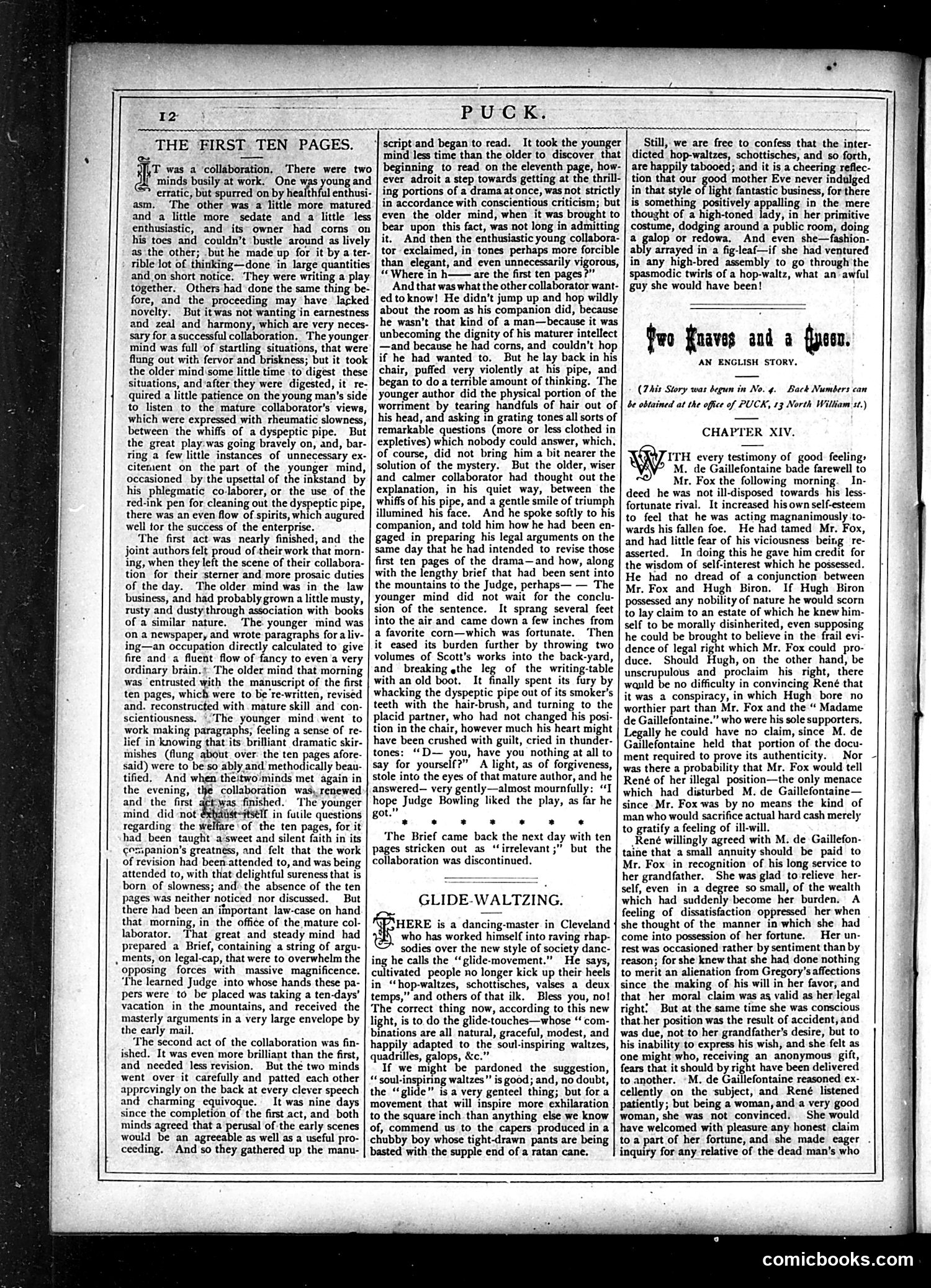
This page contains literary content rather than political cartoons. The left column discusses "The First Ten Pages," analyzing a theatrical collaboration between two authors—one younger and enthusiastic, the other older and more measured. The text critiques their working process, noting tensions between their different approaches to dramatic writing. The right side features "Two Knaves and a Knop," described as "An English Story," beginning Chapter XIV. It concerns Mr. Fox and Mr. Hiron in what appears to be a domestic drama involving questions of honor and propriety. Rather than satire of current events, this page offers literary criticism and serialized fiction—typical Puck content mixing entertainment with commentary on artistic and social matters.
📄 Transcribed text from this page (OCR, searchable)
Machine-transcribed from the original scan — historical spelling and the odd misread are preserved.
I2 PUCK. THE FIRST TEN PAGES. T was a ‘collaboration, ‘There were two minds busily at work. One Young and => erratic, but spurred on by health ful enthusi- asm. ‘The other was a little more matured and a little more sedate and a little less enthusiastic, and its’ owner had corns on his toes and couldn’t bustle around as lively as the other; but he made up for it by a ter- rible lot of thirking—done in large quantities and_on short notice. ‘They were writing a play together. Others had done the same thing be- fore, and the proceeding may have lacked novelty, But it was not wanting in earnestness and zeal and harmony, which are very neces- sary for a successful collaboration. The younger mind was full of startling situations, that were flung out with fervor and briskness; but it took the older mindsome little time to digest these situations, and’after they were digested, it re- quired a little patience on the young man’s side to listen to the mature collaborator’s views, which were expressed with rheumatic slowness, between the whiffs of a dyspeptic pipe. But the great play.was going bravely on, and, bar- ring a few little instances of unnecessary ex- citemment on the part of the younger mind, occasioned by the upsettal of the inkstand by his phlegmatic co-laborer, or the use of the red-ink pen for cleaning out the dyspeptic pipe, there was an even flow of spirits, which augured well tor the success of the enterprise. The first act was neatly finished, and the joint authors felt proud of their work that morn- ing, when they left the scene of their collabora- tion for their sterner and more prosaic duties of the day. The older mind was in the law business, and had probably grown a little musty, tusty and dusty'through association with books of a similar nature. The younger mind was on a newspaper, and wrote paragraphs for a liv- ing—an occupation directly calculated to give fire and a fluent flow of fancy to even a very ordinary brain.*. The older mind that morning was ‘entrusted with the manuscript of the first ten pages, which were to be're-written, revised and. reconstructed with. mature skill and con- scientiousness. “The younger mind went to work making paragraphs; feeling a sense of re- lief in knowing that its brilliant dramatic skir- mishes (flung about over. the ten pages afore- said) were to be so ably and methodically beau- tified. And when theitwo'minds met again in the evening, thé collaboration was, renewed. and the first finished. ‘The younger mind did not regarding: the welfare of the ten pages, for it had been taught a’sweet and silent faith in its cenpanion’s greatness, and felt that the work of revision had been.attended to, and was being attended to, with that delightful sureness that is born of slowness; and the absence of the ten pages was neither noticed nor discussed. But there had been an important law-case on hand that morning, in the office of the mature col- laborator. That great and steady mind had prepared a Brief, containing a string of argu- , ments, on legal-cap, that were to overwhelm the opposing forces with massive magnificence. ‘The learned Judge into whose hands these pa- pers were to be placed was taking a ten-days’ vacation in the mountains, and received the masterly arguments in a very large envelope by the early mail. The second act of the collaboration was fin- ished. It was even more brilliant than the first, and needed less revision. But the two minds went over it carefully and patted each other approvingly on the back at every clever speech and charming equivoque. It was nine days since the completion of the first act, and both minds agreed that a perusal of the early scenes would be an agreeable as well as a useful pro- ’) script'and began to read. t Sie in futile questions | 8°! ceeding. And so they gathered up the manu- Tt took the younger mind less time than the older to discover that beginning to read on the eleventh page, how- ever adroit a step towards getting at the thrill- ing portions of a drama atonce, was not strictly in accordance with conscientious criticism; but even the older mind, when it was brought to bear upon this fact, was not long in admitting it. And then the enthusiastic young collabora- tor exclaimed, in tones perhaps more forcible than elegant, and even unnecessarily vigorous, ‘Where in h—— are the first ten pages?” And that was what the other collaborator want- ed toknow! He didn’t jump up and hop wildly about the room as his companion did, because he wasn’t that kind of a man—because it was unbecoming the dignity of his maturer intellect —and because he had corns, and couldn't hop if he had wanted to. But he lay back in his chair, puffed very violently at his pipe, and an to doa terrible amount of thinking. ‘The younger author did the physical portion of the worriment by tearing handfuls of hair out of his head, and asking in grating tones all sorts of remarkable questions (more or less clothed in expletives) which nobody could answer, which, of course, did not bring him a bit nearer the solution of the mystery. But the older, wiser and calmer collaborator had thought out the explanation, in his quiet way, between the whiffs of his pipe, and a gentle smile of triumph illumined his face. And he spoke softly to his companion, and told him how he had been en- gaged in preparing his legal arguments on the same day that he had intended to revise those first ten pages of the drama—and how, along with the lengthy brief that had been sent into the mountains to the Judge, perhapsp— — The younger mind did not wait for the conclu- sion of the sentence. It sprang several feet into the air and came down a few inches from a favorite corn—which was fortunate. Then it eased its burden further by throwing two volumes of Scott’s works into the back-yard, and breaking sthe leg of the writing-table with an old boot. It finally spent its fury by whacking the dyspeptic pipe out of its smoker's teeth with the hair-brush, and turning to the placid partner, who had not changed his posi- tion in the chair, however much his heart might have been crushed with guilt, cried in thunder- tones: “D— you, have you nothing at all to say for yourself?” A light, as of forgiveness, stole into the eyes of that mature author, and he answered— very gently—almost mournfully: “I hope Judge Bowling liked the play, as far he ‘an - 8 8 © &© 28 «© The Brief came back the next day with ten ages stricken out as ‘‘irrelevant ;” but the collaboration was discontinued. GLIDE-WALTZING. HERE is a dancing-master in Cleveland who has worked himself into raving rhap- sodies over the new style of society danc- He says, ing he calls the “glide-movement.” cultivated people no longer kick up their heels in “hop-waltzes, schottisches, valses a deux temps,” and others of that ilk. Bless you, no! The correct thing now, according to this new light, is to. do the glide-touches—whose ‘‘ com- binations are all natural, graceful, modest, and happily adapted to the soul-inspiring waltzes, quadrilles, galops, &c.” If we might be pardoned the suggestion, “ soul-inspiring waltzes” is good; and, no doubt, the “glide” is a very genteel thing; but fora movement that will inspire more exhilaration to the square inch than anything else we know of, commend us to the capers produced in a chubby boy whose tight-drawn pants are being basted with the supple end of a ratan cane. Still, we are free to confess that the inter- dicted hop-waltzes, schottisches, and so forth, are happily tabooed; and it is a cheering reflec- tion that our good mother Eve never indulged in that style of light fantastic business, for there is something positively appalling in the mere thought of a high-toned lady, in her primitive costume, dodging around a public room, doing lop or redowa. And even she—fashion- ably arrayed in a fig-leaf—if she had ventured in any high-bred assembly to go through the spasmodic twirls of a hop-waltz, what an awful guy she would have been! Feo faaves and a fysen. AN ENGLISH STORY. (This Story was begun in No. 4. Back Numbers can be obtained at the office of PUCK, 13 North William st.) CHAPTER XIV. ITH every testimony of good feelings M. de Gaillefontaine bade farewell to Mr. Fox the following morning. In- deed he was not ill-disposed towards his less- fortunate rival. It increased his own self-esteem to feel that he was acting magnanimously to- wards his fallen foe. He had tamed Mr. Fox, and had little fear of his viciousness being re- asserted. In doing this he gave him credit for the wisdom of self-interest which he possessed. He had no dread of a conjunction between Mr. Fox and Hugh Biron. If Hugh Biron possessed any nobility of nature he would scorn to lay claim to an estate of which he knew him- self to be morally disinherited, even supposing he could be brought to believe in the frail evi- dence of legal right which Mr. Fox could pro- duce. Should Hugh, on the other hand, be unscrupulous and proclaim his right, there wauld be no difficulty in convincing René that it was a conspiracy, in which Hugh bore no worthier part than Mr. Fox and the “ Madame de Gaillefontaine.” who were his sole supporters, Legally he could have no claim, since M. de Gaillefontaine held that portion of the docu- ment required to prove its authenticity. Nor was there a probability that Mr. Fox would tell René of her illegal position—the only menace which had disturbed M. de Gaillefontaine— since Mr. Fox was by no means the kind of man who would sacrifice actual hard cash merely to gratify a feeling of ill-will. .René willingly agreed with M. de Gaillefon- taine that a small annuity should be paid to Mr. Fox in recognition of his long service to her grandfather. She was glad to-relieve her- self, even in a degree so small, of the wealth which had suddenly become her burden. A feeling of dissatisfaction oppressed her when she thought of the manner in which she had come into possession of her fortune. Her un- rest was occasioned rather by sentiment than by reason; for she knew that she had done nothing to merit an alienation from Gregory’s affections since the making of his will in her favor, and that her moral claim was as valid as her legal right? But at the same time she was conscious that.her position was the result of accident, and was due, not to her grandfather’s desire, but to his inability to express his wish, and she felt as one might who, receiving an anonymous gift, fears that it should by right have been delivered to another. »M. de Gaillefontaine reasoned ex- cellently on the subject, and René listened patiently; but being a woman, and a very good woman, she was not convinced. She would have welcomed with pleasure any honest claim to a part of her fortune, and she made eager . inquiry for any relative of the dead man’s who comicbooks.com