
Puck, 1877-07-04 · page 14 of 16
Puck — July 4, 1877 — page 14: what you’re looking at
What you’re looking at
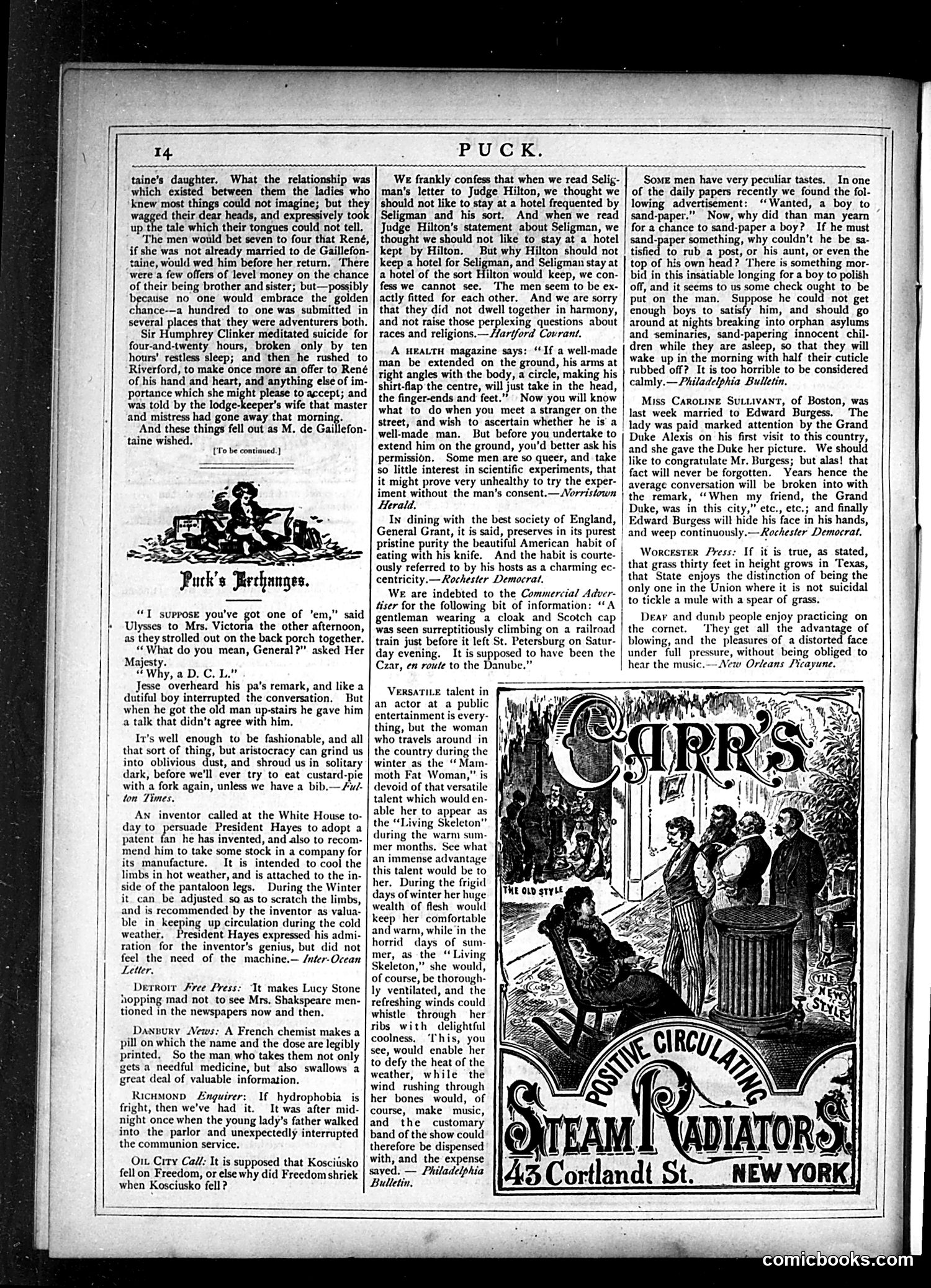
This page contains satirical commentary sections ("Puck's Briefings") rather than a single cartoon. The content mocks various contemporary figures and practices: **Notable sections:** - Commentary on General Grant's social habits and his tendency to visit hotels frequented by wealthy men - Criticism of phrenology (the pseudoscience of reading character from skull shape) - A joke about President Hayes and an inventor's leg-scratching device for winter - Medical satire about a French chemist's dubious "dose-legible" pills - Mockery of phophobia (fear of light) The page reflects late-19th-century American satirical humor targeting public figures, pseudoscientific fads, and medical quackery. An advertisement for "Positive Circulating Steam Radiators" appears at bottom right.
📄 Transcribed text from this page (OCR, searchable)
Machine-transcribed from the original scan — historical spelling and the odd misread are preserved.
| 14, PUCK. taine’s daughter. What the relationship was which existed between them the ladies who knew most things could not imagine; but the; ed their dear heads, and expressively too! up the tale which their tongues could not tell. The men would bet seven to four that René, if she was not already married to de Gaillefon- taine, would wed him before her return. There ‘were a few offers of level money on the chance of their being brother and sister; but—possibly because no one would embrace the golden ances hundred to one was submitted in several places that they were adventurers both. Sir Humphrey Clinker meditated suicide for four-and-twenty hours, broken only by ten hours’ restless sleep; and then he rushed to Riverford, to make once more an offer to René of his hand and heart, and anything else of im- portance which she might please to accept; and was told by the lodge-keeper’s wife that master and mistress had gone away that morning. And these things fell out as M. de Gaillefon- taine wished, [To be continued.) “(I suppose you've got one of ‘em,” said Ulysses to Mrs. Victoria the other afternoon, as they strolled out on the back porch together. “What do you mean, General?” asked Her Majenty. “Why, a D.C. L."” Jesse overheard his pa's remark, and like a dutiful boy interrupted the conversation. But when he got the old man upstairs he gave him a talk that didn’t agree with him. Ir's well enough to be fashionable, and all that sort of thing, but aristocracy can grind us into oblivious dust, and shroud us in solitary dark, before we'll ever try to eat custard-pie with’a fork again, unless we have a bib.—/u/- ton Times. An inventor called at the White House to- day to persuade President Hayes to adopt a patent fan he has invented, and also to recom- mend him to take some stock in a company for its manufacture. It is intended to cool the limbs in hot weather, and is attached to the in- side of the pantaloon legs. During the Winter it can be adjusted so as to scratch the limbs, and is recommended by the inventor as valua- ble in keeping up circulation during the cold weather, President Hayes expressed his admi- ration for the inventor’s genius, but did not feel the need of the machine.— /nter-Ocean Letter, Derrorr Free Press: ‘Tt makes Lucy Stone hopping mad not to see Mrs. Shakspeare men- tioned in the newspapers now and then. Danbury News: A French chemist makes a pill on which the name and the dose are legibly printed, So the man who takes them not only gets a needful medicine, but also swallows a great deal of valuable information. Ricumonp Enguirer: If hydrophobia is fright, then we've had it. It was after mid- night once when the young lady’s father walked into the parlor and unexpectedly interrupted the communion service. Ou. Crry Cad: It is supposed that Kosciisko fell on Freedom, or else why did Freedom shriek when Kosciusko fell? We frankly confess that when we read Sclig- man's letter to Judge Hilton, we thought we should not like to stay at a hotel frequented by Seligman and his sort, And when we read Judge Hilton’s statement about Seligman, we thought we should not like to stay at a hotel kept by Hilton. But why Hilton should not keep a hotel for Seligman, and Seligman stay at a hotel of the sort Hilton would keep, we con- fess we cannot see. ‘The men seem to be ex- actly fitted for each other. And we are sorry that they did not dwell together in harmony, and not raise those perplexing questions about races and religions.— Hartford Courant. A HEALTH magazine says: ‘If a well-made man be extended on the ground, his arms at tight angles with the body, a circle, making his shirt-flap the centre, will just take in the head, the finger-ends and feet.” Now you will know what to do when you meet a stranger on the street, and wish to ascertain whether he is a well-made man. But before you undertake to extend him on the ground, you'd better ask his permission. Some men are so queer, and take so little interest in scientific experiments, that it might prove very unhealthy to try the exper- iment without the man’s consent.—Worristown Herald, In dining with the best society of England, General Grant, it is said, preserves in its purest pristine purity the beautiful American habit of eating with his knife. ously referred to by his hosts as a charming ec- centricity.—Kochester Democrat. We are indebted to the Commercial Adver- ser for the following bit of information: A gentleman wearing a cloak and Scotch cap was seen surreptitiously climbing on a railroad train just before it left St. Petersburg on Satur- day evening. It is supposed to have been the Czar, en route to the Danube.” And the habit is courte- | Some men have very peculiar tastes. In one of the daily papers recently we found the fol- lowing advertisement: ‘Wanted, a boy to sand-paper.” Now, why did than man yearn © for a chance to sand-paper a boy? If he must sand-paper something, why couldn't he be sa- tisfied to rub a st, or his aunt, or even the top of his own head? There is something mor- bid in this insatiable longing for a boy to polish off, and it seems to us some check ought to be put on the man. Suppose he could not get enough boys to satisfy him, and should go around at nights breaking into orphan asylums and seminaries, sand-papering innocent chil- j dren while they are asleep, so that they will wake up in the morning with half their cuticle rubbed off? It is too horrible to be considered calmly.—Philadelphia Bulletin, Miss Carouine Suttivant, of Boston, was last week married to Edward Burgess. The lady was paid marked attention by the Grand Duke Alexis on his first visit to this country, and she gave the Duke her picture. We should like to congratulate Mr. Burgess; but alas! that fact will never be forgotten. Years hence the average conversation will be broken into with the remark, “When my friend, the Grand Duke, was in this city,” etc., etc.; and finally Edward Burgess will hide his face in his hands, | and weep continuously.—Rochester Democrat. Worcester ress: If it is true, as stated, that grass thirty feet in height grows in Texas, that State enjoys the distinction of being the only one in the Union where it is not suicidal to tickle a mule with a spear of grass. Dear and dunib people enjoy practicing on the cornet. ‘They get all the advantage of blowing, and the pleasures of a distorted face under full pressure, without being obliged to hear the music.—Aew Orleans Picayune, VeRrSATILE talent in an actor at a public entertainment is every- thing, but the woman who travels around in the country during the winter as the “Mam- moth Fat Woman,” is devoid of that versatile talent which would en- able her to appear as the “Living Skeleton” during the warm sum- mer months, See what an immense advantage jf this talent would be to her, During the frigid days of winter her huge wealth of flesh would keep her comfortable and warm, while in the horrid) days of sum- mer, as the “Living Skeleton,” she would, of course, be thoroug ly ventilated, and the refreshing winds could whistle through — her ribs with delightful coolness, ‘This, you see, would enable her to defy the heat of the weather, while the wind rushing through her bones would, of course, make music, and the customary band of the show could therefore be dispensed with, and the expense sayed. — Philadelphia Bulletin,