
A complete issue · 44 pages · 1929
Life — August 9, 1929
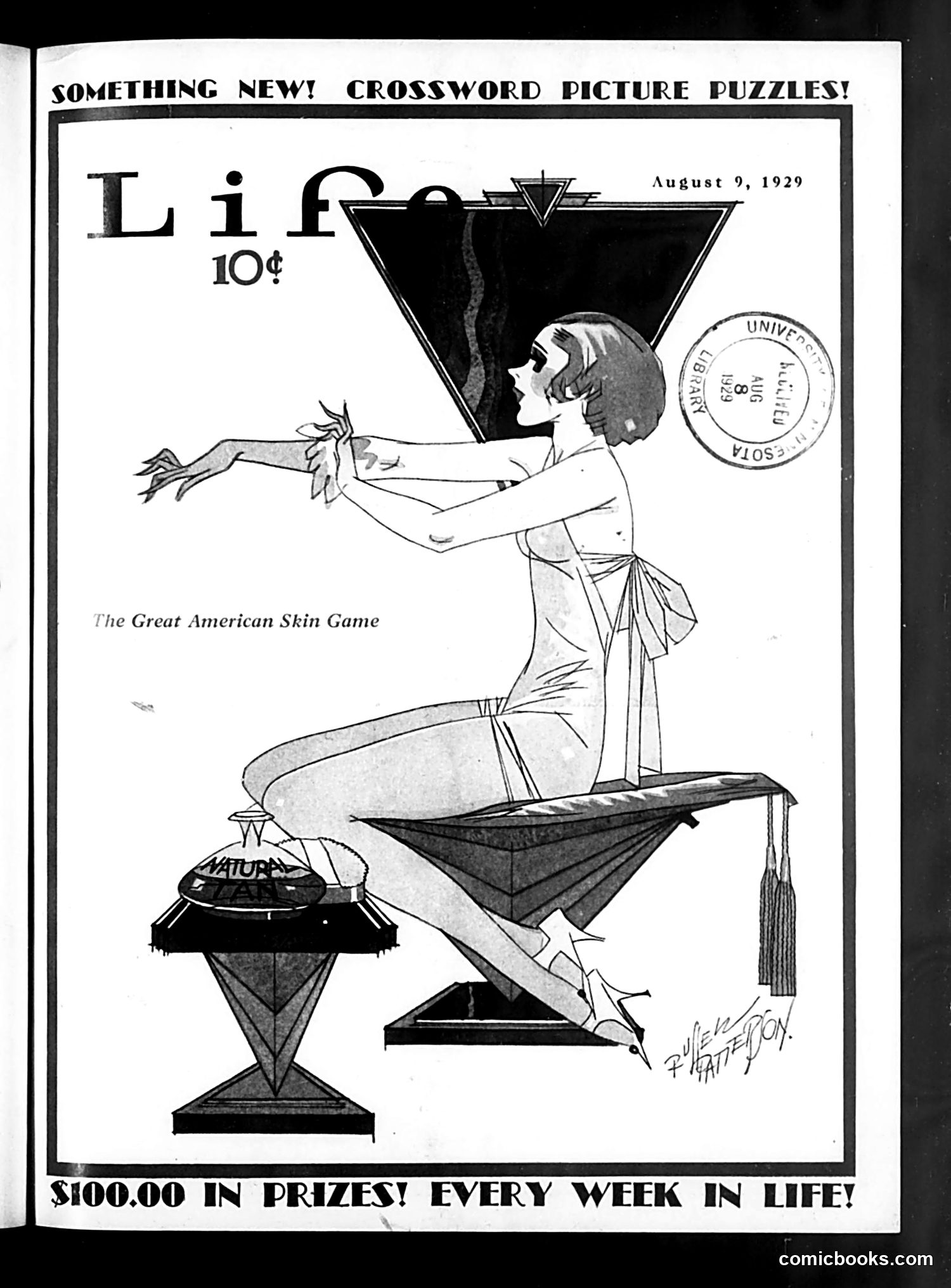
This is a Life magazine cover from August 9, 1929, advertising a puzzle contest ("Something New! Crossword Picture Puzzles!"). The illustration depicts a stylized 1920s woman in fashionable attire—short bobbed hair, revealing clothing, and decorative accessories—positioned suggestively. The caption reads "The Great American Skin Game," a double entendre referring both to sunbathing (a leisure activity gaining popularity in the 1920s) and to the woman's exposed skin. The phrase "skin game" was also slang for a swindle, adding satirical bite. The image epitomizes Jazz Age attitudes toward women's liberation and changing fashion norms. The cover promises "$100.00 in Prizes! Every Week in Life!" to promote reader participation in the puzzle competition.
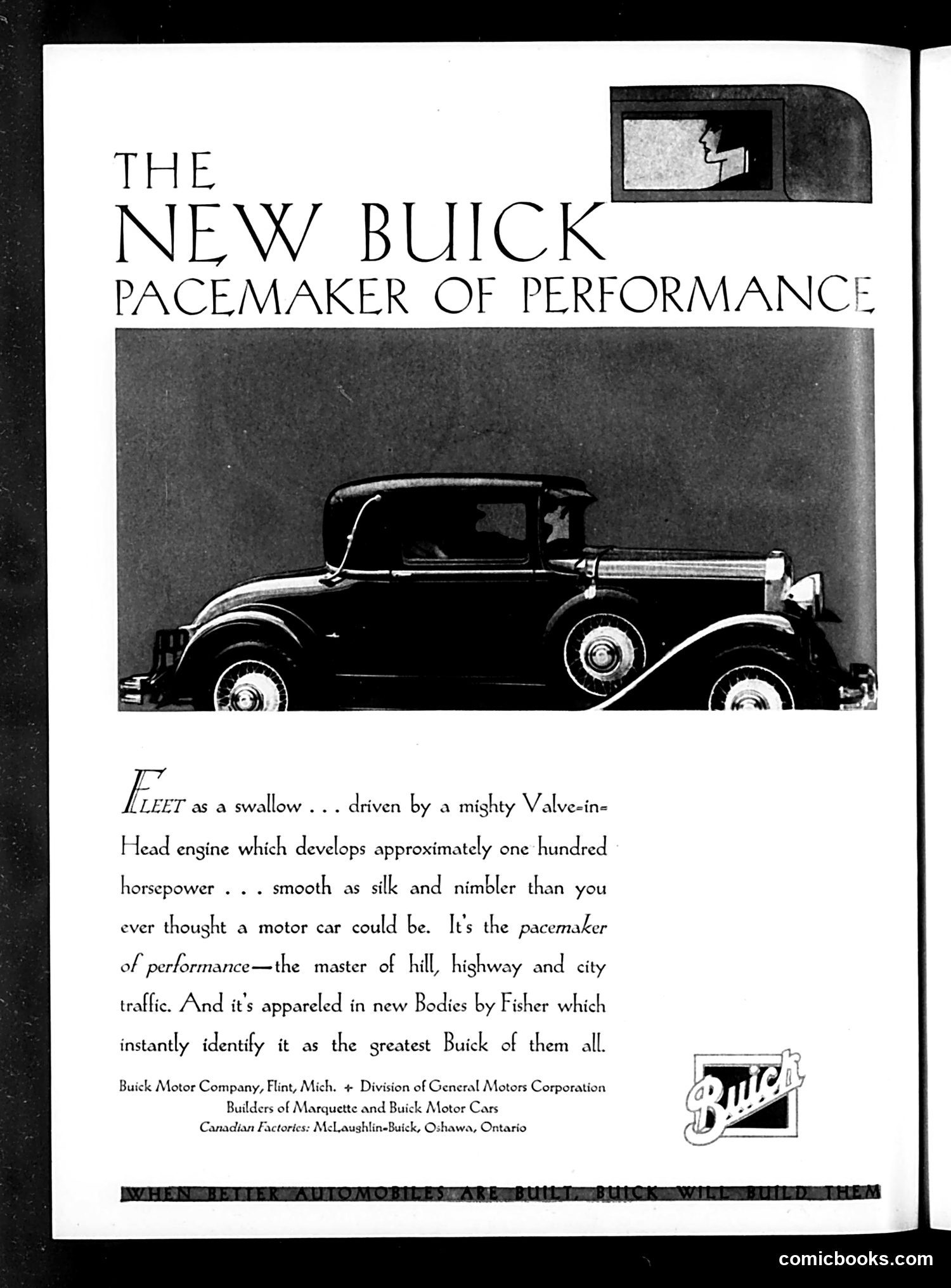
This is primarily **advertising, not satire or political commentary**. It's a Buick Motor Company advertisement for "The New Buick Pacemaker of Performance." The ad uses the metaphor of a swallow—"fleet as a swallow"—to describe the car's speed and elegance. It emphasizes the vehicle's Valve-in-Head engine (approximately 100 horsepower), smooth performance, and new Fisher bodies. The tagline calls it the "pacemaker of performance," suggesting it leads in automotive capability. The small illustration in the upper right appears to be a Buick logo or brand mark. This represents typical 1920s-30s automobile marketing rhetoric, emphasizing power, smoothness, and style to appeal to affluent consumers. There is no political or satirical content—it's straightforward product promotion.
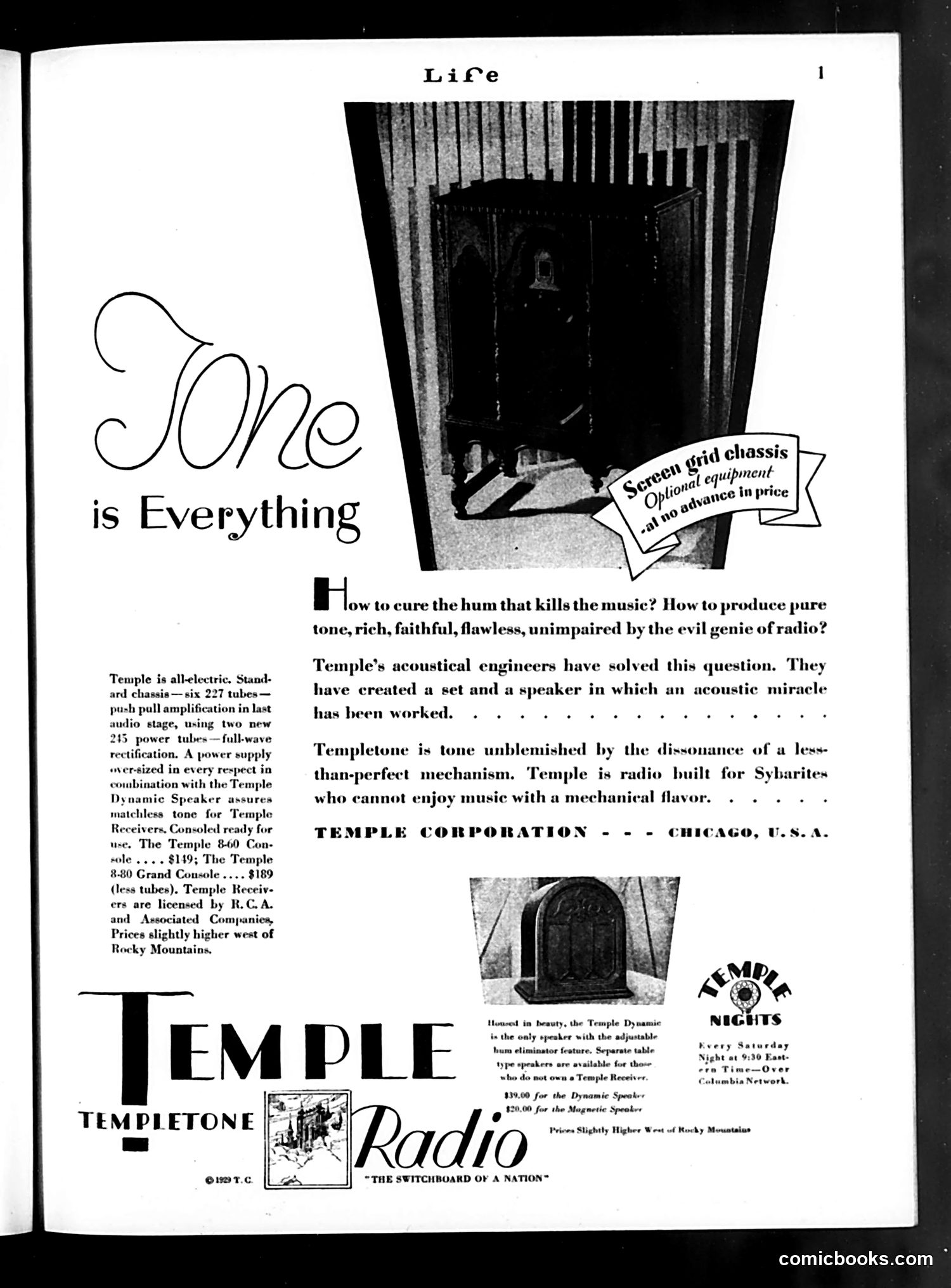
This page is primarily **advertising, not satire or political content**. It's a Temple Corporation advertisement for radio equipment, specifically promoting their "Templetone Radio" line. The page plays on the phrase "Tone is Everything" to market Temple's radio receivers and speakers as superior audio solutions. The advertisement emphasizes that Temple has engineered acoustic equipment to eliminate radio's characteristic distortion—"the hum that kills the music." The small illustrations show radio chassis and speakers. "Temple Nights" appears to be a radio program. The text targets radio owners seeking better sound quality, a significant consumer concern during the early radio era when audio fidelity remained problematic. This is essentially a vintage consumer electronics advertisement, not political or social commentary.
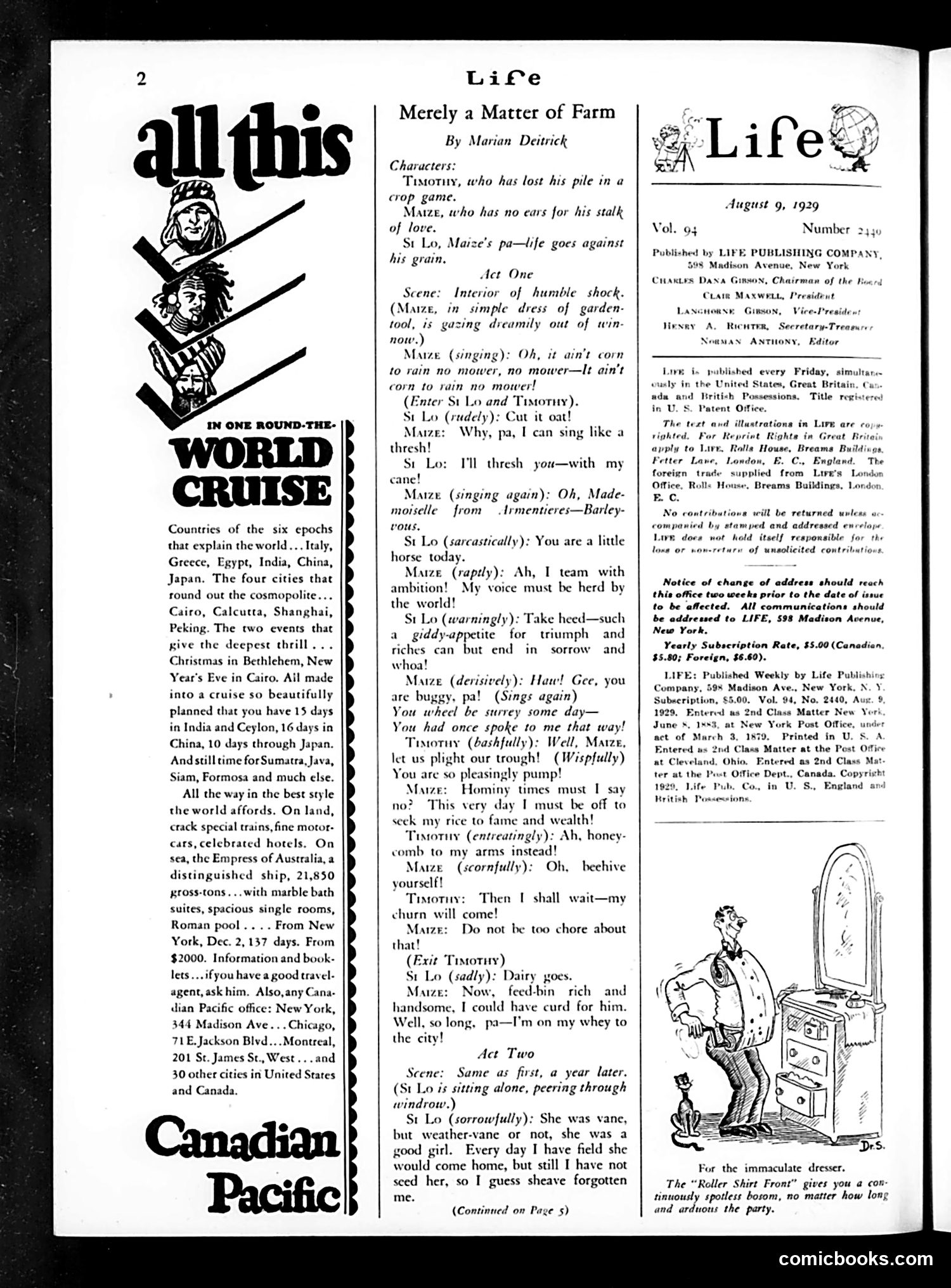
**Left Page Advertisement:** The "All This In One Round-the-World Cruise" ad promotes Canadian Pacific steamship travel, listing exotic destinations (Greece, Egypt, India, China, Japan) and emphasizing luxury accommodations. This reflects the Jazz Age's celebration of leisure travel for the wealthy. **Center: "Merely a Matter of Farm" Play** A theatrical comedy script by Marian Deitrick featuring rural characters (Timothy, Maize, Si Lo) in a romantic entanglement. The dialogue parodies rustic speech patterns and farm life stereotypes popular in 1920s entertainment—depicting rural folks as simple, comedic figures. **Right Page:** A cartoon shows a man admiring his reflection in a mirror, captioned "For the immaculate dresser," satirizing male vanity and fashion consciousness of the era.
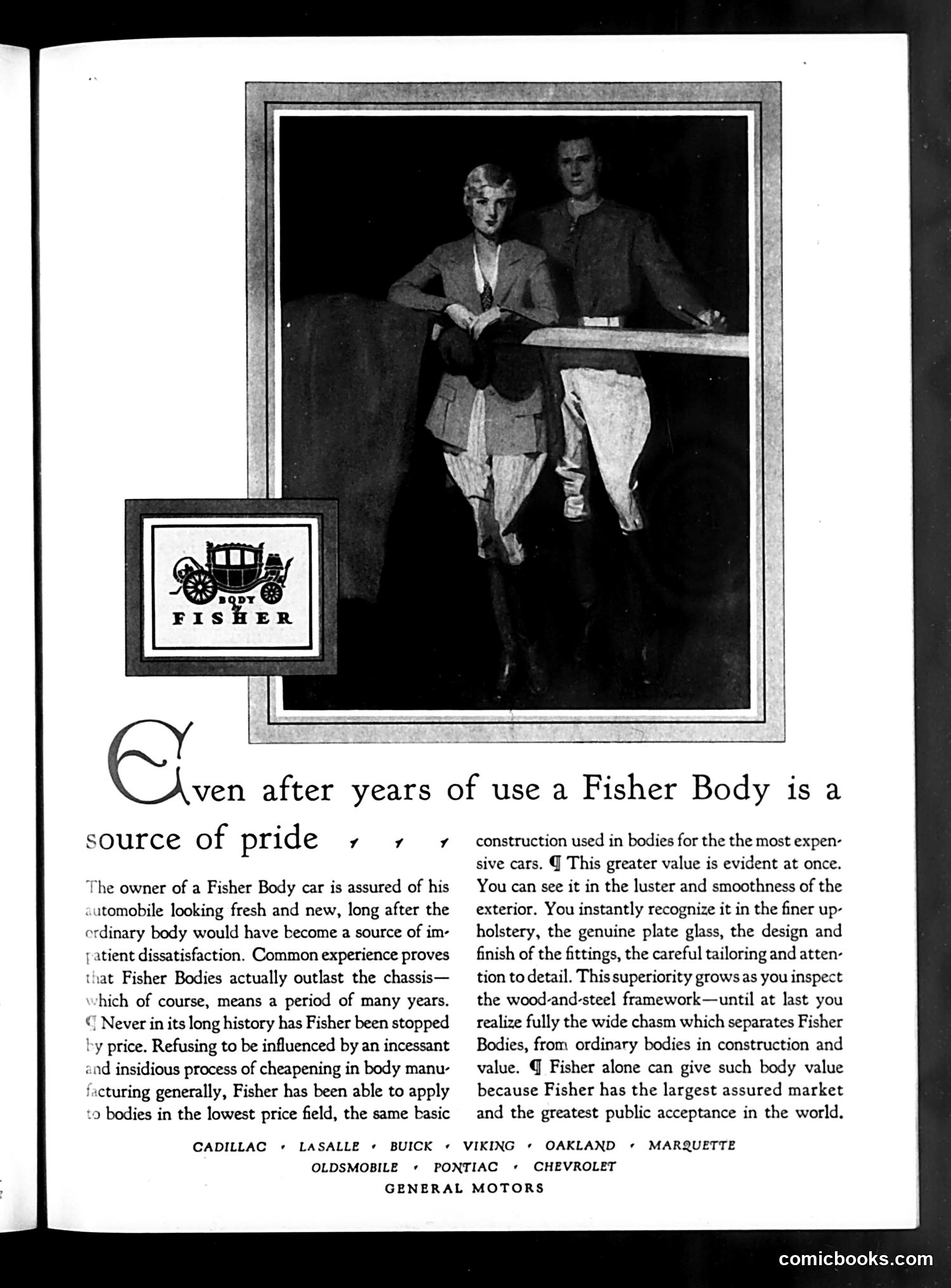
This page is primarily a **Fisher Body advertisement**, not satire or political content. The ad features a photograph of two people examining an automobile body, with the Fisher Body company logo (a horse-drawn carriage) prominently displayed. The advertisement's argument is straightforward: Fisher Bodies maintain their quality and appearance "even after years of use." The text claims Fisher Bodies "outlast the chassis" and resist the cheapening processes common in manufacturing. The ad emphasizes Fisher's market dominance and craftsmanship—superior upholstery, genuine glass, careful tailoring, and wood-frame construction—to justify premium pricing. This represents General Motors' Fisher Body division marketing its quality to potential car buyers during what appears to be the early-to-mid twentieth century.
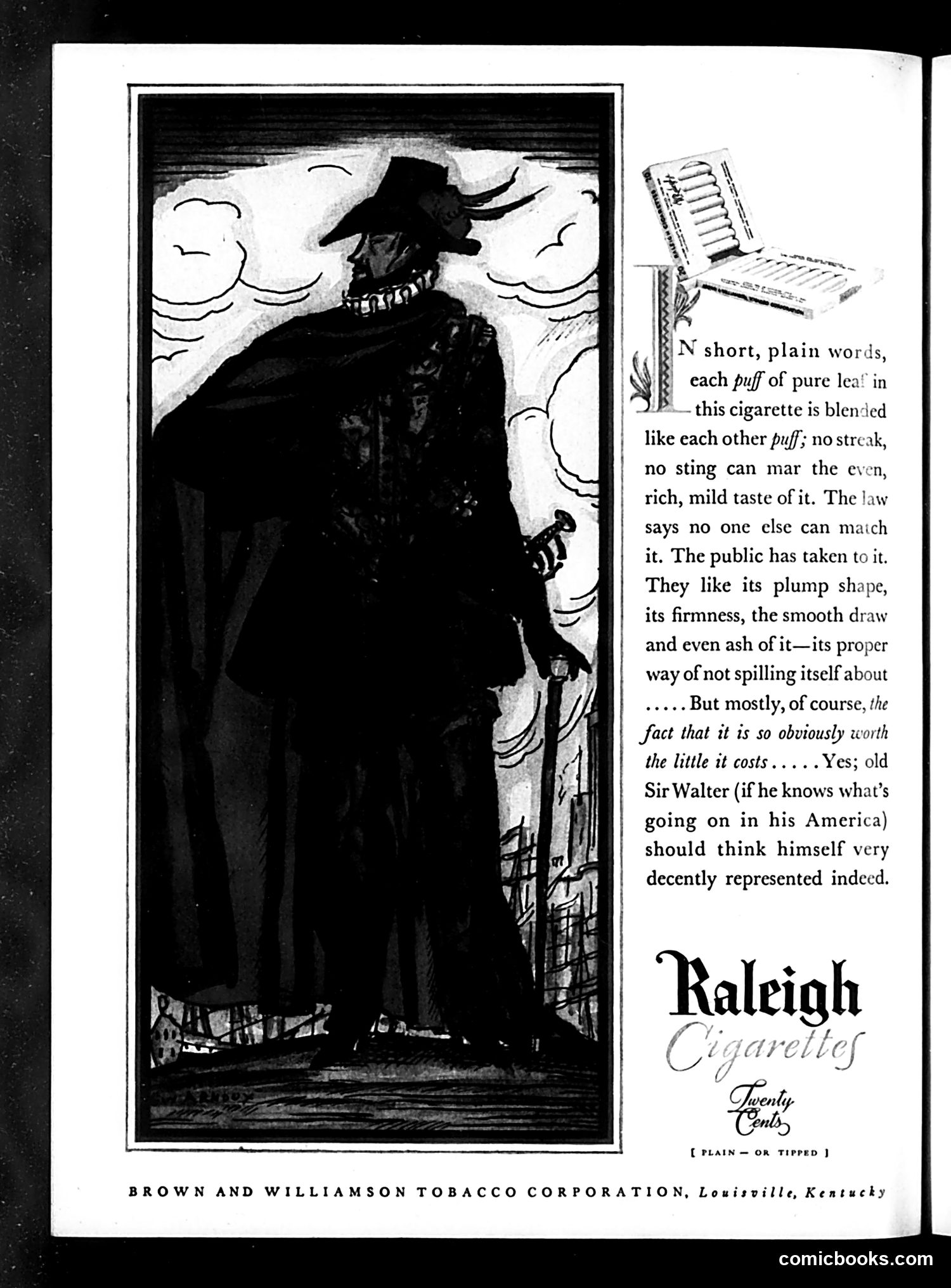
This page is primarily a **cigarette advertisement** for Raleigh brand, not political satire. The illustration shows a silhouetted figure in formal attire (coat, hat) viewed from behind, standing before clouds. The accompanying text uses period marketing language emphasizing the cigarette's quality: consistent blending, mild taste, and firm construction. The reference to "old Sir Walter" appears to invoke Sir Walter Raleigh, the historical figure after whom the brand is named—a common marketing practice linking products to famous names. The final line "[PLAIN—OR TIPPED]" indicates packaging options available to consumers. This represents early 20th-century tobacco advertising, notable today primarily for its candid promotion of cigarettes without health warnings—a practice later restricted by law.
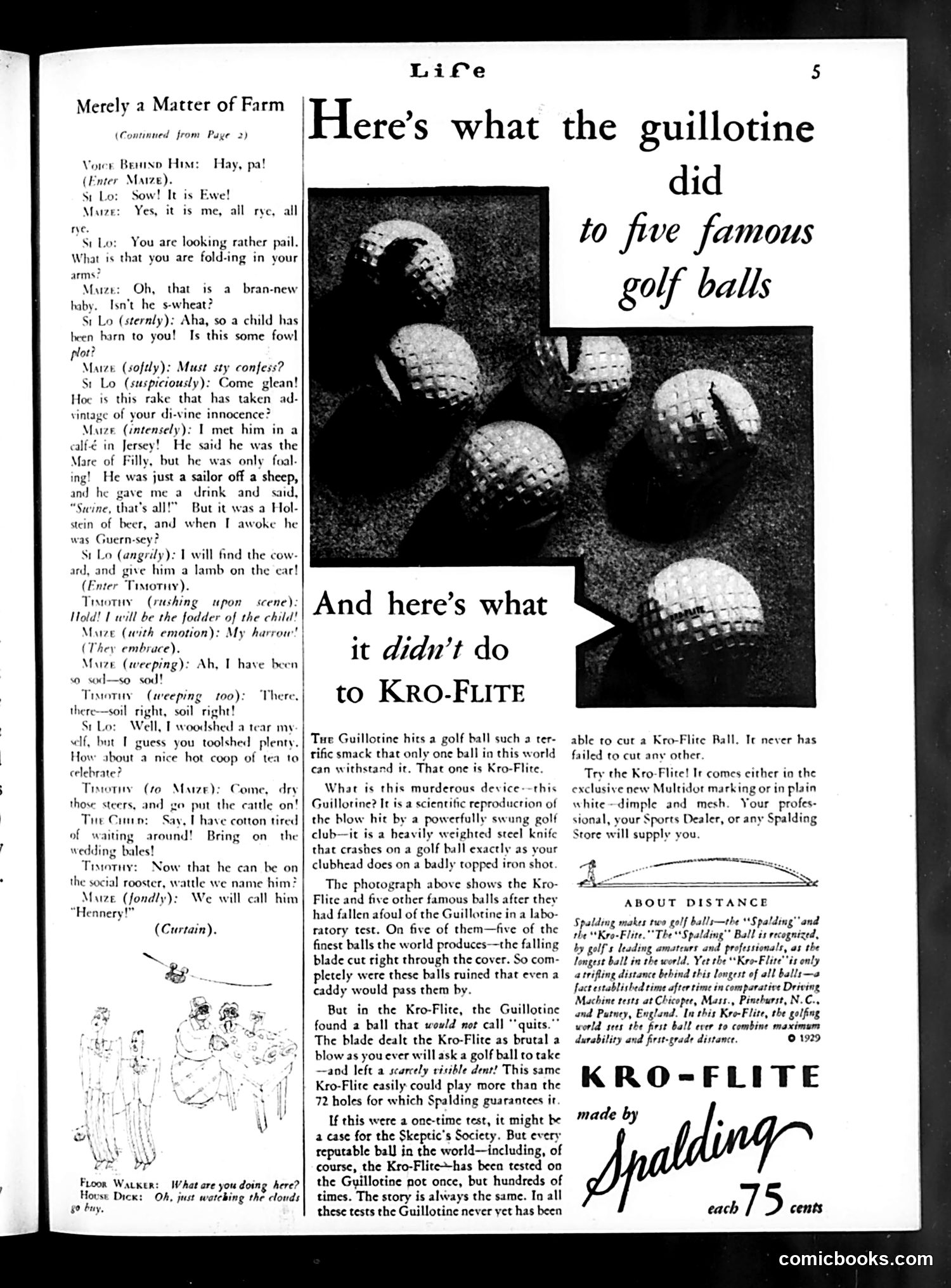
This page is primarily **advertising** for Kro-Flite golf balls, made by Spalding. The top half includes a theatrical script excerpt titled "Merely a Matter of Farm" (continued from an earlier page), featuring characters named Muze, Si Lo, Timothy, and The Choir discussing a newborn child and various rural matters—apparently a comedic sketch with no clear political content. The dominant content is a product advertisement with photographs of golf balls. The copy claims the Guillotine (a golf ball testing device) can damage other brands but cannot cut Kro-Flite balls, positioning them as superior and durable. The ad emphasizes Kro-Flite's proven performance through rigorous testing, priced at 75 cents each. This is straightforward early 20th-century advertising, not political satire.
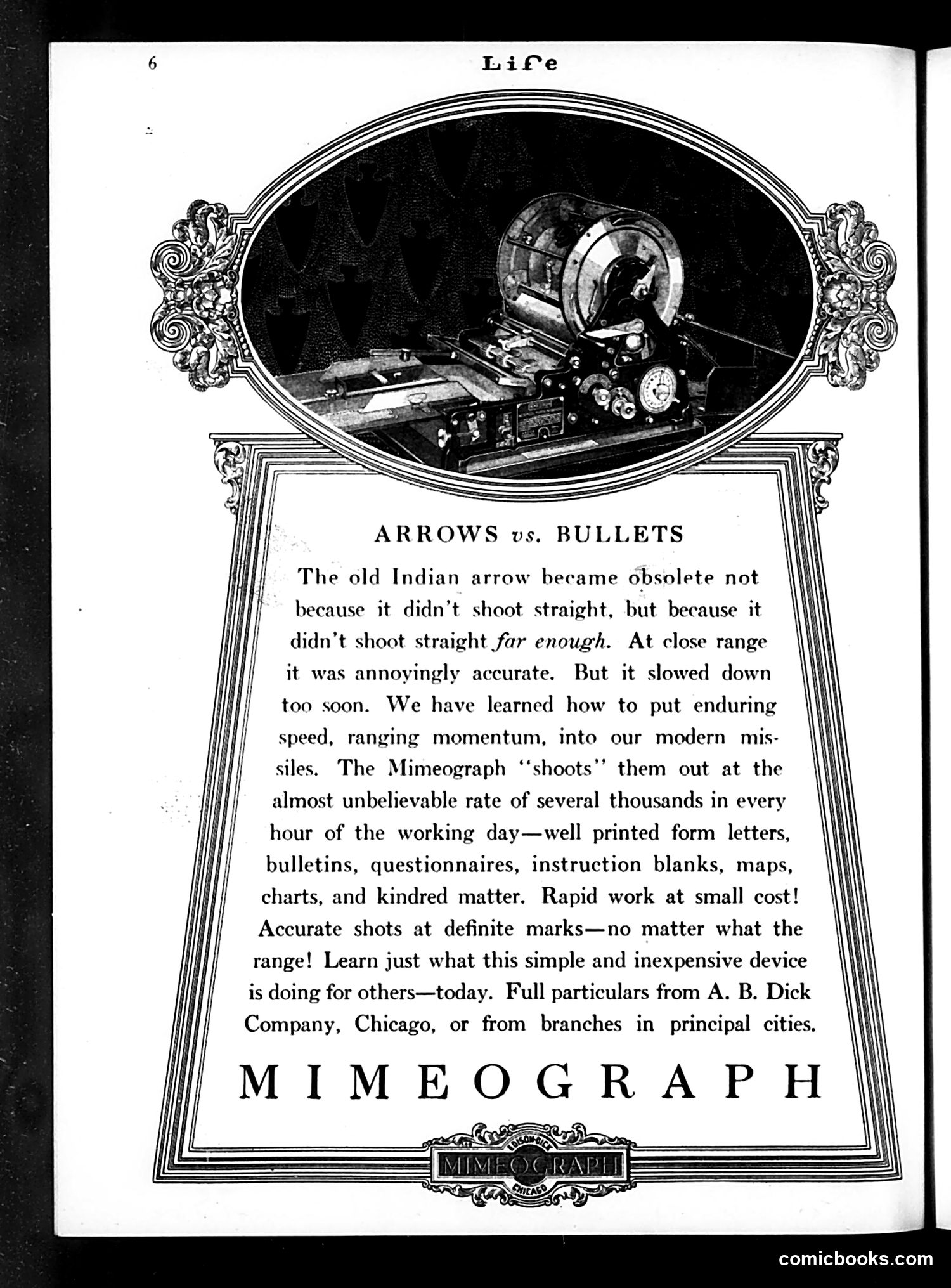
This is a **Mimeograph machine advertisement**, not a political cartoon. The page uses an extended metaphor comparing technological progress to warfare: The headline "ARROWS VS. BULLETS" draws a parallel between the obsolete Indian arrow and the modern bullet—just as arrows became outdated due to insufficient range and speed, older office equipment presumably became outdated compared to the Mimeograph. The machine pictured is a Mimeograph, a duplicating device that could rapidly reproduce documents. The ad emphasizes its speed ("several thousands in every hour"), accuracy, and low cost for printing business materials (letters, bulletins, maps, charts). The satirical point is gentle: just as warfare technology evolved, so too has office technology. The A.B. Dick Company marketed this machine as the modern solution for businesses needing efficient document reproduction.
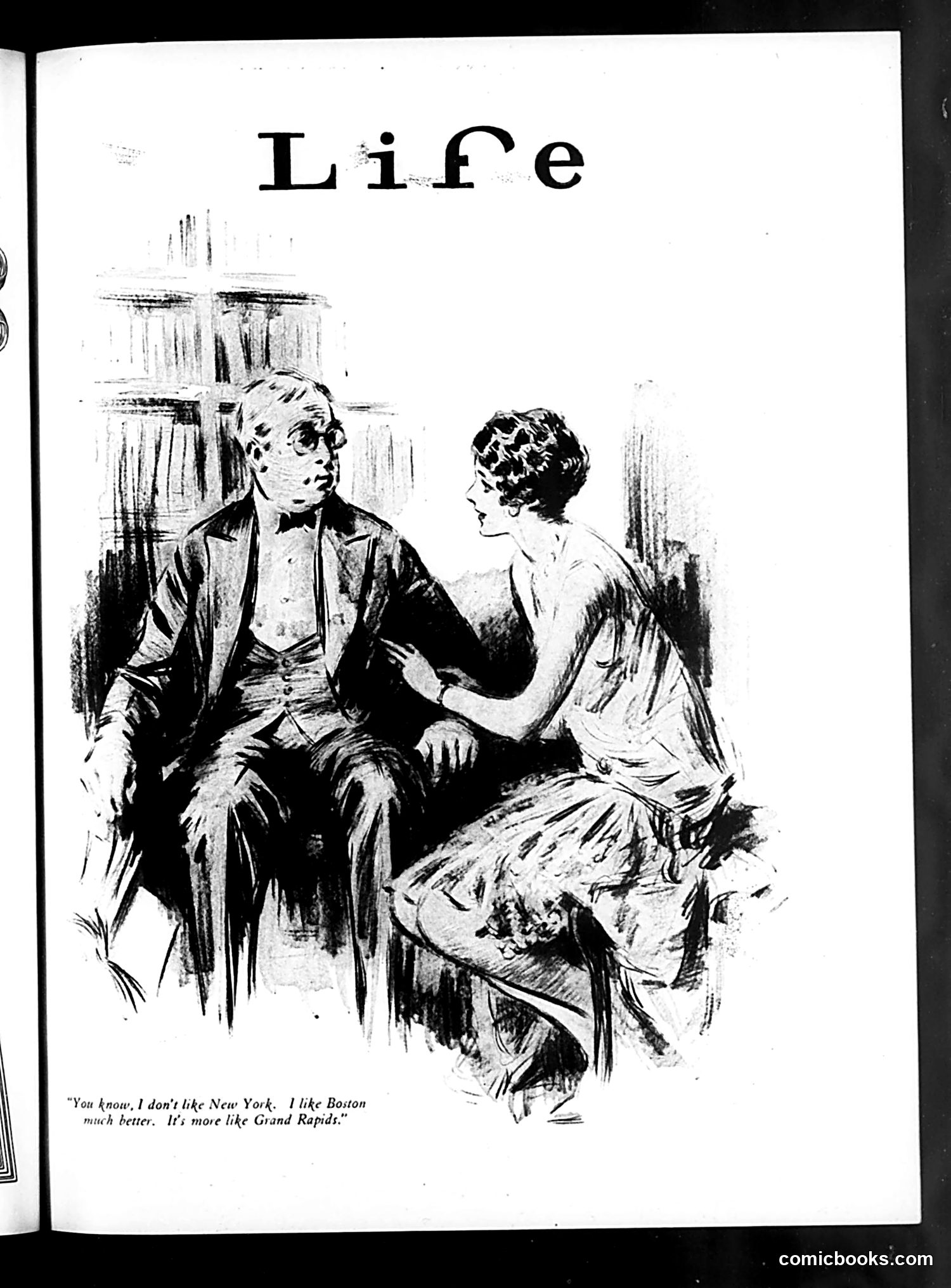
This satirical cartoon depicts a domestic scene between a man and woman in conversation. The man, dressed formally in a dark suit, appears skeptical or unimpressed as the woman speaks to him. The caption reads: "You know, I don't like New York. I like Boston much better. It's more like Grand Rapids." The humor rests on a geographic and social hierarchy joke: the woman is suggesting that Boston—a major American city with significant historical and cultural prestige—is merely comparable to Grand Rapids, Michigan, a much smaller industrial city. This is absurd flattery or obliviousness, mocking either provincial tastes or someone's inability to recognize cultural distinctions between cities. The satire appears to target American regional attitudes, possibly commenting on Midwestern perspectives or the social pretensions of the era.
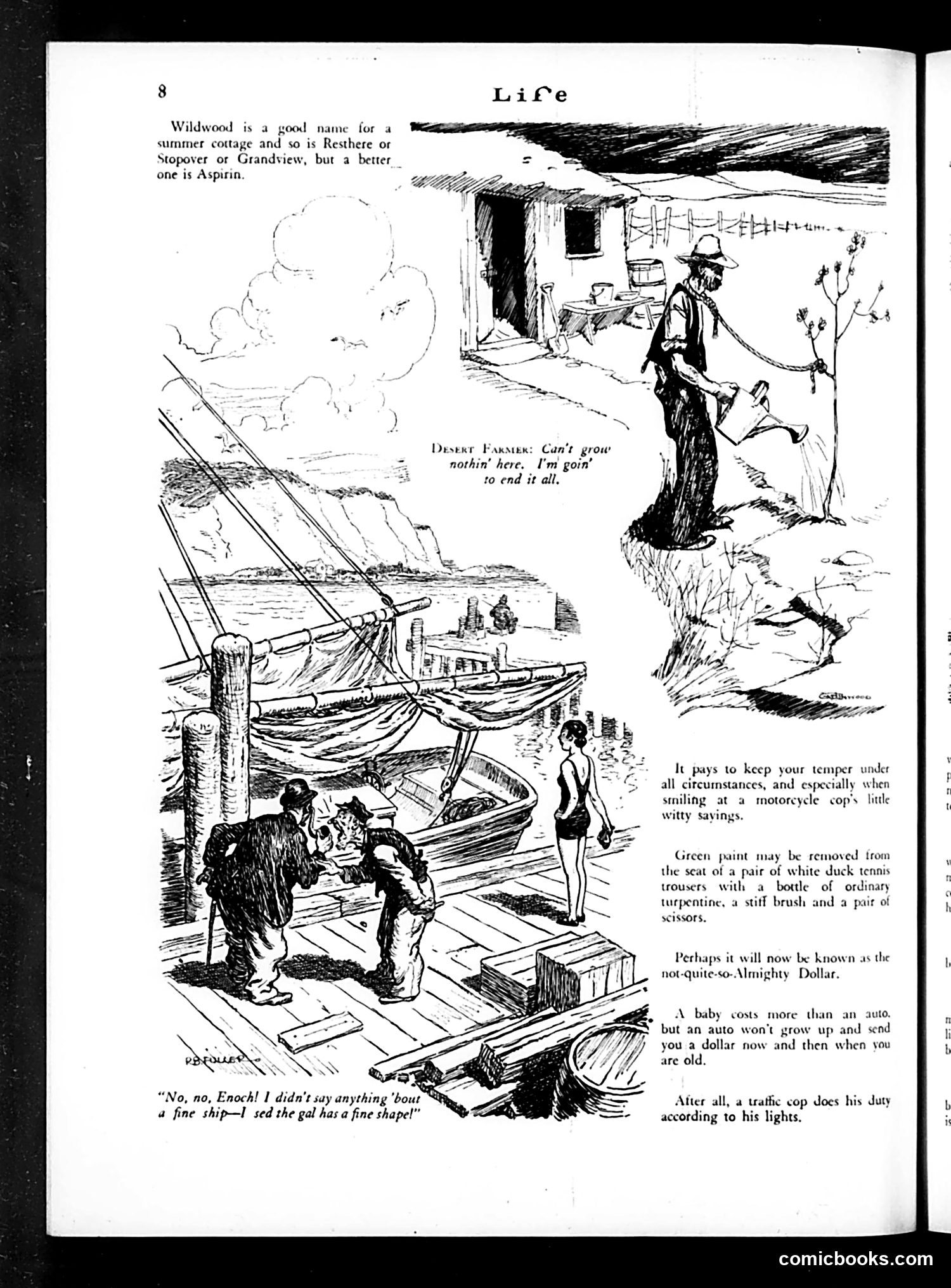
This page contains three separate humorous sketches with accompanying witticisms: 1. **Desert Farmer sketch** (top right): Shows a discouraged farmer abandoning his land, saying "Can't grow nothin' here, I'm goin' to end it all"—satirizing the hardships of desert agriculture. 2. **Harbor scene** (left): Features two characters at a dock with boats. The caption reads: "No, no, Enoch! I didn't say anything 'bout a fine ship—I sed the gal has a fine shape!"—a pun on mishearing "ship" versus "shape." 3. **Scattered quips** (right margin): Brief humorous observations about temper control around motorcycle cops, removing green paint from tennis shoes, and comparing baby costs to automobiles. The page is typical early-20th-century *Life* magazine humor—simple visual gags and puns targeting everyday situations.
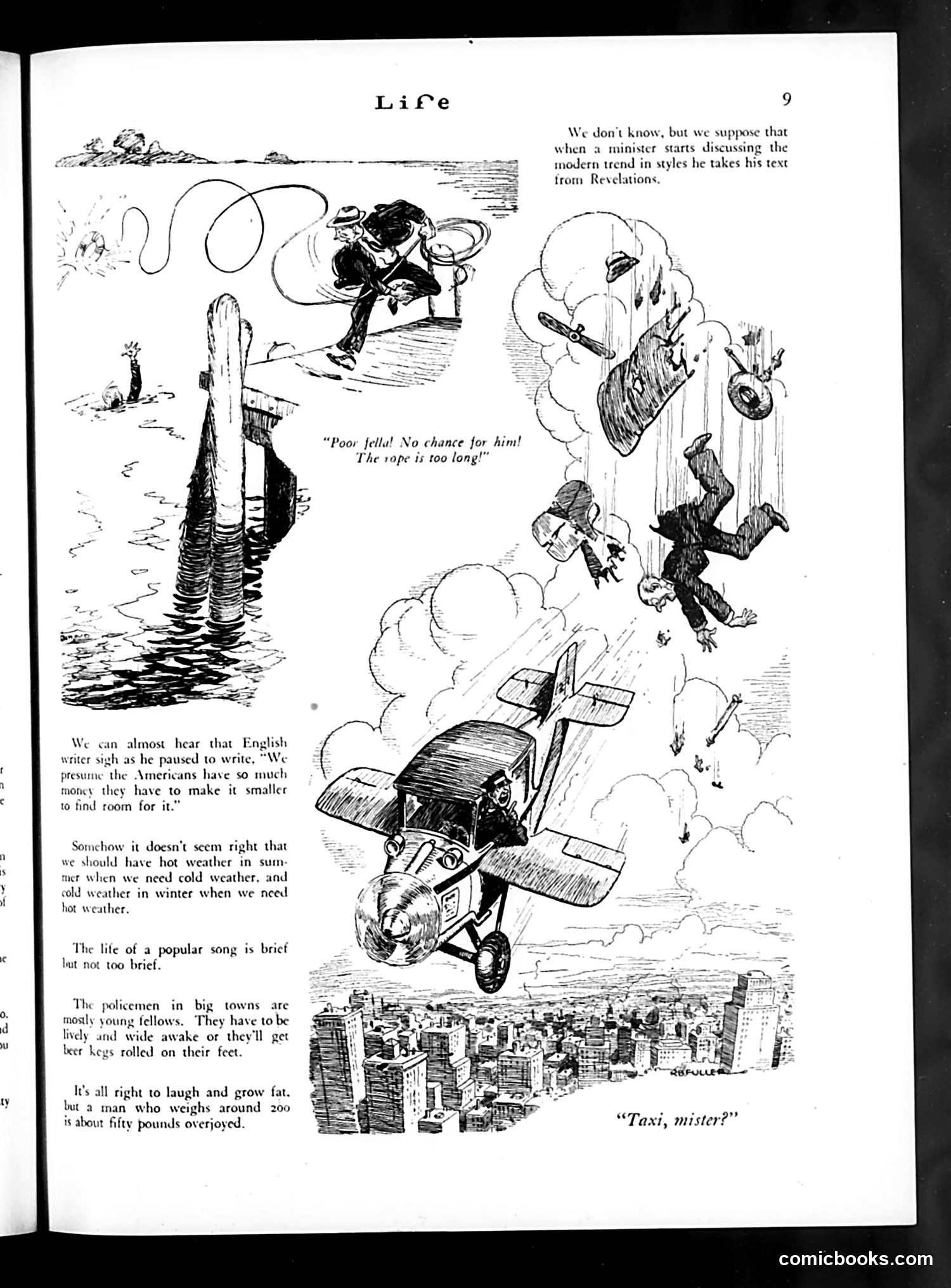
This page contains humorous observations on modern life rather than explicit political cartoons. The sketches satirize everyday absurdities: 1. **The rope-jumping scene** mocks Americans' obsession with fashion and trends, showing someone struggling with an impractically long rope while others comment "Poor fellow! No chance for him!" 2. **The airplane dropping objects onto a city** appears to joke about modern air travel's disruptions to urban life, with the caption "Taxi, mister?" suggesting the chaos created. 3. **Accompanying text** includes observations about English writers struggling with American economics, weather inconsistencies, song brevity, police conduct in cities, and weight standards—all gentle social commentary on contemporary middle-class concerns and contradictions rather than pointed political satire.
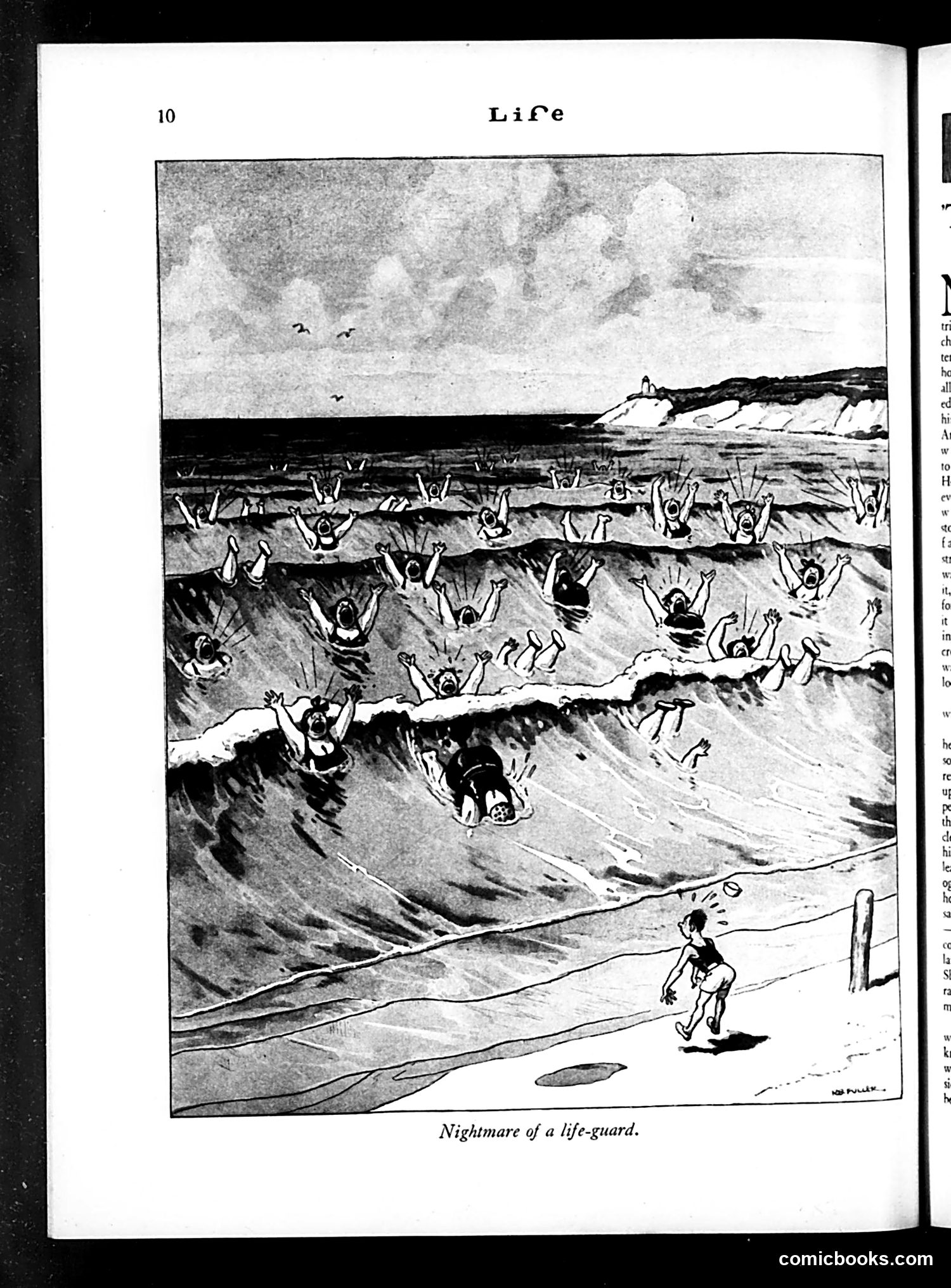
This cartoon depicts a lifeguard's anxious dream scenario at a crowded beach. The image shows numerous swimmers in the water with their arms raised—a visual that could suggest either distress signals or simply crowded beach conditions. The single lifeguard figure in the foreground appears overwhelmed or panicked, looking back at the mass of beachgoers. The satire plays on the lifeguard's responsibility anxiety: the "nightmare" is being responsible for protecting so many swimmers simultaneously, making it impossible to monitor everyone's safety. This reflects early 20th-century concerns about public beach safety as recreational swimming grew more popular. The humor derives from the lifeguard's sense of helplessness when outnumbered by swimmers, a relatable workplace anxiety about being overwhelmed by one's duties.
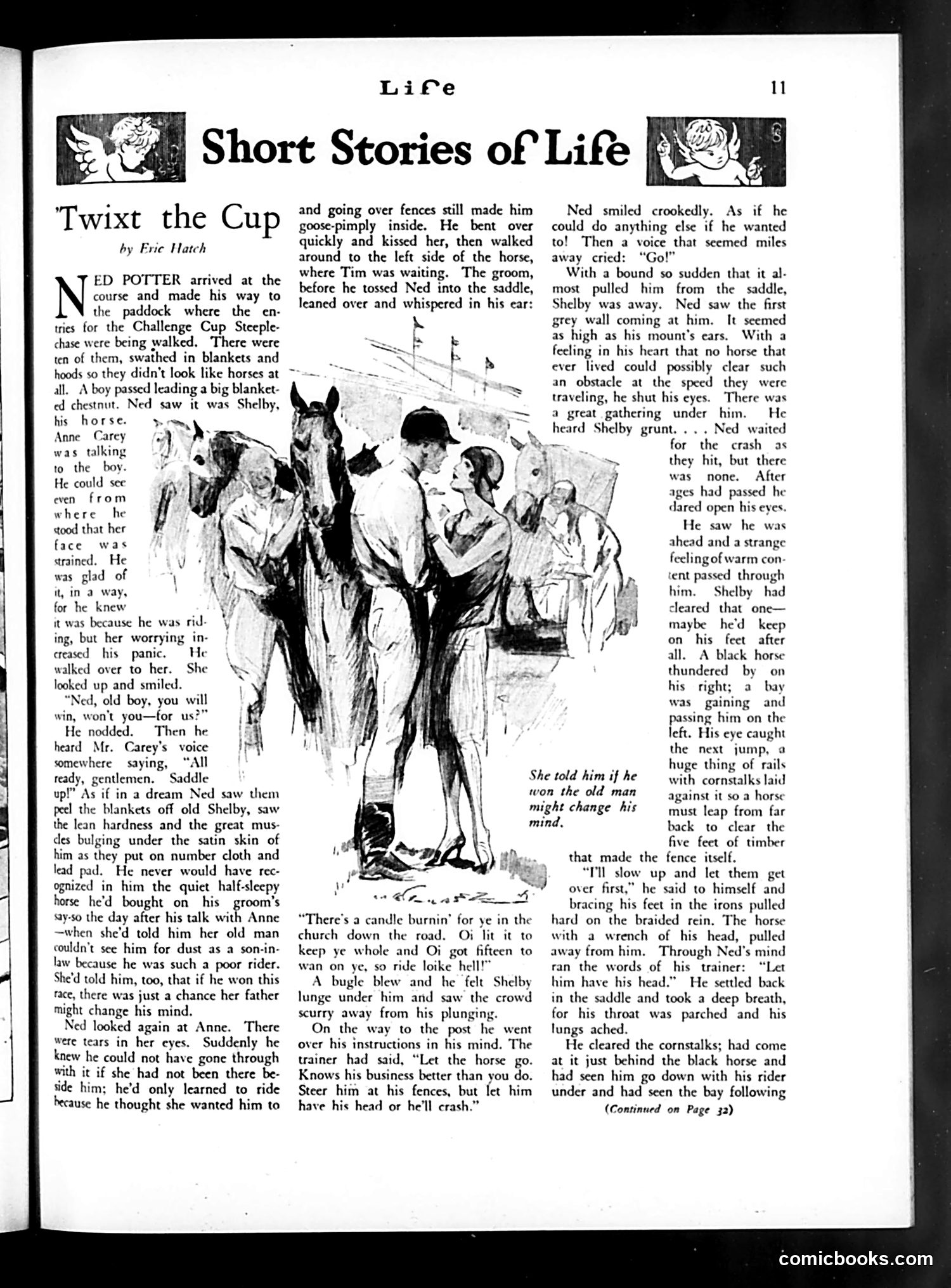
This is a short story, not a political cartoon. The narrative follows Ned Potter at a horse race (the Challenge Cup Steeplechase), where he encounters a boy leading a horse named Shelby. Ned becomes emotionally invested in whether the horse will win, despite his initial detachment. The story illustrates human nature through sports—specifically how spectators develop unexpected attachments to outcomes. The title's phrase "between the cup and the lip" suggests the uncertainty between anticipation and result. There is no political satire here; rather, it's a character study about hope, anxiety, and the psychology of witnessing competition. The accompanying illustration shows the crowd gathered around the horses before the race.
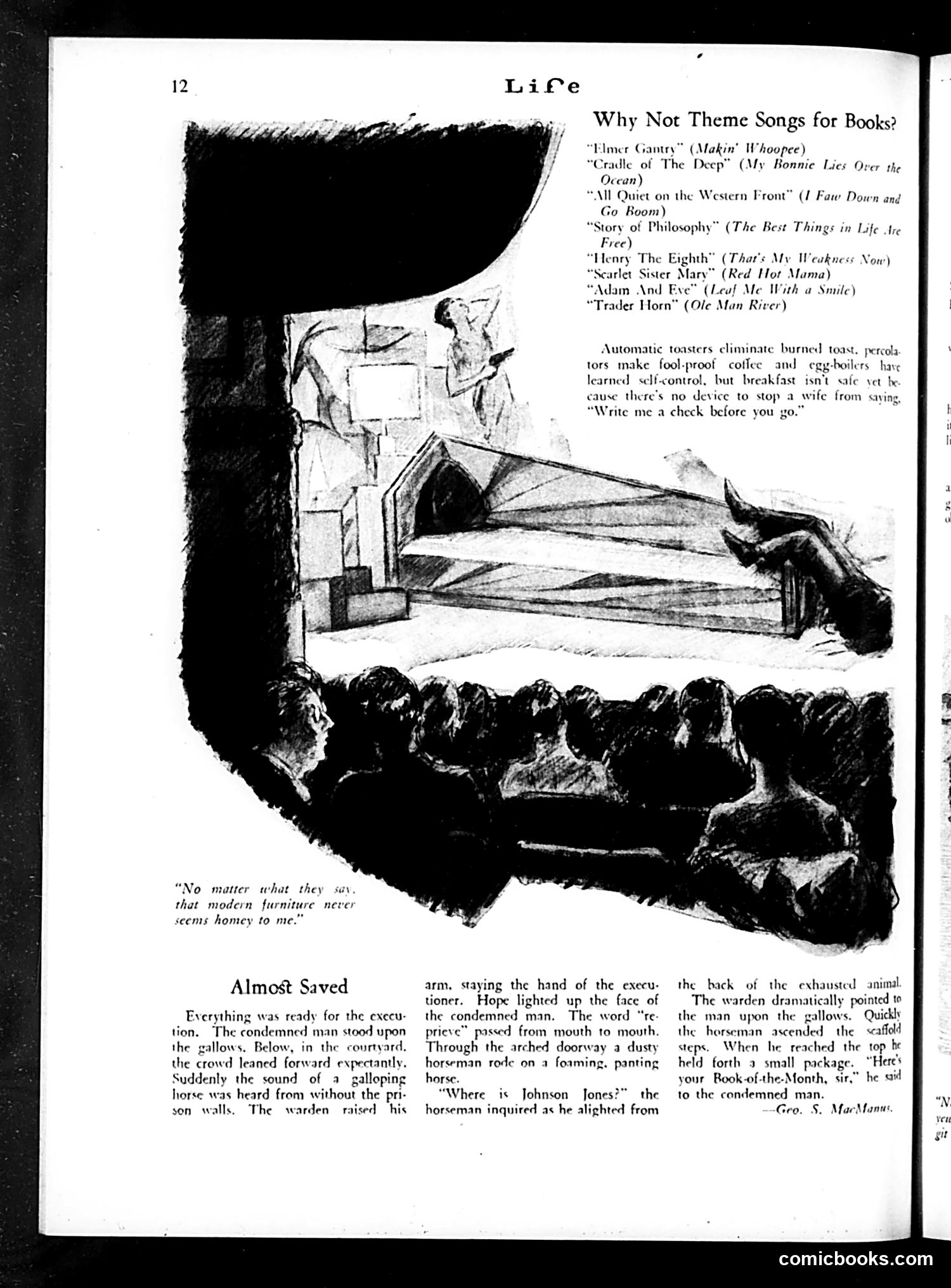
This page contains two distinct items: **"Why Not Theme Songs for Books?"** is a humorous list proposing movie-style theme songs for classic literature—a satirical jab at 1920s-30s Hollywood's practice of creating catchy songs for films. The titles are absurd pairings (e.g., "Ulysses Gantry" paired with a whoopee song). **"Almost Saved"** is a cartoon story about a last-minute reprieve from execution. A condemned man awaits the gallows when a horseman arrives with news—a "Book-of-the-Month" selection. The joke appears to mock how book clubs and literary selections were viewed as trivial cultural pursuits, insufficient to save even a condemned man's life. The satire critiques middlebrow American culture's obsession with fashionable reading.
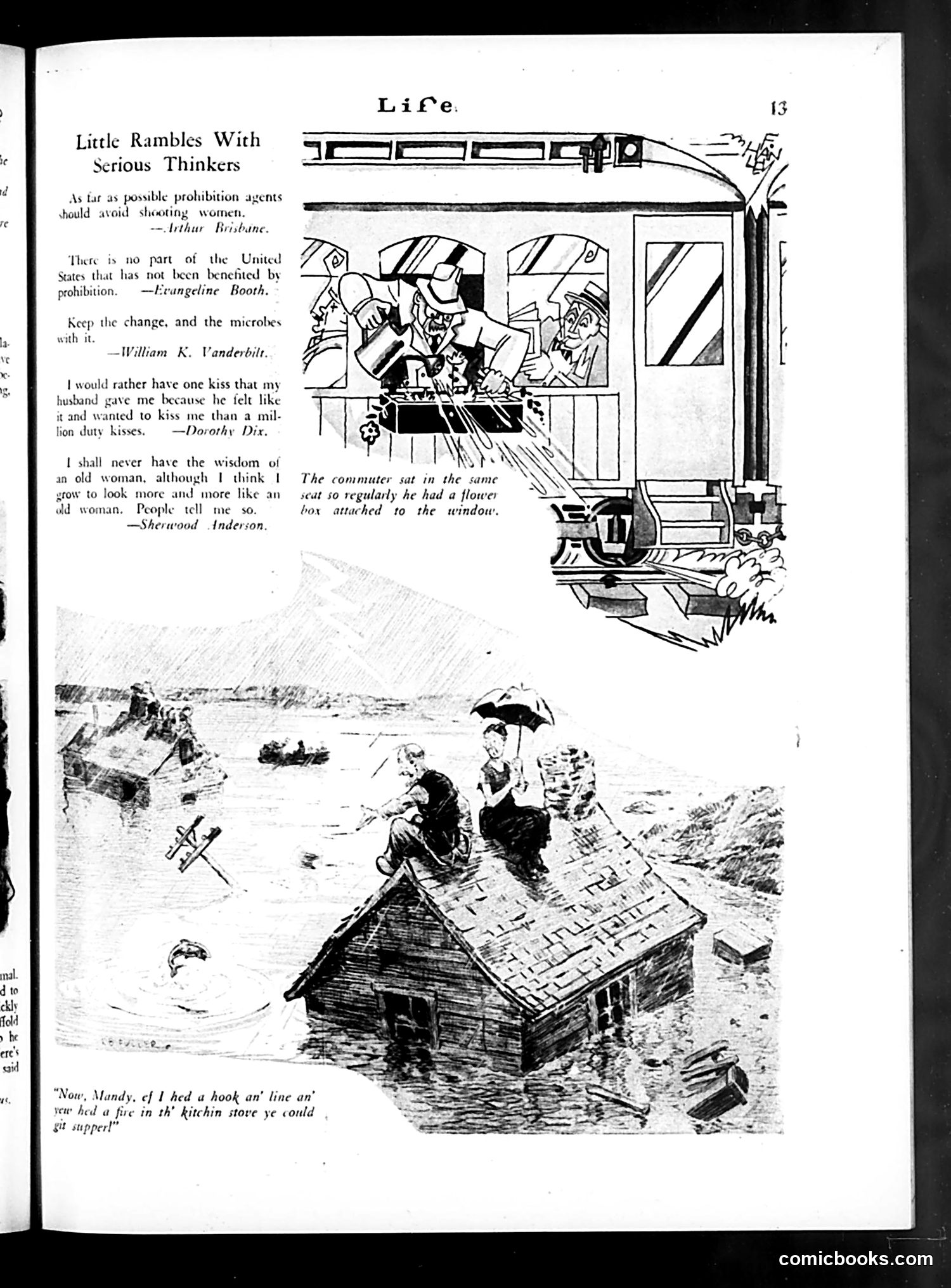
This page contains two distinct elements: **Upper section:** "Little Rambles With Serious Thinkers" — a collection of brief philosophical quotes from named figures (Arthur Brisbane, Evangeline Booth, William K. Vanderbilt, Dorothy Dix, Sherwood Anderson). These appear to be witty observations on topics like prohibition, kissing, and aging. This was a common Life feature presenting punchy commentary. **Illustrations:** - Top cartoon shows a train commuter with a flower box at the window—likely satirizing urban commuting life - Bottom illustration depicts flood victims on a roof during heavy rain, with a caption quoting dialect speech about lacking a "hook an' line" to catch supper The flood scene appears to be social satire addressing poverty and disaster relief, using humor to comment on hardship.
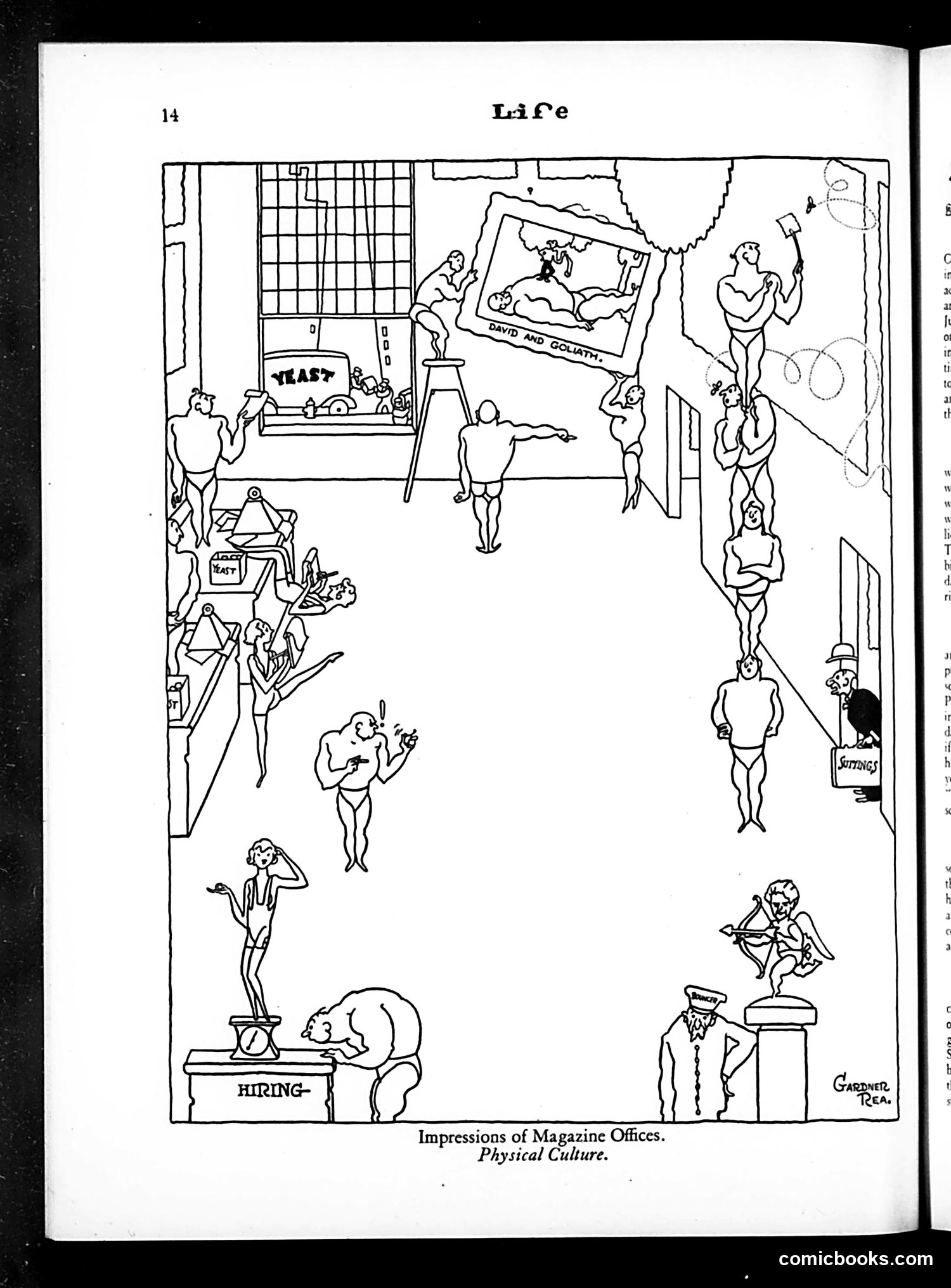
This satirical cartoon depicts the offices of *Physical Culture* magazine as a gym-obsessed environment. Nearly nude or minimally-clothed figures perform various bodybuilding exercises throughout the space, including posing on pedestals labeled "Hiring" and "Gardner Trea[d]" (likely "Gardner Tread," a fitness device). The contrast is stark: while ordinary clothed workers conduct business at desks and windows, muscular individuals dominate the space, some performing acrobatic feats. The satire mocks *Physical Culture*'s extreme emphasis on physique and fitness culture—suggesting the magazine's offices are consumed by the very obsession it promoted. A YEAST sign and "Sittings" window indicate commercial operations overwhelmed by bodybuilder spectacle. The joke targets early 20th-century fitness fads and the magazine's single-minded focus on physical development over practical work.
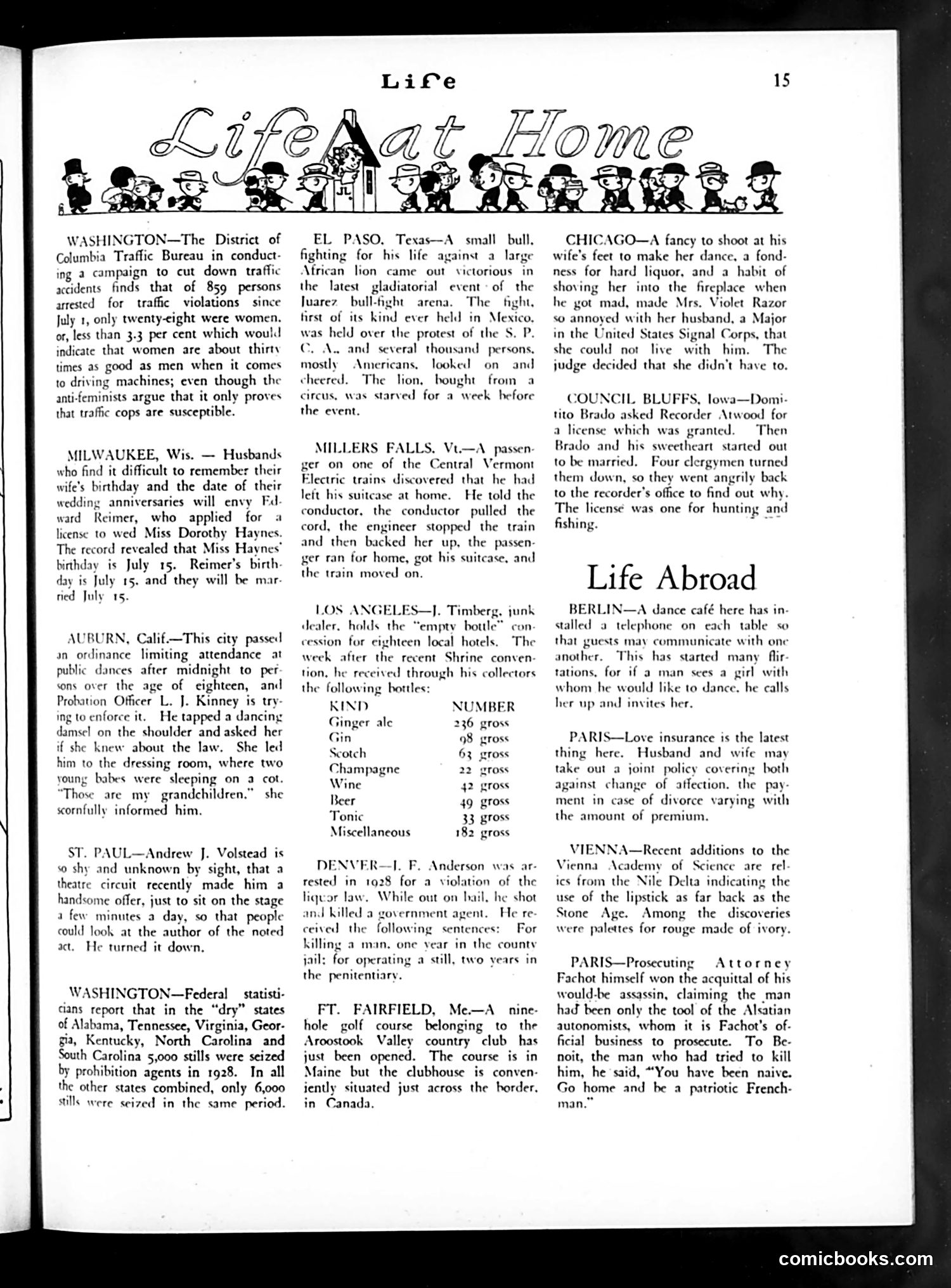
This page contains two columns of brief, humorous anecdotes rather than political cartoons. "Life at Home" features American domestic incidents—a woman correcting a traffic cop about women drivers, a husband struggling to remember wedding dates, a shy man refusing a stage offer, and various prohibition-era violations. "Life Abroad" presents international humor: Berlin's newfangled table telephones, Paris's "love insurance" for married couples, Vienna's scientific innovations, and a French prosecutor's acquittal speech mocking an Albanian assassin. The satire targets everyday social absurdities: gender stereotypes, marital confusion, prohibition enforcement, and old-world European customs. These brief jokes reflect 1920s-30s concerns about modernity, marriage, and international quirks—designed for quick laughs rather than deep political commentary.
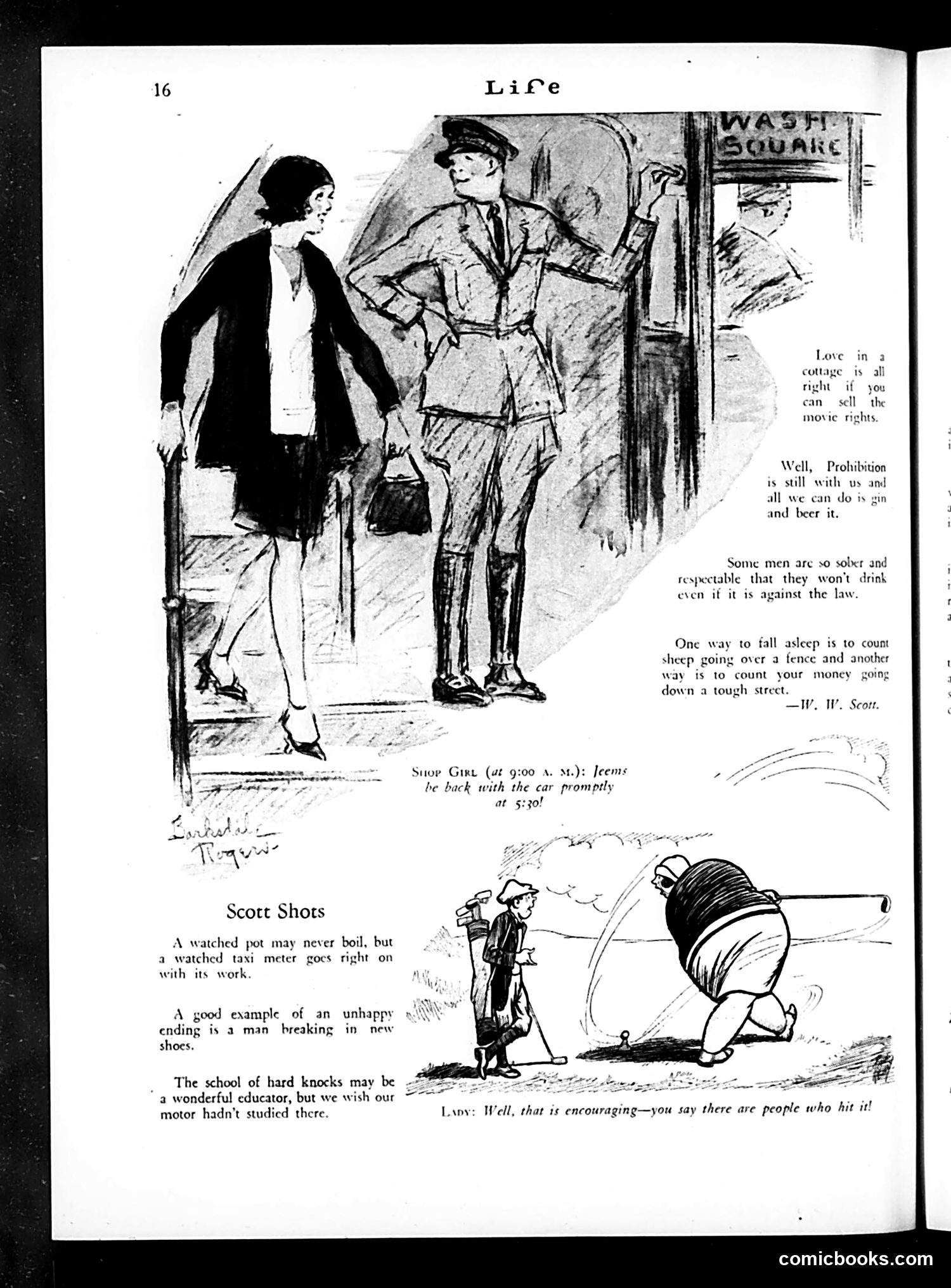
This page contains three separate satirical pieces: 1. **Top cartoon**: A soldier and woman meet on a street corner near "Wash Square." The caption jokes about movie rights and prohibition, suggesting wartime romance as commercial opportunity. 2. **"Shop Girl" caption**: Mocks a young woman's promise to return promptly from her outing, with implied skepticism about her reliability. 3. **"Scott Shots" section**: Three brief satirical observations about modern life—unwatched taxi meters continuing to run, new shoes causing discomfort, and motor cars being "wonderful educators" in hard knocks. The bottom cartoon shows someone being hit by a car, with dark humor about traffic dangers. The overall tone reflects early 20th-century American urban humor about dating, commerce, prohibition, and automobile culture.
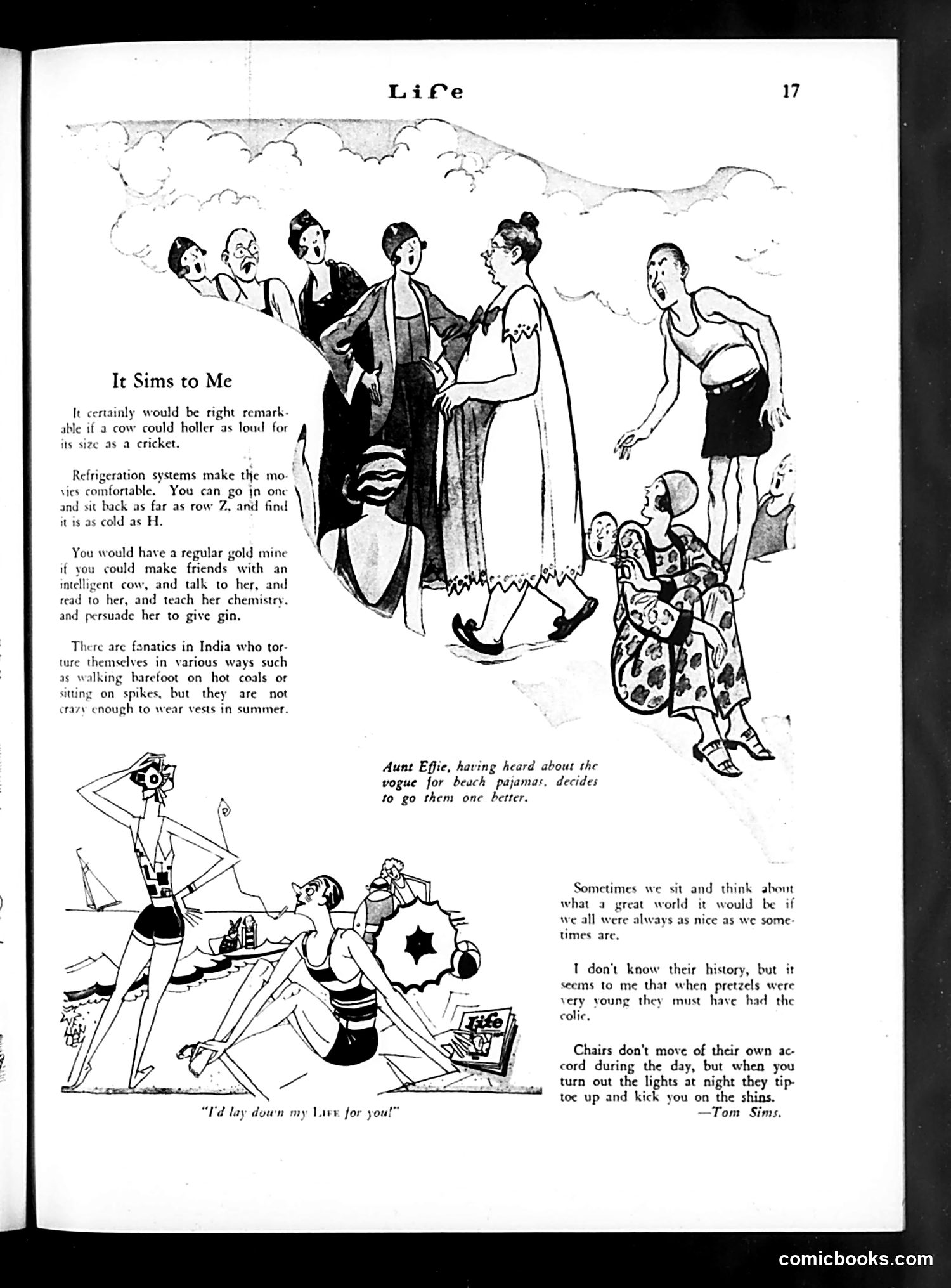
This page contains two unrelated humorous pieces typical of Life's satirical content. **Top Cartoon ("It Sims to Me"):** The column title suggests commentary by someone named Sims. The text offers absurdist observations—remarking that cows should bellow as loud as crickets, praising refrigeration, and noting that befriending intelligent cows would be profitable. The accompanying illustration shows "Aunt Effie" considering beach pajamas, depicted with a child and fashionable adults. **Bottom Cartoon ("I'd lay down my Life for you!"):** A beach scene showing stylized figures in 1920s-era swimwear. The caption plays on the double meaning of "Life" (the magazine's name and the concept of one's existence), a common joke format for house ads. Both pieces exemplify Life's blend of surreal humor, social observation, and self-referential wordplay aimed at sophisticated urban readers.
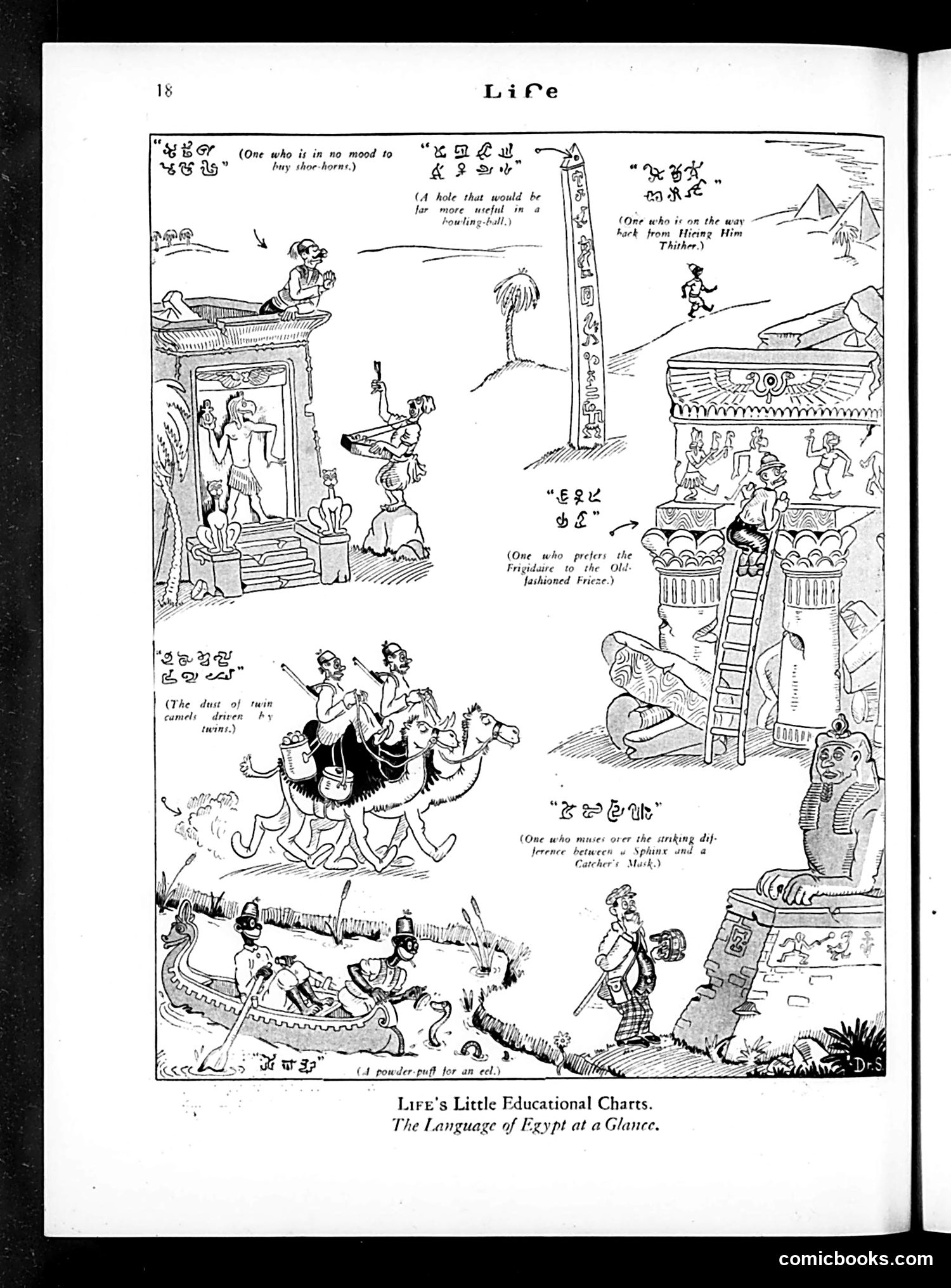
This page is a humorous educational chart depicting Egyptian hieroglyphics alongside modern English translations. Each illustration shows a scene with Egyptian-style artwork paired with phonetic hieroglyph spellings and witty English phrases. The satire mocks both Egyptology (the study of ancient Egypt, popular in early 20th-century America) and modern colloquialisms by pretending ancient Egyptians had phrases like "One who is in no mood to pay shoe-horns" and "A powder-puff for an eel." The joke relies on the absurdity of matching hieroglyphs to contemporary slang, suggesting that ancient Egyptian language is either incomprehensible or that modern interpretation of it is ridiculous. It's essentially satirizing academic pretension around deciphering ancient texts.
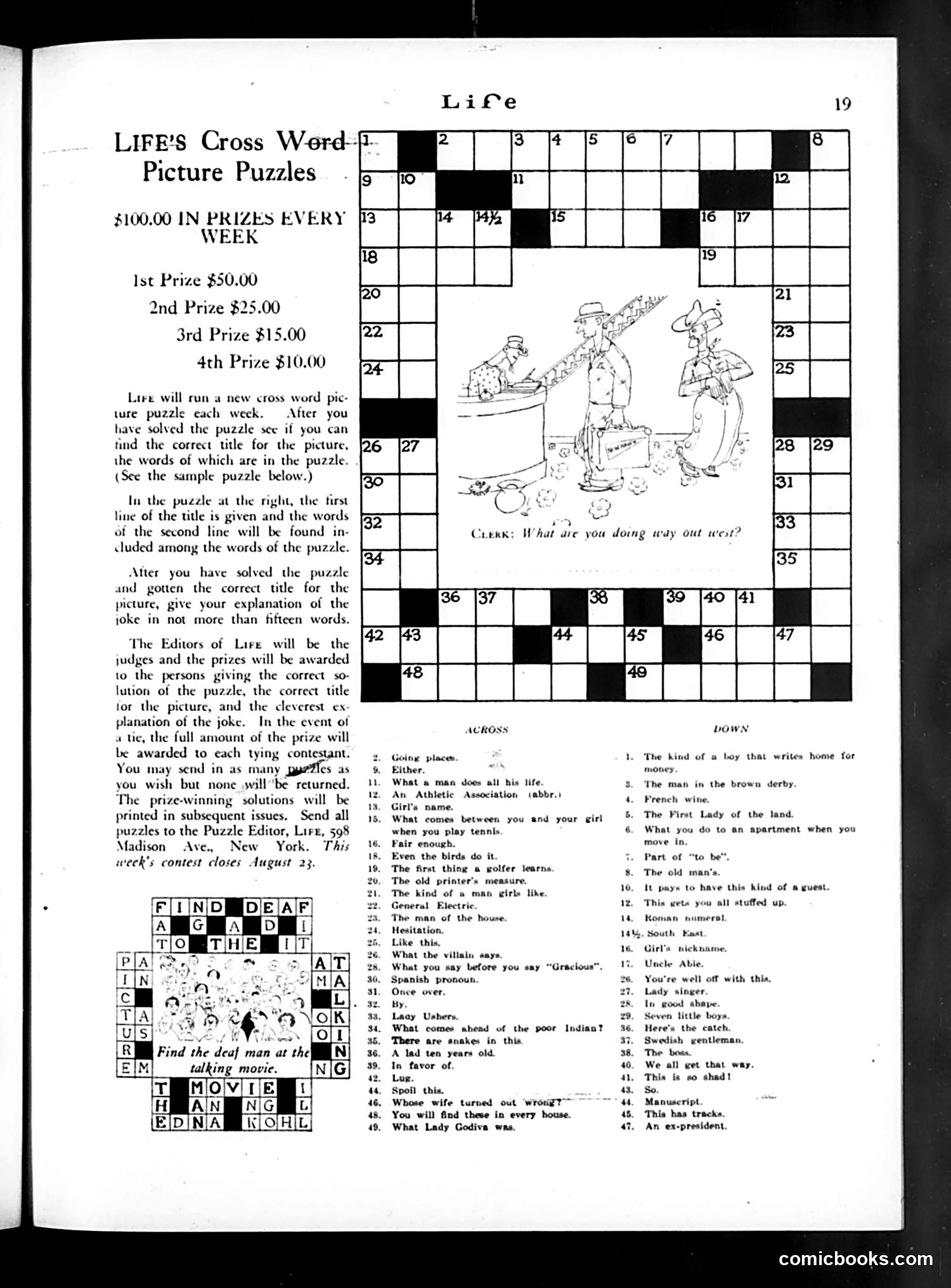
This page presents **Life magazine's weekly puzzle contest**, not political satire. It's a competition game where readers solve a crossword puzzle integrated with a cartoon illustration to determine the picture's title and explain its joke. The sample puzzle shown depicts a scene at a movie theater with the caption "CLERK: What are you doing way out west?" The humor appears to reference the popularity of Western films and the incongruity of someone's presence or behavior in that setting. The puzzle mechanics are straightforward: solvers find crossword answers embedded in the grid, use them to determine the cartoon's title, then submit their own humorous explanation (15 words max) for a chance to win cash prizes ($50 first place down to $10 fourth place). This represents **early 20th-century entertainment marketing**—magazines used interactive contests to boost circulation and reader engagement, a common practice of the era.
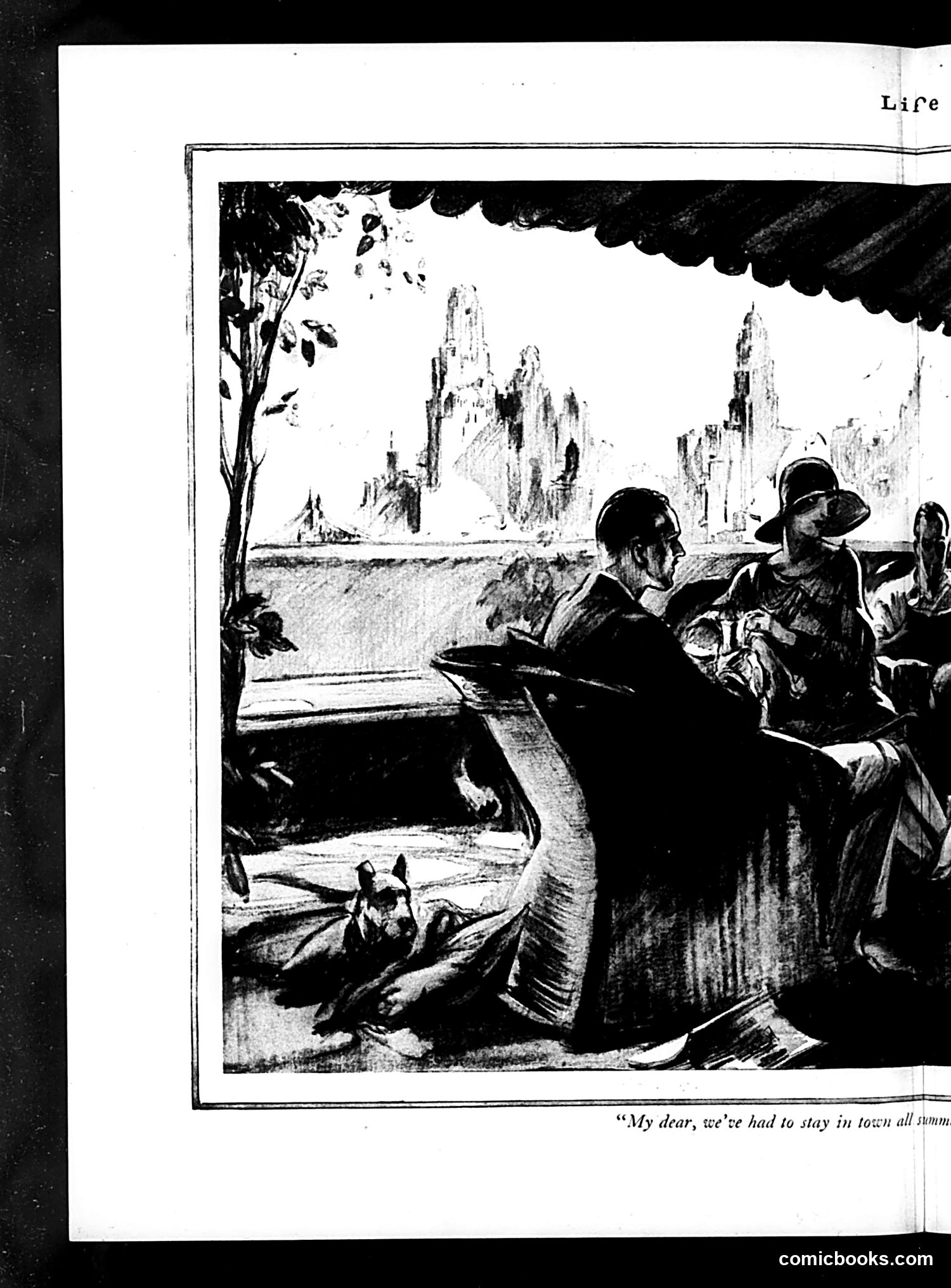
This appears to be a satirical cartoon from *Life* magazine depicting a couple on a boat or waterfront, with a cityscape visible across the water. The incomplete caption reads: "My dear, we've had to stay in town all summ[er]..." The satire likely concerns **urban entrapment during summer months**—a relatable complaint for affluent readers who traditionally fled cities for country estates or resorts. The couple's resigned body language and the contrast between their confined waterfront position and the distant cityscape suggests they're stuck in an undesirable situation, possibly due to financial constraints, work obligations, or wartime restrictions. Without the complete caption and publication date, the specific contextual reference remains unclear, but the joke hinges on disappointed vacation expectations—a timeless subject for satirical magazines targeting middle and upper-class readers.
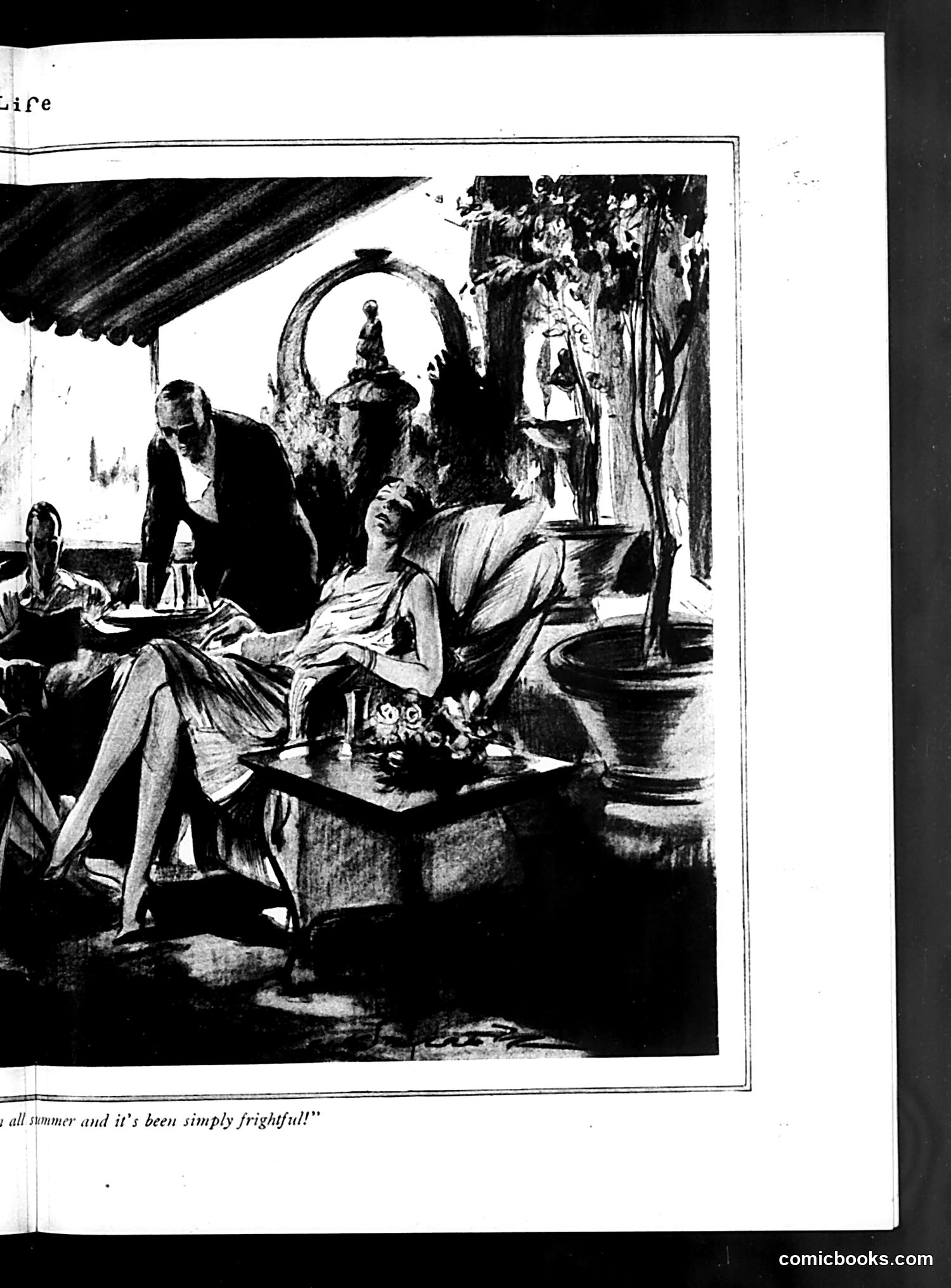
This appears to be a domestic comedy scene from an early-to-mid 20th century issue of Life magazine. The cartoon shows a woman reclining on a couch speaking to a man (likely her husband or social acquaintance) who stands nearby. The partial caption reads: "all summer and it's been simply frightful!" The humor targets upper-class complaints about summer heat and discomfort. The woman's dramatic recline and the man's attentive posture suggest she's commiserating about seasonal hardships—likely heat, humidity, or the burden of maintaining social appearances during hot months. The setting appears to be a well-appointed interior with decorative elements visible in the background, emphasizing the affluent, leisured context of the complaint. The satire mocks the trivial grievances of the wealthy during uncomfortable seasons.
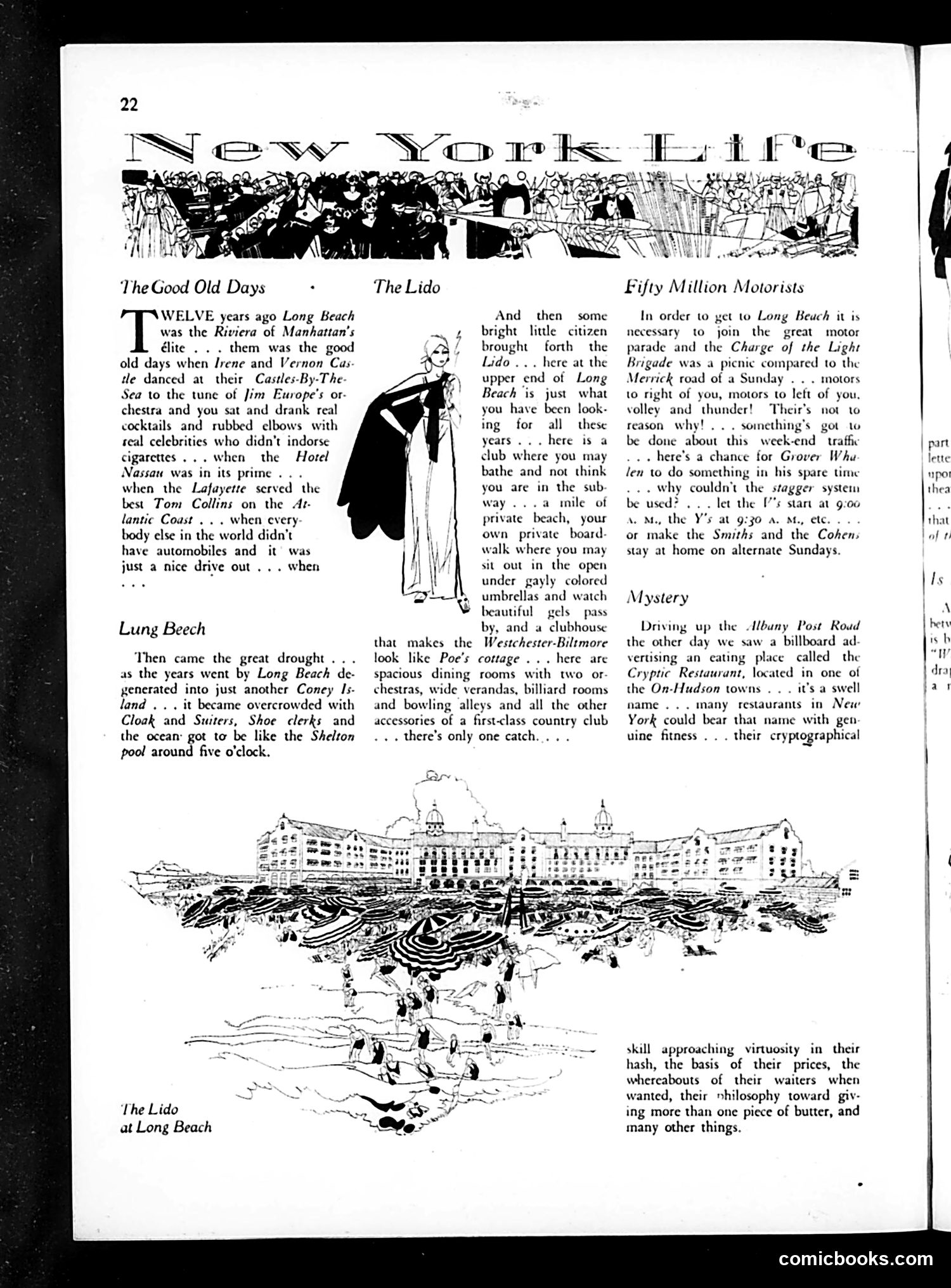
This page nostagically contrasts Long Beach's past elite status with its present decline. "The Good Old Days" laments Long Beach's transformation from a fashionable resort—where celebrities like dancers Vernon and Irene Castle performed—into an overcrowded "Coney Island" frequented by working-class "Cloak and Suiters" and "Shoe clerks." "The Lido" presents a new upscale club attempting to recapture that lost exclusivity, offering private beaches and first-class amenities. "Fifty Million Motorists" satirizes the weekend traffic problem: the newly accessible Long Beach attracts masses of automobiles, creating chaos compared to the "Charge of the Light Brigade." The satire suggests implementing a "stagger system" where different social groups (I's, Y's, Smiths, Cohens) visit on alternate days. "Mystery" jokes about the "Cryptic Restaurant"—a poorly run establishment where the menu is incomprehensible ("cryptic"), waiters are never present, and butter portions miserly. The overall tone mocks both elite nostalgia and mass commercialization.
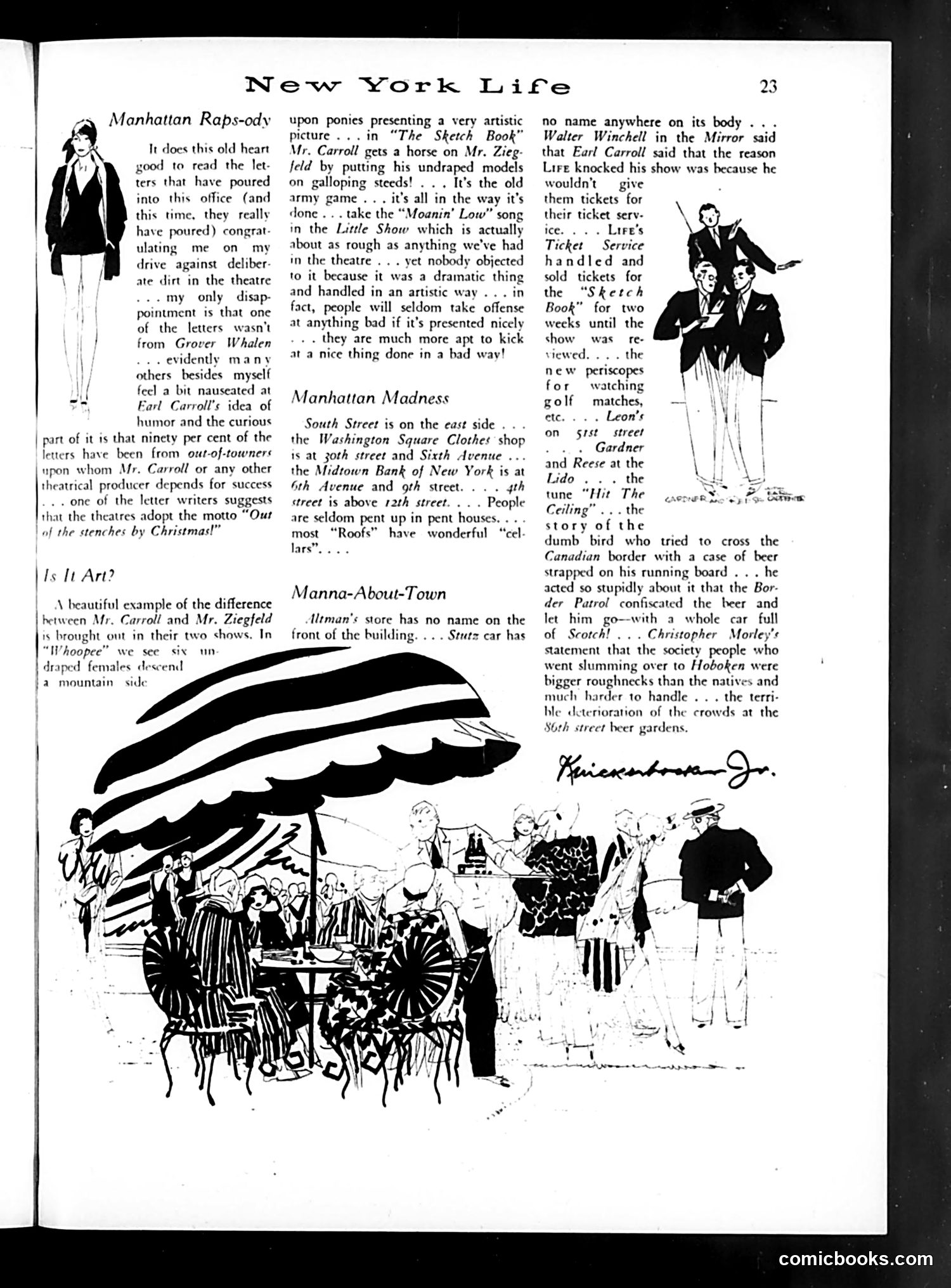
This page from *Life* magazine contains satirical commentary on New York theater and nightlife, likely from the late 1920s. The main targets are theatrical producers **Earl Carroll** and **Florenz Ziegfeld**, who were competing showmen of the era. The satire critiques Carroll's approach to theatrical "art"—specifically, his use of nude dancers on galloping horses in "The Sketch Book," presented as a crude imitation of Ziegfeld's "Whoopee." The author argues that presentation and artistic framing matter; the same content can be acceptable or offensive depending on how it's staged. The "Manhattan Madness" and "Manna-About-Town" sections offer absurdist observations about New York geography, commerce, and social behavior—noting contradictions like buildings with no names, and wealthy people "slumming" in Hoboken behaving worse than local residents. The overall tone mocks both theatrical pretension and high-society hypocrisy during the Jazz Age.
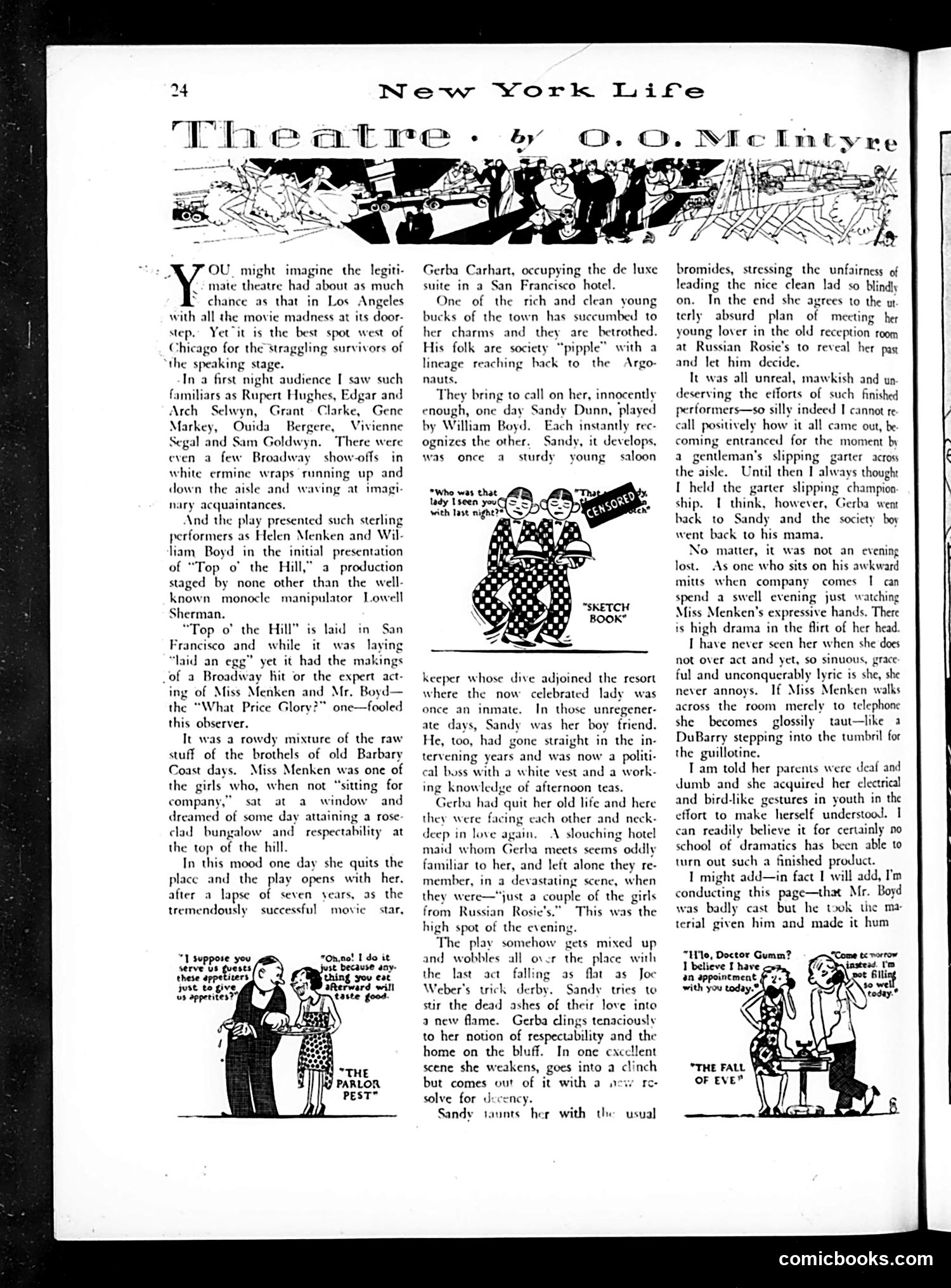
This is O.O. McIntyre's theatre review of the play "Top o' the Hill," starring Helen Menken and William Boyd. The satire critiques both the play's melodramatic plot and San Francisco's theatrical scene amid Hollywood's dominance. The review describes a dated Barbary Coast morality tale: Menken plays a former brothel worker who becomes a movie star and must choose between respectability (marrying a society man) and rekindling romance with Sandy Dunn (Boyd), her old saloon-keeper boyfriend who's now a political boss. McIntyre finds the plot "mawkish" and "silly," though he credits the skilled performers. The small cartoons mock common theatrical tropes—the parlor seduction and romantic misunderstandings typical of stage comedies of the era. McIntyre suggests the play succeeds despite, not because of, its material, being essentially a recycled "Barbary Coast" formula dressed up with star power rather than genuine theatrical merit.
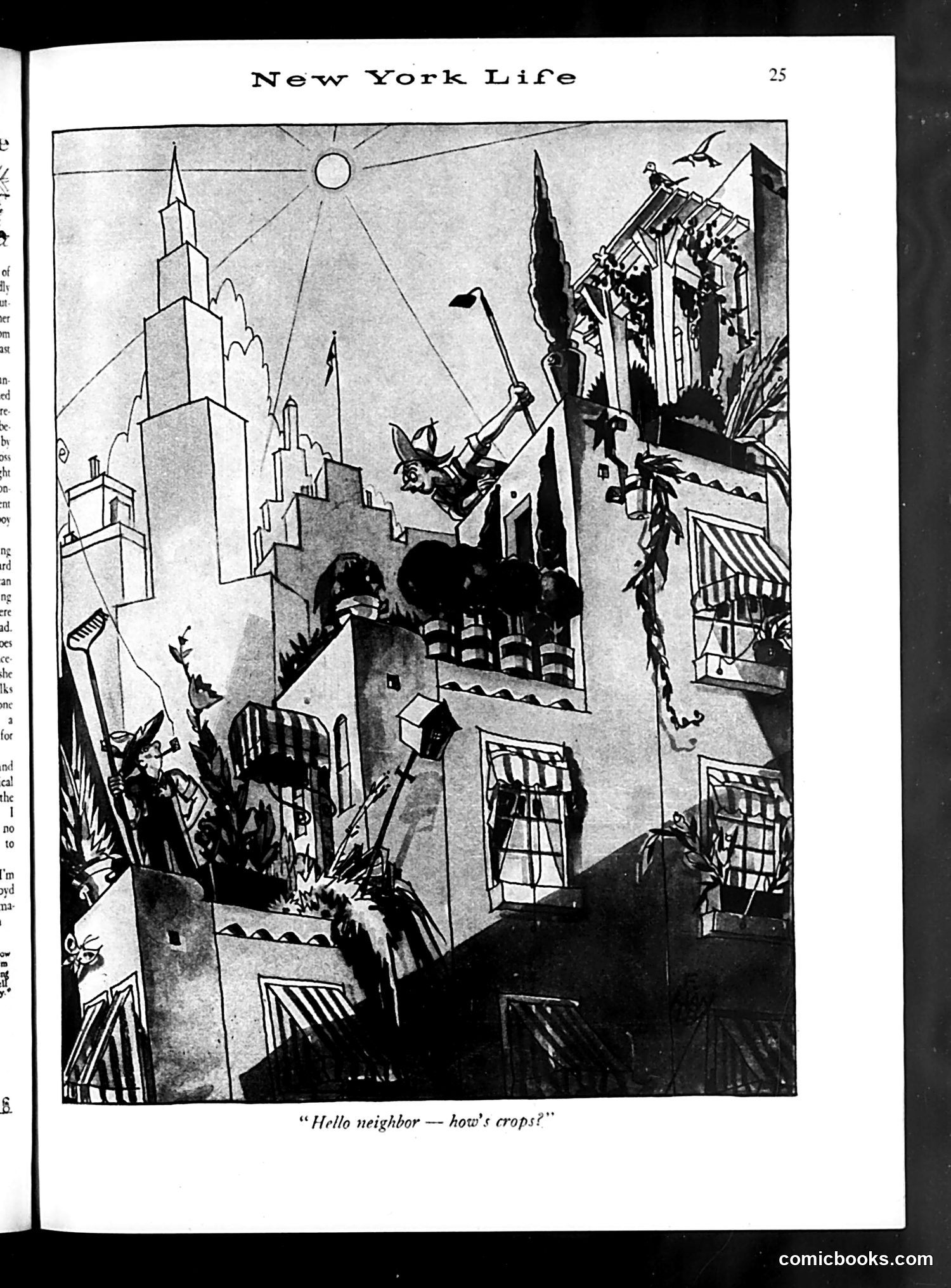
This cartoon depicts an urban farming scene in New York City, likely satirizing Depression-era or wartime efforts to grow food in cities. A man on a fire escape addresses another neighbor, asking "Hello neighbor — how's crops?" — a rural greeting absurdly applied to city dwellers. The humor lies in the contrast between traditional agricultural language and the cramped urban setting. Multiple figures are shown tending plants on fire escapes and windowsills, suggesting city residents attempting subsistence gardening in limited spaces. Tall buildings loom in the background, emphasizing the incongruity. This likely mocks either Depression-era "victory gardens" or similar urban agricultural initiatives, presenting the notion of New Yorkers becoming farmers as inherently ridiculous while acknowledging the economic necessity driving such efforts.
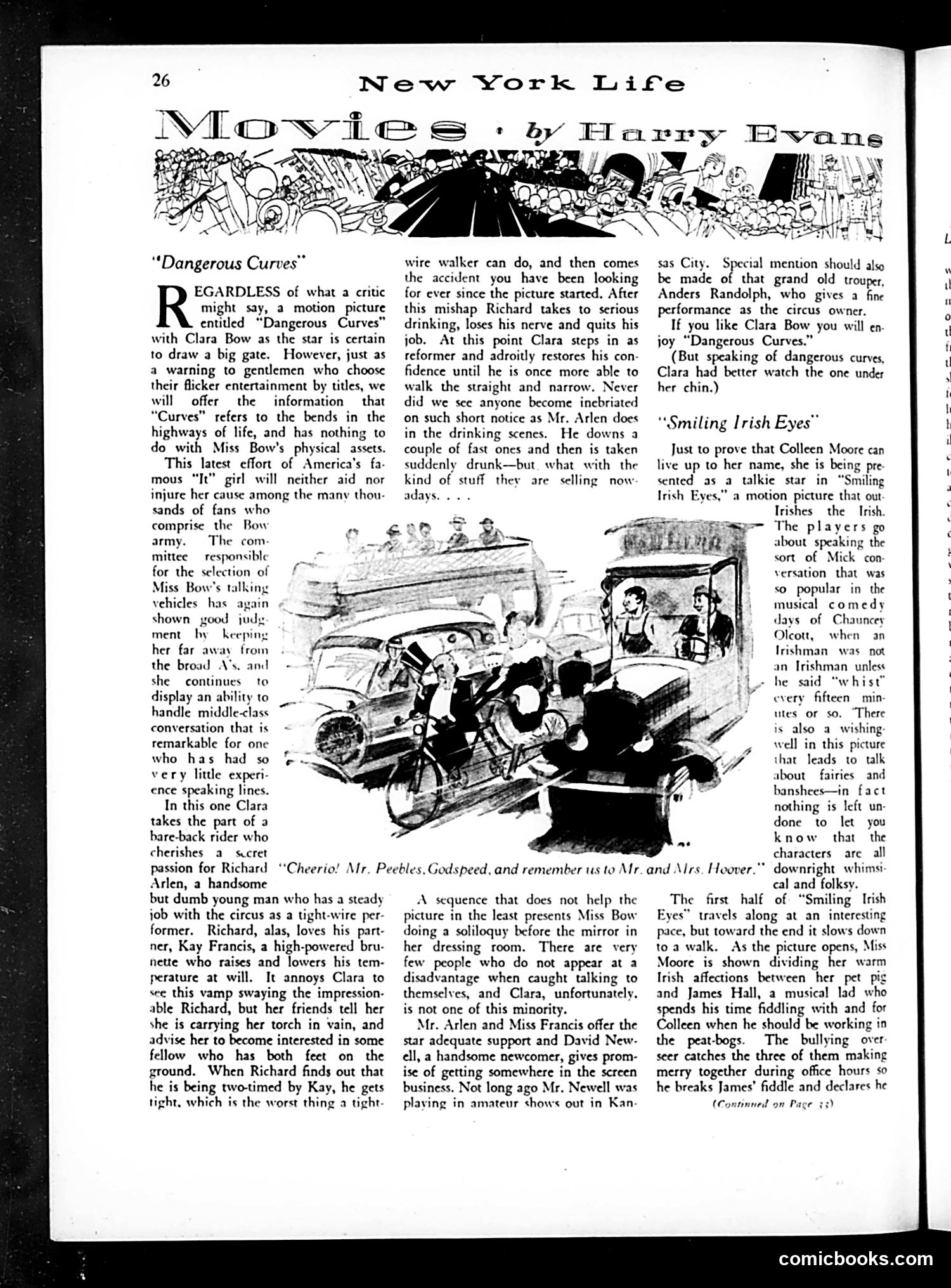
This page reviews two silent-era films transitioning to "talkies" (talking pictures). **"Dangerous Curves"** stars Clara Bow, the famous "It" girl—a sex symbol whose appeal lay in her physical attractiveness. The reviewer jokes that despite the title's suggestion, "curves" refers to road bends, not Bow's body. The plot involves circus performers: Bow plays a bareback rider loving wire-walker Richard Arlen, who's entangled with brunette Kay Francis. After Arlen drinks heavily and nearly dies in an accident, Bow reforms him. The reviewer praises Bow's surprising ability at dialogue while subtly mocking her limited acting experience. A captioned illustration mocks Prohibition-era drinking ("remember us to Mr. and Mrs. Hoover"—Herbert Hoover was president during Prohibition). A final quip about watching "the one under her chin" is a backhanded compliment about her appearance. **"Smiling Irish Eyes"** stars Colleen Moore. The reviewer satirizes the film's heavy-handed Irish stereotyping—excessive "Mick" dialect and clichéd Irish mythology (wishing wells, fairies, banshees)—mocking dated theatrical conventions.
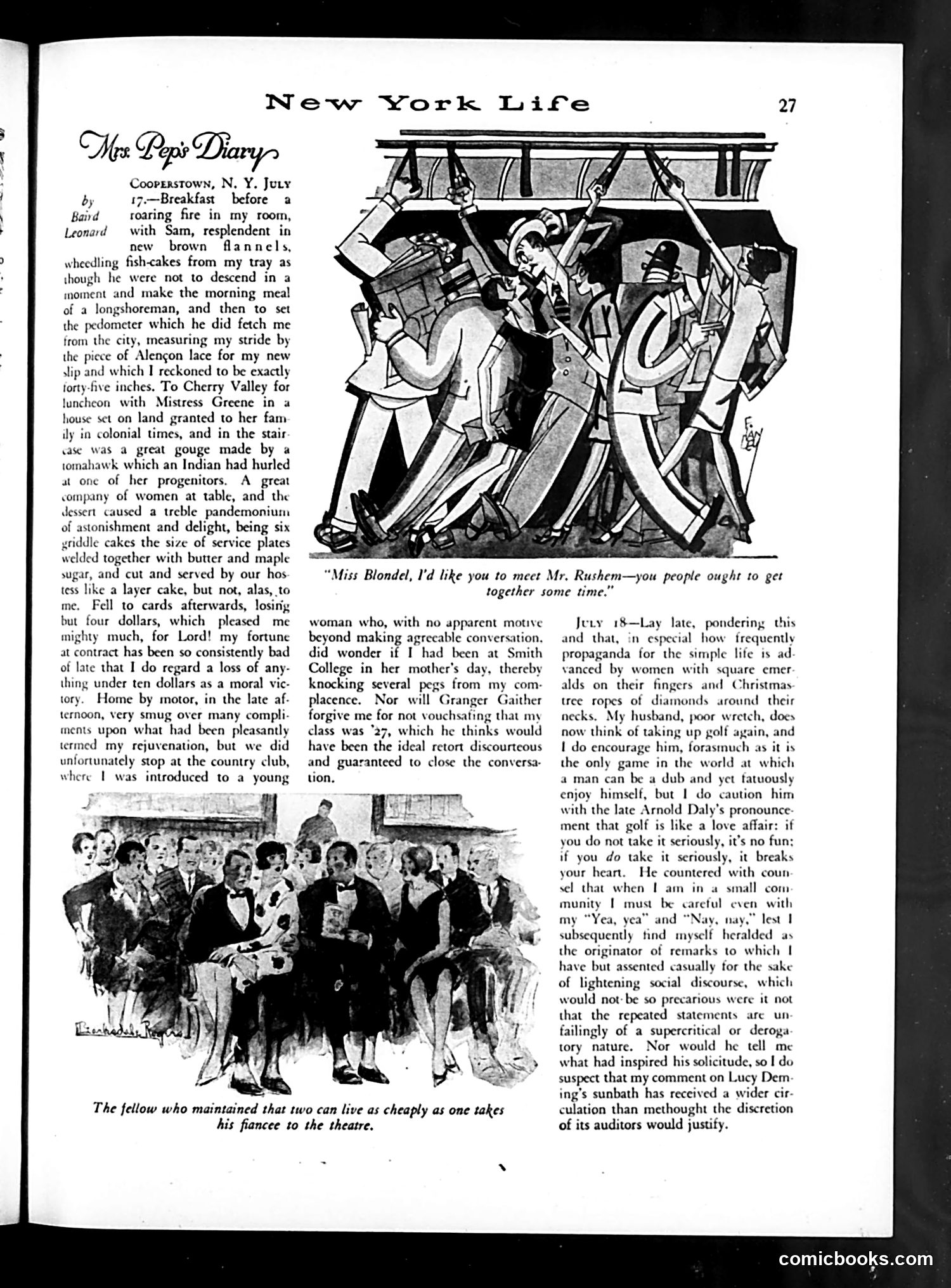
This page features a society diary column by Baird Leonard documenting upper-class leisure activities in 1920s New York. The two illustrations satirize social pretensions: **Top cartoon**: Shows a crowded, chaotic automobile interior with fashionably dressed passengers crammed awkwardly together. The caption—"Miss Blondel, I'd like you to meet Mr. Rushem—you people ought to get together some time"—mocks forced social introductions at country clubs. **Bottom cartoon**: Illustrates the accompanying text's ironic observation that wealthy women promote "the simple life" while wearing expensive jewelry and furs—exposing the hypocrisy of aristocratic slumming. The diary entries themselves humorously chronicle trivial concerns: card games, pedestrian measurements, social anxieties about college years, and gossip. The satire targets the vanity and superficiality of the leisure class during the Jazz Age, poking fun at their self-absorption and social climbing.
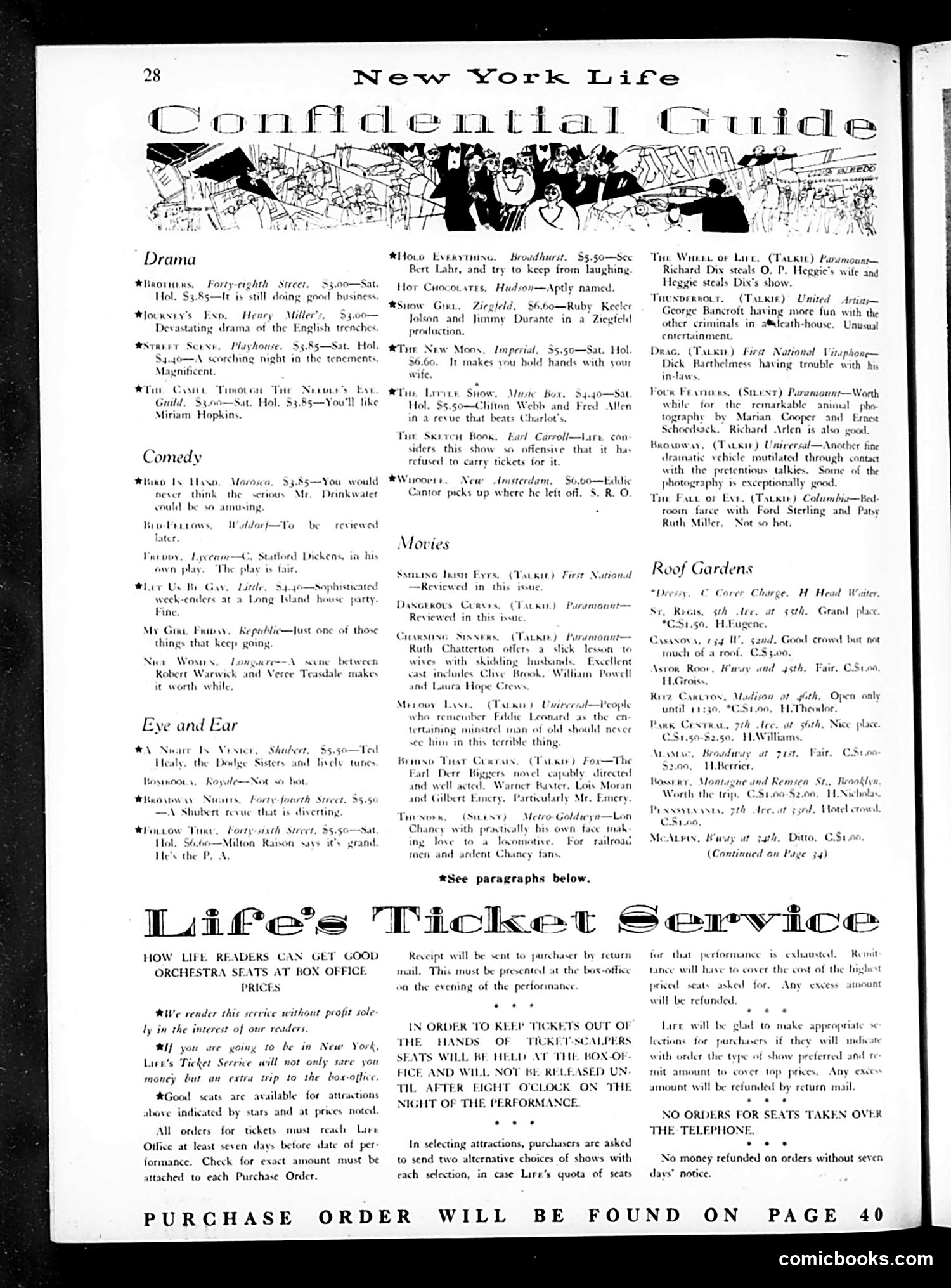
This is primarily a **theater and entertainment listing page**, not a political cartoon. It's a "Confidential Guide" to New York entertainment circa the late 1920s, cataloging stage productions (drama, comedy, musicals), movies, and rooftop restaurants/venues. The page reflects the **Jazz Age entertainment scene**: references to popular performers like Eddie Cantor, Lon Chaney, and Ruby Keeler; emphasis on "talkies" (newly popular talking pictures) versus silent films; and listing prices for both orchestra seats and rooftop garden venues—luxury entertainment for the era's affluent. The satirical tone is mild—typical of Life magazine's era—with brief comedic descriptions ("Aptly named" for a show called "Hot Chocolates"). The mention of "ticket scalpers" in the service notice suggests contemporary concerns about market manipulation. This is a **primary source showing 1920s New York popular culture**, not political satire, reflecting what urban audiences paid to see and where the wealthy socialized.
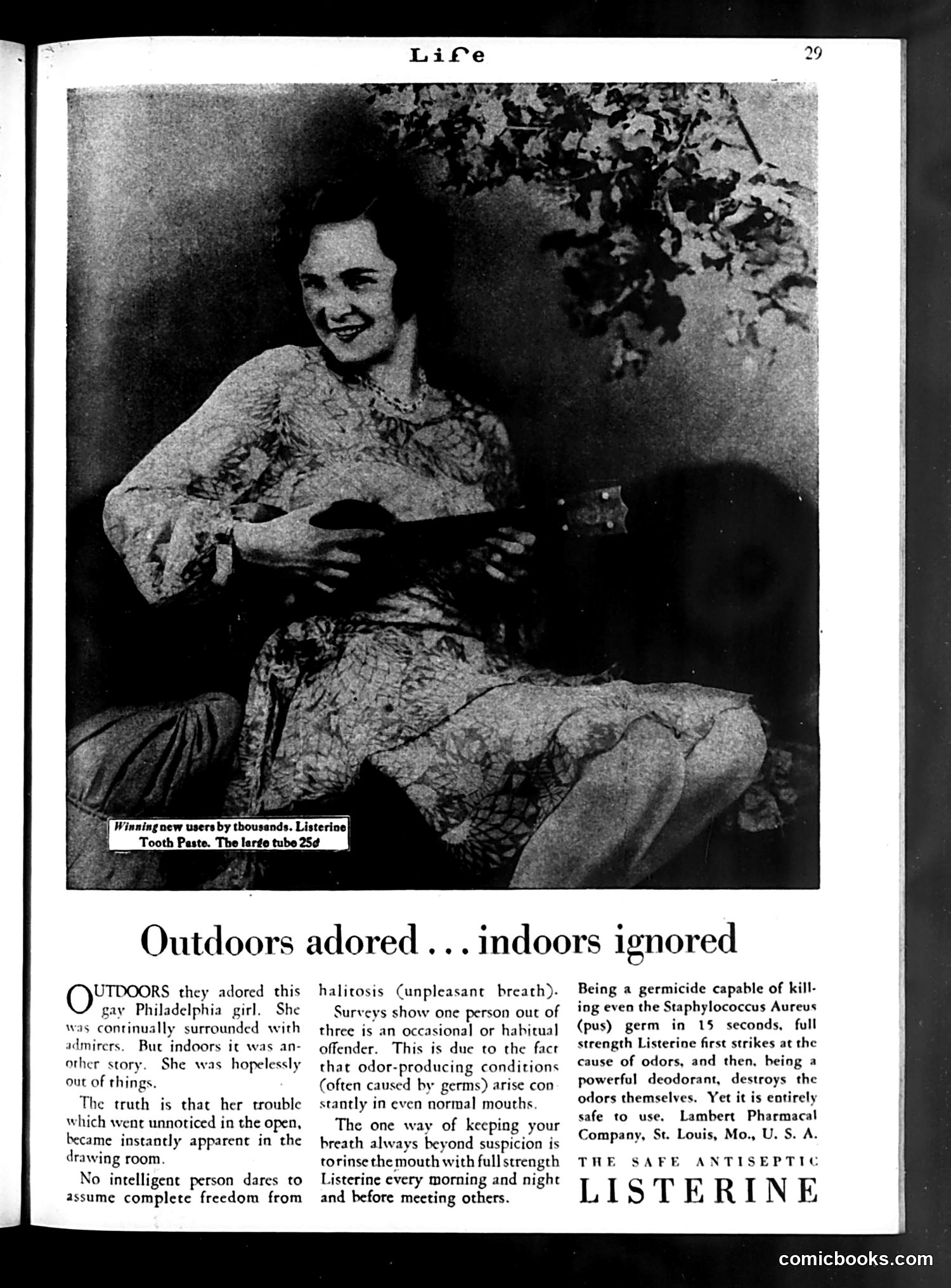
This is a **Listerine mouthwash advertisement**, not political satire. It uses social anxiety as its selling point. The ad presents a narrative about a Philadelphia woman popular outdoors but socially isolated indoors. The implied problem: **bad breath** (halitosis). The advertisement exploits early 20th-century social shame by claiming that one in three people suffer from this condition due to mouth germs. The copy emphasizes that using Listerine mouthwash twice daily—before social meetings—will eliminate odor-causing bacteria and prevent social embarrassment. It positions the product as a "safe antiseptic" capable of killing germs in 15 seconds. This reflects period advertising strategy: create anxiety about invisible social defects, then offer a commercial solution. The photograph shows the woman holding what appears to be a ukulele, reinforcing her social desirability once the "problem" is solved.
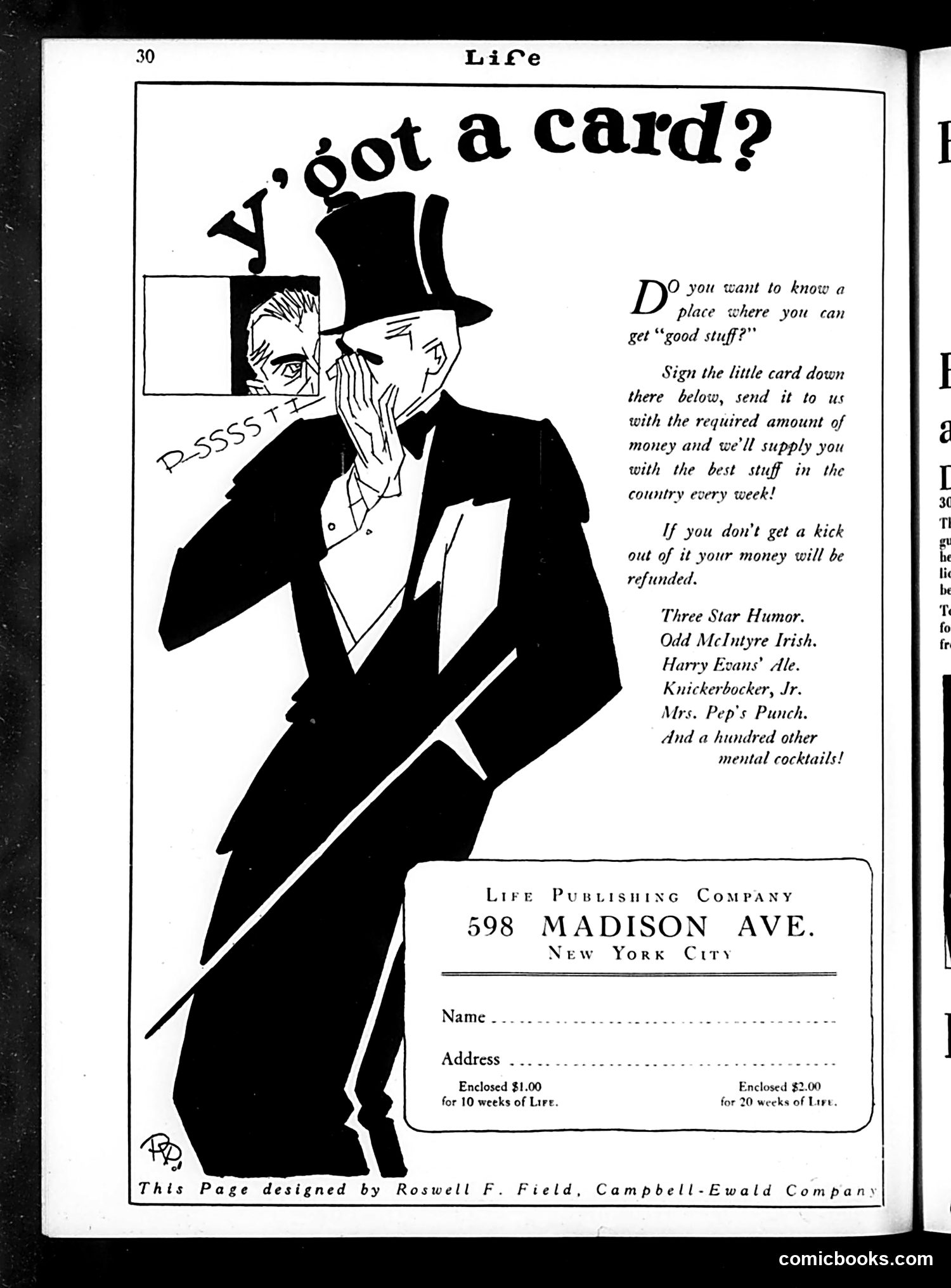
This is an advertisement for a subscription to *Life* magazine itself, disguised as satirical content. The cartoon depicts a well-dressed man in a top hat whispering conspiratorially—the "good stuff" he's promoting is *Life's* weekly humor content. The ad lists actual humor columns that appeared in the magazine: "Three Star Humor," "Odd McIntyre Irish," "Harry Evans' Ale," "Knickerbocker, Jr.," and "Mrs. Pep's Punch," calling them "mental cocktails." This plays on Prohibition-era humor—since alcohol was banned, the magazine humorously offered intellectual/comedic stimulation as a substitute. Readers could subscribe for $1 (10 weeks) or $2 (20 weeks), with a money-back guarantee. The tone mimics the secretive, slightly illicit manner of actual Prohibition-era alcohol distribution, making the joke work on multiple levels: clever wordplay about forbidden pleasures applied to legal entertainment.
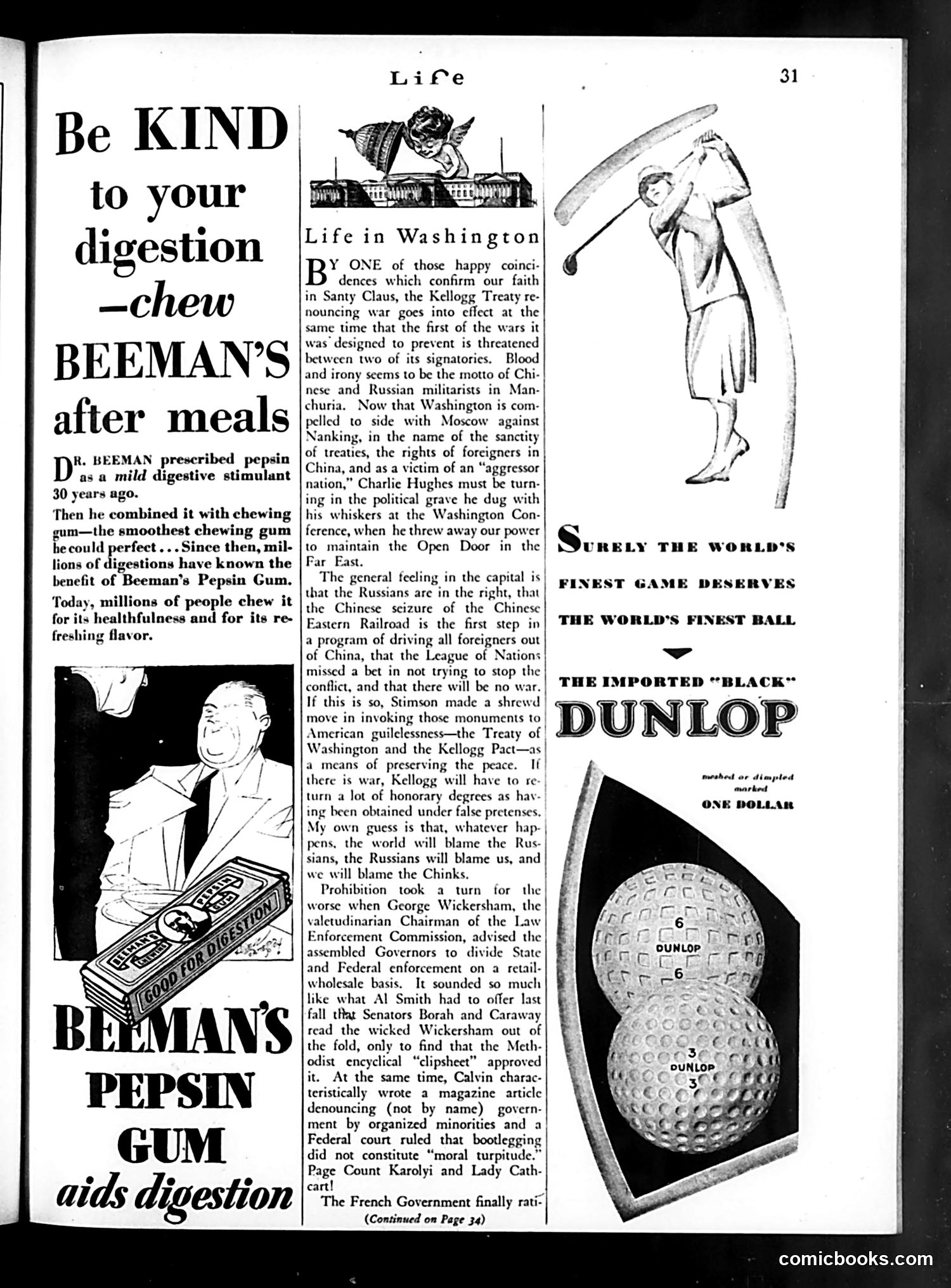
This page mixes advertisements with political commentary under "Life in Washington." **The Cartoons/Satire:** The main article satirizes U.S. foreign policy contradictions. It references the Kellogg Treaty (renouncing war) becoming effective just as conflict erupts between Russia and China over Manchuria. The satire targets Secretary of State Charles Hughes (deceased but invoked symbolically) and current Secretary Henry Stimson for invoking treaties meant to prevent this exact scenario. The author sarcastically predicts mutual blame: "the world will blame the Russians, the Russians will blame us, and we will blame the Chinks"—mocking diplomatic futility. A secondary critique attacks Prohibition enforcement under George Wickersham's Law Enforcement Commission, suggesting his retail-wholesale enforcement scheme echoes discredited proposals, while President Calvin Coolidge hypocritically denounces "government by organized minorities." **Advertisements:** The left side features Beeman's Pepsin Gum (digestive aid) and the right advertises Dunlop golf balls—period marketing claiming superior quality.
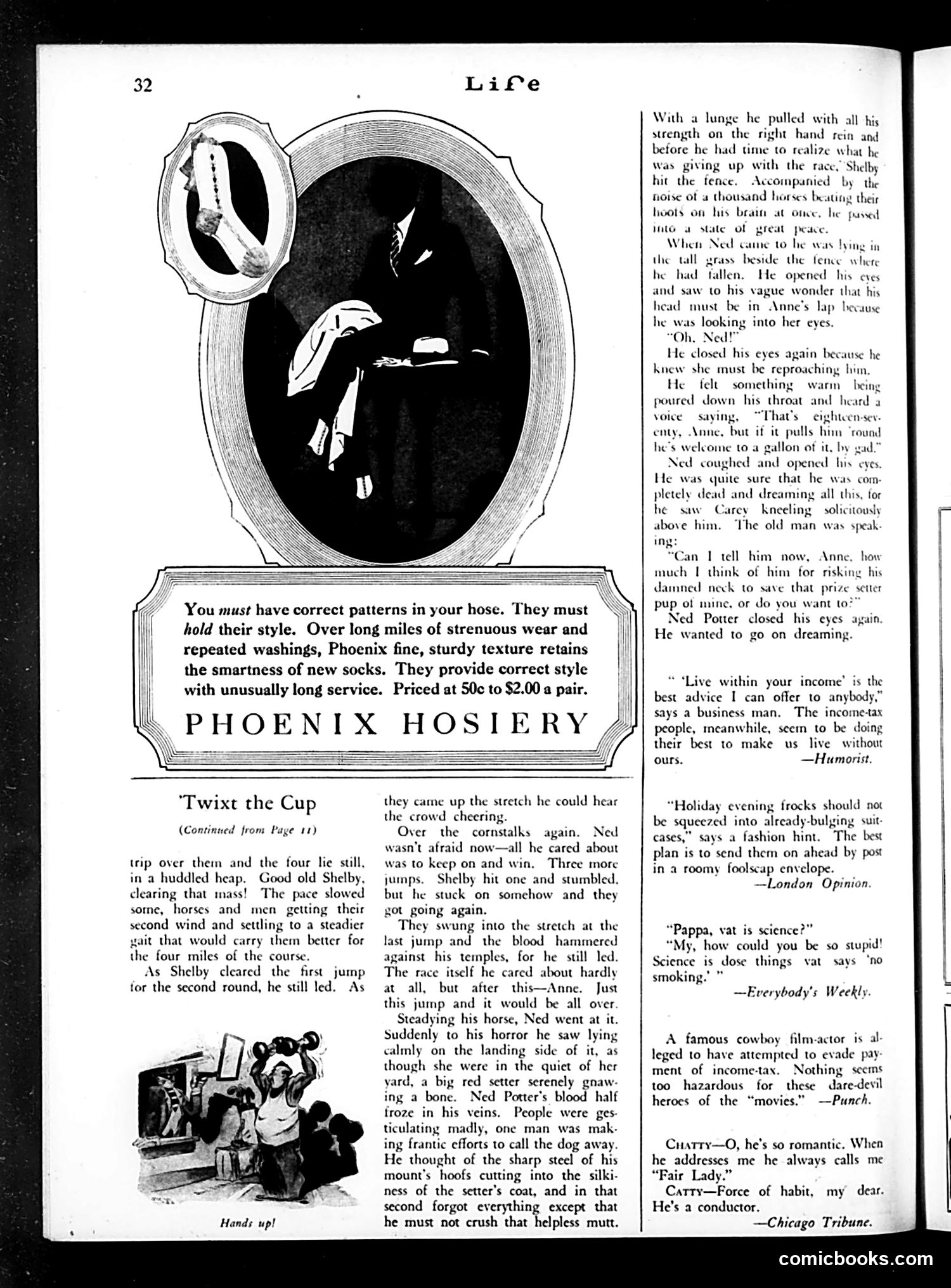
This Life magazine page (number 32) contains a serialized short story titled "'Twixt the Cup" alongside advertisements and humor snippets. The main narrative follows a horse-race scene where protagonist Ned Potter must choose between winning a steeplechase competition and saving a dog lying on the landing of a jump. He sacrifices victory to avoid injuring the animal. Upon waking, he discovers the dog belongs to Carey—Anne's father—who expresses gratitude for Ned's selflessness. The story emphasizes moral character over material gain. The surrounding humor quotes mock contemporary social issues: income taxes, fashion advice, a Yiddish-inflected joke about science, and a cowboy actor's tax evasion scandal. A Phoenix Hosiery advertisement promotes durable socks at 50 cents to $2.00. The illustration shows a dramatic moment from the race narrative, likely depicting Ned's collision or the aftermath of his decision.
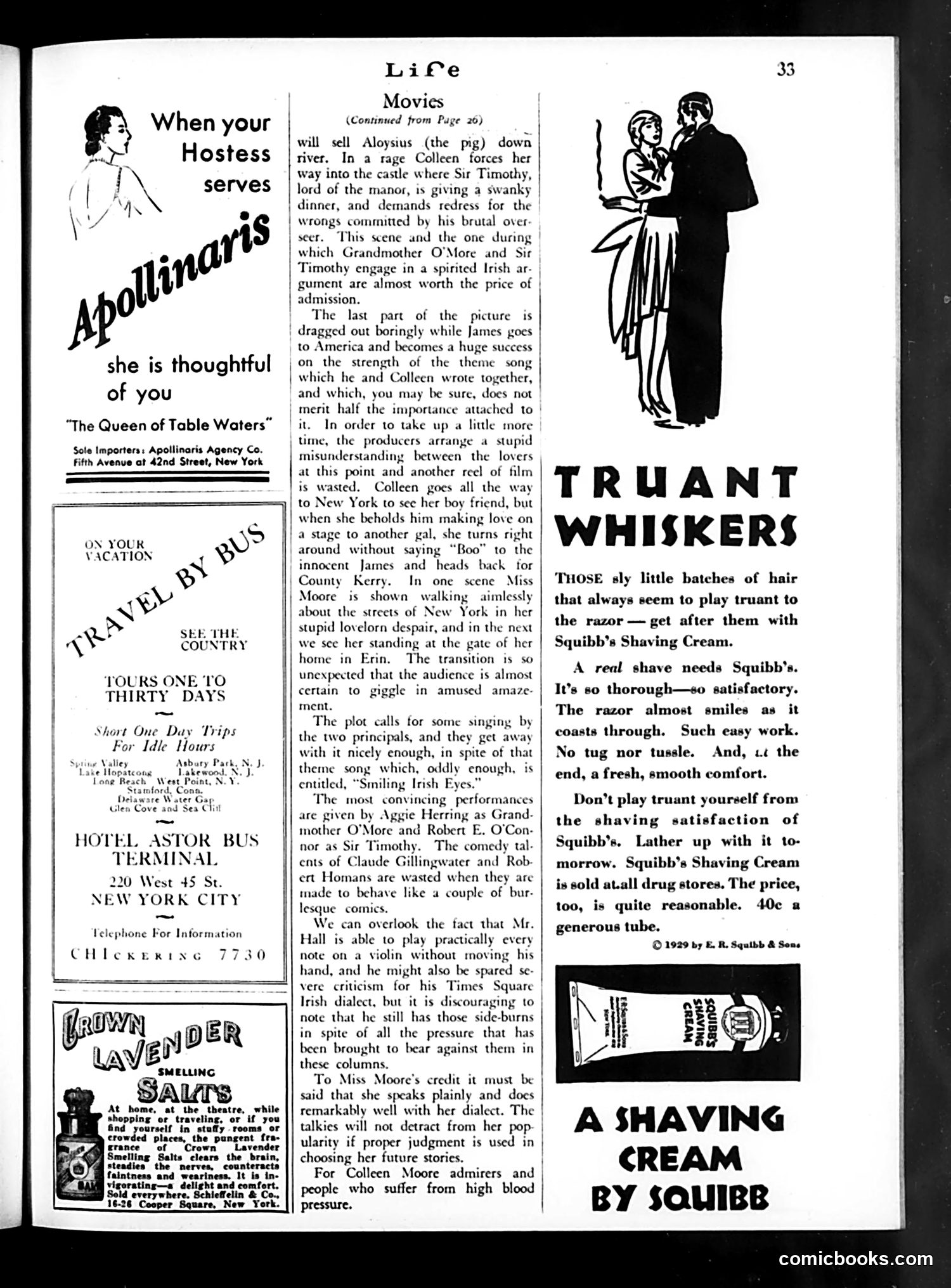
This is primarily a **movie review page** with related advertisements, not a political cartoon. The main content reviews a film featuring actress **Colleen Moore** in an Irish-themed story involving characters named James, Sir Timothy, and Grandmother O'More. The reviewer critiques the plot as predictable and overly long, though praising supporting performances by Aggie Herring and Robert E. O'Connor. The film includes singing and a theme song called "Smiling Irish Eyes." The reviewer notably complains about actor Hall's prominent **sideburns**, suggesting the magazine had previously criticized this facial hair style—a humorous recurring complaint. The advertisements include **Apollinaris water**, bus tours, and **Squibb's Shaving Cream** (which playfully connects to the sideburn commentary). The page reflects 1929 American entertainment culture and contemporary grooming standards.
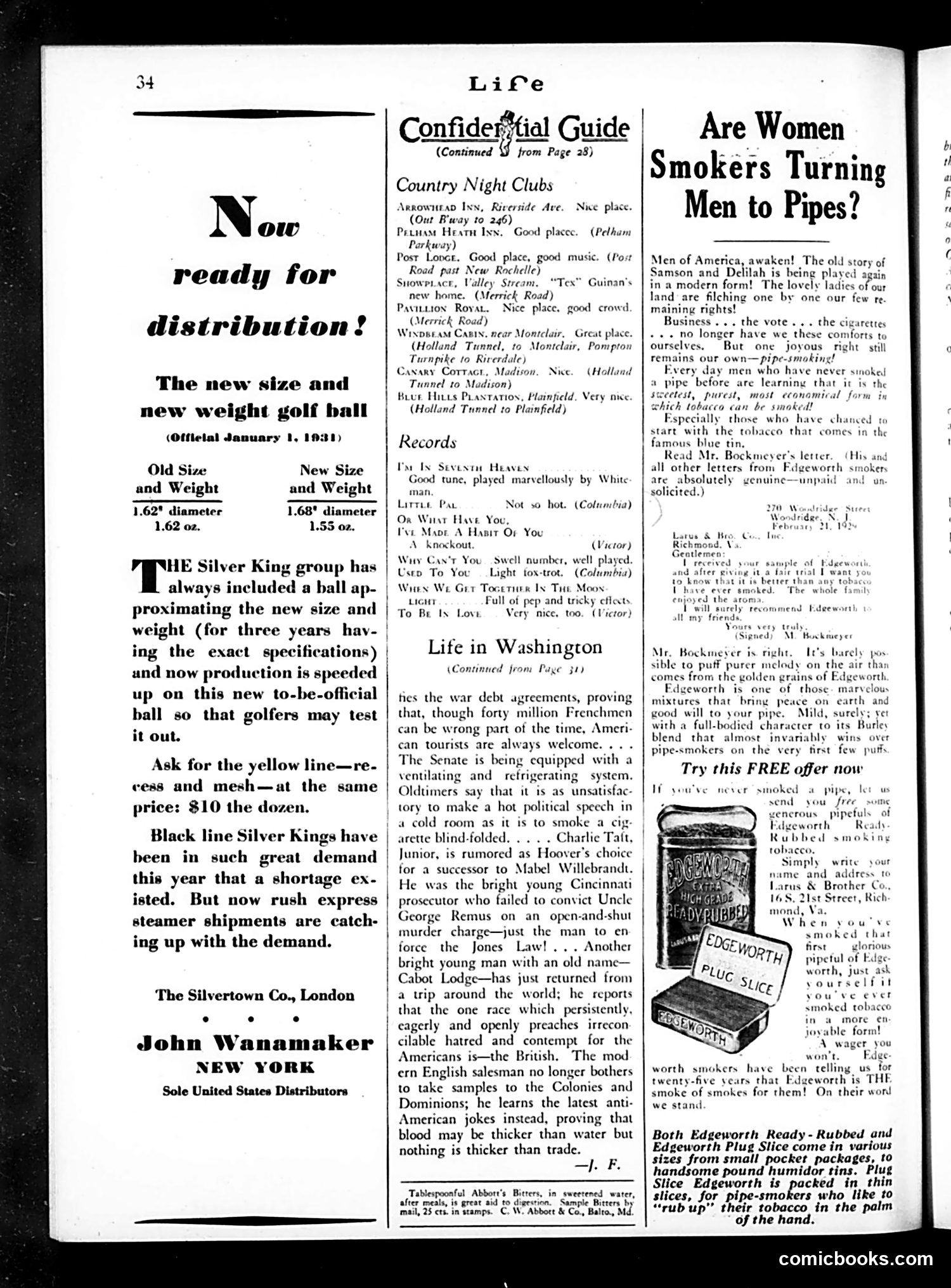
This advertisement-article warns men that women are encroaching on male privileges. It references the biblical story of Samson and Delilah—implying women are seductively undermining male power—and catalogs lost male domains: business, voting rights, and cigarette smoking. The satirical premise is that as women increasingly smoke cigarettes (a relatively new social freedom in the 1920s-30s), men should retreat to pipe smoking as their last remaining "joyous right." The piece promotes Edgeworth pipe tobacco as the solution, suggesting pipes offer men exclusivity, economy, and distinction from women's modern behavior. The satire mocks masculine anxiety about changing gender roles while simultaneously marketing tobacco. It's both comedic social commentary on male defensiveness and straightforward product promotion—typical of Life magazine's blend of humor and advertising during this era of women's liberation.
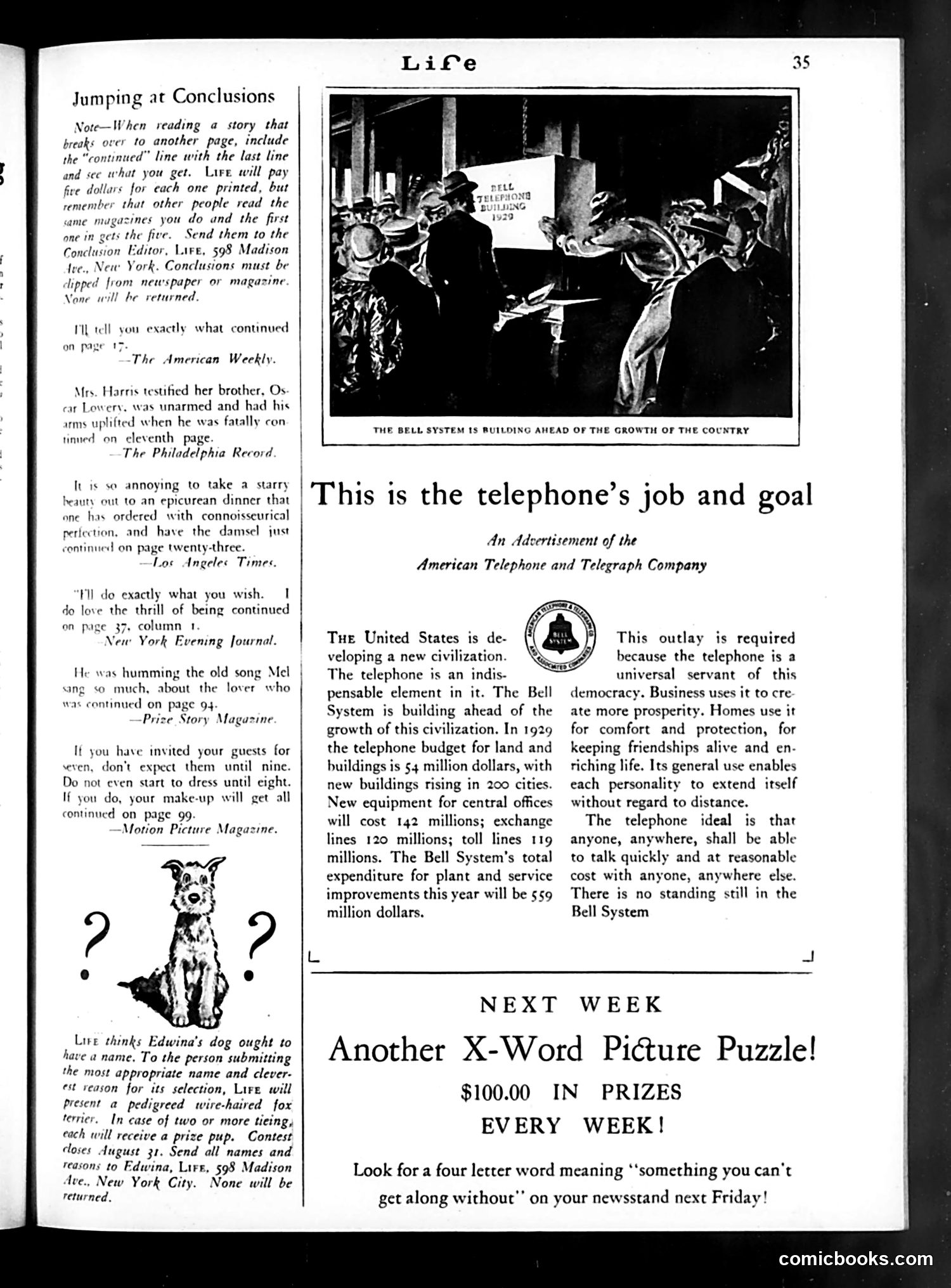
This page satirizes the frustration of magazine readers encountering "continued on page X" breaks in serialized stories. The humor works by showing what happens when readers *actually follow* the instruction and read the "continued" line paired with the previous sentence's ending. The examples mock real newspaper/magazine clippings: a murder trial's "unarmed and had his arms uplifted when he was fatally continued on eleventh page" becomes absurdly comedic; a romantic dinner becomes ridiculous when "the damsel just continued on page twenty-three." Life's joke targets both publishers (who fragment stories across pages to boost readership) and the editorial practice itself—the incongruity between serious news content and the accidental nonsense created by page breaks. The page also includes a substantial Bell Telephone advertisement claiming the company is building infrastructure to serve American civilization's growth, representing corporate boosterism typical of 1920s advertising.
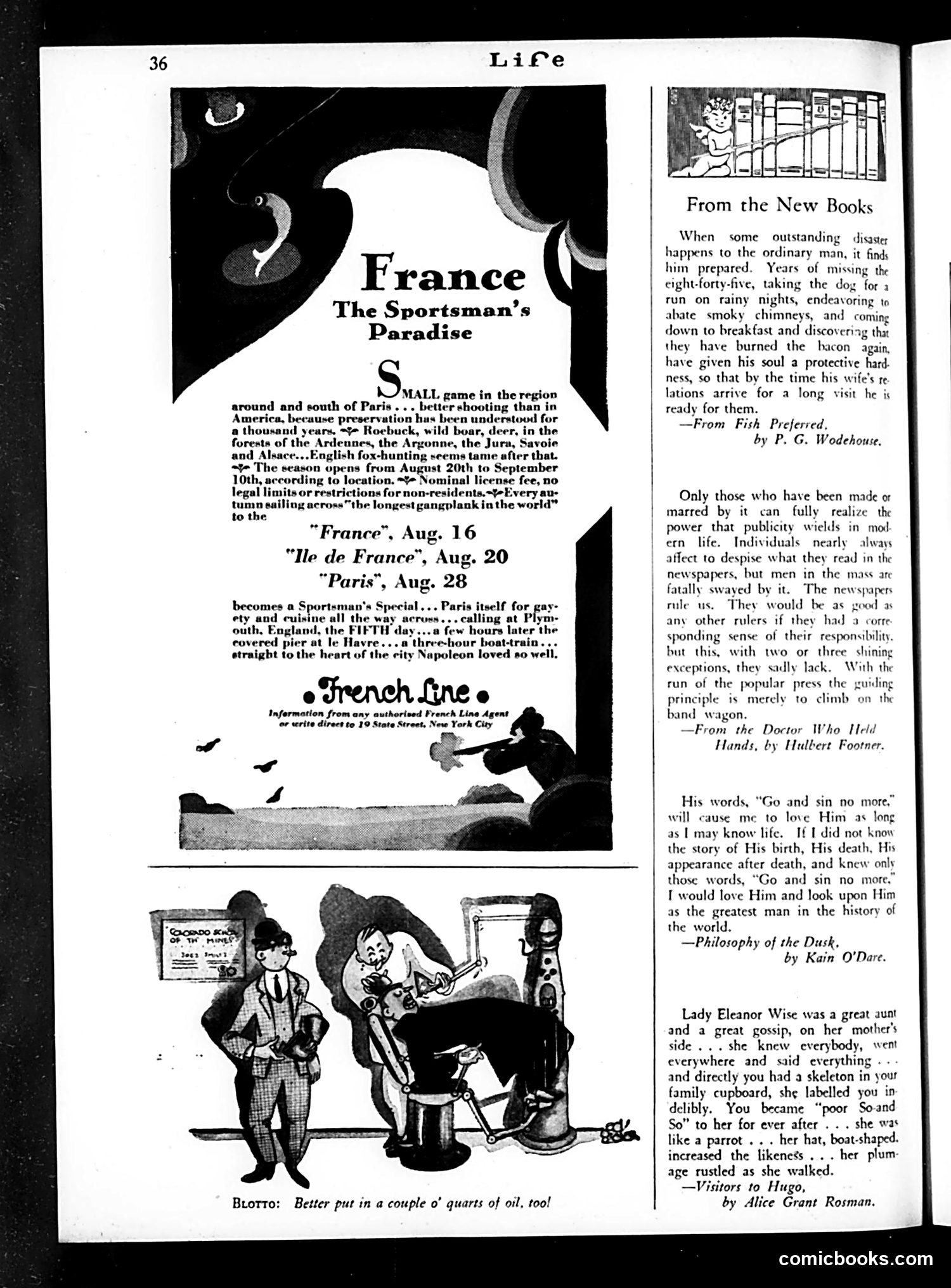
This page combines **travel advertising** with **book reviews**. The left side advertises the French Line steamship service to France, marketing it as "The Sportsman's Paradise" for hunting. It emphasizes excellent game hunting (boar, deer, roebuck) available in French forests with minimal restrictions—appealing to wealthy American sportsmen. The cartoon below shows two men discussing an automobile, with one advising to add oil before a journey, likely a humorous aside about car maintenance before the transatlantic voyage. The right side features literary excerpts from contemporary books (P.G. Wodehouse, Hulbert Footner, and others), promoting popular fiction of the era through brief, witty passages showcasing each author's style. The page reflects 1920s leisure culture: affluent Americans could afford European hunting trips via luxury ocean liners, while also enjoying modern middlebrow literature. It's essentially aspirational lifestyle content marketed to Life's educated, wealthy readership.
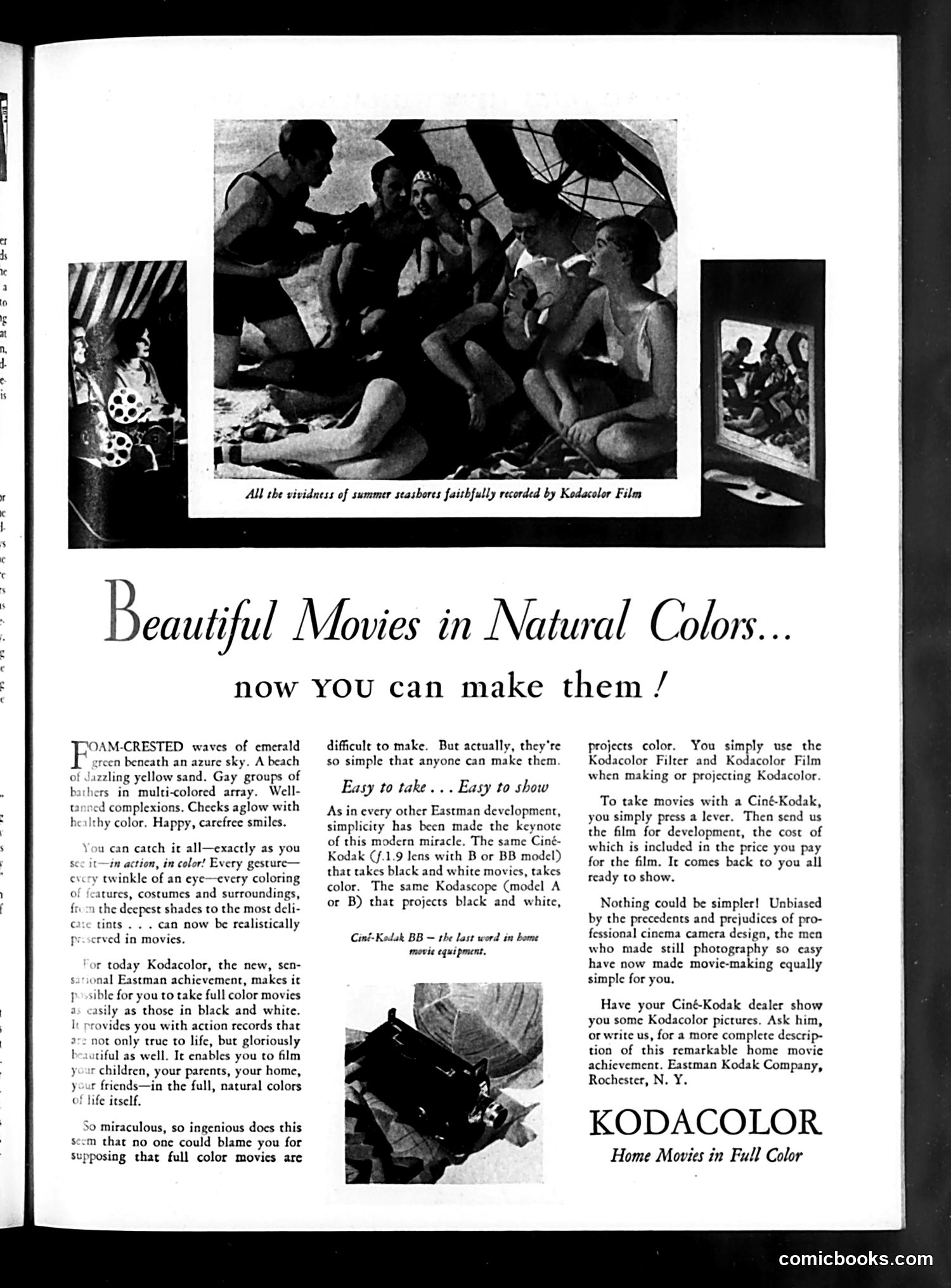
This is a full-page advertisement for Kodacolor film, not a political cartoon. It promotes Eastman Kodak's new color home movie technology to American consumers, likely from the 1930s-40s. The page features photographs of people enjoying beach activities in color, emphasizing the product's appeal: families can now film their own memories in vibrant natural colors rather than black-and-white. The advertisement stresses simplicity—anyone can operate a Ciné-Kodak camera by "simply press[ing] a lever." The text repeatedly uses phrases like "so simple," "easy to take," and "nothing could be simpler" to overcome consumer hesitation about technical complexity. It positions color home movies as accessible to ordinary people documenting family life, not just professional filmmakers. The advertisement reflects post-war American consumer optimism and the growing amateur photography market.
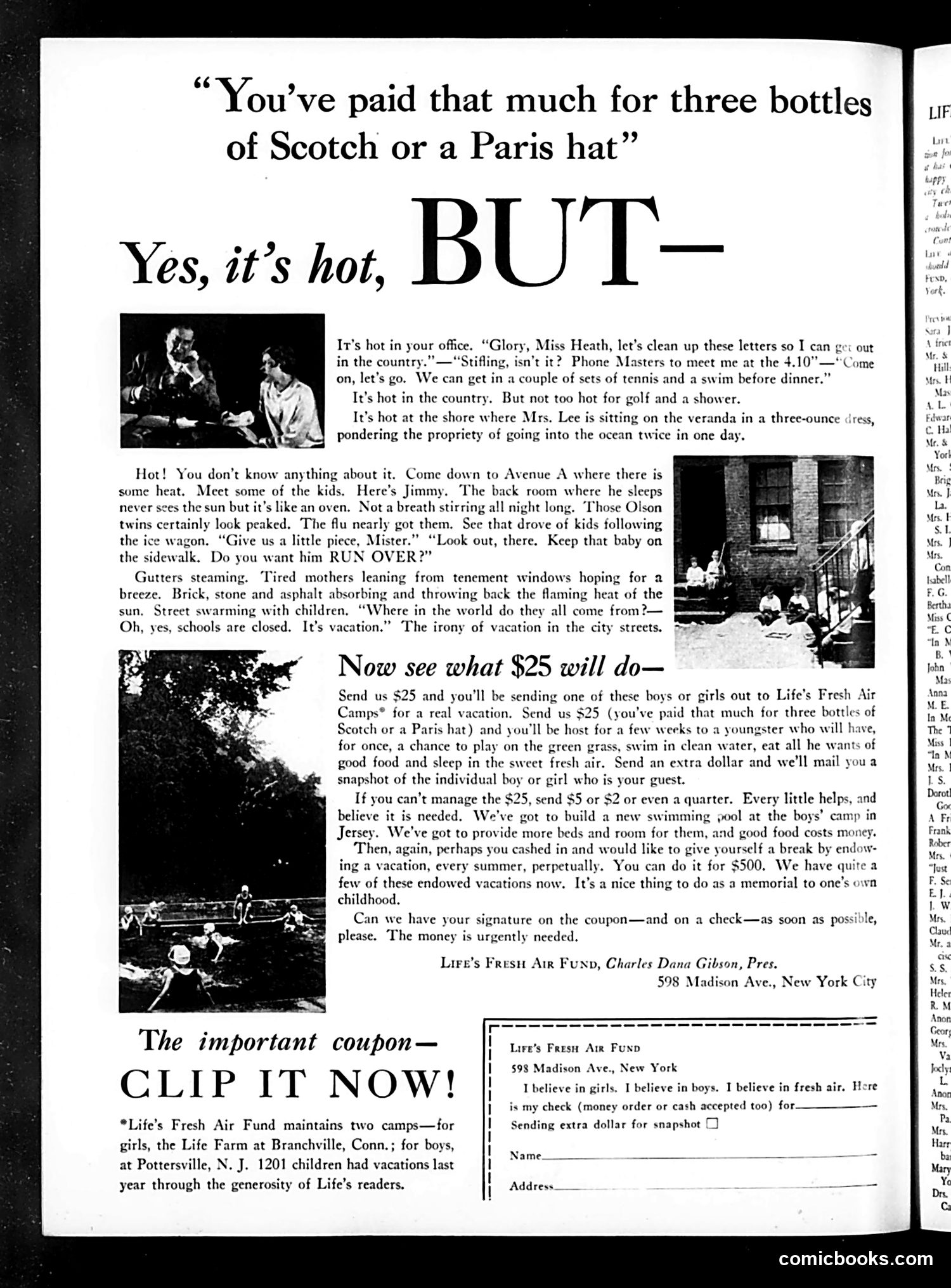
This is a charitable fundraising advertisement for Life's Fresh Air Fund, not a political cartoon. It uses social contrast to persuade readers to donate $25 to send urban children to summer camps. The appeal contrasts wealthy city dwellers (complaining about heat in offices, playing tennis, vacationing at shore) with poor tenement children on Avenue A suffering in brutal urban heat—sleeping in unventilated rooms, following ice wagons, crowding in steaming streets while schools close for "vacation" they cannot escape. The satire is gentle: the wealthy have already "paid that much for three bottles of Scotch or a Paris hat," so why not redirect that money to help children experience fresh air and nature? The photographs show idyllic camp scenes versus grim city streets, emphasizing what the donation provides: grass, clean water, good food, and sleep in fresh air—basics the poor lack. This reflects Progressive Era charity messaging (early 1900s), when Life magazine promoted social welfare causes among affluent readers.
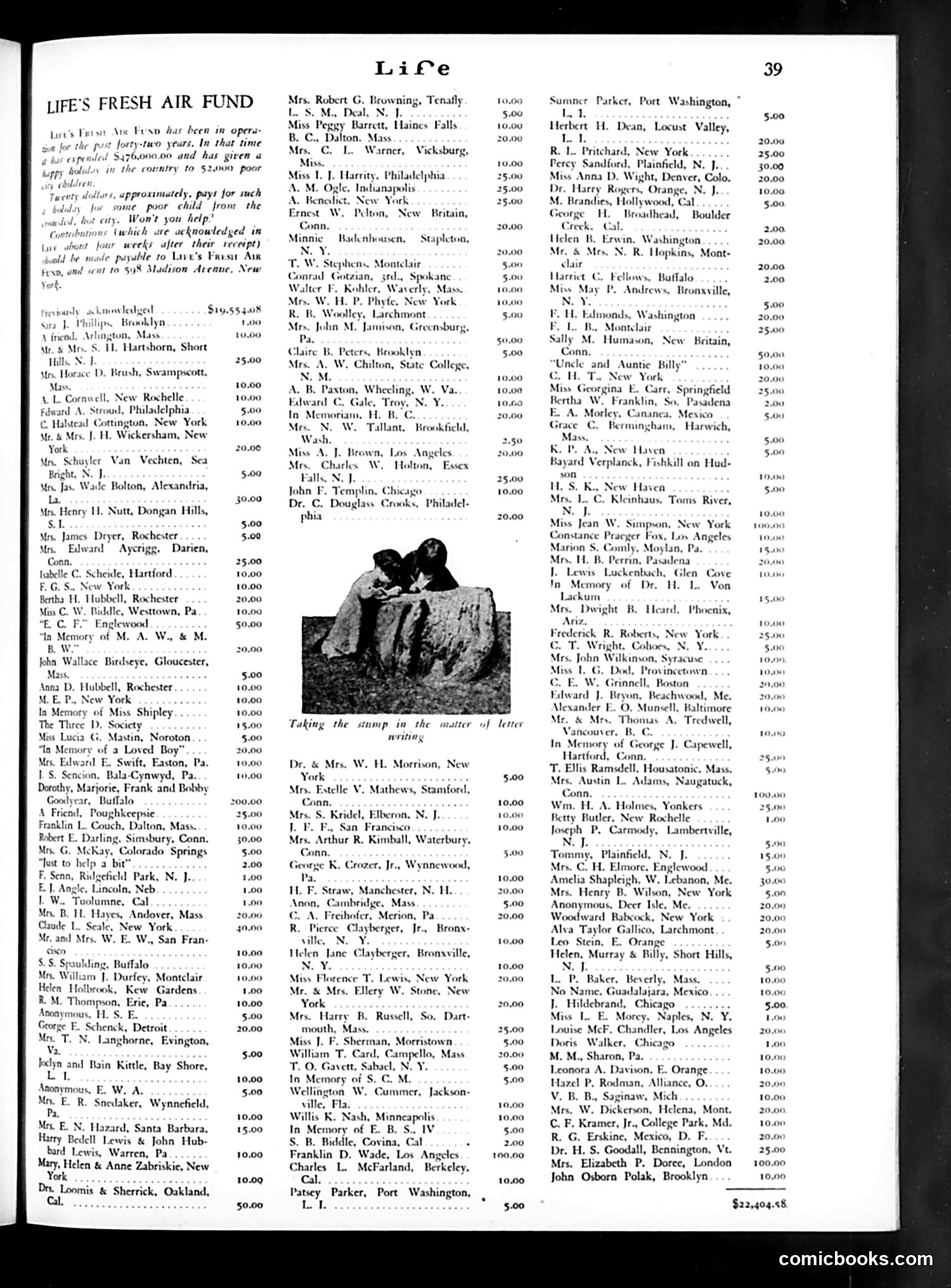
This page documents donations to **Life's Fresh Air Fund**, a charitable initiative that has operated for 42 years (the text doesn't specify the exact date, but this appears to be an early 20th-century publication based on the typography). The fund's purpose: providing poor urban children with countryside vacations. Life magazine itself solicits donations—approximately $2,000 annually funds one child's summer respite from the city. **The cartoon** (center of page) shows two children sitting on a tree stump "Taking the stump in the matter of letter writing"—a visual pun. The children appear to be composing thank-you letters for their Fresh Air Fund experiences, humorously depicting them as political candidates "taking the stump" (campaigning). The remainder is a donor roll call—hundreds of names with contribution amounts ($1–$100), a transparency device showing Life's readers as active philanthropists supporting poor urban children's welfare. This reflects Progressive Era concern for child welfare and the urban poor, while also serving as subtle social advertising for the magazine itself.
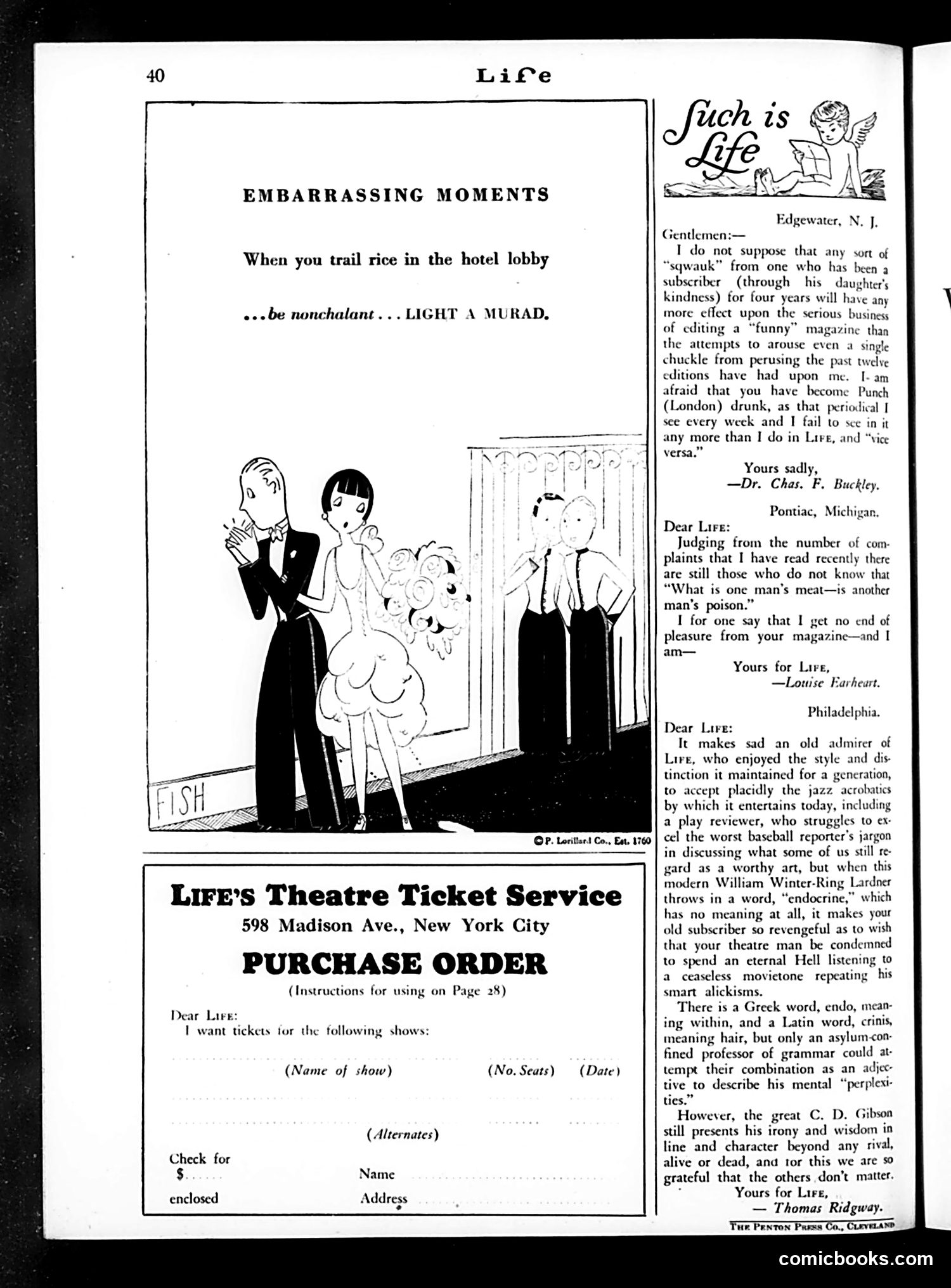
This page combines humor with reader correspondence. The cartoon titled "Embarrassing Moments" depicts a couple in a hotel lobby awkwardly encountering a child who has trailed rice (likely from a wedding) on the floor—a social faux pas amplified by public visibility. The joke relies on the discomfort of being associated with messy, childish behavior in a formal setting. The caption advises nonchalantly lighting a Murad cigarette (a real brand) to deflect embarrassment through casual sophistication. The letters section reveals Life's editorial struggles. Readers complain the magazine has become too influenced by British humor (Punch) and now employs pretentious language and "jazz acrobatics" in its theater reviews. One critic mocks the reviewer's use of "endocrine," calling it meaningless jargon. These complaints suggest Life was losing its traditional audience to modernism and perceived affectation, while supporters like Louise Earheart defended its evolution. The page also includes a theatre ticket service advertisement.
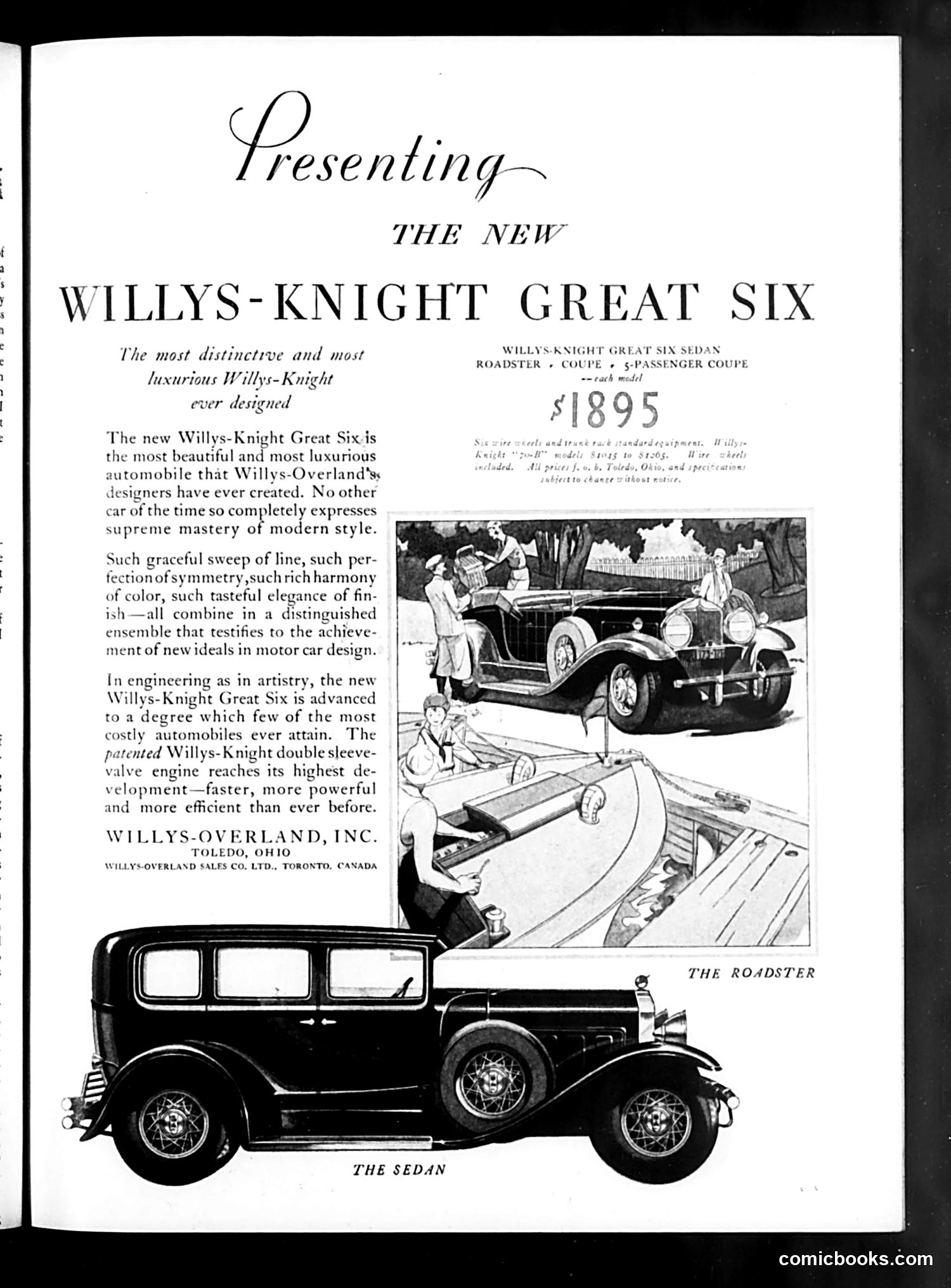
This is **not a cartoon or satire**—it's a straightforward automobile advertisement for the Willys-Knight Great Six, priced at $1895. The page presents the new car model across three body styles (sedan, roadster, coupe) with accompanying illustrations: a sketch of wealthy passengers admiring the vehicle, a technical diagram showing the engine, and a side-profile silhouette of the sedan. The advertising copy emphasizes luxury, modern design, and engineering innovation—particularly the "patented" double sleeve-valve engine. The tone is aspirational, targeting affluent consumers by stressing that the car represents "supreme mastery of modern style" and engineering advancement comparable to "the most costly automobiles." This represents typical 1920s-era automotive marketing: appealing to status-conscious buyers through claims of aesthetic refinement and technological superiority.
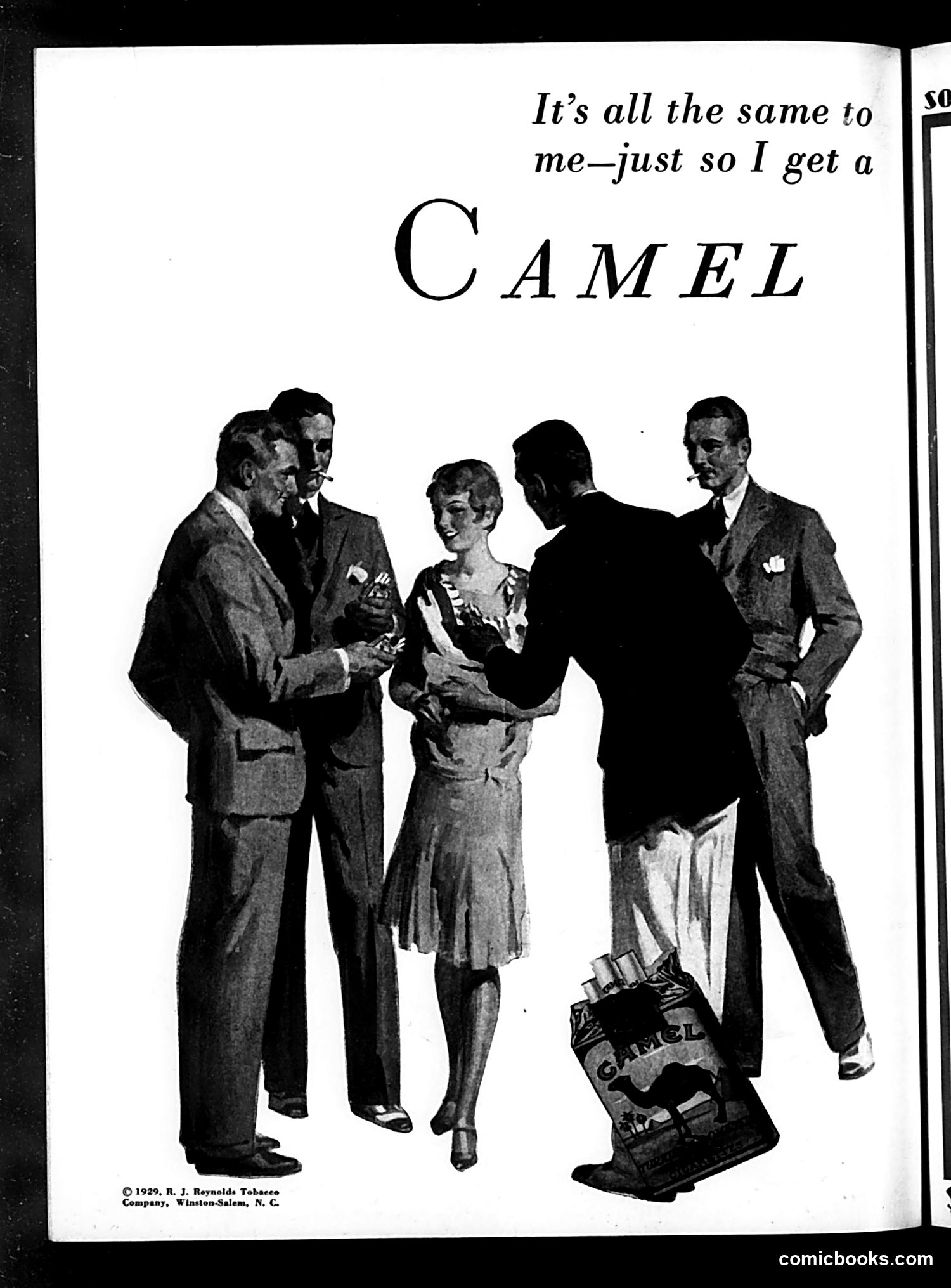
This is a 1929 advertisement for Camel cigarettes. The image shows five well-dressed people in formal attire at what appears to be a social gathering, with one figure holding a Camel cigarette package. The tagline "It's all the same to me—just so I get a CAMEL" suggests the message that regardless of social situation or company, the smoker's preference remains constant: Camel cigarettes. The advertisement uses aspirational imagery typical of the era, depicting sophisticated, upper-class individuals to associate smoking with refinement and social status. The copyright credit to R.J. Reynolds Tobacco Company confirms this is official brand advertising. This represents pre-regulation tobacco marketing, before warning labels or advertising restrictions existed in the United States.