
Life, 1929-08-09 · page 26 of 44
Life — August 9, 1929 — page 26: what you’re looking at
What you’re looking at
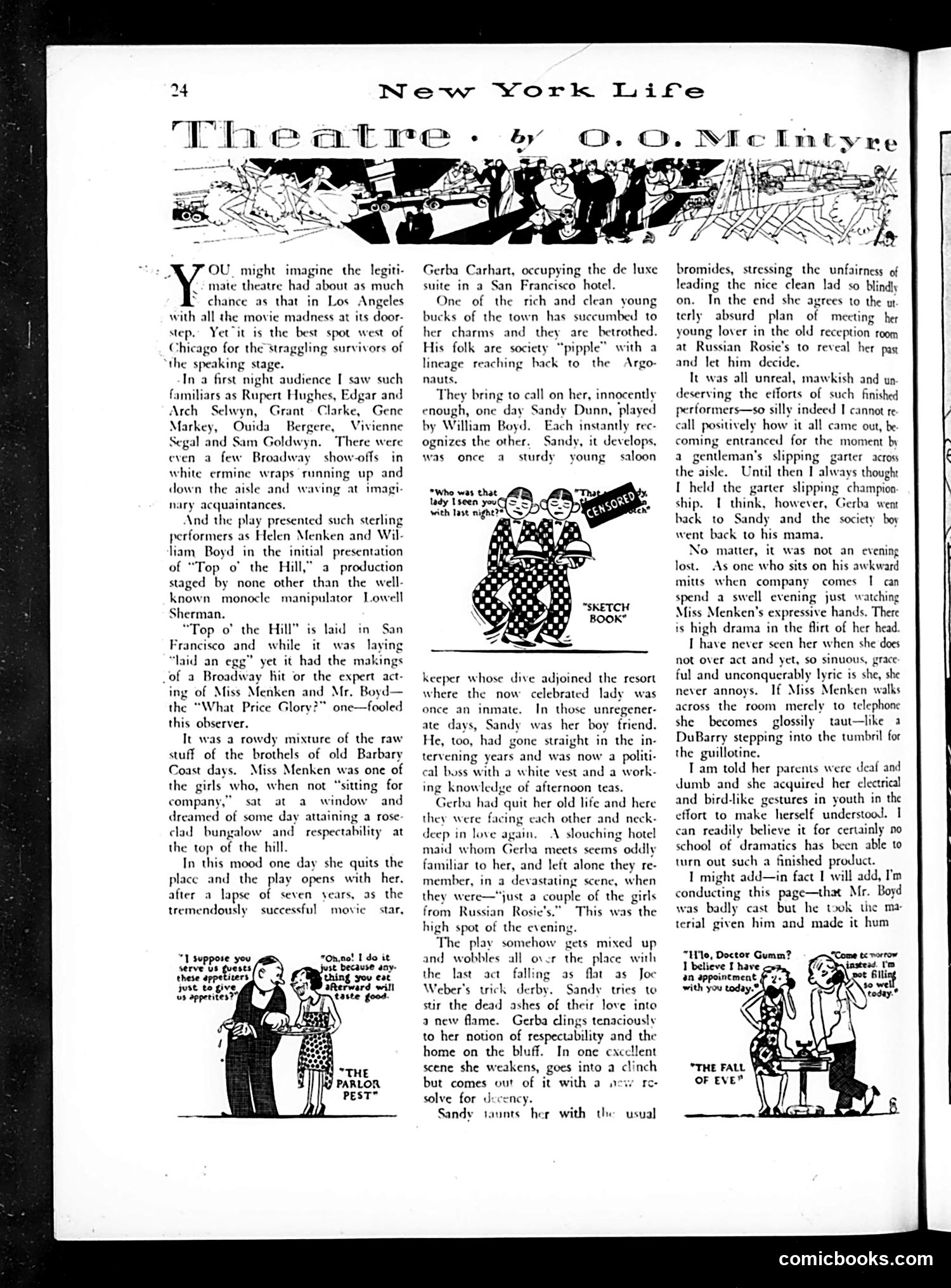
This is O.O. McIntyre's theatre review of the play "Top o' the Hill," starring Helen Menken and William Boyd. The satire critiques both the play's melodramatic plot and San Francisco's theatrical scene amid Hollywood's dominance. The review describes a dated Barbary Coast morality tale: Menken plays a former brothel worker who becomes a movie star and must choose between respectability (marrying a society man) and rekindling romance with Sandy Dunn (Boyd), her old saloon-keeper boyfriend who's now a political boss. McIntyre finds the plot "mawkish" and "silly," though he credits the skilled performers. The small cartoons mock common theatrical tropes—the parlor seduction and romantic misunderstandings typical of stage comedies of the era. McIntyre suggests the play succeeds despite, not because of, its material, being essentially a recycled "Barbary Coast" formula dressed up with star power rather than genuine theatrical merit.
📄 Transcribed text from this page (OCR, searchable)
Machine-transcribed from the original scan — historical spelling and the odd misread are preserved.
24 New York Life OU, might imagine the legiti- mate theatre had about as much chance as that in Los Angeles with all the movie madness at its door- sep. Yet it is the best spot west of Chicago for the straggling survivors of the speaking stage. In a first night audience I saw such familiars as Rupert Hughes, Edgar and Arch Selwyn, Grant) Clarke, Gene Markey, Ouida Bergere, Vivienne Segal and Sam Goldwyn. There were even a few Broadway show-offs in white ermine wraps running up and down the aisle and waving at imagi- nary acquaintances. And the play presented such sterling performers as Helen Menken and Wil- liam Boyd in the initial presentation of “Top o° the Hill,” a production staged by none other than the well- known monocle manipulator Lowell Sherman. “Top o° the Hill” is laid in San Francisco and while it was laying “laid an egg” yet it had the makings of a Broadway hit or the expert act- ing of Miss Menken and Mr. Boyd— the “What Price Glory?” one—fooled this observer. It was a rowdy mixture of the raw stuff of the brothels of old Barbary Coast days. Miss Menken was one of the girls who, when not “sitting for company,” sat at a window and dreamed of some day attaining a rose clad bungalow and_ respectability at the top of the hill. In this mood one day she quits the place and the play opens with her. after a lapse of seven years, as the tremendously successful movie star, "| suppose you serve us guests these appetivers just to give us apperites?4 by’ Gerba Carhart, occupying the de luxe suite in a San Francisco hotel. One of the rich and clean young bucks of the town has succumbed to her charms and they are betrothed. His folk are society “pipple” with a lineage reaching hack to the Argo- nauts. They bring to call on her, innocently enough, one day Sandy Dunn, ‘played by William Boyd. Each instantly ree- ognizes the other, Sandy, it develops, was once a sturdy young saloon "Who was that "Tha lady I seen youC] Rete . with last nighe?’ ren" Sp 6 Tm) domeey 6 VEX keeper whose dive adjoined the resort where the now celebrated lady was once an inmate. In those unregener- ate days, Sandy was her boy friend. He, too, had gone straight in the in- tervening years and was now a politi- cal boss with a white vest and a work- ing knowledge of afternoon teas. Gerba had quit her old life and here they were facing cach other and neck- deep in love again. A slouching hotel maid whom Gerba meets seems oddly familiar to her, and left alone they re- member, in a devastating scene, when they were—“just a couple of the girls from Russian Rosie's.” This was the high spot of the evening. The play somehow gets mixed up and wobbles all over the place with the last act falling as flat as Joc Weber's uick derby. Sandy tries to stir the dead ashes of their love into a new flame. Gerba clings tenaciously to her notion of respectability and the home on the bluff. In one excellent scene she weakens, goes into a clinch but comes out of it with a new re- solve for decency. Sandy jaunts her with the usual bromides, stressing the unfairness of leading the nice clean lad so blindly on. In the end she agrees to the ut terly absurd plan of meeting her young lover in the old reception room at Russian Rosie’s to reveal her pas and let him decide. It was all unreal, mawkish and un deserving the efforts of such finished performers—so silly indeed I cannot re call positively how it all came out, be coming entranced for the moment by a gentleman's slipping garter across the aisle. Until then I always thought I held the garter slipping champion ship. I think, however, Gerba went back to Sandy and the society boy went back to his mama, No matter, it was not an evening lost. As one who sits on his awkward mitts when company comes [can spend a swell evening just watching Miss Menken’s expressive hands. There is high drama in the flirt of her head. I have never scen her when she does not over act and yet, so sinuous, grace ful and unconquerably lyric is she, she never annoys. If Miss Menken walks across the room merely to telephone she becomes glossily taut—like a DuBarry stepping into the tumbril for the guillotine. T am told her parents were deaf and dumb and she acquired her clectrical and bird-like gestures in youth in the effort to make herself understool. 1 can readily believe it for certainly no school of dramatics has been able to turn out such a finished product. I might add—in fact I will add, I'm conducting this page—that Mr. Boyd was badly cast but he took the ma terial given him and made it hum “Hilo, Doctor Gumm? comicbooks.com