
A complete issue · 37 pages · 1929
Life — June 28, 1929
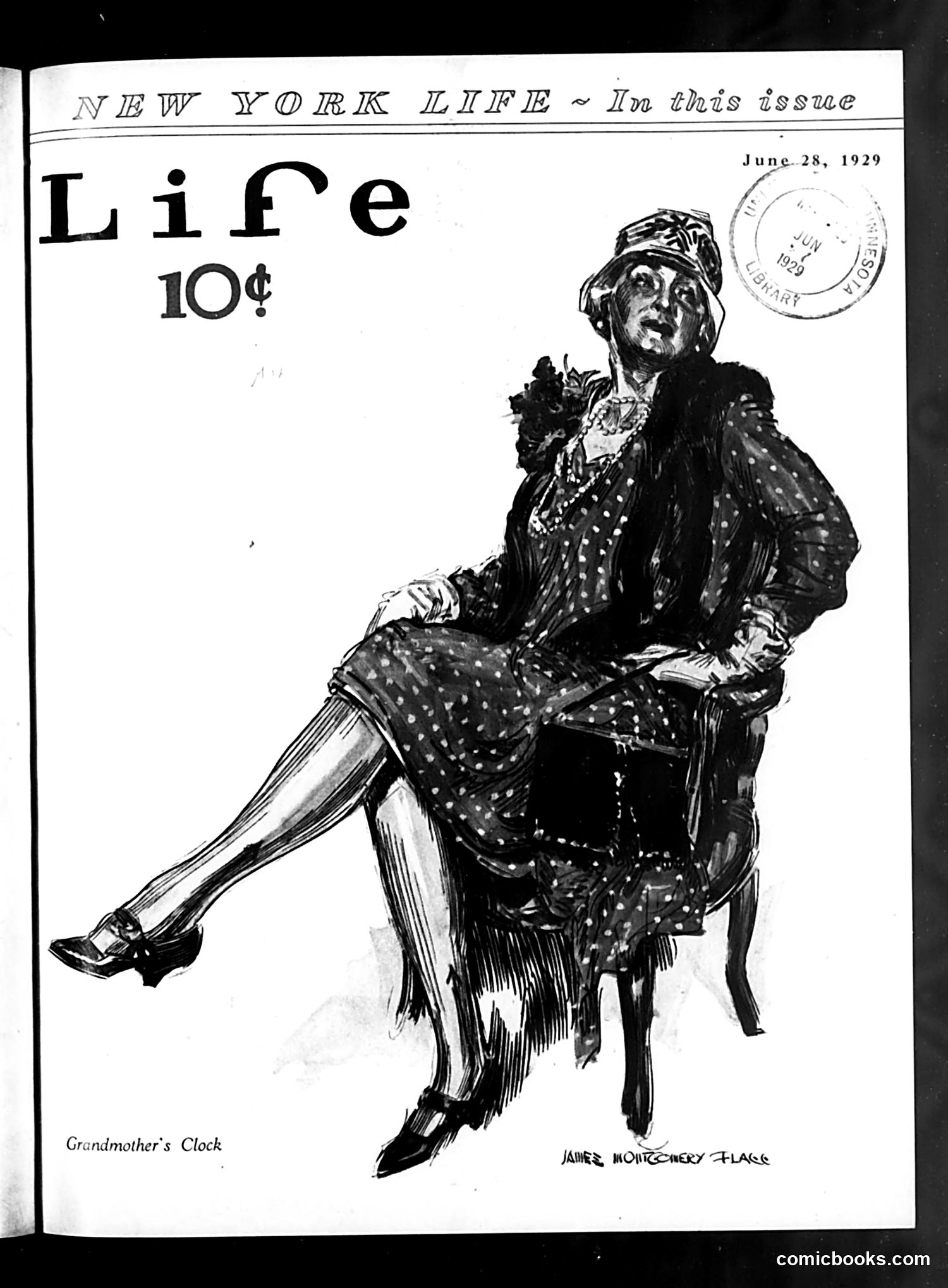
This cover illustration by James Montgomery Flagg depicts an elderly woman in elaborate, ornate clothing—a polka-dotted dress with decorative patterns and a fancy hat—seated in a relaxed pose with her leg extended. She holds flowers and appears well-dressed and affluent. The caption reads "Grandmother's Clock," likely referencing the famous nursery rhyme about a grandfather clock that "stood ninety years on the floor." The satire appears to mock aging society women or perhaps comment on the preservation of old-fashioned values and styles among the elderly wealthy class during the Jazz Age of 1929. The illustration's exaggerated ornamentation suggests mockery of dated fashion and outdated sensibilities among older generations.
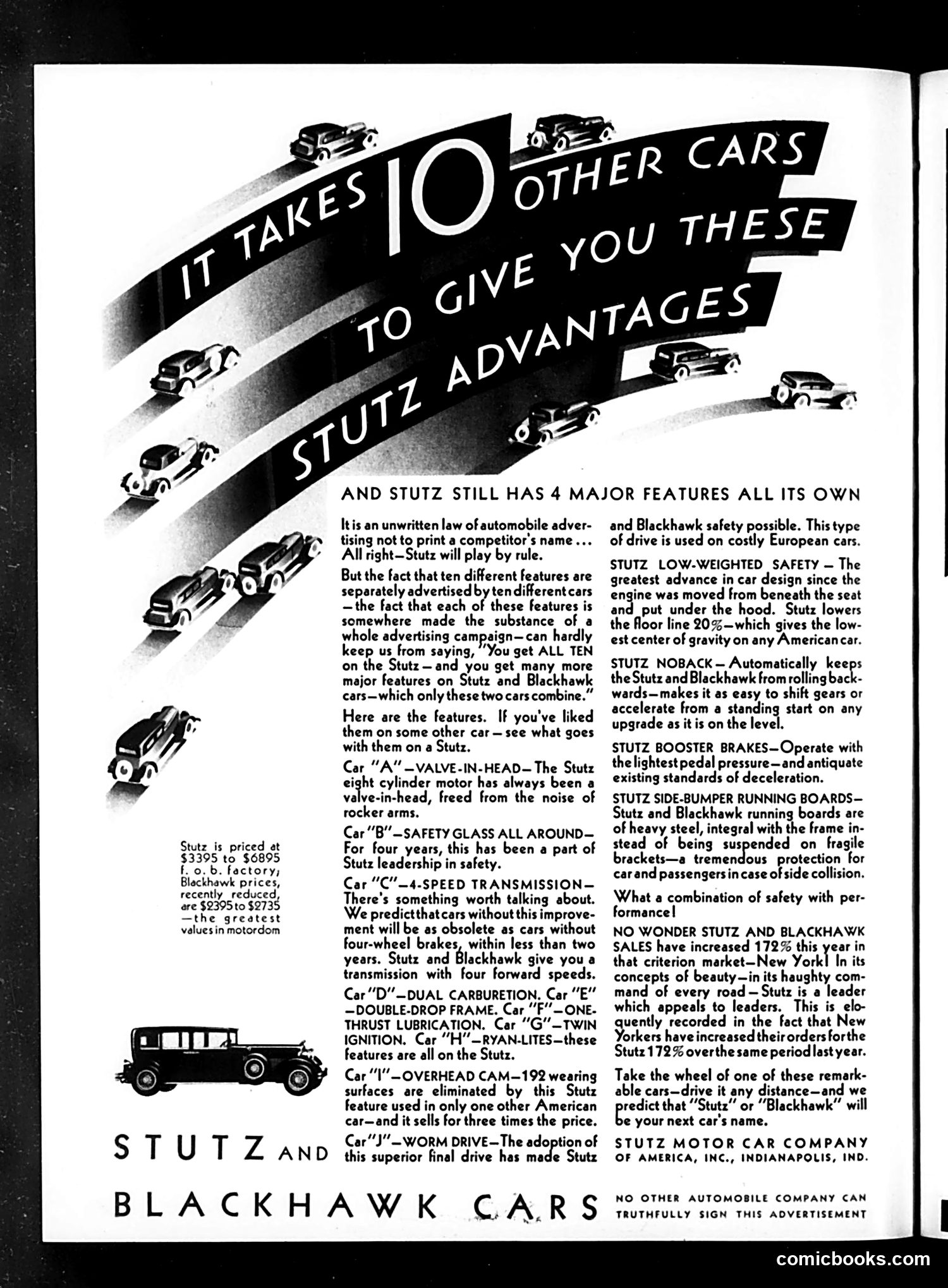
This is **not a satirical cartoon page** but rather a **straightforward automobile advertisement** for Stutz and Blackhawk cars, published in Life magazine (likely 1920s-1930s based on styling). The ad makes comparative claims that Stutz and Blackhawk possess "10 other cars" worth of advantages combined. It then details specific features: valve-in-head engine, safety glass, four-speed transmission, dual carburetion, dual-drop frame, twin ignition, overhead cam, and final drive. The small illustrations show various car models climbing a stylized hill, visually representing competitive superiority. A truck illustration appears at bottom left. The closing statement emphasizes that "no other automobile company can truthfully sign this advertisement"—a bold competitive claim typical of aggressive auto marketing of that era. This is commercial advertising, not political satire.
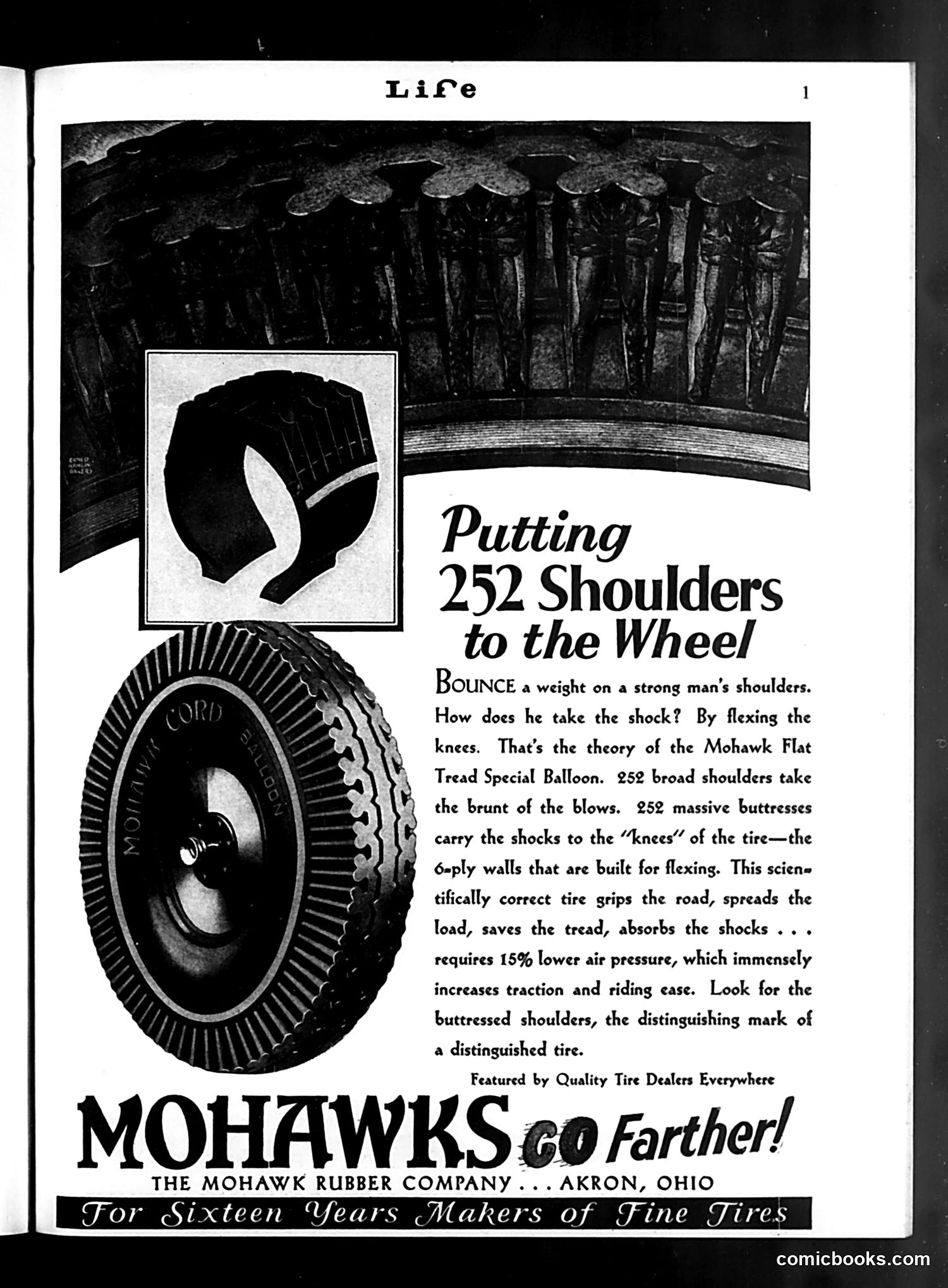
This is primarily **advertising, not satire or editorial content**. It's a Mohawks tire advertisement from The Mohawk Rubber Company (Akron, Ohio) that appeared in Life magazine. The ad uses a clever analogy: just as human shoulders absorb impact by flexing at the knees, the tire's 252 "buttressed shoulders" (reinforced sidewalls) absorb road shocks through the tire's 6-ply walls. The ad emphasizes technical features—the buttressed design, 15% lower air pressure requirement, and improved traction—as marks of quality. The headline "Putting 252 Shoulders to the Wheel" is a pun on the idiom "putting your shoulder to the wheel" (meaning hard work). There's no political or social satire here; this is straightforward product marketing highlighting tire engineering innovations.
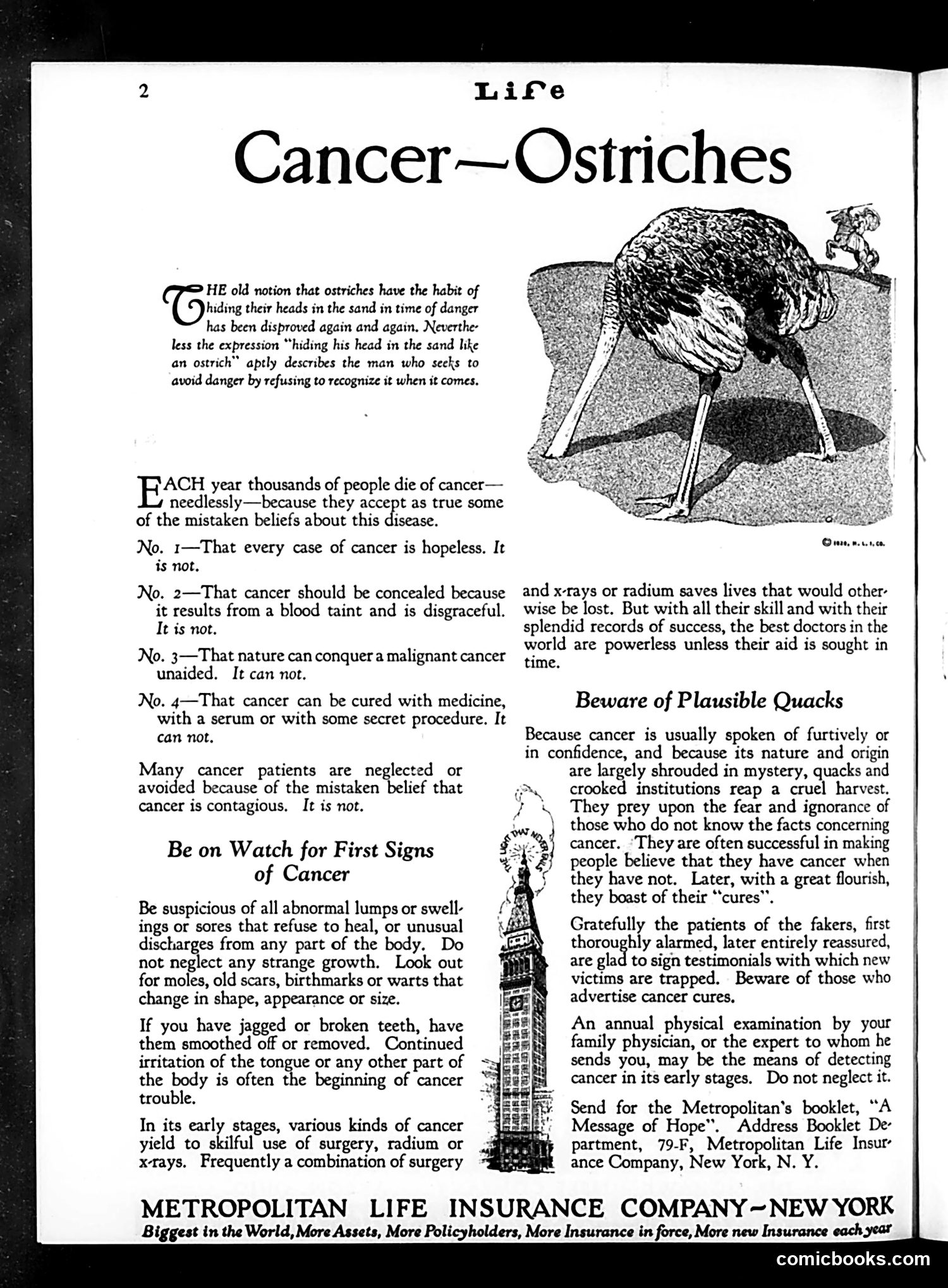
This page uses the ostrich metaphor (top illustration) to satirize public denial about cancer. The opening compares people who ignore cancer symptoms to ostriches mythically burying their heads in sand—they avoid confronting danger by refusing to acknowledge it. The text debunks four widespread misconceptions: that cancer is hopeless, should be hidden due to shame, cannot be conquered by medicine, or can be cured by quacks. The real satire targets "plausible quacks" who exploit cancer patients' fear and ignorance, offering fake "cures" while legitimate doctors and early detection through surgery, radium, and x-rays actually save lives. This appears to be a Metropolitan Life Insurance Company public-health advertisement promoting medical expertise and early intervention over superstition and charlatan medicine.
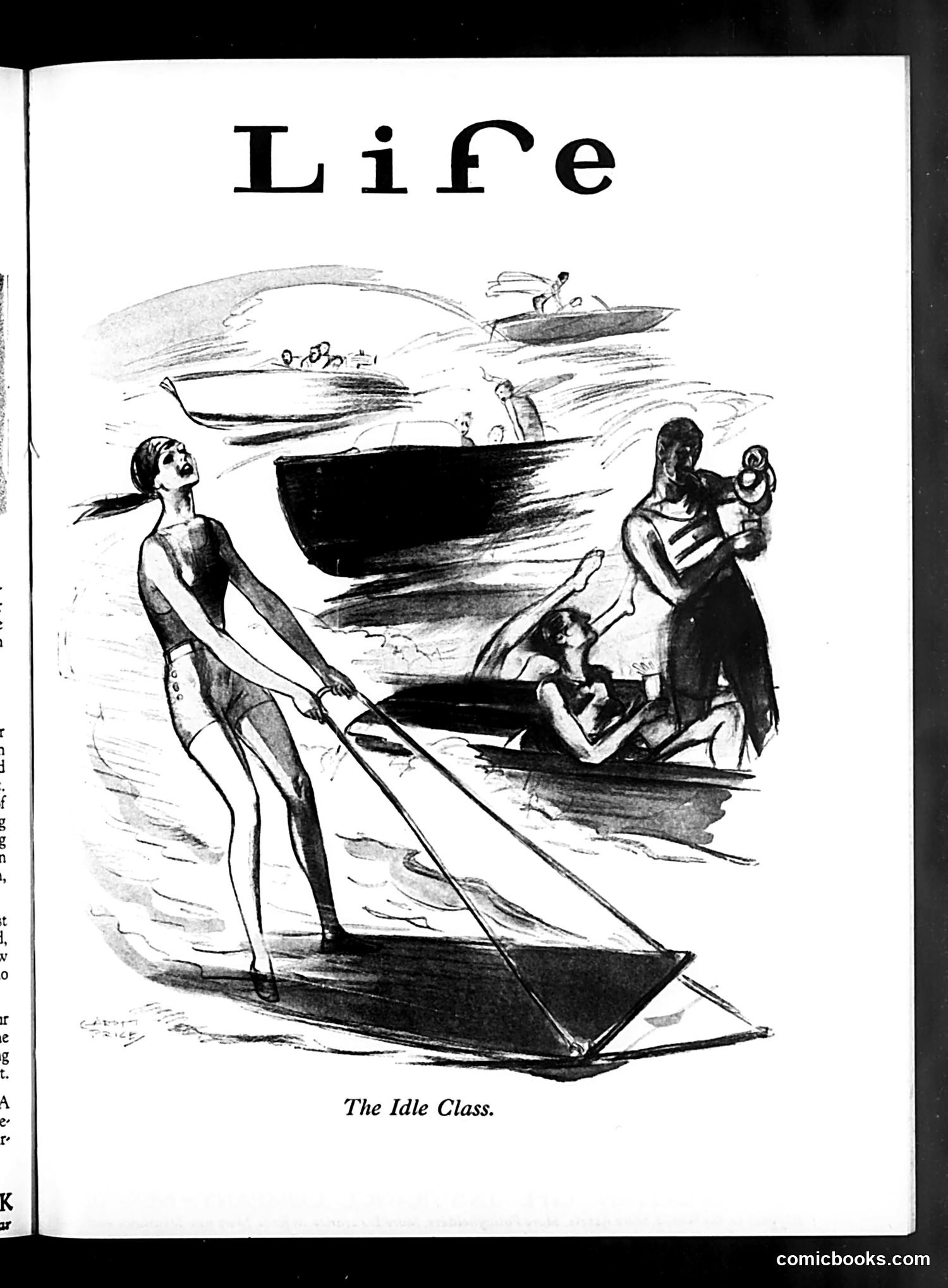
This satirical illustration titled "The Idle Class" depicts a beach leisure scene with figures in swimwear and boats. The cartoon appears to critique wealthy individuals who spend their time in idle pursuits—lounging, boating, and lounging with children—rather than engaging in productive work. The sketch-style rendering emphasizes the contrast between those actively enjoying seaside recreation and the broader social context. Given Life magazine's tradition of social satire, this likely mocks the leisure activities of the wealthy class during a period when labor and productivity were valued social ideals. The casual poses and abundance of recreational vessels suggest commentary on conspicuous consumption and class distinctions. The subtitle reinforces the satirical point about an unproductive social stratum.
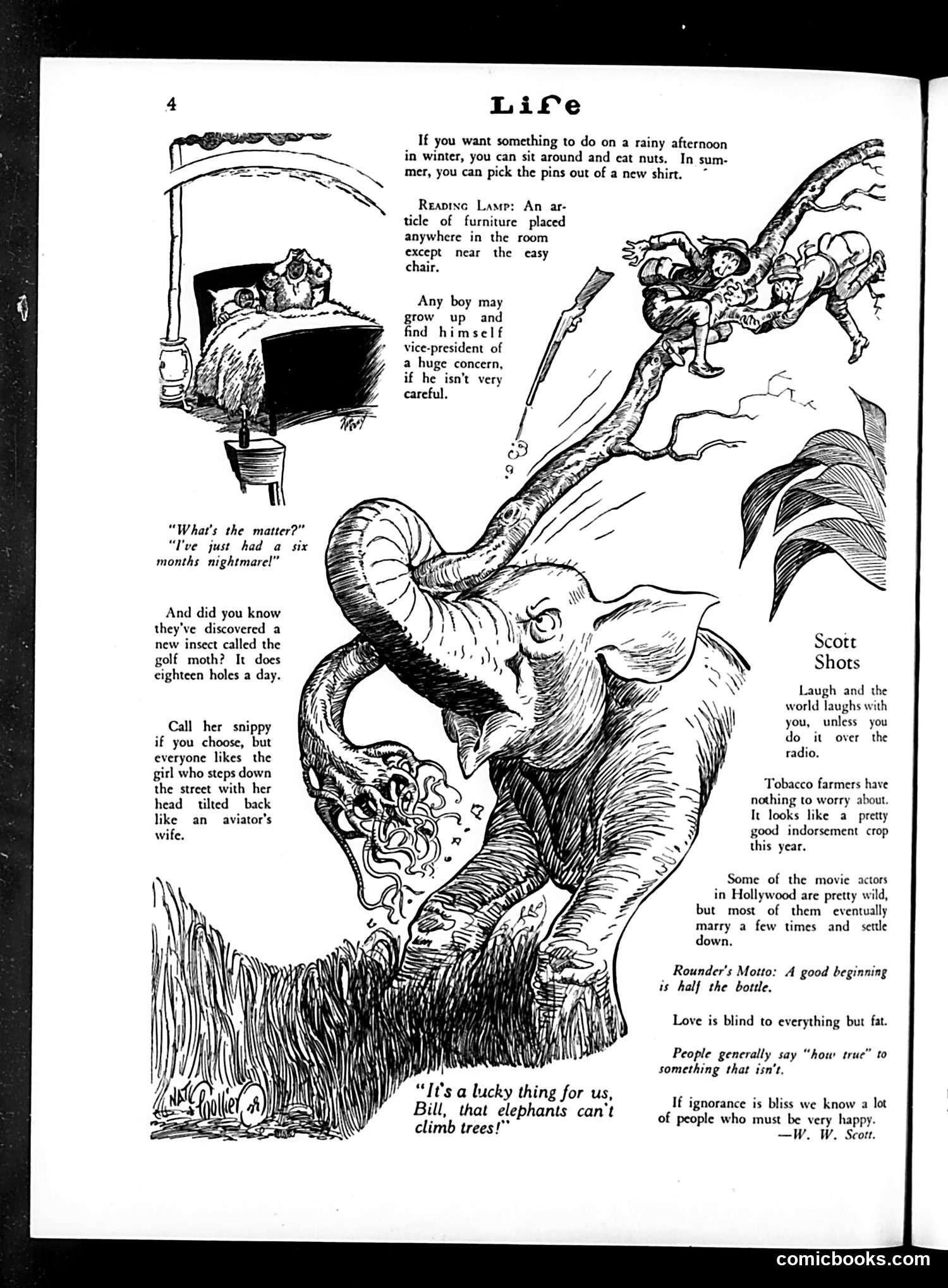
This page presents humorous observations and illustrations rather than political commentary. The central image depicts an elephant carrying monkeys in a tree, with the caption "It's a lucky thing for us, Bill, that elephants can't climb trees!" — a simple joke about animal limitations. The right column contains miscellaneous quips attributed to "Scott Shoss" and others, offering lighthearted social commentary: observations about rainy-day activities, reading lamps, boy ambitions, and Hollywood actors. The tone is gentle satirical humor typical of Life magazine's style. The left illustrations show a person in bed with a reading lamp and someone having a nightmare — domestic humor focused on everyday life rather than political events or public figures. Overall, this represents Life's brand of gentle, non-partisan humor and commentary on American social customs and domestic situations.
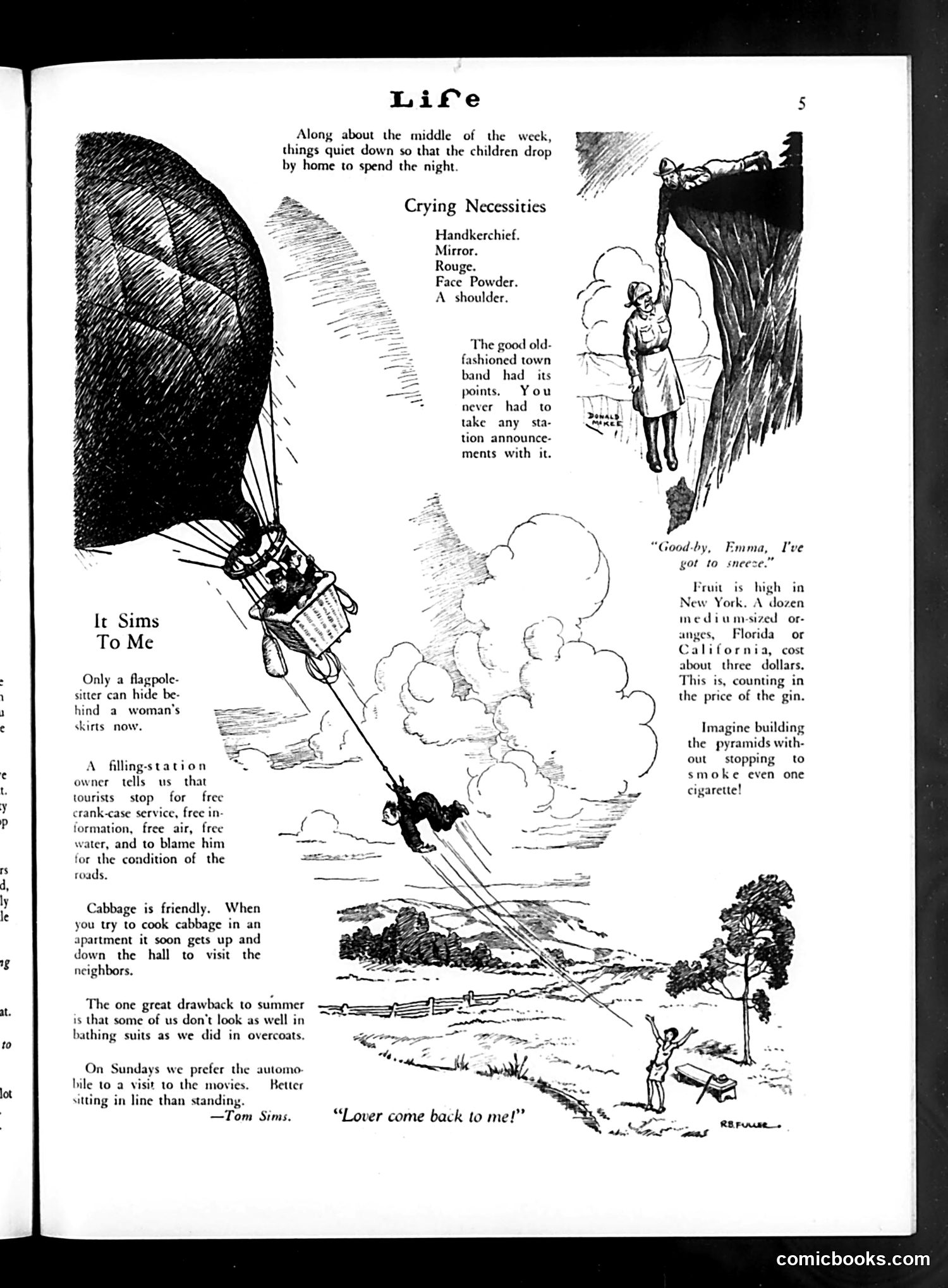
This page contains humorous observations about modern city life by Tom Sims, accompanied by satirical illustrations. The main cartoon depicts a hot air balloon landing near a woman and child, with the caption "Lower come back to me!" The satire appears to target the novelty and impracticality of early aviation as transportation—a wealthy person escaping by balloon while leaving behind dependents. Sims's accompanying commentary mocks various urban inconveniences: flagpole-sitters hiding behind women's skirts, filling-station owners blaming tourists for road conditions, cabbage cooking odors in apartment buildings, and bathing suits looking unflattering compared to overcoats. The "Crying Necessities" list humorously catalogs items required for emotional display in polite society—handkerchief, mirror, rouge, powder, and "a shoulder" to cry on. The overall tone satirizes urban pretension and modern social affectations.
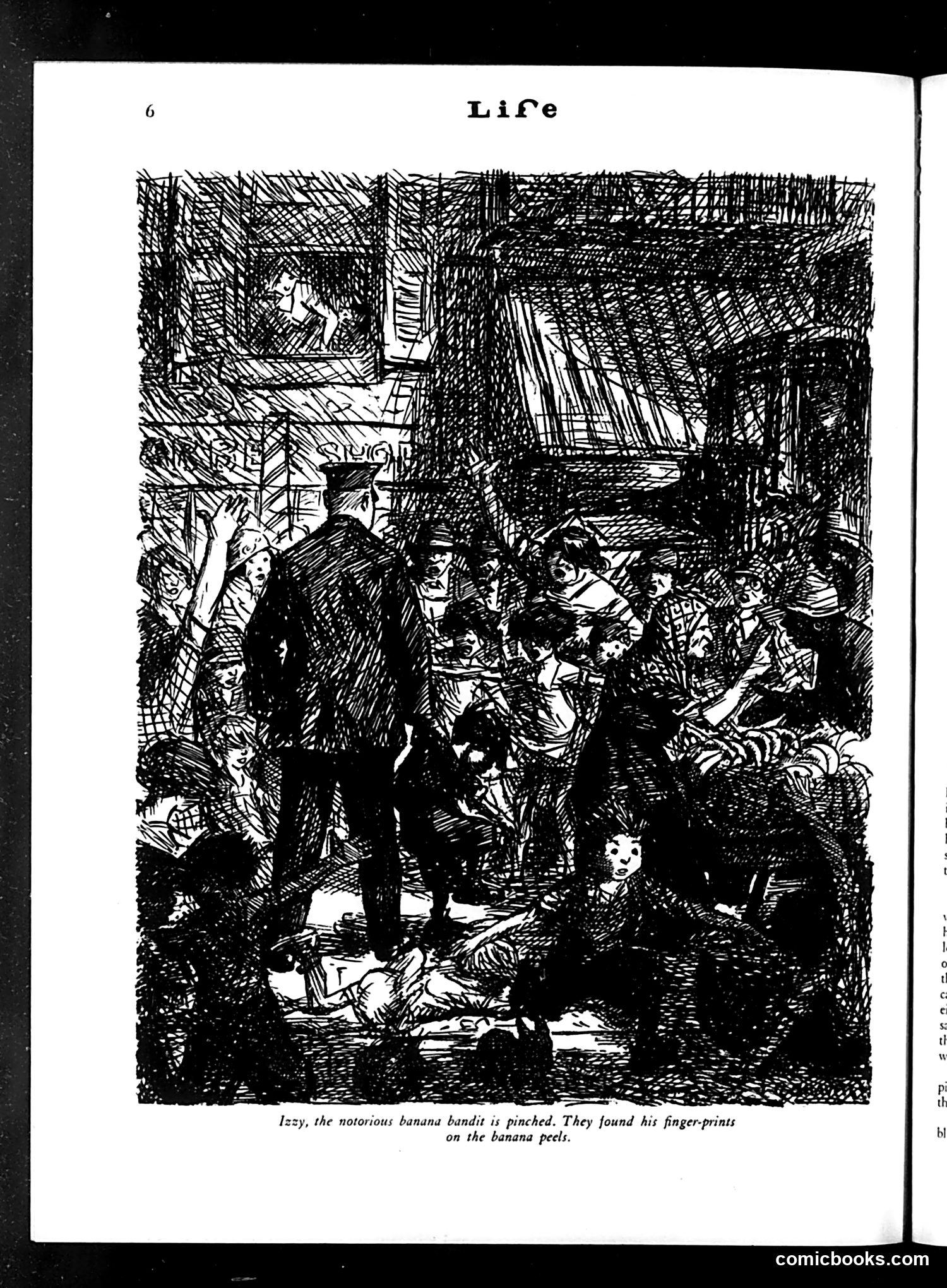
This page from *Life* magazine shows a satirical illustration depicting the capture of "Izzy, the notorious banana bandit." According to the caption, authorities found his fingerprints on banana peels. The cartoon appears to be a humorous parody of crime reporting and police procedures—specifically mocking the then-popular practice of using fingerprint evidence in criminal investigations. By applying serious forensic techniques to the trivial crime of stealing bananas, the satire ridicules either sensationalized crime reporting or the over-application of scientific methods to minor offenses. The crowded urban scene with multiple figures suggests a comical overreaction by authorities to this absurd "criminal." The joke relies on the incongruity between serious police work and a trivial fruit theft.
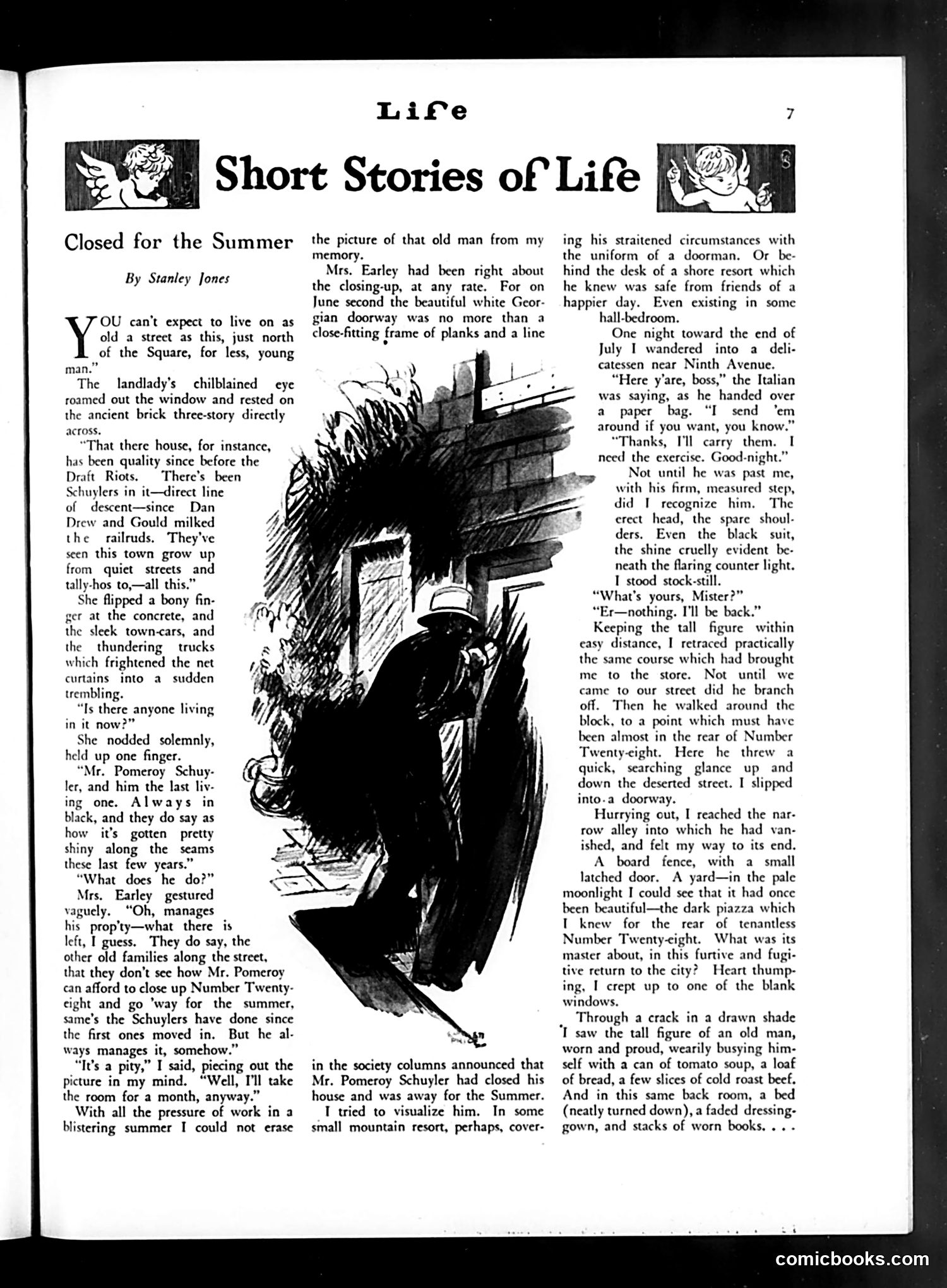
This is a short story about urban decay and social class in early 20th-century New York. The illustration shows a shabby, deteriorating tenement building—likely in a poor neighborhood north of Washington Square. The narrative centers on Mr. Pomeroy Schuyler, a wealthy man who has closed his house for summer vacation. The story explores the contrast between his seasonal absence and the permanent hardship of those living in the surrounding slums. The detailed sketch emphasizes the building's decay and abandonment, reflecting contemporary concerns about urban blight and class inequality. The piece appears to be social commentary on how the wealthy escape the city while the poor remain trapped in declining neighborhoods.
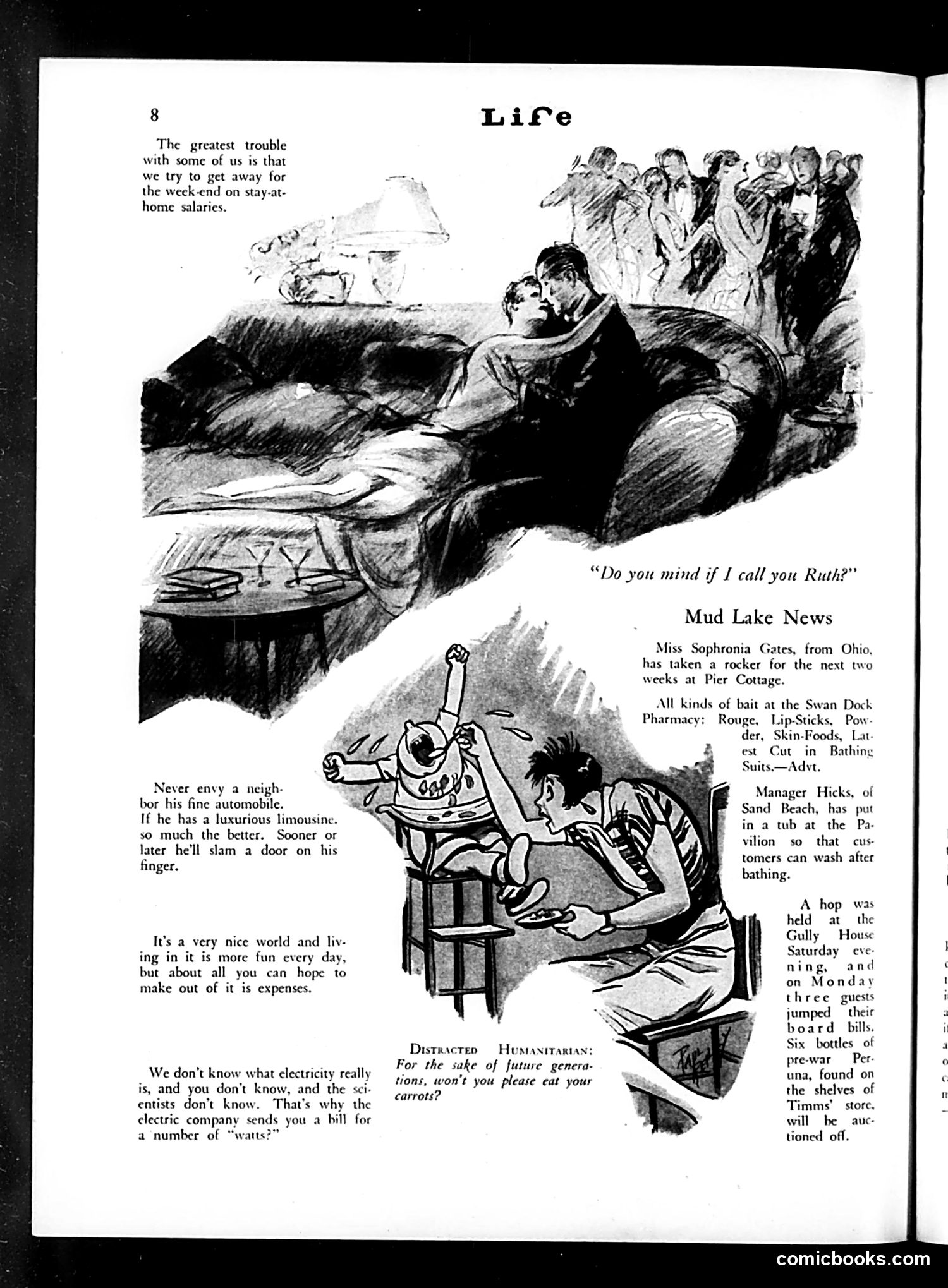
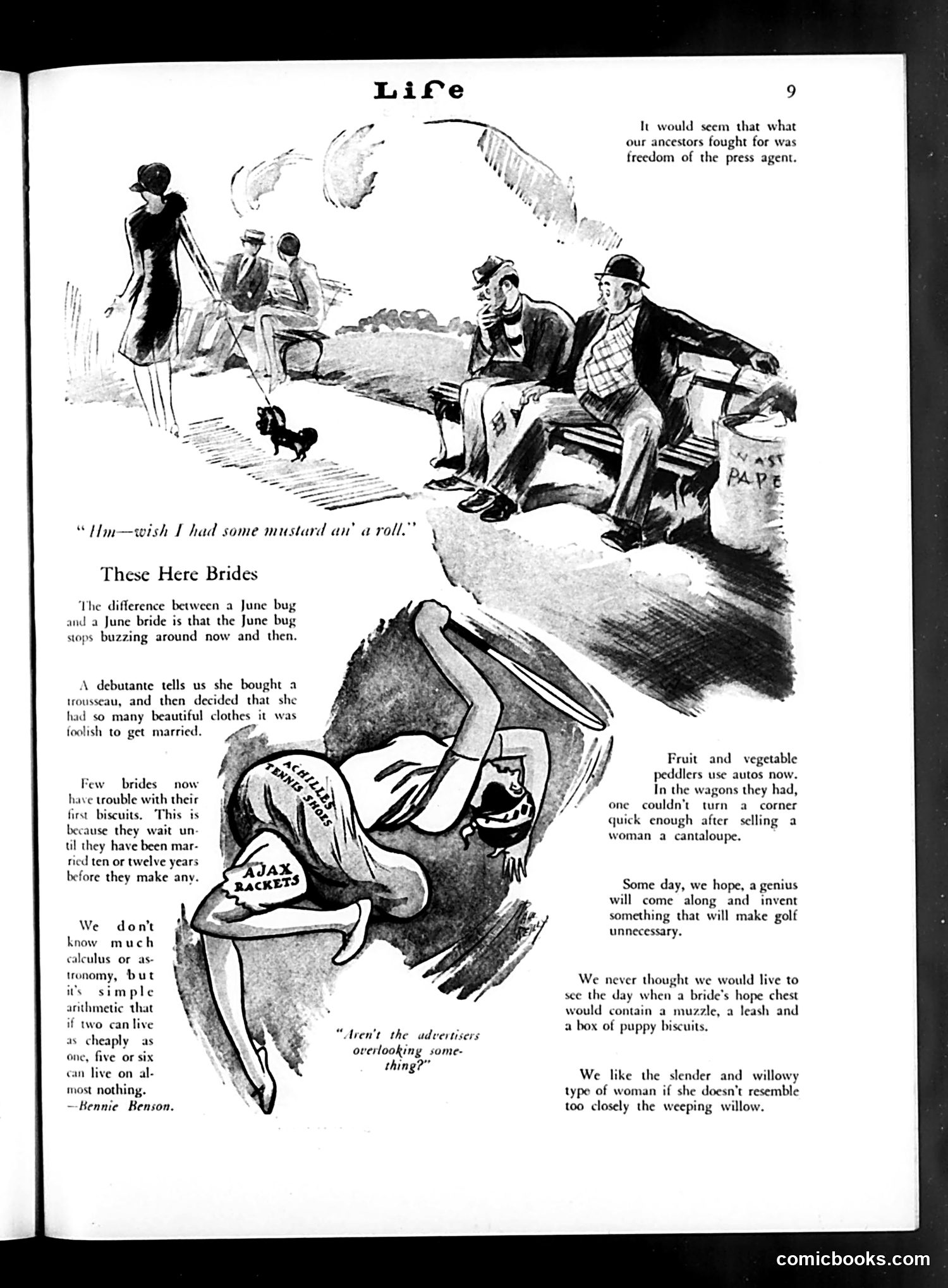
This page satirizes modern courtship and marriage through three interconnected jokes: **Top cartoon**: Men on a picnic complain "Hmm—wish I had some mustard an' a roll," mocking how June weddings have become obligatory social events rather than romantic occasions. **Middle section titled "These Here Brides"**: The text contrasts June brides unfavorably with June bugs—at least bugs stop being annoying eventually. It mocks women who delay marriage to accumulate trousseau collections, suggesting materialism drives weddings rather than love. **Bottom cartoon**: Shows an exhausted bride dragging shopping bags labeled "Ajax" and "Crackers," satirizing how modern advertising and consumer goods have infiltrated bridal expectations. The caption "Isn't the advertisers overlooking something?" suggests even advertisers haven't fully commercialized weddings yet. The overall satire critiques how American consumerism has transformed marriage into a shopping-driven social obligation.
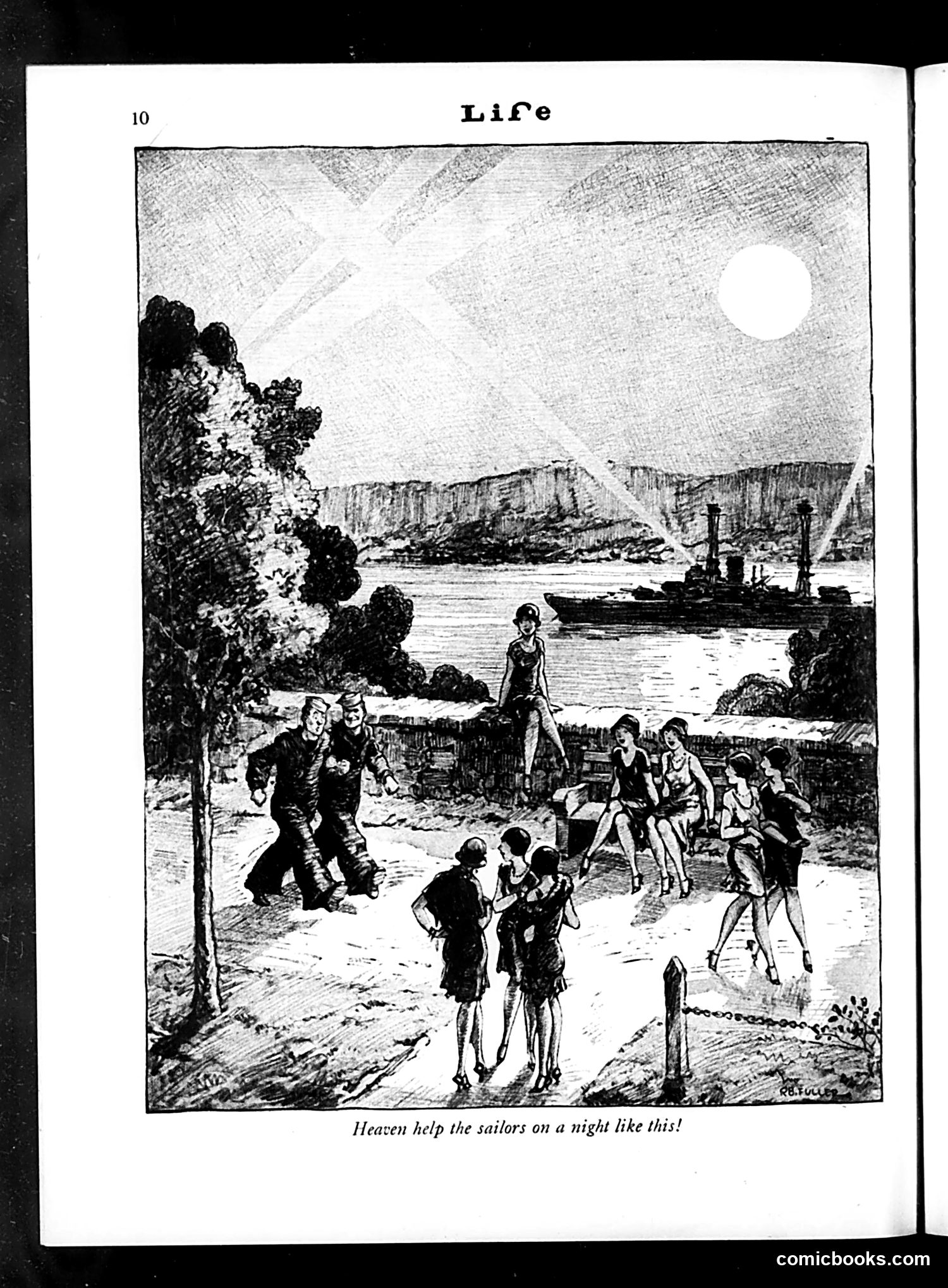
This is a satirical illustration from *Life* magazine showing children playing on a beach at night under a full moon, with industrial ships and factories visible across the water. The caption reads: "Heaven help the sailors on a night like this!" The satire works through irony: while the children enjoy carefree play on the shore, the caption expresses concern for sailors' safety during nighttime conditions. The industrial landscape—smokestacks and vessels—suggests wartime activity or maritime danger. The joke appears to comment on the contrast between civilian leisure and the hazards faced by those at sea, possibly referencing WWI or WWII naval operations when night navigation posed genuine risks. The illustration critiques either wartime disruption or industrial dangers affecting workers.
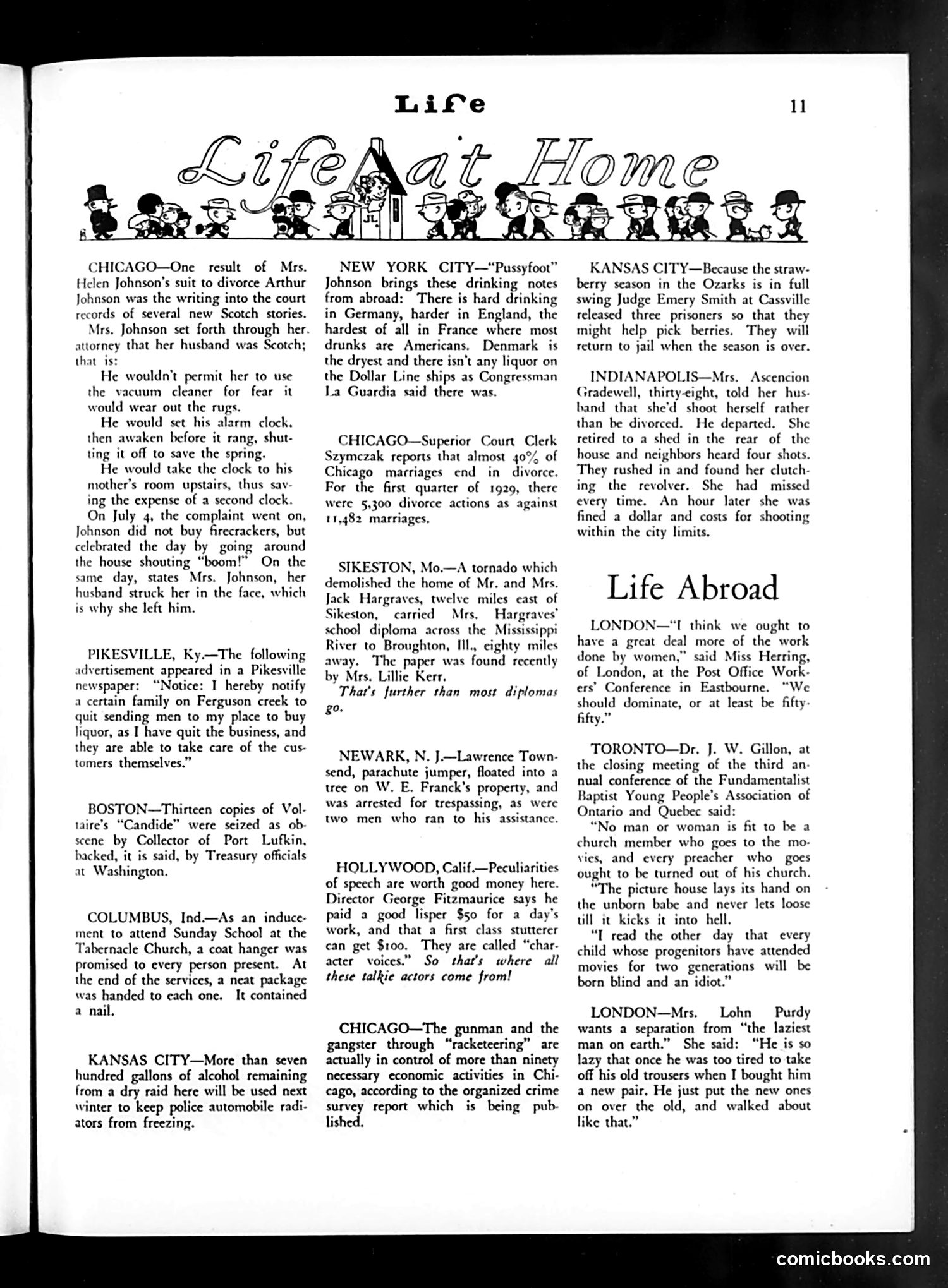
This page contains a "Life at Home" column featuring humorous anecdotes about American domestic life and a "Life Abroad" section with international gossip items. The header illustration shows a row of silhouetted figures in various poses—appearing to be men in hats and formal dress—suggesting the diversity of human behavior being humorously documented. The content satirizes everyday absurdities: a Chicago divorce case where a Scottish husband forbade his wife from using a vacuum cleaner "for fear it would wear out the rugs," and a Kansas woman shooting herself over divorce rather than jail time. The "Life Abroad" section mocks foreign and American attitudes, including commentary on movie actors' salaries in Hollywood and criticism of church attendance. The satire targets domestic quarrels, legal absurdities, and social pretensions of the era.
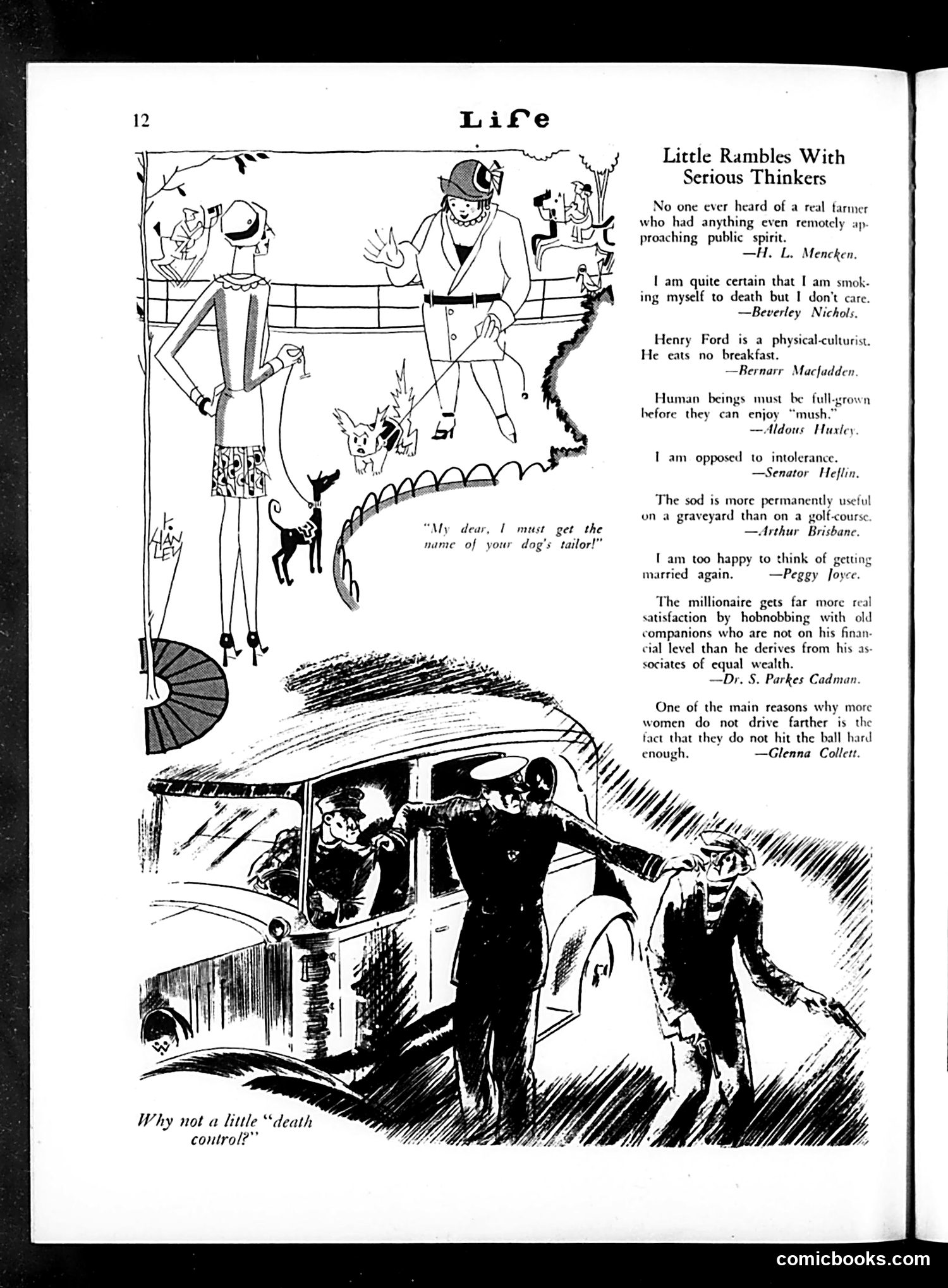
This page presents **"Little Rambles With Serious Thinkers,"** a satirical feature pairing cynical quotes from notable figures (H.L. Mencken, Beverley Nichols, Henry Ford, etc.) with humorous illustrations. The **top cartoon** shows a farmer surrounded by chaos—his animals misbehaving, children playing—while someone asks for his dog's tailor's name, mocking rural life and vanity. The **bottom cartoon** depicts a car accident with the caption "Why not a little 'death control?'" — a dark joke contrasting with period discussions about birth control. It satirizes reckless driving and suggests ironic solutions to overpopulation. Together, the quotes and cartoons mock pretension, agrarian stereotypes, and contemporary social anxieties through absurdist humor typical of 1920s-30s satire.
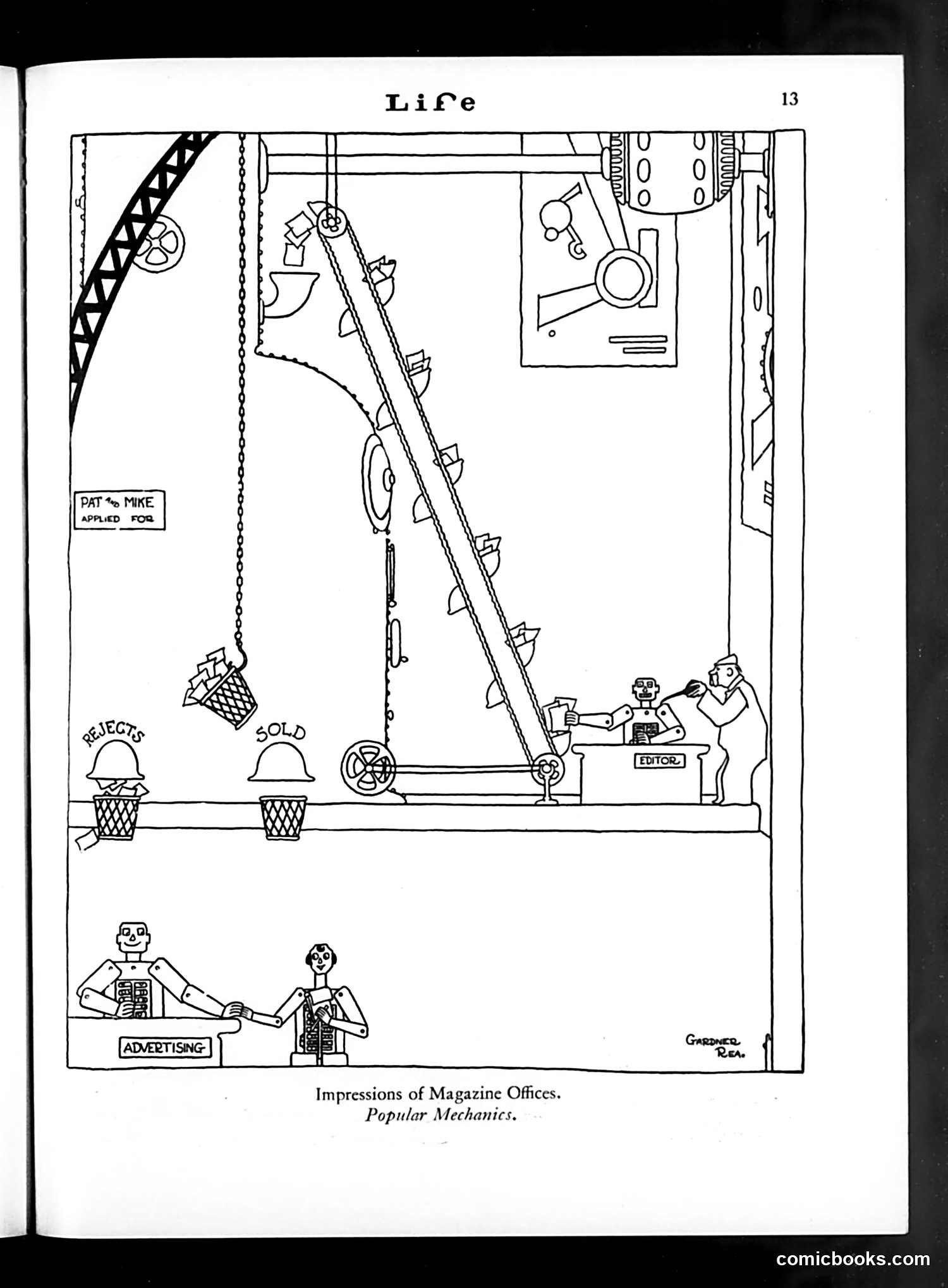
This single-panel cartoon satirizes the operations of a magazine office, specifically depicting the Popular Mechanics editorial workflow. The illustration shows a large industrial crane system dominating the space, suggesting that magazine production is mechanized and industrial rather than creative or intellectual. Key labeled sections visible include "Rejects" and "Sold" baskets (depicting discarded and accepted submissions), an "Editor" at a desk, and an "Advertising" department below with figures handling commercial content. The crane apparatus appears to represent the editorial process itself—mechanically sorting and processing material. The satire mocks how commercial magazines prioritize advertisements and sales over editorial merit, reducing creative work to an assembly-line operation controlled by profit motives rather than journalistic standards.
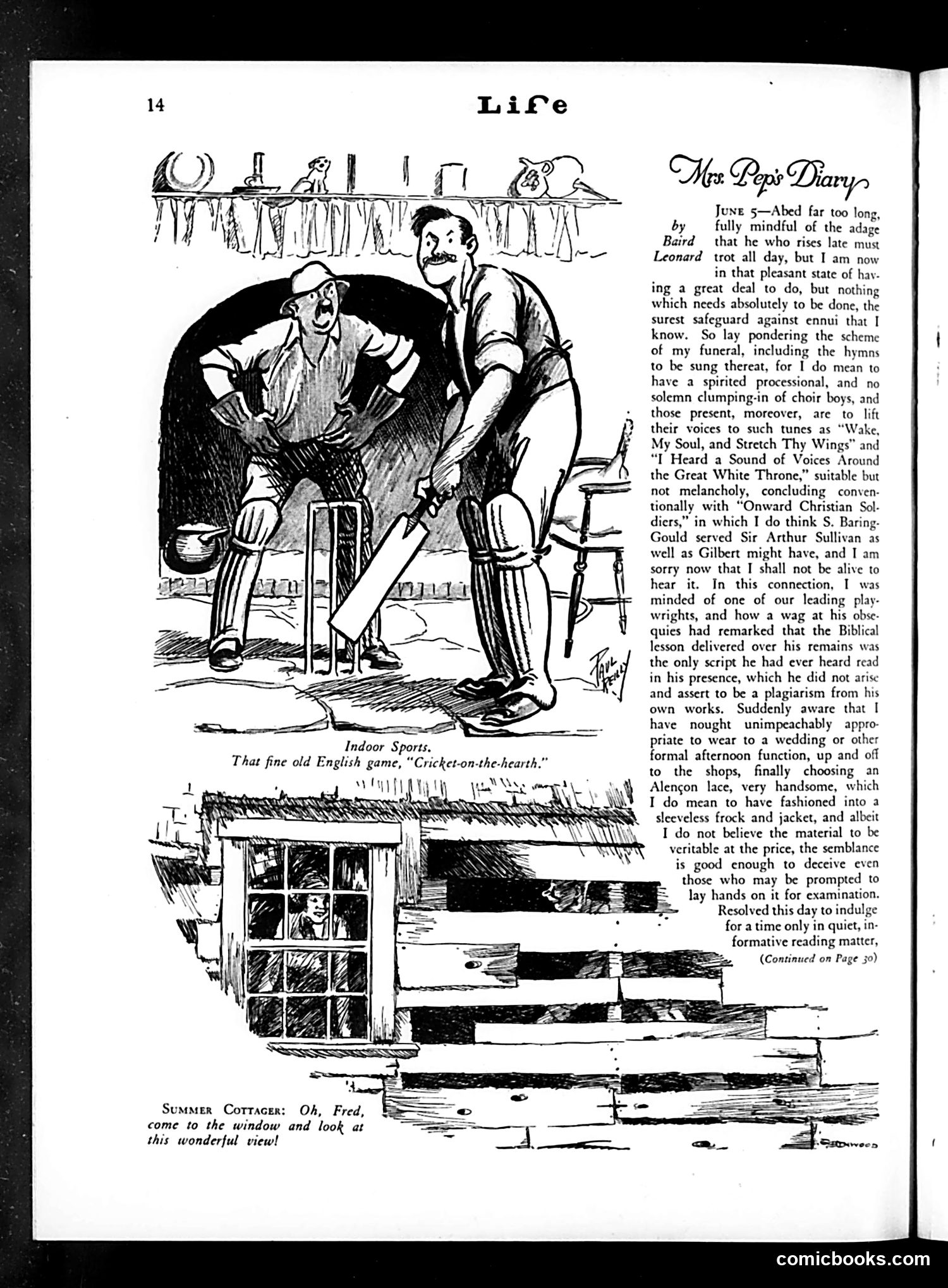
This page presents a diary entry by "Leonard" (byline visible) dated June 5, discussing funeral arrangements and choir music selection. The accompanying illustrations satirize indoor leisure activities. The top cartoon, labeled "Indoor Sports: That fine old English game, 'Cricket-on-the-hearth,'" shows two men playing cricket indoors using a fireplace hearth as the pitch—a visual pun on the phrase "cricket on the hearth" (a cozy domestic scene). The joke mocks the absurdity of playing an outdoor sport inside. The bottom illustration depicts a cottage window with someone looking out, captioned "Summer Cottage: Oh, Fred, come to the window and look at this wonderful view!" Both images use gentle humor to satirize domestic life and leisure activities of the era. The diary entry continues on page 30.
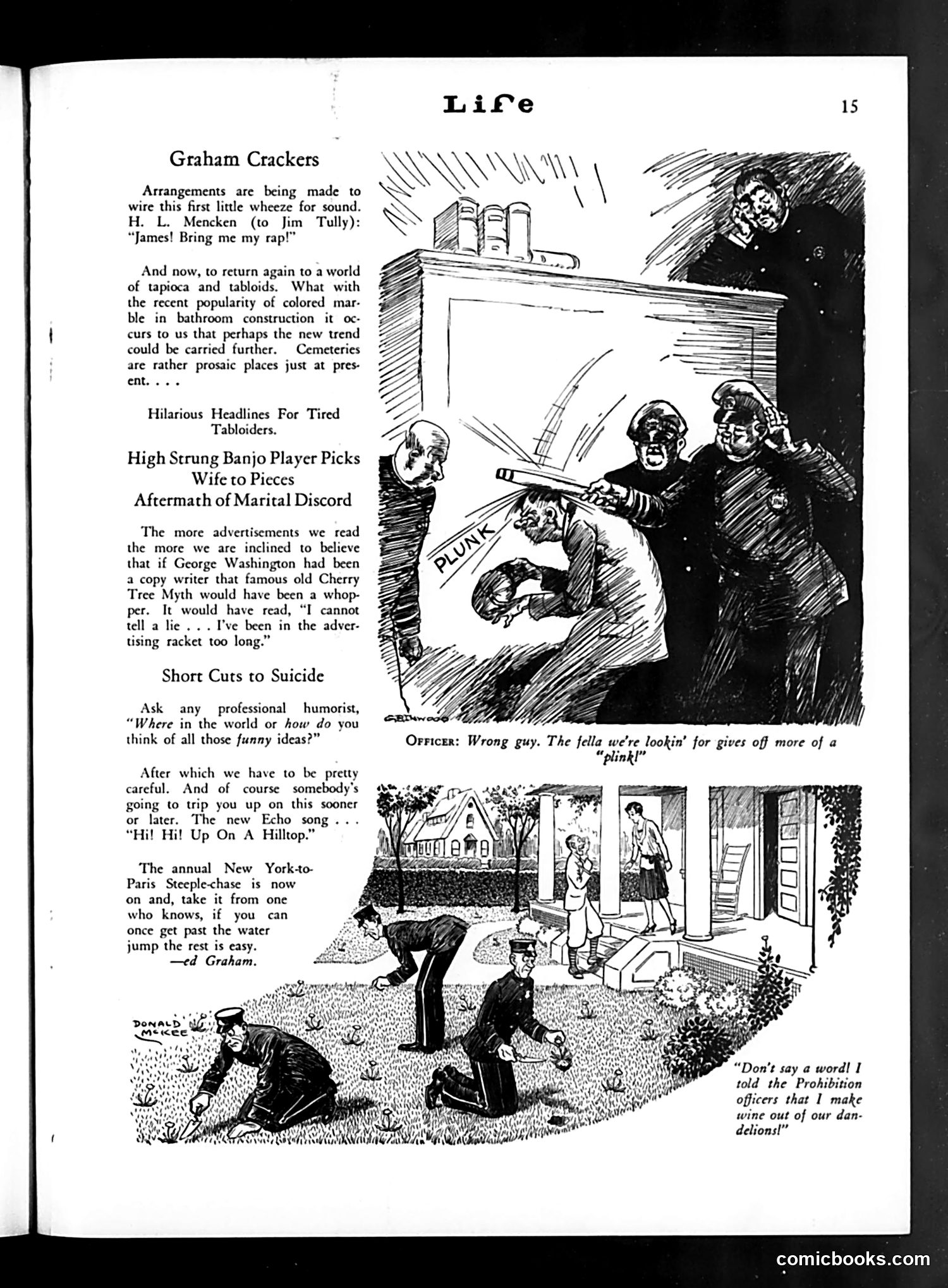
This page contains two editorial cartoons satirizing American society during the Prohibition era. **Top cartoon:** An officer confronts what appears to be bootleggers or speakeasy operators, demanding harder liquor ("gives off more of a 'plink'"). The "plink" sound suggests weak or inferior alcohol. **Bottom cartoon:** Depicts Prohibition enforcement agents conducting raids on a residential house. The caption mocks the contradiction in their work—an officer tells his colleagues not to mention to Prohibition officers that he produces homemade alcohol, suggesting even law enforcement participated in bootlegging. Both cartoons satirize the widespread hypocrisy and failure of Prohibition (1920-1933), when the constitutional ban on alcohol actually increased illegal production and consumption rather than preventing it.
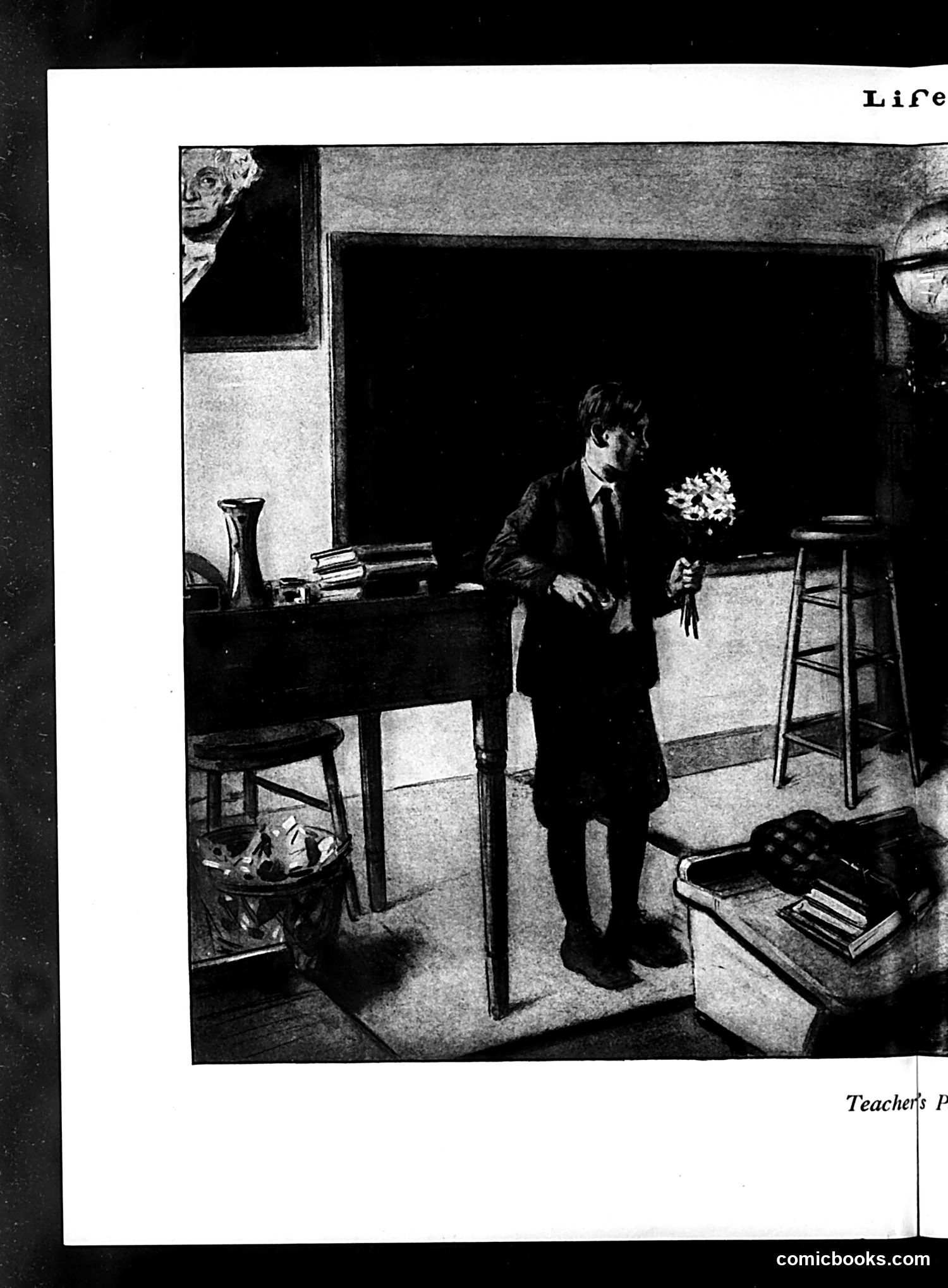
This is a satirical illustration titled "Teacher's Pet" (visible at bottom right). It depicts a classroom scene where a young male student stands holding flowers, apparently presenting them to an unseen teacher. An older man's face peers through a window in the background, observing the scene. The cartoon satirizes the practice of students giving gifts or showing favoritism to teachers—the "teacher's pet" dynamic. The flowers suggest romantic or ingratiating gesture. The observer at the window may represent school administration or a parent witnessing this behavior, adding a voyeuristic element to the satire. This appears to be social commentary on classroom favoritism and the somewhat awkward or questionable nature of student-teacher gift-giving practices in American schools.
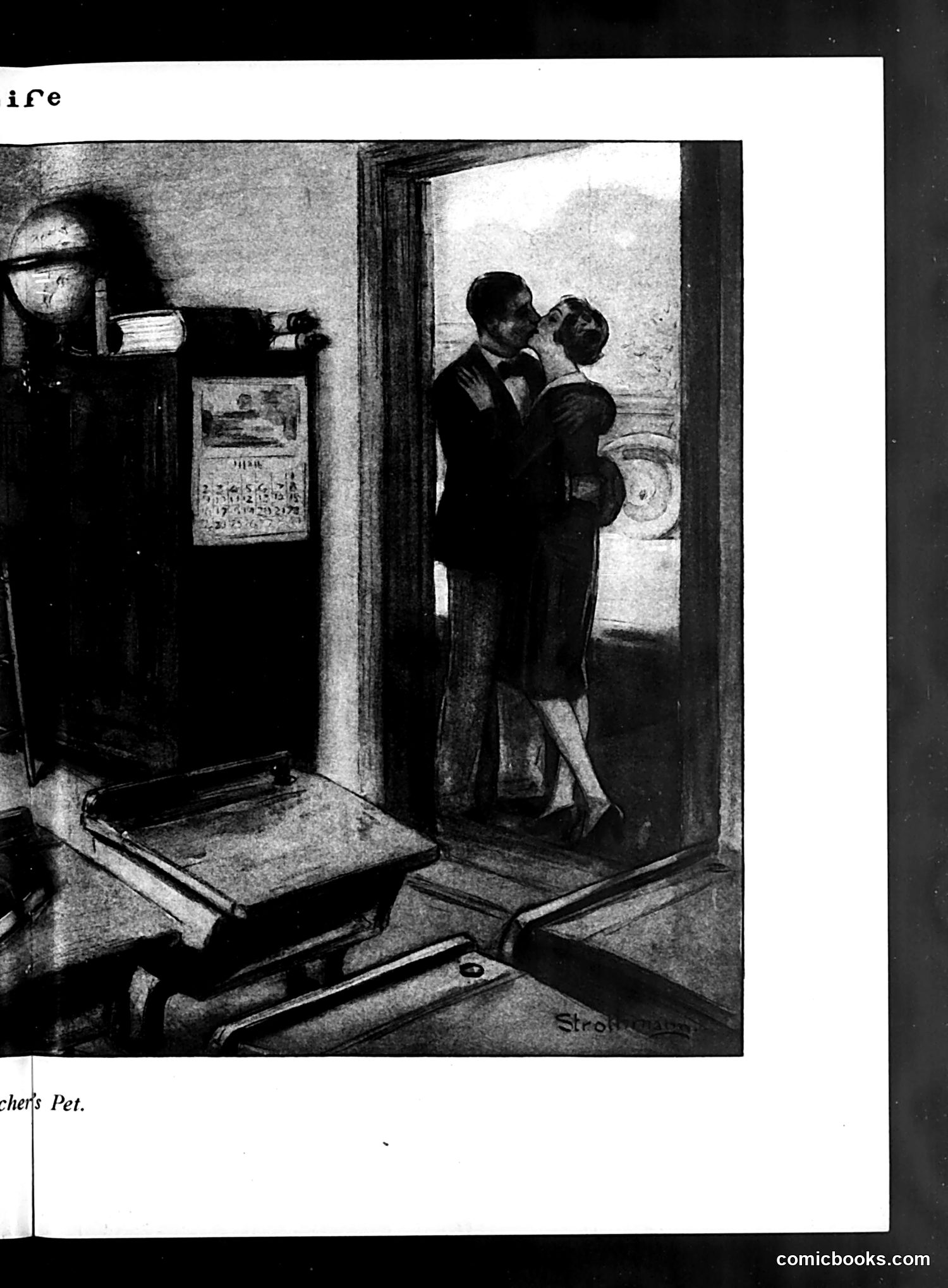
This page from Life magazine depicts what appears to be a satirical scene of an elevator encounter. On the left stands a woman (labeled "cher's Pet" at bottom, text partially cut off) observing the scene. In the center doorway, a man in formal attire holds a woman close while looking at what appears to be a gauge or meter on the right wall. The satire likely mocks contemporary social behavior—specifically, the man using the confined elevator space as an opportunity for physical intimacy while pretending to examine something mechanical. The humor relies on the contrast between the pretense of innocent activity and the actual romantic/physical interaction occurring. The cartoon critiques either elevator etiquette, workplace romance, or social hypocrisy of the era, though without publication date or clearer text, the specific target remains somewhat unclear.
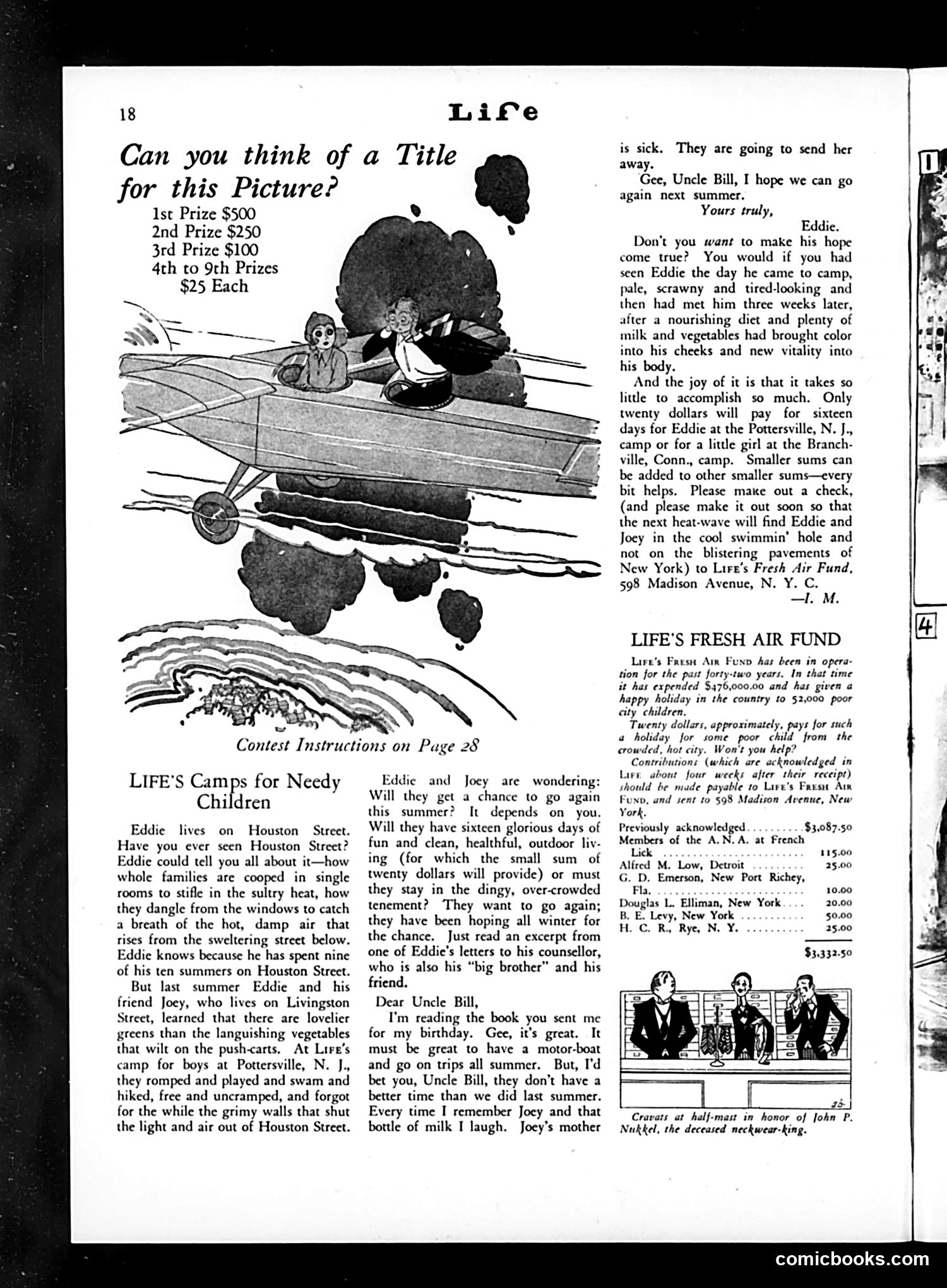
This page is primarily a charitable appeal rather than political satire. The main content features "LIFE's Camps for Needy Children," describing a real charitable initiative that funded summer camp experiences for poor urban children. The illustration shows two women and a child in a boat, appearing to represent the contrast between privileged leisure activities and the impoverished circumstances of children living in tenements on Houston Street in New York City. The text emphasizes how modest donations (twenty dollars) could provide weeks of healthy outdoor activity for children otherwise confined to hot, crowded urban housing. The page includes a contest offering cash prizes for a title for the picture, along with donation information. This appears to be genuine philanthropy messaging rather than satire.
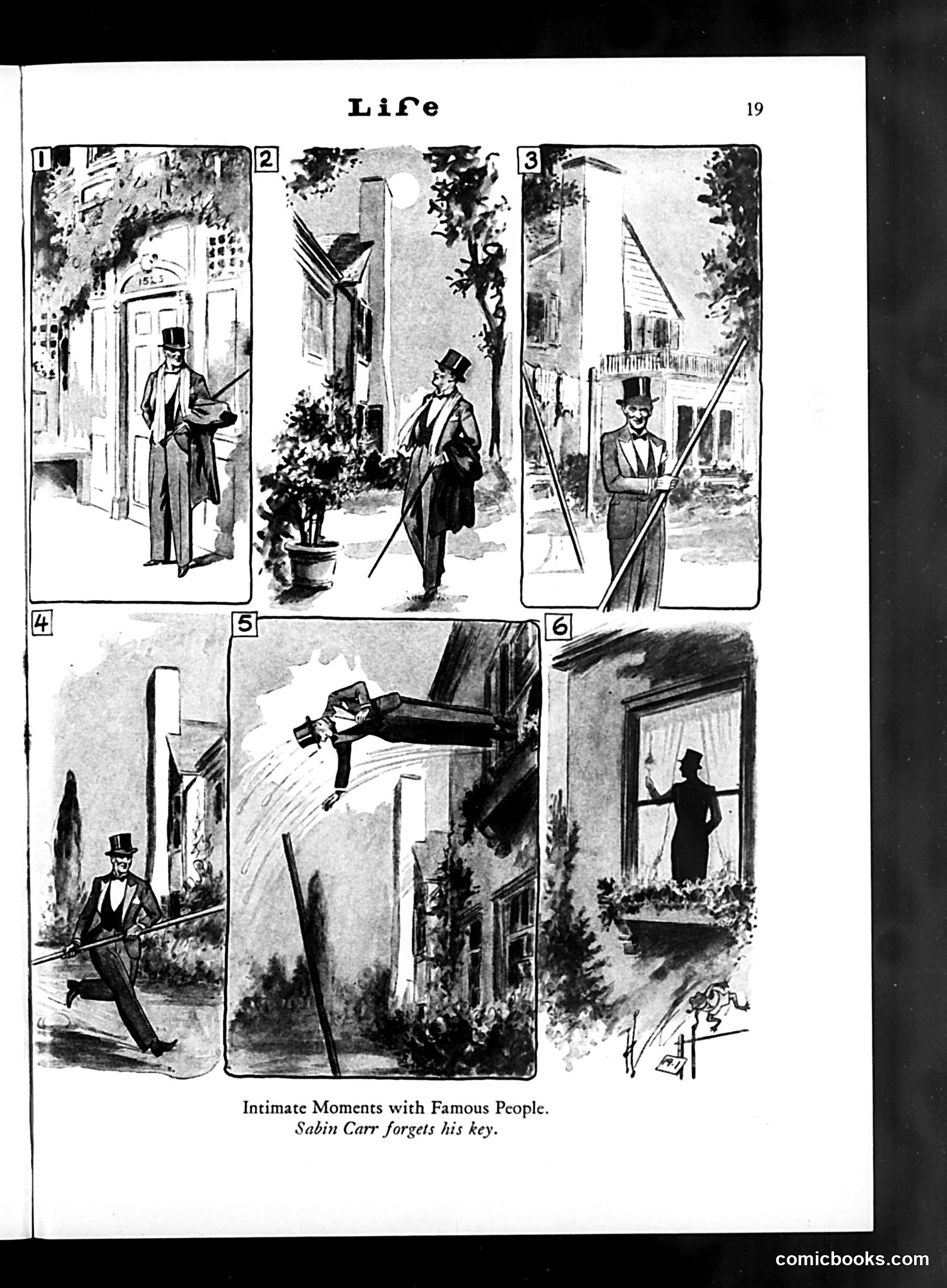
This is a six-panel comic strip titled "Intimate Moments with Famous People: Sabin Carr forgets his key." The strip shows a gentleman in formal attire (top hat and coat) attempting to enter what appears to be his home or office after forgetting his key. The panels depict his escalating efforts to gain entry—examining the door, trying the lock, climbing through a window, falling, and finally being observed by a woman at another window. The humor relies on slapstick physical comedy: a well-dressed, presumably dignified man reduced to undignified scrambling to enter his own residence. The title suggests "Sabin Carr" was a recognizable public figure to Life's contemporary readers, though this identity is not definitively clear from the image alone. The satire appears to mock the gap between public propriety and private desperation.
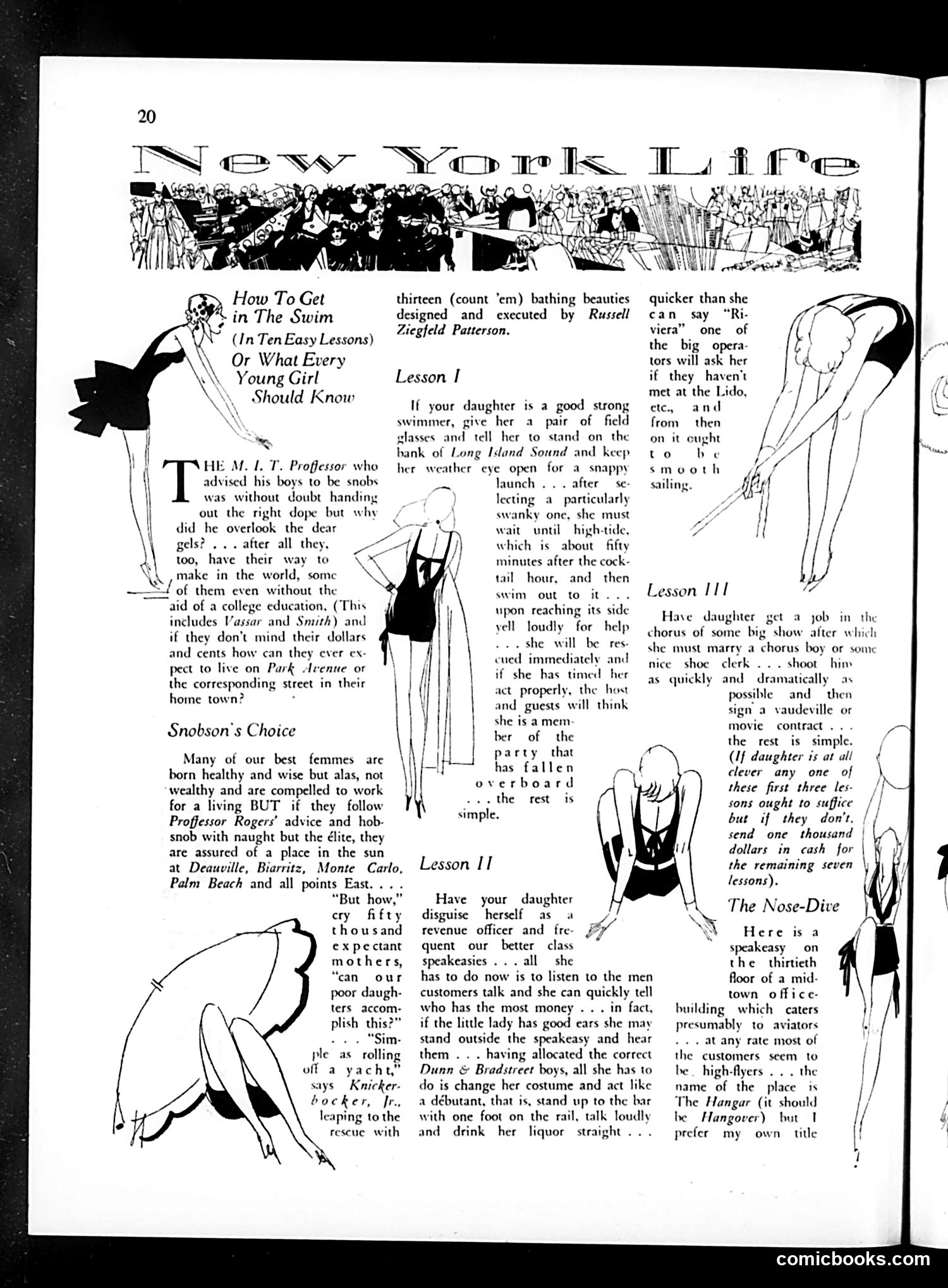
This is a satirical advice column mocking the social-climbing aspirations of young women in the Jazz Age (appears to be 1920s based on references to speakeasies, Prohibition-era "revenue officers," and fashionable resorts like Monte Carlo and Palm Beach). The piece ridicules both the women seeking wealthy husbands and the wealthy elite ("snobs") they pursue. It presents deliberately absurd "lessons" for social advancement: faking a drowning to meet boat owners, posing as a Prohibition agent in speakeasies, marrying chorus boys then divorcing them for publicity, or simply eavesdropping on rich men's conversations to identify the wealthiest targets. The accompanying illustrations by Russell Ziegfeld Patterson show bathing beauties and women in various stages of these schemes. The humor depends on readers recognizing the transparent desperation and phoniness of this gold-digging strategy, while also satirizing the shallow materialism of the wealthy men being hunted.
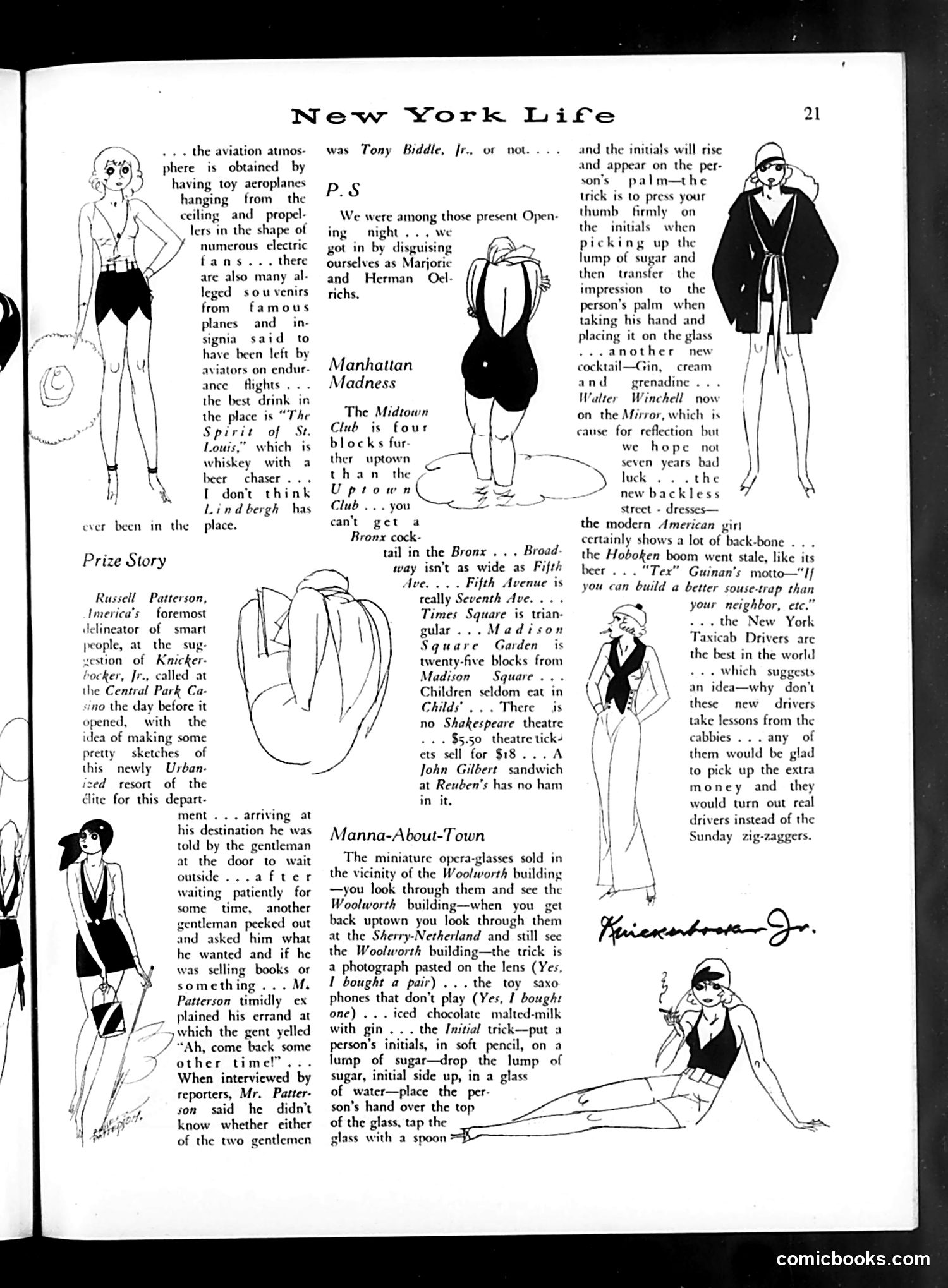
This is a satirical gossip and humor column about Manhattan nightlife and social trends, circa the 1920s (evidenced by references to Lindbergh and the Central Park Casino's recent opening). **Key content:** The "Prize Story" mocks an elite social venue's gatekeepers who rudely turned away illustrator Russell Patterson, not recognizing him. The joke: Patterson gained entry by impersonating wealthy society figures Marjorie and Herman Oelrichs—suggesting the nouveau riche elite were indistinguishable from impostors. **"Manhattan Madness"** contains absurdist one-liners lampooning NYC's geography, commerce, and culture: contradictions about Broadway's width, theaters' high prices ($18 vs. $5.50), and the disconnect between neighborhood names and actual locations. **"Manna-About-Town"** catalogs novelty tourist items and cocktail tricks—opera glasses with painted Woolworth Building lenses, toy saxophones, and sugar-lump initials tricks—satirizing both tourist gullibility and the era's frivolous consumer culture. The illustrations show fashionable 1920s women in period dress, reinforcing the magazine's focus on smart society.
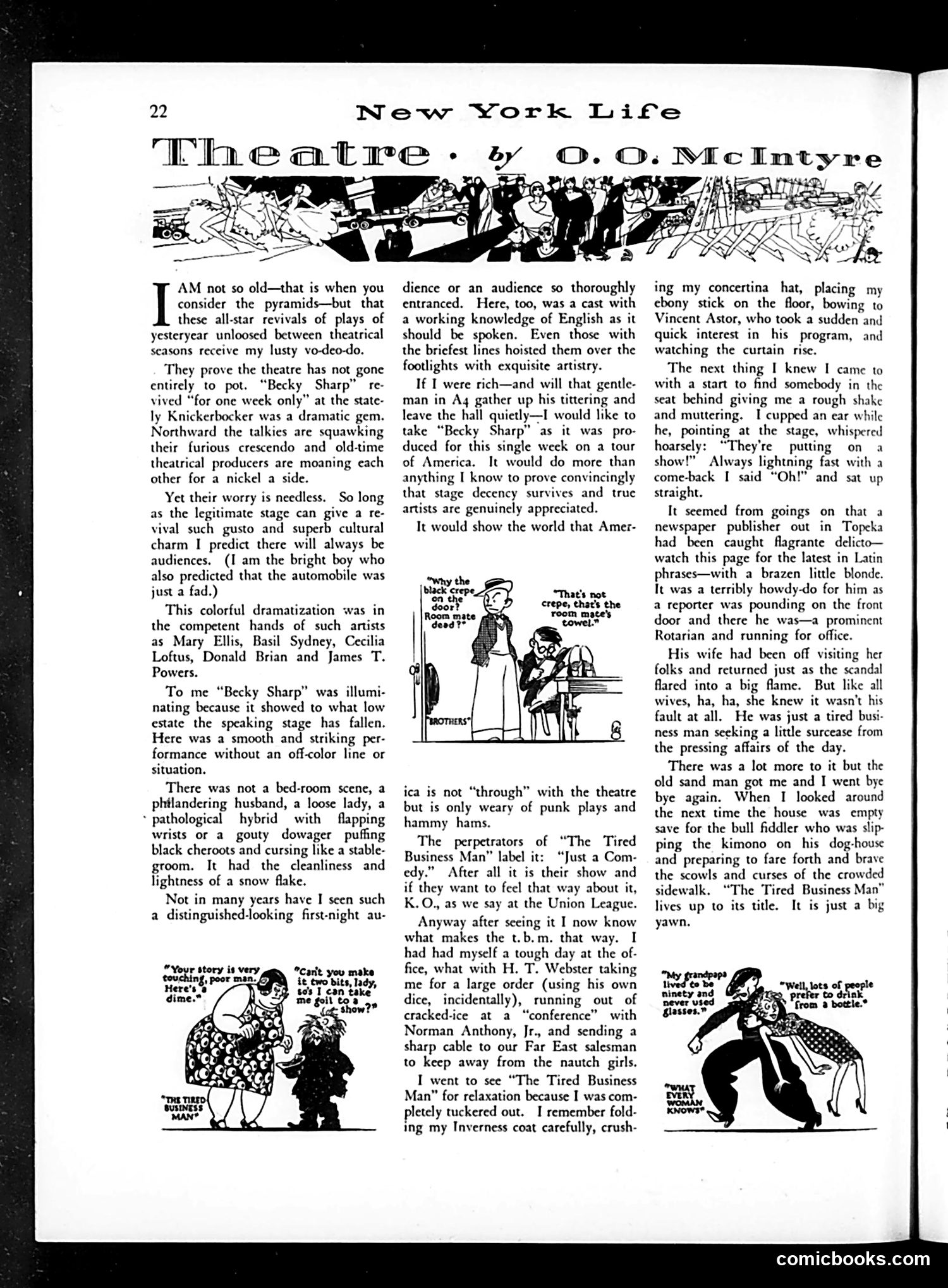
This is O.O. McIntyre's theater column reviewing Broadway productions. The page discusses two plays: **"Becky Sharp"** (praised as wholesome and well-acted) and **"The Tired Business Man"** (criticized as formulaic and dull). The small cartoons illustrate McIntyre's anecdotes: - One shows him discussing a story with a woman ("Here's a dime") - Another depicts him at a show with an audience member shaking him awake, pointing at the stage—illustrating his point that "The Tired Business Man" was so boring he fell asleep McIntyre's satire targets: 1. **Hollywood's threat to theater**: "talkies are squawking" while producers "moan each other for a nickel" 2. **Declining theatrical standards**: modern plays rely on bedroom scenes, affairs, and crude humor rather than artistry 3. **Lazy playwriting**: the "tired businessman" plot (infidelity) is tired itself The humor derives from McIntyre literally becoming the "tired business man"—so exhausted by work (and theater gossip involving H.T. Webster and Norman Anthony Jr.) that he sleeps through the show meant to entertain such men.
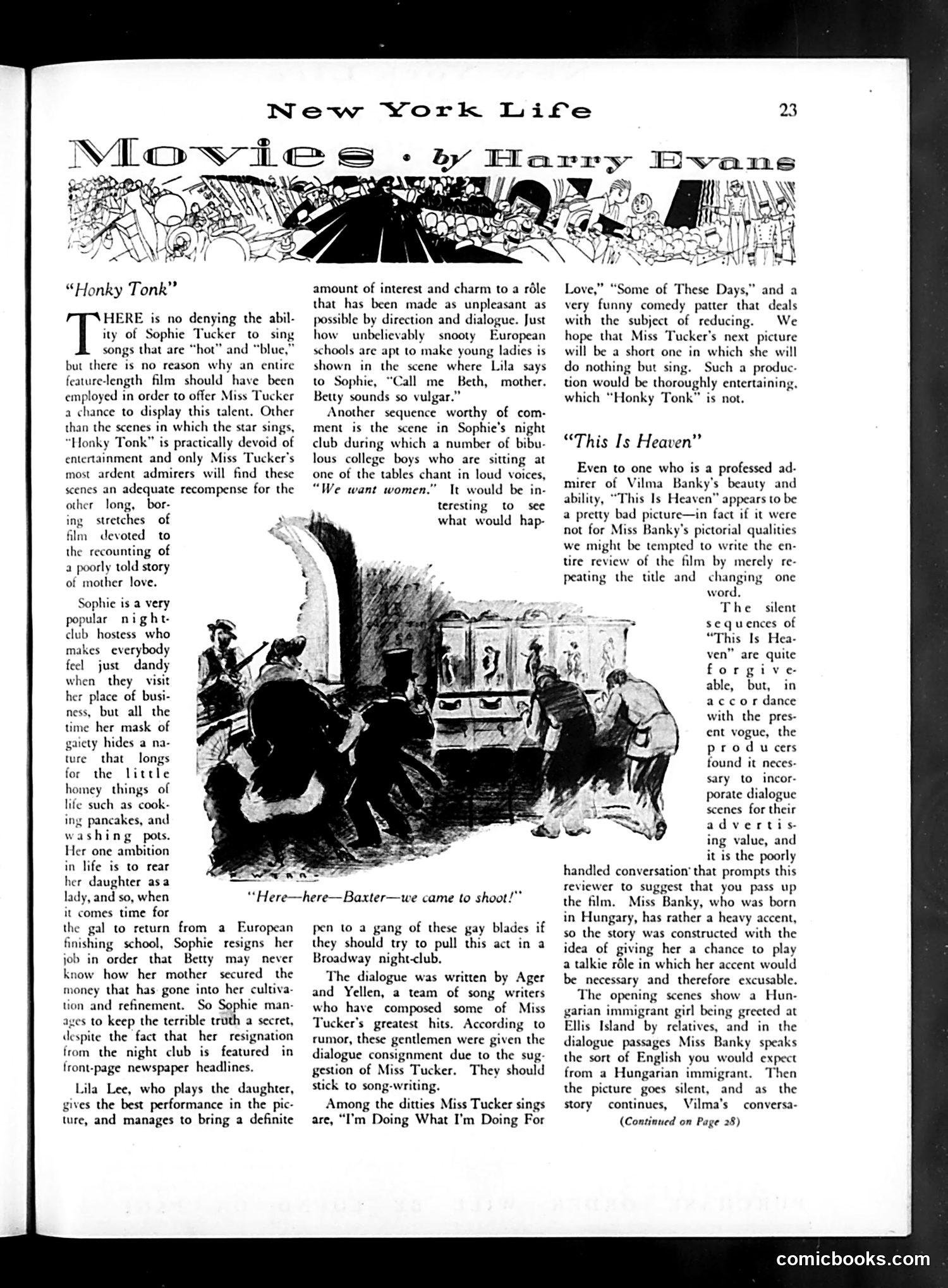
This page contains film criticism by Harry Evans reviewing two movies: "Honky Tonk" (starring Sophie Tucker) and "This Is Heaven" (starring Vilma Banky). **"Honky Tonk"**: Evans criticizes the film as a vehicle built around Tucker's singing talent. The plot concerns a night-club hostess who sacrifices her reputation to fund her daughter's European education, only to have the daughter—snobbishly ashamed—reject her working-class origins. Evans finds the non-musical portions tedious and poorly constructed, though he acknowledges Tucker's popularity and singing ability. **"This Is Heaven"**: Evans dismisses this as a weak picture saved only by Banky's appearance. He notes the film was designed to exploit Banky's Hungarian accent through dialogue scenes, which he finds poorly handled—a comment reflecting the early-talkie era's struggles with non-native English speakers on screen. Both reviews exemplify 1920s silent-film criticism, when "talkies" were introducing dialogue as a selling point rather than dramatic necessity.
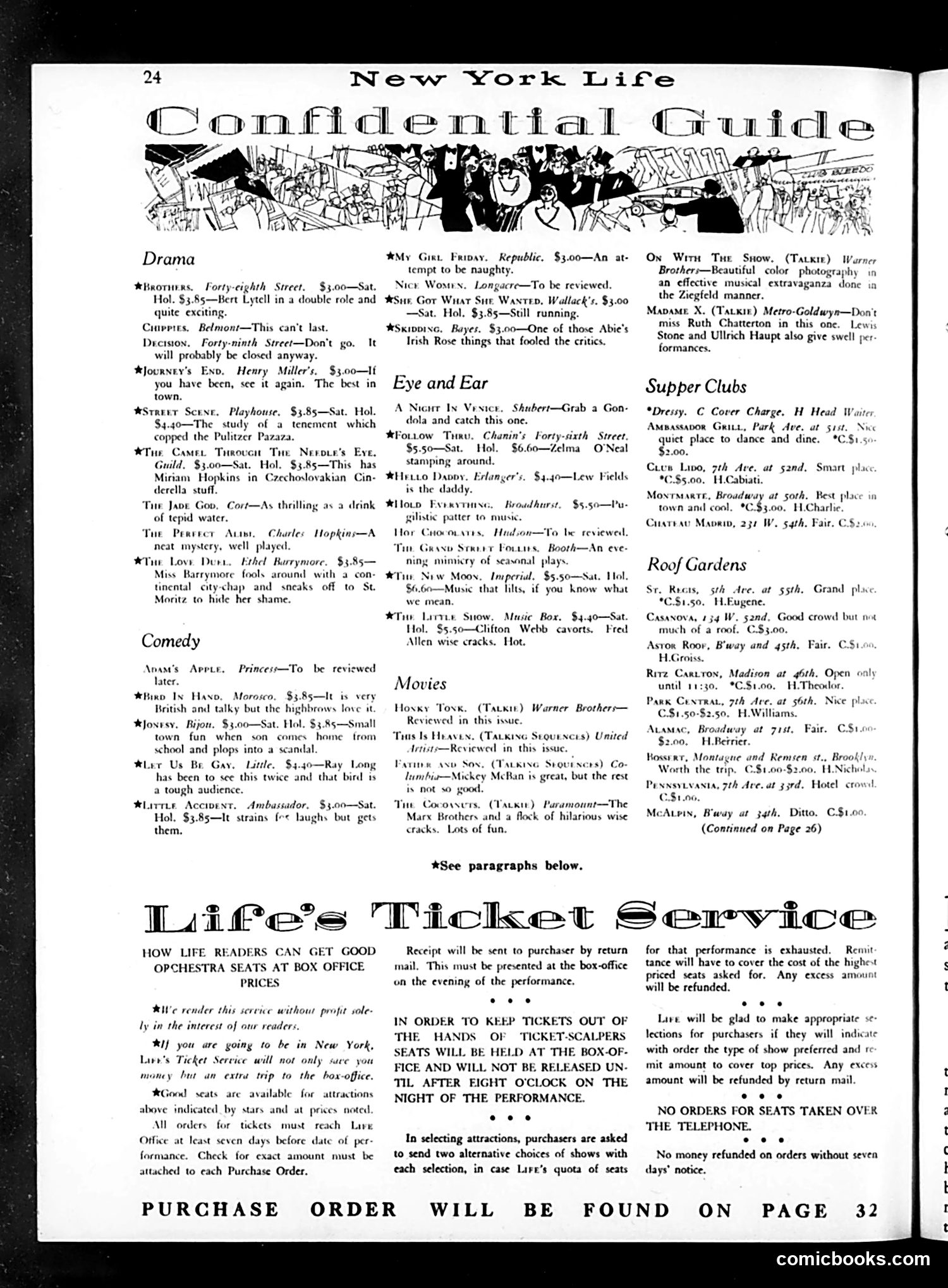
This is a **theater and entertainment guide** from Life magazine—not a political cartoon or satirical piece. It lists Broadway shows, movies, nightclubs, and roof gardens available in New York, with brief critical reviews and prices. The page reflects **1920s entertainment culture**: theaters with live plays dominate, movies (many newly "talking" pictures) are listed separately, and "supper clubs" and "roof gardens" were fashionable venues. Notable details for modern readers: - **"Talkie" notation** distinguishes early sound films from silent ones - Prices ($3–$6.60) and warnings about ticket scalpers show theater's commercial importance - References like "Abie's Irish Rose" and Marx Brothers indicate popular entertainment of that era - The tone is witty and dismissive ("This can't last," "As thrilling as a drink of tepid water") This is essentially a **contemporary entertainment listings page**—the ancestor of modern theater reviews and "what's on" guides.
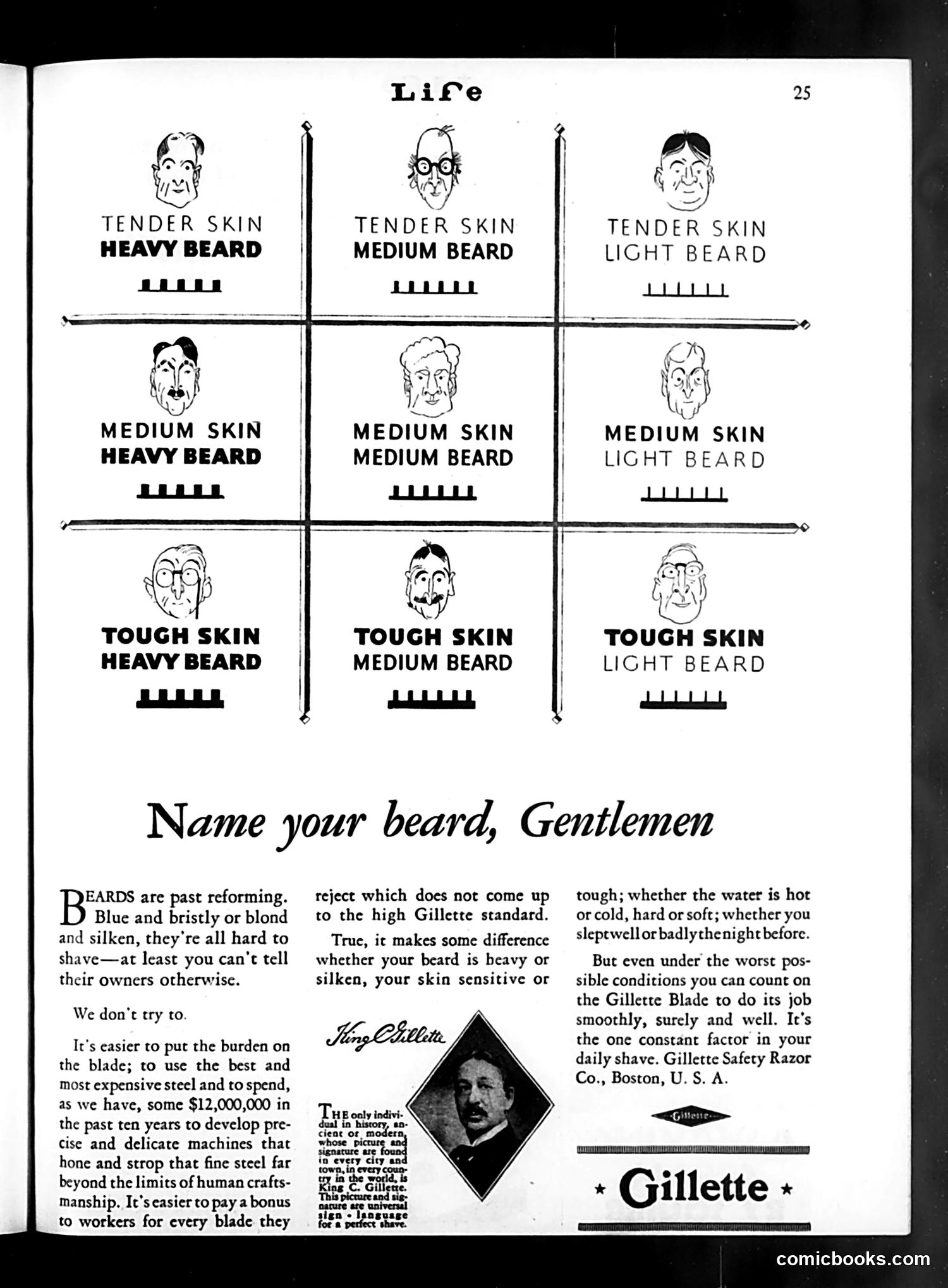
This is primarily a **Gillette razor advertisement** disguised as humorous content. The 3x3 grid at top categorizes nine male face types by skin texture (tender/medium/tough) and beard density (light/medium/heavy)—a playful taxonomy suggesting that shaving challenges vary widely among men. The advertisement's strategy is clever: rather than claim one razor works for everyone, Gillette *acknowledges* these differences exist, then argues the blade itself—not technique or skin type—is the constant factor. The company boasts $12 million invested in precision manufacturing and worker bonuses for quality control, positioning the blade as superior technology that compensates for individual variation. The portrait of "King Gillette" (the founder) reinforces the brand's authority and longevity. This approach—admitting product limitations while emphasizing engineering excellence—was sophisticated marketing for early 20th-century readers accustomed to simpler product claims.
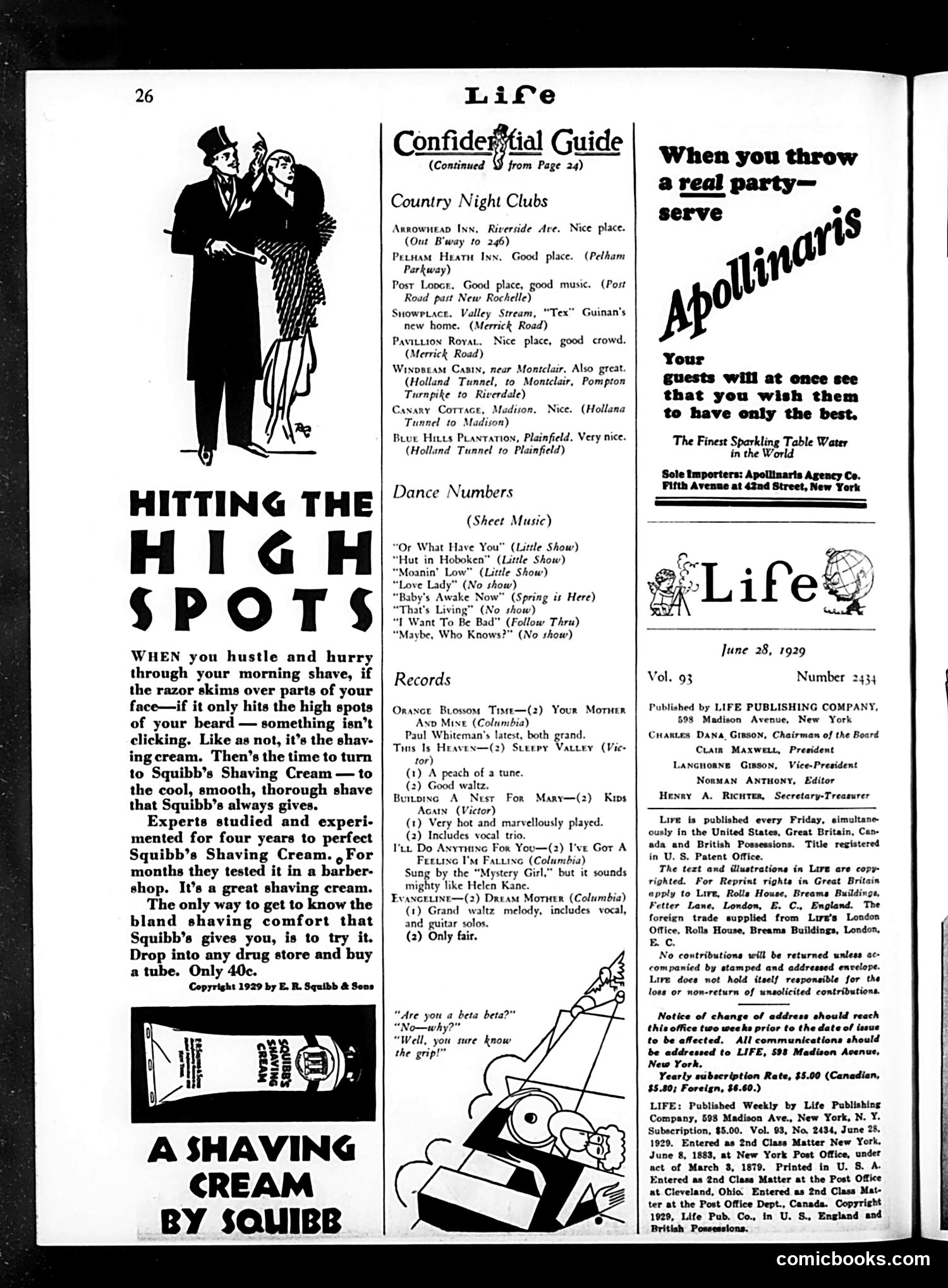
This page is primarily a **commercial advertisement** for Squibb shaving cream, using a play on words for satire. The phrase "hitting the high spots" typically means visiting nightlife venues or enjoying entertainment—reinforced by the "Confidential Guide" listing country night clubs and dance records on the same page. The ad humorously applies this phrase to **shaving**, claiming that inferior shaving cream only catches the "high spots" of facial hair, leaving patches missed. The solution: Squibb's shaving cream, perfected over four years and tested in barbershops, promises complete coverage. The cartoon shows a couple dressed for a night out, connecting the advertisement's leisure-lifestyle context to the nightlife guide beside it. The humor relies on the **double meaning**—equating thorough shaving with thorough enjoyment of modern entertainment and consumer products. This reflects 1929's consumer culture optimism and advertising's growing sophistication in using wordplay and lifestyle branding.
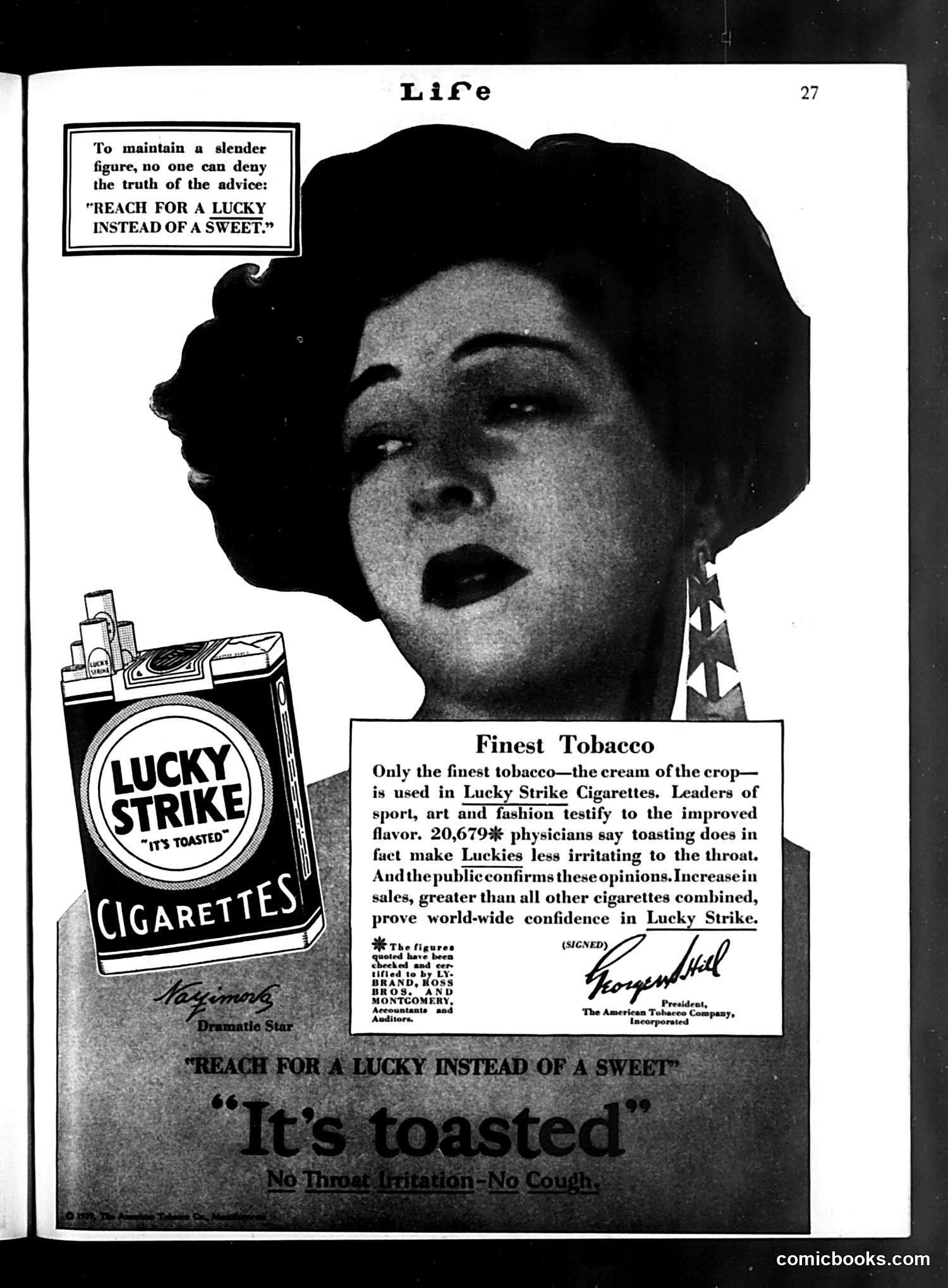
This is a **cigarette advertisement**, not satire—though it contains what modern readers would recognize as deeply problematic marketing. The ad features an attractive woman ("Dramatic Star," identified by signature) promoting Lucky Strike cigarettes. The central pitch exploits weight-conscious women: "Reach for a Lucky instead of a sweet" suggests cigarettes suppress appetite, positioning smoking as a diet aid rather than admitting nicotine addiction. The ad cites dubious claims: "20,679 physicians" allegedly endorse the product, and "toasting" supposedly reduces throat irritation. These figures are fabricated or misleading—a common tactic in early-20th-century tobacco marketing before advertising regulations. What's jarring to modern readers: the open marketing of cigarettes to women for weight control, the false health claims, and the celebrity endorsement strategy—all now recognized as deceptive practices that contributed to widespread smoking addiction and disease.
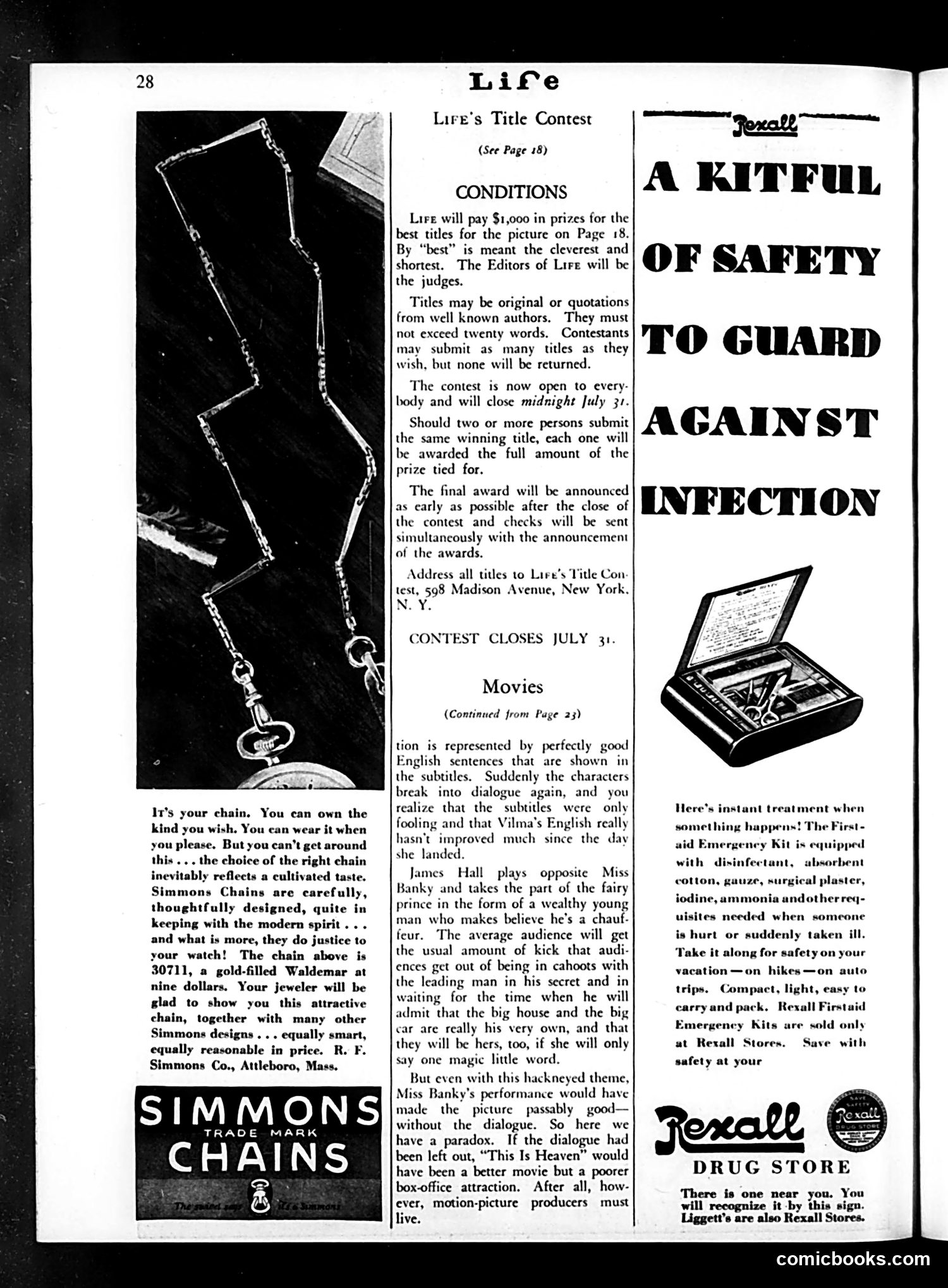
This page is primarily **commercial advertising** with secondary content. ## Main Content: **Simmons Chains Advertisement** (left): A jewelry ad promoting gold-filled watch chains, emphasizing that chain selection reflects "cultivated taste" and complements one's watch. The featured "Waldemar" design costs nine dollars. **Life's Title Contest** (center): A reader participation contest offering $1,000 in prizes for clever, short titles (under 20 words) for an unnamed picture on page 18. Closes July 31. This was common engagement strategy for magazines of this era. **Movie Review** (right column): Discussion of the film "This Is Heaven," featuring actress Vilma Banky and James Hall. The reviewer notes a paradox: the film would be better artistically without dialogue but performs worse at the box office. **Rexall First-Aid Kit Advertisement** (right): Marketing emergency medical kits as portable safety equipment for vacations and automobile trips. The page reflects 1920s consumer culture and early sound-film transition issues.
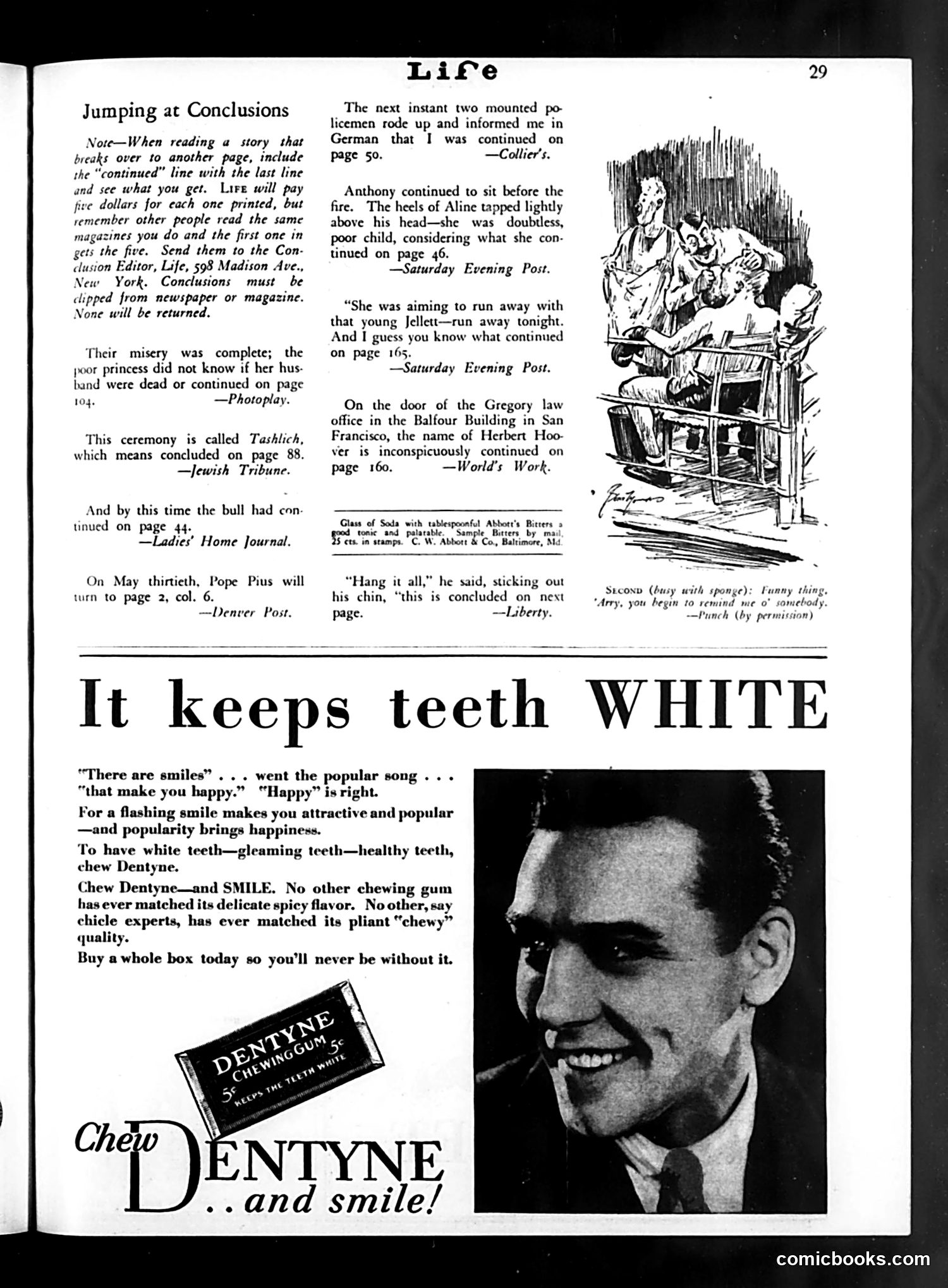
This page presents a humor feature mocking the common frustration of serialized magazine stories that span multiple pages. The "Jumping at Conclusions" section collects absurd, unintentionally hilarious results when readers connect the ending of one article directly to the "continued on page X" notice—creating nonsensical juxtapositions. Examples include: "the poor princess did not know if her husband were dead or continued on page 104" and "Pope Pius will turn to page 2, col. 6." The satire targets both magazine editors' poor layout decisions and readers' experience of fragmented narratives. The page also includes a small cartoon by Punch depicting two workers, and a Dentyne chewing gum advertisement promoting white teeth and smiling—typical 1920s-30s consumer advertising emphasizing beauty and social appeal. The feature invites readers to submit their own "conclusions" for payment, making it participatory satire.
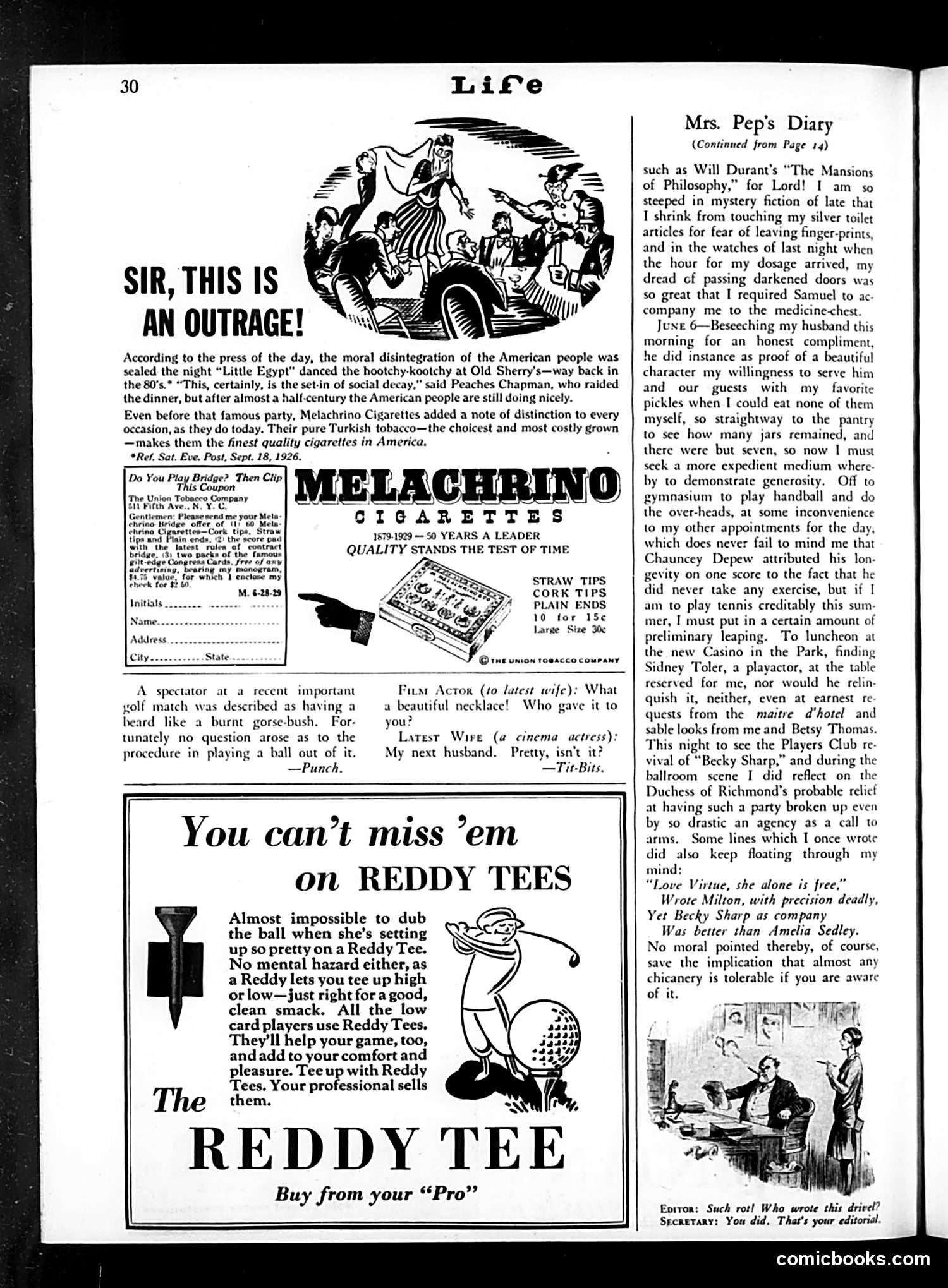
This page contains satirical commentary on American morality wrapped in cigarette advertising. The main cartoon mocks contemporary pearl-clutching over alleged moral decay. It references "Little Egypt," who performed a scandalous belly dance ("hootchy-kootchy") at an 1880s dinner party, which moralists claimed signaled America's social collapse. The joke: nearly 50 years later, society survived fine—undermining conservative hysteria about each generation's "corrupting" entertainments. The page also includes gossip items and a society diary mocking pretentious upper-class life, plus product advertisements for golf tees and cigarettes. The overall effect satirizes both moral panic and the advertising industry's exploitation of aspirational consumer culture. The "outrage" headline is ironic—Life is deflating exaggerated fears of decline while simultaneously selling luxury goods to the very anxious public it's mocking.
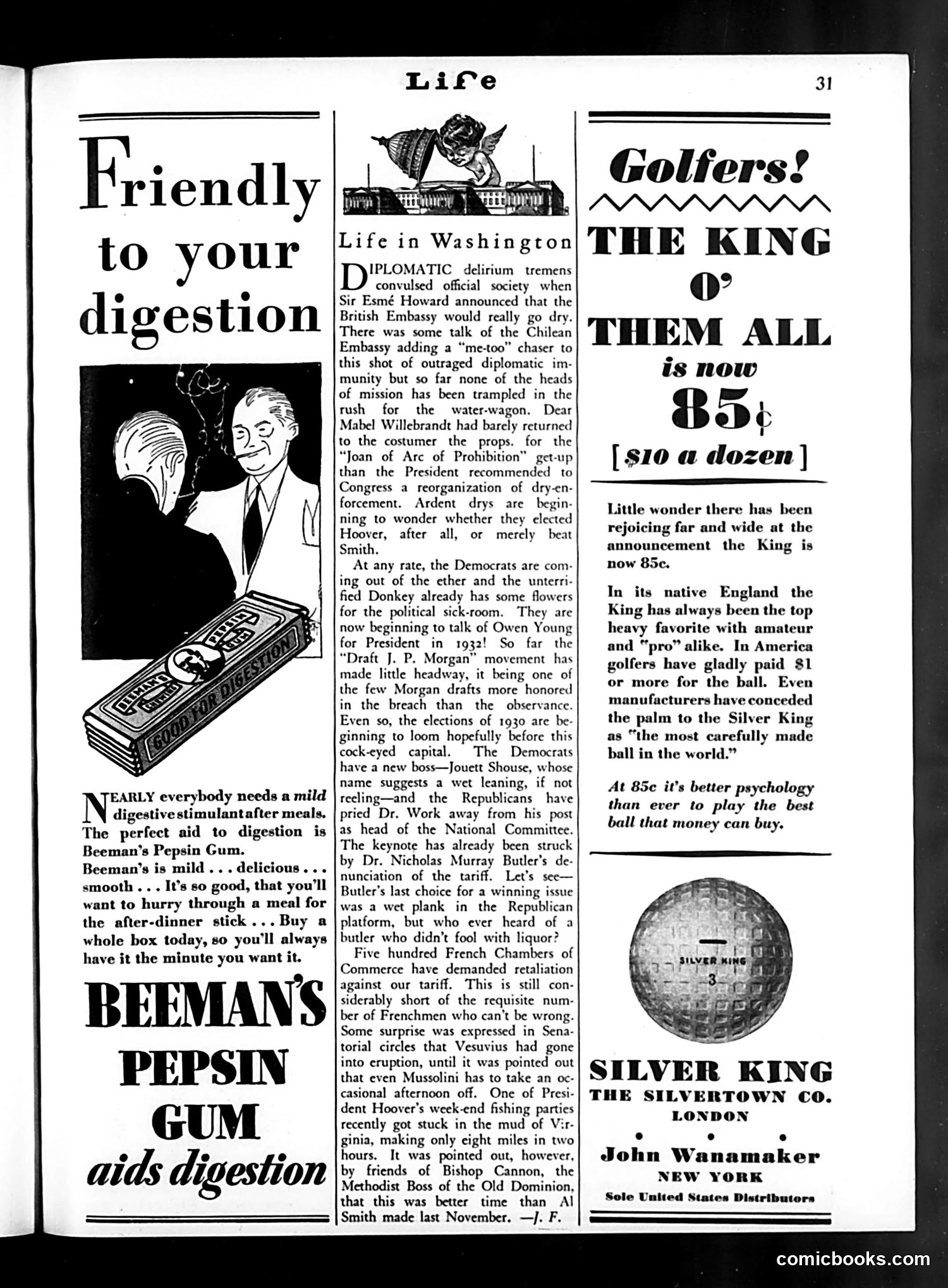
This page mixes advertising with political satire from the Prohibition era (appears to be late 1920s-early 1930s). **Left side:** A Beeman's Pepsin Gum ad featuring a cartoon man and woman, playing on post-meal digestion needs. **Center:** "Life in Washington" political column by J.F. (likely columnist J.F. Gould) satirizes recent political developments: - The British Embassy's commitment to Prohibition ("going dry") - Mabel Willebrandt, a prominent Prohibition enforcement figure - President Hoover's reorganization of dry-enforcement agencies - Democratic Party maneuvering, mentioning Owen Young for potential 1932 presidential run - References to Al Smith (likely the 1928 Democratic candidate, associated with opposing Prohibition) - Jokes about Republican and Democratic leadership positions **Right side:** Advertisement for "Silver King" golf balls, now priced at 85 cents—marketed as superior quality at an affordable price. The satire targets Prohibition politics and shifting party strategies during this turbulent period.
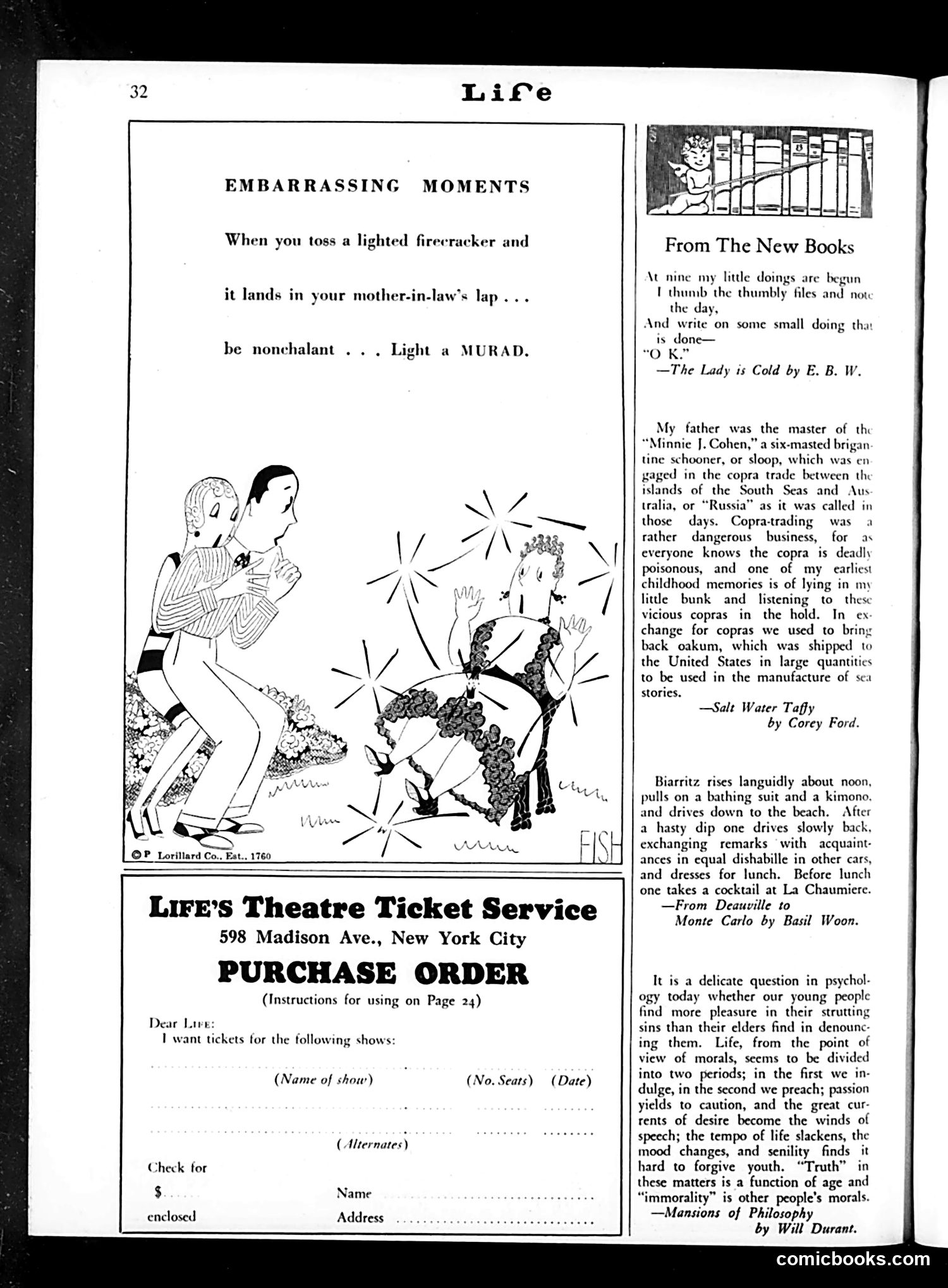
This advertisement uses humor to sell Murad cigarettes. The cartoon depicts a mortifying social scenario: a man has tossed a lit firecracker that lands in his mother-in-law's lap, causing her distress (shown by her shocked expression and the explosive impact). The joke's advice is to remain calm and cool in this awkward situation—specifically by lighting a cigarette. The humor relies on the mother-in-law being a stock figure of comedy (the difficult, fault-finding relative), and the absurdity of treating a genuinely dangerous accident with indifference. By smoking Murad, the implication goes, one projects such nonchalant sophistication that even disaster becomes manageable. This plays on mid-20th century advertising's association of cigarettes with composure and masculine aplomb—a marketing angle that would be unthinkable today.
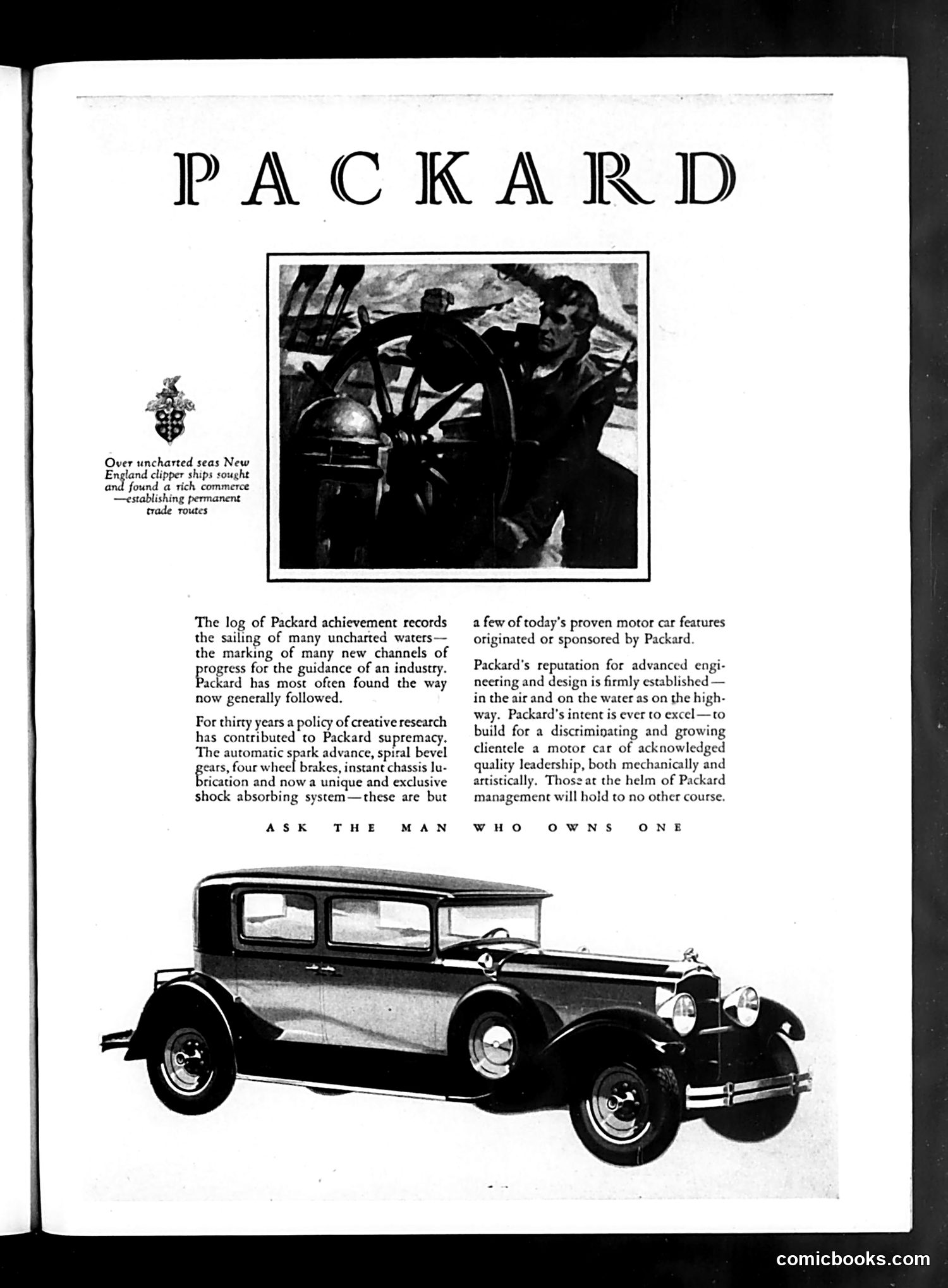
This is a **Packard automobile advertisement**, not political satire. The page uses historical metaphor to market luxury cars: the opening image of clipper ships discovering trade routes parallels Packard's claim to pioneering automotive innovation. The advertisement asserts that Packard has led the industry for thirty years, originating features like automatic spark advance, spiral bevel gears, four-wheel brakes, and shock absorption systems. The bottom half displays a 1920s-era Packard sedan. The tagline "Ask the man who owns one" was Packard's actual famous slogan, implying satisfied owners would testify to quality. For modern readers: this targets affluent, discriminating buyers by positioning Packard as the thoughtful luxury choice—not merely expensive, but technologically superior and artistically refined. The maritime metaphor suggests exploration and prestige rather than mass-market accessibility.
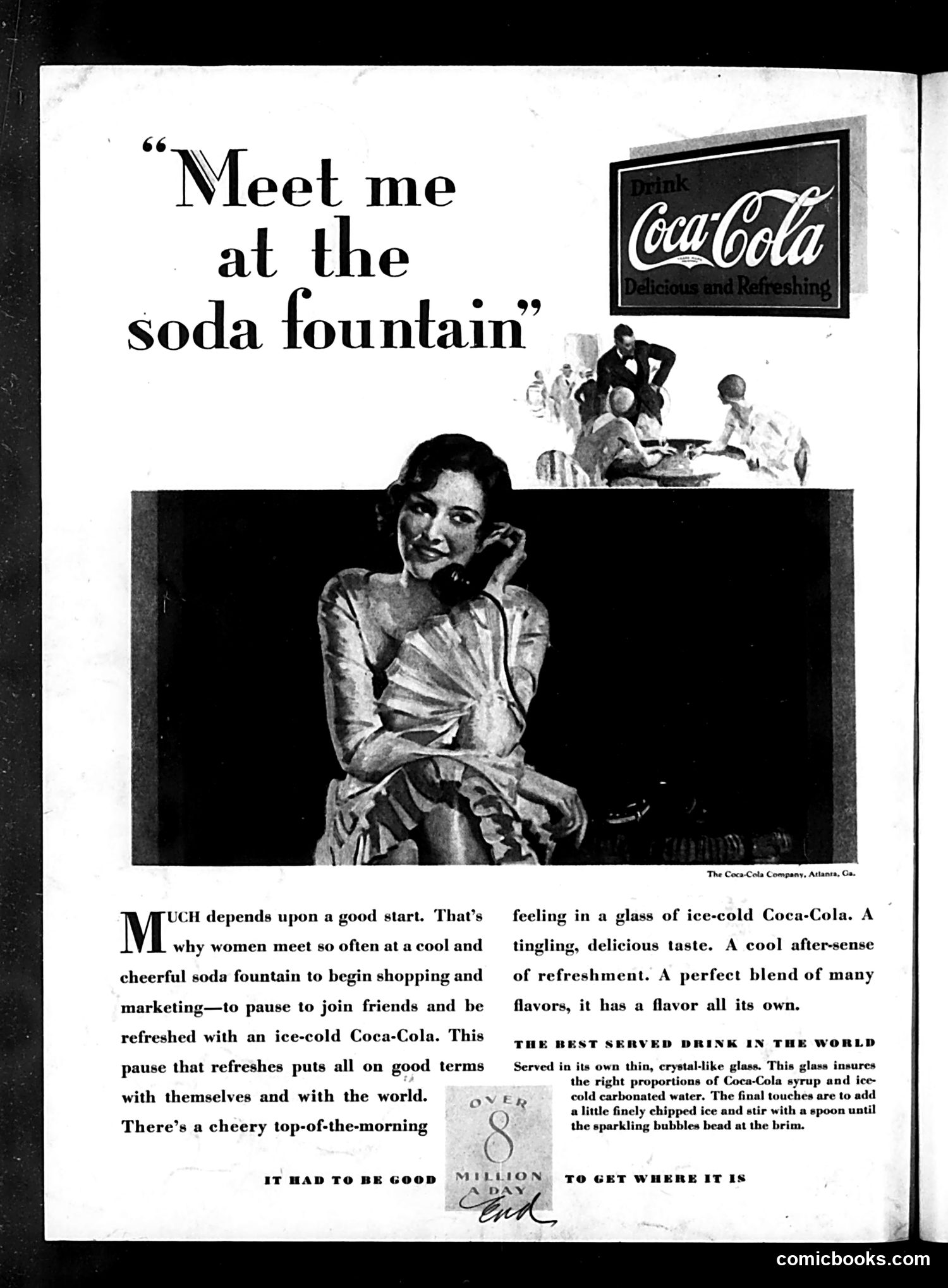
This is a **Coca-Cola advertisement**, not satire or a political cartoon. It depicts a woman on the telephone with the tagline "Meet me at the soda fountain." The ad targets female consumers by associating soda fountains as social gathering spaces for women during shopping and errands. It frames Coca-Cola consumption as a refreshing social ritual that improves mood and relationships ("puts all on good terms with themselves and with the world"). The background shows other patrons at a fountain, normalizing it as a popular destination. The ad emphasizes product details (the specific glass, proportions, ice preparation) to establish quality and consistency. The "8 Million a Day" claim suggests Coca-Cola's market dominance. This represents early 20th-century marketing strategy: positioning a commercial product as essential to modern social life and specifically appealing to women as consumers making leisure and social decisions.

I can see this is a blank or nearly blank page from Life magazine, with only a "comicbooks.com" watermark visible at the bottom. There is no discernible cartoon, illustration, text content, or political commentary visible on this page to analyze. This appears to be either a blank page from the magazine's original printing, a title page, or an advertising page that has not reproduced clearly in this image. Without visible content—whether satirical cartoons, figures, caricatures, or contextual text—I cannot identify specific political or social references, intended satire, or historical meaning for a modern reader. A clearer image or a different page would be needed for meaningful analysis.