
Life, 1929-06-28 · page 25 of 37
Life — June 28, 1929 — page 25: what you’re looking at
What you’re looking at
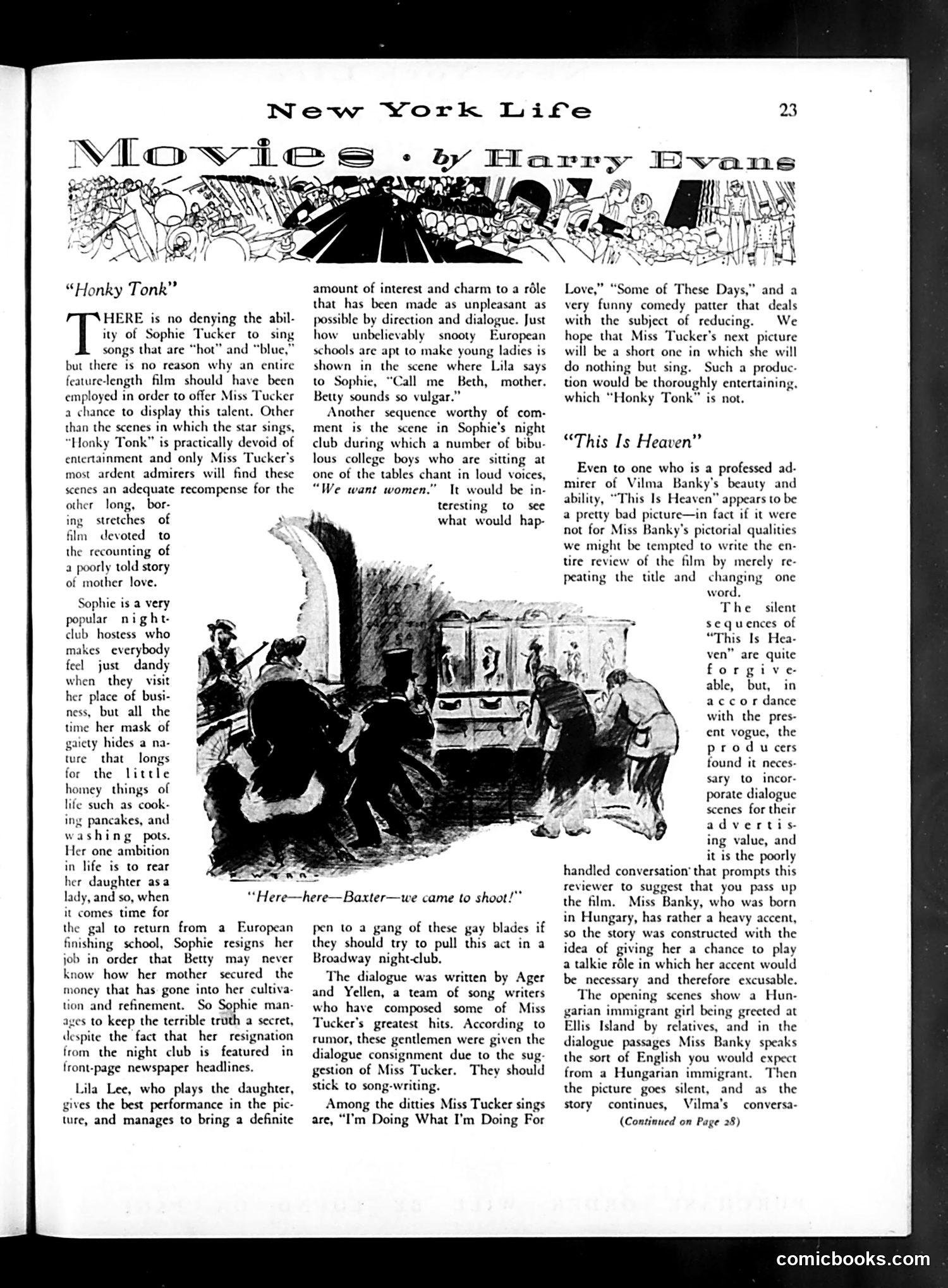
This page contains film criticism by Harry Evans reviewing two movies: "Honky Tonk" (starring Sophie Tucker) and "This Is Heaven" (starring Vilma Banky). **"Honky Tonk"**: Evans criticizes the film as a vehicle built around Tucker's singing talent. The plot concerns a night-club hostess who sacrifices her reputation to fund her daughter's European education, only to have the daughter—snobbishly ashamed—reject her working-class origins. Evans finds the non-musical portions tedious and poorly constructed, though he acknowledges Tucker's popularity and singing ability. **"This Is Heaven"**: Evans dismisses this as a weak picture saved only by Banky's appearance. He notes the film was designed to exploit Banky's Hungarian accent through dialogue scenes, which he finds poorly handled—a comment reflecting the early-talkie era's struggles with non-native English speakers on screen. Both reviews exemplify 1920s silent-film criticism, when "talkies" were introducing dialogue as a selling point rather than dramatic necessity.
📄 Transcribed text from this page (OCR, searchable)
Machine-transcribed from the original scan — historical spelling and the odd misread are preserved.
New York Life 23 “Honky Tonk” HERE is no denying the abil- ity of Sophie Tucker to sing songs that are “hot” and “blue,” but there is no reason why an entire feature-length film should have been employed in order to offer Miss Tucker a chance to display this talent. Other than the scenes in which the star sings, “Honky Tonk” is practically devoid of entertainment and only Miss Tucker's most ardent admirers will find these scenes an adequate recompense for the other long, bor- ing stretches of film devoted to the recounting of a poorly told story of mother love. Sophie is a very popular night club hostess who makes everybody feel just dandy when they visit her place of busi- ness, but all the time her mask of gaiety hides a na- ture that longs for the little homey things of life such as cook- ing pancakes, and washing pots. Her one ambition in life is to rear her daughter asa lady, and so, when it comes time for the gal to return from a European finishing school, Sophie resigns her job in order that Betty may never know how her mother secured the money that has gone into her cultiva- tion and refinement. So Sophie man- ages to keep the terrible truth a secret, despite the fact that her resignation from the night club is featured in front-page newspaper headlines. Lila Lee, who plays the daughter, gives the best performance in the pic- ture, and manages to bring a definite amount of interest and charm to a réle that has been made as unpleasant as possible by direction and dialogue. Just how unbelievably snooty European schools are apt to make young ladies is shown in the scene where Lila says to Sophie, “Call me Beth, mother. Betty sounds so vulgar.” Another sequence worthy of com- ment is the scene in Sophie's night club during which a number of bibu- lous college boys who are sitting at one of the tables chant in loud voices, “We want women.” It would be in- teresting to see what would hap- “‘Here—here—Baxter—we came to shoot!" pen to a gang of these gay blades if they should try to pull this act in a Broadway nightclub, The dialogue was written by Ager and Yellen, a team of song writers who have composed some of Miss Tucker's greatest hits. According to rumor, these gentlemen were given the dialogue consignment due to the sug- gestion of Miss Tucker. They should stick to song-writing. Among the ditties Miss Tucker sings are, “I’m Doing What I'm Doing For Love,” “Some of These Days,” and a very funny comedy patter that deals with the subject of reducing. We hope that Miss Tucker's next picture will be a short one in which she will do nothing but sing. Such a produc- tion would be thoroughly entertaining, which “Honky Tonk” is not. “This Is Heaven” Even to one who is a professed ad- mirer of Vilma Banky's beauty and ability, “This Is Heaven” appears to be a pretty bad picture—in fact if it were not for Miss Banky’s pictorial qualities we might be tempted to write the en- tire review of the film by merely re- peating the tide and changing one word. The silent sequences of “This Is Hea- ven” are quite forgive. able, but, in accordance with the pres- ent vogue, the prod u cers found it neces- sary to incor- porate dialogue scenes for their advertis ing value, and it is the poorly handled conversation’ that prompts this reviewer to suggest that you pass up the film. Miss Banky, who was born in Hungary, has rather a heavy accent, so the story was constructed with the idea of giving her a chance to play a talkie réle in which her accent would be necessary and therefore excusable. The opening scenes show a Hun- garian immigrant girl being greeted at Ellis Island by relatives, and in the dialogue passages Miss Banky speaks the sort of English you would expect from a Hungarian immigrant. Then the picture goes silent, and as the story continues, Vilma’s conversa- (Continued on Page 28) comicbooks.com