
Life, 1929-06-28 · page 24 of 37
Life — June 28, 1929 — page 24: what you’re looking at
What you’re looking at
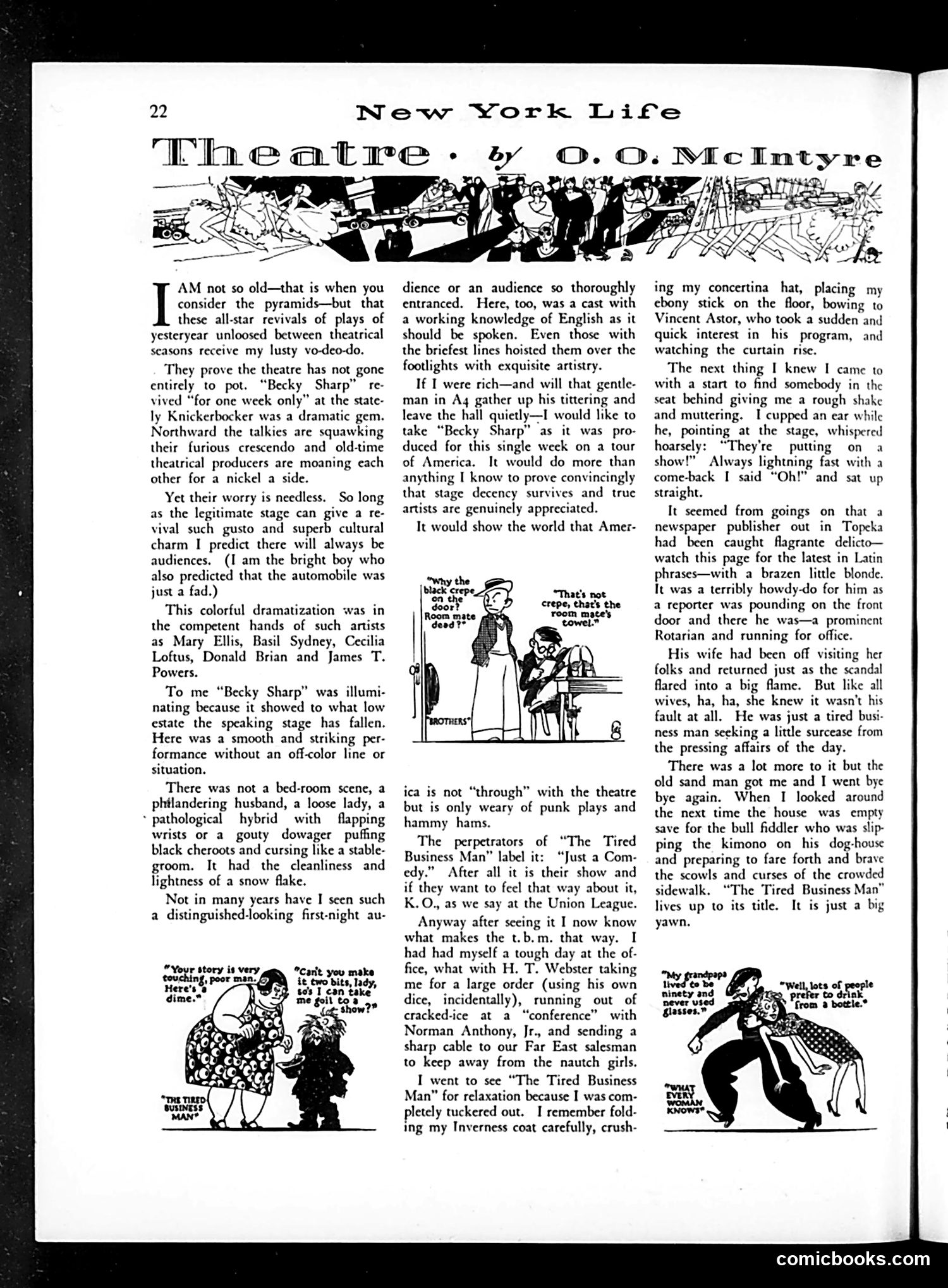
This is O.O. McIntyre's theater column reviewing Broadway productions. The page discusses two plays: **"Becky Sharp"** (praised as wholesome and well-acted) and **"The Tired Business Man"** (criticized as formulaic and dull). The small cartoons illustrate McIntyre's anecdotes: - One shows him discussing a story with a woman ("Here's a dime") - Another depicts him at a show with an audience member shaking him awake, pointing at the stage—illustrating his point that "The Tired Business Man" was so boring he fell asleep McIntyre's satire targets: 1. **Hollywood's threat to theater**: "talkies are squawking" while producers "moan each other for a nickel" 2. **Declining theatrical standards**: modern plays rely on bedroom scenes, affairs, and crude humor rather than artistry 3. **Lazy playwriting**: the "tired businessman" plot (infidelity) is tired itself The humor derives from McIntyre literally becoming the "tired business man"—so exhausted by work (and theater gossip involving H.T. Webster and Norman Anthony Jr.) that he sleeps through the show meant to entertain such men.
📄 Transcribed text from this page (OCR, searchable)
Machine-transcribed from the original scan — historical spelling and the odd misread are preserved.
22 New York Life Theatre. consider the pyramids—but that these all-star revivals of plays of yesteryear unloosed between theatrical seasons receive my lusty vo-deo-do. They prove the theatre has not gone entirely to pot. “Becky Sharp” re- vived “for one week only” at the state- ly Knickerbocker was a dramatic gem. Northward the talkies are squawking their furious crescendo and old-time theatrical producers are moaning each other for a nickel a side. Yet their worry is needless. So long as the legitimate stage can give a re- vival such gusto and superb cultural charm I predict there will always be audiences. (I am the bright boy who also predicted that the automobile was just a fad.) This colorful dramatization was in the competent hands of such artists as Mary Ellis, Basil Sydney, Cecilia Loftus, Donald Brian and James T. Powers. To me “Becky Sharp” was illumi- nating because it showed to what low estate the speaking stage has fallen. Here was a smooth and striking per- formance without an off-color line or situation. There was not a bed-room scene, a philandering husband, a loose lady, a > pathological hybrid with flapping wrists or a gouty dowager puffing black cheroots and cursing like a stable- groom. It had the cleanliness and lightness of a snow flake. Not in many years have I seen such a distinguished-looking first-night au- I AM not so old—that is when you dience or an audience so thoroughly entranced. Here, too, was a cast with a working knowledge of English as it should be spoken. Even those with the briefest lines hoisted them over the footlights with exquisite artistry. If I were rich—and will that gentle- man in Aq gather up his titering and leave the hall quietly—I would like to take “Becky Sharp” as it was pro- duced for this single week on a tour of America. It would do more than anything I know to prove convincingly that stage decency survives and true artists are genuinely appreciated. Tt would show the world that Amer- ica is not “through” with the theatre but is only weary of punk plays and hammy hams. The perpetrators of “The Tired Business Man” label it: “Just a Com- edy.” After all it is their show and if they want to feel that way about it, K.O., as we say at the Union League. Anyway after seeing it I now know what makes the t.b.m. that way. I had had myself a tough day at the of- fice, what with H. T. Webster taking me for a large order (using his own dice, incidentally), running out of cracked-ice at a “conference” with Norman Anthony, Jr., and sending a sharp cable to our Far East salesman to keep away from the nautch girls. I went to see “The Tired Business Man” for relaxation because I was com- pletely tuckered out. I remember fold- ing my Inverness coat carefully, crush- ing my concertina hat, placing my ebony stick on the floor, bowing to Vincent Astor, who took a sudden and quick interest in his program, and watching the curtain. rise. The next thing I knew I came to with a start to find somebody in the seat behind giving me a rough shake and muttering. I cupped an ear while he, pointing at the stage, whispered hoarsely: “They're putting on a show!” Always lightning fast with a come-back I said “Oh!” and sat up straight. It seemed from goings on that a newspaper publisher out in Topeka had been caught flagrante delicto— watch this page for the latest in Latin phrases—with a brazen little blonde. Tt was a terribly howdy-do for him as a reporter was pounding on the front door and there he was—a prominent Rotarian and running for office. His wife had been off visiting her folks and returned just as the scandal flared into a big flame. But like all wives, ha, ha, she knew it wasn't his fault at all. He was just a tired busi- ness man seeking a little surcease from the pressing affairs of the day. There was a lot more to it but the old sand man got me and I went bye bye again. When I looked around the next time the house was empty save for the bull fiddler who was slip- ping the kimono on his dog-house and preparing to fare forth and brave the scowls and curses of the crowded sidewalk. “The Tired Business Man” lives up to its title. It is just a big yawn. ninety and never v Slasses.” comicbooks.com