
A complete issue · 44 pages · 1929
Life — April 12, 1929
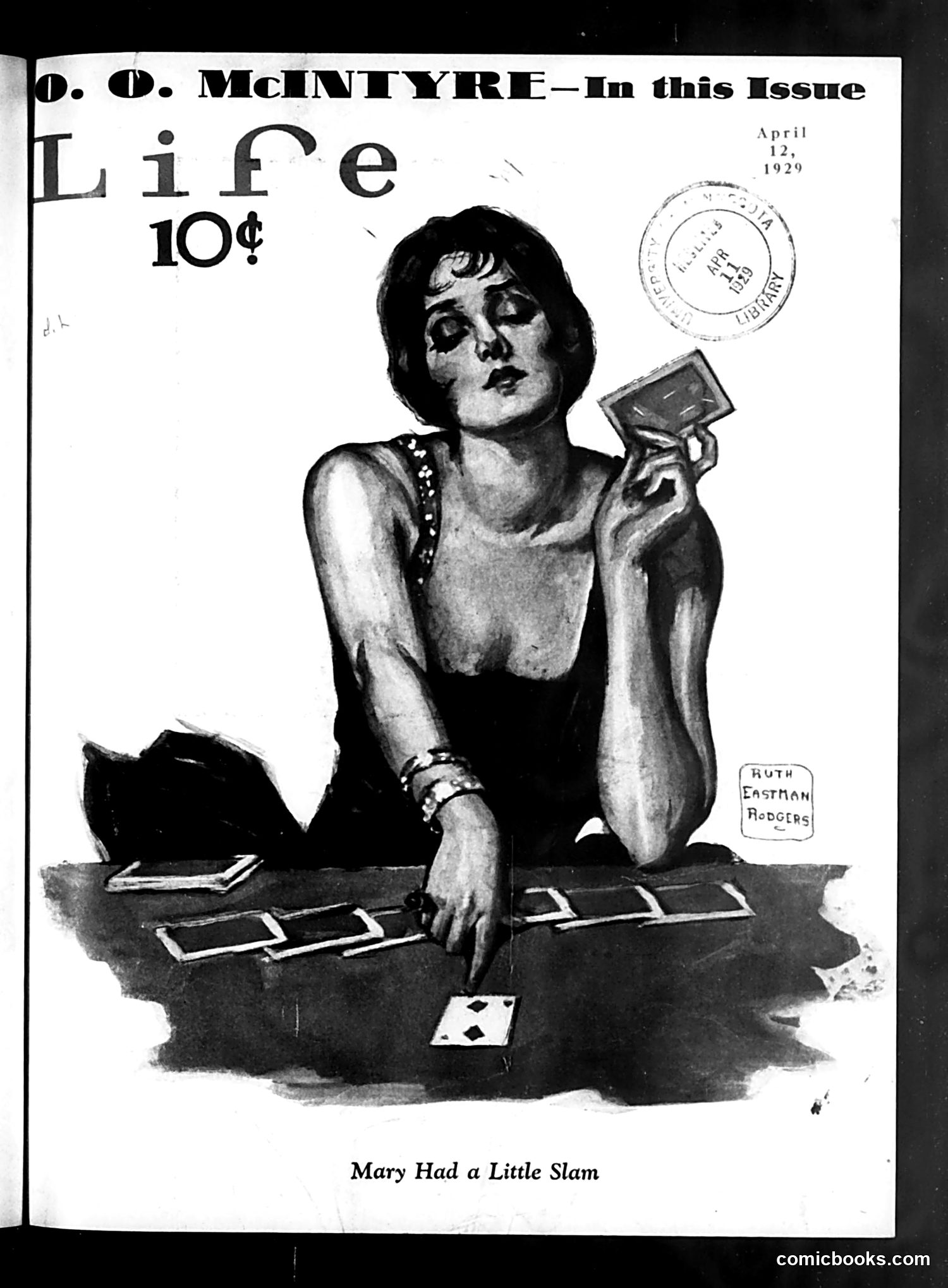
This cover illustration by Ruth Eastman Rodgers depicts a woman engaged in card playing, likely bridge or a similar game popular in 1920s leisure culture. The title "Mary Had a Little Slam" is a playful pun on the nursery rhyme "Mary Had a Little Lamb," substituting "slam" — a bridge-playing term referring to winning all or most tricks. The artwork satirizes the era's enthusiasm for card games among women and the leisure class. The figure's fashionable 1920s appearance (bobbed hair, jewelry, sleeveless dress) reflects the "modern woman" of the Jazz Age. The cartoon suggests society's preoccupation with games and gambling during the prosperous pre-Depression period. At 10¢, this issue cost considerably less than many publications today.
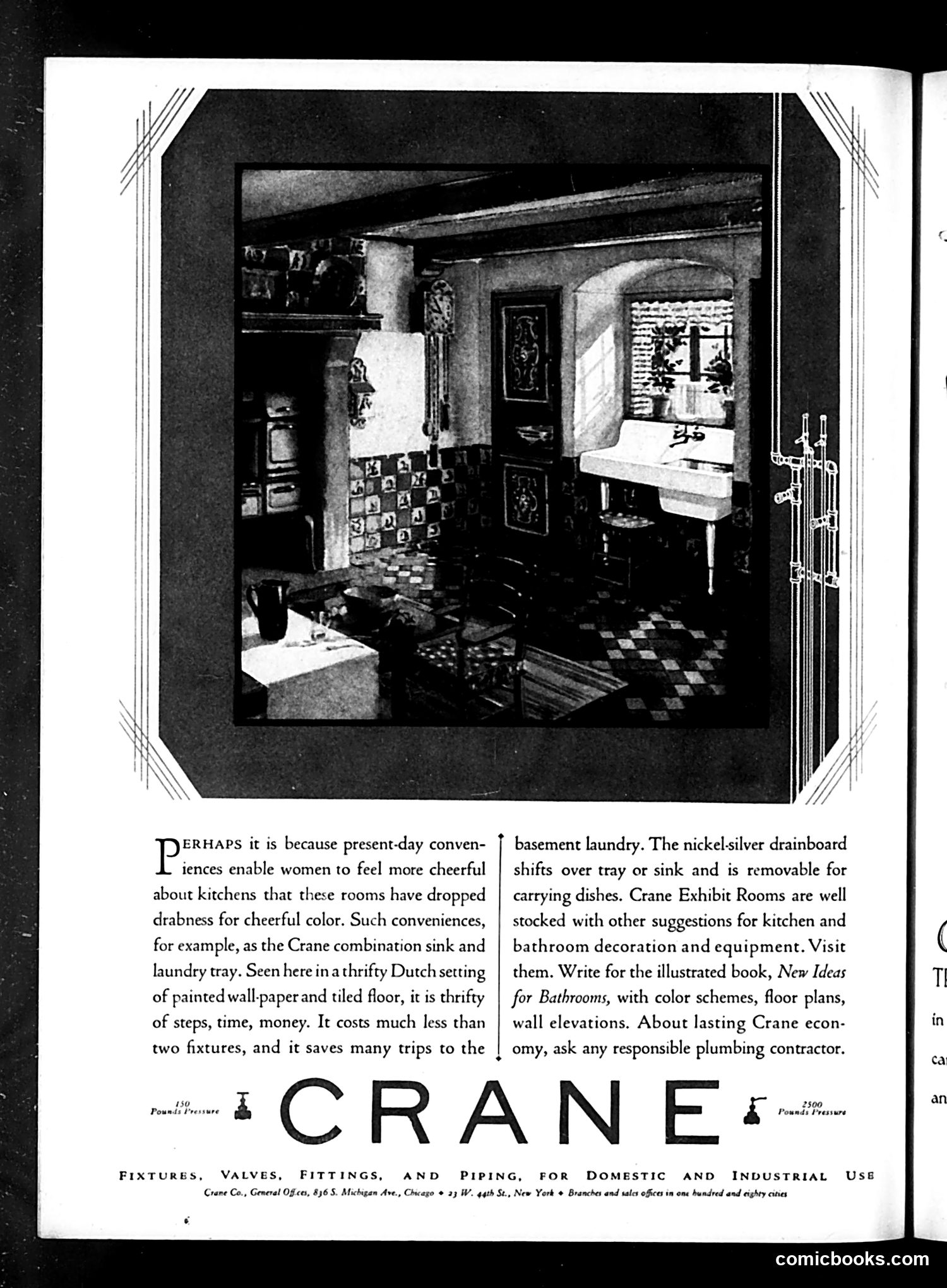
This page is primarily **advertising, not satire or political commentary**. It features a Crane plumbing fixtures advertisement showcasing a modern bathroom design from what appears to be the early 20th century. The ad emphasizes practical conveniences—specifically a combination sink and laundry tray—marketed to appeal to women by promoting efficiency and cheerfulness in kitchen and bathroom spaces. The text highlights cost savings compared to installing two separate fixtures and emphasizes the time and money saved for homemakers. The "Dutch setting" with painted wallpaper and tiled floor is presented as an aspirational example of thrifty, attractive home design. This is consumer advertising celebrating modern domestic convenience rather than social or political satire.
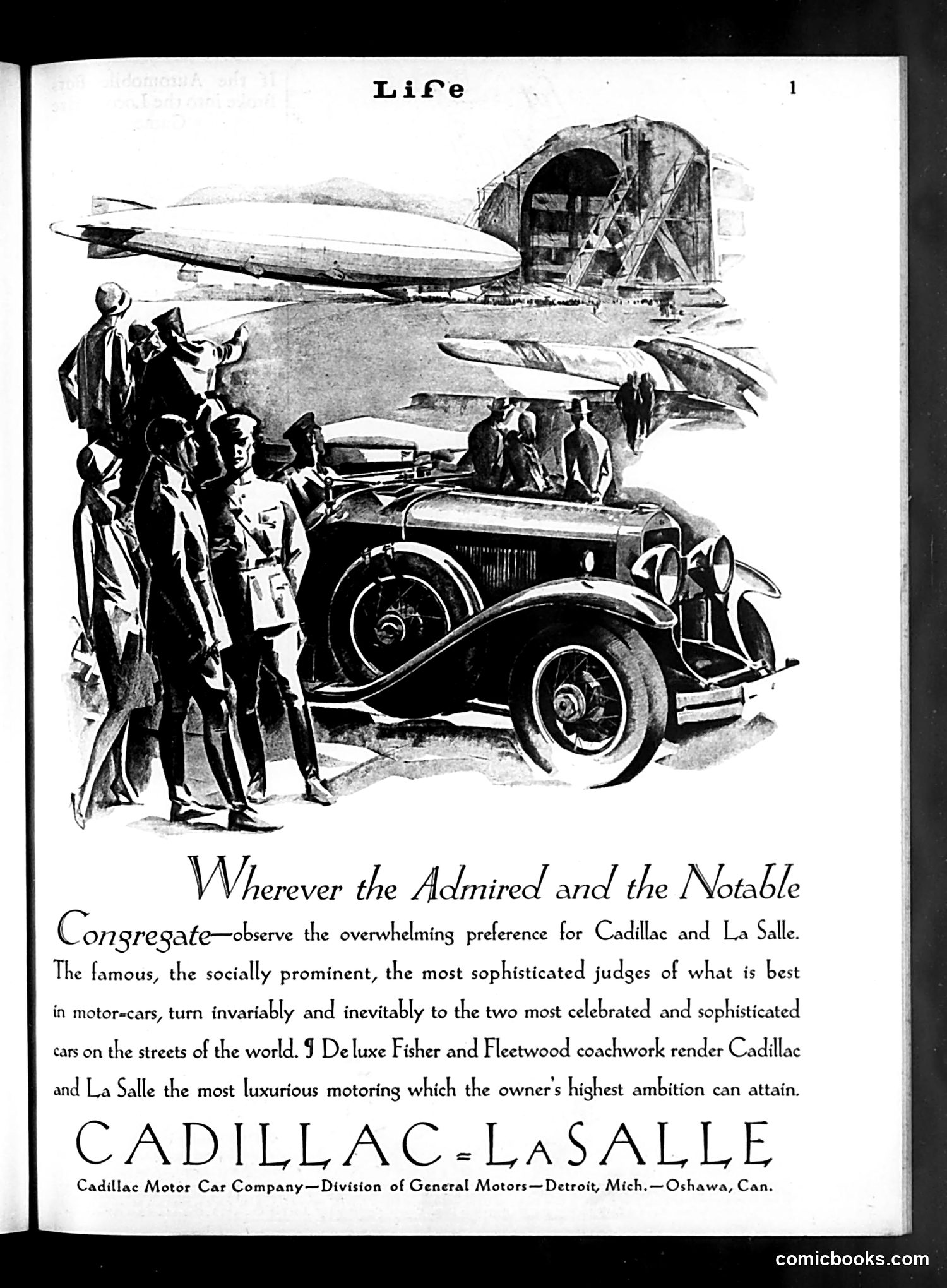
This is **primarily an advertisement**, not satire or political commentary. It promotes Cadillac and La Salle automobiles to *Life* magazine's wealthy readership. The ad uses aspirational imagery: well-dressed figures (appearing to be socialites or wealthy professionals) examining a luxury car, with an airplane and airfield in the background. The message targets status-conscious consumers by claiming that "the famous, the socially prominent, the most sophisticated judges" inevitably choose Cadillac or La Salle. The airplane imagery suggests modernity and prestige. The text emphasizes "luxury" and "deluxe Fisher and Fleetwood coachwork"—premium body styles that distinguished high-end automobiles. This reflects 1920s marketing strategy: associating products with wealth, sophistication, and social prominence rather than practical features. There is no political satire present—this is straightforward luxury goods promotion.
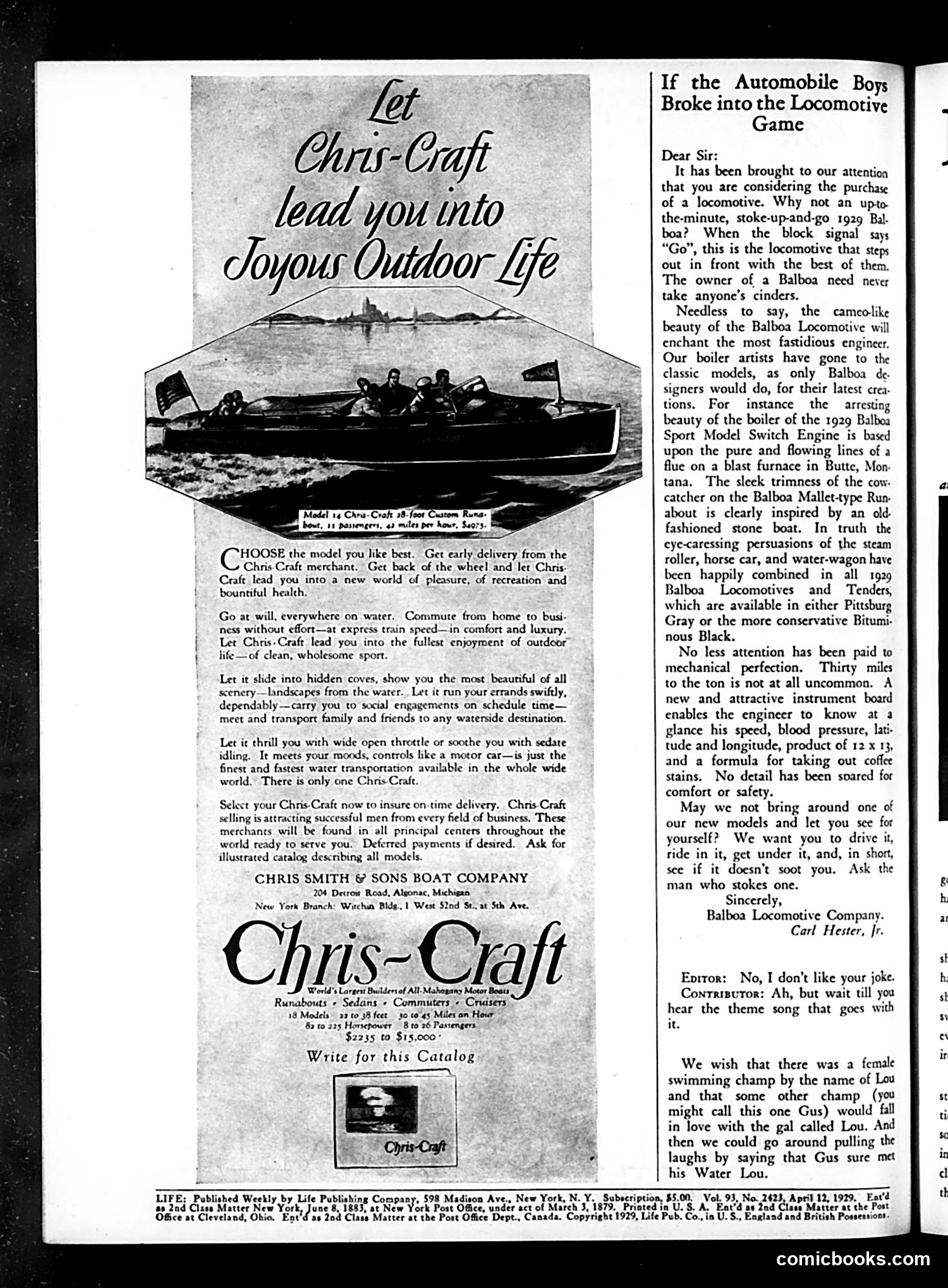
This page is **primarily advertising**, not political satire. The left side contains a full-page advertisement for Chris-Craft motorboats, emphasizing recreational leisure and outdoor enjoyment. The right side features reader letters and editorial responses. The main content is a humorous exchange where the **Balboa Locomotive Company** satirically proposes selling a locomotive instead of a motorboat for recreation. The editor dismisses this as a joke, but the humor lies in the absurdity—contrasting the elegant, purposeful design of pleasure boats with the impracticality of a locomotive for leisure activities. The subsequent editorial banter about a "female swimming champ" named Lou appears to be typical magazine humor filler, unrelated to broader political commentary. This reflects 1920s recreational culture and automotive advertising.
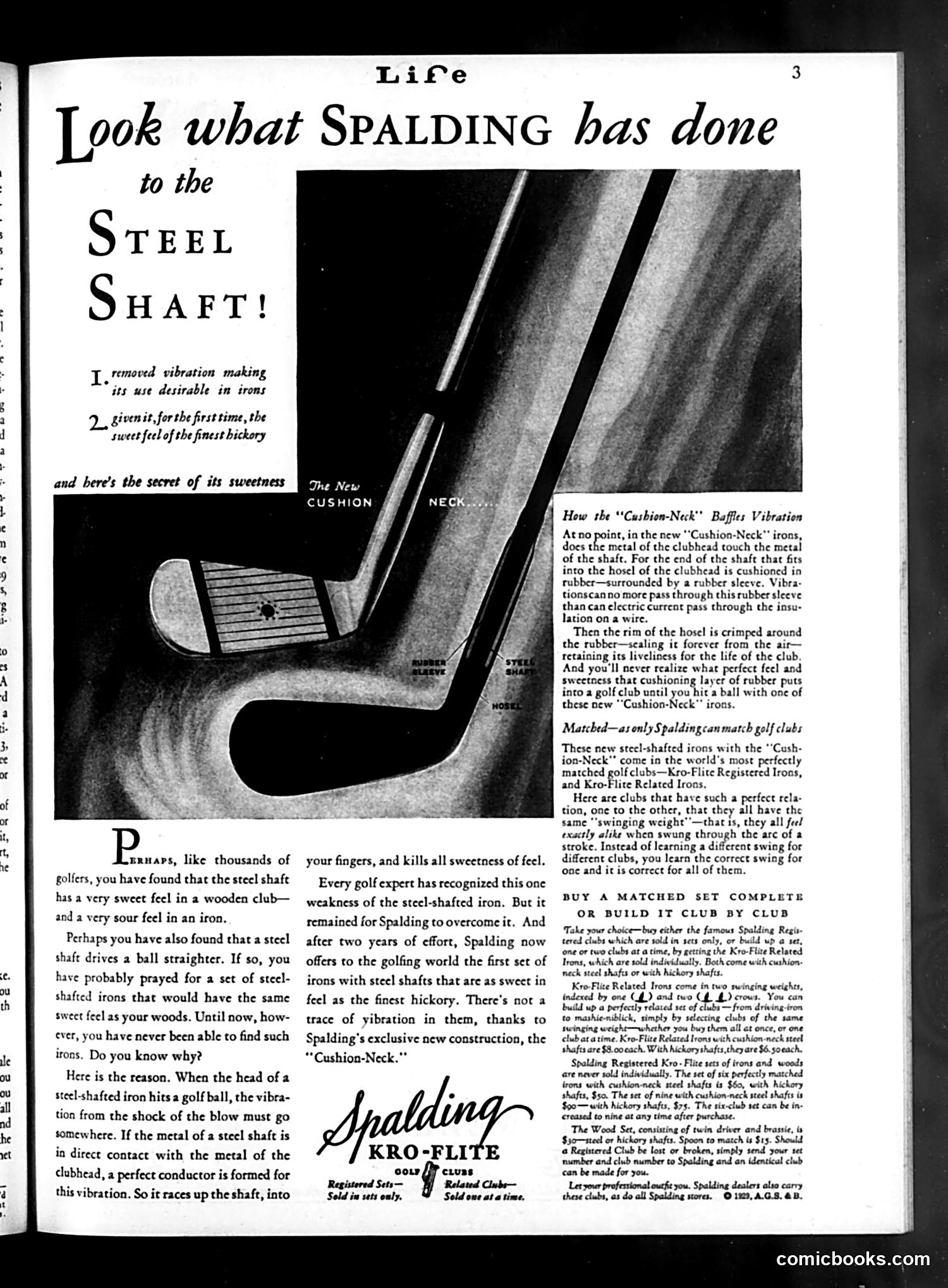
This is **not a political cartoon or satire**—it's a straightforward **golf equipment advertisement** for Spalding golf clubs, specifically their new "Cushion-Neck" steel-shaft irons. The page uses technical diagrams and detailed explanations to market a product innovation: a rubber cushioning layer between the metal clubhead and steel shaft that supposedly reduces vibration, improving ball control and consistency. The ad emphasizes this eliminates the "sweet spot" problem golfers faced with earlier steel-shaft designs. The dramatic close-up photograph of the club head demonstrates the construction. This represents standard 1920s-30s advertising copy typical of *Life* magazine, which carried both humor and commercial content. There is no satire or political reference present.
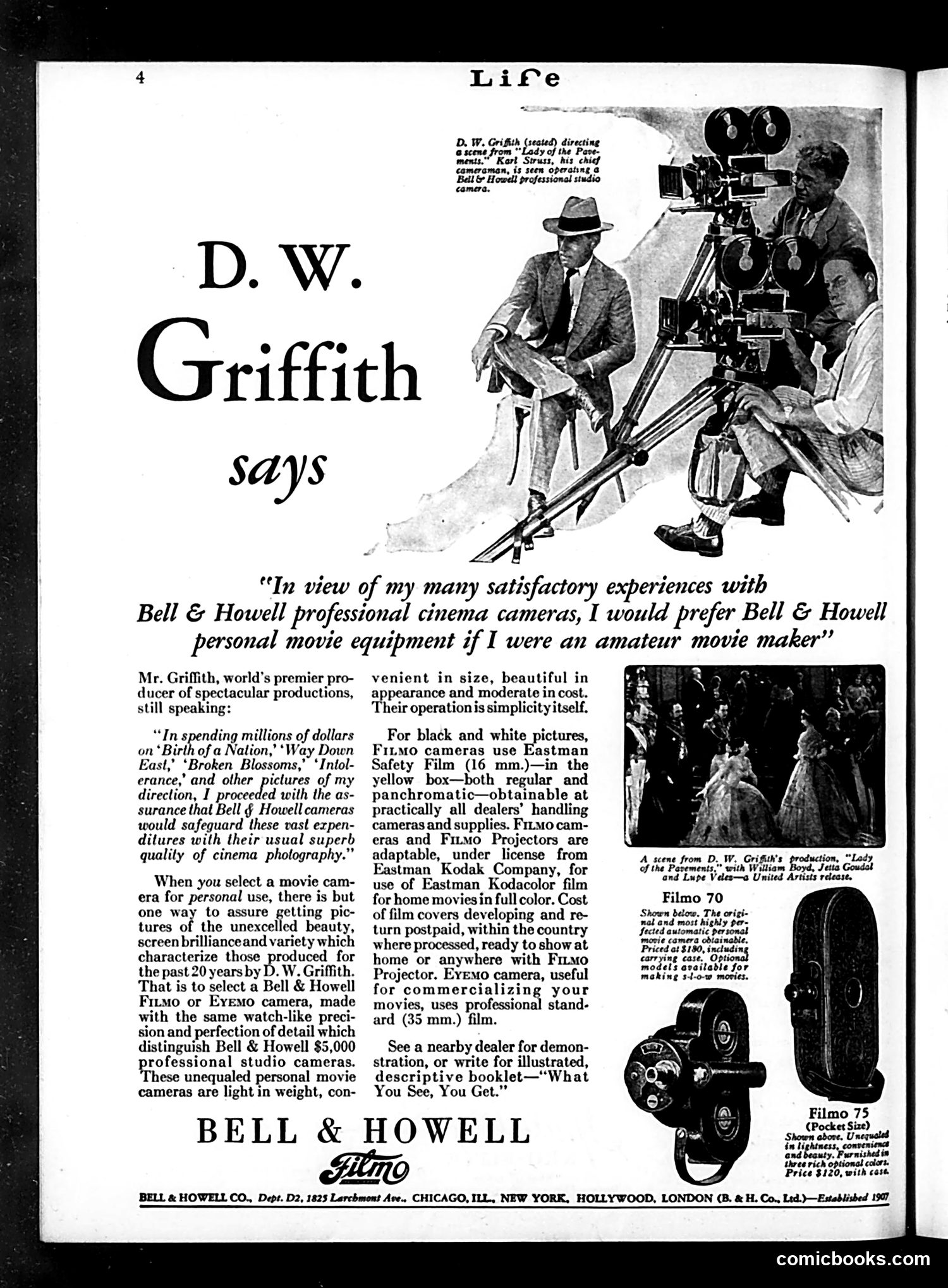
This is primarily an **advertisement, not satire or cartoon content**. It features D.W. Griffith, the famous film director, endorsing Bell & Howell movie cameras for amateur filmmakers. The page includes a photograph of Griffith directing on set with professional cinema equipment, and images of Bell & Howell's Filmo camera models (Filmo 70 and 75). Griffith's quoted endorsement emphasizes that despite his extensive experience with professional equipment, he would choose Bell & Howell cameras for personal amateur use—a marketing strategy positioning the equipment as quality equipment accessible to non-professionals. The text discusses technical specifications: film types, projection capabilities, and costs. This is straightforward product advertising leveraging Griffith's prestige to market home movie equipment to hobbyists during the early film era.
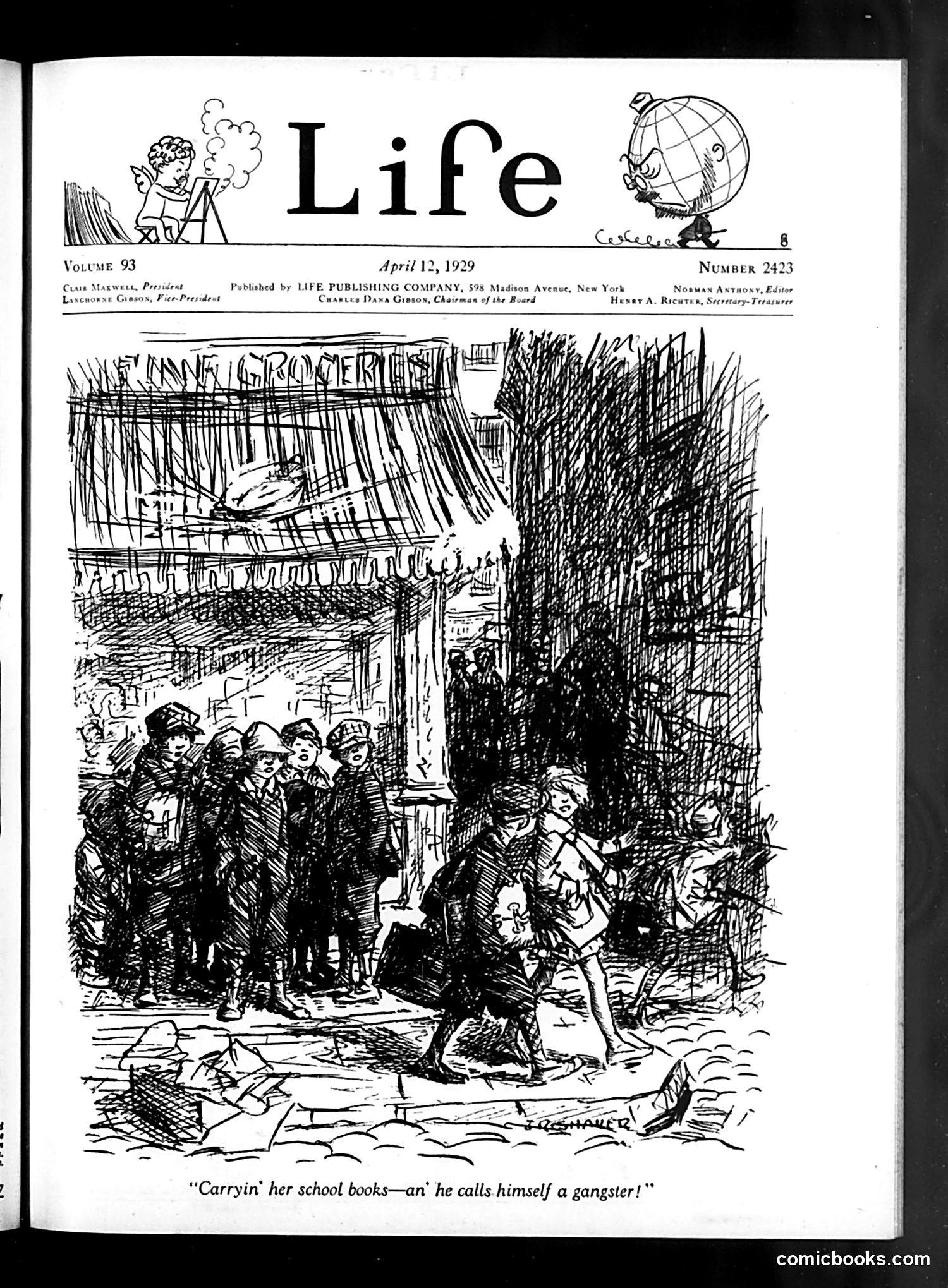
This cartoon depicts a street scene where a young boy carries school books while a group of tougher, older youths surround him. The caption reads: "Carryin' her school books—an' he calls himself a gangster!" **The joke:** The satire mocks the pretensions of small-time street toughs or "gangsters." A boy performing the innocent, gentlemanly act of carrying a girl's schoolbooks is sarcastically dismissed by the rougher crowd as unworthy of the "gangster" label—suggesting that real gangsters would never be caught doing something so civilized or helpful. This reflects 1929 concerns about youth gangs and street culture, while poking fun at the romantic mythology surrounding organized crime and petty criminals.
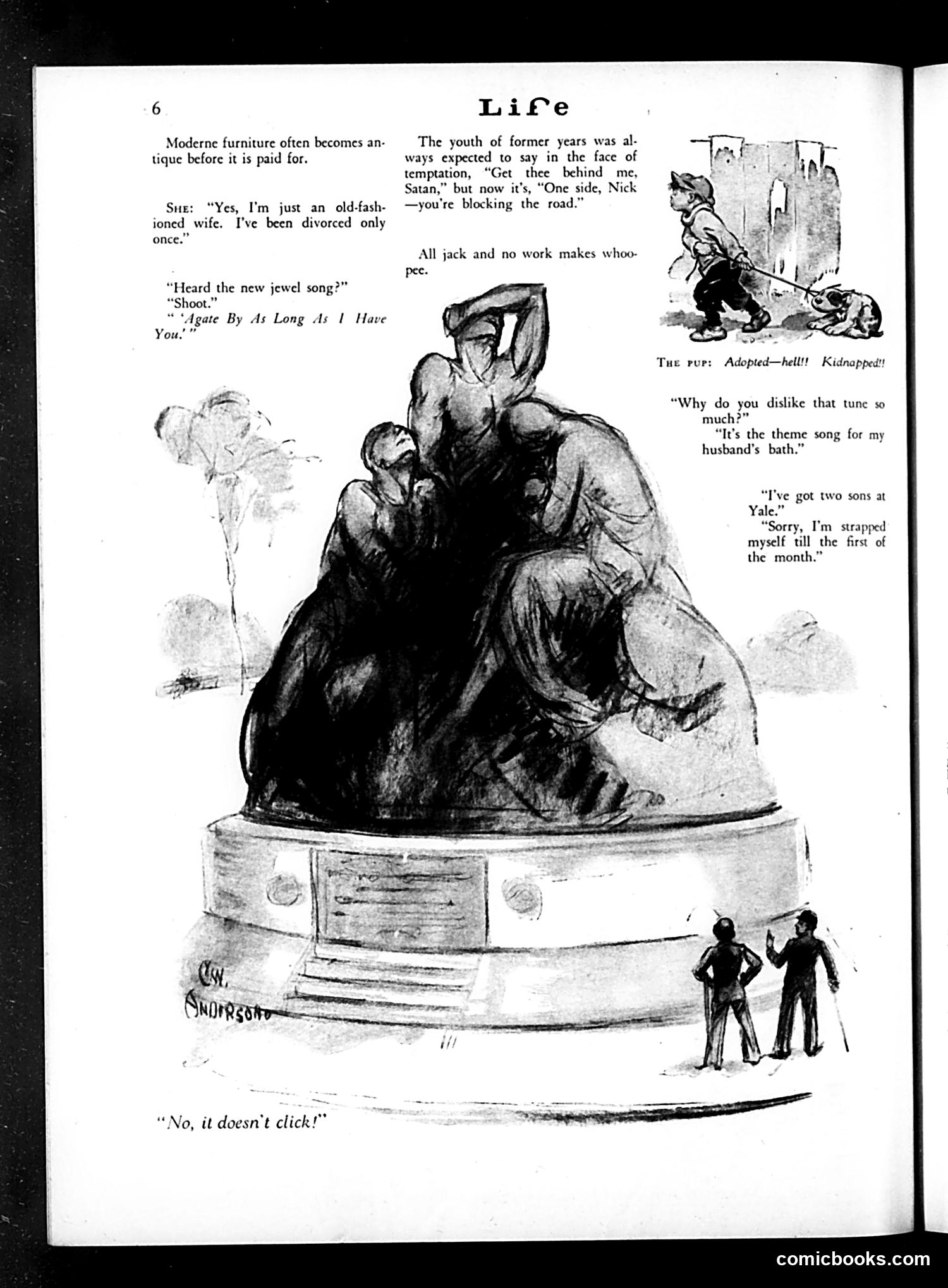
This page contains several brief satirical quips and two cartoon illustrations mocking early 20th-century social attitudes. The top-left exchanges joke about divorce ("I've been divorced only once") and a song title "Agate By As Long As I Have You," satirizing popular music. The large central cartoon depicts a statue of a woman holding children, positioned on a pedestal like a monument—likely mocking the idealization of motherhood and domesticity. Two small male figures below comment "No, it doesn't click!", suggesting skepticism about this romanticized vision. The right-side cartoons joke about gender dynamics: one about a kidnapped pup, another mocking women's education ("two sons at Yale") juxtaposed with financial dependence ("strapped till the first of the month"). Overall, the page satirizes changing social attitudes toward women, marriage, motherhood, and education in this era.
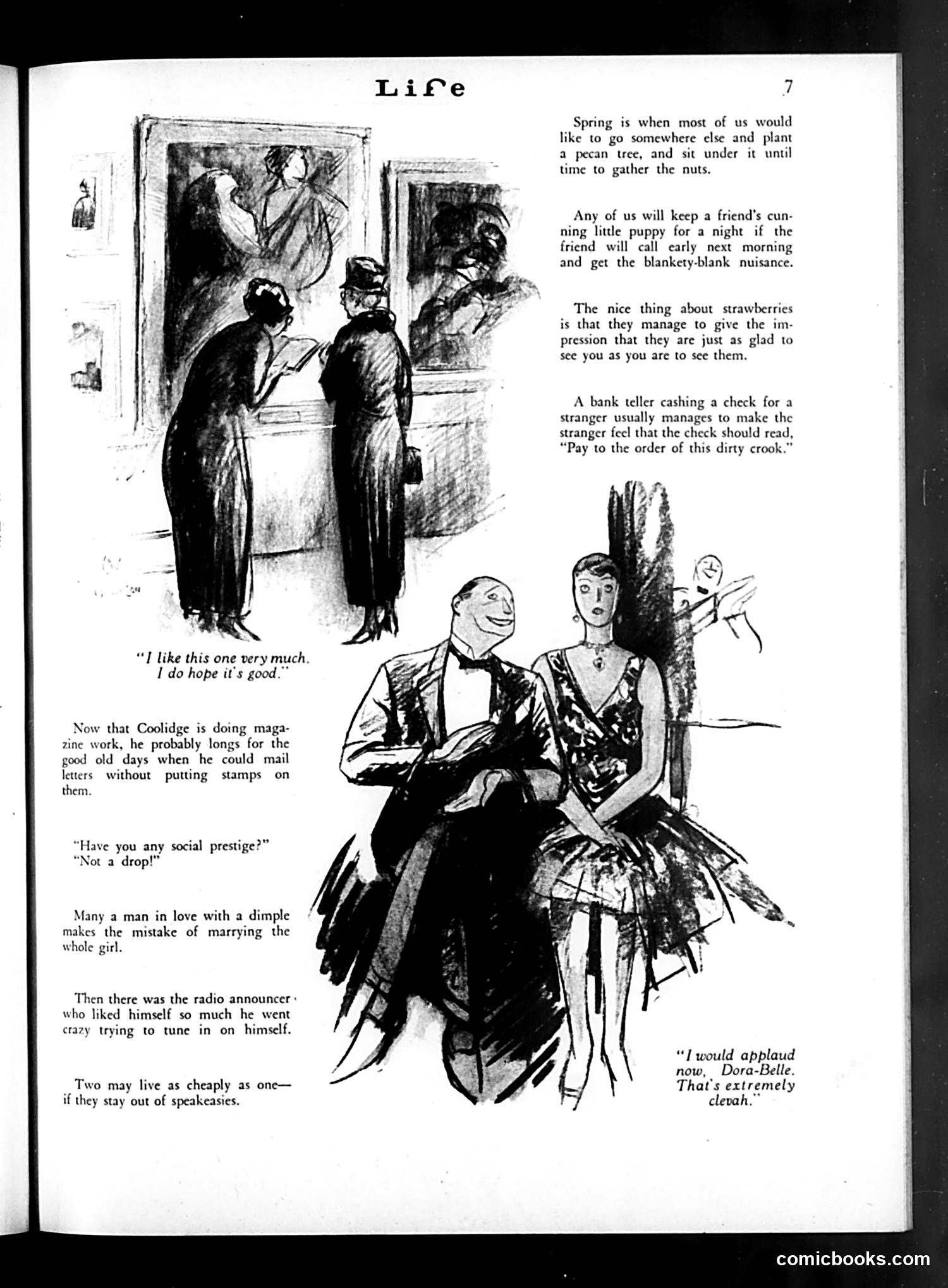
This page presents social humor and observations typical of Life magazine's satirical approach. The top cartoon shows two men examining artwork in what appears to be a gallery or art dealer's space, with one saying "I like this one very much. I do hope it's good"—mocking the pretense of art appreciation among those uncertain of their own taste. The lower illustration depicts a fashionably dressed couple at what appears to be a social event, with the man saying he would applaud a woman named "Dora-Belle" for being "extremely cleah" (clear/refined)—likely satirizing affected upper-class speech patterns and social pretension. The surrounding text vignettes offer brief satirical observations about human nature: spring fantasies, puppy-sitting inconvenience, strawberries, bank tellers, Coolidge (the sitting president), dimples, radio announcers, and economical cohabitation. These are gentle, domestic social critiques rather than political commentary.
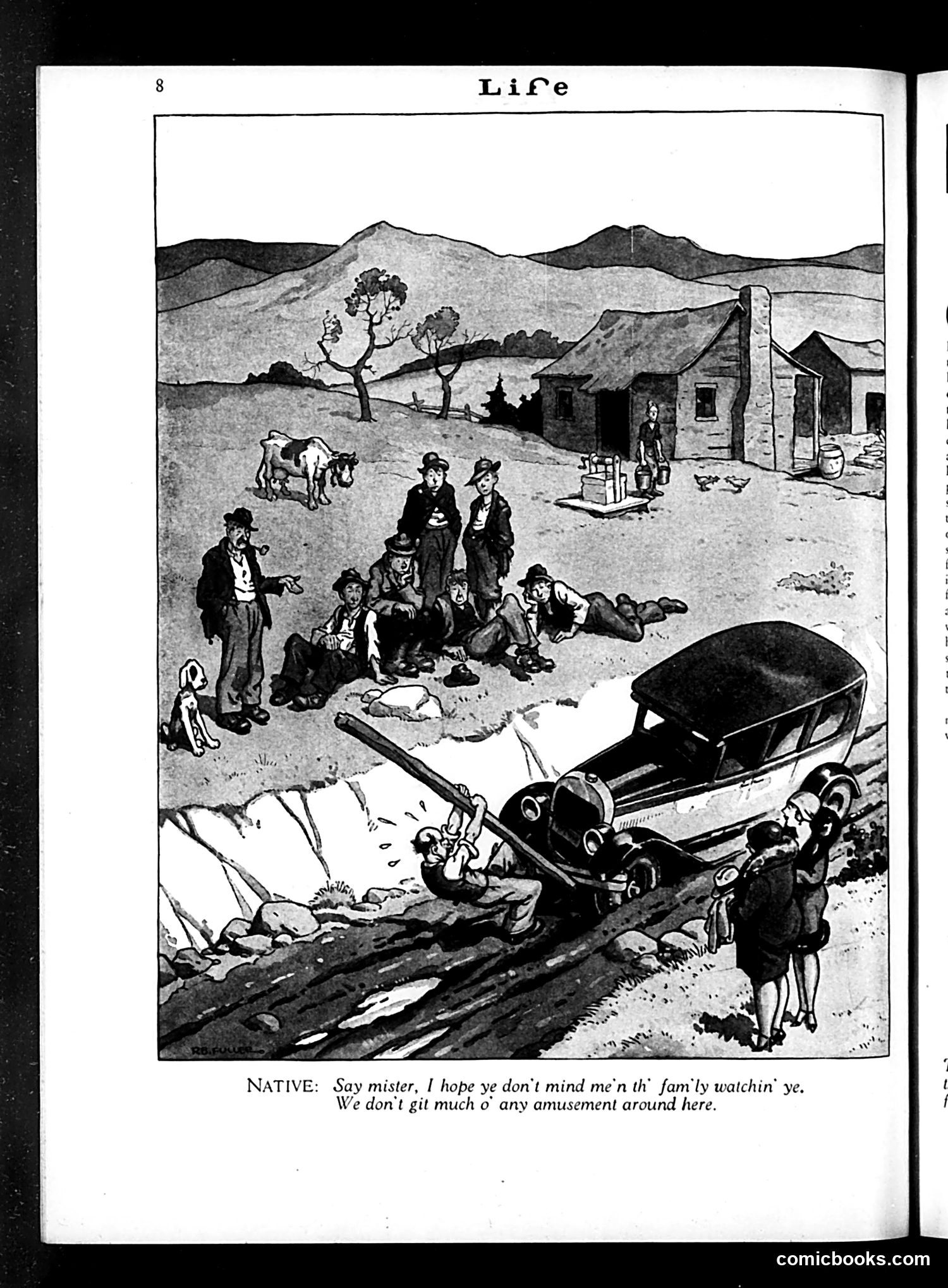
This is a single-panel cartoon from *Life* magazine depicting a rural scene where a Native American is speaking to a group of well-dressed city visitors who have arrived by automobile. The Native American explains that local Indigenous people don't "git much o' any amusement around here," while the visitors appear to be treating the encounter as entertainment—watching and observing the Native American as if he were a curiosity. The satire mocks early-twentieth-century tourism and the perspective of wealthy urban Americans who traveled to rural/frontier areas to gawk at Native Americans as exotic attractions rather than as people with their own lives and dignity. The contrast between the visitors' formal attire and the sparse rural setting emphasizes their outsider status and voyeuristic attitude.
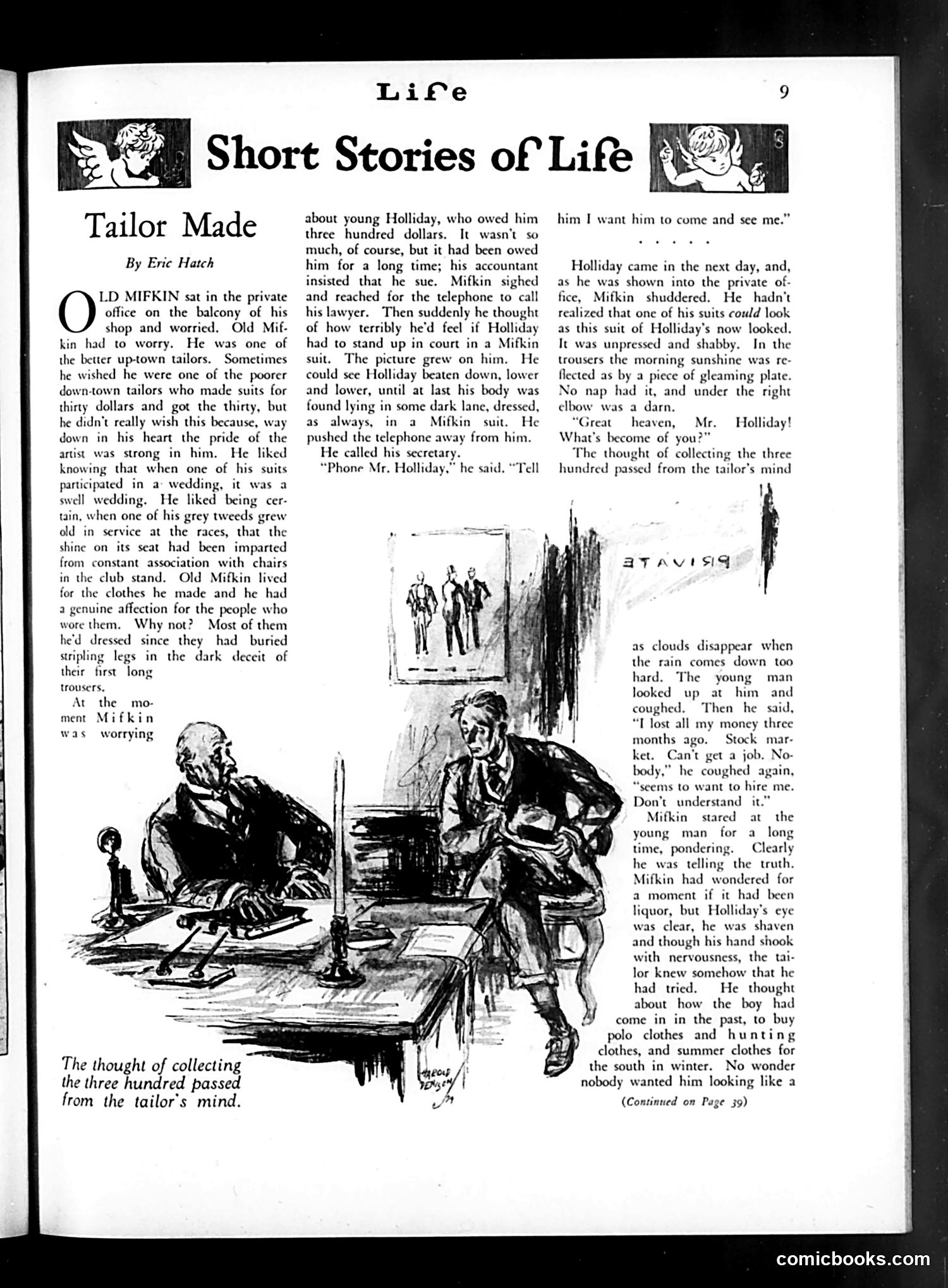
This story satirizes class anxiety and financial desperation during economically hard times. Old Mifkin, an uptown tailor, worries about collecting a $300 debt from a wealthy client named Holliday. The narrative suggests Mifkin's precarious social position: despite his skill and pride in dressing the upper classes, he remains financially vulnerable and dependent on wealthy patrons who may not pay. The accompanying sketch shows Mifkin at his desk, troubled by the collection problem. The story explores themes of class difference, professional dignity, and economic insecurity—a tailor's pride clashing with his powerlessness against defaulting customers. The humor lies in Mifkin's internal conflict between maintaining dignity and pursuing legitimate payment.
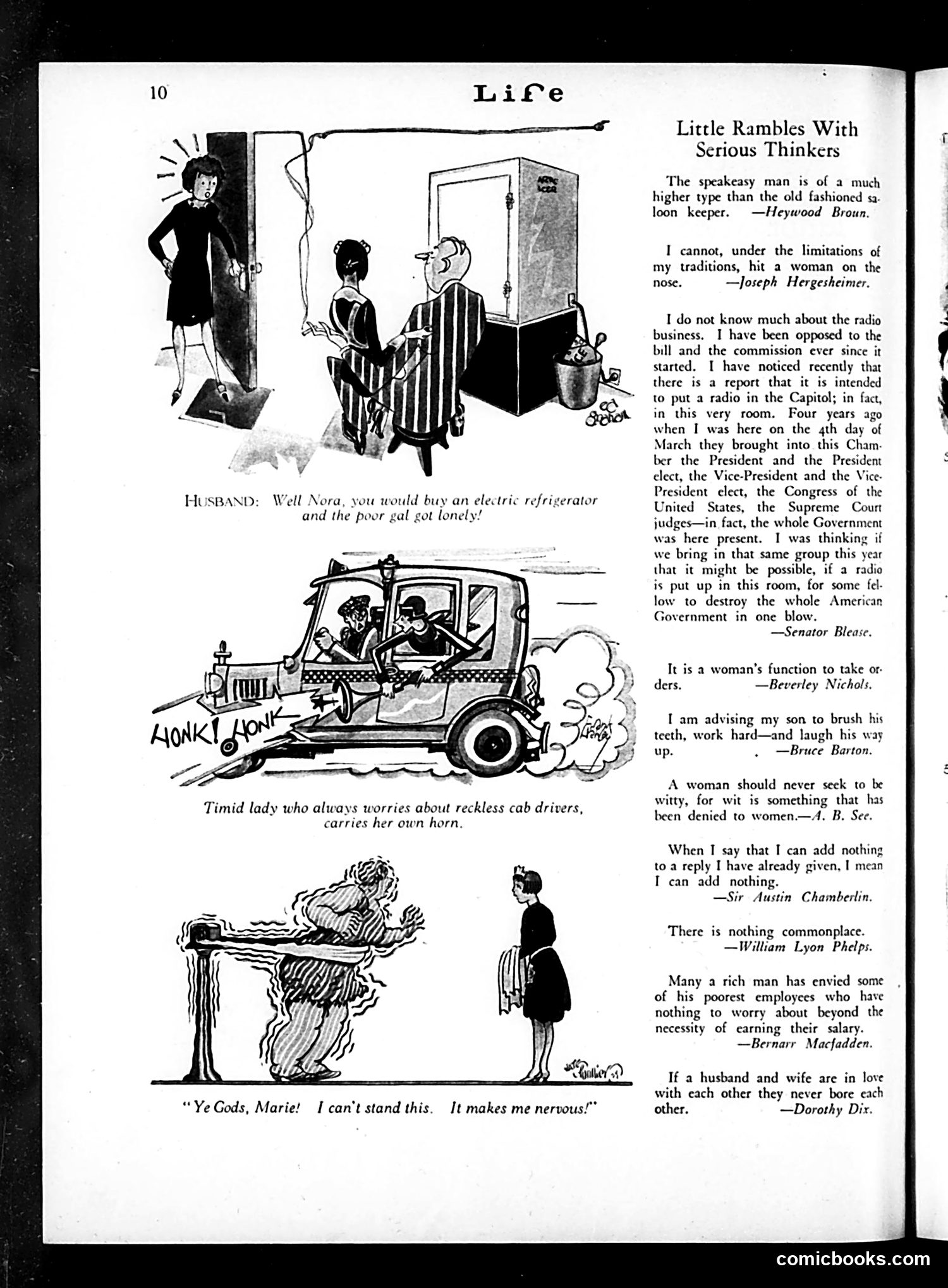
This page contains three cartoons satirizing domestic life and social anxieties of the era. The **top cartoon** shows a wife confronting her husband about buying an electric refrigerator and "poor gal" (likely a servant), suggesting tension over modern appliances and household staff employment. The **middle cartoon** depicts a nervous woman with her own car horn, satirizing women drivers as anxious and timid—a common stereotype when women began driving automobiles. The **bottom cartoon** shows a disheveled woman telling another "Ye Gods, Marie! I can't stand this. It makes me nervous!"—apparently referencing domestic exhaustion, possibly from housework or childcare. The right column contains philosophical quotes about women's roles, radio dangers, and marriage—reflecting period anxieties about modernity, female independence, and domestic life.
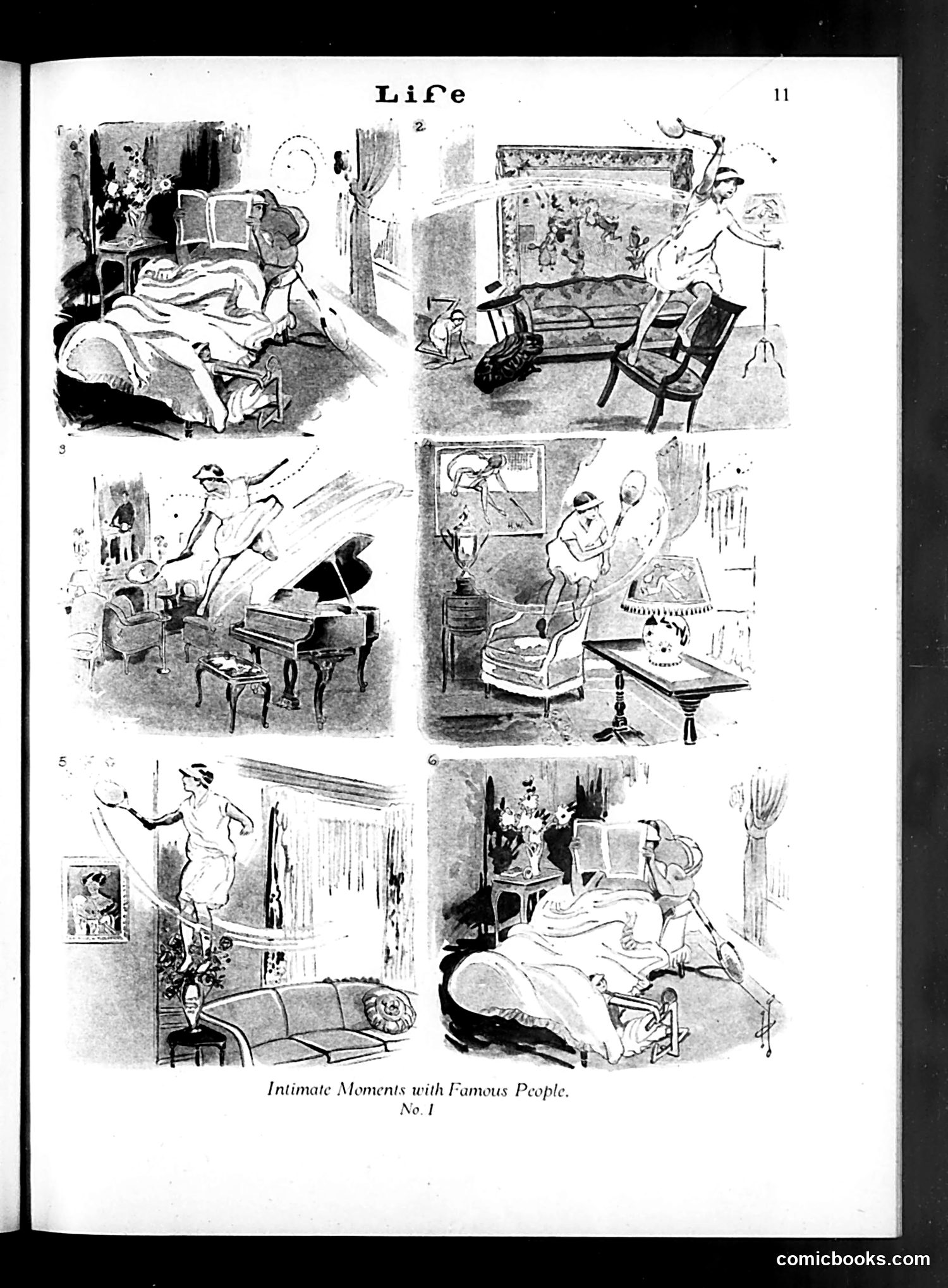
This is a humorous satirical series showing six vignettes of celebrities in private, unglamorous moments—the opposite of their public personas. The cartoon's joke relies on the contrast between fame and reality: famous people are depicted in mundane, undignified situations (sleeping, practicing music poorly, lounging messily, etc.) rather than their celebrated public images. However, **I cannot identify which specific famous people are being caricatured** from the drawings alone. The cartoonist likely intended readers of Life magazine (circa early 20th century) to recognize contemporary celebrities through visual caricature, but without labels or clearer identifying features, the specific targets remain unclear to a modern viewer. The satire's appeal was deflating celebrity mystique by humanizing the famous.
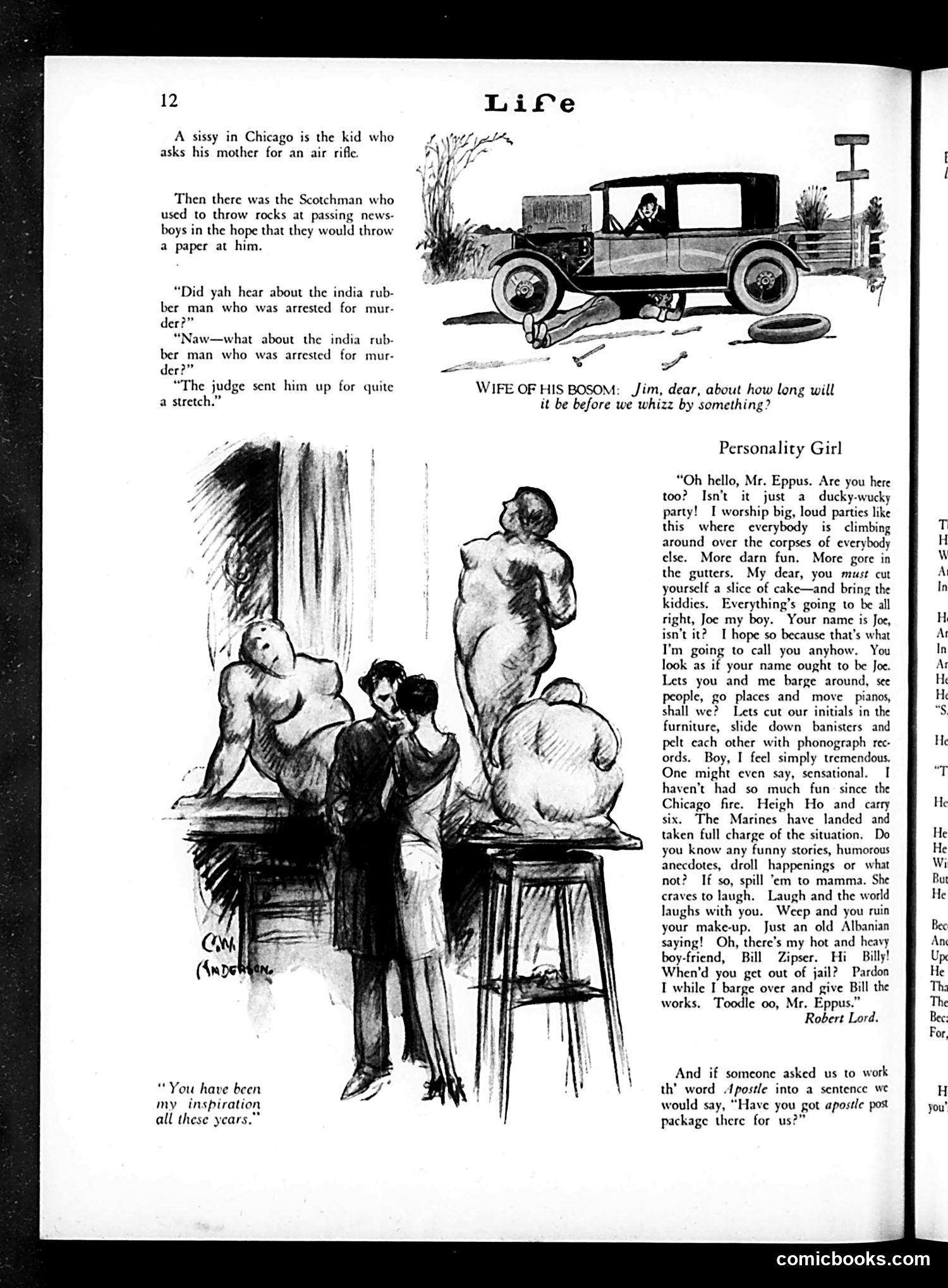
This page contains humorous anecdotes and a sketch. The top cartoon shows a truck with a caption about a wife asking her husband how long before they "whizz by something"—likely mocking the speed and recklessness of 1920s automobiles. Below is a sketch by Cesare Cunningham depicting two nude or partially-draped classical figures with the caption "You have been my inspiration all these years," satirizing pretentious artistic or bohemian claims about muses and creative inspiration. The "Personality Girl" section features gossipy, irreverent commentary by Robert Lord about party culture, calling out someone named "Mr. Eppus" for attending a chaotic gathering. The tone is flippant and mocking of post-WWI social excess and frivolous behavior among the wealthy set.
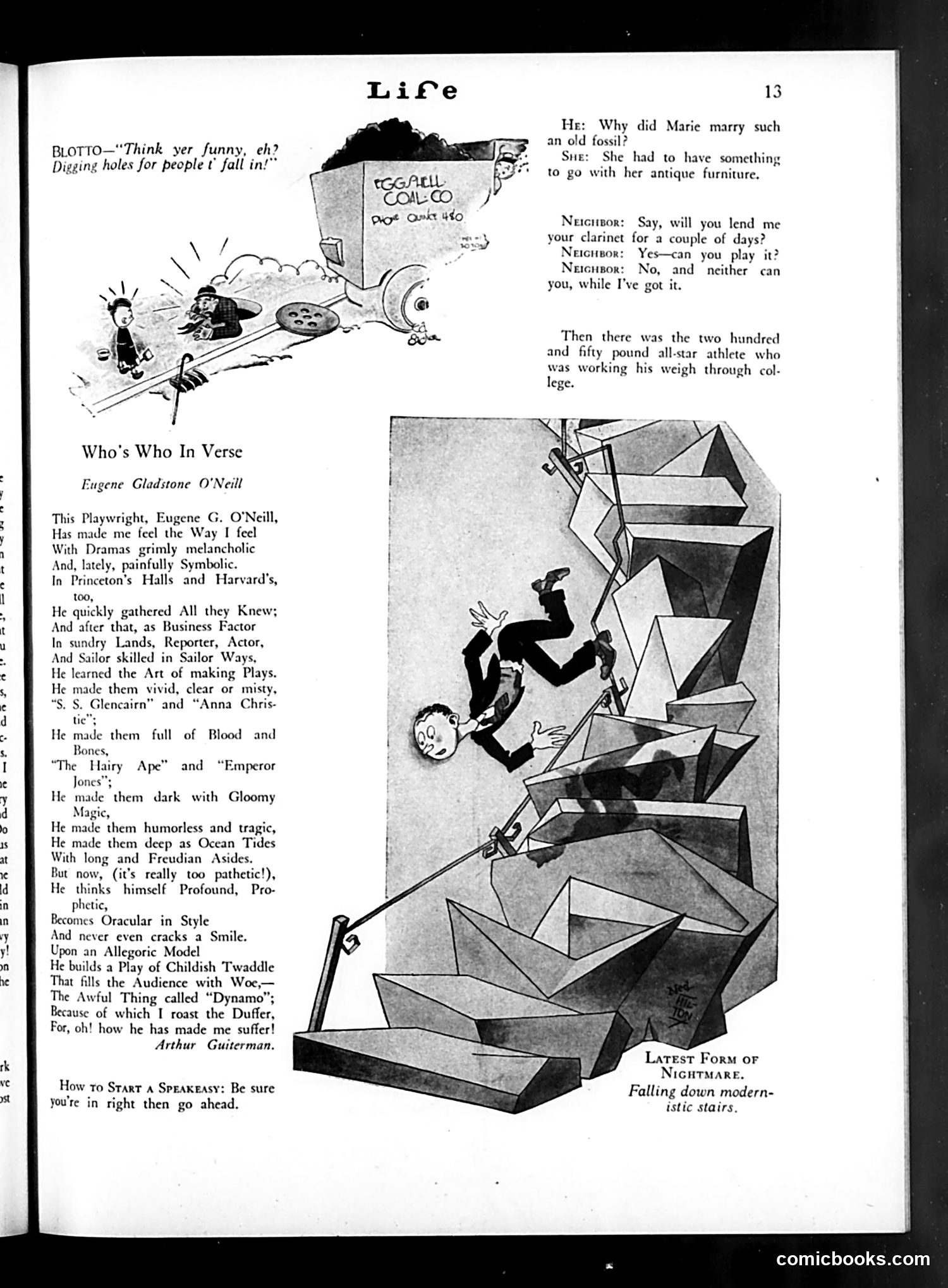
The page contains several satirical humor pieces typical of Life magazine's format. **Top cartoon (Blotto)**: A simple visual joke about a coal company digging holes—people fall in. The humor is straightforward slapstick. **"Who's Who In Verse"**: A poem by Arthur Guiterman praising playwright Eugene G. O'Neill's dramatic work. It catalogs his plays ("S.S. Glencairn," "Anna Christie," "The Hairy Ape," "Emperor Jones") and his style—gloomy, symbolic, tragic. The poem is complimentary but slightly mocking his pretentiousness ("thinks himself Profound, Prophetic"). **Right illustration**: Titled "Latest Form of Nightmare: Falling down modernistic stairs," this shows a figure tumbling down abstract, geometric stairs—a visual gag about the impracticality and danger of modernist architecture design. The page reflects 1920s attitudes toward avant-garde theater and contemporary design movements.
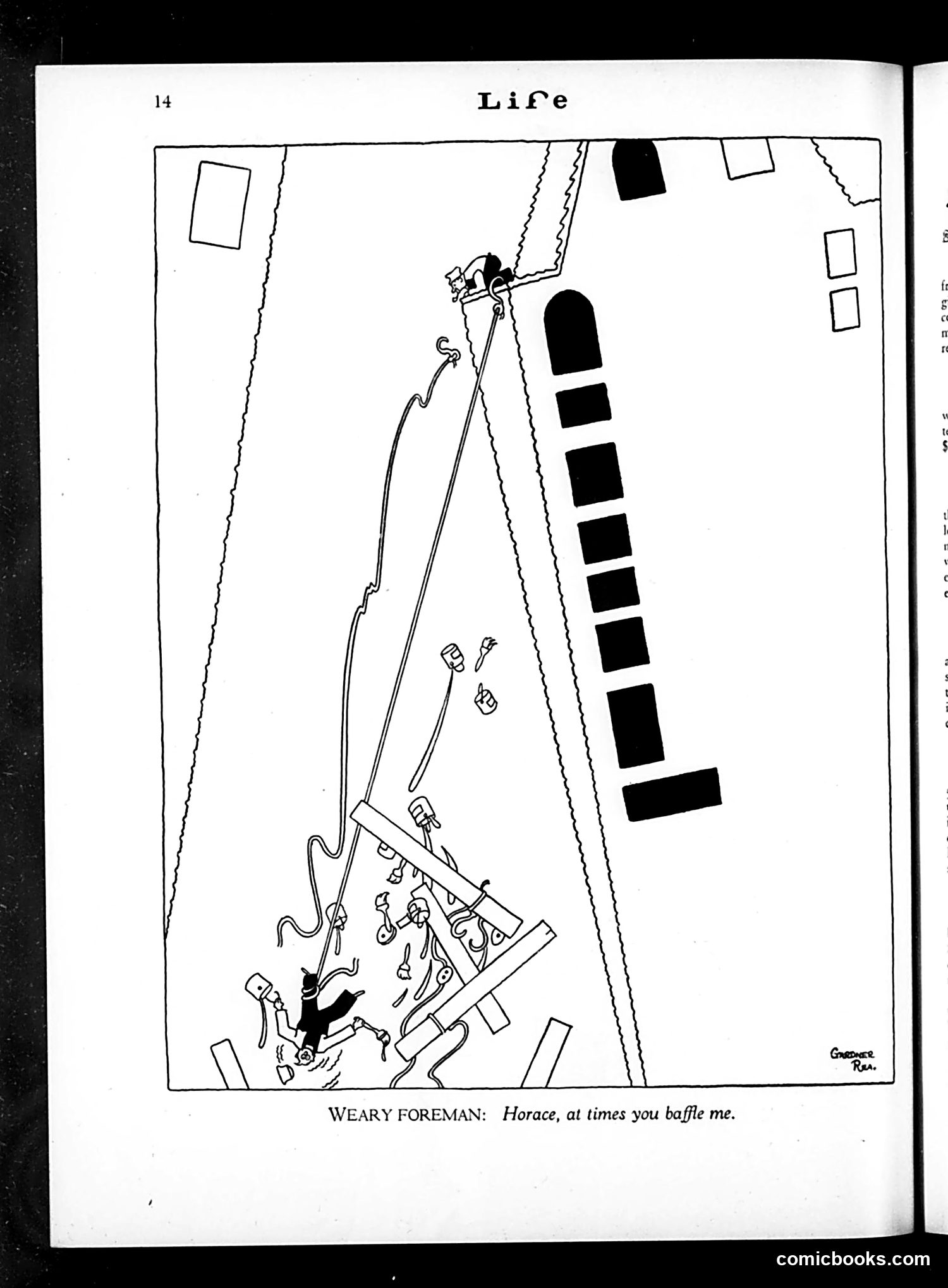
This cartoon depicts a foreman (labeled "Weary Foreman") supervising a complex, chaotic system of pulleys, ropes, and mechanical contraptions. A small figure operates the machinery while objects fall or swing unpredictably around the work site. The caption reads: "Horace, at times you baffle me." **The satire**: This appears to critique inefficient or overly complicated management systems, where a worker (Horace) operates bewildering machinery that produces confusing results. The foreman's exasperation suggests the absurdity of the setup itself—not the worker's incompetence, but rather the impractical system he's been given to work with. The cartoon likely satirizes industrial or bureaucratic complexity, mocking how organizations create unnecessarily convoluted processes. The artist is credited as "Gardner Rea."
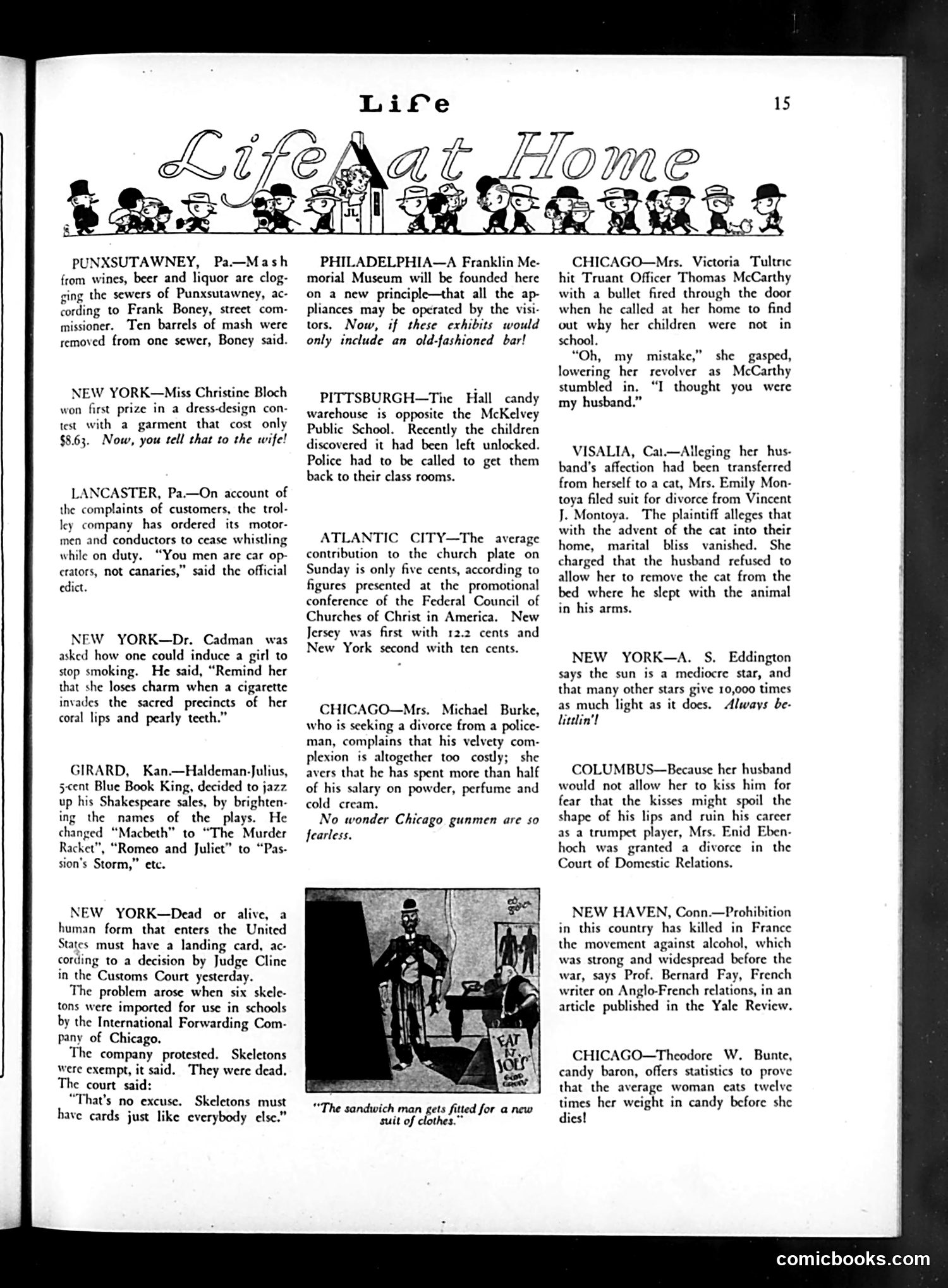
This page contains a collection of humorous short items about domestic life rather than political cartoons. The visible photograph shows "the sandwich man gets fitted for a new suit of clothes"—a man wearing a sandwich board advertisement being measured by a tailor, satirizing the absurdity of tailoring clothes for someone whose body is obscured by signage. The text items mock various domestic situations: a woman shooting her husband's lover, church congregations' meager donations, a husband forbidding kisses to preserve his trumpet-playing lips, and complaints about excessive spending on cosmetics. The overall tone is satirical commentary on middle-class American married life, gender relations, and consumer culture—presenting domestic conflicts and marital absurdities as entertainment for readers.
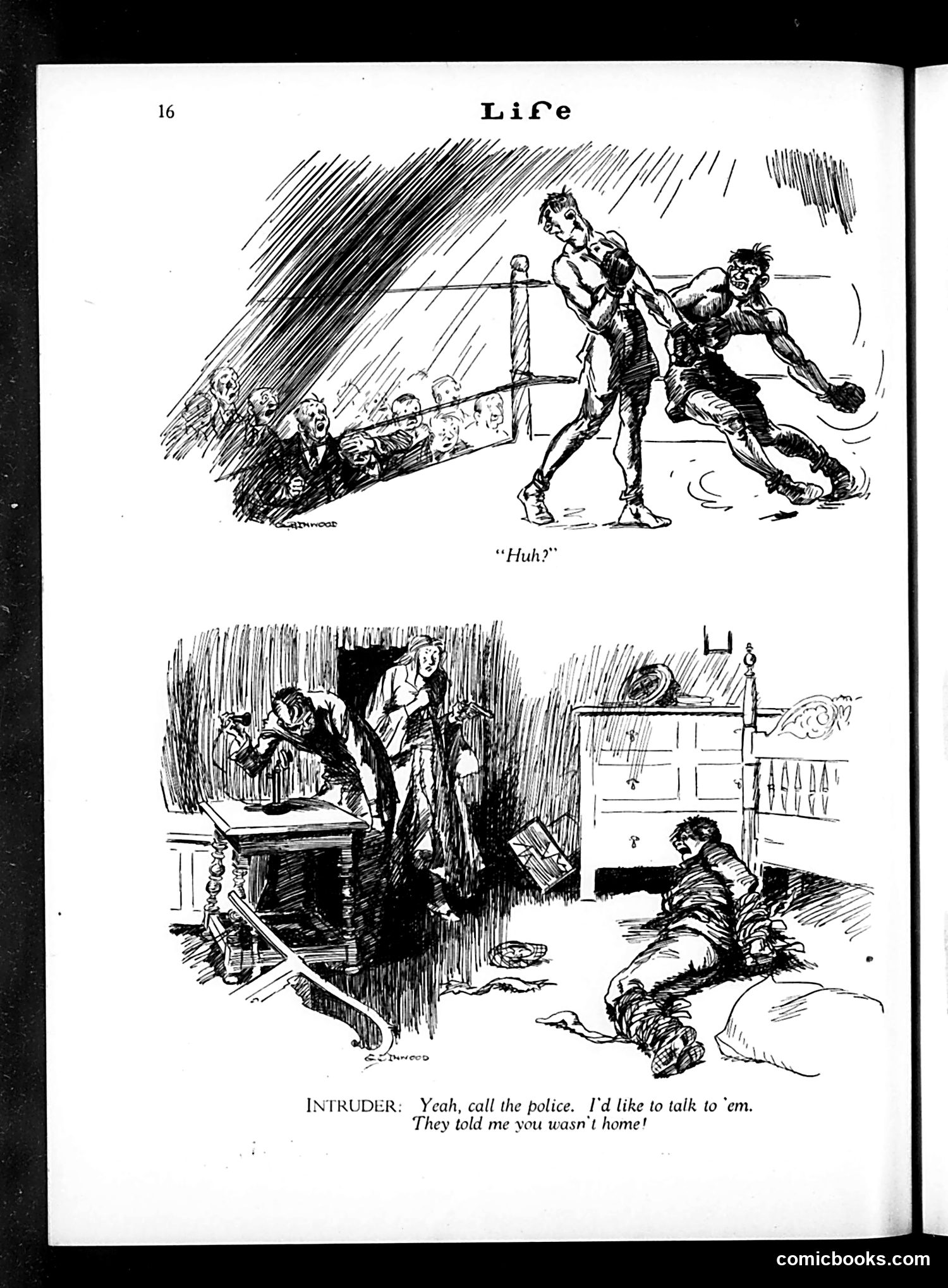
This page contains two related cartoons about a home intruder. The top panel shows a boxing match where one fighter appears confused ("Huh?"), suggesting he's been hit unexpectedly. The bottom panel depicts an actual break-in: a homeowner has apparently knocked down an intruder, who now wants to "call the police" to report that "they told me you wasn't home!" The satire plays on ironic reversal—the burglar, caught red-handed by the homeowner, attempts to shift blame to whoever informed him the house would be empty. The joke mocks the intruder's audacity and the absurdity of his complaint. The boxing reference in the top panel likely parallels the physical confrontation, both depicting unexpected knockout moments.
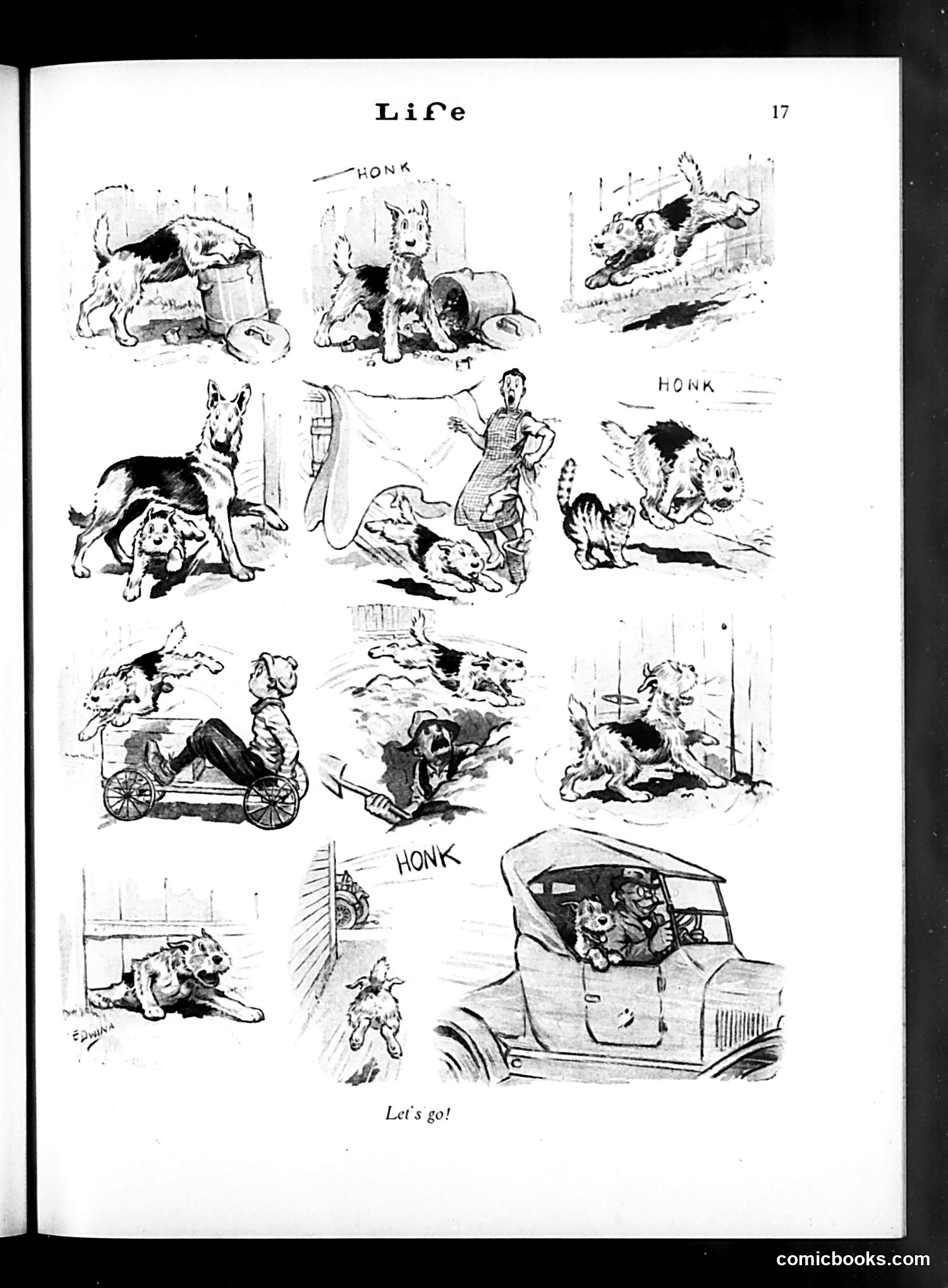
This is a humorous comic strip depicting a dog's day, progressing from morning mischief through evening chaos. The narrative shows: 1. **Top panels**: A dog stealing food, being scolded ("HONK"), and escaping 2. **Middle panels**: The dog causing domestic disruption—interfering with a woman's housework, playing with children, creating general mayhem 3. **Bottom panels**: Escalating chaos including a dog-drawn cart accident and culminating in the dog riding in a car with passengers, with the caption "Let's go!" The satire targets the unpredictable, mischievous nature of pet dogs in household life. The repeated "HONK" sound effects suggest automobile horns, emphasizing the dog as a chaotic urban presence. The humor lies in depicting dogs as persistent domestic nuisances that nonetheless become integrated into family life.
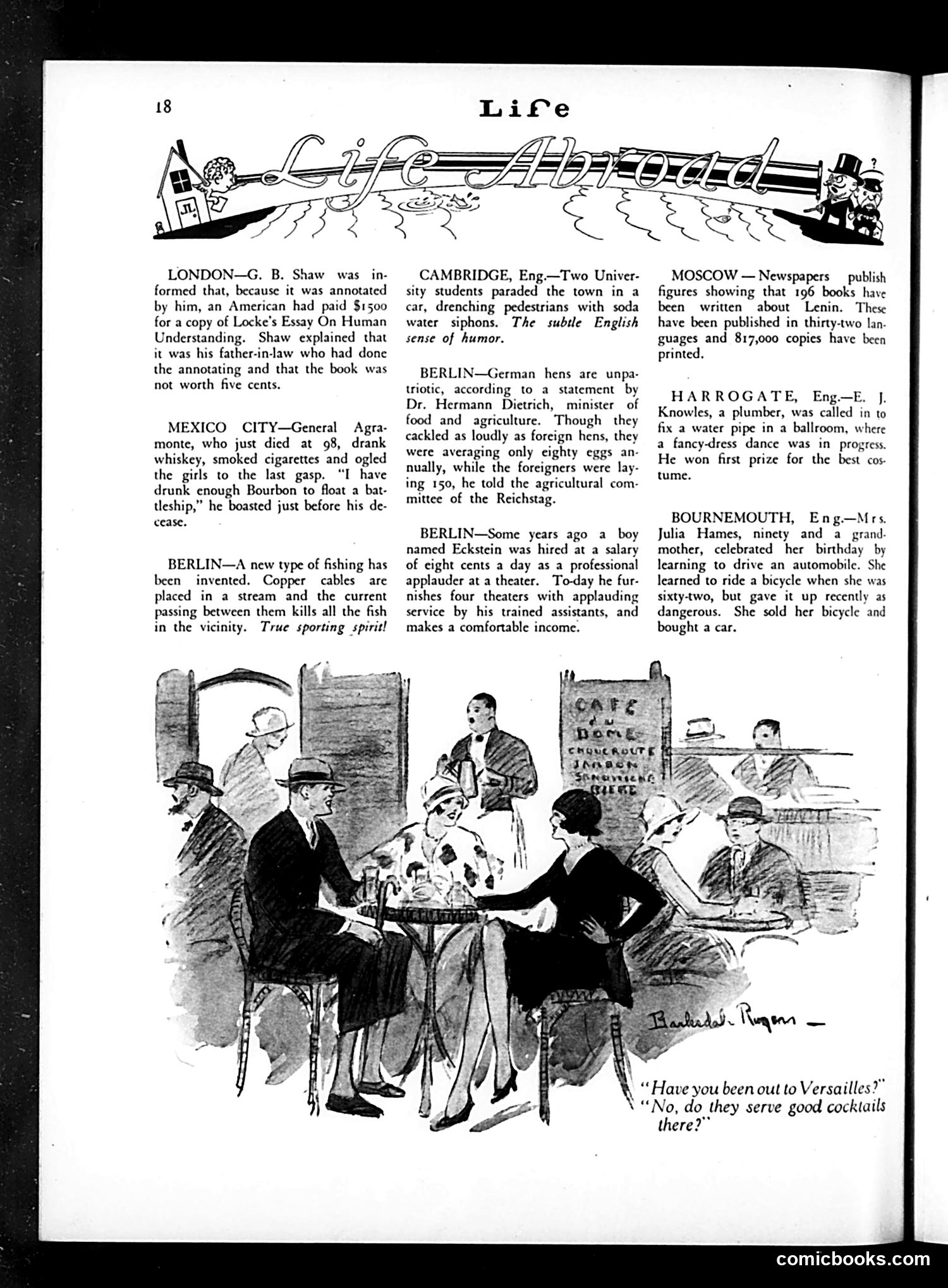
This page contains brief international news items and a single cartoon by **Rollin Kirby** (signed lower right). The cartoon depicts two people at a café, with the man asking the woman: *"Have you been out to Versailles? No, do they serve good cocktails there?"* The satire mocks **American tourist priorities during Prohibition**. Versailles—the historically significant French palace—is reduced to a mere backdrop for asking about cocktails. This reflects post-WWI American attitudes: wealthy Americans traveling to Europe prioritized drinking (illegal at home under Prohibition, 1920-1933) over cultural appreciation. The joke cynically suggests Americans abroad care more about obtaining alcohol than appreciating European history or architecture.
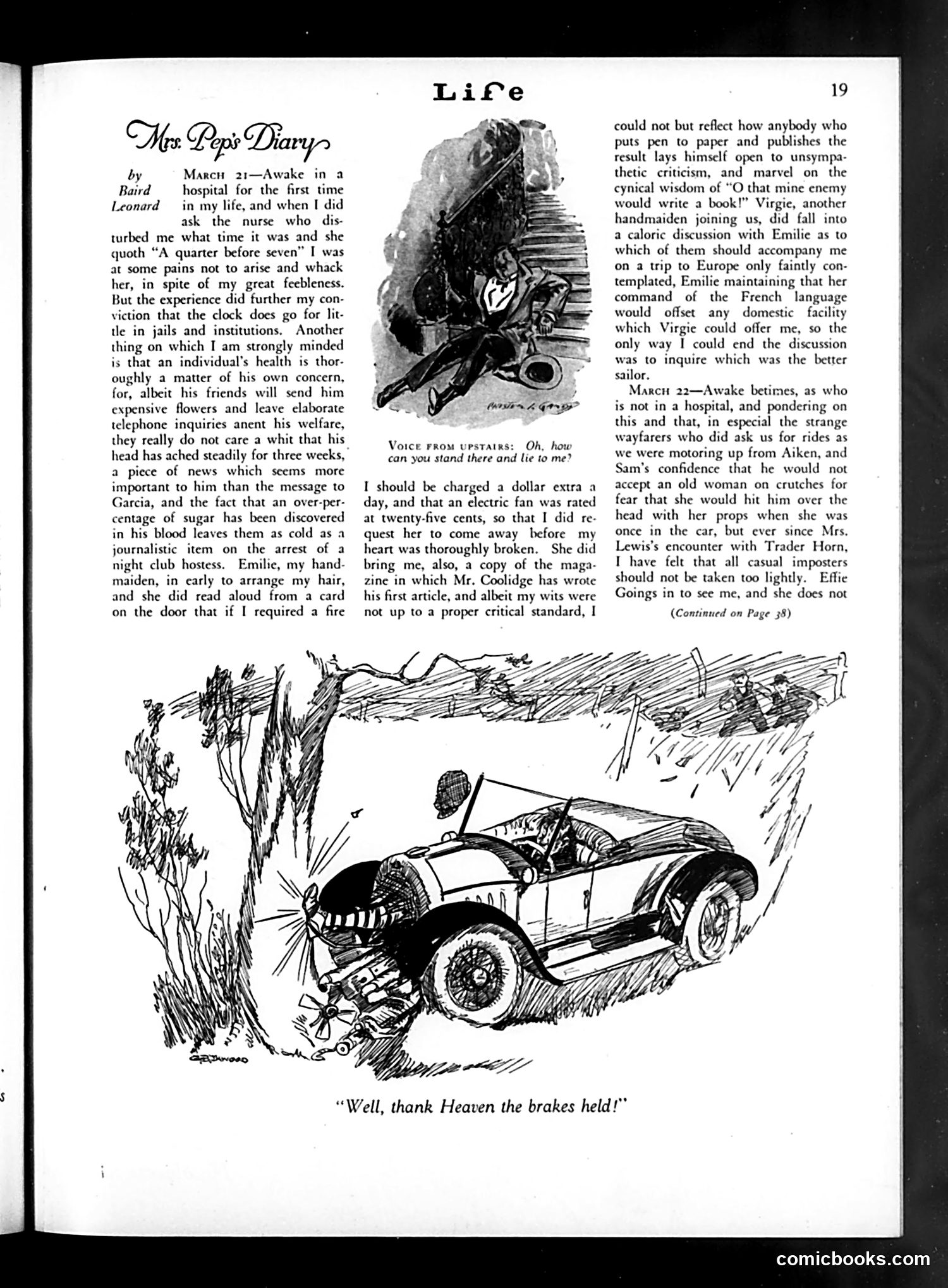
This page presents a humorous diary entry by Baird Leonard, a hospitalized writer recuperating from illness. The accompanying cartoon illustrates one anecdote: a near-fatal automobile accident where the brakes barely functioned, narrowly preventing disaster. The diary satirizes institutional life—hospitals, their arbitrary rules (charging for fans and fires), and the indifference of well-meaning visitors who send flowers but ignore genuine suffering. It also gently mocks contemporary figures: President Coolidge's new magazine article receives backhanded praise, and there's a reference to "Trader Horn" (likely the 1931 adventure film/book). The humor relies on the diarist's acerbic observations about human nature—servants bickering over who should accompany him to Europe, his cynical view of casual hitchhikers, and his wry reflection that anyone publishing their work invites criticism. The cartoon's caption—thanking Heaven the brakes held—captures the narrow escape theme running through the entry.
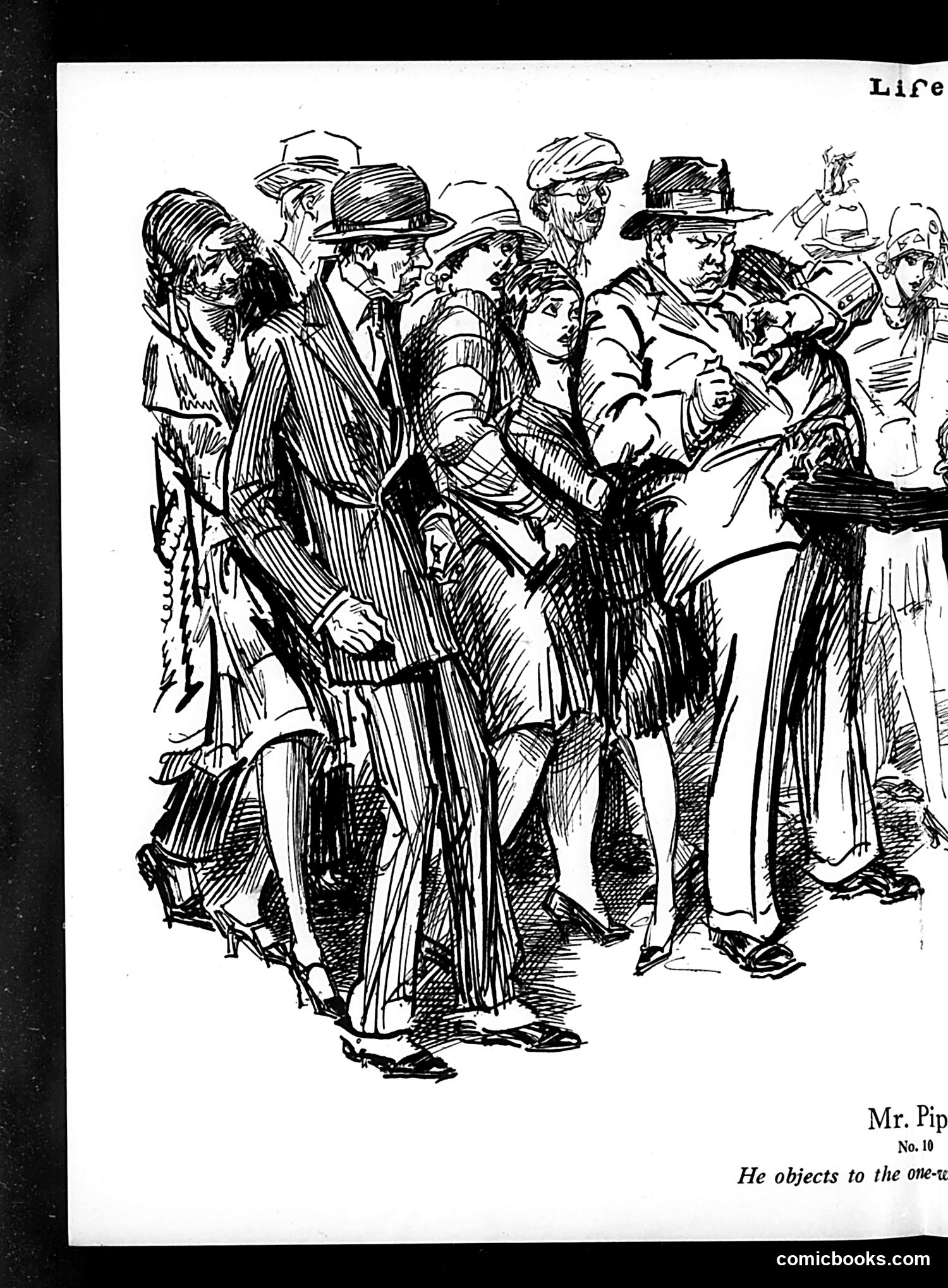
This appears to be a satirical illustration titled "Mr. Pip" showing a man in formal dress (center, with distinctive facial features) objecting to something described as "the one-v[?]" (the text is cut off). He's surrounded by various figures in period clothing and hats, suggesting a crowd or public gathering scene. Without the complete caption and given the fragmentary OCR text, the specific political or social reference remains unclear. However, the cartoon's setup—depicting someone's objection to an unnamed policy or practice amid diverse onlookers—suggests commentary on a public controversy. The formal Victorian-era clothing indicates this is from the late 19th or early 20th century. The identity of "Mr. Pip" and the exact nature of his objection cannot be determined from the visible information alone.
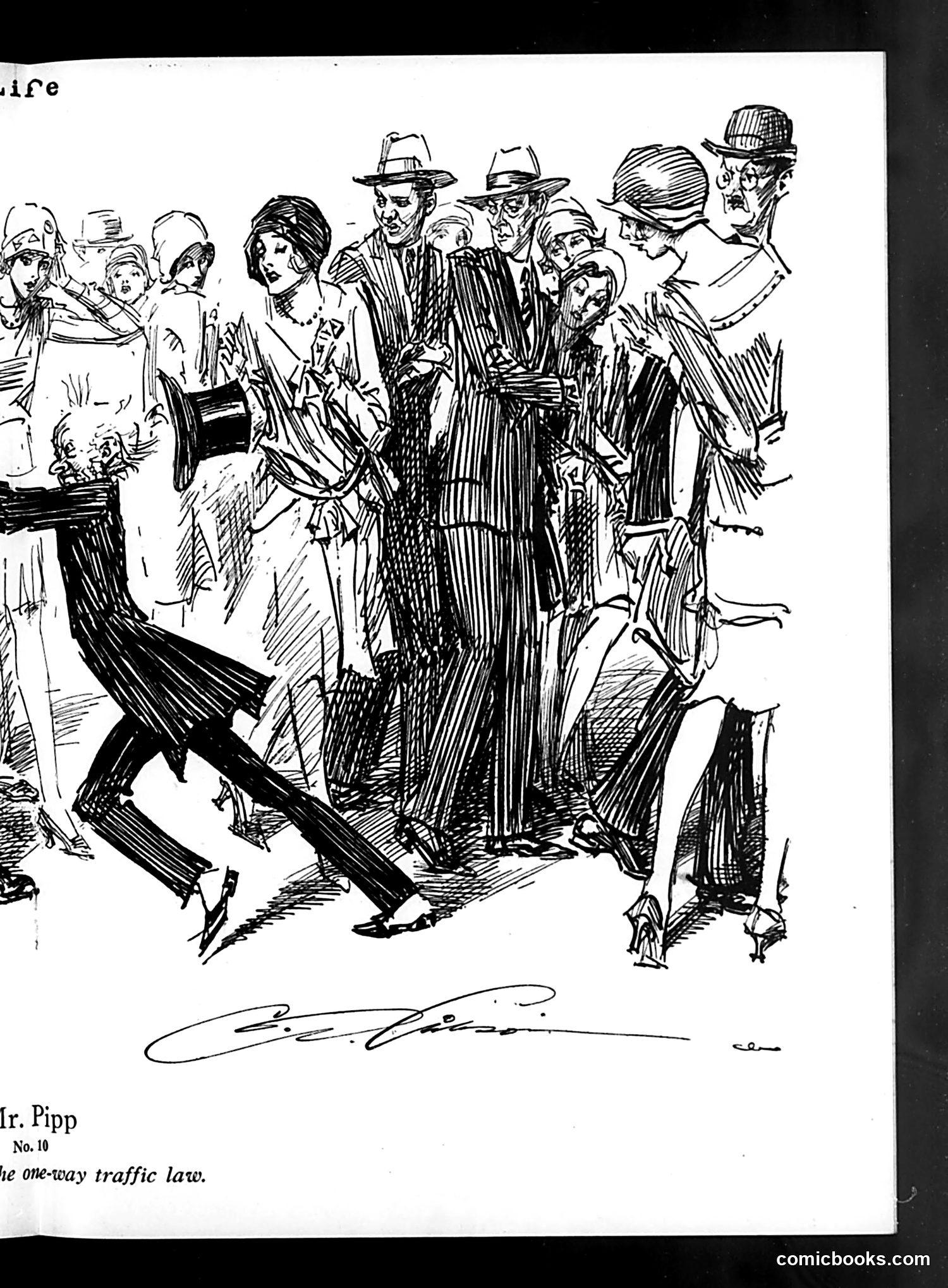
This satirical cartoon, credited to "Mr. Pipp" (No. 10), depicts a crowded group of well-dressed men and women in early 20th-century attire, apparently confused or arguing about directional movement. The caption references "the one-way traffic law." The satire likely mocks the confusion or resistance surrounding newly implemented one-way traffic regulations in urban areas. The jumbled composition—with figures facing different directions and appearing disoriented—humorously suggests public bewilderment at following strict traffic laws. The well-dressed subjects suggest this affects all social classes equally, poking fun at both the general public's difficulty adapting to modern urban traffic control and possibly at city planners' assumption that citizens would easily comply with such regulations.
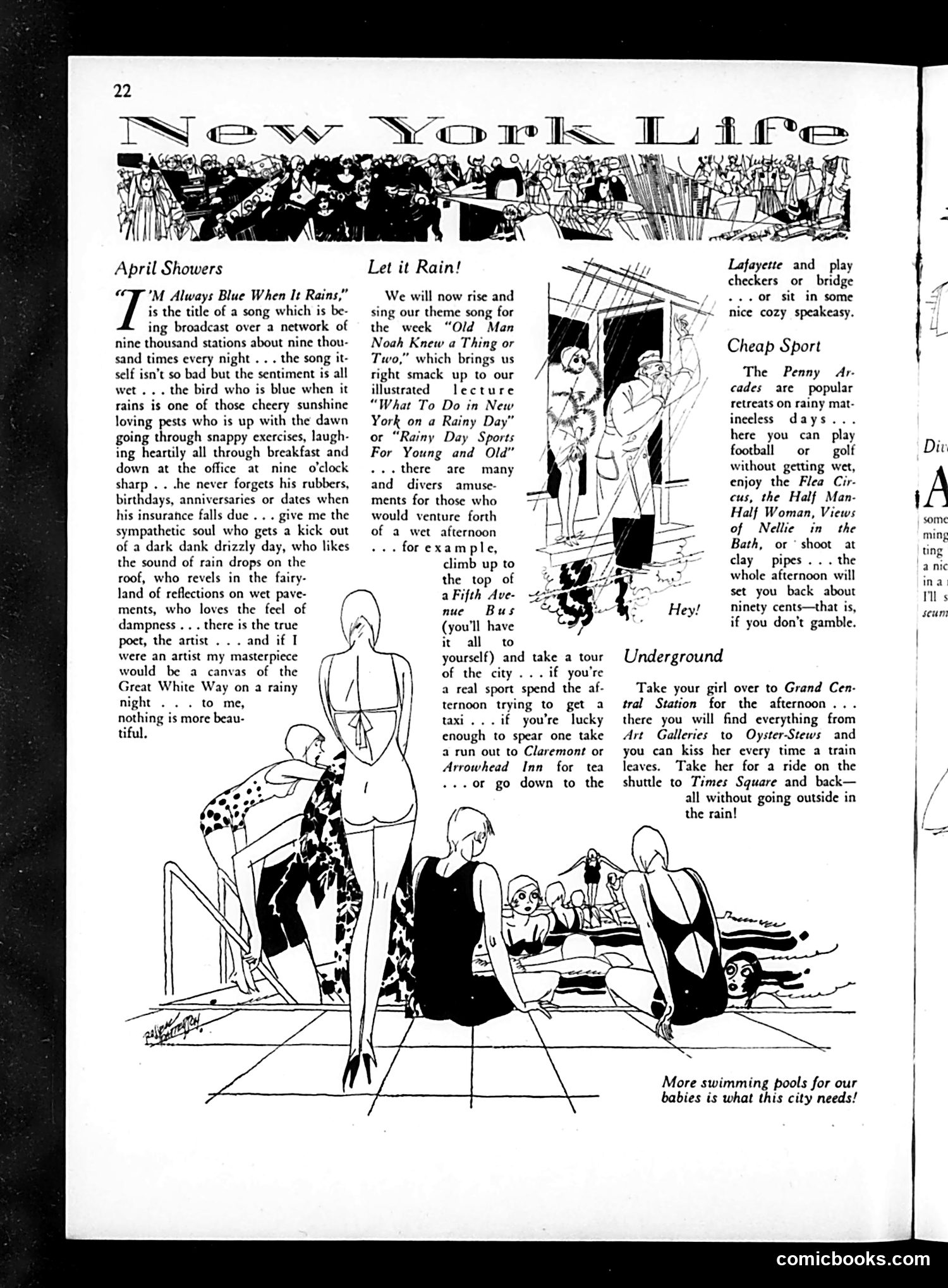
This page satirizes two opposing temperaments about rainy days in 1920s New York City. **"April Showers"** mocks the relentlessly cheerful person—the exercise-obsessed, punctual type who never forgets insurance payments. The author champions instead the melancholic poet who finds beauty in rain, wet pavements, and dreariness. **"Let it Rain!"** humorously catalogs indoor rainy-day activities for New Yorkers: taking buses around the city, hunting for taxis (itself presented as a "sport"), visiting speakeasies (illegal during Prohibition—a knowing joke), penny arcades with curiosities like "Half Man-Half Woman," and exploring Grand Central Station's shops and restaurants. The final caption sarcastically demands "more swimming pools" when the city already offers endless indoor distractions. The satire gently mocks both urban ennui and New York's commercialized leisure culture—turning a rainy day into an elaborate urban adventure designed to keep people indoors spending money.
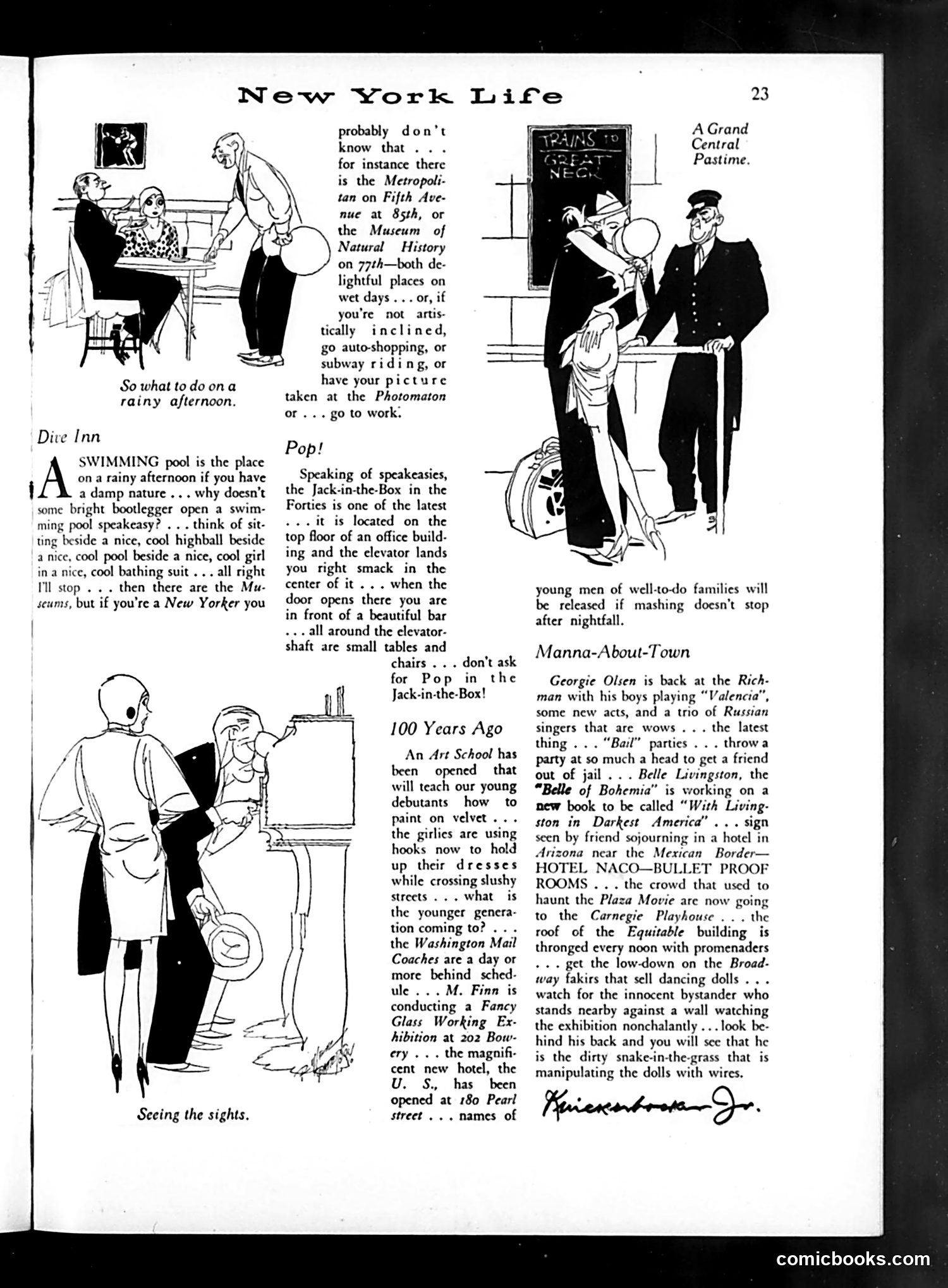
This 1920s *Life* magazine page satirizes Manhattan leisure and entertainment during Prohibition. The cartoons and text offer social commentary on rainy-day activities for affluent New Yorkers. **Key Content:** The "Dive Inn" section humorously suggests indoor swimming pools as speakeasy venues—combining Prohibition-era illegal drinking with recreation. The reference to "bootlegger" emphasizes speakeasies' illegal status. "Pop!" describes the Jack-in-the-Box, a fashionable speakeasy in an office building's top floor, accessible via elevator—a clever hidden location to evade law enforcement. The "100 Years Ago" section mocks social progress by contrasting 1820s concerns (women's dress hooks, debutantes painting on velvet) with modern decadence, implying little genuine advancement. "Manna-About-Town" gossip covers nightclub performers, socialite Belle Livingston, and Broadway street con artists selling dancing dolls with hidden puppet-masters—metaphorically critiquing urban deception. The cartoons depict well-dressed New Yorkers enjoying museums, restaurants, and nightlife, celebrating the era's sophisticated urban leisure culture.
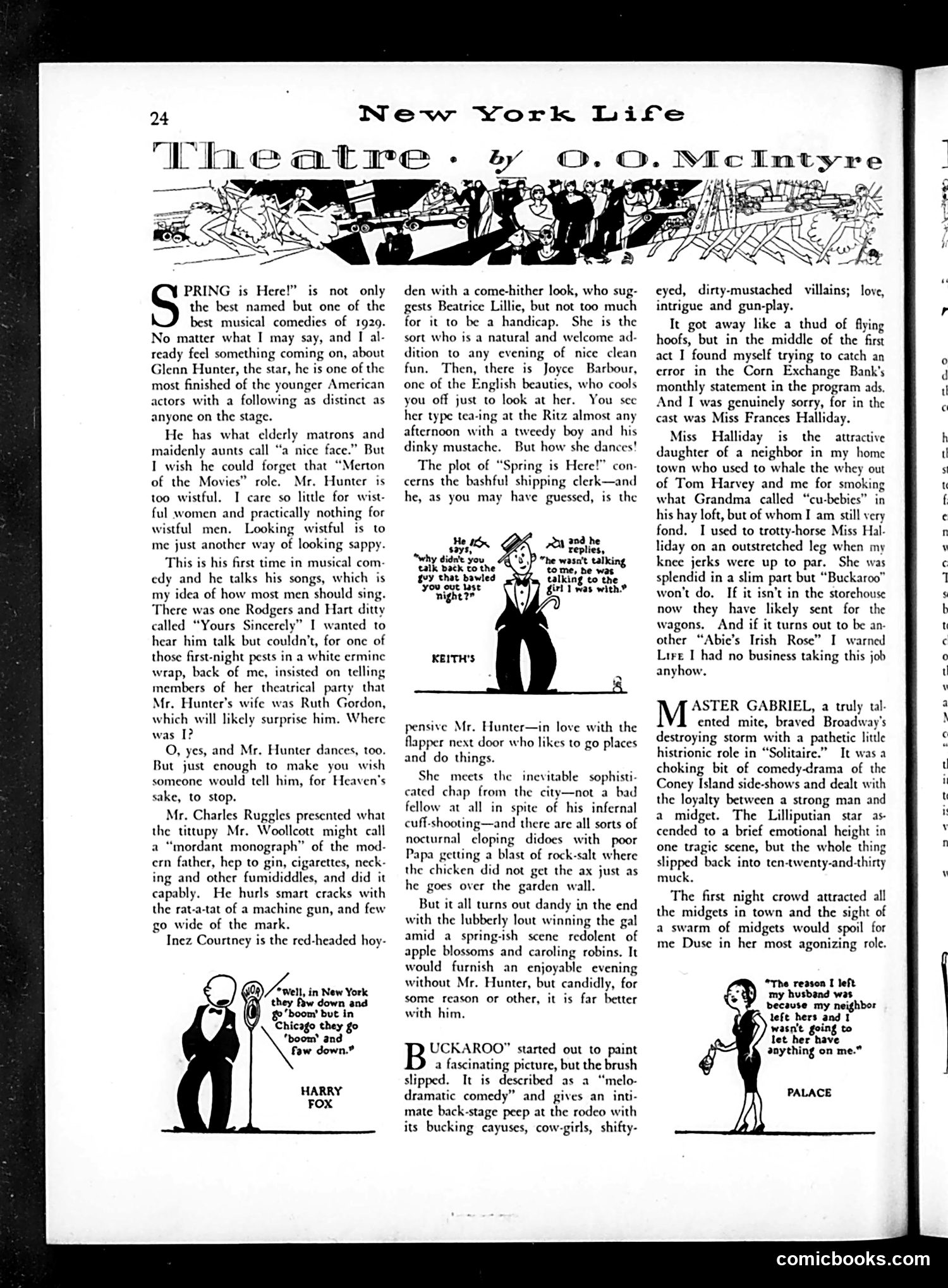
This is O.O. McIntyre's theatre column reviewing Broadway productions from 1929. The page contains three small cartoon vignettes illustrating theatrical gossip and observations: **The cartoons show:** - **Harry Fox** (labeled, a vaudeville star): A joke about New York slang where "boom" means both up and down - **Keith's** (theatre circuit): A man explaining he wasn't talking to his companion but to a girl with her - **Palace** (famous vaudeville house): A woman's complaint about a man leaving her for another woman **The reviews cover:** - "*Spring is Here!*" - a 1929 musical comedy starring Glenn Hunter, whom McIntyre admires despite finding his "wistful" acting style sappy - "*Buckaroo*" - a melodramatic comedy set in rodeo culture with villains and romance, which McIntyre found poorly executed The tone is gossipy and irreverent, typical of Life magazine's satirical theatre criticism of the era, mixing professional critique with personal anecdotes and mild social commentary about 1920s theatrical culture.
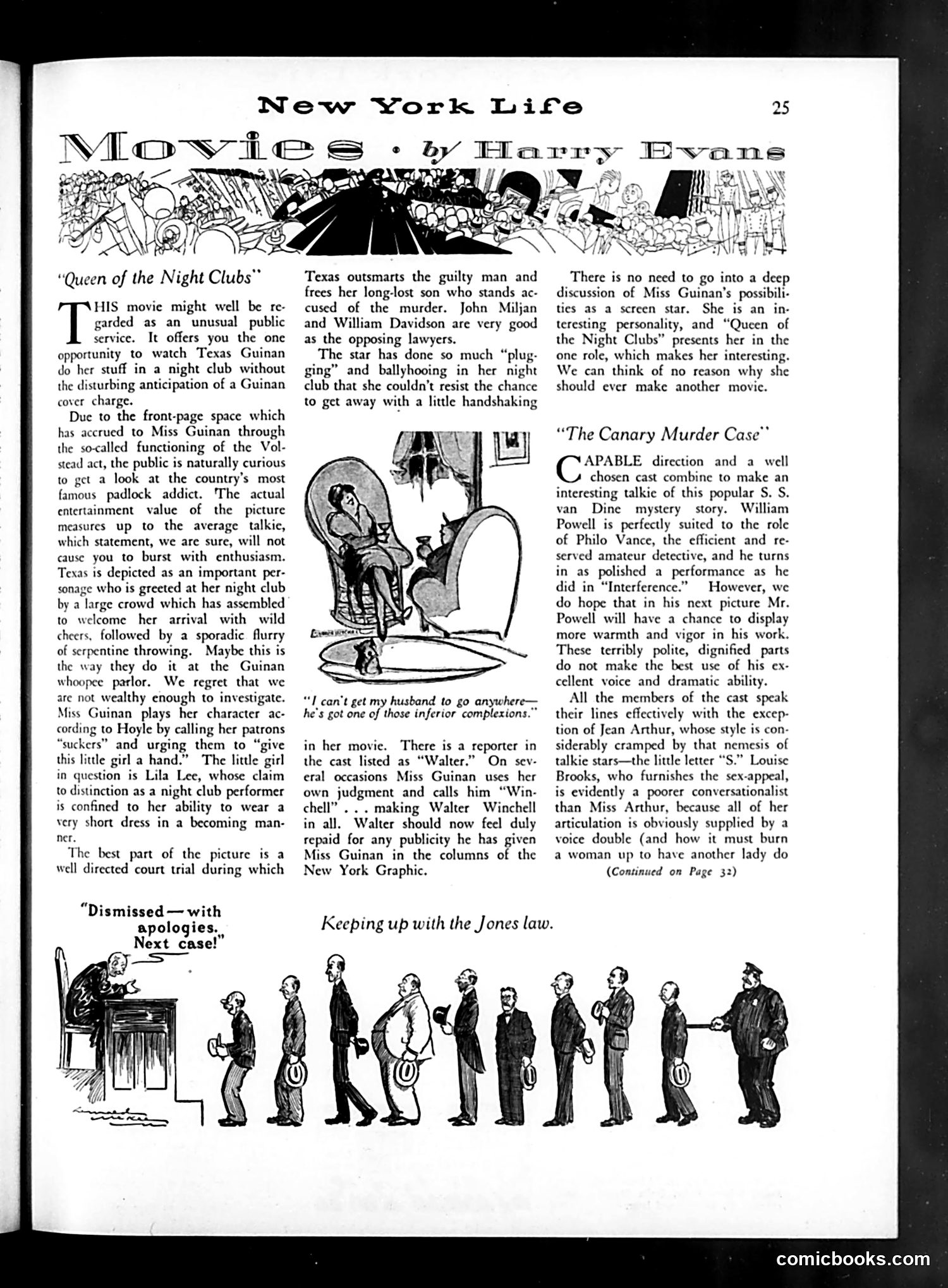
This page reviews two films featuring prominent figures of the Prohibition era (1920s-1930s). **"Queen of the Night Clubs"** stars Texas Guinan, a real nightclub owner famous for evading Prohibition laws (the Volstead Act). The review is satirical—Life notes that watching her in a film is preferable to visiting her actual speakeasy, where patrons faced police raids ("padlock addict"). The reviewer mocks her acting abilities and her self-promotion, noting she even ad-libbed "Winchell" (Walter Winchell) into the script, likely referencing the gossip columnist's coverage of her. **"The Canary Murder Case"** is a straightforward positive review of a S.S. Van Dine mystery adaptation starring William Powell. The cartoon at bottom, captioned "Keeping up with the Jones law," appears to reference Prohibition enforcement (though "Jones law" is unclear—possibly conflating enforcement with contemporary cultural references). The satire reflects Life's irreverent tone toward Prohibition-era celebrity and the era's underground nightclub culture.
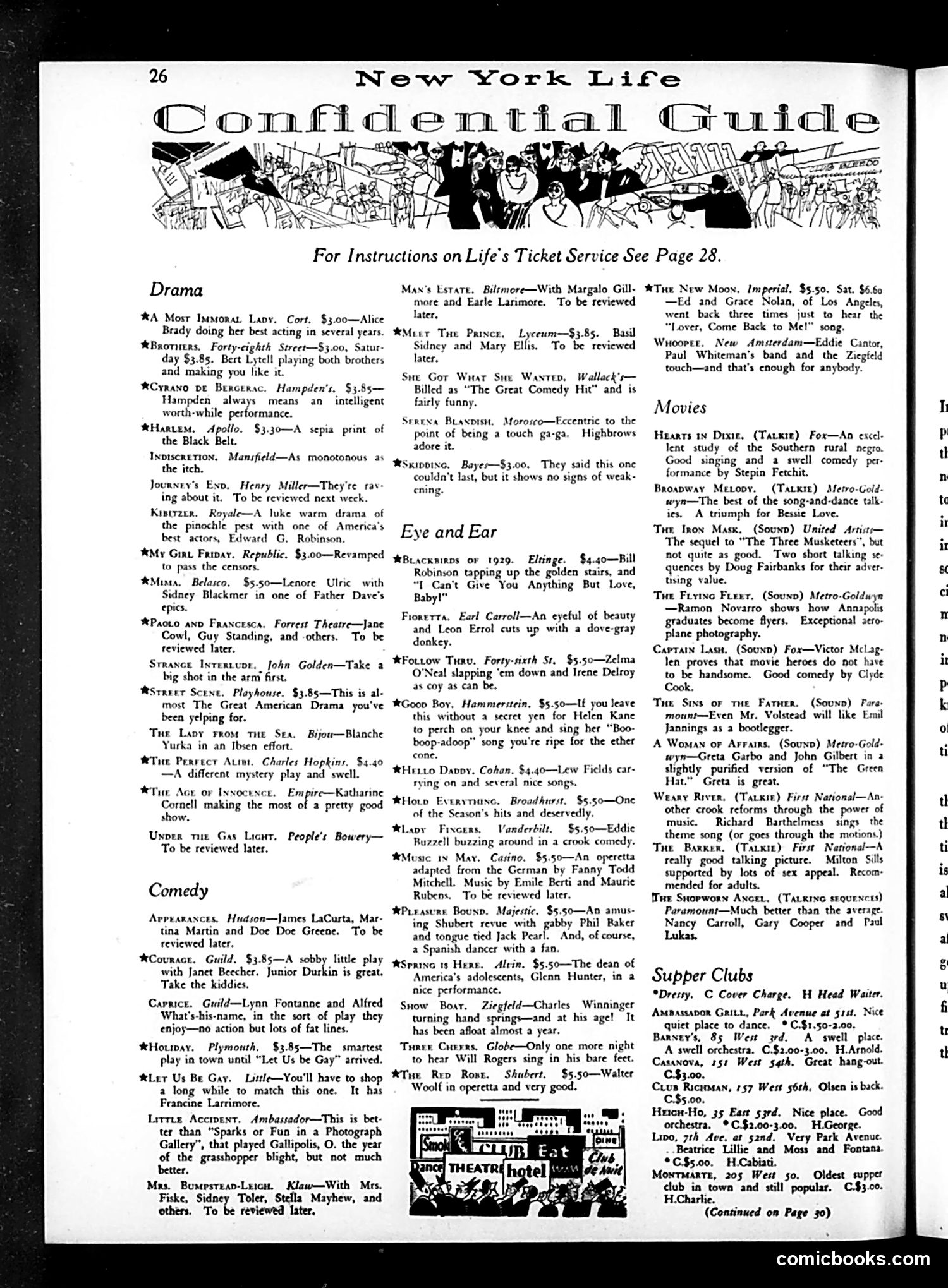
This page is primarily **entertainment advertising and reviews**, not political cartoon content. It's from *New York Life* magazine's "Confidential Guide" section listing Broadway shows, movies, and nightclubs with ticket prices and brief critiques. The content reflects 1920s theater culture: drama productions starring established actors (Hampden, Edward G. Robinson), comedies, and "Eye and Ear" entertainment (musicals and revues). Notable references include performers like Bill Robinson and Helen Kane, and venues like the Apollo and Vanderbilt theaters. The small illustration at the bottom appears to be a theater advertisement but is too unclear to identify specifically. **This page contains no political satire**—it's a straightforward entertainment guide typical of magazine content from this era, aimed at New York leisure-class readers seeking cultural activities and dining recommendations.
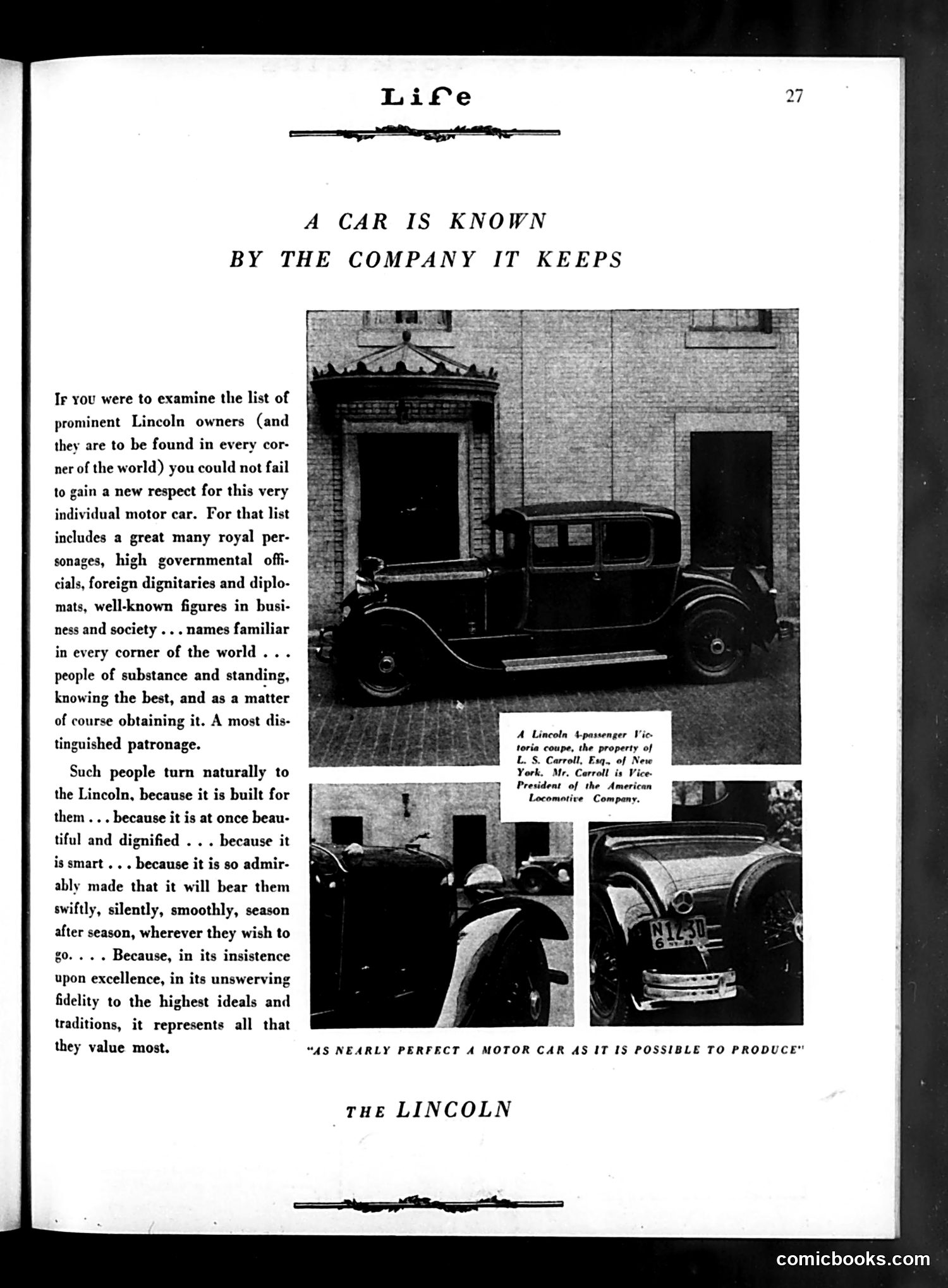
This is **not a cartoon or satire** — it's a straightforward **luxury automobile advertisement** for Lincoln cars, appearing in *Life* magazine (page 27). The ad employs aspirational marketing: it argues that Lincoln owners are distinguished people of global prominence — royalty, government officials, diplomats, and business leaders. The tagline "A Car Is Known By The Company It Keeps" suggests that owning a Lincoln signals one's membership in an elite social class. The three photographs show a Lincoln passenger Victoria coupe owned by L.S. Carroll, Vice President of the American Locomotive Company, presented as visual proof of the car's prestigious appeal. The copy emphasizes Lincoln's qualities — beauty, dignity, smooth performance, reliability, and "excellence" — as reflecting the values of its discerning clientele. This represents typical early 20th-century luxury marketing: selling status and refinement rather than mechanical features, targeting wealthy readers who aspire to associate themselves with global elites.
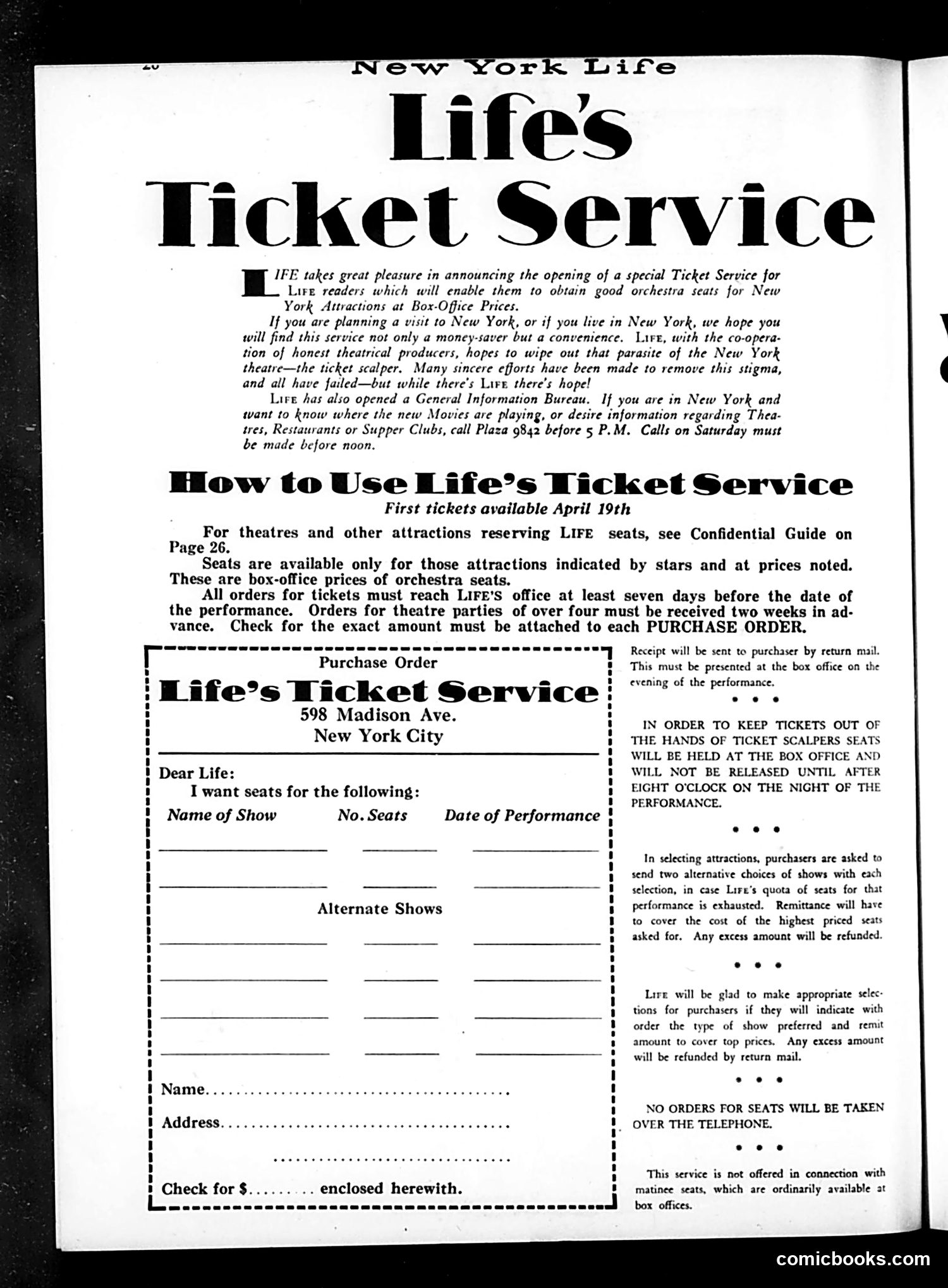
This is a **service advertisement**, not a cartoon. Life magazine is announcing a new ticket-booking bureau to help readers obtain Broadway theater seats at box-office prices—a direct response to the widespread problem of **ticket scalping** in New York. The social context: Ticket scalpers were parasites who bought up good seats and resold them at inflated prices, a major irritant to theatergoers. Life positions itself as a reformer, partnering with "honest theatrical producers" to eliminate this practice by offering legitimate seats directly. The mechanism includes anti-scalping safeguards: tickets held at box offices until 8 PM on performance night to prevent resale, advance ordering requirements (seven days minimum), and alternative show selections in case demand exceeds supply. This reflects early 20th-century consumer frustrations and Life's role as a magazine advocating for readers' interests against exploitation.
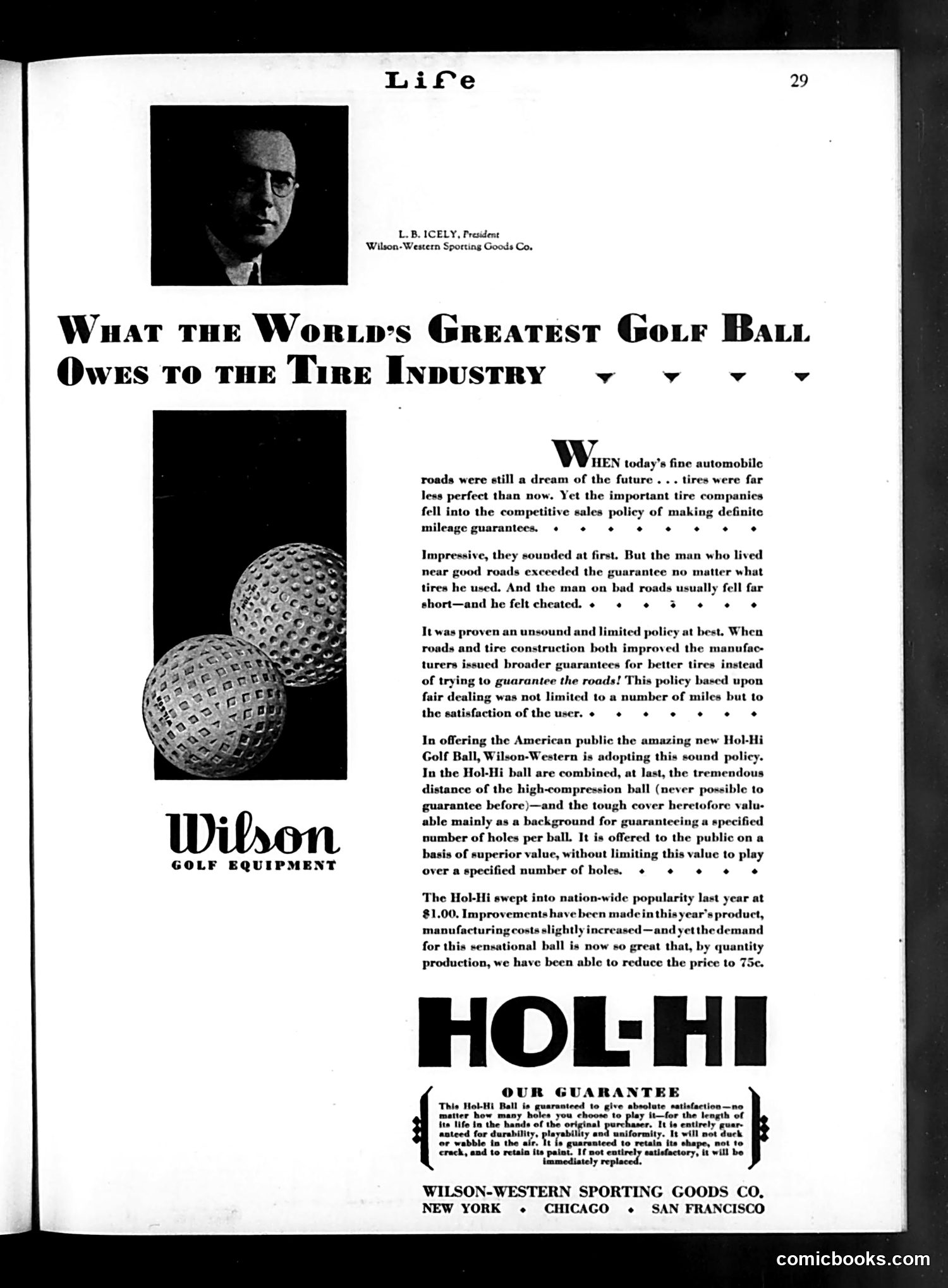
This is **not a cartoon or satire**—it's a straightforward advertisement for the Hol-Hi golf ball by Wilson-Western Sporting Goods Co., featuring company president L.B. Icely. The ad uses an **analogy to make a business argument**: it compares tire industry history to golf ball marketing strategy. The point is that tire companies initially made limited mileage guarantees, which unfairly penalized customers on poor roads. Once roads improved, manufacturers switched to broader guarantees based on customer satisfaction rather than arbitrary specifications. Wilson-Western claims to apply this "sound policy" to golf balls: the Hol-Hi combines distance and durability without limiting its guarantee to a specific number of holes played. Instead, it guarantees overall satisfaction. The headline's framing—crediting tires for golf ball excellence—is playful business rhetoric, not political satire. The ad emphasizes value: improvements made while price dropped from $1.00 to 75¢ through quantity production. This reflects early 20th-century consumer capitalism emphasizing reliability and fair dealing as competitive advantages.
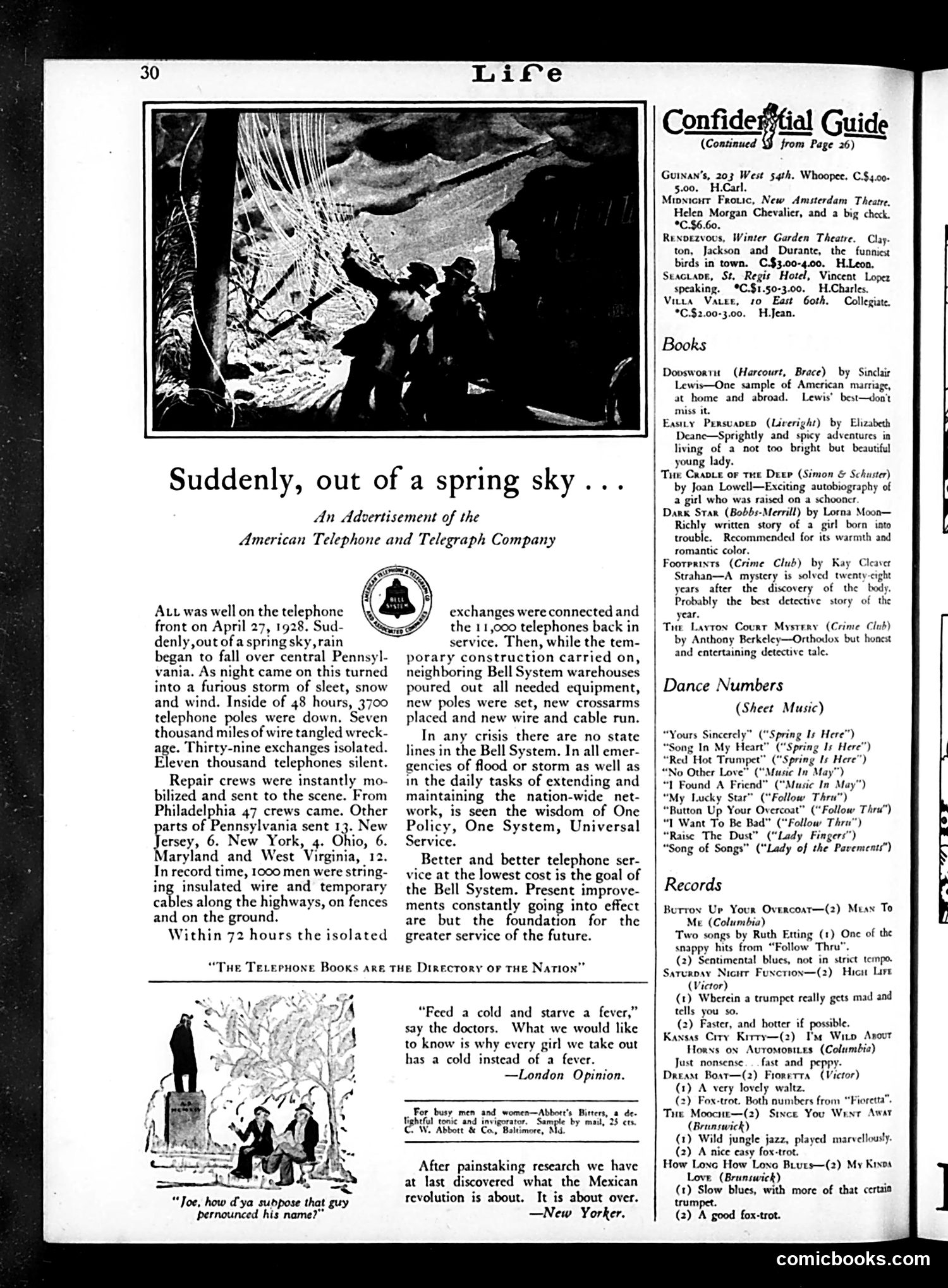
This page combines a corporate advertisement with satirical humor typical of Life magazine's format. **The Main Advertisement:** A full AT&T testimonial describes a real 1928 Pennsylvania storm that downed 3,700 telephone poles and 11,000 miles of wire. The ad celebrates the Bell System's coordinated national response—crews mobilized from multiple states restored service within 72 hours. The message: the telephone monopoly's "One Policy, One System, Universal Service" proves indispensable during crises. **The Cartoons Below:** Two small jokes mock urban nightlife and contemporary attitudes. One depicts a man mispronouncing someone's name ("Joe, how d'ya suppose that guy pronounced his name?"), likely referencing speakeasies and social climbing in the Jazz Age. The other jokes about dating during cold season. **The Satire:** Life sarcastically frames a corporate propaganda piece alongside trivial comedy, suggesting the gap between AT&T's grand claims about national unity and ordinary Americans' petty concerns—dating mishaps and social embarrassment.
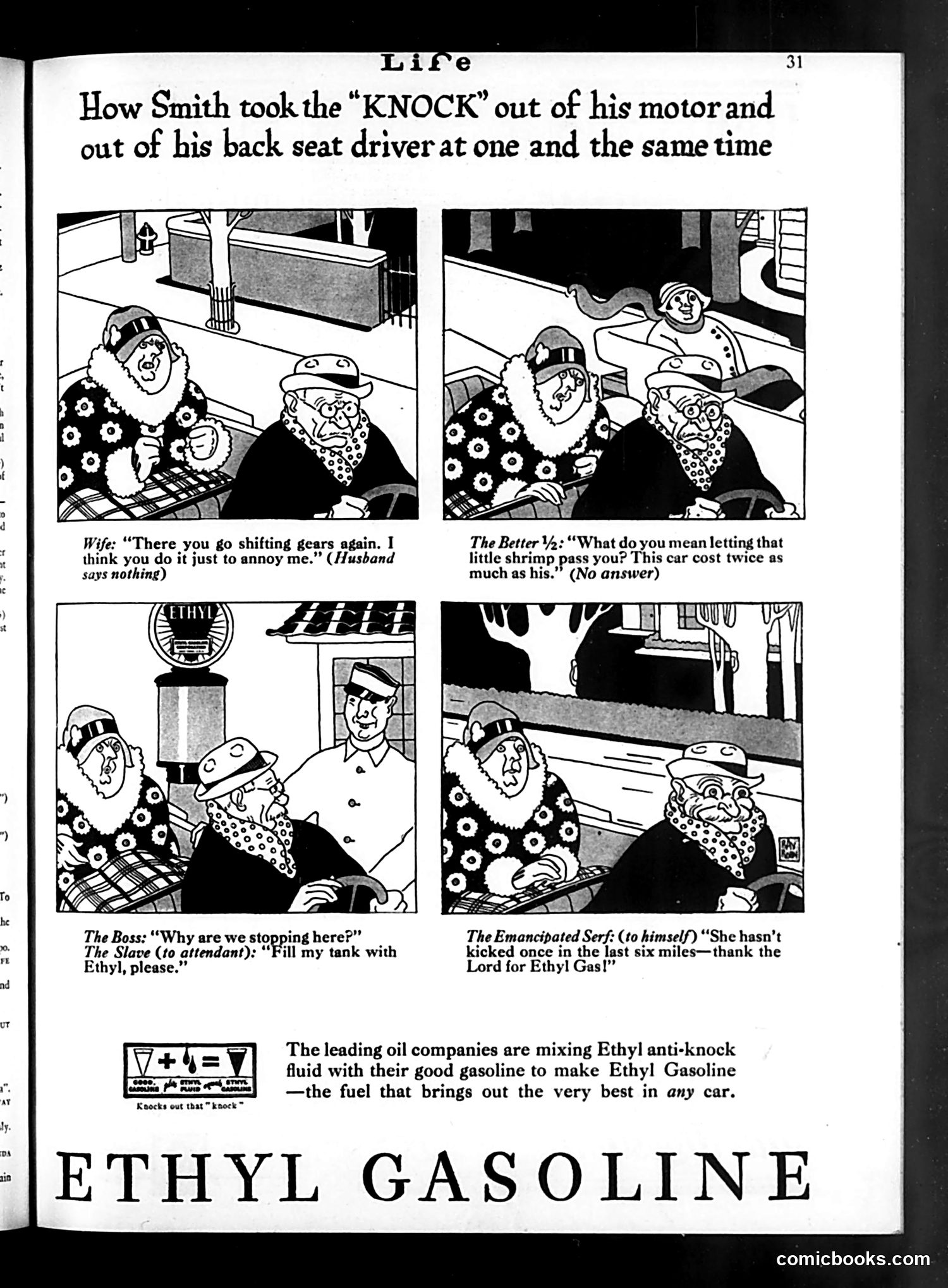
This is a **1920s advertising comic** for Ethyl Gasoline, promoting "anti-knock" fuel as a solution to engine problems. The four-panel narrative follows a man (Smith) whose car "knocks" (engine pinging/detonation). Each panel shows a different passenger complaining—his wife criticizing his driving, a wealthy acquaintance insulting his car, his boss questioning stops, and finally a servant. The joke's punchline: after filling up with Ethyl Gasoline, the car runs smoothly and the "back seat driver" (the servant) stays quiet for six miles, calling it a blessing. The satire satirically positions Ethyl fuel as solving not just mechanical problems but also *social friction*—silencing nagging passengers through superior engine performance. The ad conflates car trouble with marital/class tension, using humor to suggest that the right gasoline product improves one's entire life experience by eliminating complaints from those around you.
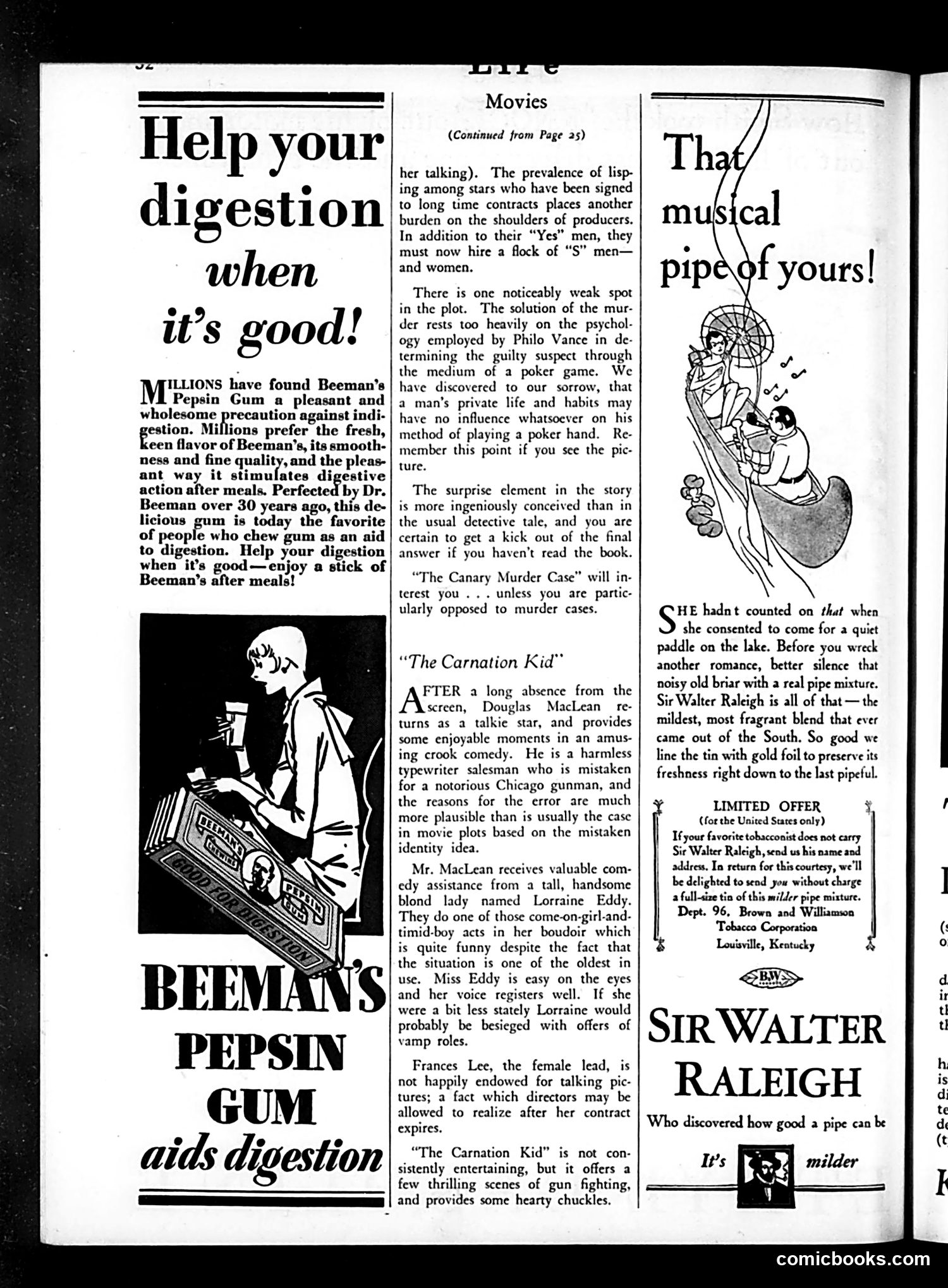
This page contains **movie reviews** (continuing from page 23) discussing three films: "The Canary Murder Case," "The Carnation Kid," and a brief mention of another picture. The reviewer critiques plot devices, acting performances, and dialogue quality in early "talkie" (sound) films—a recent innovation at the time. The page is dominated by **period advertisements**: Beeman's Pepsin Gum (marketed as a digestive aid) and Sir Walter Raleigh pipe tobacco. The tobacco ad features a cartoon couple in a canoe with flirtation humor—the woman apparently didn't expect her date to smoke a pipe, but the "milder" Sir Walter Raleigh won't disturb romance. The reviews themselves note emerging challenges of sound cinema: actors with lisping problems, and the difficulty of casting "talkie" stars. This reflects the industry's early adjustment to recorded dialogue, circa late 1920s-early 1930s.
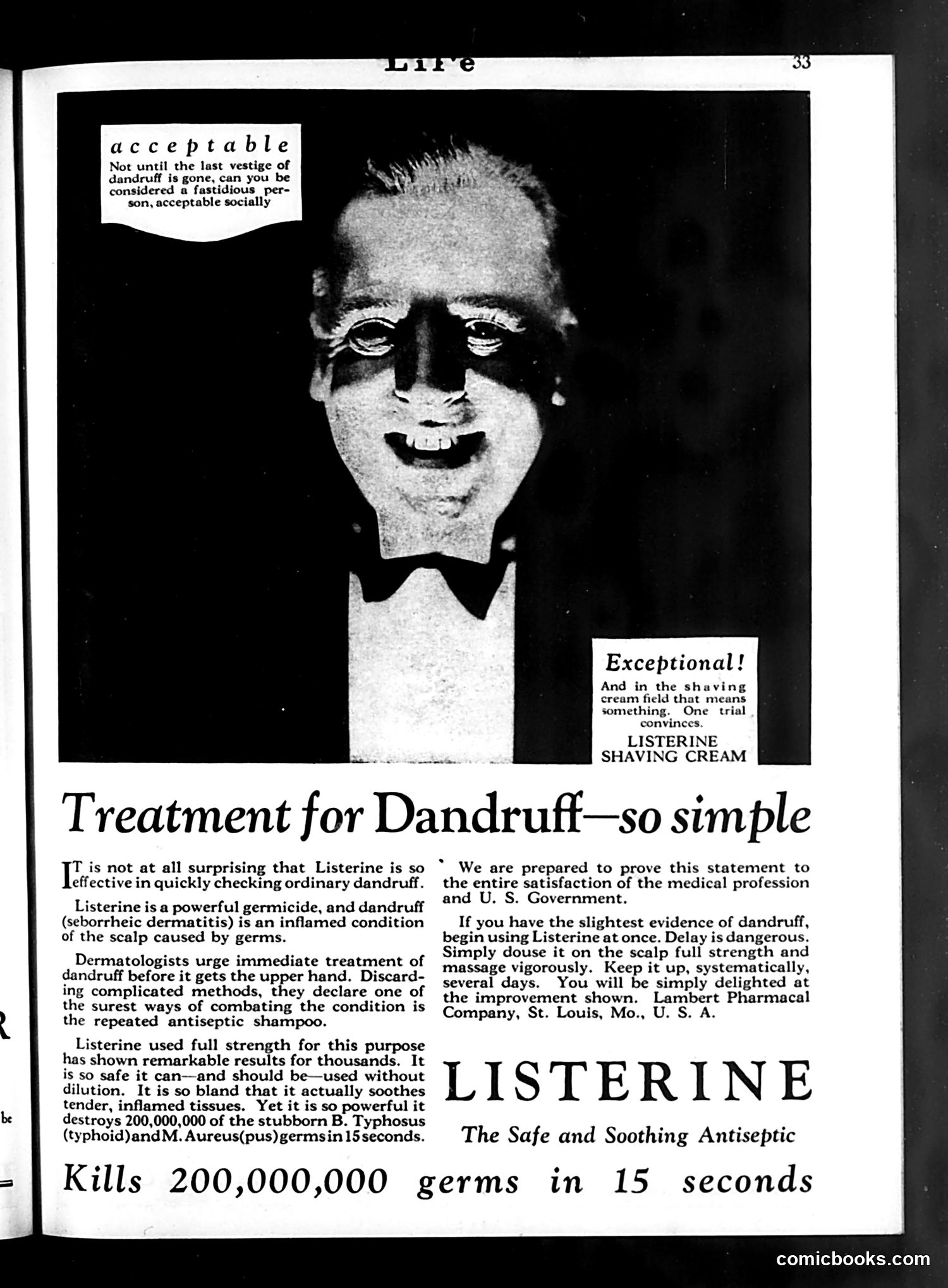
This is a vintage **Listerine advertisement**, not political satire. The page uses social anxiety as a marketing tool, a common advertising tactic of the early-to-mid 20th century. The cartoon shows a man in formal wear (tuxedo, sunglasses) with the caption that dandruff makes one "unacceptable socially"—implying social failure and embarrassment. This creates shame to motivate purchase. The ad claims Listerine, used as a full-strength scalp treatment, kills bacteria causing dandruff (seborrheic dermatitis). It cites specific germ counts ("200,000,000 germs in 15 seconds") and appeals to medical authority ("dermatologists," "U.S. Government"). The humor/satire is **unintentional**: modern readers recognize the exaggerated social consequences, pseudoscientific claims, and fear-based marketing as absurd—yet this was standard advertising practice then. The "exceptional" shaving cream callout suggests Listerine's multi-use positioning.
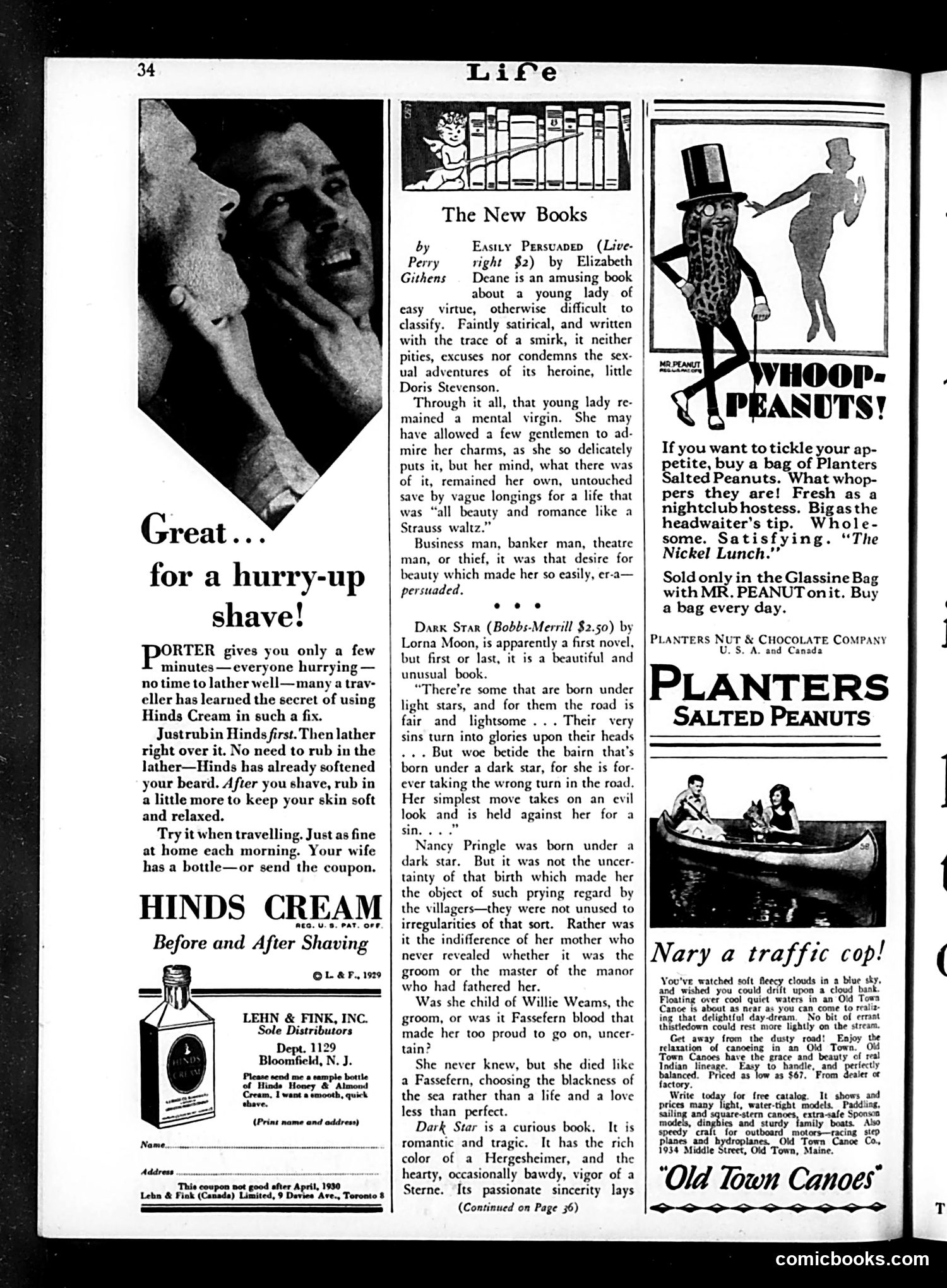
This page is primarily **advertising and book reviews**, not political satire. The main content includes: **Advertisements:** - **Hinds Cream** (shaving product): Appeals to busy travelers with a "before and after" pitch about quick shaving - **Planters Salted Peanuts**: Features Mr. Peanut (the mascot in top hat) as a figure of sophistication, marketing peanuts as an affordable "nickel lunch" - **Old Town Canoes**: Romantic imagery of peaceful boating **Book Reviews:** - *Easily Persuaded* by Elizabeth Deane: A satire about an amoral young woman who maintains mental innocence despite sexual adventures - *Dark Star* by Lorna Moon: A tragic novel about a woman born under a "dark star," exploring class and illegitimacy themes The page reflects 1920s consumer culture and literary trends rather than political commentary. The advertisements use humor and aspiration to sell products to middle-class readers.
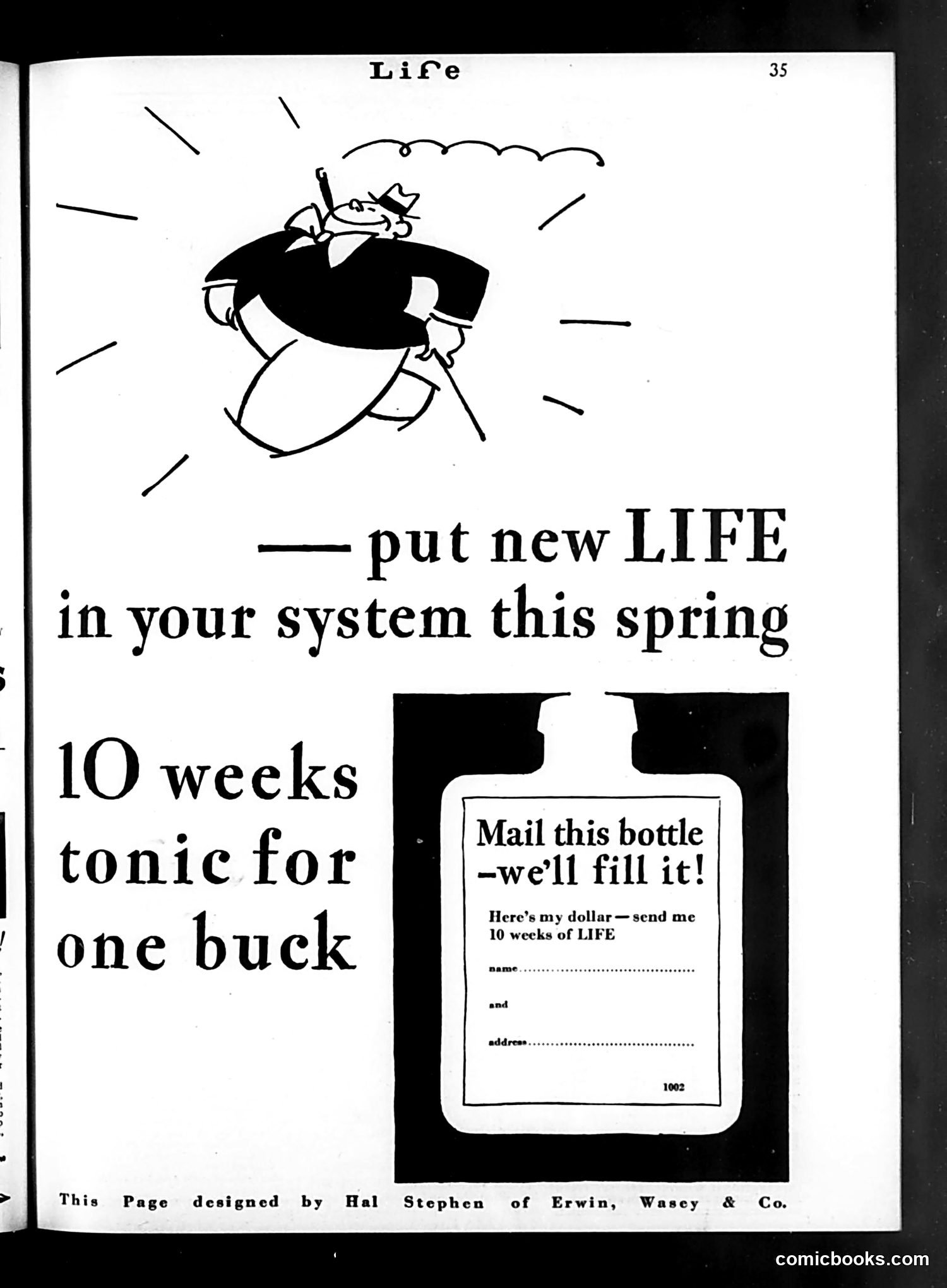
This is an **advertisement for Life magazine itself**, disguised as a patent-medicine pitch. The cartoon shows a cheerful figure receiving a bottle labeled "LIFE," playing on the double meaning: the magazine *Life* and the concept of vitality/renewed energy. The ad mimics early-20th-century "tonic" advertisements—dubious patent medicines promising to cure fatigue and boost health. By positioning the magazine as a "10 weeks tonic for one buck," Life's publishers humorously suggest that reading their satirical publication is as rejuvenating as a medicinal tonic. The mail-in coupon with fill-in-the-blank name and address fields completes the parody of direct-mail medical advertising common in that era. This self-aware humor about both patent-medicine culture and magazine subscriptions would appeal to Life's educated, skeptical readership.
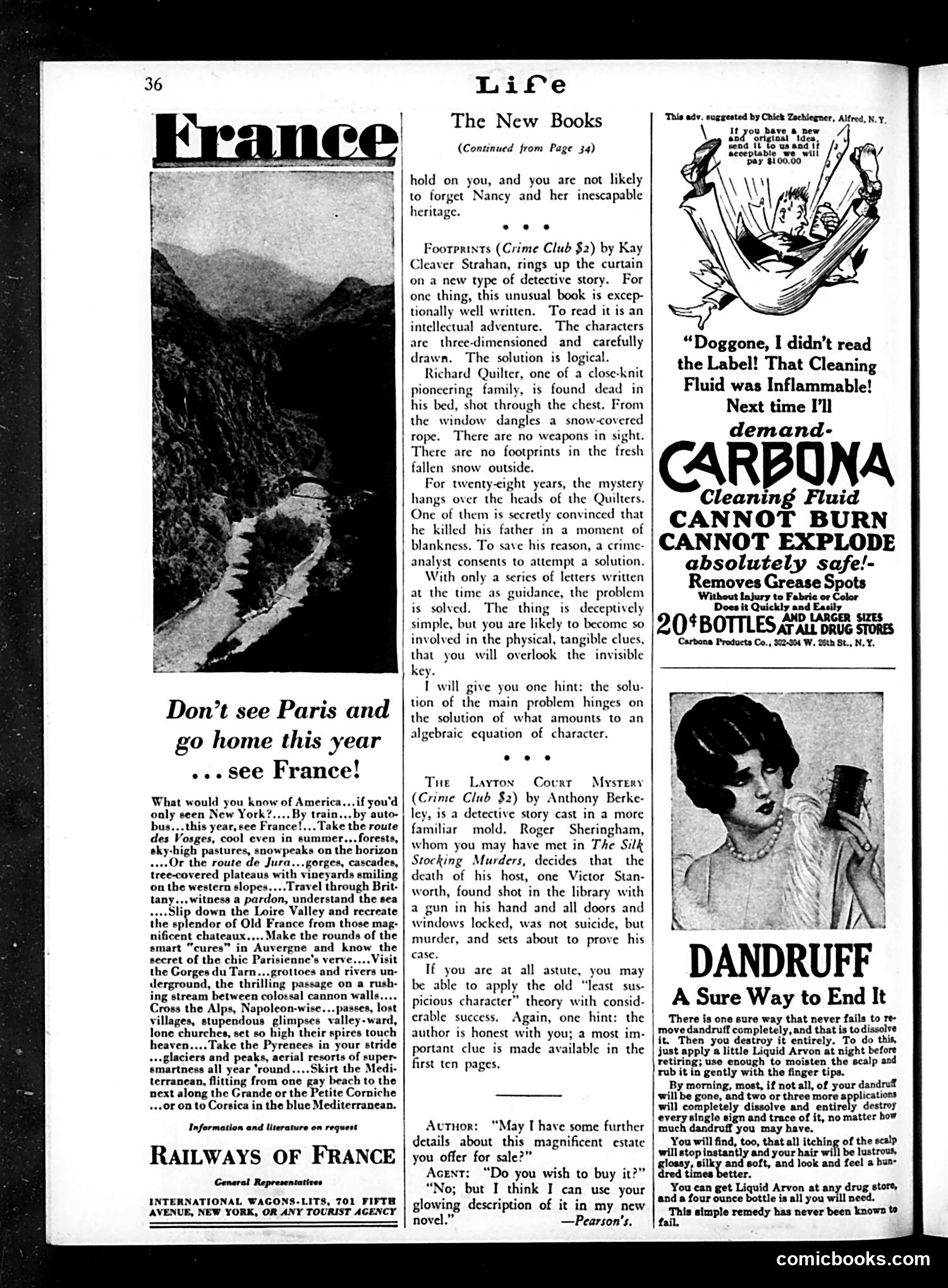
This page contains a **travel advertisement for French Railways** (left) and **book reviews** (center/right), with commercial ads interspersed. ## The France Travel Ad The large advertisement uses a common marketing appeal of the interwar period: encouraging Americans to experience "authentic" France beyond Paris. The copy emphasizes scenic routes, historical sites (châteaux, the Loire Valley), and the lifestyle associated with French sophistication—recreating "the splendor of Old France" and understanding "the secret of the chic Parisienne's verve." The implicit message reflects 1920s-30s American cultural anxiety: merely seeing New York doesn't make one cultured; one must travel to Europe (specifically France) to gain genuine sophistication and refinement. ## The Book Reviews Reviews of detective mysteries reflect the period's popular Crime Club series. These are straightforward literary notices with plot summaries—typical middlebrow magazine content of the era. ## The Advertisements Side advertisements include **Carbona Cleaning Fluid** and a **dandruff remedy**—everyday products marketed through bold typography and health/appearance appeals characteristic of Depression-era advertising.
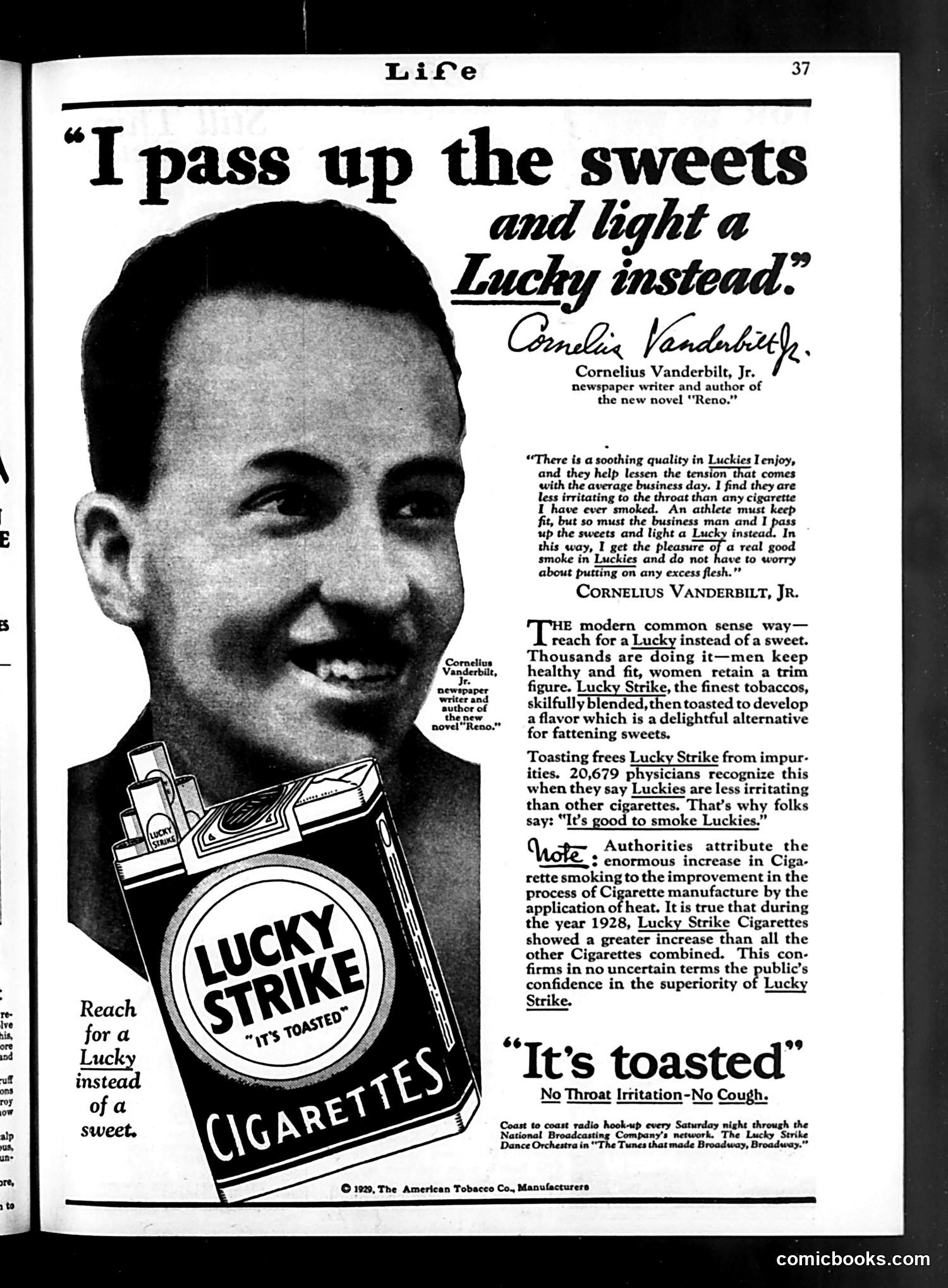
This is **not satire or political commentary**—it's a straightforward cigarette advertisement disguised as celebrity endorsement. Cornelius Vanderbilt Jr., a real newspaper writer and author, is quoted claiming he chooses Lucky Strike cigarettes over sweets to stay fit and avoid weight gain. The ad argues cigarettes are a healthier alternative to candy, promoting the idea that smoking suppresses appetite. The advertisement makes now-shocking health claims: that Lucky Strikes are "less irritating to the throat" than competitors, citing "20,679 physicians" as endorsement. It emphasizes the toasting process as a health benefit. **Modern context**: This reflects pre-regulation advertising when tobacco companies made unsubstantiated health claims and recruited celebrities for endorsements. The "slim and fit" messaging targeted weight-conscious consumers, particularly women, equating smoking with weight control—a common marketing tactic throughout the 20th century before tobacco regulation.
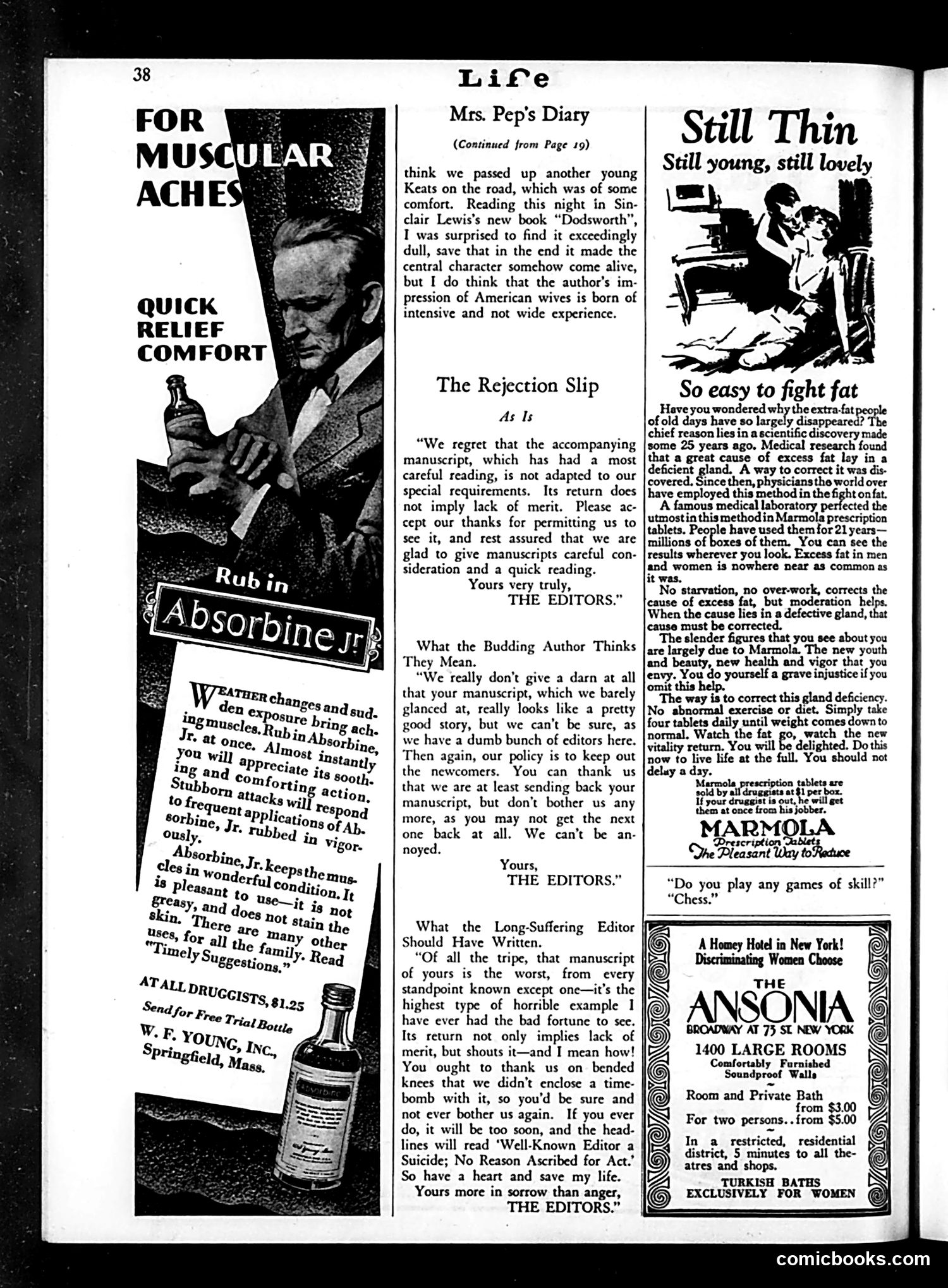
This page from *Life* magazine (approximately 1920s-1930s) contains satirical commentary on the publishing industry and period advertisements. **"The Rejection Slip" section** mocks the gap between what literary magazines politely tell rejected authors and what editors actually think. The satire presents three versions: the formal rejection letter (diplomatic), what the budding author interprets it to mean (insulting dismissal), and what the "long-suffering editor" should honestly write (brutally honest condemnation). The humor stems from exposing the hypocrisy of genteel rejection language masking contempt for amateur writers. **"Mrs. Pep's Diary"** offers casual book criticism of Sinclair Lewis's *Dodsworth*, dismissing it as dull while noting the author's narrow view of American wives. The page also contains period advertisements for **Absorbine Jr.** (a liniment) and **Marmola** (a diet aid claiming to correct glandular deficiencies causing obesity), plus a hotel advertisement—typical commercial content of the era. The satire targets pretentious literary gatekeepers and their coded rejection language.
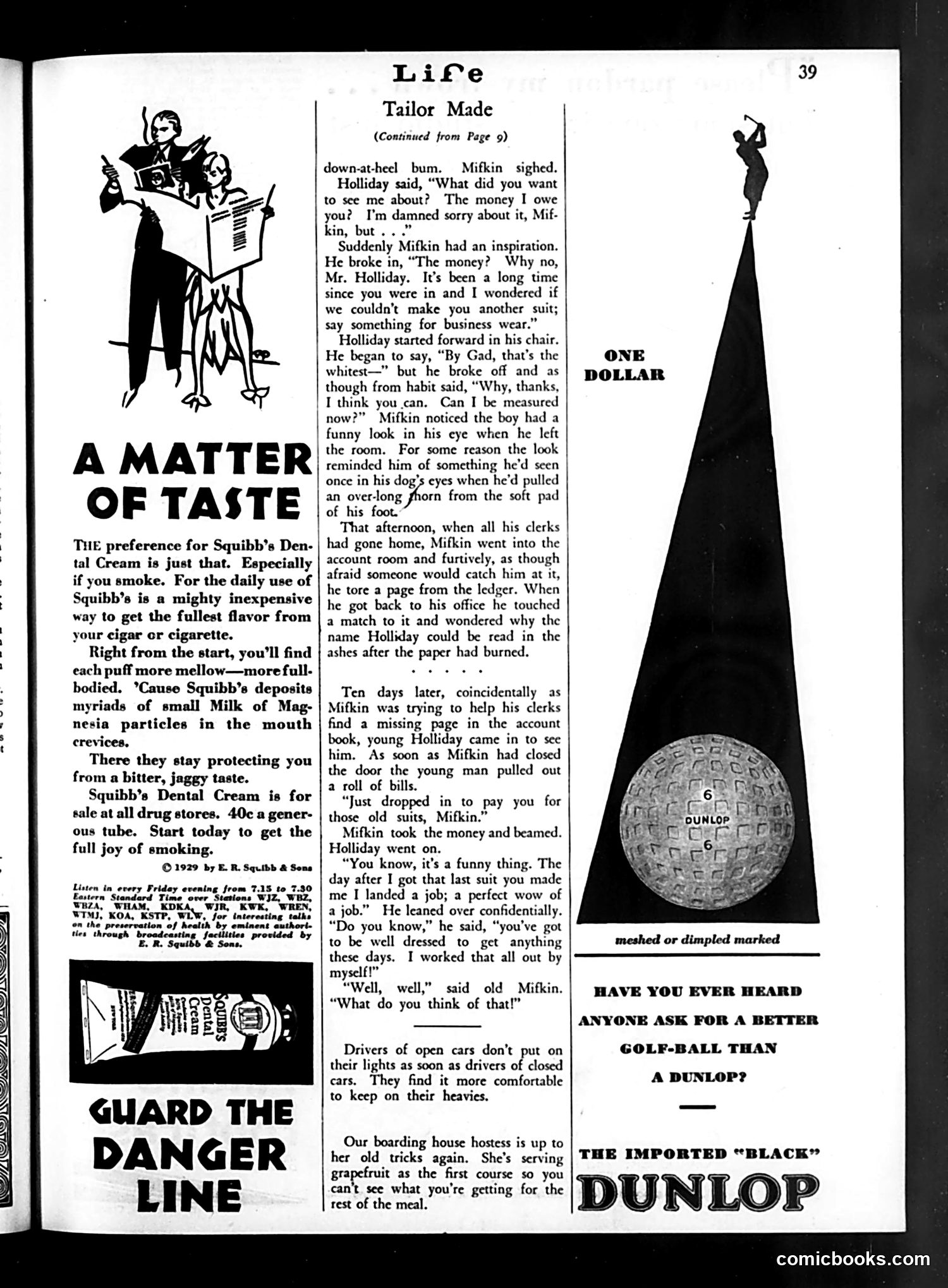
This page contains primarily **advertising and a serialized story**, not political cartoons. The main narrative, "Tailor Made" (continued from page 9), tells a morality tale: a tailor named Mifkin extends credit to a struggling man named Holliday by offering to make him a suit "for business wear," essentially forgiving a debt. Holliday later returns with money, crediting his new suit with helping him land a job—implying that appearance/respectability enables social advancement. The story exemplifies 1929 optimism about self-improvement and the dignity of credit. The page also features **advertisements**: Squibb's Dental Cream (claiming to enhance cigar flavor), and Dunlop golf balls. Small humorous asides mock social behaviors (open-car drivers not using lights, boarding-house hostesses serving grapefruit to hide poor meals). The cartoons in the left margin are decorative illustrations accompanying the tailor story, not satirical commentary.
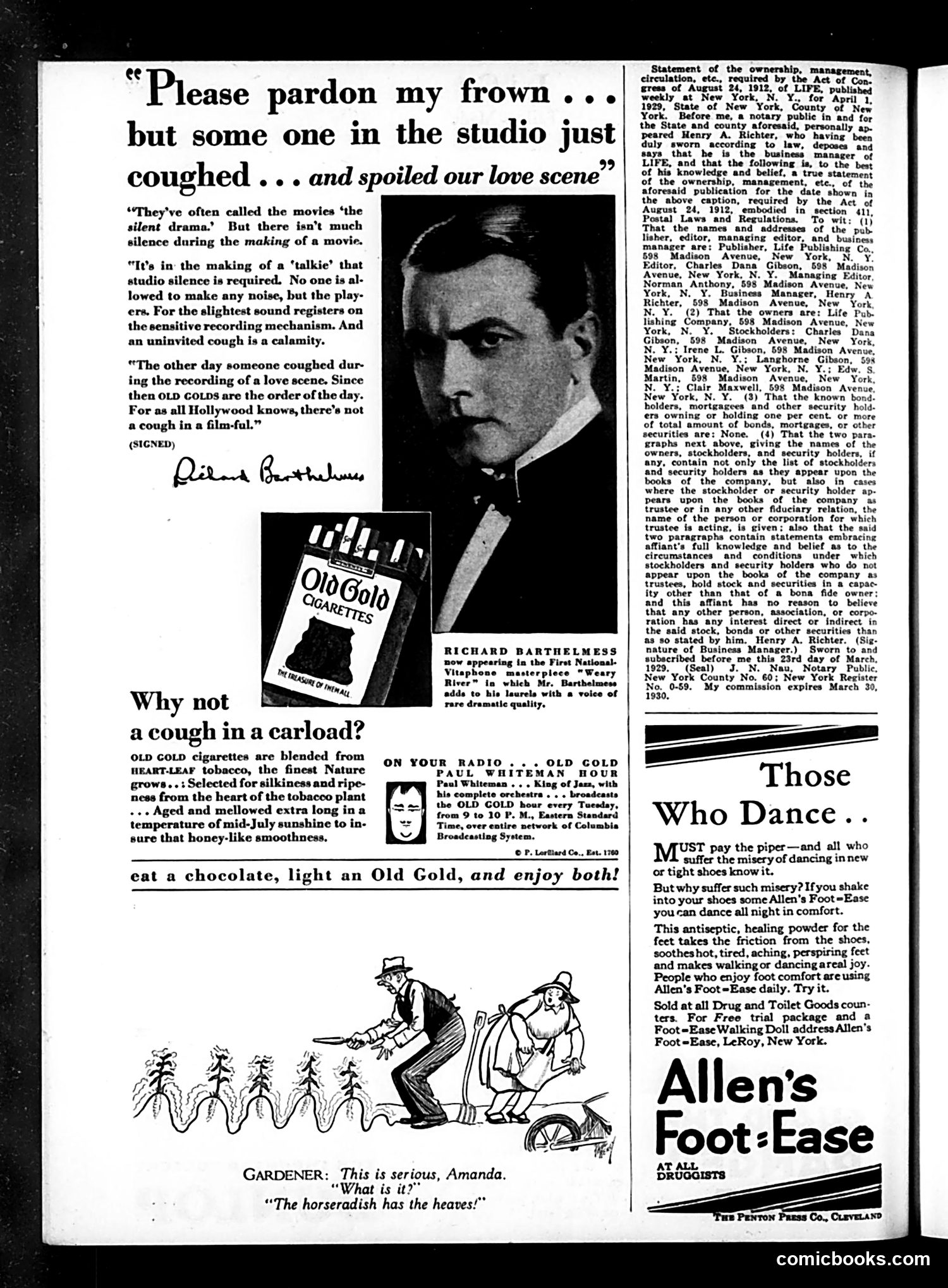
This page contains two separate advertisements disguised as editorial content, typical of 1920s Life magazine satire. **Main Advertisement (Top):** Actor Richard Barthelmess endorses Old Gold cigarettes by joking about "talkies" (early sound films). The humor plays on a real problem: when movies transitioned from silent to sound in the late 1920s, studios discovered that ANY noise—including coughs—ruined recordings. Barthelmess quips that Old Golds are now "the order of the day" in Hollywood because they don't make you cough, solving this technical headache. **Bottom Advertisement:** A simple cartoon jokes about a gardener's horseradish plant having "the heaves" (a respiratory disease in horses)—absurdist humor treating a vegetable like a sick animal. Both ads use humor and celebrity endorsement to sell products by appearing witty rather than promotional, reflecting Life's satirical advertising approach of the era.
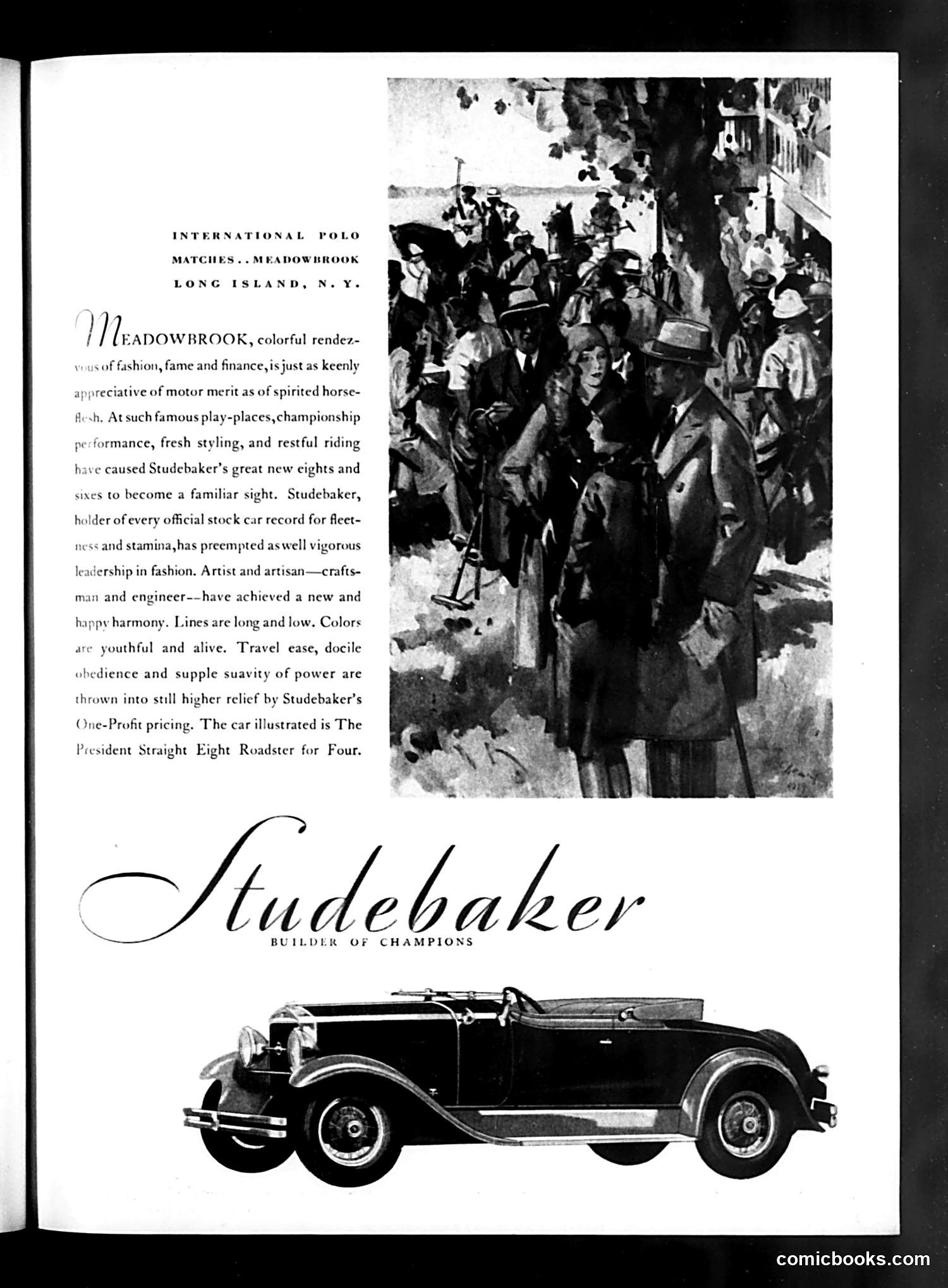
The page is a **Studebaker automobile advertisement** disguised as editorial content about the International Polo Matches at Meadowbrook, Long Island—a wealthy enclave associated with high society and status. The ad's strategy: associate the Studebaker car with prestige by placing it in an aspirational social setting. The photograph shows polo spectators (affluent crowds), implying that Studebaker owners belong among the fashionable elite who frequent such exclusive venues. The text claims Studebaker holds "every official stock car record" and pairs engineering excellence with aesthetic sophistication. The tagline "Builder of Champions" reinforces this positioning. The car shown is "The President Straight Eight Roadster for Four"—the name itself suggesting leadership and power. This approach—linking consumer products to wealth, exclusivity, and social achievement—was standard advertising strategy in this era.
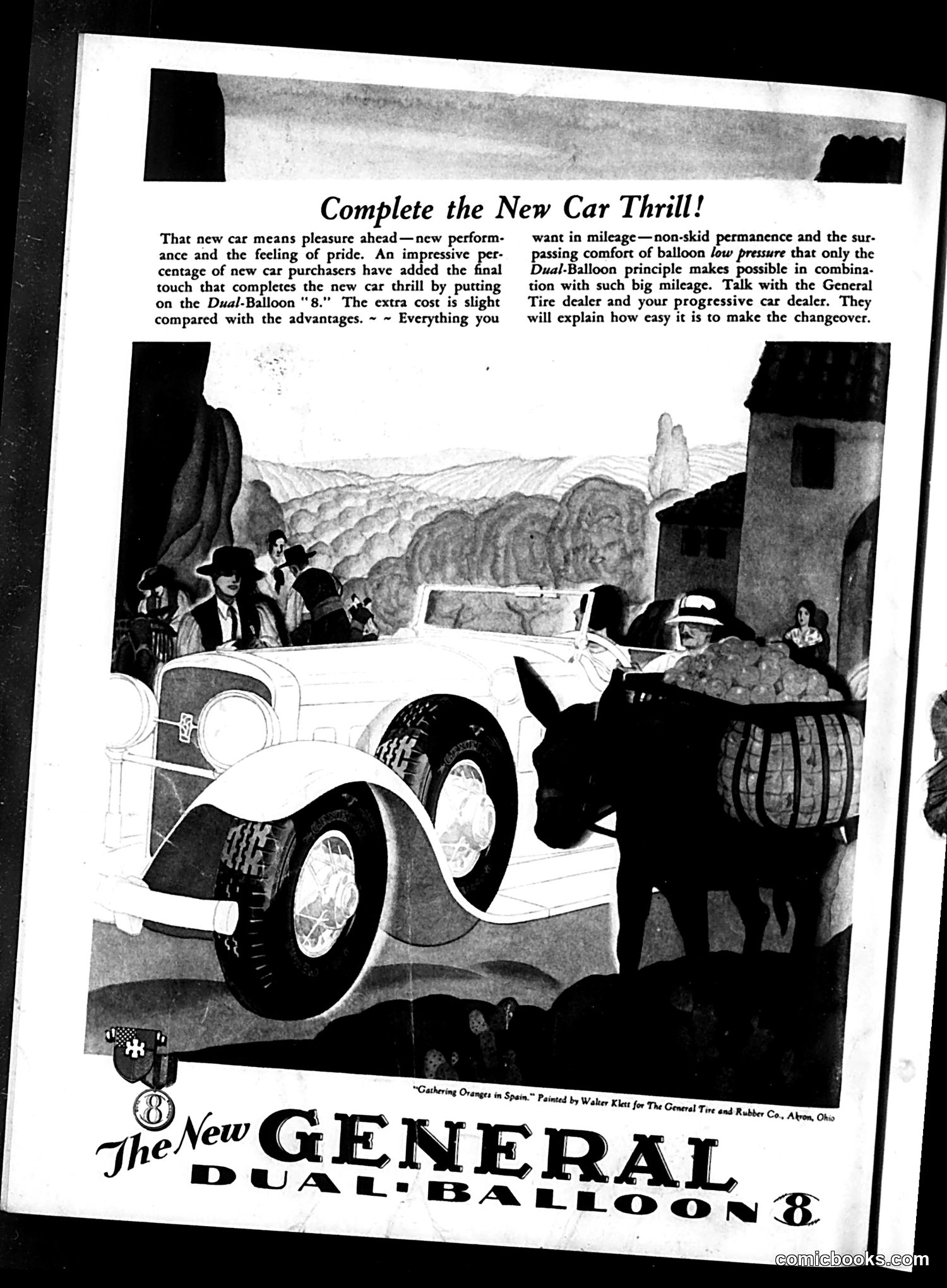
This is a **General Tire advertisement**, not political satire. The page promotes the company's "Dual-Balloon 8" tires for automobiles. The illustration depicts a luxurious touring car in Spain, surrounded by locals gathering oranges—an exotic, aspirational scene designed to appeal to wealthy car buyers of the era. The "new car thrill" messaging emphasizes that purchasing these premium balloon tires completes the ownership experience with superior mileage, safety ("non-skid permanence"), and comfort. The artwork by Walter Klett romanticizes travel and leisure, positioning General Tire products as essential to modern automotive pleasure. This reflects 1920s advertising's focus on lifestyle aspiration rather than technical specifications—the balloon tire itself was a genuine innovation offering improved comfort through lower pressure. The page contains no political content or satire, despite appearing in *Life* magazine.