
Life, 1929-04-12 · page 6 of 44
Life — April 12, 1929 — page 6: what you’re looking at
What you’re looking at
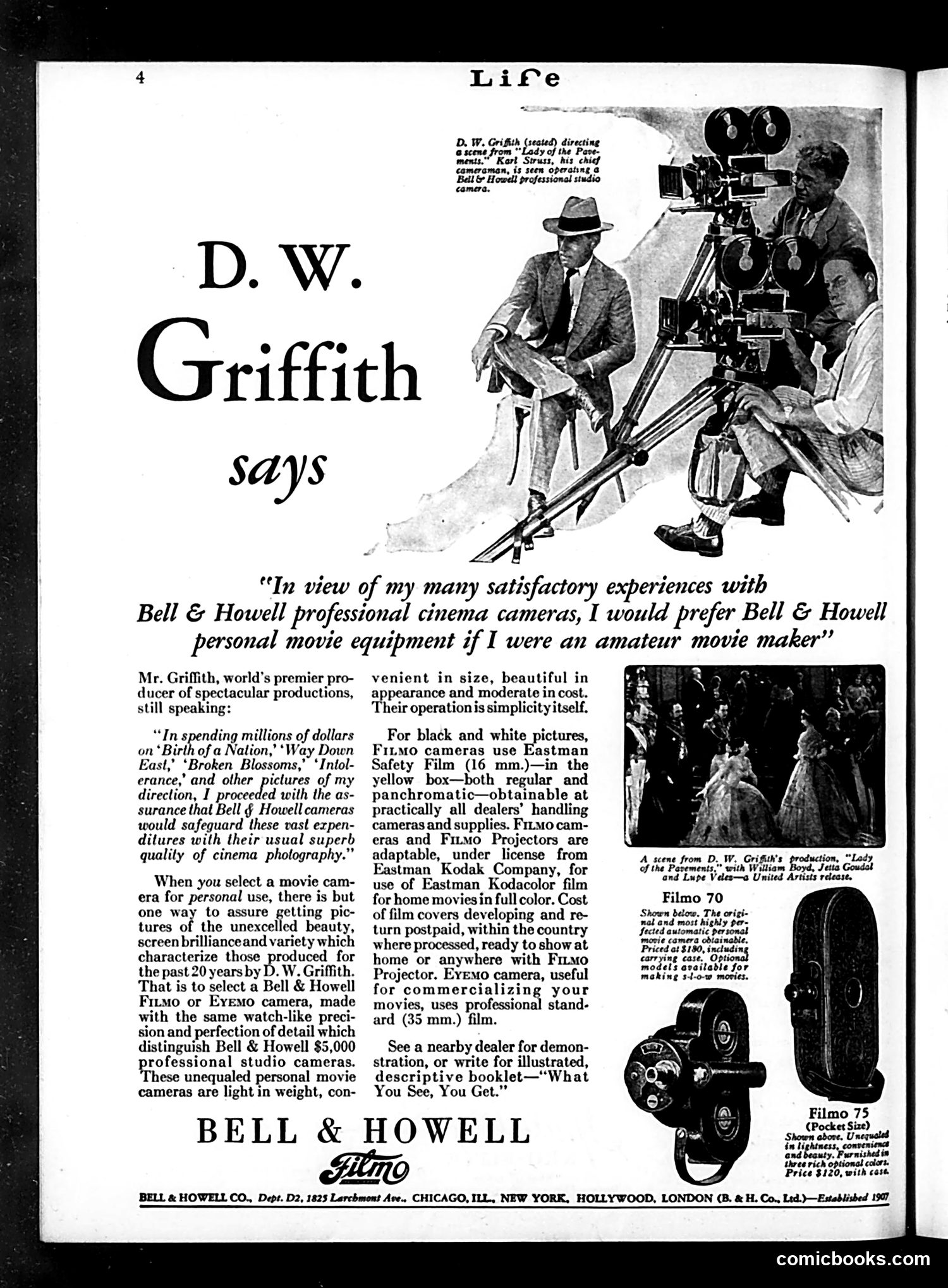
This is primarily an **advertisement, not satire or cartoon content**. It features D.W. Griffith, the famous film director, endorsing Bell & Howell movie cameras for amateur filmmakers. The page includes a photograph of Griffith directing on set with professional cinema equipment, and images of Bell & Howell's Filmo camera models (Filmo 70 and 75). Griffith's quoted endorsement emphasizes that despite his extensive experience with professional equipment, he would choose Bell & Howell cameras for personal amateur use—a marketing strategy positioning the equipment as quality equipment accessible to non-professionals. The text discusses technical specifications: film types, projection capabilities, and costs. This is straightforward product advertising leveraging Griffith's prestige to market home movie equipment to hobbyists during the early film era.
📄 Transcribed text from this page (OCR, searchable)
Machine-transcribed from the original scan — historical spelling and the odd misread are preserved.
D. W. Life D, WW. Griith (seated directing @ scene from “Lady of the Pave. ments.” Karl Struss, his chief cameraman, és seen operating & Bal & Howell professional studio camera. Griffith SAYS “In view of my many satisfactory experiences with Bell & Howell professional cinema cameras, I would prefer Bell & Howell personal movie equipment if I were an amateur movie maker’ Mr. Griffith, world’s premier pro- ducer of spectacular productions, still speaking: “In spending millions of dollars on ‘Birthofa Nation,’ ‘Way Down East,’ ‘Broken Blossoms,’ ‘Intol- erance,’ and other pictures of my direction, I proceeded with the as- surance that Bell § Howell cameras would safeguard these vast expen- ditures with their usual superb quality of cinema photography.” When you select a movie cam- era for personal use, there is but one way to assure getting pic- tures of the unexcelled beauty, screen brillianceand variety which characterize those produced for the past 20 years by D. W. Griffith. That is to select a Bell & Howell Fitmo or Eyemo camera, made with the same watch-like preci- sion and perfection of detail which distinguish Bell & Howell $5,000 professional studio cameras. hese unequaled personal movie cameras are light in weight, con- venient in size, beautiful in Bppearance and moderate in cost. heir operation is simplicity itself. For black and white pictures, Fitmo cameras use Eastman Safety Film (16 mm.)—in the yellow box—both regular and panchromatic—obtainable at practically all dealers’ handling cameras and supplies. Frumo cam- eras and Fitmo Projectors are adaptable, under license from Eastman Kodak Company, for use of Eastman Kodacolor film for home moviesin full color. Cost of film covers developing and re- turn postpaid, within the country where processed, ready to show at home or anywhere with Fitmo Projector. Eyemo camera, useful for commercializing your movies, uses professional stand- ard (35 mm.) film. See a nearby dealer for demon- stration, or write for illustrated, descriptive booklet—“What You See, You Get.” BELL & HOWELL Lio BELL & HOWELL CO.. Dept. D2, 1825 Larchmont Ave. CHICAGO, ILL, NEW YORK, HOLLYWOOD, LONDON (B. & H. Co., Ltd.)—Exstablished 1907 A scene from D. W. Grifith's Iuction, “Lady of the elements’* with William Brot Jetta Goudat and Lupe Veles—a United Artists release, Filmo 70 Shown below. The origi- nal and most highly per- fected automatic per ‘movie camera obtainable, Priced at $190, includin, carrying case. Opti models available for making s-1-o-w movies. three rich optional ¢ Price $120, with cose comicbooks.com