
Life, 1929-04-12 · page 26 of 44
Life — April 12, 1929 — page 26: what you’re looking at
What you’re looking at
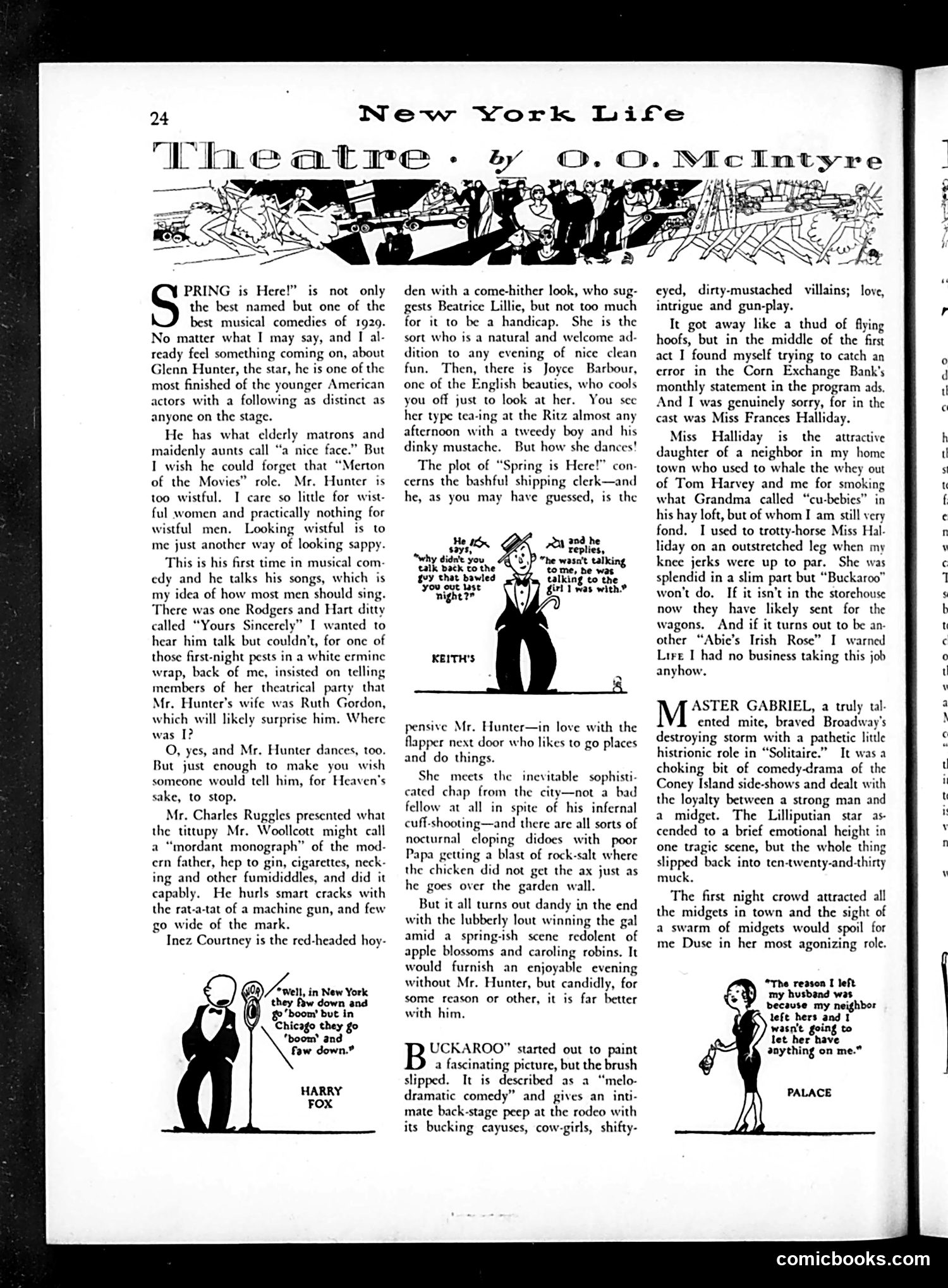
This is O.O. McIntyre's theatre column reviewing Broadway productions from 1929. The page contains three small cartoon vignettes illustrating theatrical gossip and observations: **The cartoons show:** - **Harry Fox** (labeled, a vaudeville star): A joke about New York slang where "boom" means both up and down - **Keith's** (theatre circuit): A man explaining he wasn't talking to his companion but to a girl with her - **Palace** (famous vaudeville house): A woman's complaint about a man leaving her for another woman **The reviews cover:** - "*Spring is Here!*" - a 1929 musical comedy starring Glenn Hunter, whom McIntyre admires despite finding his "wistful" acting style sappy - "*Buckaroo*" - a melodramatic comedy set in rodeo culture with villains and romance, which McIntyre found poorly executed The tone is gossipy and irreverent, typical of Life magazine's satirical theatre criticism of the era, mixing professional critique with personal anecdotes and mild social commentary about 1920s theatrical culture.
📄 Transcribed text from this page (OCR, searchable)
Machine-transcribed from the original scan — historical spelling and the odd misread are preserved.
New York Life PRING is Here!” is not only S the best named but one of the best musical comedies of 1929. No matter what I may say, and I al- ready feel something coming on, about Glenn Hunter, the star, he is one of the most finished of the younger American actors with a following as distinct as anyone on the stage. He has what elderly matrons and maidenly aunts call “a nice face.” But I wish he could forget that “Merton of the Movies” role. Mr. Hunter is too wistful. I care so little for wist- ful women and practically nothing for wistful men. Looking wistful is to me just another way of looking sappy. This is his first time in musical com- edy and he talks his songs, which is my idea of how most men should sing. There was one Rodgers and Hart ditty called “Yours Sincerely” I wanted to hear him talk but couldn’t, for one of those first-night pests in a white ermine wrap, back of me, insisted on telling members of her theatrical party that Mr. Hunter's wife was Ruth Gordon, which will likely surprise him. Where was I? O, yes, and Mr. Hunter dances, too. But just enough to make you wish someone would tell him, for Heaven's sake, to stop. Mr. Charles Ruggles presented what the titupy Mr. Woollcott might call a “mordant monograph” of the mod- ern father, hep to gin, cigarettes, neck- ing and other fumididdles, and did it capably. He hurls smart cracks with the rat-a-tat of a machine gun, and few go wide of the mark. Inez Courtney is the red-headed hoy- ee in New York down and boca but in nienge they go ‘boom’ and faw down.” HARRY FOX den with a come-hither look, who sug- gests Beatrice Lillie, but not too much for it to be a handicap. She is the sort who is a natural and welcome ad- dition to any evening of nice clean fun. Then, there is Joyce Barbour, one of the English beauties, who cools you off just to look at her. You sec her type tea-ing at the Ritz almost any afternoon with a tweedy boy and his dinky mustache. But how she dances! The plot of “Spring is Here!” con. cerns the bashful shipping clerk—and he, as you may have guessed, is the P “he wasn't talking tome, be was talking to the Girl 1 was with? KEITH'S pensive Mr. Hunter—in love with the flapper next door who likes to go places and do things. She meets the inevitable sophisti- cated chap from the city—not a bad fellow at all in spite of his infernal cuff-shooting—and there are all sorts of nocturnal cloping didoes with poor Papa getting a blast of rock-salt where the chicken did not get the ax just as he goes over the garden wall. But it all turns out dandy in the end with the lubberly lout winning the gal amid a spring-ish scene redolent of apple blossoms and caroling robins. It would furnish an enjoyable evening without Mr. Hunter, but candidly, for some reason or other, it is far better with him. UCKAROO” started out to paint a fascinating picture, but the brush slipped. It is described as a “melo- dramatic comedy” and gives an_inti- mate back-stage peep at the rodeo with its bucking cayuses, cow-girls, shifty- eyed, dirty-mustached villains; love, intrigue and gun-play. Tt_got away like a thud of flying hoofs, but in the middle of the first act I found myself trying to catch an error in the Corn Exchange Bank's monthly statement in the program ads. And I was genuinely sorry, for in the cast was Miss Frances Halliday. Miss Halliday is the attractive daughter of a neighbor in my home town who used to whale the whey out of Tom Harvey and me for smoking what Grandma called “cu-bebies” in his hay loft, but of whom I am still very fond. I used to trotty-horse Miss Hal- liday on an outstretched leg when my knee jerks were up to par. She was splendid in a slim part but “Buckaroo” won't do. If it isn’t in the storehouse now they have likely sent for the wagons. And if it turns out to be an- other “Abie’s Irish Rose” I warned Lire I had no business taking this job anyhow. Masks GABRIEL, a tly tal- ented mite, braved Broadway's destroying storm with a pathetic little histrionic role in “Solitaire.” It was a choking bit of comedy-drama of the Coney Island side-shows and dealt with the loyalty between a strong man and a midget. The Lilliputian star as- cended to a brief emotional height in one tragic scene, but the whole thing slipped back into ten-twenty-and-thirty muck. The first night crowd attracted all the midgets in town and the sight of a swarm of midgets would spoil for me Duse in her most agonizing role. *The reason I left my husband was because my neighbor left hers and 1 wasnt ing to y let nee anything on me.” PALACE comicbooks.com