
Life, 1929-04-12 · page 27 of 44
Life — April 12, 1929 — page 27: what you’re looking at
What you’re looking at
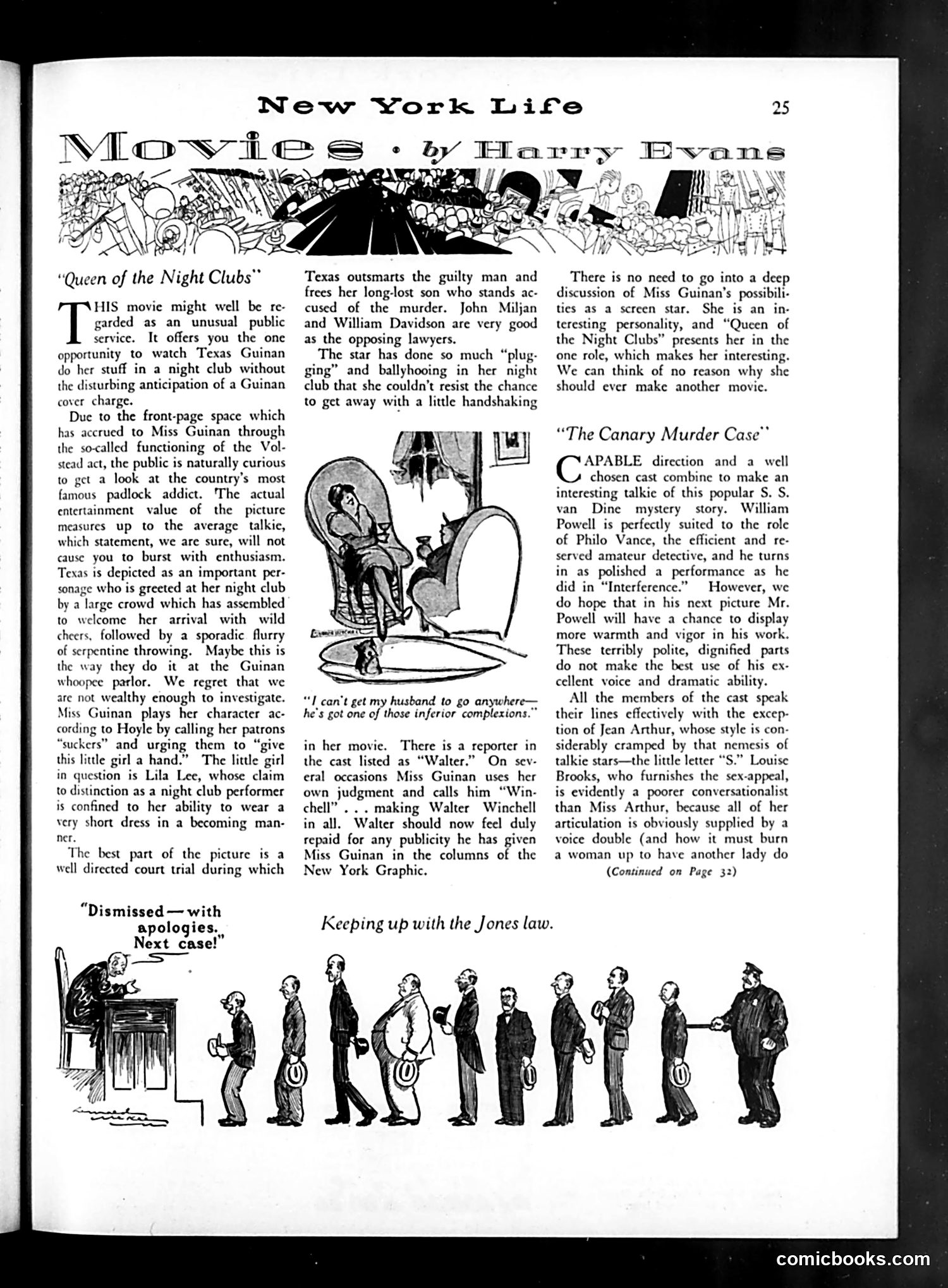
This page reviews two films featuring prominent figures of the Prohibition era (1920s-1930s). **"Queen of the Night Clubs"** stars Texas Guinan, a real nightclub owner famous for evading Prohibition laws (the Volstead Act). The review is satirical—Life notes that watching her in a film is preferable to visiting her actual speakeasy, where patrons faced police raids ("padlock addict"). The reviewer mocks her acting abilities and her self-promotion, noting she even ad-libbed "Winchell" (Walter Winchell) into the script, likely referencing the gossip columnist's coverage of her. **"The Canary Murder Case"** is a straightforward positive review of a S.S. Van Dine mystery adaptation starring William Powell. The cartoon at bottom, captioned "Keeping up with the Jones law," appears to reference Prohibition enforcement (though "Jones law" is unclear—possibly conflating enforcement with contemporary cultural references). The satire reflects Life's irreverent tone toward Prohibition-era celebrity and the era's underground nightclub culture.
📄 Transcribed text from this page (OCR, searchable)
Machine-transcribed from the original scan — historical spelling and the odd misread are preserved.
New York Life “Queen of the Night Clubs” HIS movie might well be re- | garded as an unusual public service. It offers you the one opportunity to watch Texas Guinan do her stuff in a night club without the disturbing anticipation of a Guinan cover charge. Due to the front-page space which has accrued to Miss Guinan through the so-called functioning of the Vol- stead act, the public is naturally curious to get a look at the country’s most famous padlock addict. The actual entertainment value of the picture measures up to the average talkie, which statement, we are sure, will not cause you to burst with enthusiasm. Texas is depicted as an important per- sonage who is greeted at her night club by a large crowd which has assembled to welcome her arrival with wild cheers, followed by a sporadic flurry of serpentine throwing. Maybe this is the way they do it at the Guinan whoopee parlor. We regret that we are not wealthy enough to investigate. Miss Guinan plays her character ac- cording to Hoyle by calling her patrons “suckers” and urging them to “give this litle girl a hand.” The little girl in question is Lila Lee, whose claim to distinction as a night club performer is confined to her ability to wear a very short dress in a becoming man- ner. The best part of the picture is a well directed court trial during which “Dismissed — with apologies. Next case! Texas outsmarts the guilty man and frees her long-lost son who stands ac- cused of the murder. John Miljan and William Davidson are very good as the opposing lawyers. The star has done so much “plug- ging” and ballyhooing in her night club that she couldn’t resist the chance to get away with a little handshaking “I can't get my husband to go anywhere— he's got one of those inferior complexions. in her movie. There is a reporter in the cast listed as “Walter.” On sev- eral occasions Miss Guinan uses her own judgment and calls him “Win- chell” . . . making Walter Winchell in all. Walter should now feel duly repaid for any publicity he has given Miss Guinan in the columns of the New York Graphic. Keeping up with the Jones law. There is no need to go into a deep discussion of Miss Guinan’s possibili- ties as a screen star. She is an in- teresting personality, and “Queen of the Night Clubs” presents her in the one role, which makes her interesting. We can think of no reason why she should ever make another movic. “The Canary Murder Case" Ca direction and a well chosen cast combine to make an interesting talkie of this popular S. S. van Dine mystery story. William Powell is perfectly suited to the role of Philo Vance, the efficient and re- served amateur detective, and he turns in as polished a performance as he did in “Interference.” | However, we do hope that in his next picture Mr. Powell will have a chance to display more warmth and vigor in his work. These terribly polite, dignified parts do not make the best use of his ex- cellent voice and dramatic ability. All the members of the cast speak their lines effectively with the excep- tion of Jean Arthur, whose style is con- siderably cramped by that nemesis of talkie stars—the little letter “S.” Louise Brooks, who furnishes the sex-appeal, is evidently a poorer conversationalist than Miss Arthur, because all of her articulation is obviously supplied by a voice double (and how it must burn a woman up to have another lady do (Continued on Page 32) comicbooks.com