
A complete issue · 48 pages · 1928
Life — December 14, 1928
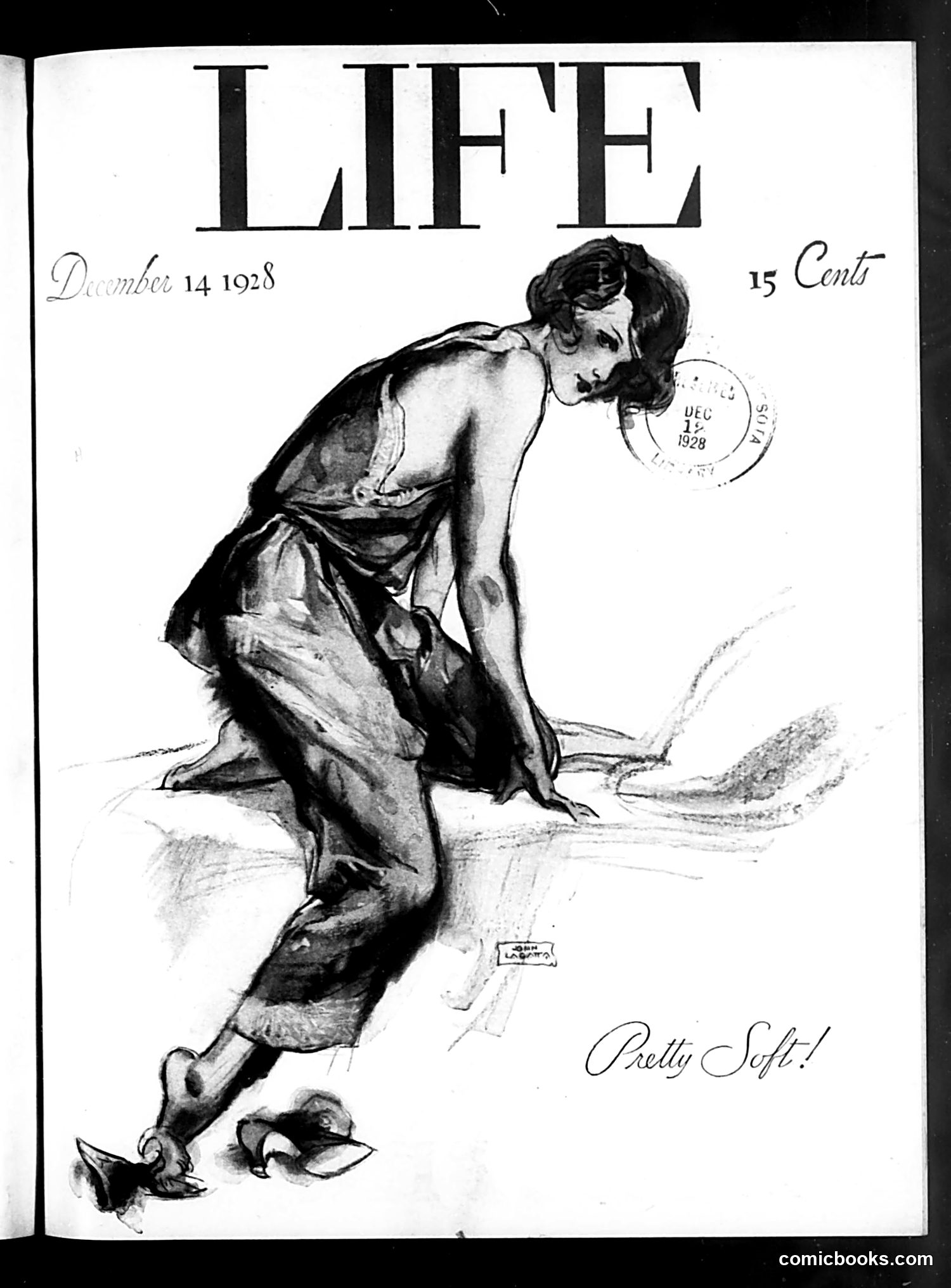
This cover illustrates a woman slipping on ice, captioned "Pretty Soft!" The phrase is ironic—falling on ice is decidedly *not* soft or pleasant. The likely satirical target relates to 1928 social conditions, possibly referencing: - **Prohibition era** hardships (women's circumstances during alcohol ban) - **Economic inequality** masked by superficial glamour - **Gender commentary** on women's precarious social position The stylized illustration depicts a fashionable woman in 1920s attire losing her footing on what appears to be winter ice or slippery ground, with her dignity compromised. Without additional article text visible, the exact political or social critique remains unclear, but the sarcastic caption suggests commentary on deceptive appearances or false promises regarding women's experiences in contemporary society.
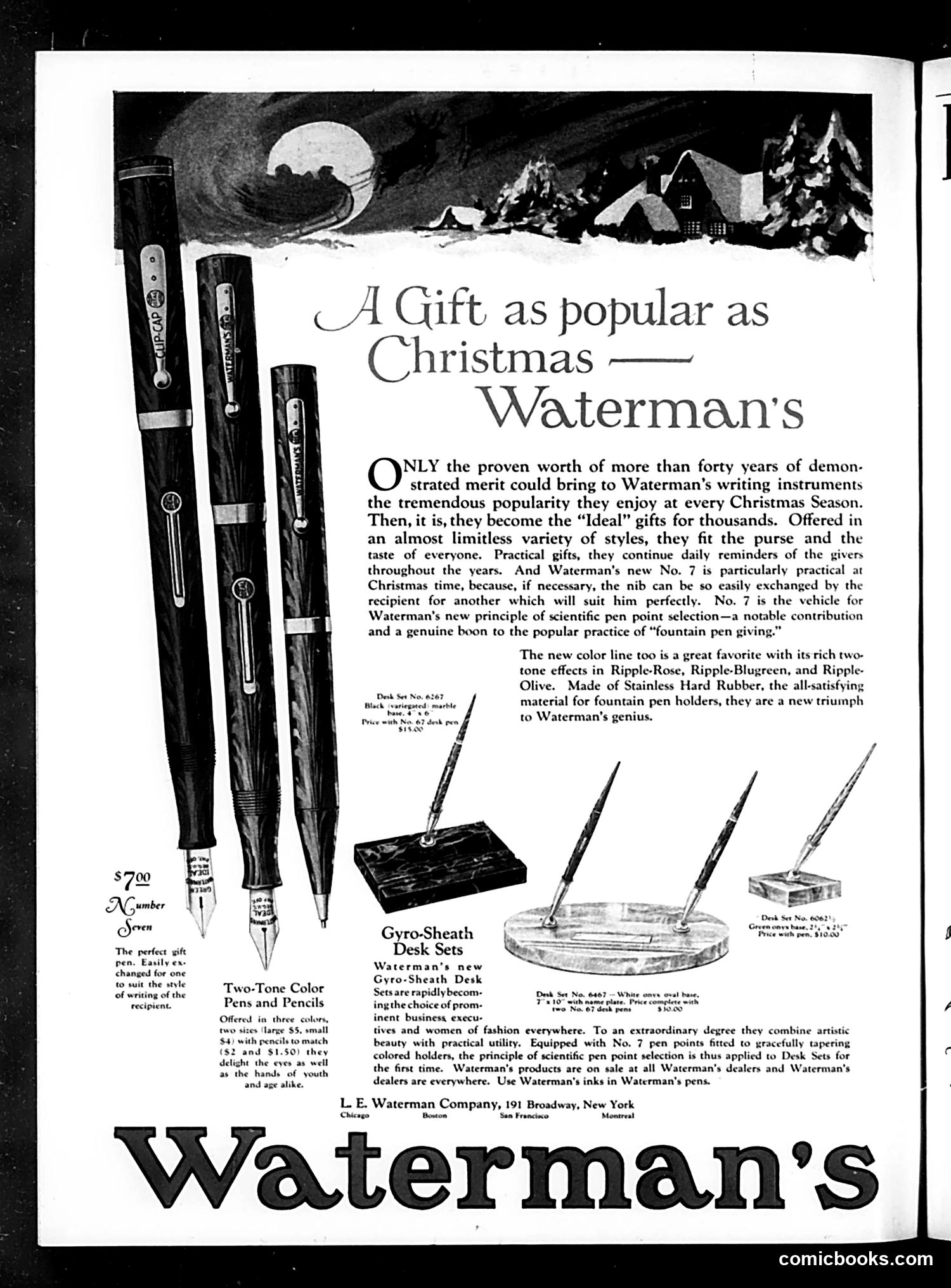
This is **not a political cartoon or satire**—it's a straightforward **advertisement for Waterman's fountain pens**, positioned as a Christmas gift guide. The page features three fountain pens displayed on the left, with pricing and product descriptions. Below are desk sets (the "Gyro-Sheath Desk Sets") shown in two styles. The text emphasizes Waterman's 40+ year reputation, variety of styles, and the new "No. 7" pen with exchangeable nibs. The winter scene at top is purely decorative holiday imagery to contextualize gift-giving. There is no political commentary or satire present. This represents early 20th-century print advertising targeting affluent consumers seeking quality writing instruments as Christmas presents.
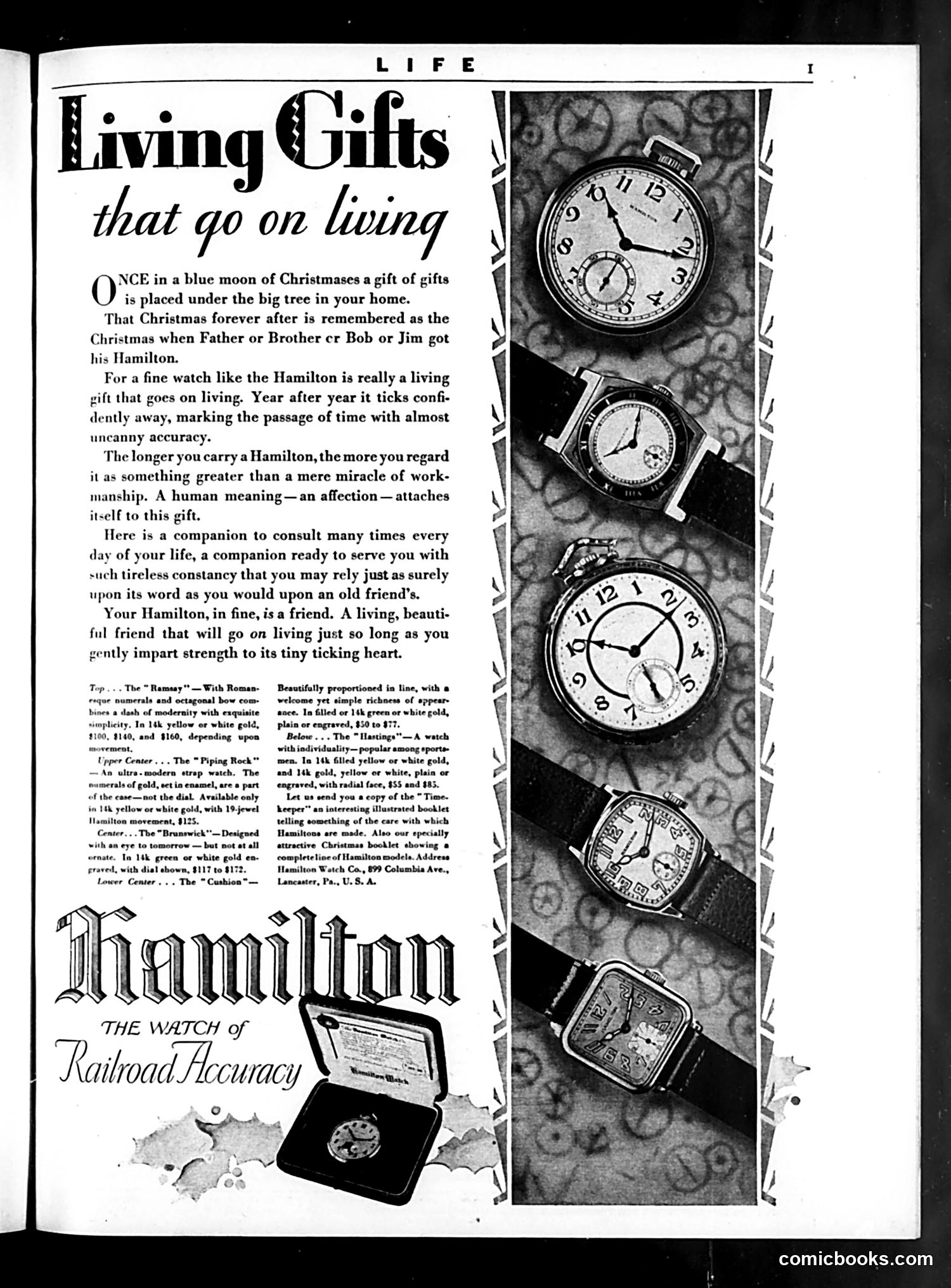
This is **not a political cartoon or satire** — it's a straightforward **luxury watch advertisement** from Life magazine. The page promotes Hamilton watches as Christmas gifts, emphasizing their durability and reliability. The text uses emotional language to position watches as meaningful, long-lasting presents: "a living gift that goes on living," suggesting the watch becomes a cherished companion over years. The advertisement includes multiple watch models displayed on the right side, with detailed descriptions of styles (The "Ramsey," "Piping Rock," "Hastings," "Cushion") and their materials (gold-filled cases, various metals) and prices. The tagline "The Watch of Railroad Accuracy" references Hamilton's historical reputation for precision timing—essential for railroad operations. This appeals to buyers seeking reliability and craftsmanship in an heirloom gift.
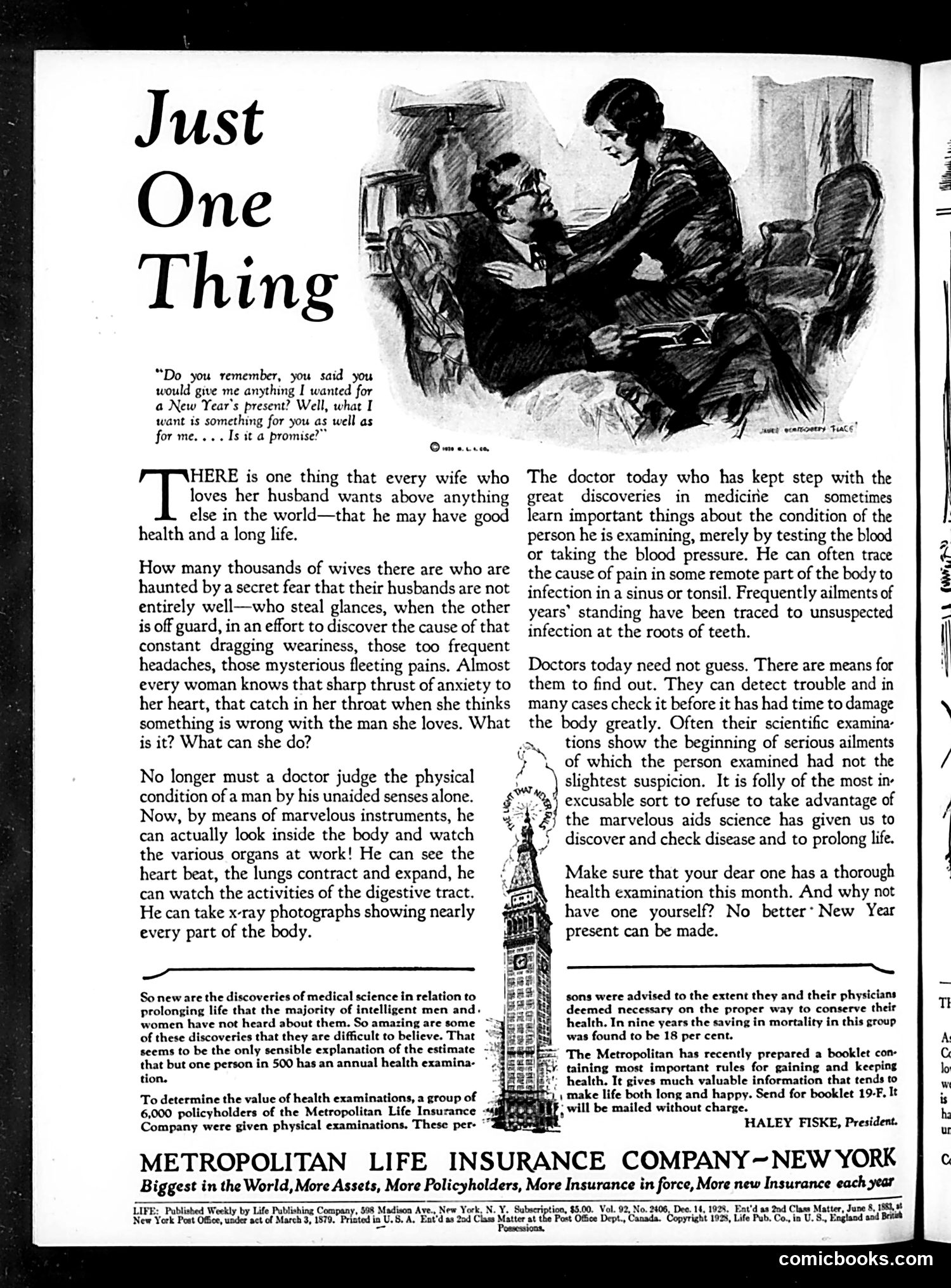
This page is primarily **advertising**, not satire or political commentary. It's a Metropolitan Life Insurance Company advertisement from the 1920s (dated Dec. 11, 1928). The illustration shows a domestic scene where a man presents a gift to a woman, with the headline "Just One Thing." The accompanying text argues that wives should want their husbands to prioritize **health and longevity** above all else. The ad promotes **medical examinations** as modern scientific tools that can detect disease early—framing this as the ideal New Year's gift. It emphasizes advances in medical technology (blood tests, X-rays, organ examination) and argues that preventive health checkups represent progress and loving care. This is corporate messaging promoting both insurance and the emerging culture of routine medical screening, not social commentary.
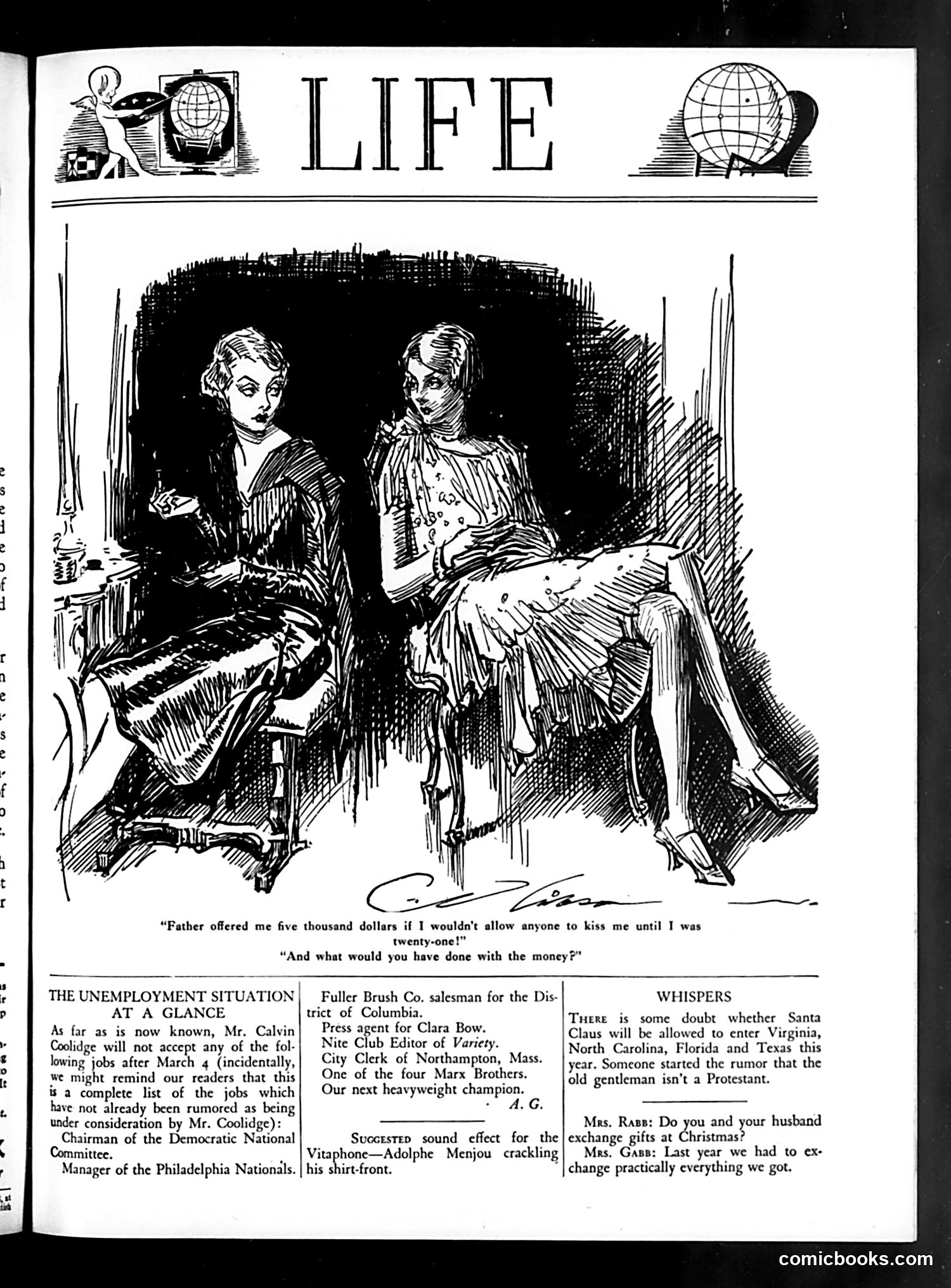
**Main Cartoon:** The illustration shows two women in conversation, with the caption: "Father offered me five thousand dollars if I wouldn't allow anyone to kiss me until I was twenty-one!" / "And what would you have done with the money?" This is a joke about courtship customs and women's autonomy. The humor relies on the implication that the second woman would have spent the money rather than accept such restrictions—suggesting that financial independence matters more to modern women than parental control over their romantic lives. It's satirizing both paternal authority and changing attitudes toward female independence during the early 20th century. **Other Content:** The page includes brief society notes and gossip items, typical of Life's satirical social commentary section.
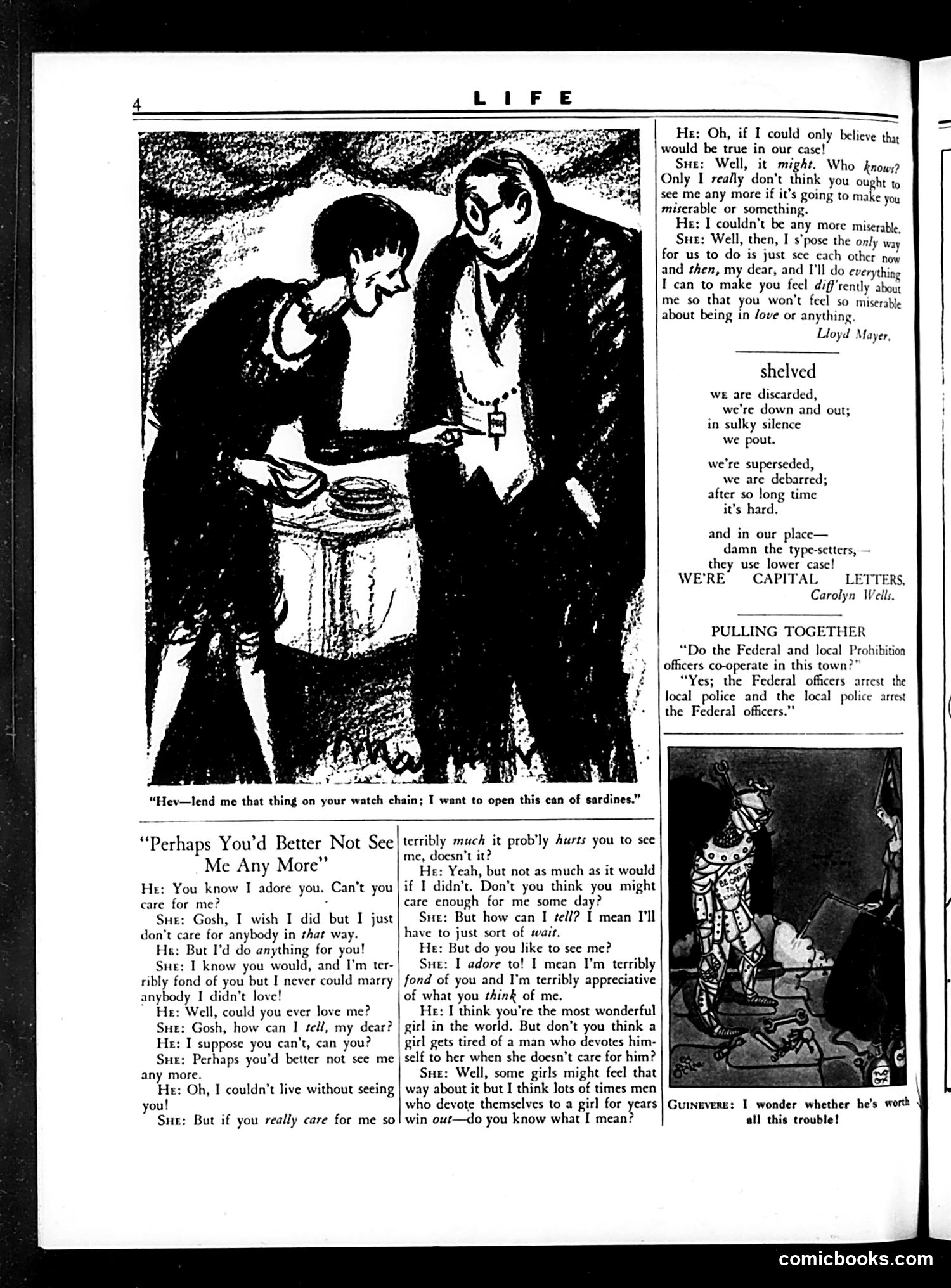
This page contains a dramatic scene depicting two men and a woman in what appears to be a tense domestic or romantic situation. The caption reads: "Hev—lend me that thing on your watch chain; I want to open this can of sardines." The main dialogue, titled "Perhaps You'd Better Not See Me Any More," presents a relationship conflict where the woman expresses deep affection while the man claims indifference. She argues that true care means enduring hardship together; he counters that love requires nothing. The satire critiques romantic relationships and differing expectations about devotion and sacrifice. The woman's passionate declarations contrast sharply with the man's emotional detachment, highlighting period anxieties about commitment and gender dynamics in courtship. The sardine-opening detail adds comedic undercut to the melodrama.
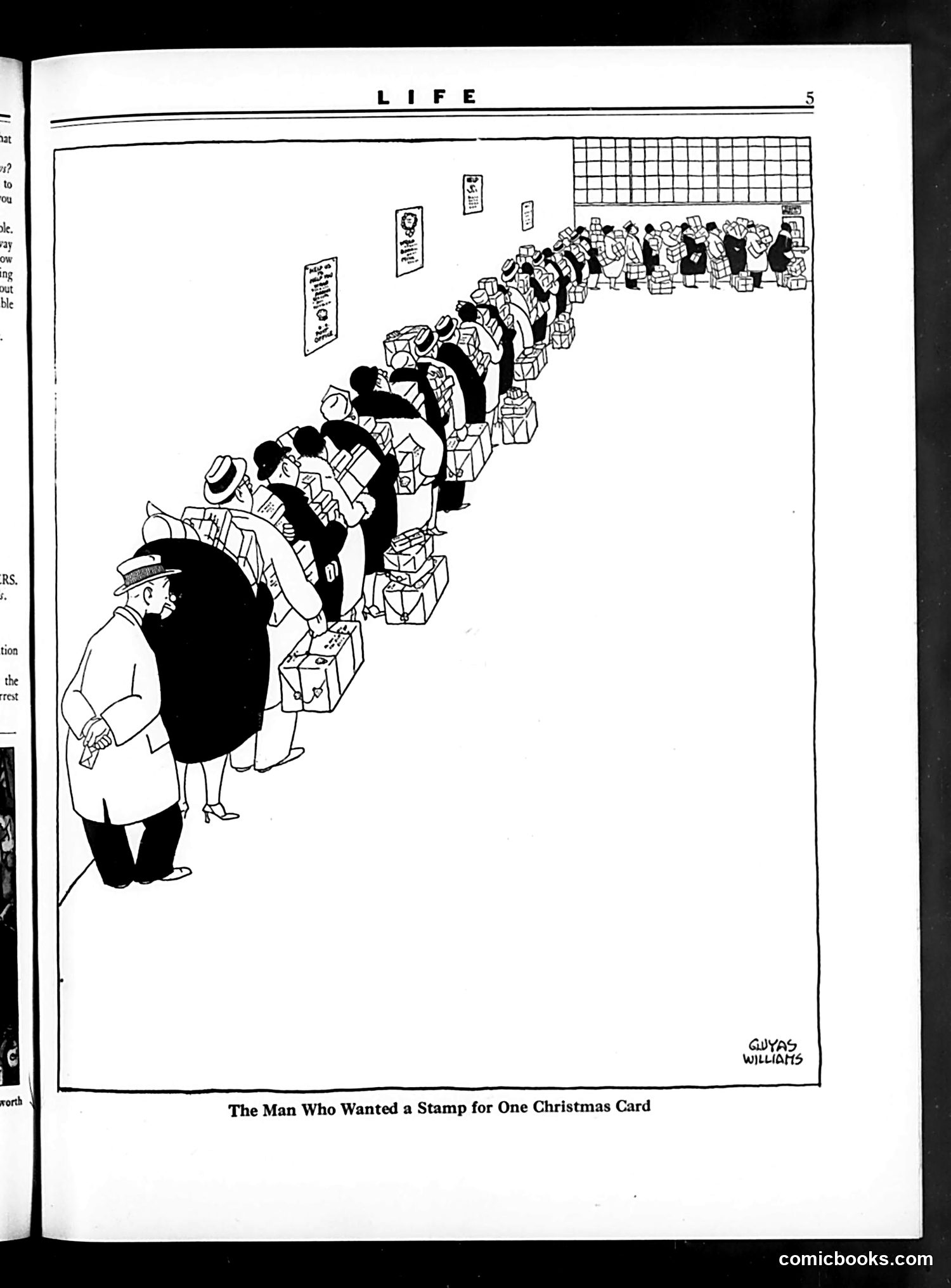
This cartoon by Guyas Williams satirizes bureaucratic absurdity. A lone man in a hat appears to need just one postage stamp for a single Christmas card. Instead of a simple transaction, he faces an enormous, snaking queue of people—depicted as identical figures carrying boxes—waiting at what appears to be a post office window. The satire critiques the inefficiency and overcrowding of postal services, likely during the Christmas season when mail volume surges dramatically. The contrast between the man's minimal need (one stamp) and the overwhelming bureaucratic machinery (represented by the massive line) highlights how institutional systems become grotesquely disproportionate to simple public requests. It's a commentary on modern administrative frustration.
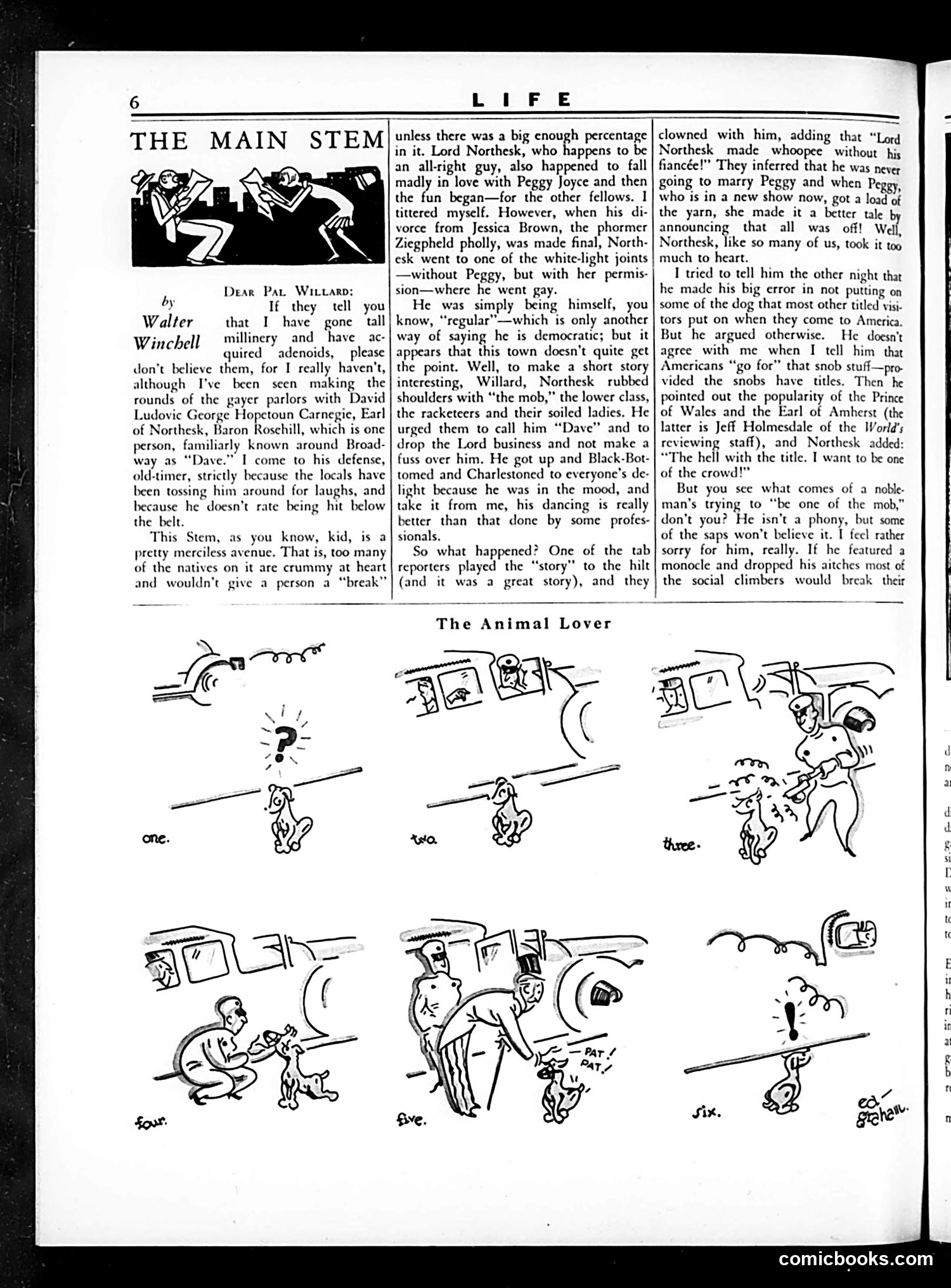
**"The Main Stem"** (top) is a satirical column by Walter Winchell about New York nightlife. It discusses Lord Northesk, apparently a British aristocrat who frequented Broadway venues with showgirl Peggy Joyce. The piece mocks Northesk's attempt to appear democratic by mingling with "the lower class" while avoiding actual commitment—he avoids marrying Joyce, instead taking her to public places. Winchell satirizes his performative populism and insincerity. **"The Animal Lover"** (bottom) is a comic strip showing a person repeatedly trying to interact with a small dog while traveling in a car, with the dog consistently running away. It's a visual gag about failed attempts at animal affection. Both pieces reflect Life's focus on social satire and urban humor typical of 1920s-30s American culture.
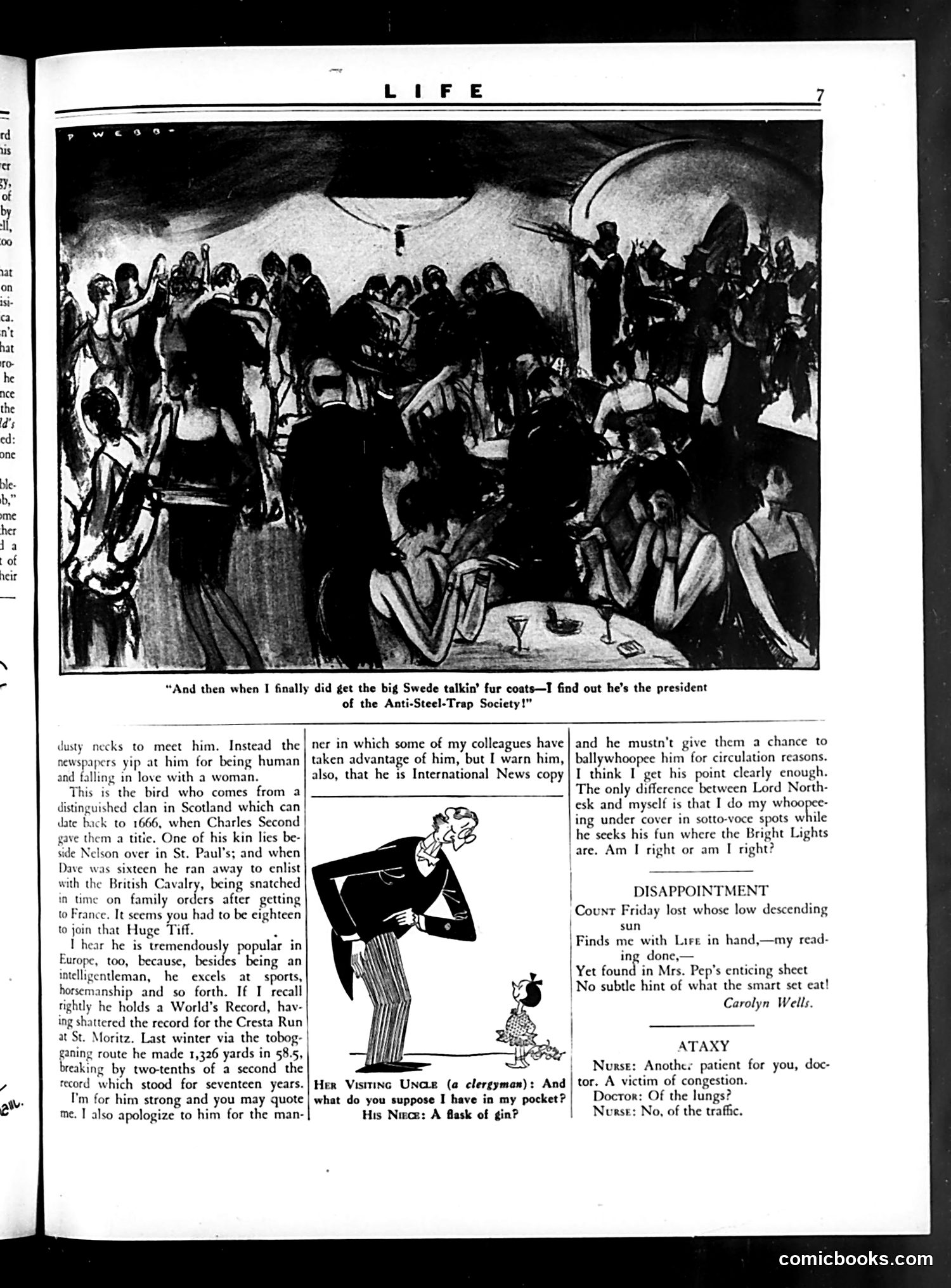
**Main Cartoon:** The large illustration shows a formal party scene where the narrator has discovered that a man he's been networking with—"the big Swede talkin' fur coats"—is actually the president of the "Anti-Steel-Trap Society." This is satirical humor about social embarrassment: the speaker apparently admires this man's wealth and style, only to learn he leads an organization opposing steel traps (likely animal traps used in fur trade), creating an ironic conflict. **Supporting Content:** The page includes a small joke about an uncle carrying gin in his pocket, and medical humor ("Ataxy") about traffic-related congestion. The overall tone mocks social pretension and the awkwardness of discovering someone's unexpected affiliations at high-society gatherings.
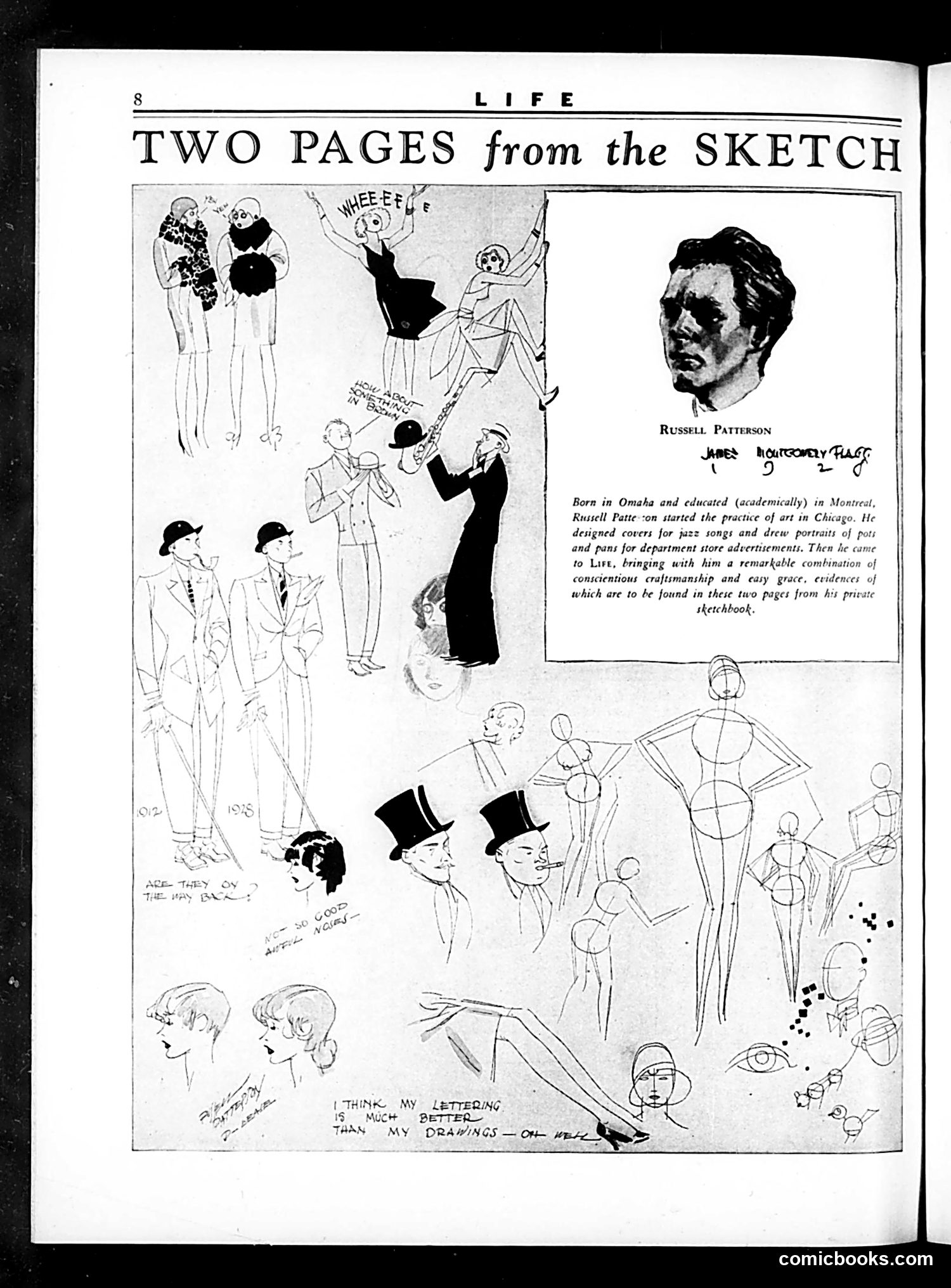
This page showcases **Russell Patterson**, a commercial artist born in Omaha and educated in Montreal. Patterson designed covers for jazz songs and created portraits for department store advertisements. The sketches demonstrate his particular talent for fashion illustration and figure drawing. The left panel contains fashion and figure studies—women in various poses wearing 1920s-style clothing, and men in suits and top hats. The right panel shows anatomical construction drawings and proportion studies, including geometric frameworks used to plan figure poses. The handwritten note at bottom ("I think my lettering is much better than my drawings—oh hell") appears self-deprecating. This page documents Patterson's professional technique rather than containing political satire—it's essentially a portfolio showcase of his commercial art methods.
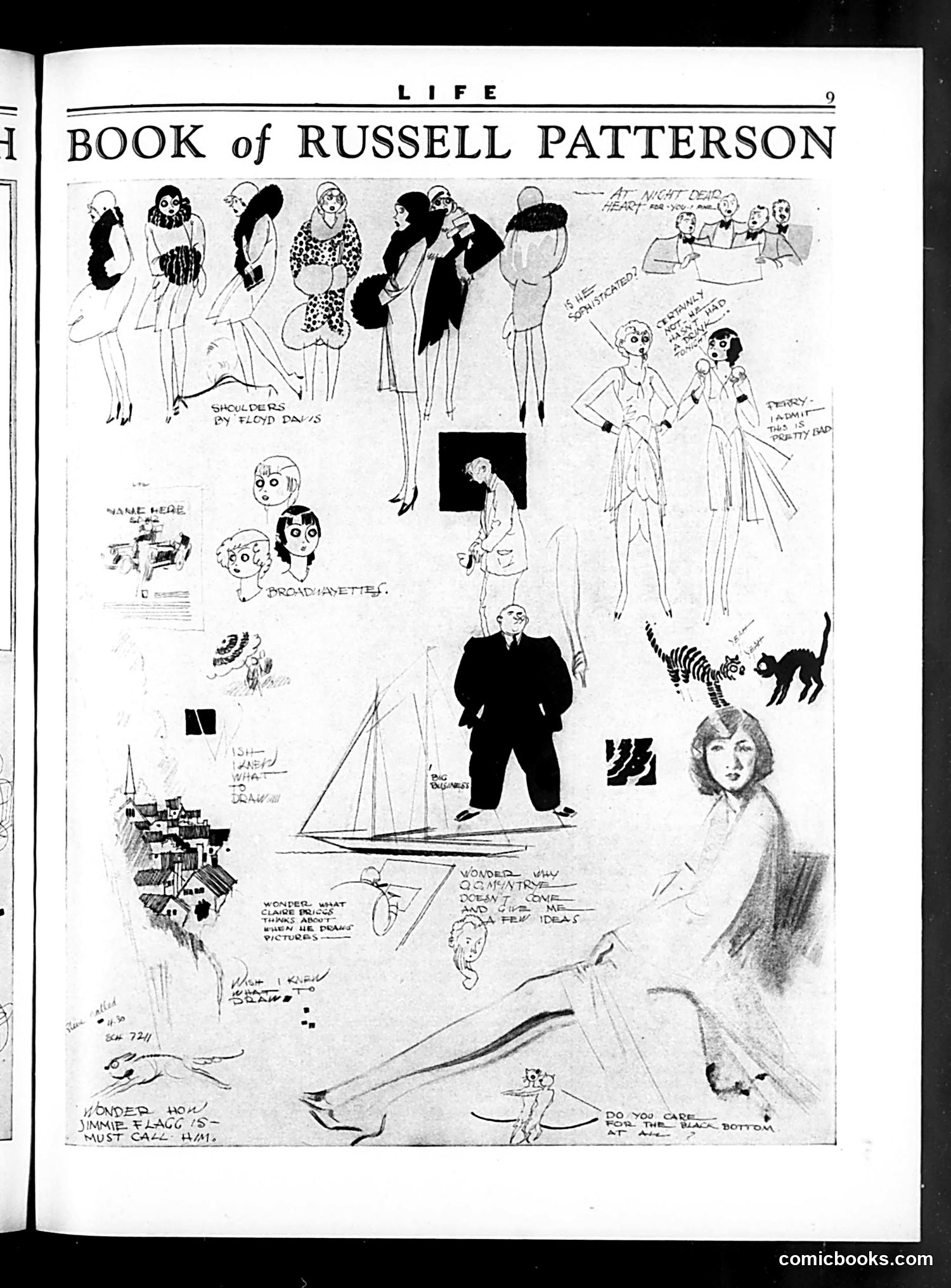
This page showcases character sketches and design studies by cartoonist Russell Patterson. The upper portion displays stylized female figures in various poses and fashions, labeled "SHOULDERS by FLOYD DAVIS," reflecting 1920s-30s fashion illustration conventions. Lower sections include character head studies labeled "DROOGHAVETTES" and "NAME HERE," plus miscellaneous sketches: a sailboat, a man in a suit, two cats, and a portrait of a woman on the right. The scattered nature and handwritten annotations suggest these are preliminary sketches or a portfolio page rather than completed satirical cartoons. The content focuses on Patterson's illustration style—elongated figures, fashionable dress, and character design—making this essentially a showcase of his artistic technique rather than political or social commentary.
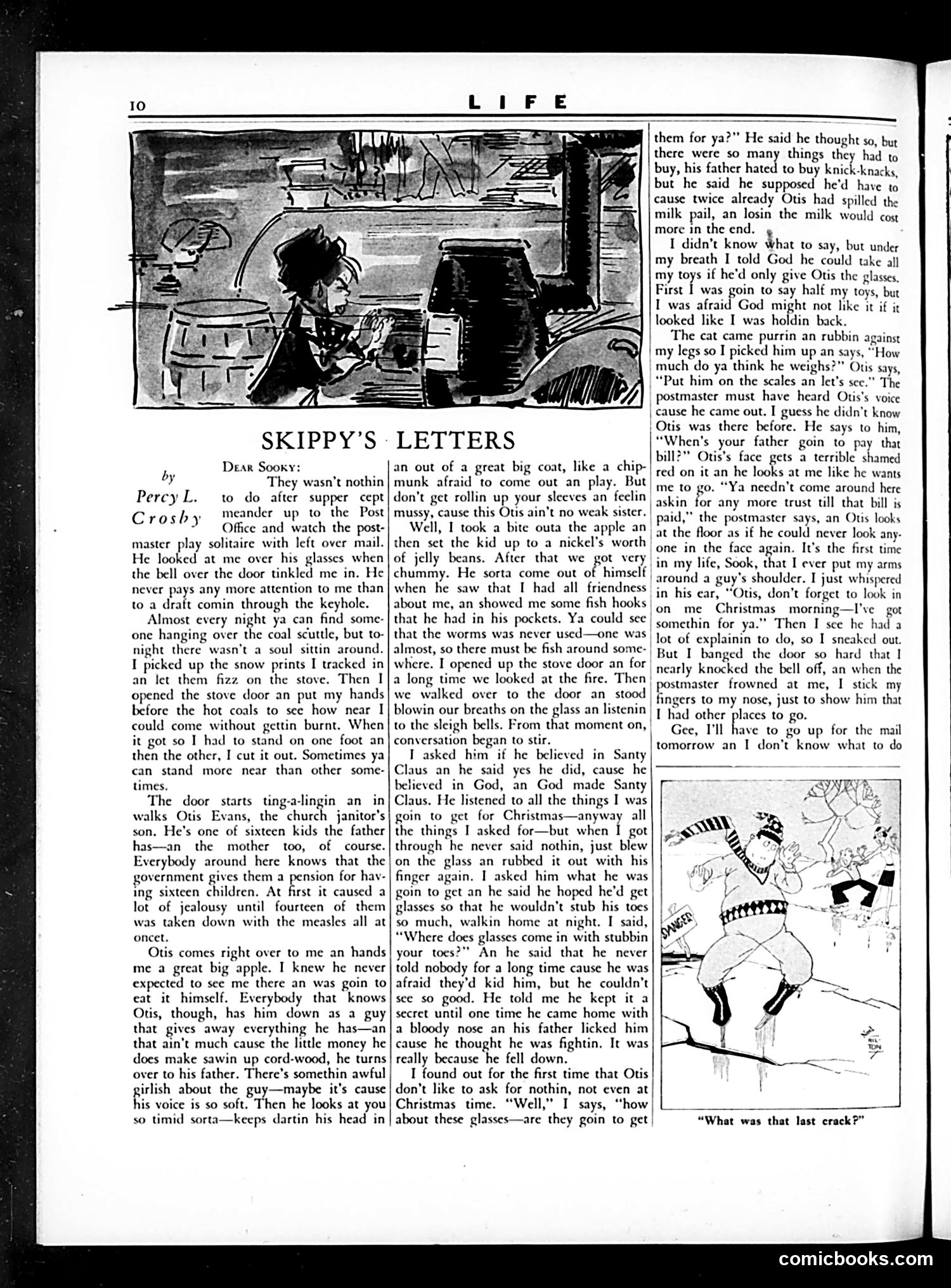
This page features "Skippy's Letters," a humorous column by Percy L. Crosby about a mischievous boy named Skippy. The letter describes Skippy's winter adventures and pranks, including tricking his friend Otis into various embarrassing situations—making him weigh himself publicly, getting him to wear glasses he doesn't need, and generally causing trouble. The accompanying cartoon shows Skippy in winter clothing, apparently after some mishap ("What was that last crack?"). The humor appeals to readers familiar with children's mischief and sibling-like teasing. It's gentle satire of childhood behavior rather than political commentary—a lighthearted entertainment feature typical of Life magazine's varied content during this era.
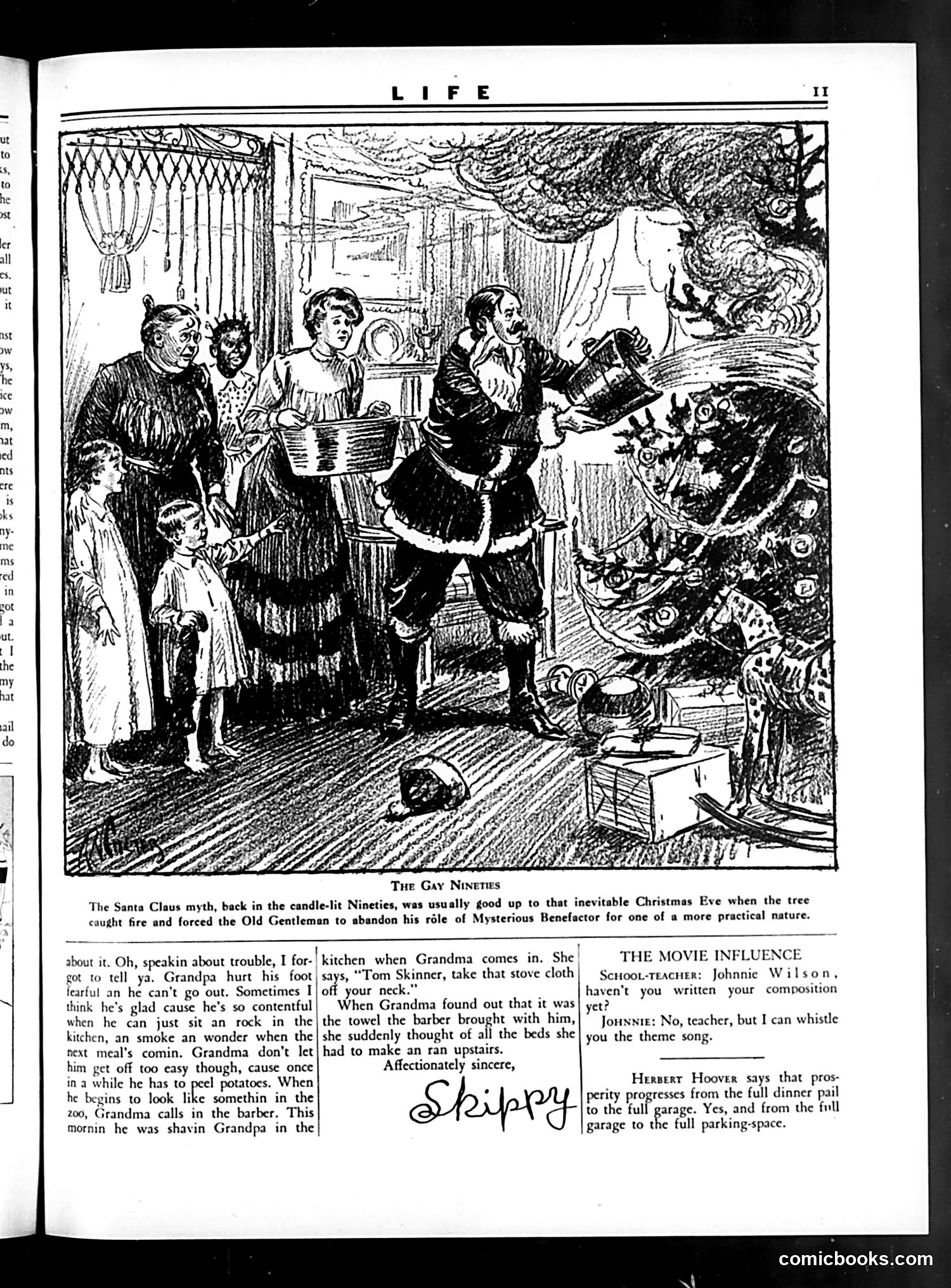
This illustration satirizes nostalgic idealization of the 1890s. The caption explains that the "Santa Claus myth" of that era—portrayed as wholesome and genteel—was disrupted when Christmas trees caught fire, forcing Santa to abandon his "Mysterious Reindeer" for practical concerns. The scene depicts a domestic crisis: a family gathered around what appears to be a burning or smoking Christmas tree, with Santa confronting the reality of the situation rather than maintaining magical pretense. The detailed household interior, formal dress, and children present contrast sharply with the chaos and danger. The satire mocks how nostalgia romanticizes the past while ignoring its genuine hazards and inconveniences—in this case, the very real fire danger of candlelit Christmas trees in the 1890s.
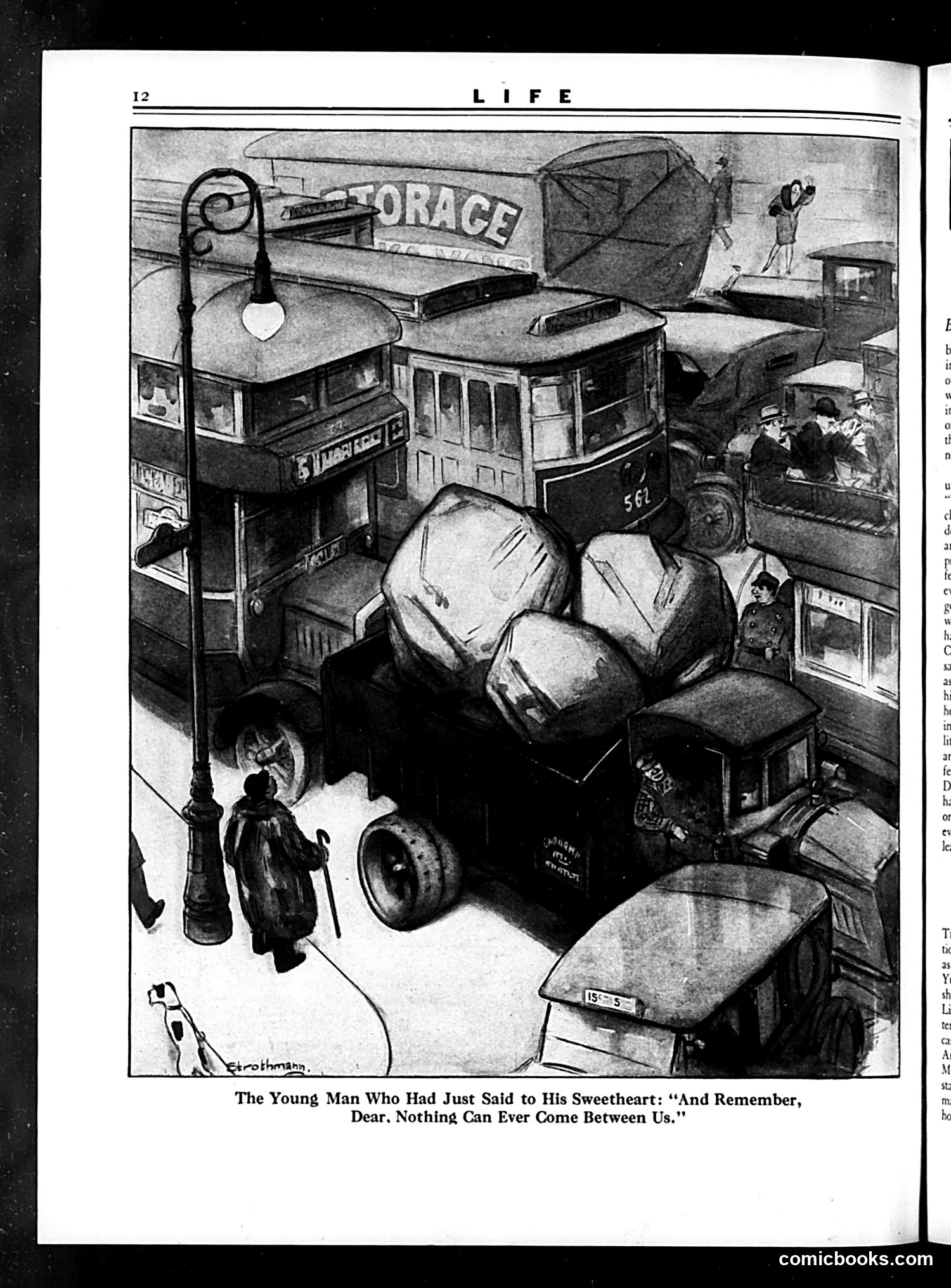
This is a satirical cartoon from *Life* magazine showing a crowded urban garage or storage facility. A young man has just promised his sweetheart that "nothing can ever come between us," but the image ironically depicts their relationship literally surrounded and squeezed by cars, automobiles, and urban infrastructure—the massive vehicles and mechanical objects pressing in from all sides. The satire critiques modern automobile culture and urban congestion of the early-to-mid 20th century. The joke suggests that despite romantic declarations of devotion, the realities of car ownership, traffic, and mechanized city life inevitably intrude on personal relationships. It's commentary on how technology and automobiles were transforming—and complicating—modern life and intimacy.
This theatre review column discusses several stage productions. The visible cartoon shows a reclining figure and what appears to be a small cherub or child figure—likely illustrating a theatrical scene or joke, though the specific reference is unclear from the image alone. The text reviews "Old Wine" by Robert Benchley, discussing theatrical revivals. It mentions productions of "Macbeth" and "The Wild Duck," critiquing their quality and performances. The column also covers "Redemption" (a Lebende Leichnam adaptation) and "The Royal Box." Notable is the discussion of Florence Reed in "Lady Macbeth" and commentary on how these classic plays still require talented actors to succeed. The tone is witty and somewhat dismissive of mediocre productions, typical of Life's satirical theatre criticism.
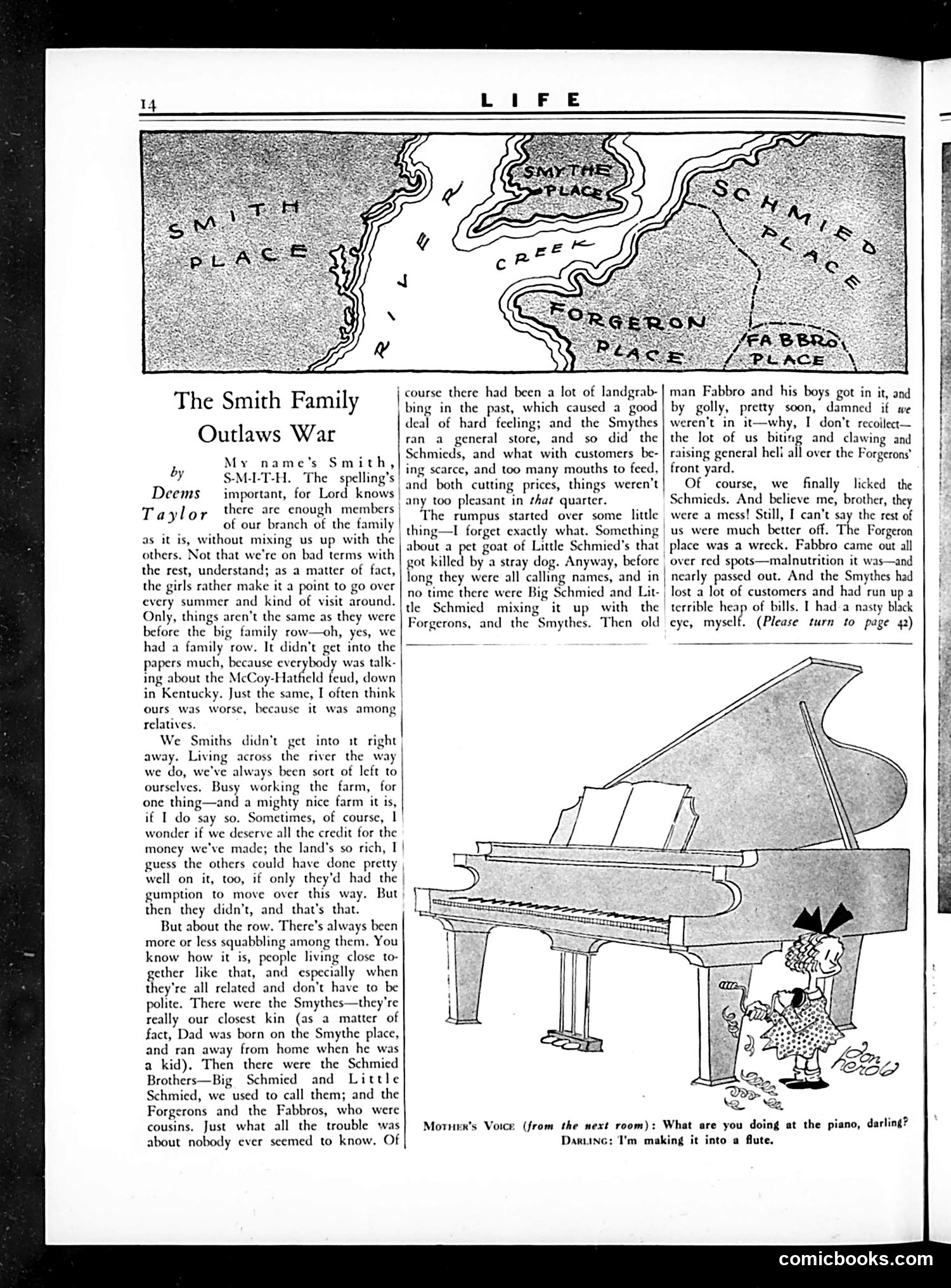
This page contains a humorous personal essay titled "The Smith Family Outlaws War" by Deems Taylor, accompanied by a cartoon illustration. The essay is a folksy, first-person account from someone named Smith describing a family feud among related Kentucky families—the Smiths, Smythes, Schmieds, Forgersons, and Fabbros. Taylor uses this rural clan conflict as a satirical commentary on the absurdity of feuding in general. The narrator describes how petty grievances escalated into serious conflict, with various families refusing to associate or trade with one another. The accompanying cartoon shows a child at a piano being transformed into a flute by their mother—a visual pun on the phrase "making it into a flute," illustrating domestic chaos and children's mischief. The piece satirizes how easily feuds perpetuate through families, even when nobody remembers the original cause of the quarrel.
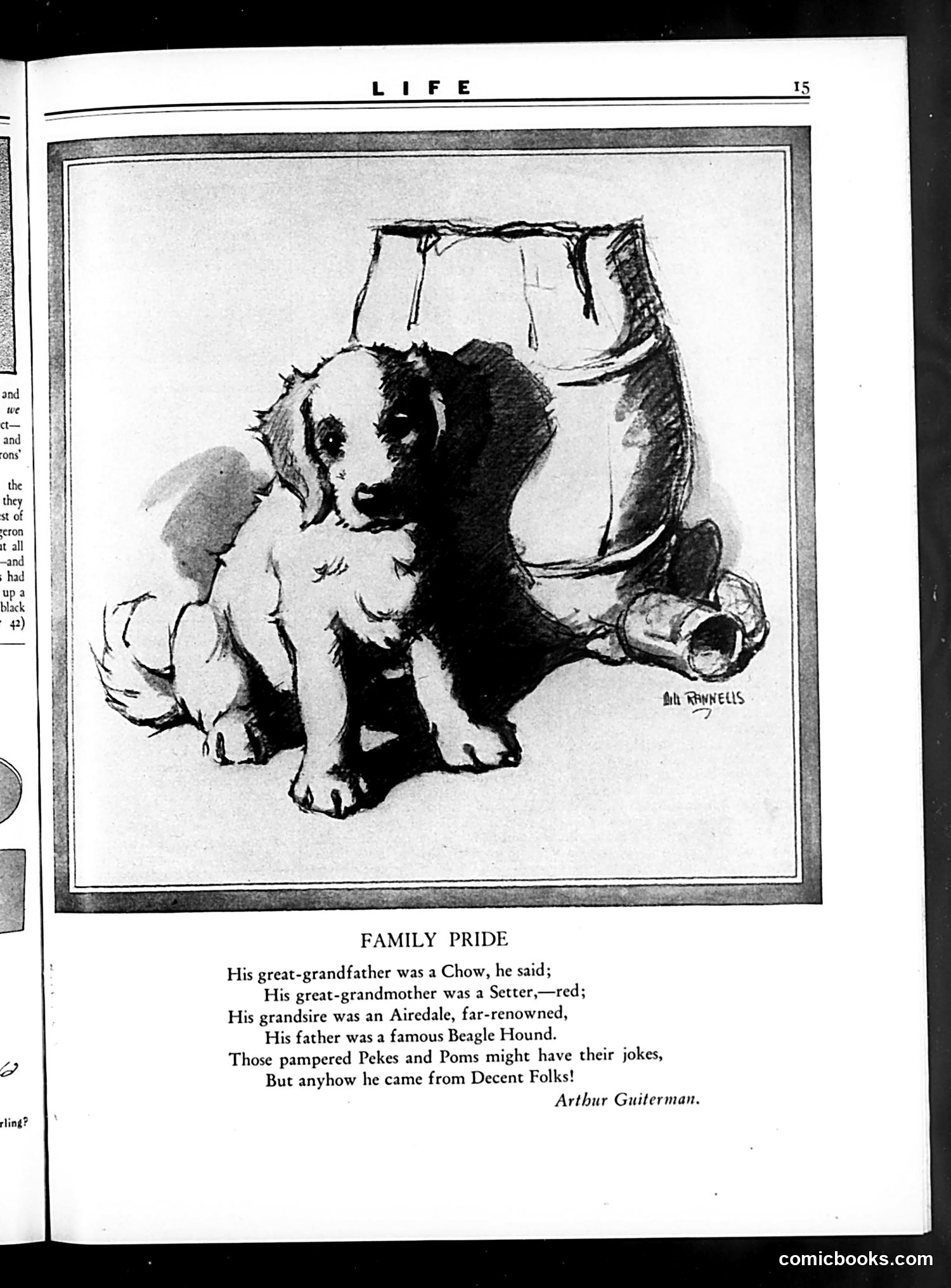
This satirical cartoon by Gill Runnells depicts a scruffy, mixed-breed dog beneath a coat of arms, mocking pretentious genealogy. The poem by Arthur Guiterman reveals the joke: the dog boasts of aristocratic ancestry (Chow, Setter, Airedale, Beagle Hound), yet somehow produced this undistinguished mongrel offspring from "Decent Folks." The satire targets social climbers and those obsessed with pedigree and noble lineage. Despite claims of pure breeding, the dog represents how mixing and chance can produce unpredictable results—a commentary on human society's similar contradictions between pretended superiority and actual outcomes. The humor lies in applying human vanity about family trees to animals, exposing the absurdity of inherited pride divorced from reality.
This page critiques President Herbert Hoover's stance on Prohibition enforcement. The main cartoon depicts a figure (likely Hoover) gesturing while a dark shadow figure looms beside him, illustrating the tension between public and private positions on alcohol policy. The text discusses how Hoover, despite being raised in the White House and aware of Prohibition's unpopularity and enforcement costs ($30 million annually to the federal government), would continue supporting the law. The article sarcastically suggests Hoover cannot simultaneously maintain diplomatic privilege while enforcing Prohibition, calling this a moral compromise. The satire targets the perceived hypocrisy of Prohibition policy under Hoover's administration—the gap between what Americans actually wanted and what their government enforced.
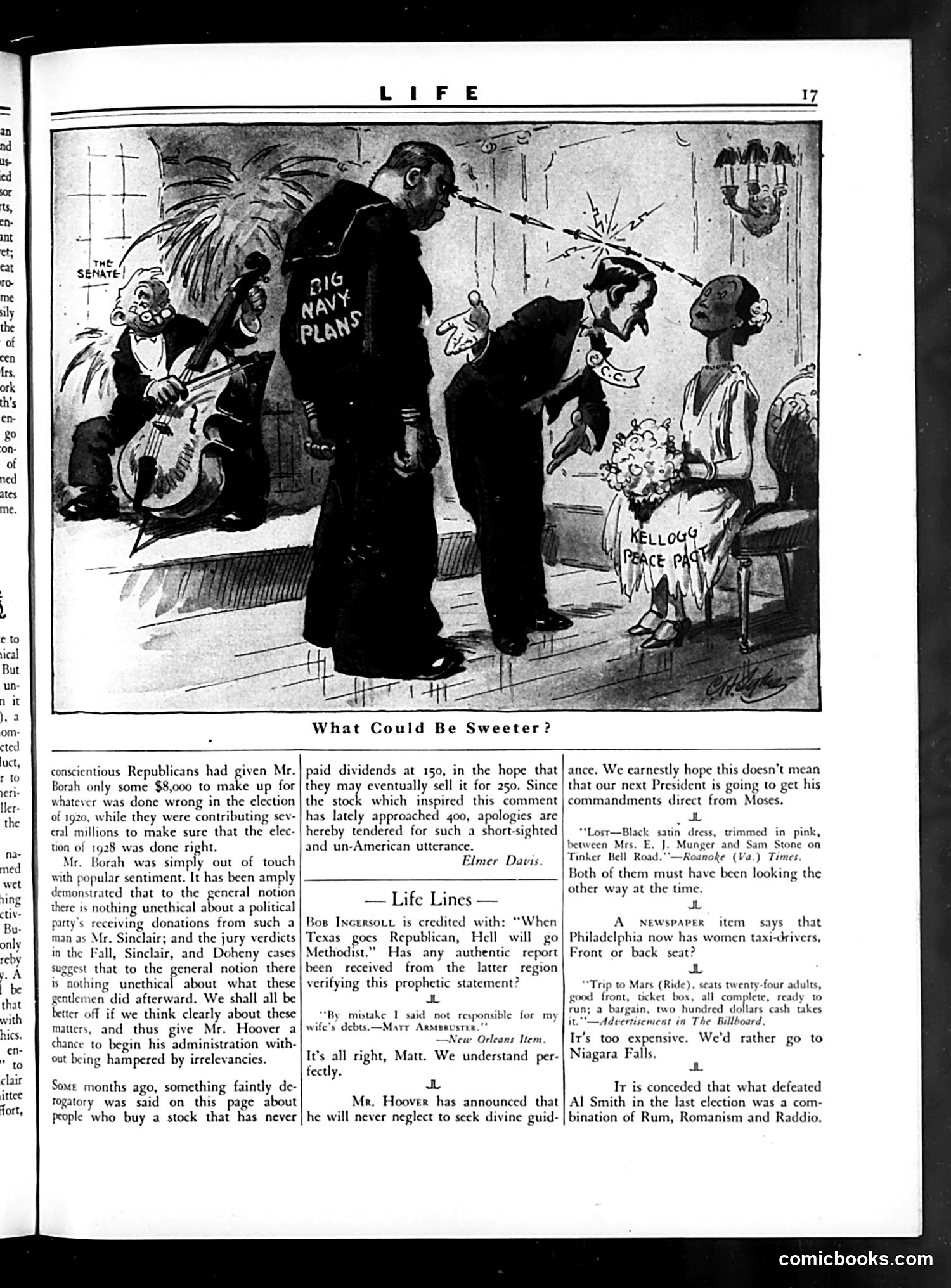
This Life magazine cartoon satirizes Republican political hypocrisy regarding campaign donations. The image shows figures labeled "The Senate" and "Big Navy Plans" receiving money, while a character labeled "Kellogg Peace Pact" stands nearby with flowers—suggesting naive idealism about peace. The accompanying text critiques Republicans for accepting substantial donations ($8,000 from Mr. Borah) while publicly opposing such contributions as unethical. The satire highlights the contradiction between stated principles against political donations and actual fund-raising practices. The "sweetness" in the title refers sarcastically to this hypocrisy: Republicans publicly condemn donations while privately accepting them to fund military expansion and political campaigns. This exposes the gap between political rhetoric and actual behavior.
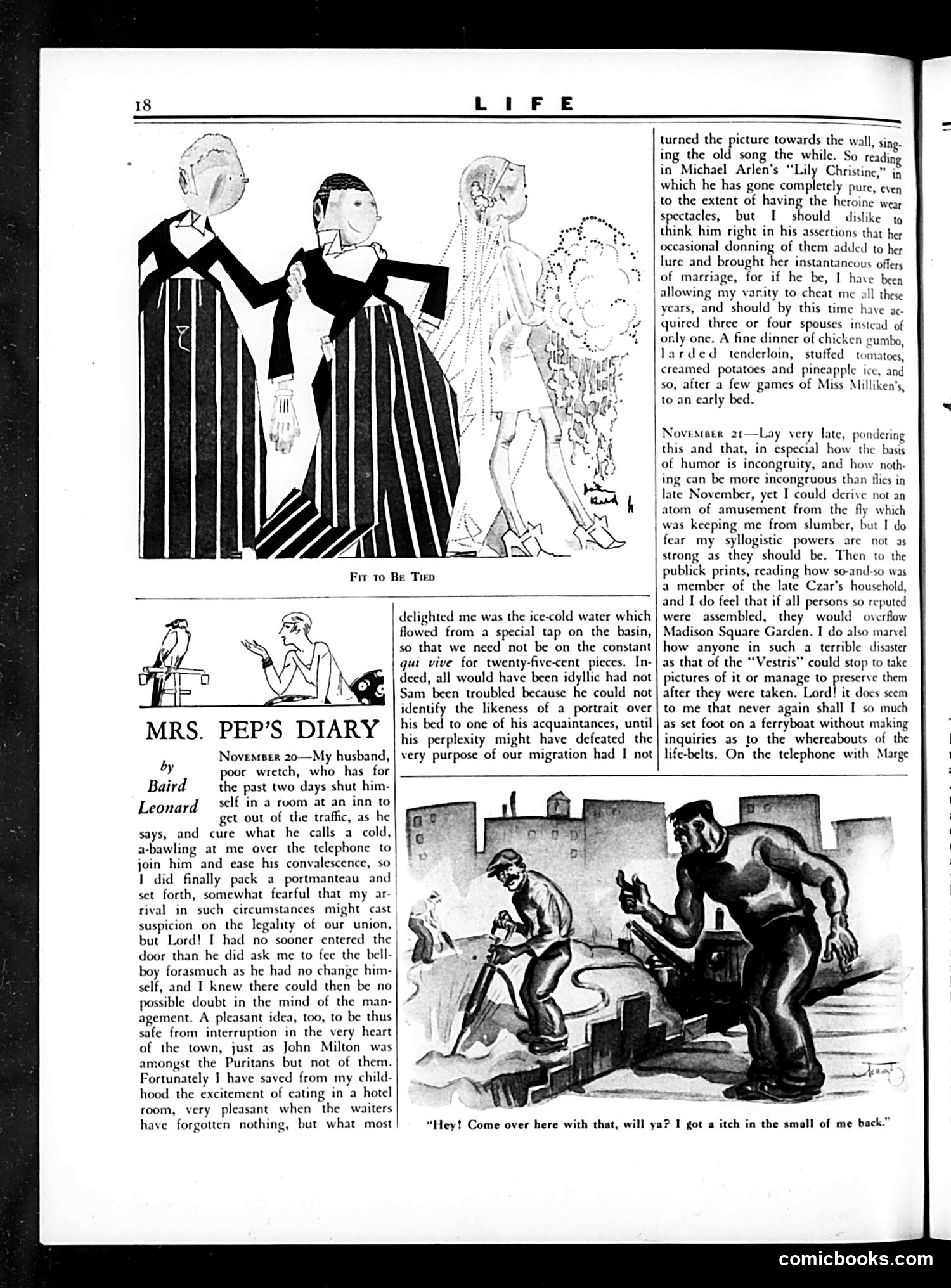
This page contains two distinct satirical pieces: **"Fit to Be Tied"** (top illustration): A fashion cartoon mocking women's formal wear, showing figures in elaborate striped gowns with the caption suggesting the garments are so restrictive they literally need to be "tied." **"Mrs. Pep's Diary"** (by Baird Leonard): A humorous diary column satirizing upper-middle-class hotel life and domestic minutiae. The entries mock: - Marital conventions and hotel proprieties (staying in rooms with husbands) - Trivial complaints (identifying mysterious portraits, ice-water availability) - Contemporary literary trends (Michael Arlen's moralistic novels) - Social pretension (claiming association with the Russian Czar's household) - Recent news obsessions (the SS *Vestris* disaster of 1928) The bottom cartoon depicts working-class men in apparently uncomfortable conditions, providing social contrast to the diary's genteel concerns. The humor relies on incongruity between elevated, precious language and trivial complaints—the stated theme of the November 21 entry itself.
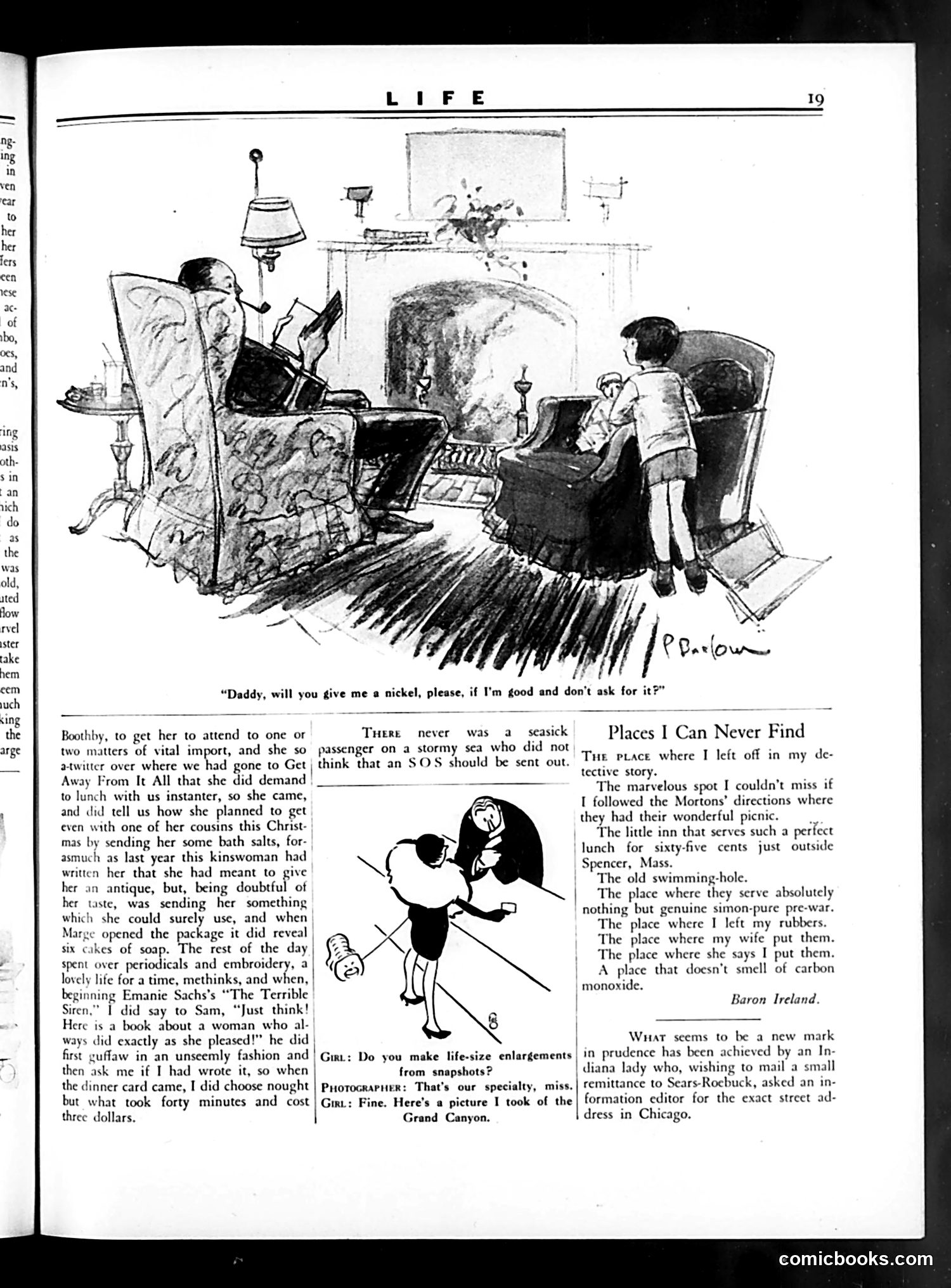
This Life magazine page contains three distinct pieces of humor: **Top Cartoon**: A child asks her father for a nickel, promising good behavior and not asking for it—a paradox exposing how children's logic contradicts itself. The joke mocks innocent manipulation by youngsters. **Middle Section**: An anecdote about a woman's visit disrupting the narrator's plans. The humor lies in the petty social drama of gift-giving etiquette (bath salts vs. soap) and the narrator's husband's quip that she should have written a book about a woman who "always did exactly as she pleased"—implying the narrator doesn't. **Bottom Cartoons**: Two brief exchanges—one about SOS signals on stormy seas (unclear context), and one where a photographer humorously misunderstands a customer's request for "life-size enlargements" of a Grand Canyon snapshot, implying he'd create an enormous print. **"Places I Can Never Find"**: A humorous list by Baron Ireland cataloging domestic absurdities—lost items, unmarked locations, spousal disagreements—relatable to 1920s readers experiencing modern inconveniences like automobile exhaust ("carbon monoxide").
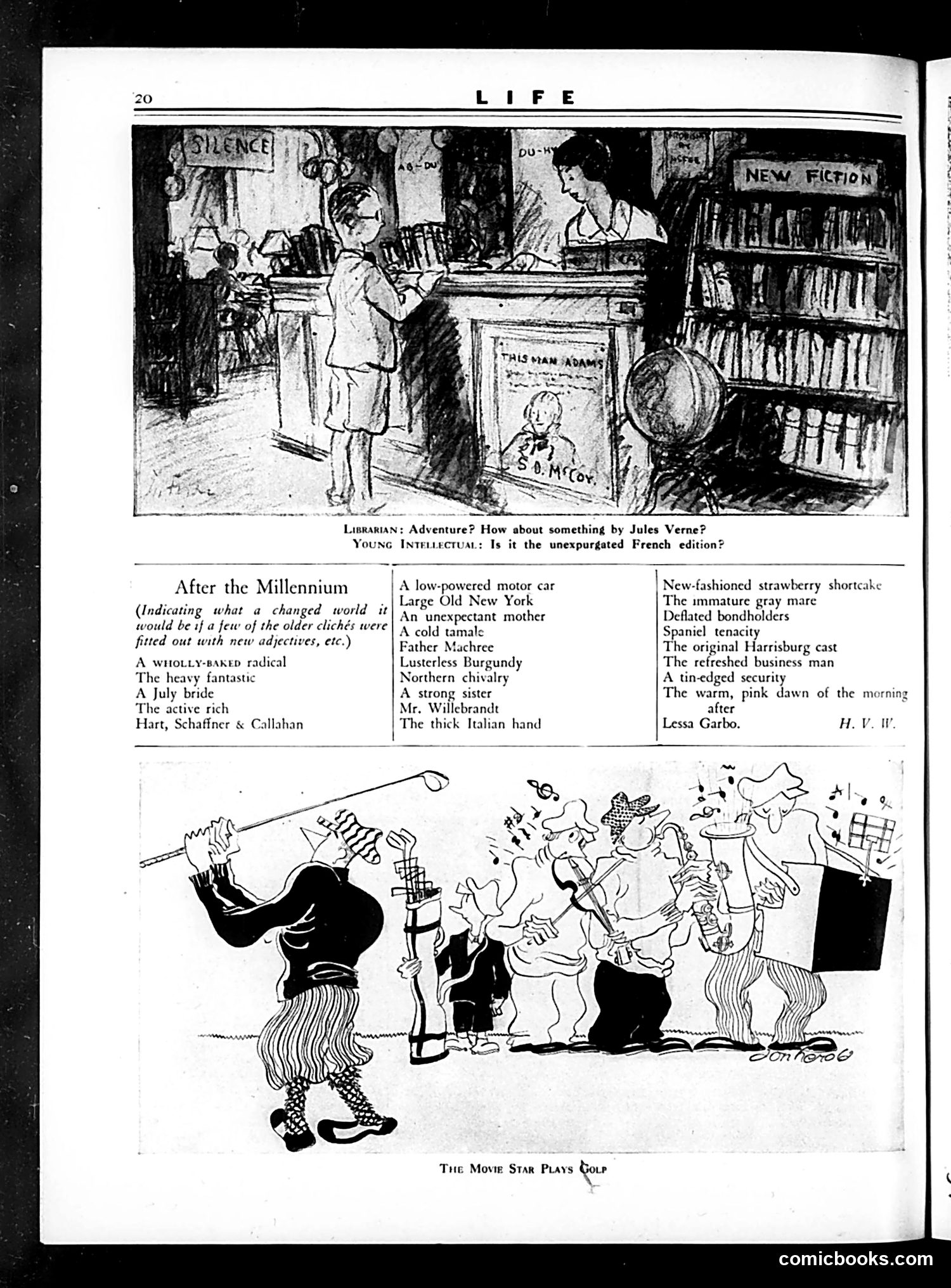
**Top Cartoon:** A young intellectual at a library desk asks the librarian for an "unexpurgated French edition" of Jules Verne—a satirical jab at pretentious youth who seek risqué literature under the guise of intellectual interest. The humor mocks both the young person's affected sophistication and the era's tendency to associate French books with adult content. **"After the Millennium" Section:** This is a satirical list imagining how familiar phrases would change if updated with new adjectives. Examples include "whotty-baked radical" (instead of "radical"), "unexpectant mother" (reversing expectations of motherhood), and "Mr. Willebrandt" (likely referring to Mabel Walker Willebrandt, a Prohibition enforcement official—the joke being she'd become something different). The section mocks social conventions and contemporary figures through linguistic wordplay. **Bottom Cartoon:** "The Movie Star Plays Golf" depicts a chaotic scene where a film star's golf swing creates comedic destruction, satirizing both Hollywood excess and the era's growing celebrity culture.
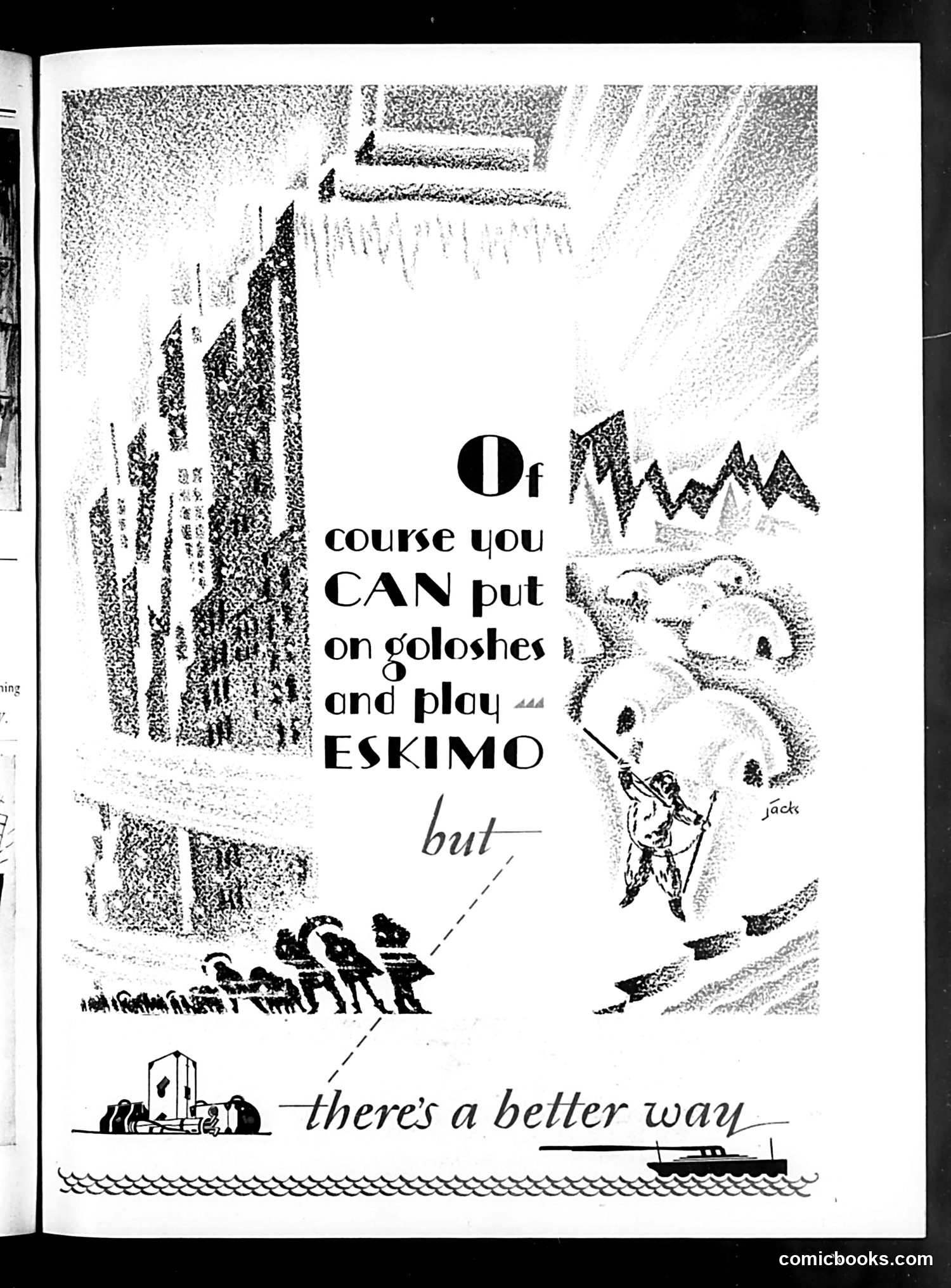
This is a vintage advertisement promoting travel by boat (visible at bottom) as superior to other winter transportation methods. The ad contrasts activities shown on the left—people in cold weather playing Eskimo games and activities like sledding on goloshes (rubber boots)—with a "better way" to travel represented by a steamship at the bottom. The humor relies on the impracticality of the left-side activities: you *can* put on galoshes and play "Eskimo" games in harsh conditions, but it's uncomfortable and inefficient. The advertisement argues that steamship travel offers comfort and ease as an alternative, likely targeting readers considering winter travel options. The dated reference to "Eskimo" reflects early-20th-century terminology and cultural attitudes no longer considered appropriate.
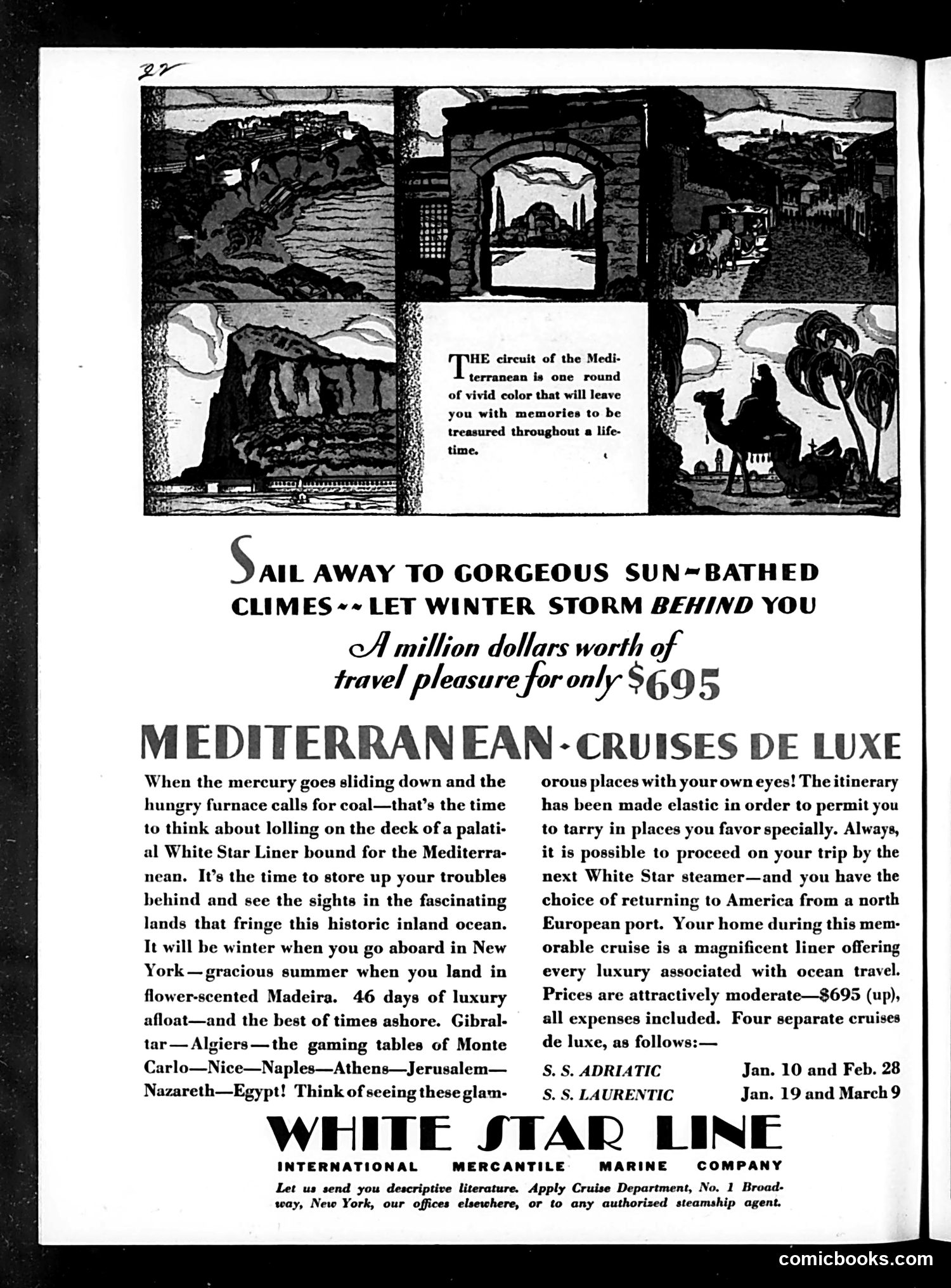
This is primarily a **travel advertisement**, not satire or political commentary. The White Star Line promotes Mediterranean cruises departing from New York during winter months, offering 46-day luxury voyages for $695 (approximately $11,000 in modern currency). The page uses period marketing tactics: the accompanying woodcut illustrations depict Mediterranean destinations (harbors, ancient gates, coastal scenes, local figures) to evoke exotic appeal. The headline's rhetorical flourish—"sail away to gorgeous sun-bathed climes"—targets affluent Americans seeking escape from harsh northeastern winters. The itinerary (Gibraltar, Algiers, Monte Carlo, Naples, Athens, Jerusalem, Egypt) and ship names (S.S. Adriatic, S.S. Laurentic) are historically accurate. The reference to "coal" furnaces reflects 1920s-era heating concerns. This is **commercial content**, not editorial commentary. The page demonstrates how magazines like *Life* mixed advertising with editorial matter to fund publication.
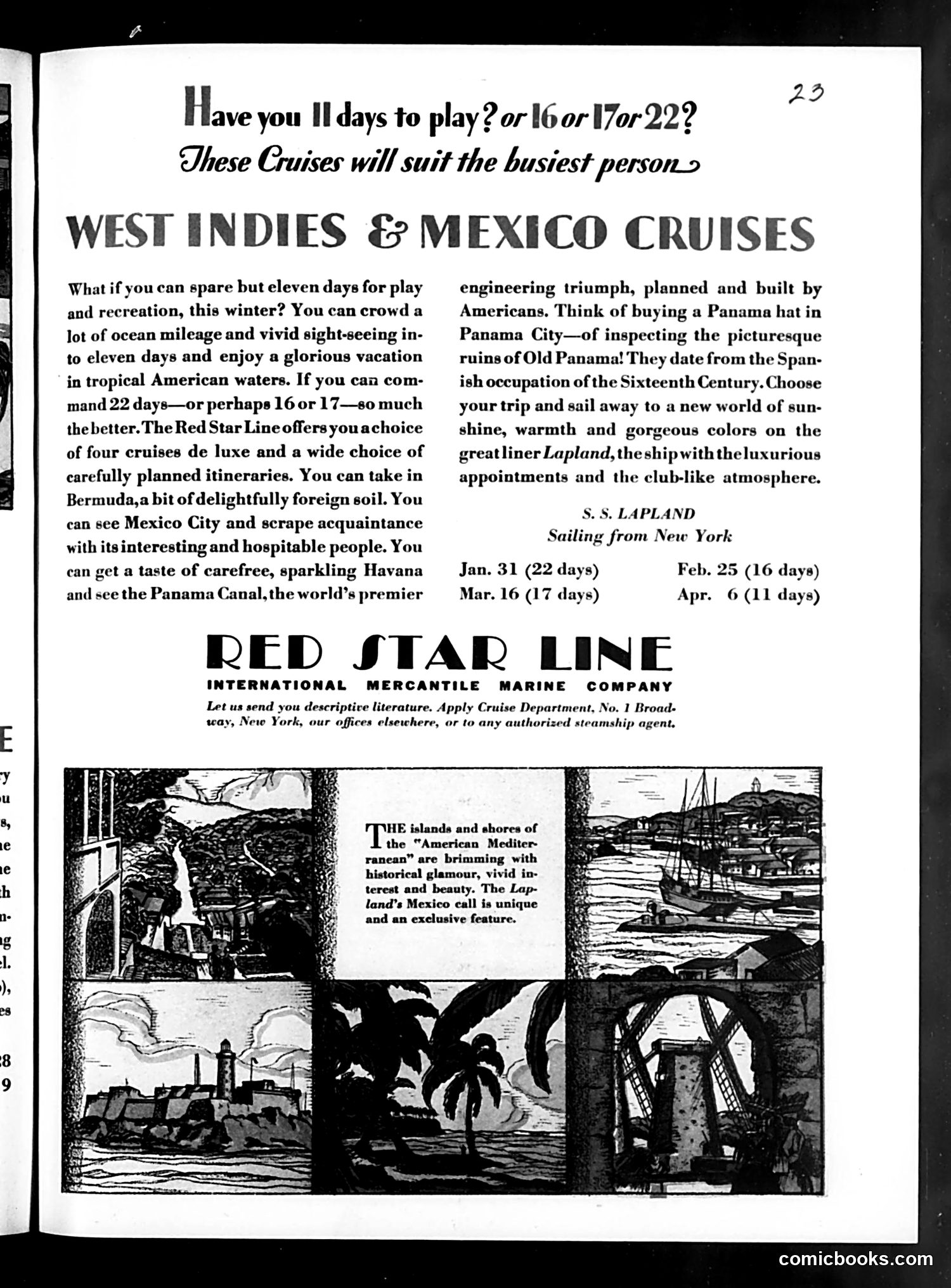
This is primarily a **luxury cruise advertisement**, not satire or political commentary. The Red Star Line promotes Caribbean and Mexican voyages aboard the S.S. Lapland for affluent Americans with varying vacation lengths (11-22 days). The page reflects **early 20th-century American attitudes**: it emphasizes the Panama Canal as an American engineering achievement, frames Mexico and the Caribbean as exotic playgrounds for wealthy travelers, and references "Old Panama" ruins from Spanish occupation in a tone treating colonialism as historical curiosity rather than oppression. The accompanying woodcut illustrations show tropical scenes—palm trees, colonial architecture, harbor views—designed to evoke romantic adventure and leisure. The marketing targets "the busiest person" who can afford extended ocean travel, appealing to the leisure class during winter season. There is **no satire evident**. This is straightforward period advertising reflecting contemporary American imperial confidence and tourism marketing practices.
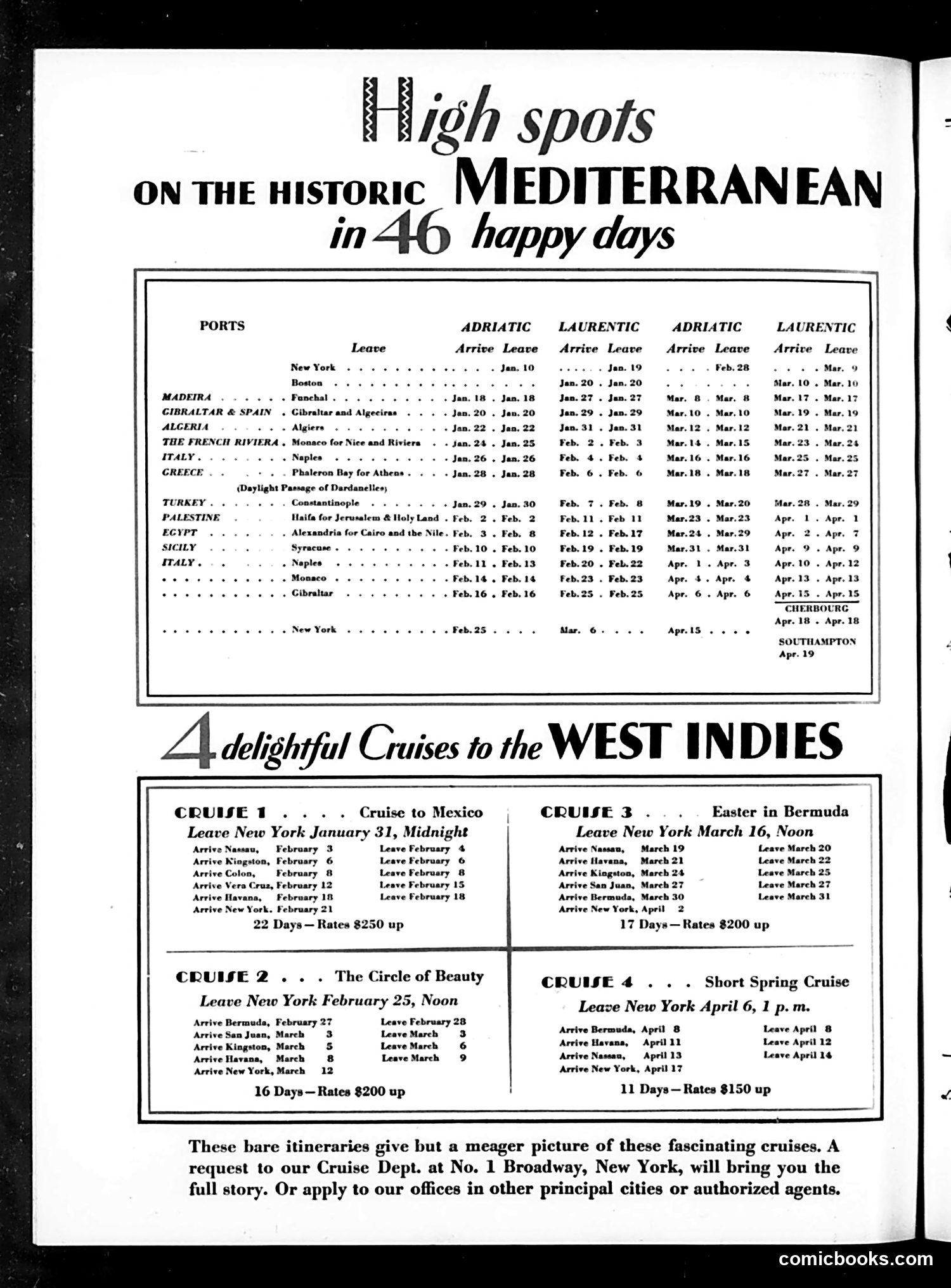
This page is **not a cartoon or satire** — it's a cruise ship advertisement, likely from the 1920s-30s based on the styling and destinations. The page promotes luxury Mediterranean and Caribbean cruises operated by what appears to be a major shipping line. The upper section advertises 46-day Mediterranean itineraries visiting ports like Madeira, Gibraltar, Naples, Alexandria, and Constantinople. The lower section promotes four separate West Indies cruises ranging from 11 to 22 days, departing from New York. The phrase "happy days" in the headline reflects the optimistic marketing of leisure cruising during this era — vacation travel was a luxury commodity for affluent Americans. Prices ranged from $150 to $250 per cruise (substantial sums in that period). The detailed port schedules and multiple departure dates indicate a competitive, well-established cruise industry targeting American tourists seeking both cultural tourism (Mediterranean "high spots") and tropical getaways.
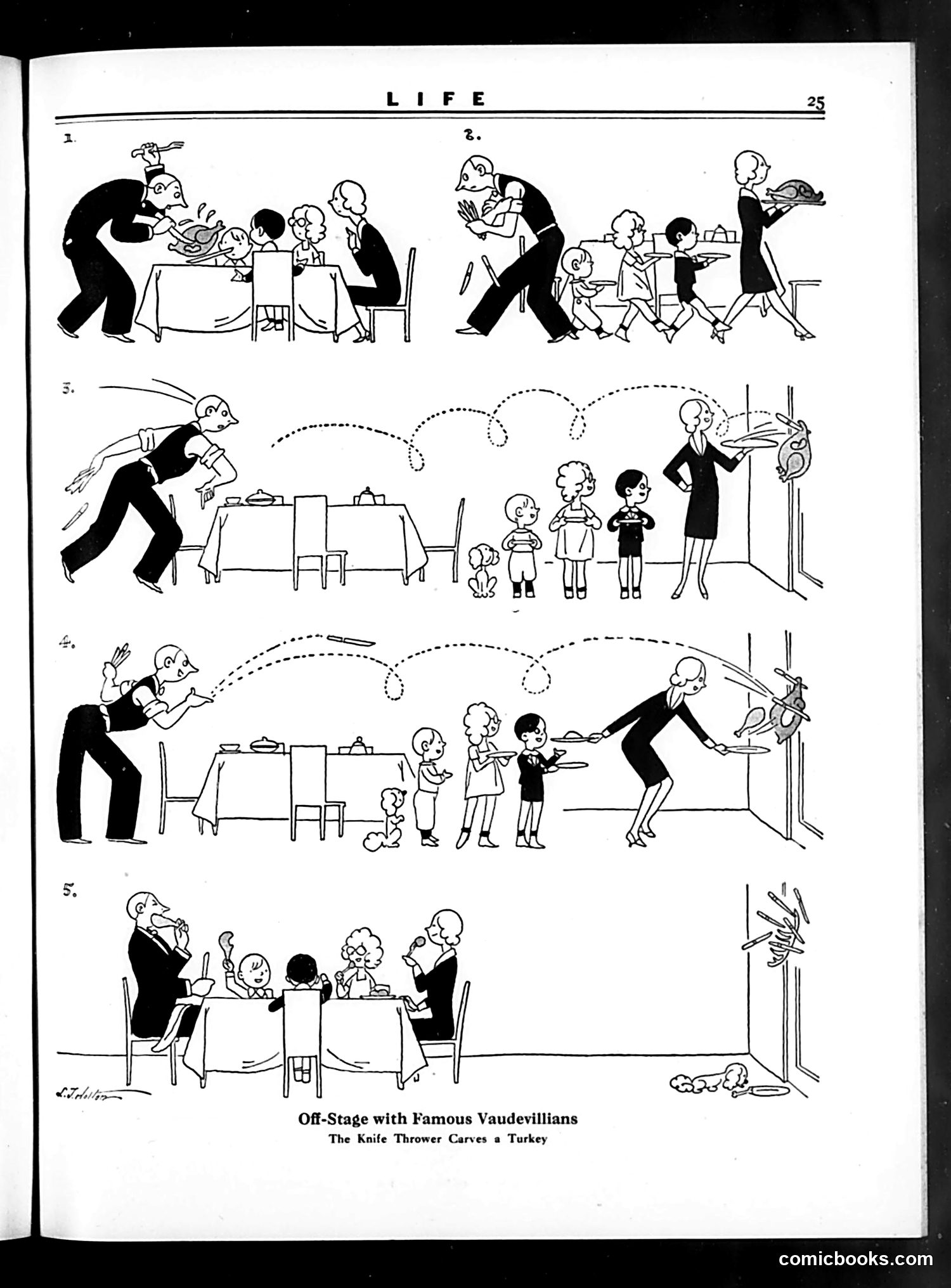
This is a humorous six-panel comic strip depicting the domestic chaos created by a vaudeville knife thrower attempting to carve a turkey for a family dinner. The joke relies on the contrast between his stage profession—throwing knives with precision at targets—and the comedic disaster that unfolds in a home setting with children present. Each panel escalates the situation: the knife thrower's practiced showmanship becomes increasingly dangerous and absurd in a domestic context. The final panel shows the family dining peacefully while turkey scraps litter the floor—suggesting the "carved" turkey is a complete mess. The satire gently mocks vaudeville performers' tendency to apply their theatrical behaviors to everyday life, and the broader notion that specialized skills don't necessarily transfer well outside their intended context.
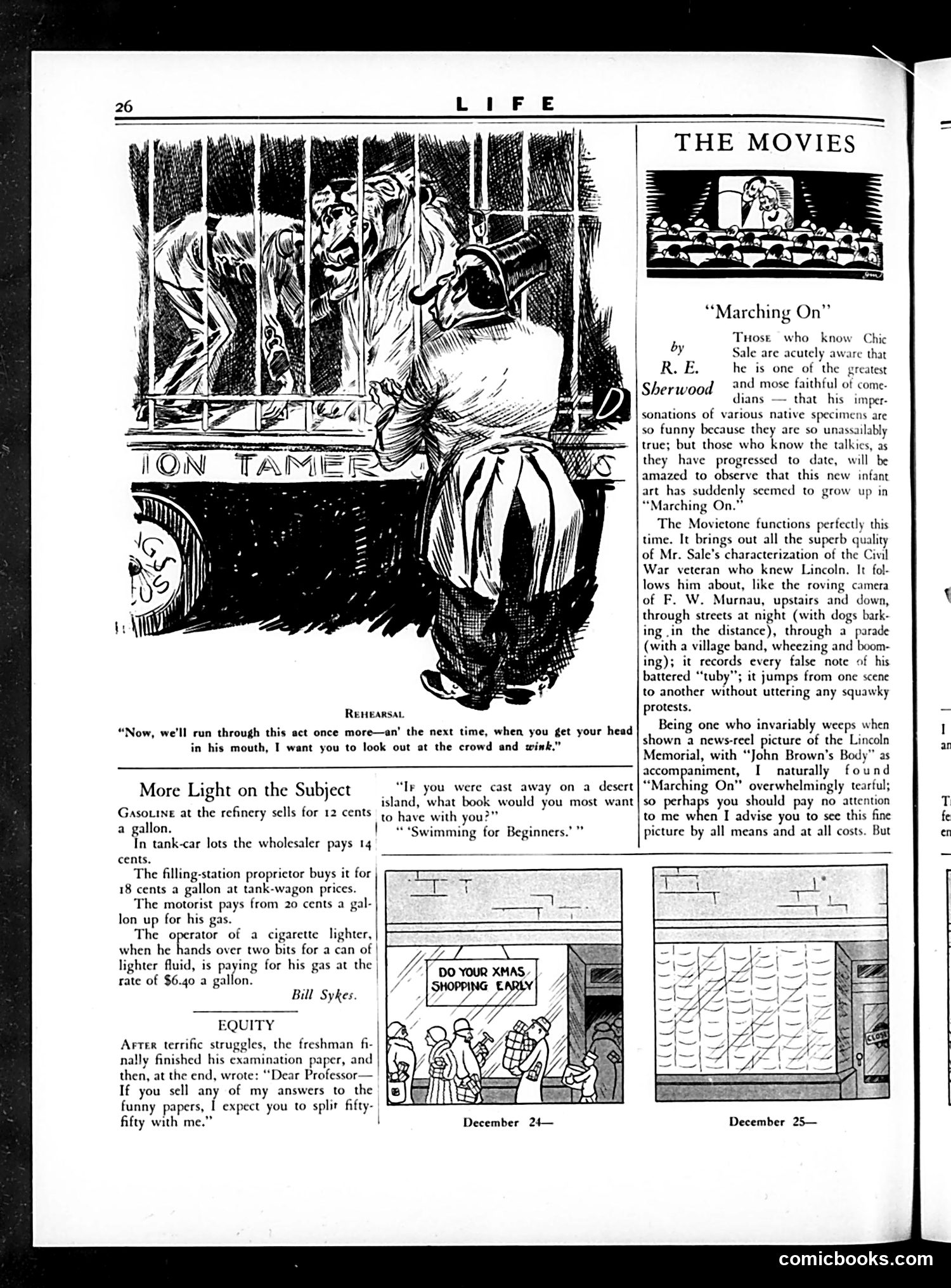
**Main Cartoon (Left):** "Lion Tamer" depicts a circus ringmaster instructing his assistant on performing with a lion—a dark joke about show business danger, emphasizing the need to maintain composure ("wink") even while risking death. **"The Movies" Section (Right):** Reviews Chic Sale's talking picture "Marching On." Sale was a famous vaudeville comedian known for impersonating rural characters. The reviewer praises how the Movietone newsreel camera work captures Sale's portrayal of a Civil War veteran reminiscing about Lincoln, noting the new "talkie" technology effectively records every detail of his performance through city streets and parades. The reviewer admits bias (weeping at Lincoln memorials) but enthusiastically recommends the film. **Sidebar Humor Sections:** Include economic observations (gasoline pricing across distribution chains) and a college joke about an exam-cheating student demanding profit-sharing. The page reflects early sound-film enthusiasm and vaudeville culture circa the late 1920s.
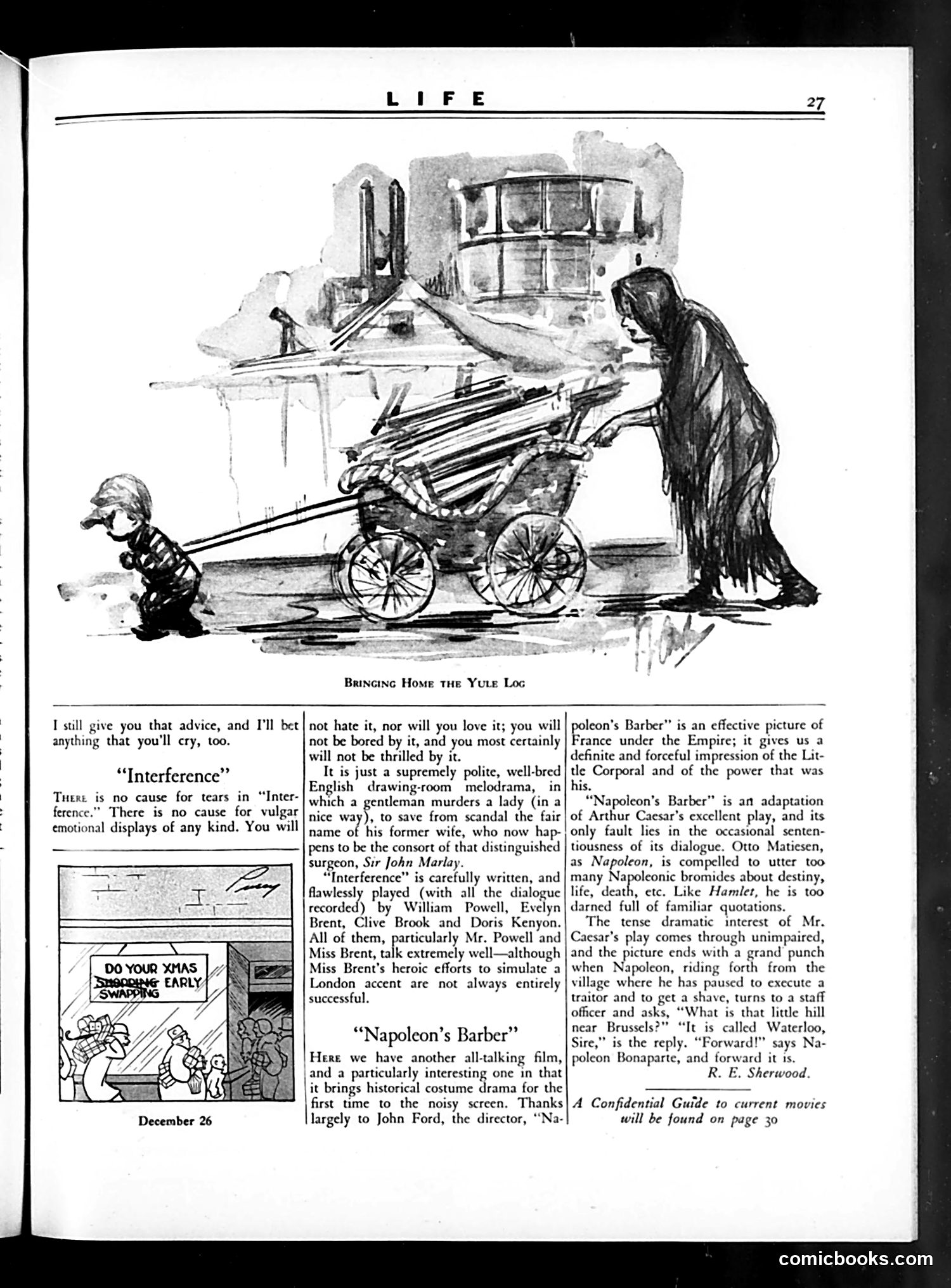
This page from Life magazine contains film reviews and a cartoon. The top illustration, "Bringing Home the Yule Log," depicts Death (a skeletal figure in dark robes) pushing a baby carriage containing a Yule log toward a house—a darkly humorous Christmas image playing on the season's associations with mortality and the "death" of the old year. Below are reviews of two early "talking pictures" (newly popular sound films). "Interference" is criticized as emotionally bland—polite but uninspiring drawing-room melodrama. "Napoleon's Barber," adapted from Arthur Caesar's play and directed by John Ford, is praised as an effective historical drama bringing costume drama to sound film, though faulted for overwrought dialogue about destiny. The review notes the dramatic irony: Napoleon asks about "that little hill near Brussels"—Waterloo, the site of his eventual defeat. The small comic strip dated "December 26" appears to advertise early Christmas shopping.
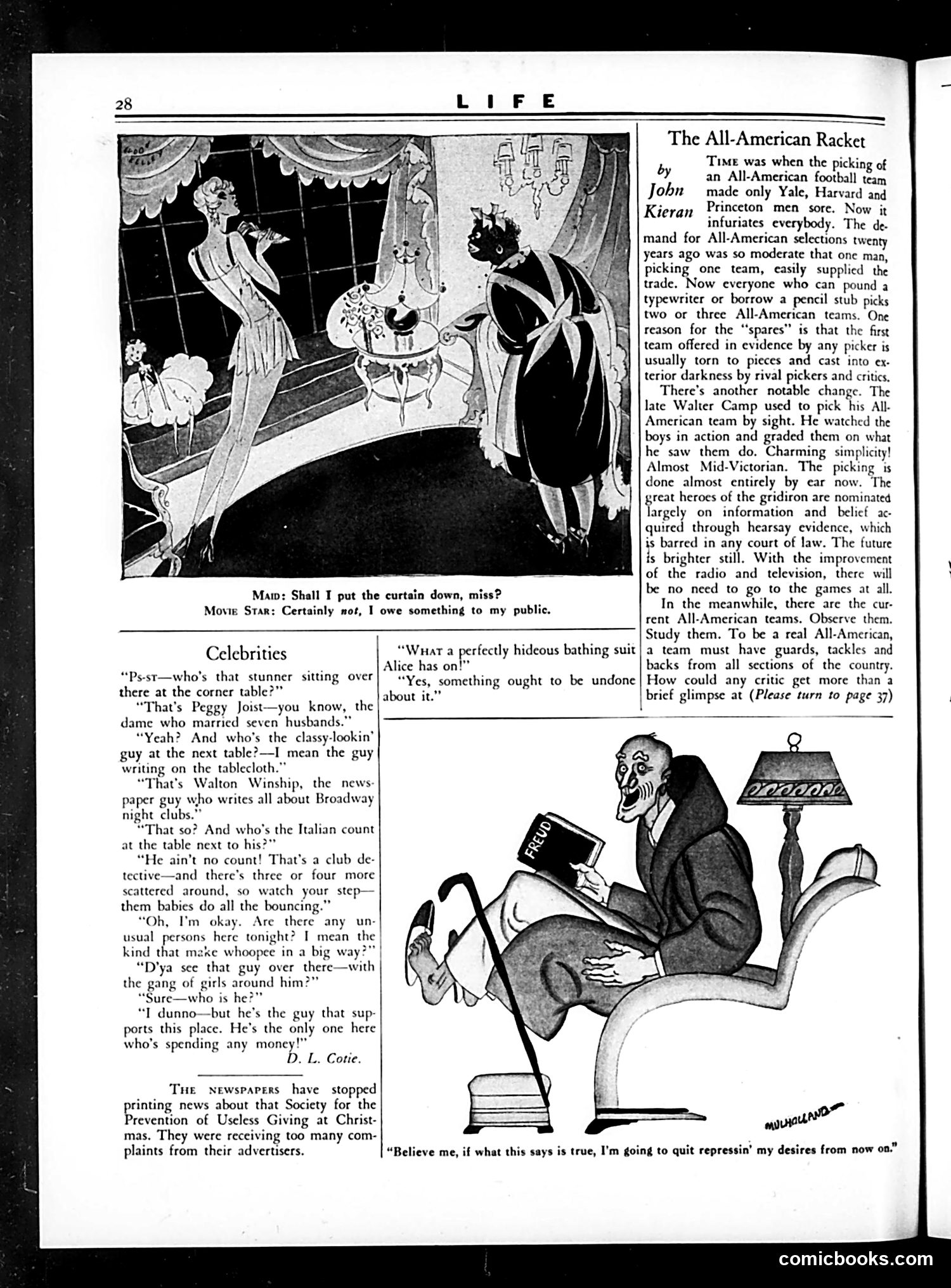
This page contains three separate satirical pieces: **Top cartoon:** A movie star refuses to close a curtain during an intimate moment, claiming she "owes something to my public"—mocking celebrities' narcissism and constant need for public attention/performance. **"Celebrities" section:** A gossip-style dialogue at a nightclub satirizes 1920s social life. It lists absurd "celebrities" (a woman with seven husbands, a Broadway gossip columnist, a fake count who's actually a club detective) and culminates in the joke that the only person of actual value is the unnamed wealthy man financing the establishment—lampooning how money, not notoriety, truly matters. **"All-American Racket":** This critique argues that college football team selections have become a commercialized mess. Once selected by expert eyewitness (Walter Camp), they're now picked by countless writers using hearsay. It sardonically predicts radio and television will eventually eliminate the need to watch games at all—satirizing how media and publicity have corrupted authentic sports evaluation.
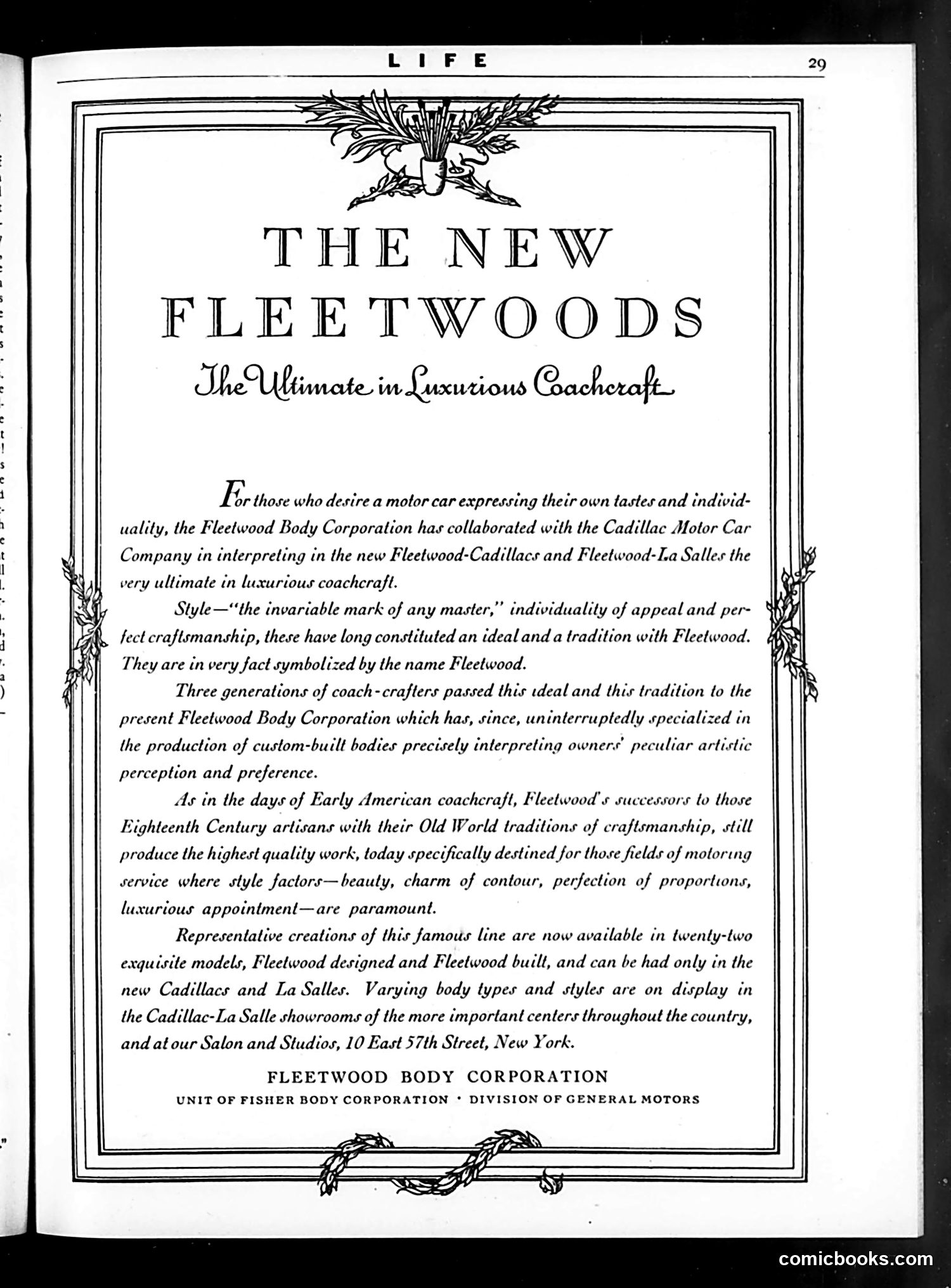
This is not a cartoon or satire—it's a **full-page advertisement** for Fleetwood luxury car bodies, a subsidiary of General Motors. The ad promotes custom-built automobile bodies for high-end Cadillac and La Salle vehicles. It positions Fleetwood as the heir to "Eighteenth Century artisans" and "Early American coachcraft," emphasizing handcrafted quality, individual taste, and luxury appointments. The rhetoric appeals to wealthy buyers seeking exclusivity and personal expression through their vehicles. The decorative borders and classical typography reflect the magazine's *Life* editorial aesthetic, lending prestige. The ad references their showroom at "10 East 57th Street, New York," indicating an upscale Manhattan location. **For modern readers:** This represents pre-Depression era aspirational marketing to the wealthy elite, before mass production became standard. The emphasis on "individuality" and "craftsmanship" ironically contrasts with the fact that these were still mass-produced General Motors products—just expensive ones.
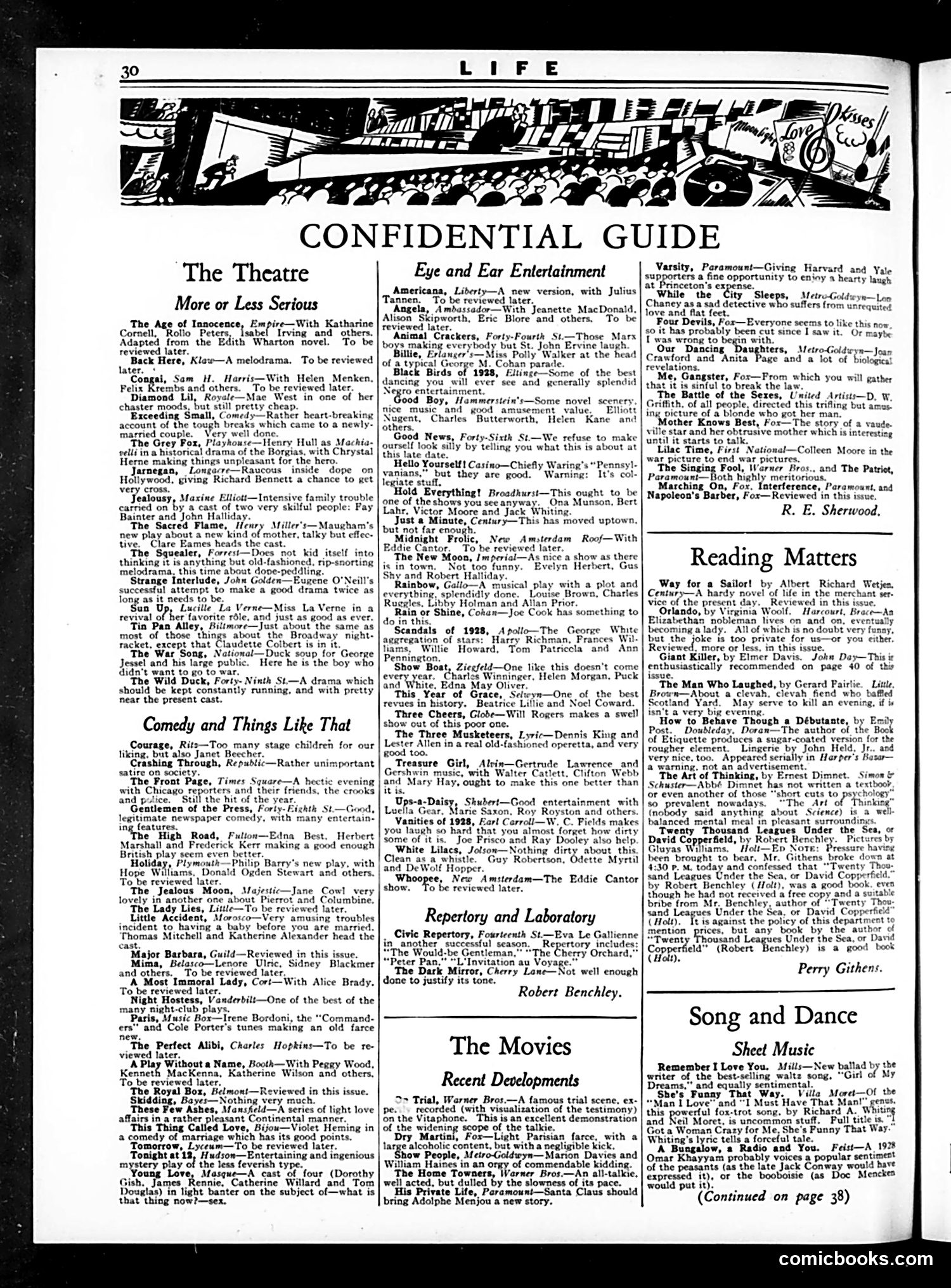
This page is a **theatre review guide**, not a political cartoon. It's a "Confidential Guide" listing Broadway shows with brief critical assessments—a standard entertainment feature in Life magazine. The satirical tone appears in the **capsule reviews themselves**. Life's critics offer sharp, witty judgments: "Diamond Lil" is "pretty cheap," "Strange Interlude" is "twice as long as it needs to be," and "Skidding" rates "Nothing very much." The page also includes sections on **movies, music, and dance**. Rather than targeting specific political figures, this represents Life's role as a **cultural arbiter**—using humor and snark to guide readers on entertainment consumption during what appears to be the late 1920s Broadway season. The satire is **social commentary through taste-making**: Life positions itself as sophisticated judges dismissing inferior art while celebrating quality productions.
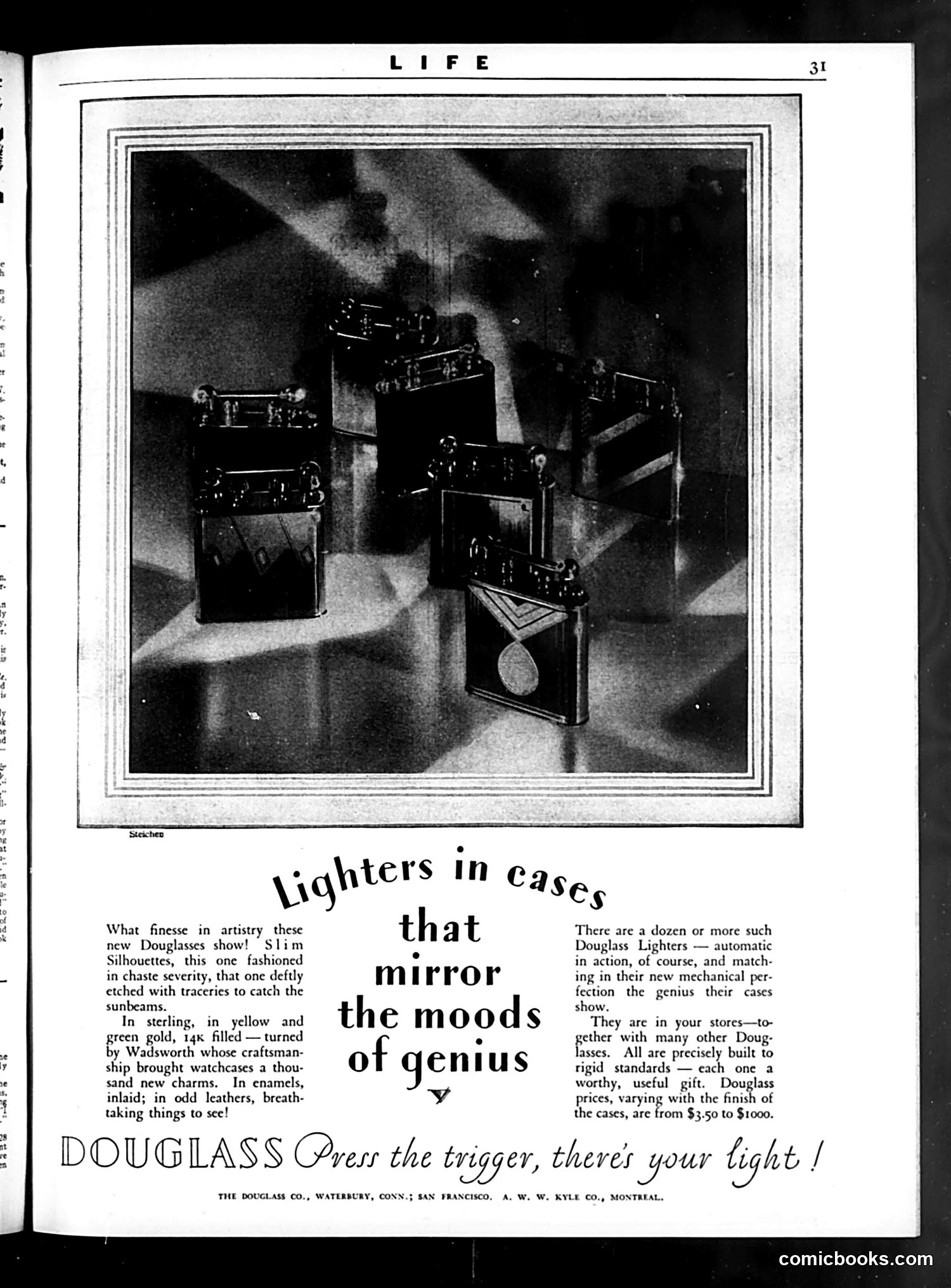
This is a **product advertisement**, not a political cartoon. It promotes Douglass brand lighters—mechanical devices that produce flame when triggered. The "satire" is subtle advertising copy aimed at wealthy consumers. The ad uses flowery language ("finesse in artistry," "chaste severity") to elevate lighters from mere functional objects to luxury items worthy of gift-giving. It emphasizes craftsmanship by Wadsworth, offering materials ranging from sterling silver to 14k gold, with enamels and leather inlays. The phrase "lighters in cases that mirror the moods of genius" is typical 1920s-30s advertising hyperbole—treating mass-produced lighters as expressions of refined taste. The price range ($3.50 to $1,000) indicates these were marketed to both middle and upper-class consumers. The tagline "Press the trigger, there's your light!" emphasizes the automatic mechanism as a modern convenience. This is straightforward product marketing rather than satirical commentary.
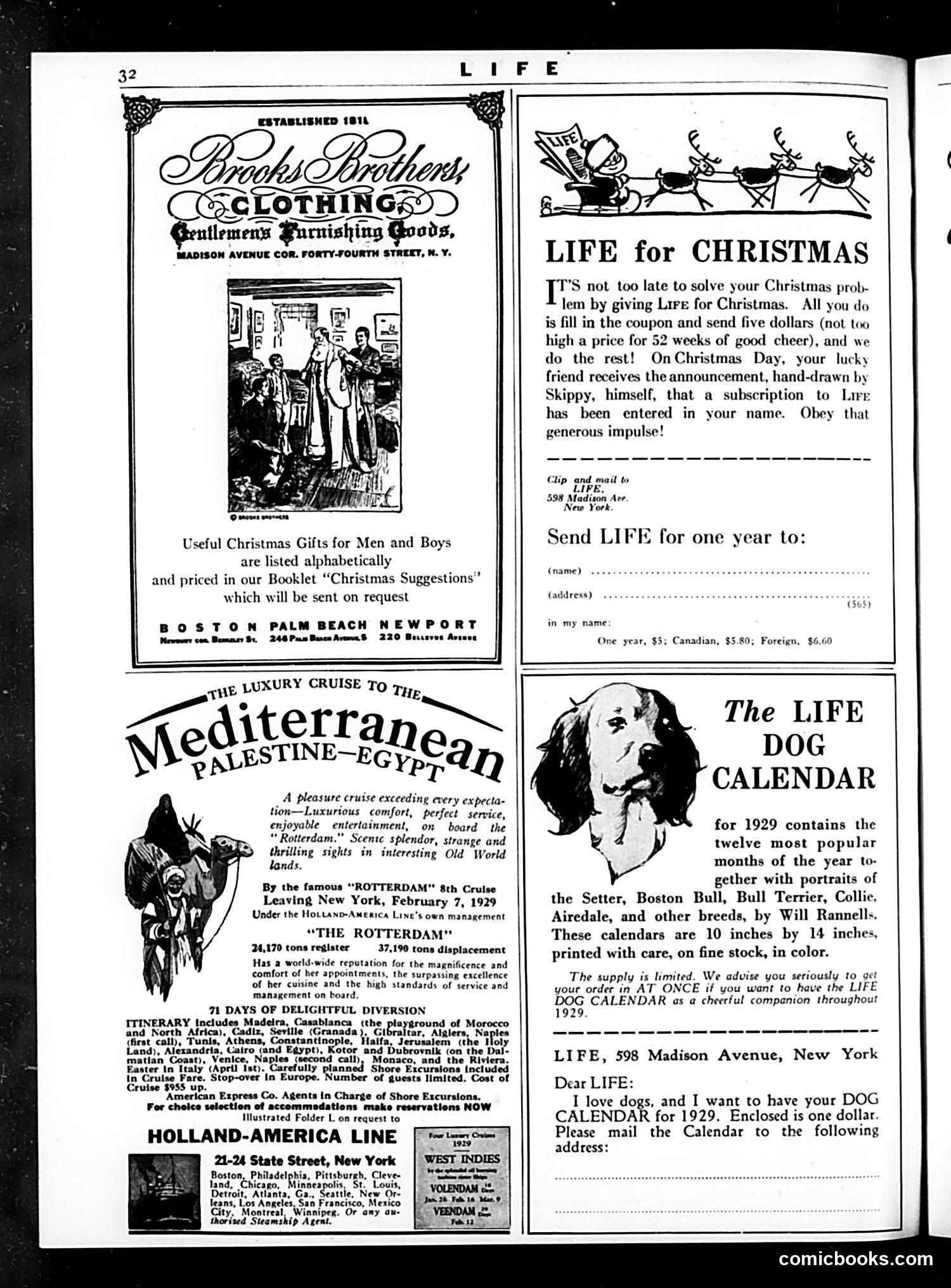
This is primarily an **advertising page** rather than editorial content. The layout features multiple paid advertisements typical of 1920s magazines: **Key Advertisements:** - **Brooks Brothers** clothing for men (upper left) - **Life magazine subscriptions** (right), promoting gift subscriptions with an illustration by "Skippy" (a popular comic character of the era) - **Holland-America cruise line** advertising a Mediterranean cruise on the S.S. Rotterdam, departing February 1929 - **Life Dog Calendar** for 1929, featuring dog breed portraits **Social Context:** The ads target affluent readers—luxury cruises, high-end clothing, magazine subscriptions—reflecting the prosperous pre-Depression era. The mention of "Skippy" drawing the subscription announcement suggests Life magazine's connection to comic entertainment. Prices ($3 annual subscription, $955+ cruise fare) indicate this was a magazine for middle-to-upper-class readers. **No significant satire or political cartooning appears on this page.** It's a commercial compilation typical of Life's revenue model.
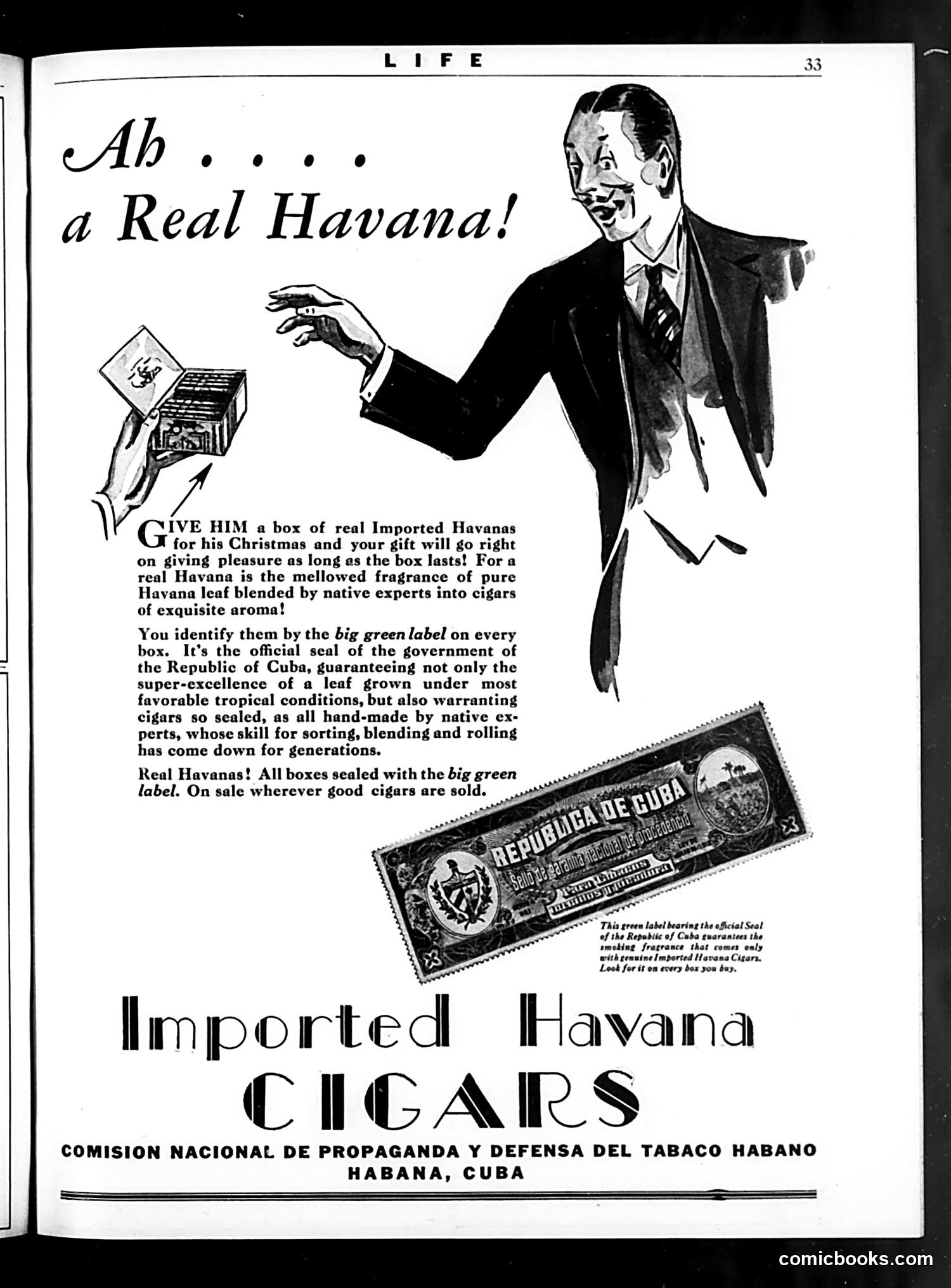
This is a **straightforward advertisement**, not satire. It promotes imported Cuban cigars as a Christmas gift, appearing in *Life* magazine (page 33). The caricatured man represents an affluent gentleman—the target consumer for luxury goods. The ad emphasizes authenticity through Cuba's official government seal (the "big green label"), positioning Havana cigars as superior due to tropical growing conditions and generations of native craftsmanship. The advertiser is Cuba's tobacco promotion commission ("Comisión Nacional de Propaganda y Defensa del Tabaco Habano"), legitimizing the product as government-guaranteed. **Historical context**: This predates the 1959 Cuban Revolution and subsequent U.S. embargo. At this time, Cuban cigars were legal and prestigious American luxury items. The ad's appeal to quality and governmental certification reflects pre-Cold War trade relationships between the U.S. and Cuba. There is **no political satire here**—it's period advertising for a now-restricted product.
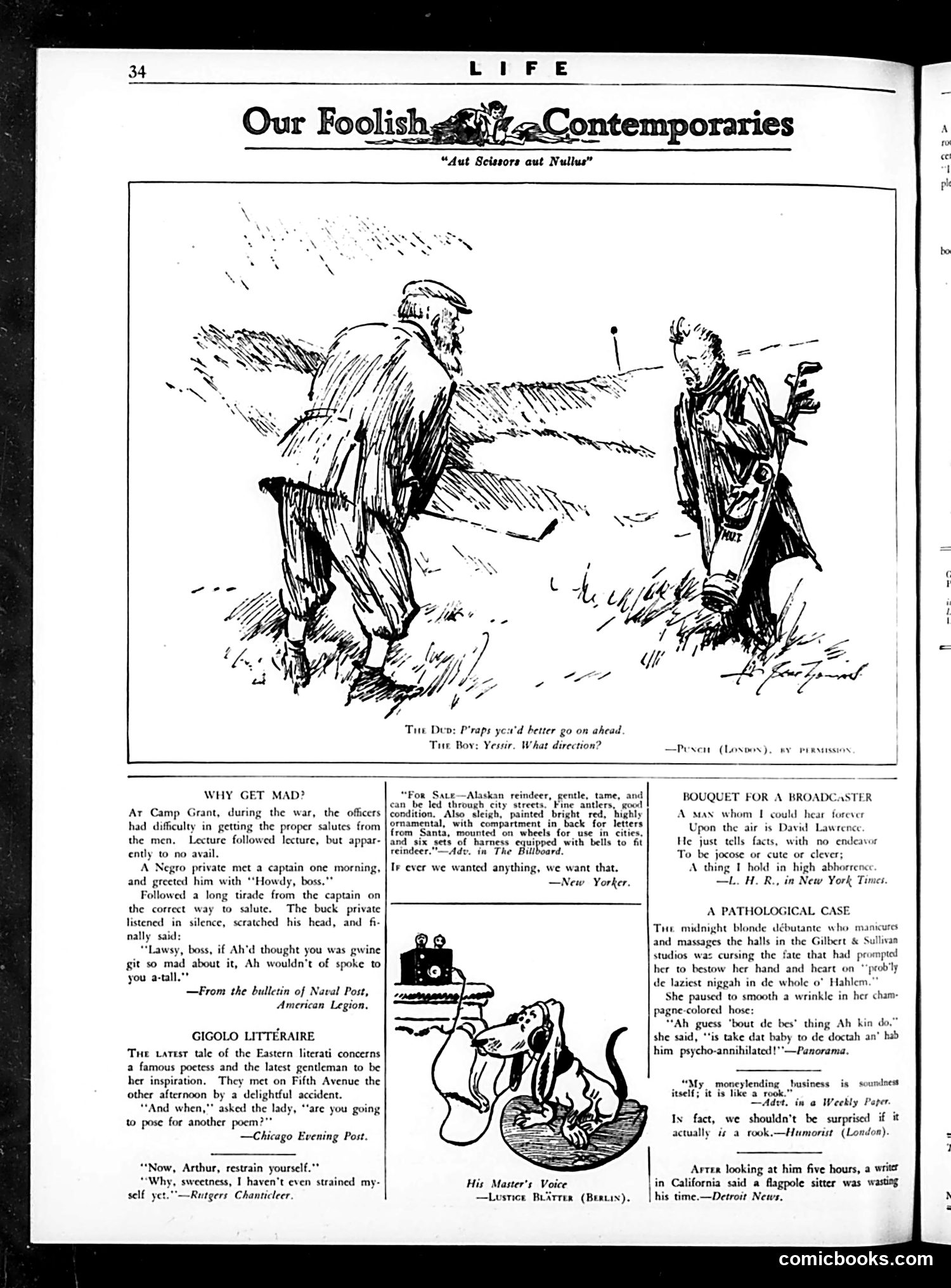
This page collects humorous anecdotes and brief jokes satirizing contemporary American society. The main cartoon shows two figures on a road—a bearded older man directing a young boy, captioned with dialogue about directions. The humor appears to play on miscommunication or uncertainty. The written pieces mock various targets: military discipline (a Negro soldier's casual greeting to an officer), literary pretension (a poetess expecting poetic inspiration from casual encounters), and consumer absurdity (a classified ad for ornamental reindeer sleighs). The page's subtitle—"Aut Scissors aut Nullus" (Latin: "Either scissors or nothing")—suggests editorial selection: Life's editors are culling or "cutting" foolish contemporary behavior worth mocking. The pieces use racial dialect and stereotypes typical of 1920s-era humor, reflecting attitudes now recognized as offensive. Overall, it's social satire targeting affectation, pretension, and everyday human foolishness.
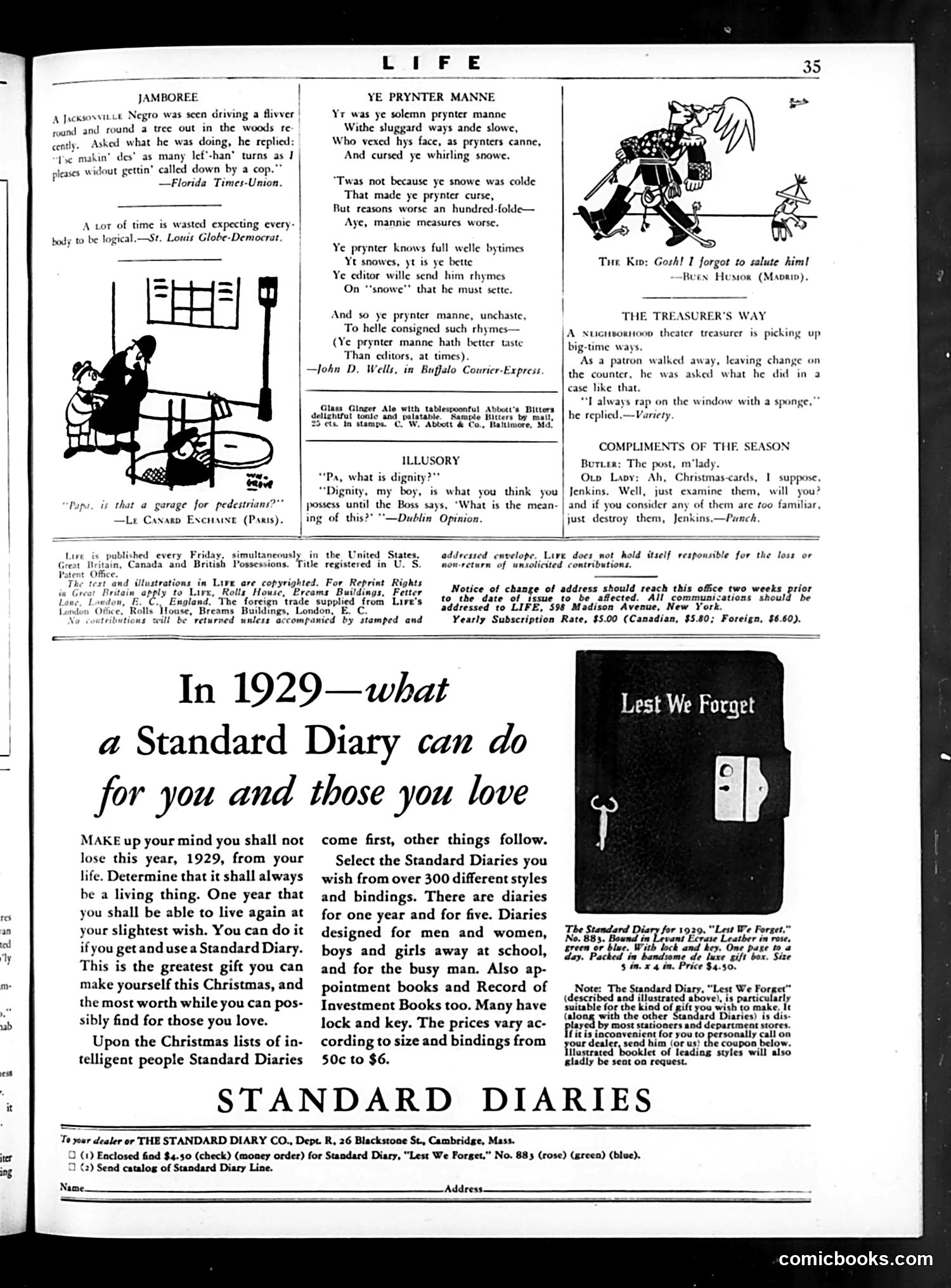
This page contains several brief humor items and cartoons typical of Life's satirical content: **"Jamboree"** mocks racial stereotypes, depicting a Black driver making excessive left turns to avoid a cop's authority—a crude joke about circumventing rules. **"Ye Prynter Manne"** is a pseudo-archaic poem satirizing the friction between printers and editors during winter snowstorms. The printer curses having to set type for rhymes about snow that editors demand, highlighting workplace tensions between creative and production staff. **"The Treasurer's Way"** jokes about a theater cashier's casual method of collecting tips—rapping the window with a sponge rather than formally asking patrons. **"Illusory"** presents a child asking about dignity, with the punchline that dignity is what you think you possess until your boss corrects you—commentary on workplace hierarchy and lost dignity. The page is primarily **advertising for Standard Diaries**, promoting them as Christmas gifts for 1929. The satire reflects early 20th-century workplace dynamics and class consciousness.
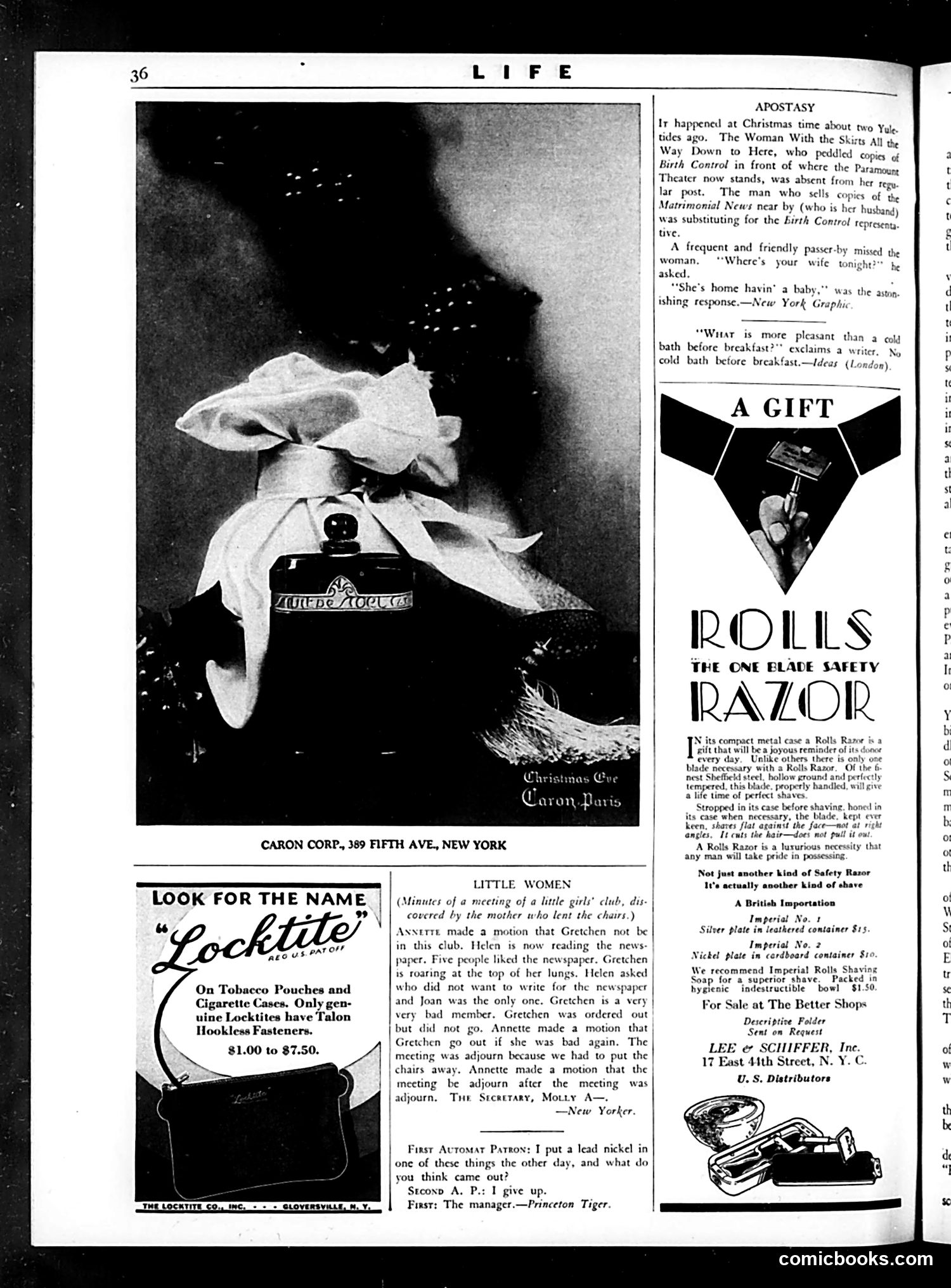
This page contains three distinct humor pieces and advertisements from early 20th-century Life magazine. **"Apostasy"** is a brief anecdote mocking the apparent hypocrisy of birth control activists. A woman regularly sold birth control literature on the street, but when asked where she was, her husband revealed she was "home havin' a baby"—the joke being the irony of someone promoting birth control while having children themselves. **"Little Women"** parodies the famous novel by presenting mundane meeting minutes from an actual girls' club. The humor derives from children's overly formal parliamentary procedures (motions, adjournments) applied to trivial disputes, particularly around excluding member Gretchen for bad behavior. The remaining content consists of period advertisements for Locktite tobacco pouches, Rolls Razor safety razors, and other luxury goods—typical of Life's advertiser-supported model. No political cartoons appear on this page; the satire is gentle and domestic rather than political.
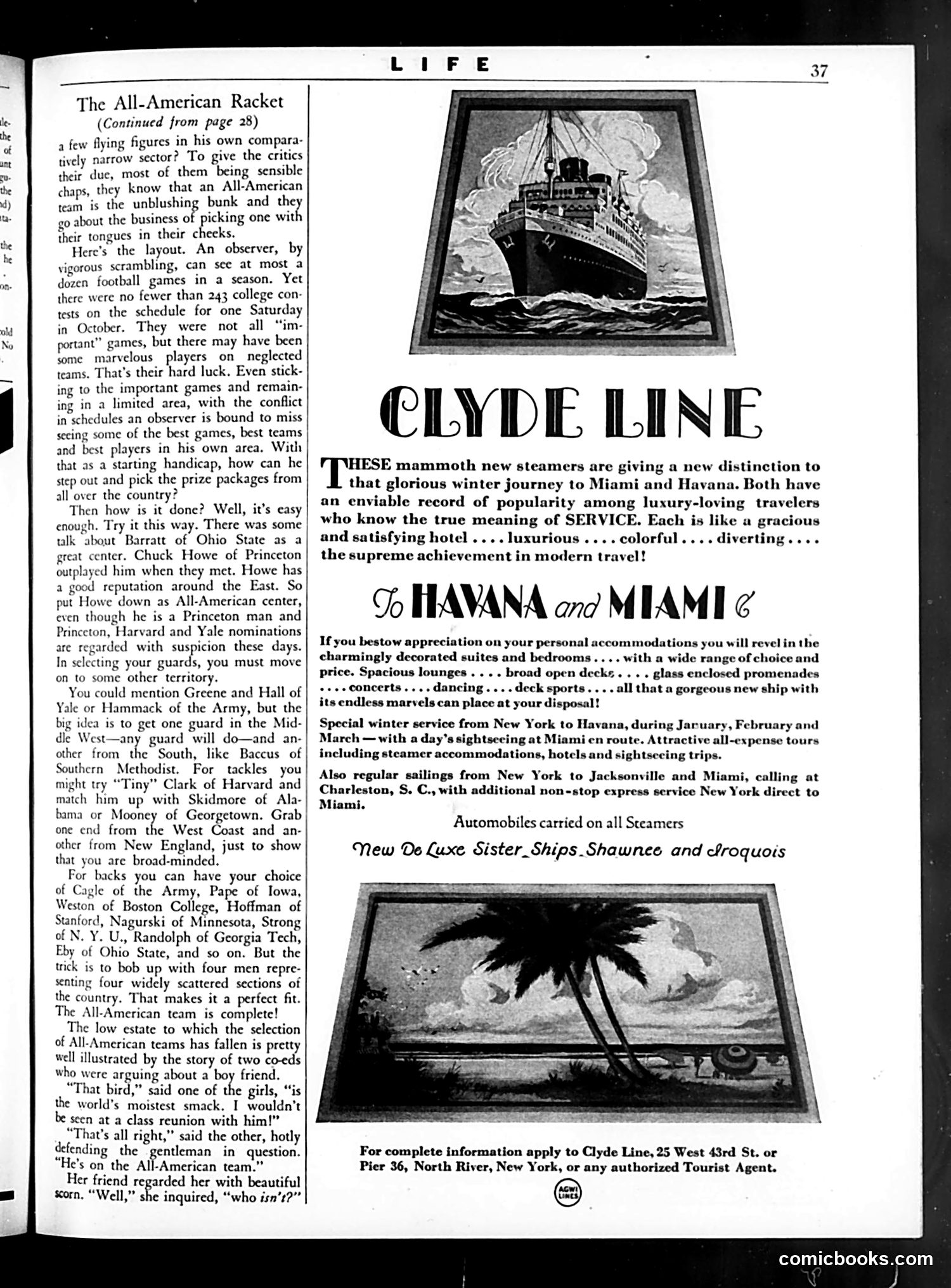
This article satirizes the annual selection of "All-American" college football teams—prestigious rosters supposedly showcasing the nation's best players. The joke: the selection process is essentially arbitrary. The author exposes the logical flaw: with 243 college games played simultaneously on a single Saturday, no observer can watch them all. Selectors therefore pick players from prestigious schools (Yale, Harvard, Princeton) they *can* see, while talent at lesser-known programs goes unnoticed—"that's their hard luck." The satirical punchline is a joke about a co-ed defending her boyfriend by saying "he's on the All-American team," and her friend responding "who isn't?"—implying the honor is so meaningless it applies to virtually anyone. The page also includes an unrelated Clyde Line steamship advertisement for Miami/Havana cruises.
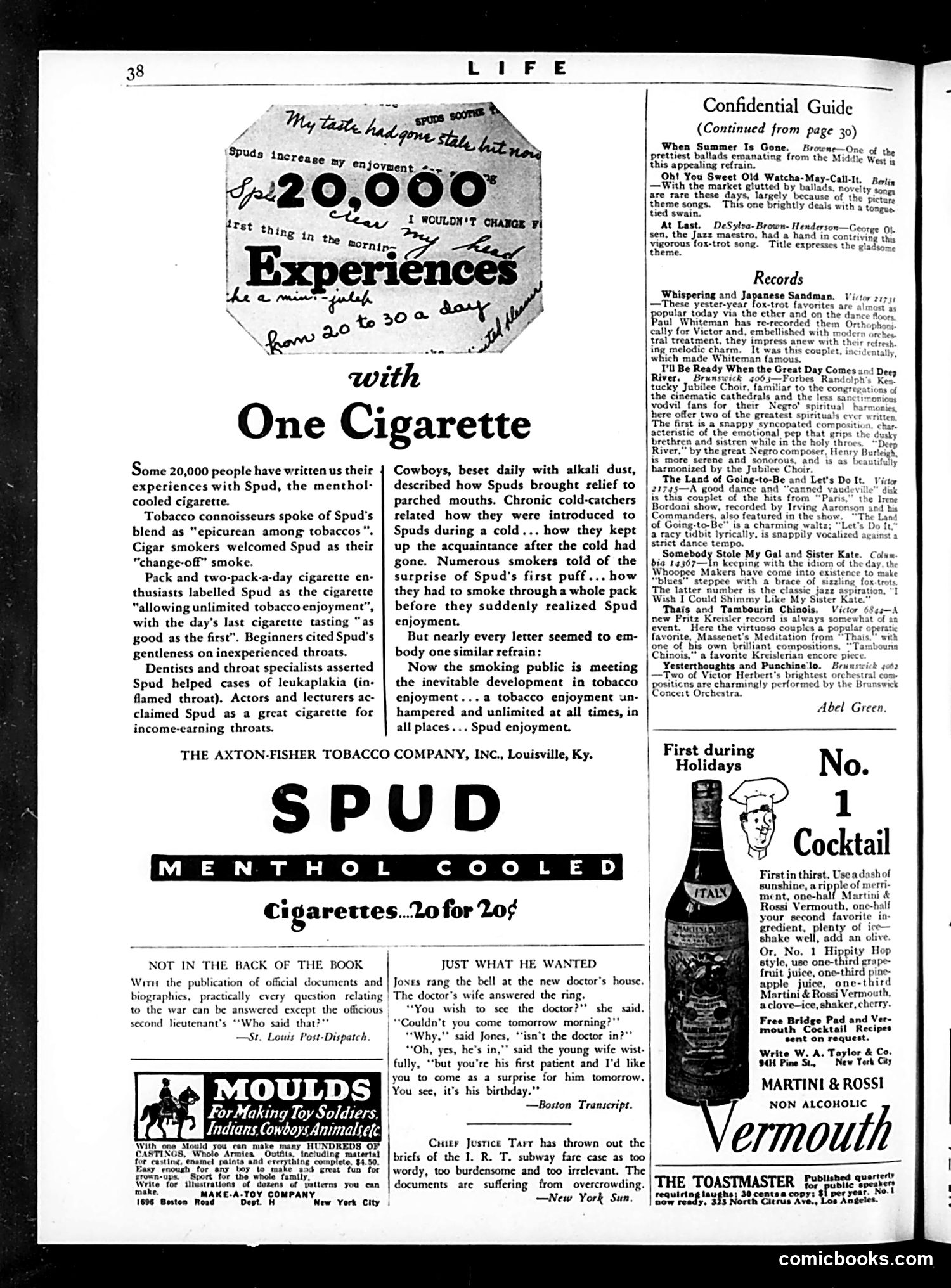
This page is primarily a **cigarette advertisement** for Spud menthol-cooled cigarettes (20¢ per pack), claiming 20,000 customer testimonials praising the product's smoothness and health benefits. The ad makes now-laughable medical claims: that Spud helps leukoplakia (inflamed throat), benefits actors and lecturers, and provides relief to cowboys dealing with dust. It promises "unlimited tobacco enjoyment." The page also contains unrelated **humor sections**: a brief military joke about a second lieutenant's vagueness, a short story about a wife wanting her husband to surprise his new doctor on his birthday, and a note about a judge dismissing overly verbose subway fare case documents. The juxtaposition reveals this as a typical 1920s Life magazine page—mixing advertising with satirical content—before cigarette health dangers were widely acknowledged.
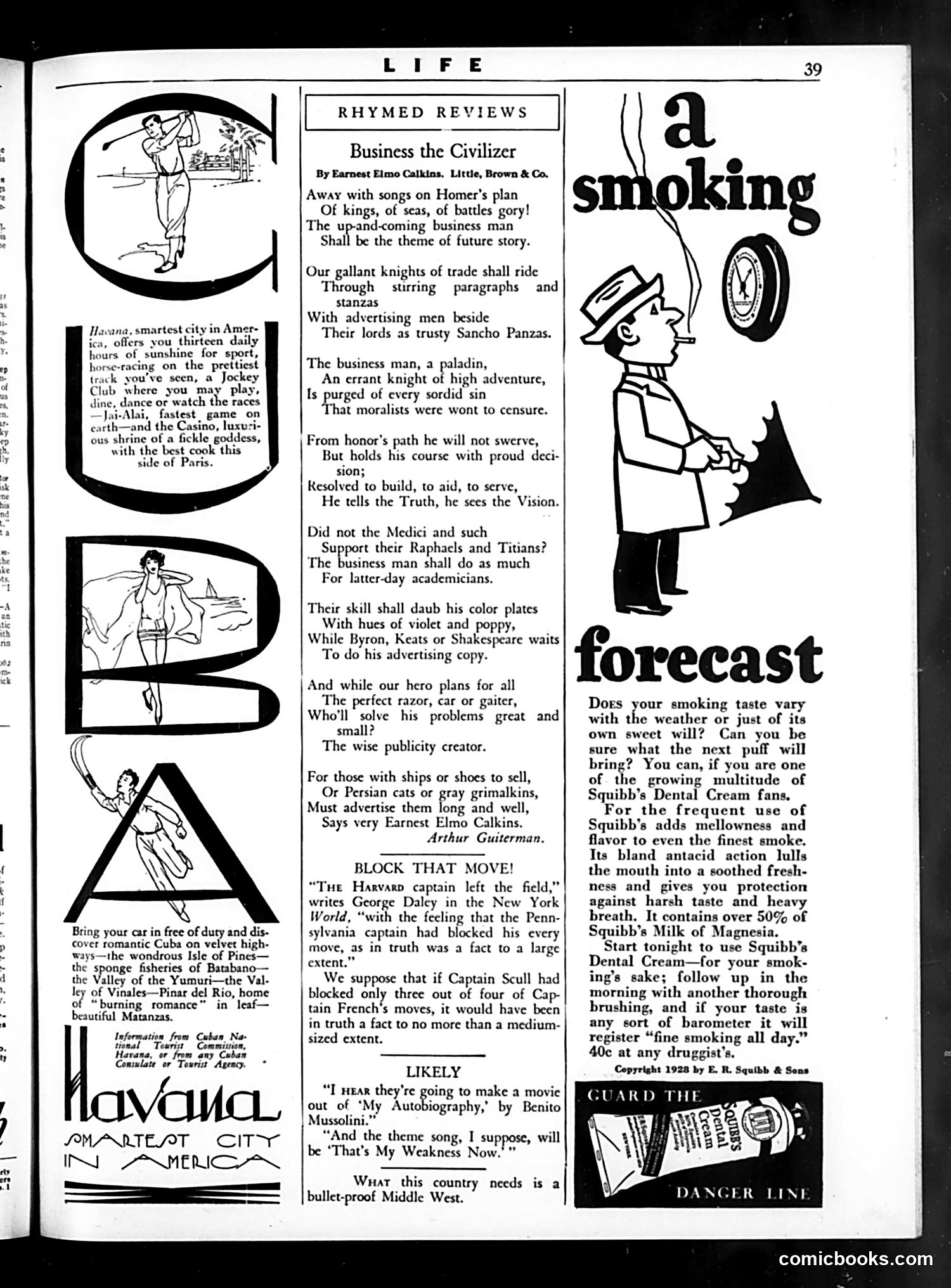
This page from Life (appears to be 1928, based on the Squibb's Dental Cream copyright) contains satirical content mocking the glorification of American businessmen. **"Business the Civilizer"** is a mock-heroic poem by Arthur Guiterman reviewing Earnest Elmo Calkins' book. It sarcastically elevates businessmen to the status of medieval knights and Renaissance patrons, claiming they're as culturally important as the Medici who supported Raphael and Titian. The satire is that advertising copywriters are compared to Shakespeare and Byron—suggesting that commercial promotion has replaced genuine artistic achievement as society's priority. **"Block That Move"** mocks overwrought sports journalism by pointing out absurd logic: a Harvard football captain claiming every move was "blocked" when logically only some could be. **"Likely"** jokes that Mussolini's autobiography being made into a movie with the theme song "That's My Weakness Now" would be darkly comedic. The page also includes a Cuba tourist advertisement and a Squibb's Dental Cream ad claiming the product improves smoking enjoyment—itself somewhat absurd marketing.
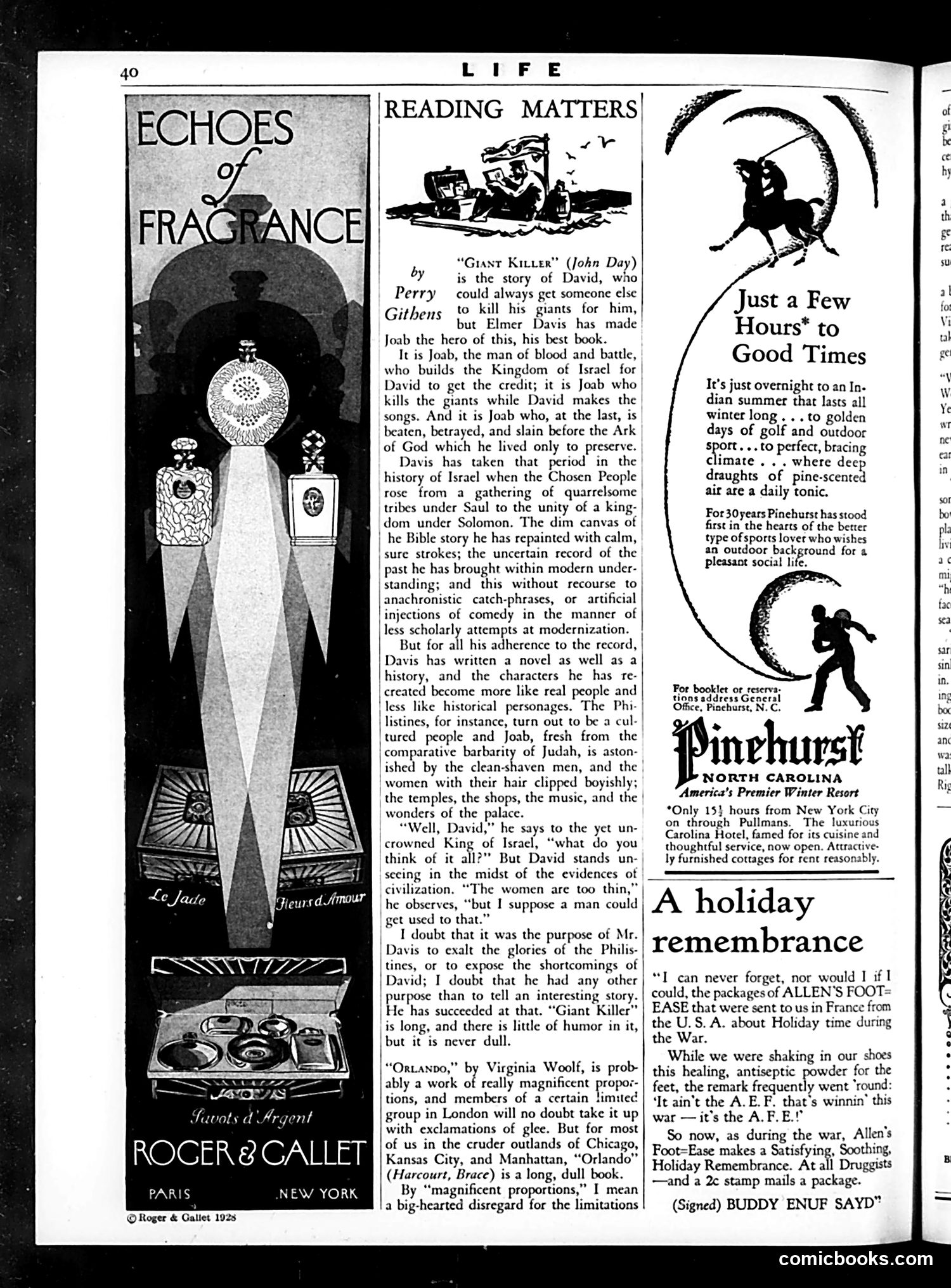
This page combines literary reviews with advertisements. The left side features a perfume ad for Roger & Callet featuring Art Deco imagery of ornate bottles. The "Reading Matters" section reviews three books: Elmer Davis's "Giant Killer" (about the biblical figure Joab), Virginia Woolf's "Orlando," and appears to continue beyond the visible text. The reviews suggest Davis successfully modernized biblical history without anachronism, while Woolf's experimental novel, though acclaimed in London literary circles, is dismissed as "dull" for mainstream American readers in "cruder outlands of Chicago, Kansas City, and Manhattan"—a somewhat snobbish critique reflecting 1920s cultural divisions between avant-garde and popular taste. The right side contains vacation and product advertising: Pinehurst resort in North Carolina and Allen's Foot-Ease powder. The foot-ease ad includes a soldier's testimonial about packages received during WWI, capitalizing on wartime nostalgia and patriotic sentiment common in 1920s advertising.
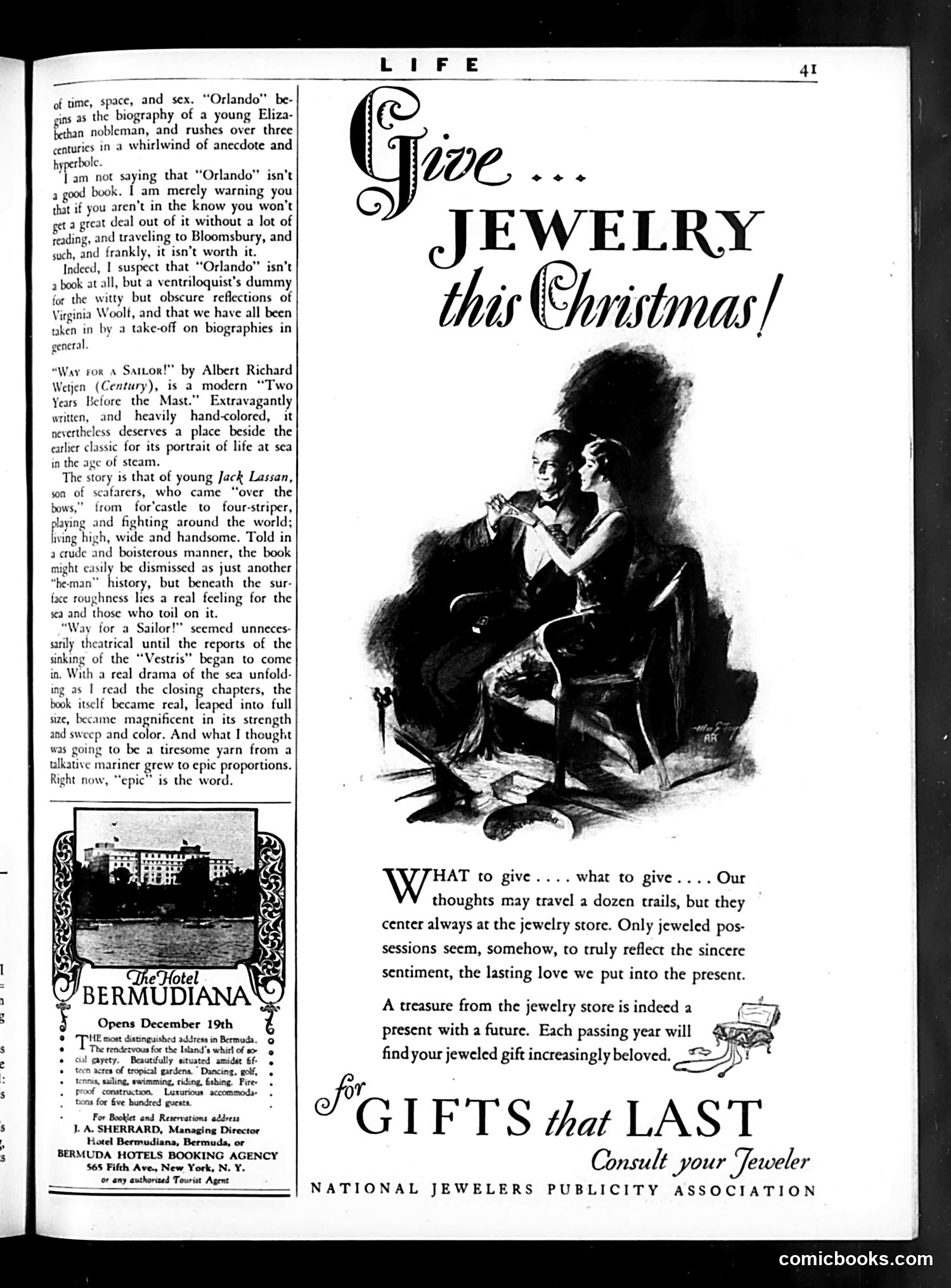
This page contains book reviews and advertisements rather than political cartoons. The main content critiques Virginia Woolf's experimental novel "Orlando," dismissing it as obscure and self-indulgent—a veiled jab at Bloomsbury Group intellectualism (the fashionable literary circle). The reviewer suspects it's merely a vehicle for Woolf's wit rather than a genuine book. A more favorable review of "Way for a Sailor!" notes it only became compelling when real events—the sinking of the SS Vestris—gave the adventure story tragic relevance. The page includes advertisements for a Bermuda hotel and jewelry as Christmas gifts. The illustrated couple exchanging jewelry reflects 1920s-30s consumer culture messaging that jewelry represents sincere, lasting sentiment—a deliberate sales pitch targeting holiday gift-givers.
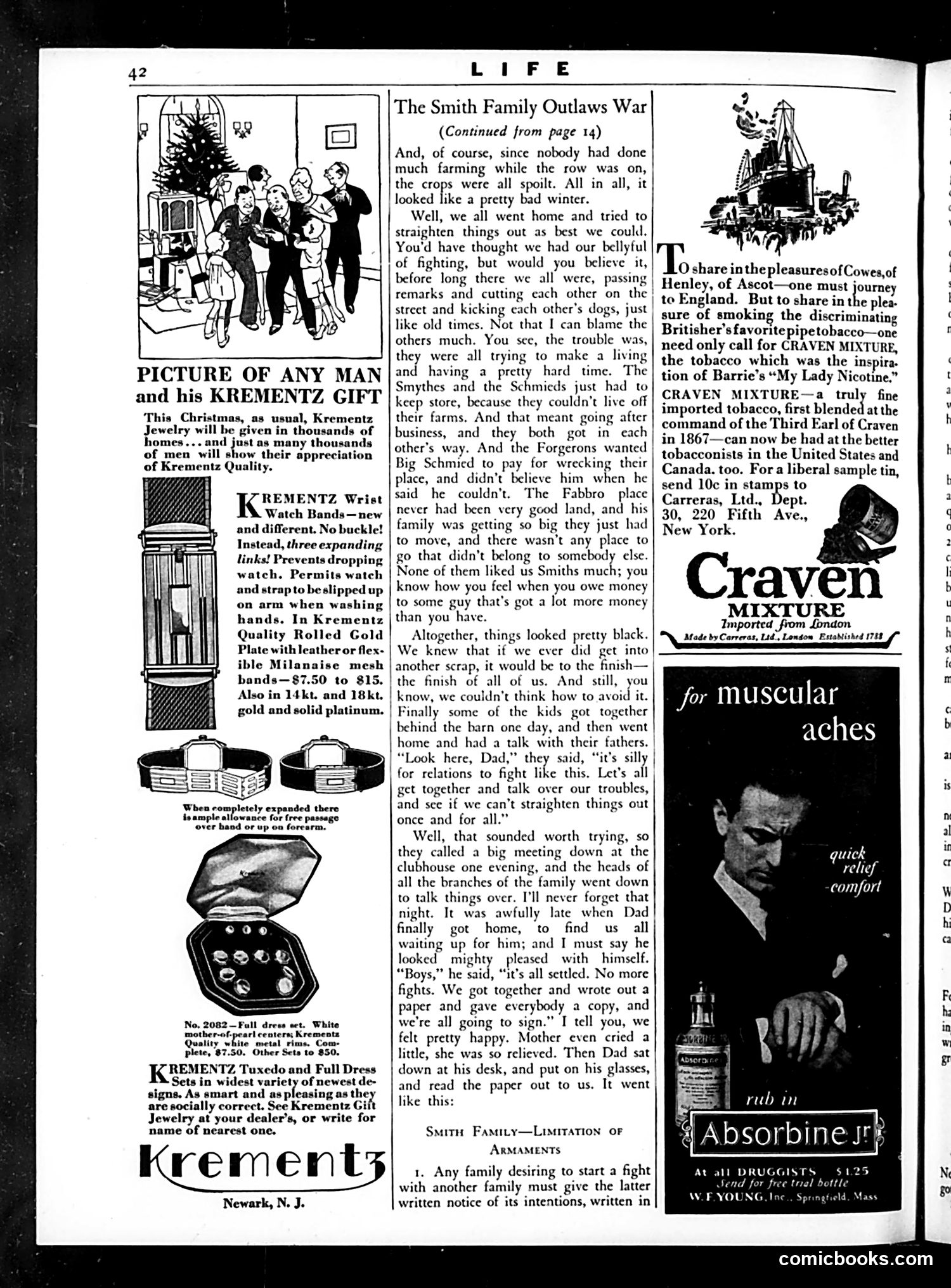
This satirical story uses a fictional family dispute as an allegory for international conflict and arms control. The "Smith Family" represents nations engaged in escalating rivalries over economic competition (shopkeeping, land disputes, debts). The humor lies in applying diplomatic solutions to petty neighborhood conflicts: families threaten each other, involve their children in feuds, and nearly destroy themselves economically before deciding to draft a treaty limiting "armaments" (weapons). The satire critiques how real nations, despite devastating consequences, struggle to prevent conflicts rooted in economic competition and resentment. By shrinking the scale to a family feud, the story exposes the absurdity and preventability of larger wars—while also suggesting that even when people recognize war's futility, actually preventing it requires formal agreements and restraint. The page treats this serious topic humorously, suggesting post-WWI readers would recognize parallels to real international tensions.
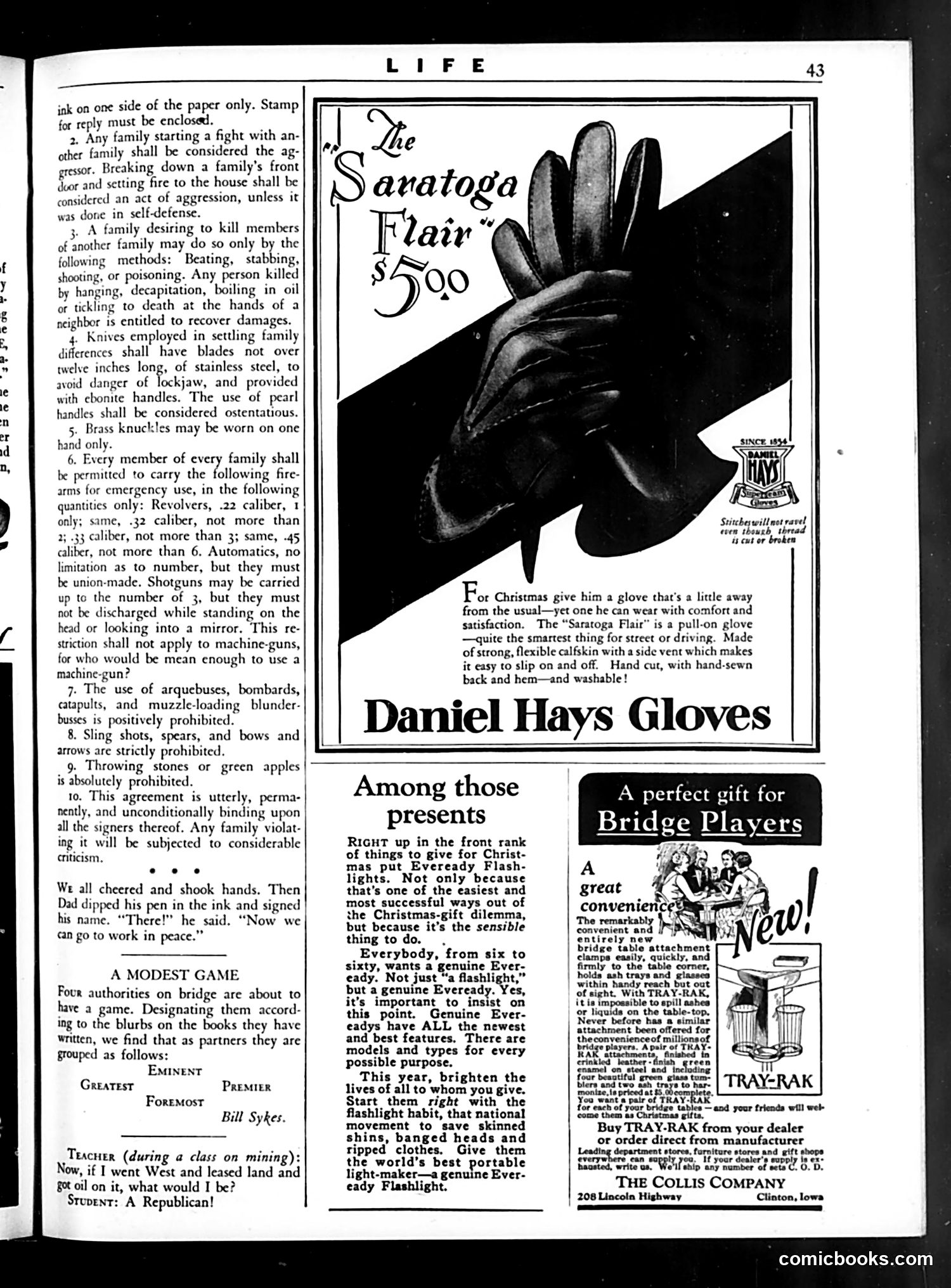
This page contains dark satire about American family violence, likely responding to Prohibition-era gang warfare and organized crime. **The Main Cartoon:** "A Modest Game" presents a mock-serious legal document establishing "rules" for family feuds—permitted methods include beating, stabbing, and shooting, but prohibit hanging, decapitation, and boiling in oil. It satirizes the absurdity of violent crime by treating it as a regulated sport needing referee authority. The joke targets how American society had seemingly normalized organized violence during Prohibition. **The Subtext:** By presenting a father cheerfully signing such a "peace agreement," Life mocks the notion that criminals could be reasoned with or regulated. The phrase "Now we can go to work in peace" darkly suggests family violence as normal business. **Additional Content:** The page also includes a brief political joke about Republican oil prospectors and advertisements for Daniel Hays Gloves and Eveready Flashlights—standard commercial fare of the era. The satire's bite depends on readers recognizing contemporary gang violence as the absurd reality being parodied.
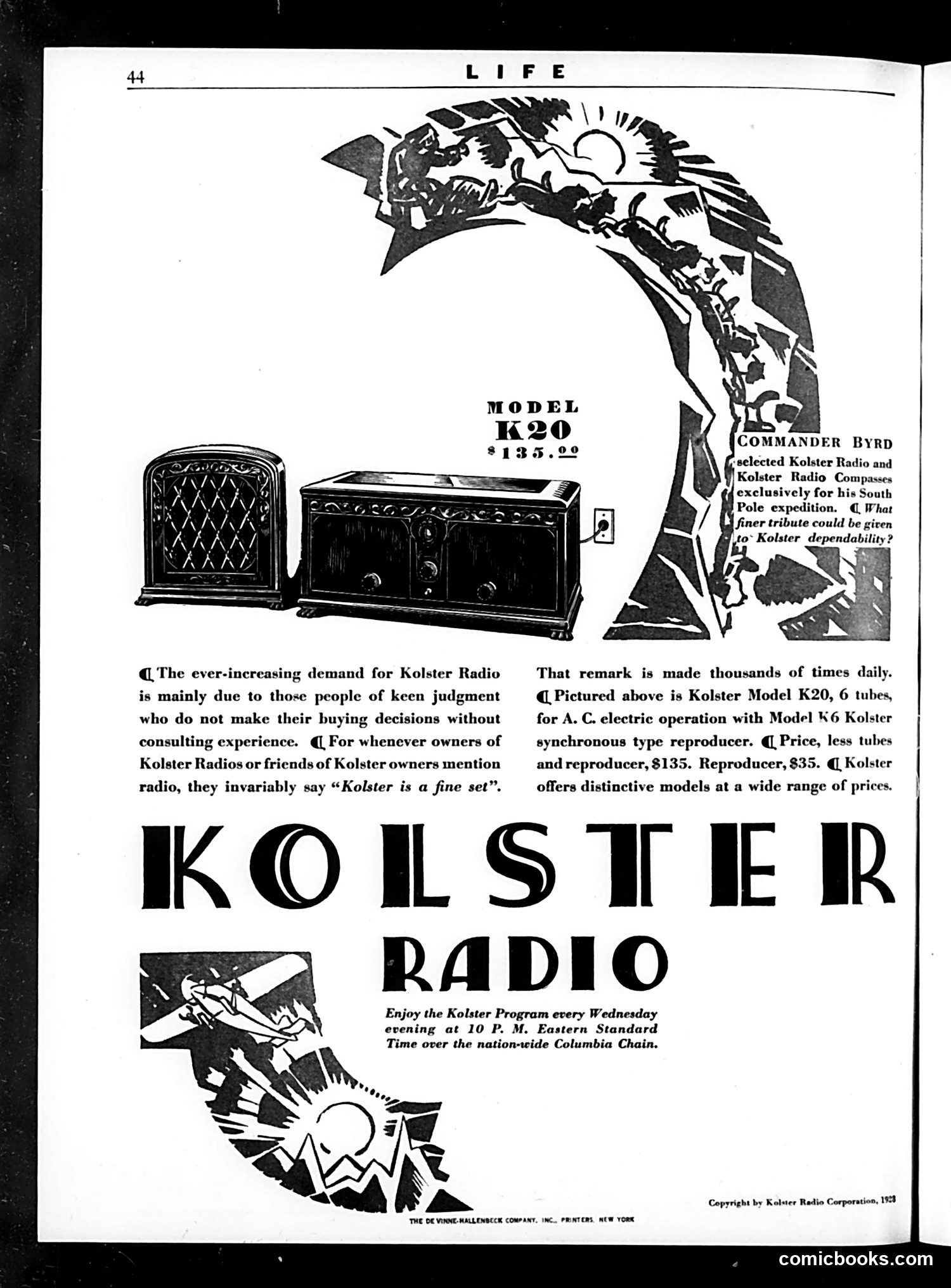
This is a **radio advertisement**, not political satire. The page promotes Kolster brand radios, specifically the Model K20 priced at $135. The decorative illustration showing a figure at the top right depicts **Commander Byrd**, the famous polar explorer, whose name appears in the advertisement text. The ad uses Byrd's endorsement as a marketing strategy—claiming he selected Kolster Radio and compasses "exclusively" for his South Pole expedition as proof of the product's reliability and quality. This was a common 1920s advertising tactic: leveraging celebrity or authority endorsements to build consumer confidence. The text emphasizes that satisfied customers repeatedly call it "a fine set," positioning Kolster as a premium choice for discerning buyers. The page also mentions a **weekly radio program** broadcast Wednesdays at 10 P.M. over the Columbia network, using broadcast programming itself as promotional content.
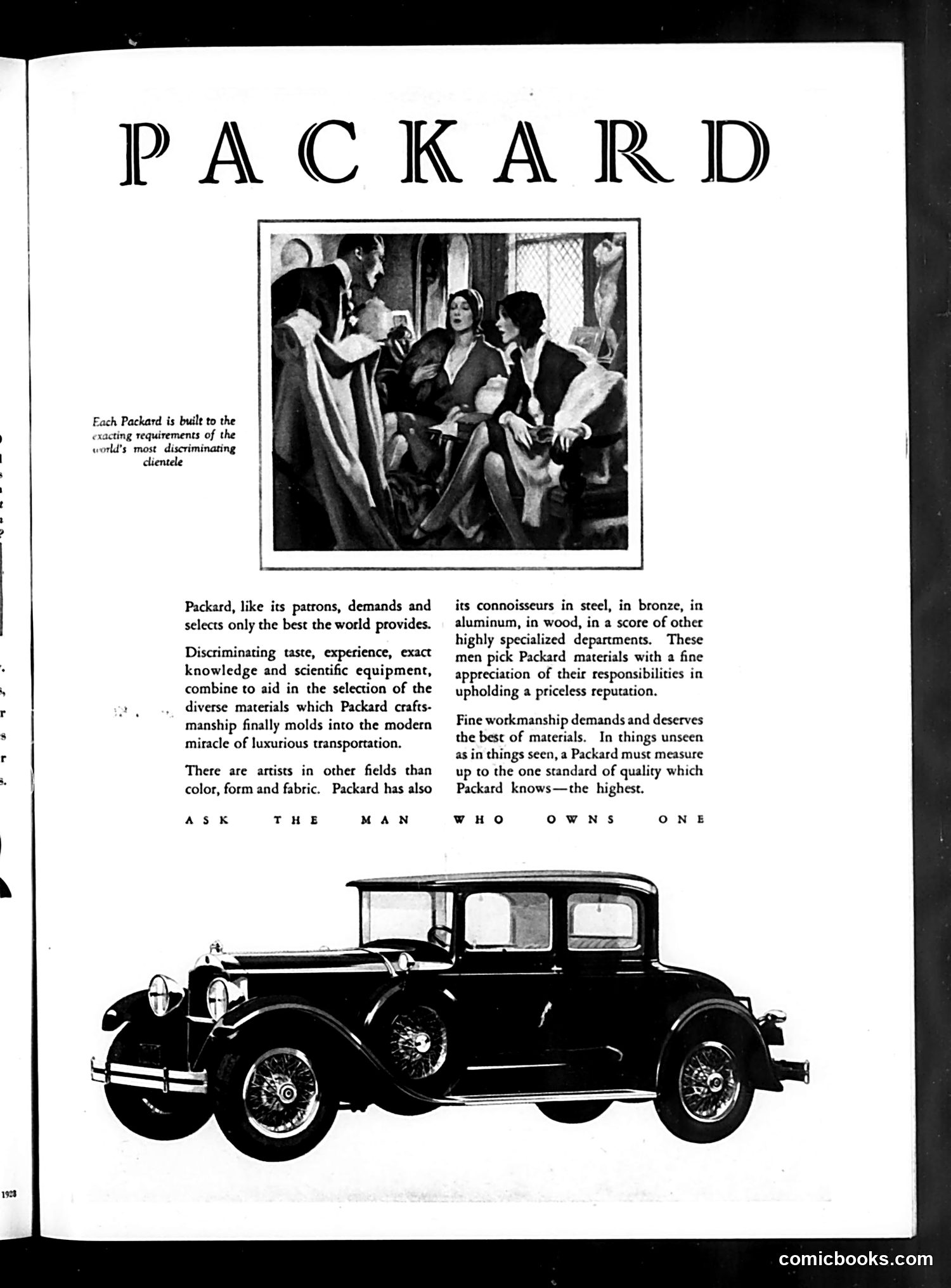
This is a **Packard automobile advertisement**, not political satire. The page uses aspirational messaging to market luxury cars to wealthy consumers. The top photograph shows well-dressed people examining fabric swatches, visually establishing that Packard owners are discriminating elites with refined taste. The accompanying text repeatedly emphasizes exclusivity: Packard selects "only the best," appeals to "connoisseurs," and serves "the world's most discriminating clientele." The bottom shows a sleek 1920s-era Packard automobile—a prestigious, high-end vehicle brand. The advertisement's strategy equates car ownership with artistic refinement and social status. It positions Packard not merely as transportation but as a marker of taste and discernment, appealing to buyers' desire to signal wealth and cultural superiority through their automobile choice. This reflects early 20th-century luxury marketing that conflated product quality with owner status.
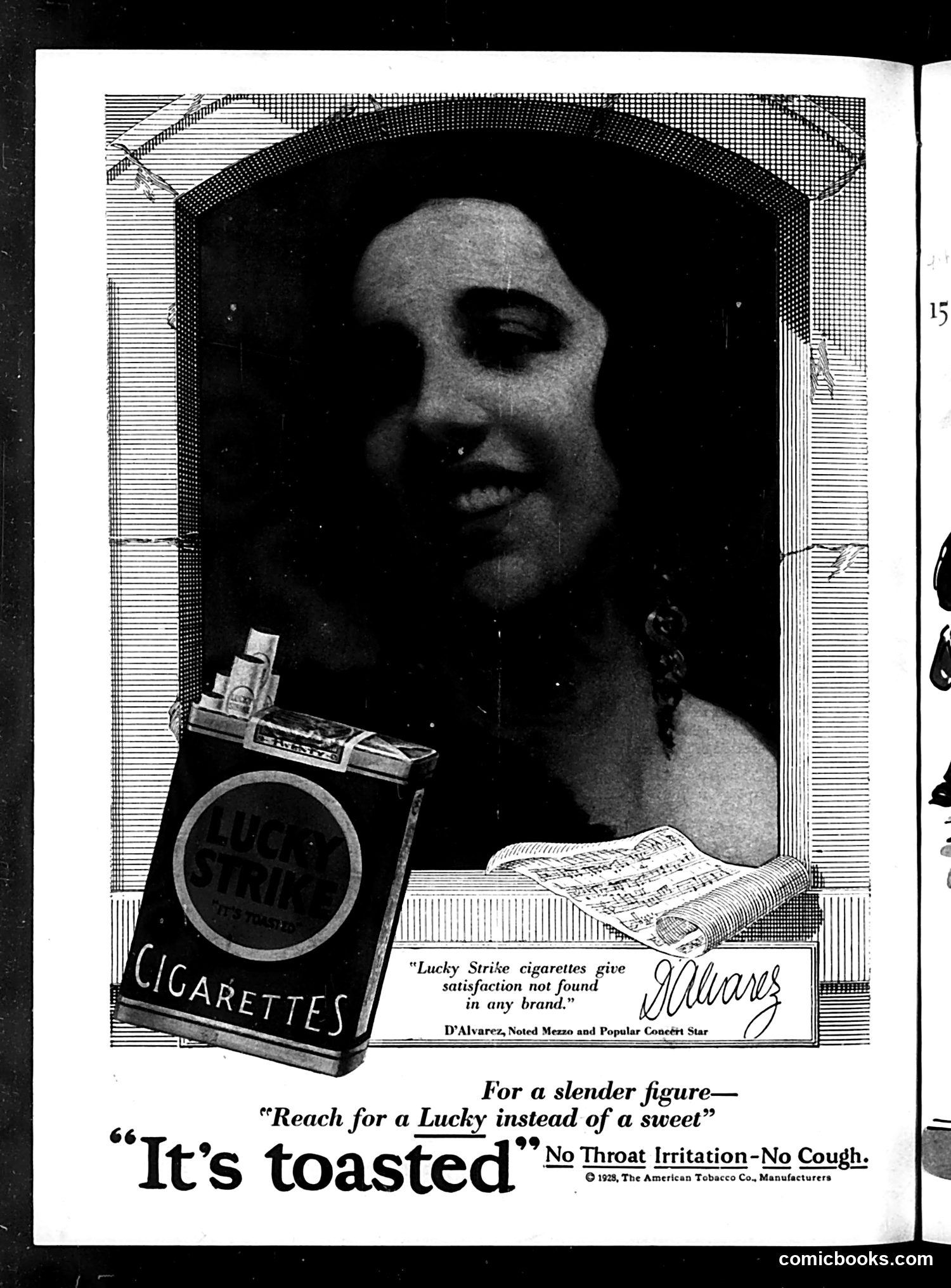
This is a Lucky Strike cigarette advertisement from 1928, not satire. It features D'Alvarez, a noted mezzo-soprano and concert performer, endorsing the product. The ad uses weight-control messaging ("For a slender figure—'Reach for a Lucky instead of a sweet'"), a famous early advertising slogan implying cigarettes suppress appetite. The "It's toasted" tagline promoted the brand's toasting process as reducing throat irritation. This represents the pre-regulation era when cigarettes were openly marketed with health claims and celebrity endorsements without scientific scrutiny—practices now recognized as misleading. The page demonstrates how tobacco companies exploited health and vanity concerns before modern advertising restrictions.